KWASHIORKORPresenters: Kasturi Mahalinggam ( 060100293)Siti Raihana (060100246)Supervisor: dr. Oke Rina Ramayani Sp.A
Definition of Kwashiorkor"Kwashiorkor" is the name given to the protein-calorie malnutrition.It is a Ga word which describes the malnourished child, the result of the ill-health which develops when an infant is weaned from breast-feeding (which may be at about 2 years of age). When a sibling is born and monopolizes breast feeding, the "weaning" or deposed child may develop kwashiorkor, an all-embracing word for the clinical syndrome of malnourishment in which reddening of the child's hair is but a part.
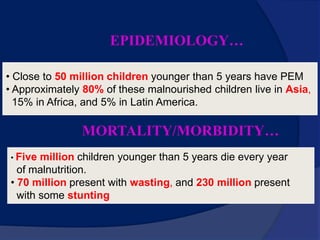
EPIDEMIOLOGY… Close to 50 million childrenyounger than 5 years have PEM
 Approximately 80%of these malnourished children live in Asia,   15% in Africa, and 5% in Latin America.  MORTALITY/MORBIDITY…Five millionchildren younger than 5 years die every year   of malnutrition. 70 millionpresent with wasting, and 230 millionpresent   with some stunting
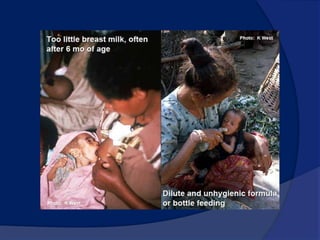
CausesSocial and EconomicPovertyIgnoranceInadequate weaning practicesChild abuseCultural and social practicesVeganLow fat diets
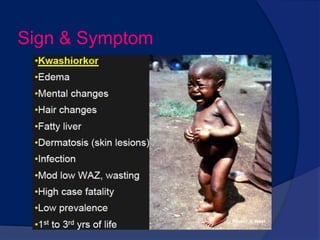
Sign & Symptom
PathophysiologyPeripheral oedemaRecent studies show that children in kwashiorkor have abnormal renal architecture that can be explained by loss of glycoseaminoglycans and they lose glycosaminoglycans from the intestine  (particularly heparansulphateproteoglycan); the loss of the ability of glycosaminoglycans to retain water in the form of a gel, may cause the appearance of pitting oedema.Fatty LiverIt was further suggested that the impaired synthesis of VLDL-apo B-100 was due to a shortage of amino acids because of the chronically inadequate dietary protein intake of children with severe malnutrition.
therefore unused lipids which would normally participate inlipoproteinsynthesis begin to accumulate. Distended abdomen Fat inside the liver can damage the liver cells, leading to what is known as fatty liver disease.
When the liver cells are damaged, the immune system of the body respond to this damage and causes inflammation inside the liver which will cause the liver to enlarge in size. This is then known as Steatohepatitis.
 Damage to the liver cells or the liver cells dying off can decrease the functions the liver is able to do to keep the body well. One of these functions is to produce proteins. Therefore, it also leads to a decrease in albumin levels, which leads to this build up of abdominal fluid.
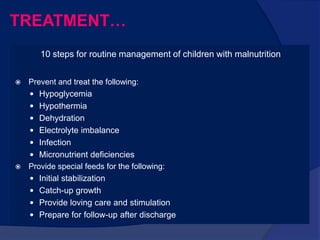
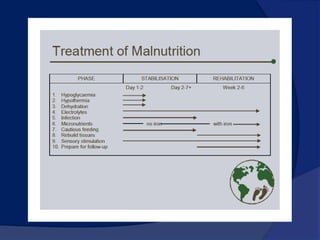
TREATMENT…10 steps for routine management of children with malnutritionPrevent and treat the following:HypoglycemiaHypothermiaDehydrationElectrolyte imbalanceInfectionMicronutrient deficienciesProvide special feeds for the following:Initial stabilization Catch-up growth Provide loving care and stimulationPrepare for follow-up after discharge
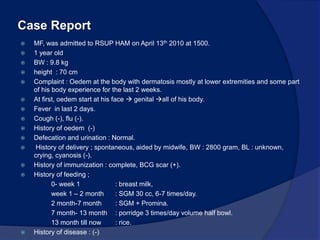
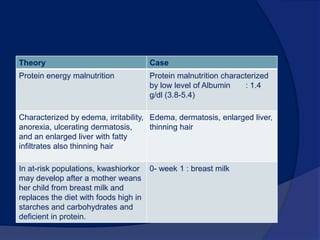
Case ReportMF, was admitted to RSUP HAM on April 13th 2010 at 1500.1 year oldBW : 9.8 kgheight  : 70 cmComplaint : Oedemat the body with dermatosis mostly at lower extremities and some part of his body experience for the last 2 weeks. At first, oedem start at his face genital all of his body. Fever  in last 2 days.Cough (-), flu (-).History of oedem (-)Defecation and urination : Normal.History of delivery ; spontaneous, aided by midwife, BW : 2800 gram, BL : unknown, crying, cyanosis (-). History of immunization : complete, BCG scar (+). History of feeding ; 	0- week 1 		: breast milk,	week 1 – 2 month 	: SGM 30 cc, 6-7 times/day.	2 month-7 month	: SGM + Promina. 	7 month- 13 month 	: porridge 3 times/day volume half bowl. 	13 month till now 	: rice. History of disease : (-) 
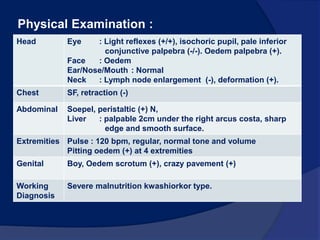
Physical Examination :
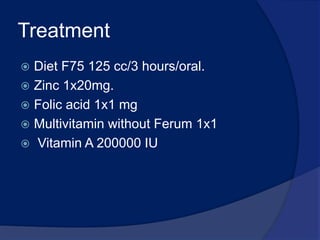
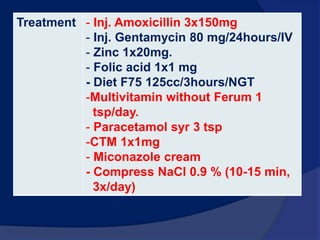
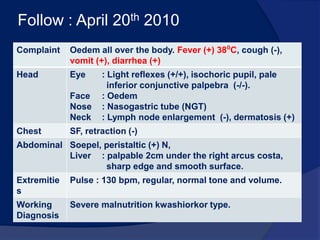
TreatmentDiet F75 125 cc/3 hours/oral.Zinc 1x20mg.Folic acid 1x1 mgMultivitamin without Ferum 1x1Vitamin A 200000 IU
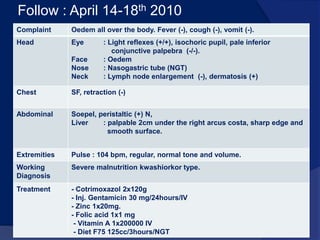
Follow : April 14-18th 2010
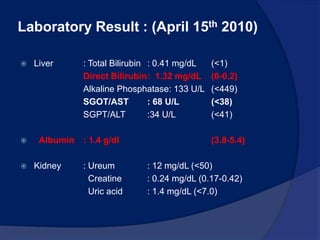
Laboratory Result : (April 15th 2010)Liver: Total Bilirubin	: 0.41 mg/dL 	(<1)Direct Bilirubin	:  1.32 mg/dL 	(0-0.2)  	   	Alkaline Phosphatase: 133 U/L 	(<449)SGOT/AST	: 68 U/L 	(<38)  	   	SGPT/ALT	:34 U/L 		(<41)Albumin	: 1.4 g/dl 			(3.8-5.4) Kidney	: Ureum		: 12 mg/dL (<50)Creatine	: 0.24 mg/dL (0.17-0.42)		  Uric acid	: 1.4 mg/dL (<7.0) 
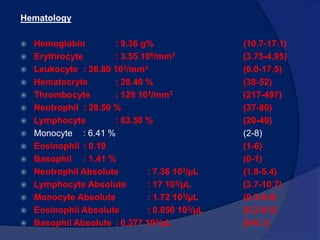
HematologyHemoglobin	: 9.36 g% 			(10.7-17.1)Erythrocyte	: 3.55 106/mm3 			(3.75-4.95)Leukocyte	: 26.80 103/mm3 			(6.0-17.5)Hematocryte	: 28.40 % 			(38-52)Thrombocyte	: 129 103/mm3 			(217-497)Neutrophil	: 28.50 % 				(37-80)Lymphocyte	: 63.50 %			(20-40)Monocyte	: 6.41 % 				(2-8)Eosinophil	: 0.19 					(1-6)Basophil	: 1.41 % 				(0-1)Neutrophil Absolute	: 7.36 103/µL 		(1.9-5.4)Lymphocyte Absolute	: 17 103/µL 		(3.7-10.7)Monocyte Absolute	: 1.72 103/µL 		(0.3-0.8)Eosinophil Absolute	: 0.050 103/µL 		(0.2-0.5) Basophil Absolute	: 0.377 103/µL 			(0-0.1)
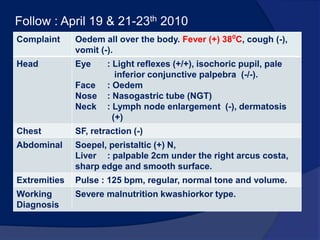
Follow : April 19 & 21-23th 2010
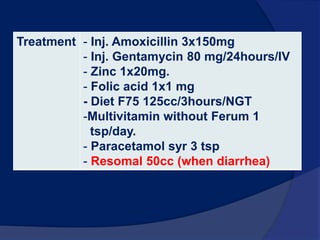
Follow : April 20th 2010
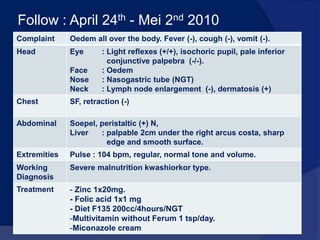
Follow : April 24th - Mei 2nd 2010
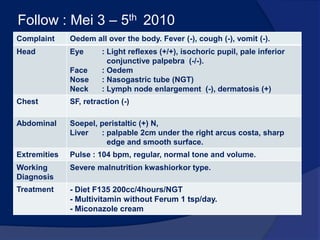
Follow : Mei 3 – 5th  2010
DISCUSSION
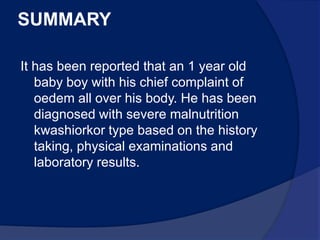
SUMMARYIt has been reported that an 1 year old baby boy with his chief complaint of oedem all over his body. He has been diagnosed with severe malnutrition kwashiorkor type based on the history taking, physical examinations and laboratory results.

Kwashiorkor

  • 1.
    KWASHIORKORPresenters: Kasturi Mahalinggam( 060100293)Siti Raihana (060100246)Supervisor: dr. Oke Rina Ramayani Sp.A
  • 4.
    Definition of Kwashiorkor"Kwashiorkor"is the name given to the protein-calorie malnutrition.It is a Ga word which describes the malnourished child, the result of the ill-health which develops when an infant is weaned from breast-feeding (which may be at about 2 years of age). When a sibling is born and monopolizes breast feeding, the "weaning" or deposed child may develop kwashiorkor, an all-embracing word for the clinical syndrome of malnourishment in which reddening of the child's hair is but a part.
  • 5.
    EPIDEMIOLOGY… Close to50 million childrenyounger than 5 years have PEM
  • 6.
    Approximately 80%ofthese malnourished children live in Asia, 15% in Africa, and 5% in Latin America. MORTALITY/MORBIDITY…Five millionchildren younger than 5 years die every year of malnutrition. 70 millionpresent with wasting, and 230 millionpresent with some stunting
  • 7.
    CausesSocial and EconomicPovertyIgnoranceInadequateweaning practicesChild abuseCultural and social practicesVeganLow fat diets
  • 9.
  • 10.
    PathophysiologyPeripheral oedemaRecent studiesshow that children in kwashiorkor have abnormal renal architecture that can be explained by loss of glycoseaminoglycans and they lose glycosaminoglycans from the intestine (particularly heparansulphateproteoglycan); the loss of the ability of glycosaminoglycans to retain water in the form of a gel, may cause the appearance of pitting oedema.Fatty LiverIt was further suggested that the impaired synthesis of VLDL-apo B-100 was due to a shortage of amino acids because of the chronically inadequate dietary protein intake of children with severe malnutrition.
  • 11.
    therefore unused lipidswhich would normally participate inlipoproteinsynthesis begin to accumulate. Distended abdomen Fat inside the liver can damage the liver cells, leading to what is known as fatty liver disease.
  • 12.
    When the livercells are damaged, the immune system of the body respond to this damage and causes inflammation inside the liver which will cause the liver to enlarge in size. This is then known as Steatohepatitis.
  • 13.
    Damage tothe liver cells or the liver cells dying off can decrease the functions the liver is able to do to keep the body well. One of these functions is to produce proteins. Therefore, it also leads to a decrease in albumin levels, which leads to this build up of abdominal fluid.
  • 14.
    TREATMENT…10 steps forroutine management of children with malnutritionPrevent and treat the following:HypoglycemiaHypothermiaDehydrationElectrolyte imbalanceInfectionMicronutrient deficienciesProvide special feeds for the following:Initial stabilization Catch-up growth Provide loving care and stimulationPrepare for follow-up after discharge
  • 16.
    Case ReportMF, wasadmitted to RSUP HAM on April 13th 2010 at 1500.1 year oldBW : 9.8 kgheight : 70 cmComplaint : Oedemat the body with dermatosis mostly at lower extremities and some part of his body experience for the last 2 weeks. At first, oedem start at his face genital all of his body. Fever in last 2 days.Cough (-), flu (-).History of oedem (-)Defecation and urination : Normal.History of delivery ; spontaneous, aided by midwife, BW : 2800 gram, BL : unknown, crying, cyanosis (-). History of immunization : complete, BCG scar (+). History of feeding ; 0- week 1 : breast milk, week 1 – 2 month : SGM 30 cc, 6-7 times/day. 2 month-7 month : SGM + Promina. 7 month- 13 month : porridge 3 times/day volume half bowl. 13 month till now : rice. History of disease : (-) 
  • 17.
  • 18.
    TreatmentDiet F75 125cc/3 hours/oral.Zinc 1x20mg.Folic acid 1x1 mgMultivitamin without Ferum 1x1Vitamin A 200000 IU
  • 19.
    Follow : April14-18th 2010
  • 20.
    Laboratory Result :(April 15th 2010)Liver: Total Bilirubin : 0.41 mg/dL (<1)Direct Bilirubin : 1.32 mg/dL (0-0.2) Alkaline Phosphatase: 133 U/L (<449)SGOT/AST : 68 U/L (<38) SGPT/ALT :34 U/L (<41)Albumin : 1.4 g/dl (3.8-5.4) Kidney : Ureum : 12 mg/dL (<50)Creatine : 0.24 mg/dL (0.17-0.42) Uric acid : 1.4 mg/dL (<7.0) 
  • 21.
    HematologyHemoglobin : 9.36 g% (10.7-17.1)Erythrocyte : 3.55 106/mm3 (3.75-4.95)Leukocyte : 26.80 103/mm3 (6.0-17.5)Hematocryte : 28.40 % (38-52)Thrombocyte : 129 103/mm3 (217-497)Neutrophil : 28.50 % (37-80)Lymphocyte : 63.50 % (20-40)Monocyte : 6.41 % (2-8)Eosinophil : 0.19 (1-6)Basophil : 1.41 % (0-1)Neutrophil Absolute : 7.36 103/µL (1.9-5.4)Lymphocyte Absolute : 17 103/µL (3.7-10.7)Monocyte Absolute : 1.72 103/µL (0.3-0.8)Eosinophil Absolute : 0.050 103/µL (0.2-0.5) Basophil Absolute : 0.377 103/µL (0-0.1)
  • 22.
    Follow : April19 & 21-23th 2010
  • 24.
  • 26.
    Follow : April24th - Mei 2nd 2010
  • 27.
    Follow : Mei3 – 5th 2010
  • 28.
  • 30.
    SUMMARYIt has beenreported that an 1 year old baby boy with his chief complaint of oedem all over his body. He has been diagnosed with severe malnutrition kwashiorkor type based on the history taking, physical examinations and laboratory results.