AN OVERVIEW ON
SPINE DISC PROBLEMS
A Seminar Submitted to
VIJAYA INSTITUTE OF PHARMACEUTICAL SCIENCE FOR
WOMEN
Under the guidance of: Submitted by:
Mrs.D.Santhi Krupa, M.Pharm., V. Kusuma
Asst. Professor,
Department of Pharmacology IV B. Pharmacy
1
CONTENTS
 INTRODUCTION
 EPIDEMIOLOGY
 ANATOMY OF THE SPINE
 CAUSES
 RISK FACTORS
 COMMON DIAGNOSTIC TESTS FOR DISC PROBLEMS
 DIFFERENT TYPES OF SPINAL DISC PROBLEMS & THEIR
TREATMENT
 CONCLUSION
 REFERENCES
2
INTRODUCTION
Spinal Cord is a complex, intricate construct that
includes a variety of nerves, bones, joints, tendons,
ligaments and muscles woven together.
The spine is designed to be remarkably strong, with
a great deal of flexibility in the lower back and
neck.
If the spine is injured, our body mobility is also
limited.
3
INTRODUCTION
Spine problems can begin as early as the late twenties, and
some unfortunately have problems even earlier due to
unhealthy lifestyle, sport injuries or bad posture.
Though their incidence is low, they can badly affect the daily
life pattern of a person, making the person immobile.
In this present topic, we focus mainly on different spine disc
diseases their surgical, and non-surgical treatments.
4
EPIDEMIOLOGY
Spine Disc Problems are emerging public health problems all
over the world. The prevalence of their symptoms are as follows:
80% - Back Pain
2-3% - Sciatica
Prevalence of Spine Problems
56% - Disc Bulge
2% - Symptomatic Disc Herniation
5
ANATOMY OF THE SPINE
It is designed to be incredibly strong, protecting the highly
sensitive nerve roots, yet highly flexible, providing for mobility
on many different planes.
Spine Disc construction consists
• Tough outer portion- Annulus Fibrosus
• Soft inner core- Nucleus Pulposus
6
CAUSES
Changes in intervertebral discs
Changes in the collagen structure of
the annulus fibrosus.
Decreased water content in the disc.
Aging
Increased amounts of inflammatory mediators
7
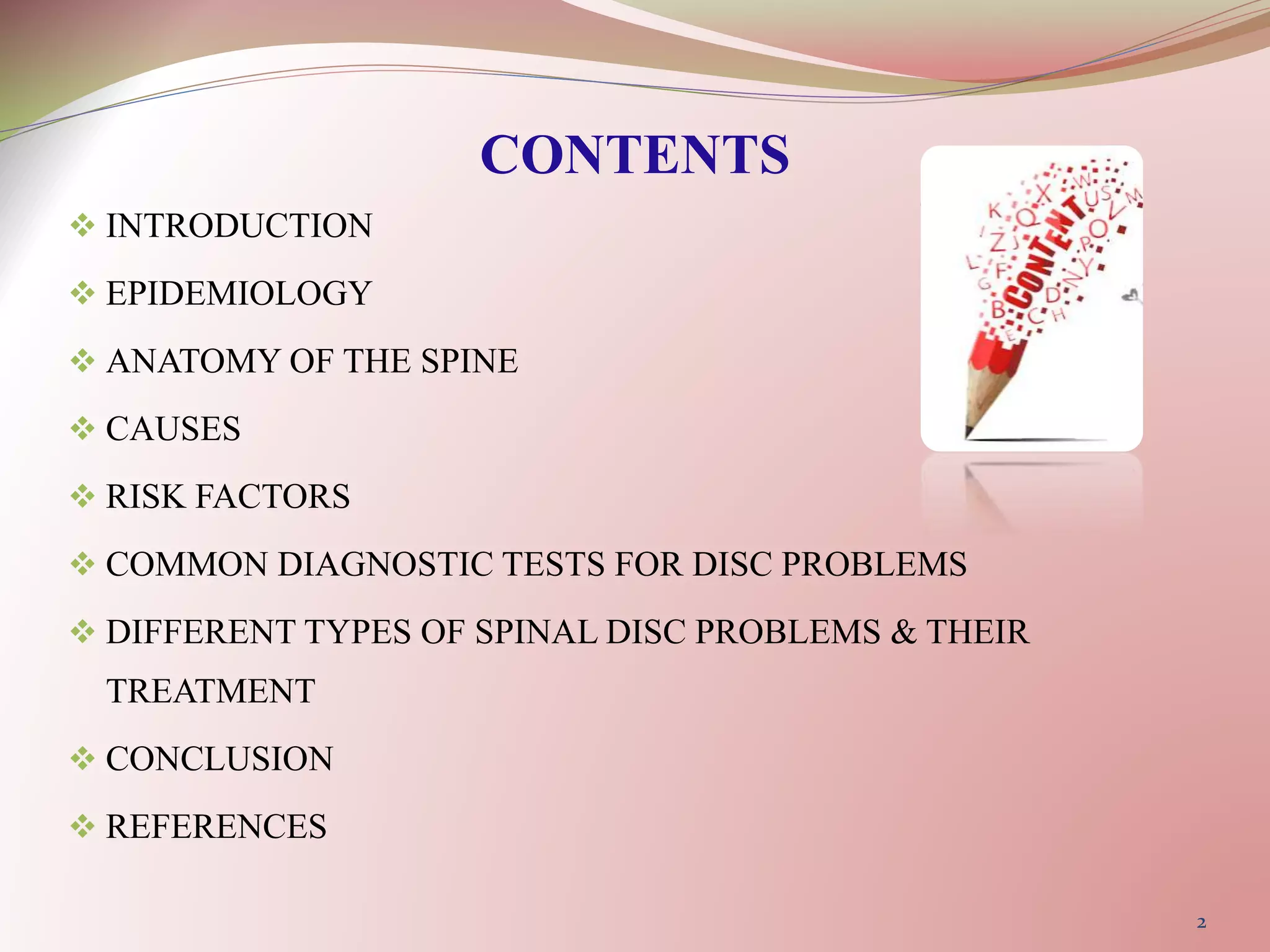
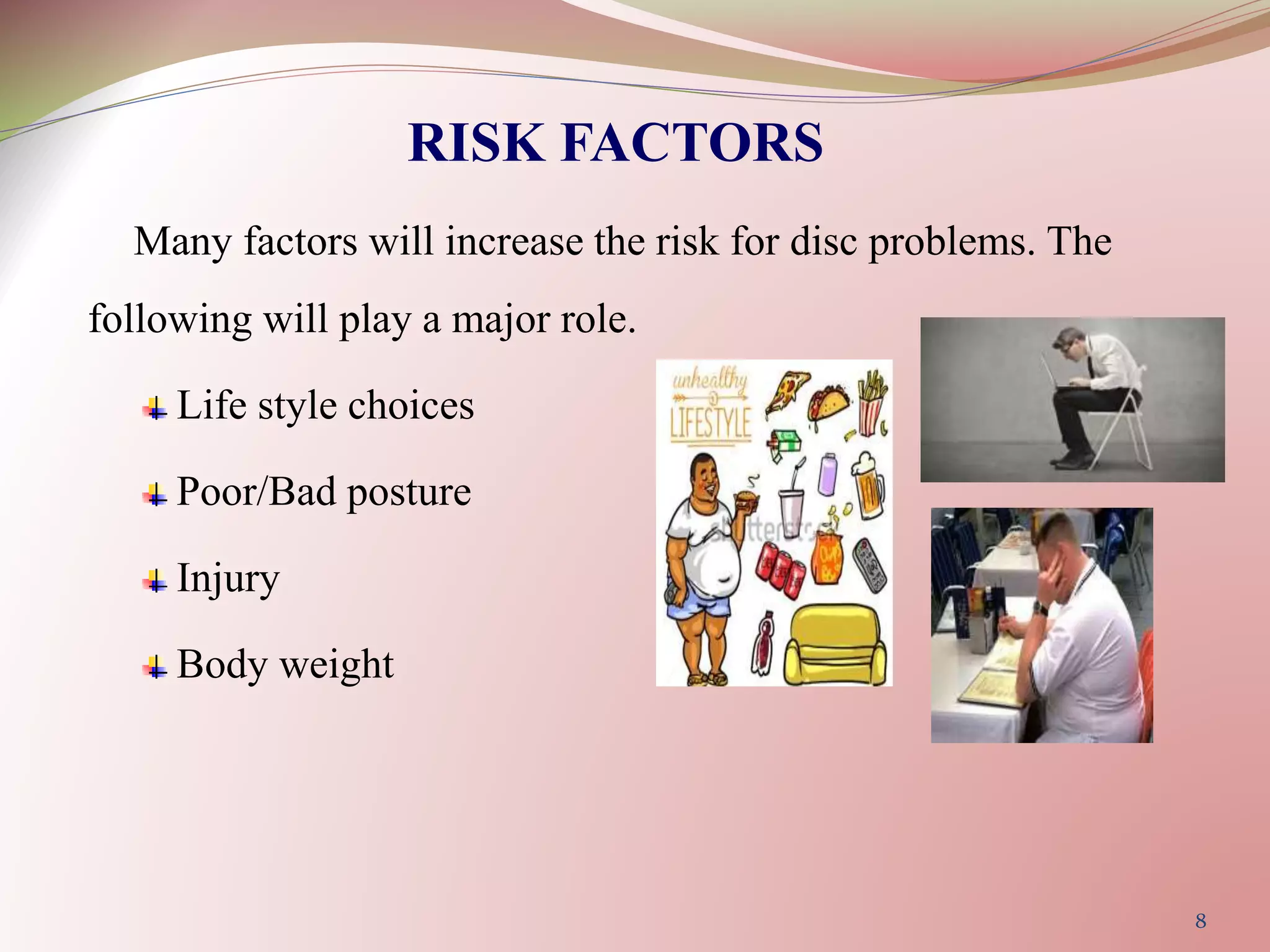
RISK FACTORS
Many factors will increase the risk for disc problems. The
following will play a major role.
Life style choices
Poor/Bad posture
Injury
Body weight
8
COMMON DIAGNOSTIC TESTS FOR
DISC PROBLEMS
A Physical examination
A Neurological examination
An X-ray
An MRI
A CT Scan
Discogram
9
DIFFERENT TYPES OF SPINAL DISC
PROBLEMS
There are different types of disc problems, with the most common
being a degenerative disc and herniated discs.
10
A. DEGENERATIVE DISC DISEASE
Degenerative disc disease is a condition that affects most
adults over the age of 50.
Even though degenerative disc disease is a common
occurrence for many adults, most people who have this
condition are not aware that they have it.
11
Degenerative Disc -Symptoms
Lower back pain.
Sometimes pain radiating to the
hips, as well as pain in the buttocks,
thighs or legs.
Tingling or weakness through the
knees and legs.
12
Degenerative Disc - Treatment
Treatment will depend on the cause and severity of
the symptoms and can include:
Over-the-counter / prescription drugs
Muscle relaxants if there is muscle spasm
Physical treatments such as massage
and physiotherapy.
Heat or cold treatment, such as placing a heat
or cold pack on the affected area
13
Degenerative Disc- Surgical treatment
Lumbar Fusion Surgery Artificial Disc Replacement
Surgery
14
B. HERNIATED DISC PROBLEMS
It is also known as a slipped
disc or ruptured disc, a herniated
disc develops when one of the
spinal disc between the vertebrae
moves out of position and it can
compress or "pinch" the
nerve. That can lead to the pain
associated with herniated discs.
15
HERNIATED DISC PROBLEMS
A herniation may develop suddenly or gradually over
weeks or months. Stages of the herniated disc are:
Disc Degeneration
Prolapse
Extrusion
Sequestration or Sequestered Disc
16
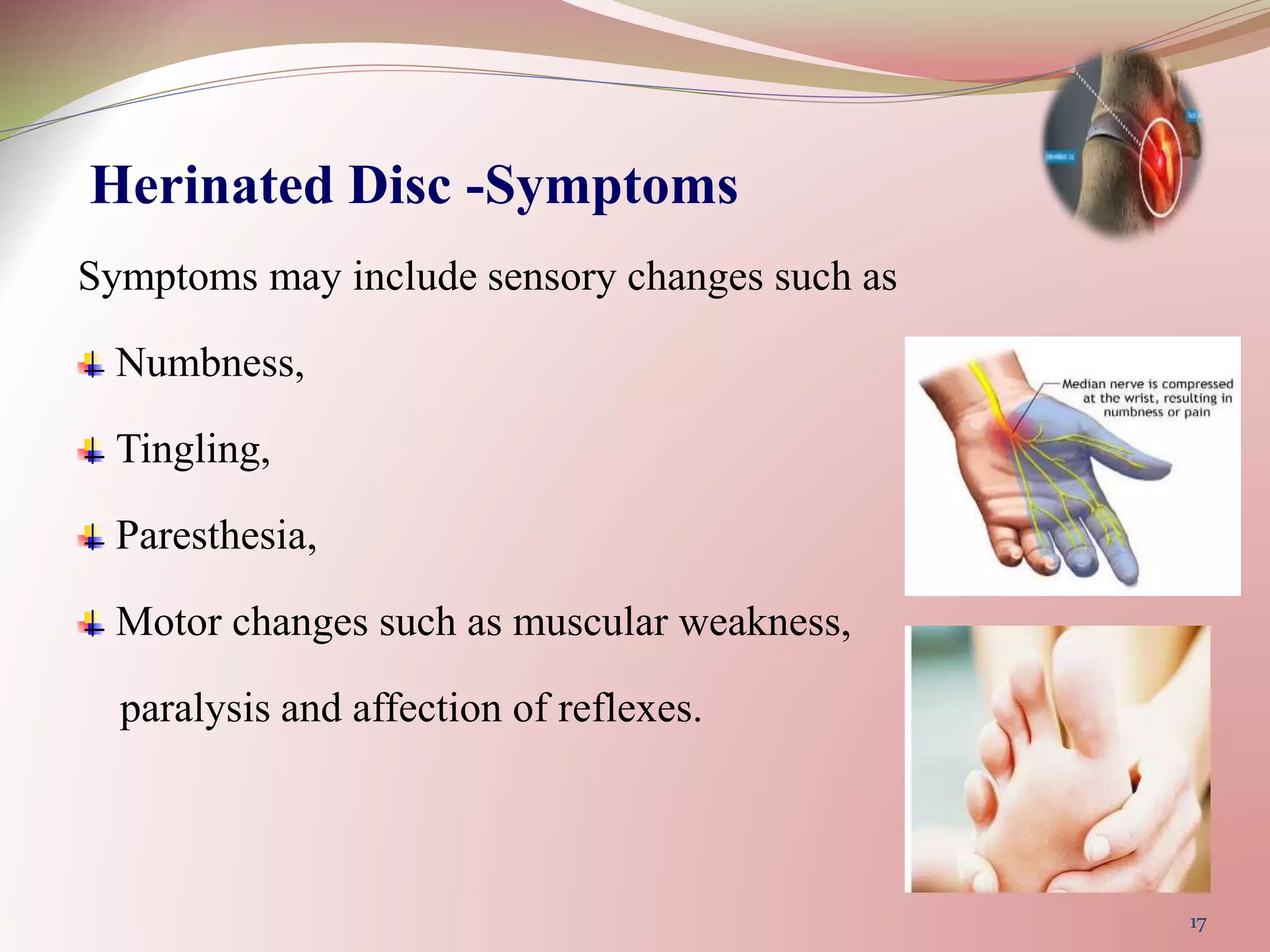
Herinated Disc -Symptoms
Symptoms may include sensory changes such as
Numbness,
Tingling,
Paresthesia,
Motor changes such as muscular weakness,
paralysis and affection of reflexes.
17
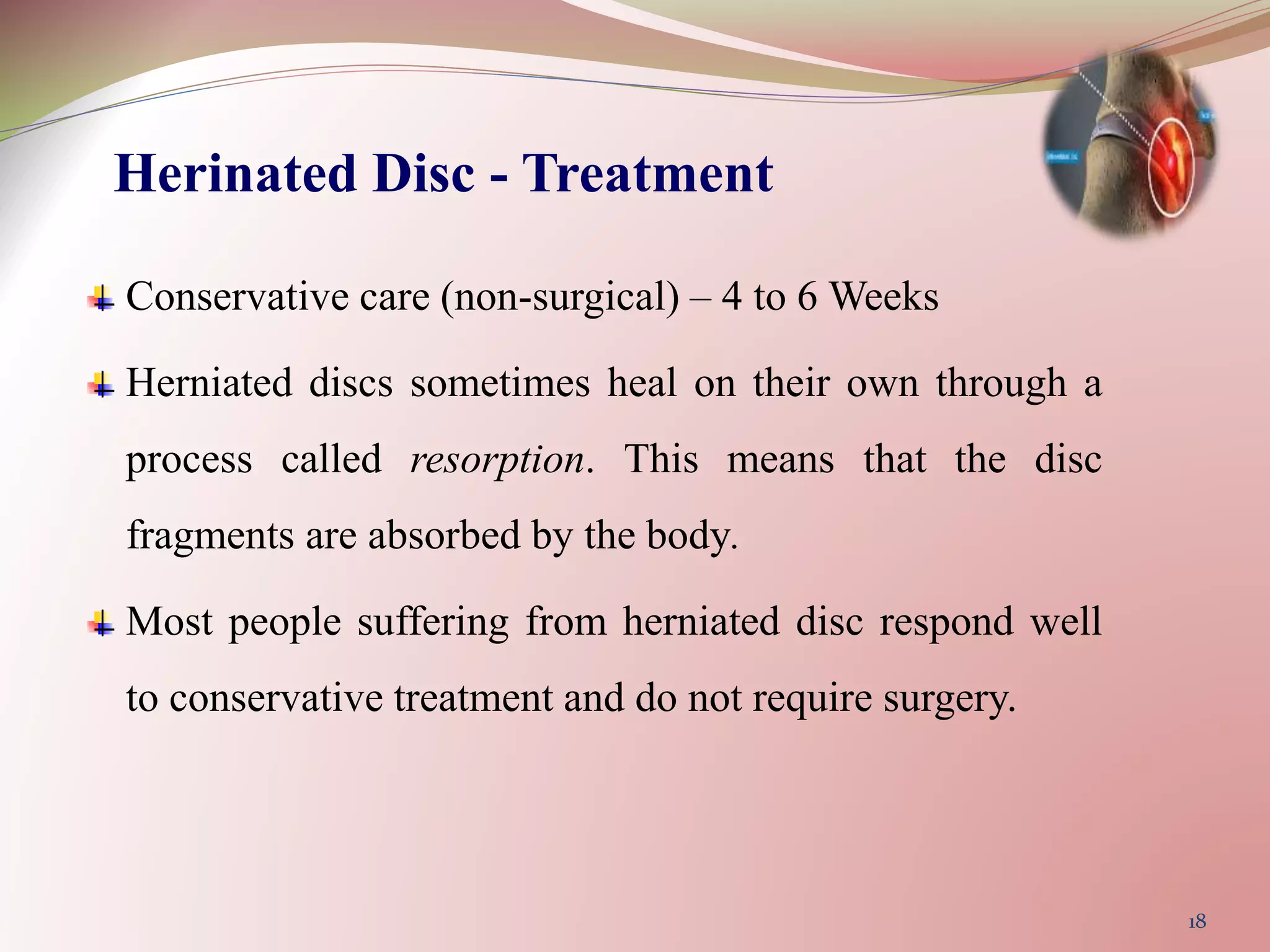
Herinated Disc - Treatment
Conservative care (non-surgical) – 4 to 6 Weeks
Herniated discs sometimes heal on their own through a
process called resorption. This means that the disc
fragments are absorbed by the body.
Most people suffering from herniated disc respond well
to conservative treatment and do not require surgery.
18
Herniated Disc- Surgical Treatment
Laminotomy/laminectomy
Laminotomy means "make an
opening in the lamina“
Discectomy/ Microdiscectomy
Discectomy means "remove the disc."
Artificial disc surgery
19
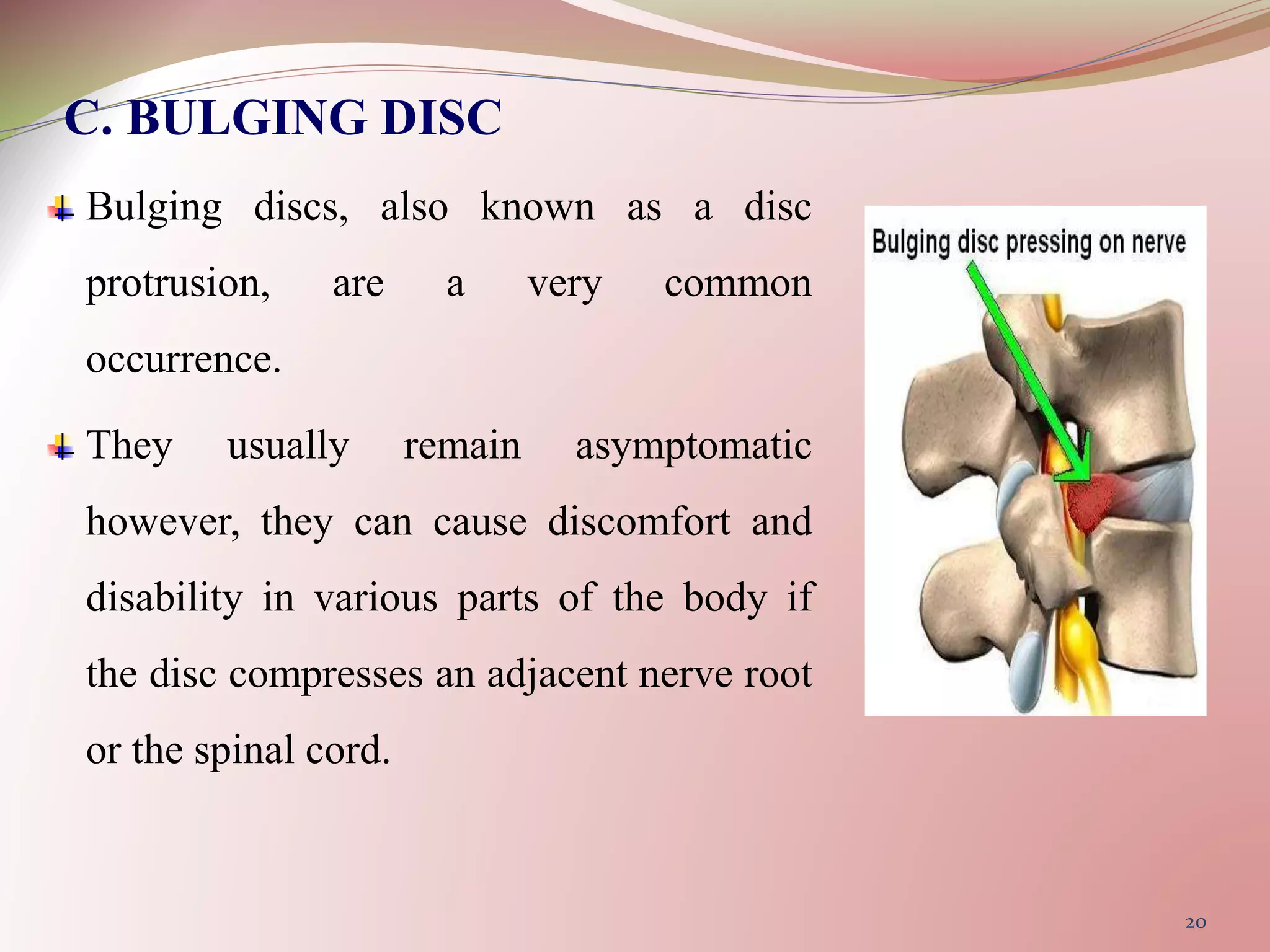
C. BULGING DISC
Bulging discs, also known as a disc
protrusion, are a very common
occurrence.
They usually remain asymptomatic
however, they can cause discomfort and
disability in various parts of the body if
the disc compresses an adjacent nerve root
or the spinal cord.
20
Bulging Disc- Symptoms
Pain or tingling in the neck, shoulders, arms, hands or fingers
can signal a bulging disc in the cervical area.
Pain in the upper back that radiates to the chest or stomach can
signal a thoracic bulging disc.
Muscle spasms and lower back pain may be evidence of a
bulging disc in the lumbar region.
21
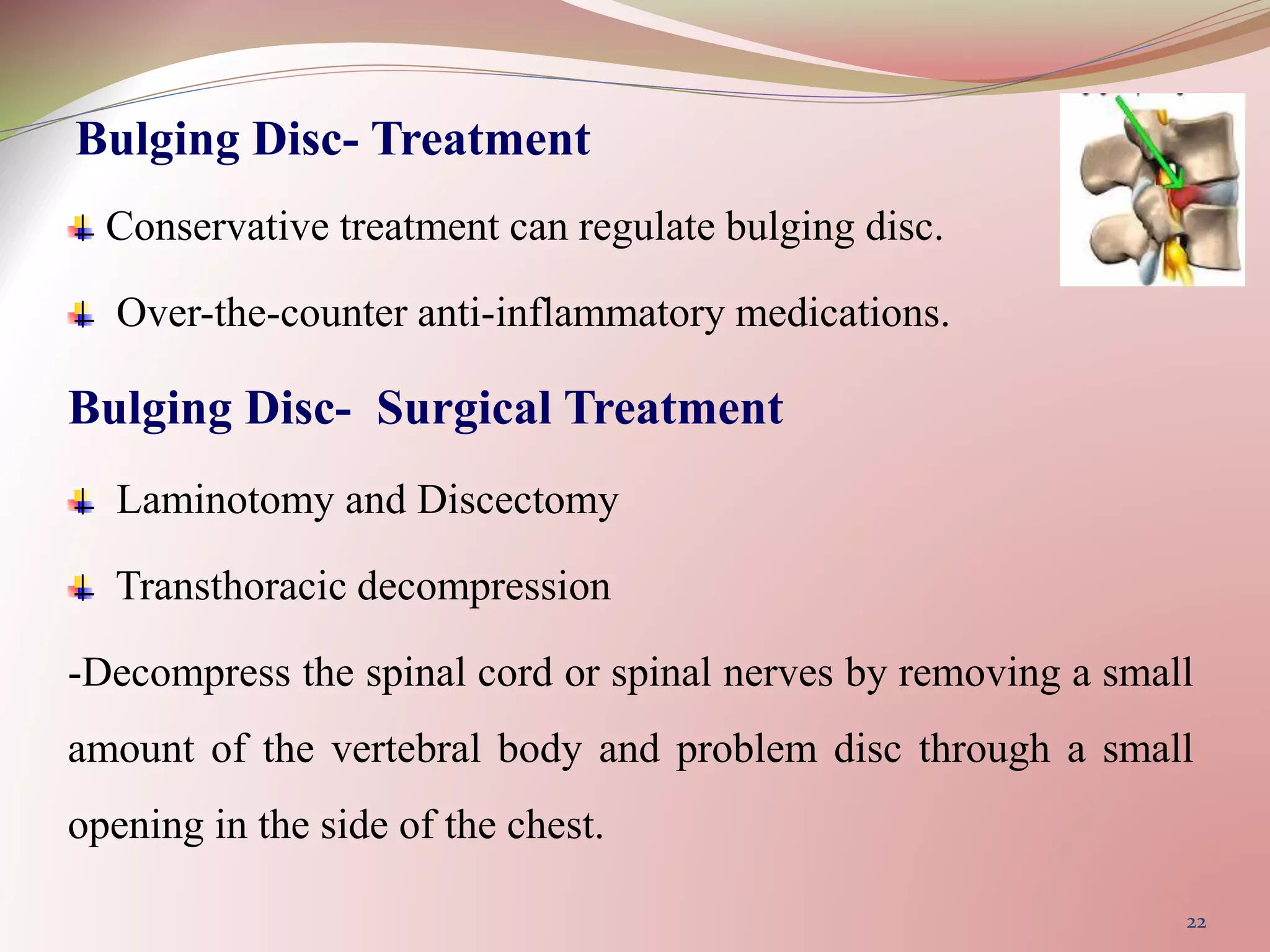
Bulging Disc- Treatment
Conservative treatment can regulate bulging disc.
Over-the-counter anti-inflammatory medications.
Bulging Disc- Surgical Treatment
Laminotomy and Discectomy
Transthoracic decompression
-Decompress the spinal cord or spinal nerves by removing a small
amount of the vertebral body and problem disc through a small
opening in the side of the chest.
22
D. THINNING DISC
The water that is found in the inner part of a disc
decreases. This water and inner disc fluid is
responsible for the disc’s height and width an
important measure to keep the spine
and vertebrae in proper alignment.
As the inner disc fluid decreases, the disc
becomes weaker. If the disc compression in the
spine is consistent, the weakened disc may begin
to thin or flatten, creating instability in the spine.
23
OTHER SPINE PROBLEMS
Ankylosing Spondylitis
24
Spinal Stenosis
PREVENTION
Maintaining a healthy weight
Limit alcohol and tobacco use
Reduce high-impact sports like football and
other contact sports .
Exercise regularly to strengthen the core
muscles around the spine.
25
CONCLUSION
Though the incidence of Spinal disc problems are less, their impact
will greatly alter the daily life pattern of the person.
The severity and the symptoms are based on the site and location of
the damaged disc in the spinal cord.
Majority of the times this problems can be treated with drugs, if the
condition is worse, the final choice will be the spine surgery.
However regular low impact exercises, healthy lifestyle,
maintanence of body posture will prevent the early incidence of
spine problems.
26
REFERENCES
 Andrew J Schoenfeld and Bradley K Weiner. Treatment of lumbar disc
herniation: Evidence-based practice. Int J Gen Med., 2010; 3: 209–214.
 Buckwalter JA. Aging and degeneration of the human intervertebral
disc. Spine., 1995;20:1307–1314.
 Carragee E. Surgical treatment of disk disorders. JAMA. 2006; 296:2485–
2487.
 Del Grande F, Maus TP, Carrino JA. Imaging the intervertebral disk: age-
related changes, herniations, and radicular pain. Radiol. Clin. North
Am.2012; 50 (4): 629–49.
 Marshall LL, Trethewie ER. Chemical irritation of nerve-root in disc
prolapse. Lancet., 1974; 2 (7824): 320. 27
28
29

Kusuma presentation (3) (1)

  • 1.
    AN OVERVIEW ON SPINEDISC PROBLEMS A Seminar Submitted to VIJAYA INSTITUTE OF PHARMACEUTICAL SCIENCE FOR WOMEN Under the guidance of: Submitted by: Mrs.D.Santhi Krupa, M.Pharm., V. Kusuma Asst. Professor, Department of Pharmacology IV B. Pharmacy 1
  • 2.
    CONTENTS  INTRODUCTION  EPIDEMIOLOGY ANATOMY OF THE SPINE  CAUSES  RISK FACTORS  COMMON DIAGNOSTIC TESTS FOR DISC PROBLEMS  DIFFERENT TYPES OF SPINAL DISC PROBLEMS & THEIR TREATMENT  CONCLUSION  REFERENCES 2
  • 3.
    INTRODUCTION Spinal Cord isa complex, intricate construct that includes a variety of nerves, bones, joints, tendons, ligaments and muscles woven together. The spine is designed to be remarkably strong, with a great deal of flexibility in the lower back and neck. If the spine is injured, our body mobility is also limited. 3
  • 4.
    INTRODUCTION Spine problems canbegin as early as the late twenties, and some unfortunately have problems even earlier due to unhealthy lifestyle, sport injuries or bad posture. Though their incidence is low, they can badly affect the daily life pattern of a person, making the person immobile. In this present topic, we focus mainly on different spine disc diseases their surgical, and non-surgical treatments. 4
  • 5.
    EPIDEMIOLOGY Spine Disc Problemsare emerging public health problems all over the world. The prevalence of their symptoms are as follows: 80% - Back Pain 2-3% - Sciatica Prevalence of Spine Problems 56% - Disc Bulge 2% - Symptomatic Disc Herniation 5
  • 6.
    ANATOMY OF THESPINE It is designed to be incredibly strong, protecting the highly sensitive nerve roots, yet highly flexible, providing for mobility on many different planes. Spine Disc construction consists • Tough outer portion- Annulus Fibrosus • Soft inner core- Nucleus Pulposus 6
  • 7.
    CAUSES Changes in intervertebraldiscs Changes in the collagen structure of the annulus fibrosus. Decreased water content in the disc. Aging Increased amounts of inflammatory mediators 7
  • 8.
    RISK FACTORS Many factorswill increase the risk for disc problems. The following will play a major role. Life style choices Poor/Bad posture Injury Body weight 8
  • 9.
    COMMON DIAGNOSTIC TESTSFOR DISC PROBLEMS A Physical examination A Neurological examination An X-ray An MRI A CT Scan Discogram 9
  • 10.
    DIFFERENT TYPES OFSPINAL DISC PROBLEMS There are different types of disc problems, with the most common being a degenerative disc and herniated discs. 10
  • 11.
    A. DEGENERATIVE DISCDISEASE Degenerative disc disease is a condition that affects most adults over the age of 50. Even though degenerative disc disease is a common occurrence for many adults, most people who have this condition are not aware that they have it. 11
  • 12.
    Degenerative Disc -Symptoms Lowerback pain. Sometimes pain radiating to the hips, as well as pain in the buttocks, thighs or legs. Tingling or weakness through the knees and legs. 12
  • 13.
    Degenerative Disc -Treatment Treatment will depend on the cause and severity of the symptoms and can include: Over-the-counter / prescription drugs Muscle relaxants if there is muscle spasm Physical treatments such as massage and physiotherapy. Heat or cold treatment, such as placing a heat or cold pack on the affected area 13
  • 14.
    Degenerative Disc- Surgicaltreatment Lumbar Fusion Surgery Artificial Disc Replacement Surgery 14
  • 15.
    B. HERNIATED DISCPROBLEMS It is also known as a slipped disc or ruptured disc, a herniated disc develops when one of the spinal disc between the vertebrae moves out of position and it can compress or "pinch" the nerve. That can lead to the pain associated with herniated discs. 15
  • 16.
    HERNIATED DISC PROBLEMS Aherniation may develop suddenly or gradually over weeks or months. Stages of the herniated disc are: Disc Degeneration Prolapse Extrusion Sequestration or Sequestered Disc 16
  • 17.
    Herinated Disc -Symptoms Symptomsmay include sensory changes such as Numbness, Tingling, Paresthesia, Motor changes such as muscular weakness, paralysis and affection of reflexes. 17
  • 18.
    Herinated Disc -Treatment Conservative care (non-surgical) – 4 to 6 Weeks Herniated discs sometimes heal on their own through a process called resorption. This means that the disc fragments are absorbed by the body. Most people suffering from herniated disc respond well to conservative treatment and do not require surgery. 18
  • 19.
    Herniated Disc- SurgicalTreatment Laminotomy/laminectomy Laminotomy means "make an opening in the lamina“ Discectomy/ Microdiscectomy Discectomy means "remove the disc." Artificial disc surgery 19
  • 20.
    C. BULGING DISC Bulgingdiscs, also known as a disc protrusion, are a very common occurrence. They usually remain asymptomatic however, they can cause discomfort and disability in various parts of the body if the disc compresses an adjacent nerve root or the spinal cord. 20
  • 21.
    Bulging Disc- Symptoms Painor tingling in the neck, shoulders, arms, hands or fingers can signal a bulging disc in the cervical area. Pain in the upper back that radiates to the chest or stomach can signal a thoracic bulging disc. Muscle spasms and lower back pain may be evidence of a bulging disc in the lumbar region. 21
  • 22.
    Bulging Disc- Treatment Conservativetreatment can regulate bulging disc. Over-the-counter anti-inflammatory medications. Bulging Disc- Surgical Treatment Laminotomy and Discectomy Transthoracic decompression -Decompress the spinal cord or spinal nerves by removing a small amount of the vertebral body and problem disc through a small opening in the side of the chest. 22
  • 23.
    D. THINNING DISC Thewater that is found in the inner part of a disc decreases. This water and inner disc fluid is responsible for the disc’s height and width an important measure to keep the spine and vertebrae in proper alignment. As the inner disc fluid decreases, the disc becomes weaker. If the disc compression in the spine is consistent, the weakened disc may begin to thin or flatten, creating instability in the spine. 23
  • 24.
    OTHER SPINE PROBLEMS AnkylosingSpondylitis 24 Spinal Stenosis
  • 25.
    PREVENTION Maintaining a healthyweight Limit alcohol and tobacco use Reduce high-impact sports like football and other contact sports . Exercise regularly to strengthen the core muscles around the spine. 25
  • 26.
    CONCLUSION Though the incidenceof Spinal disc problems are less, their impact will greatly alter the daily life pattern of the person. The severity and the symptoms are based on the site and location of the damaged disc in the spinal cord. Majority of the times this problems can be treated with drugs, if the condition is worse, the final choice will be the spine surgery. However regular low impact exercises, healthy lifestyle, maintanence of body posture will prevent the early incidence of spine problems. 26
  • 27.
    REFERENCES  Andrew JSchoenfeld and Bradley K Weiner. Treatment of lumbar disc herniation: Evidence-based practice. Int J Gen Med., 2010; 3: 209–214.  Buckwalter JA. Aging and degeneration of the human intervertebral disc. Spine., 1995;20:1307–1314.  Carragee E. Surgical treatment of disk disorders. JAMA. 2006; 296:2485– 2487.  Del Grande F, Maus TP, Carrino JA. Imaging the intervertebral disk: age- related changes, herniations, and radicular pain. Radiol. Clin. North Am.2012; 50 (4): 629–49.  Marshall LL, Trethewie ER. Chemical irritation of nerve-root in disc prolapse. Lancet., 1974; 2 (7824): 320. 27
  • 28.
  • 29.