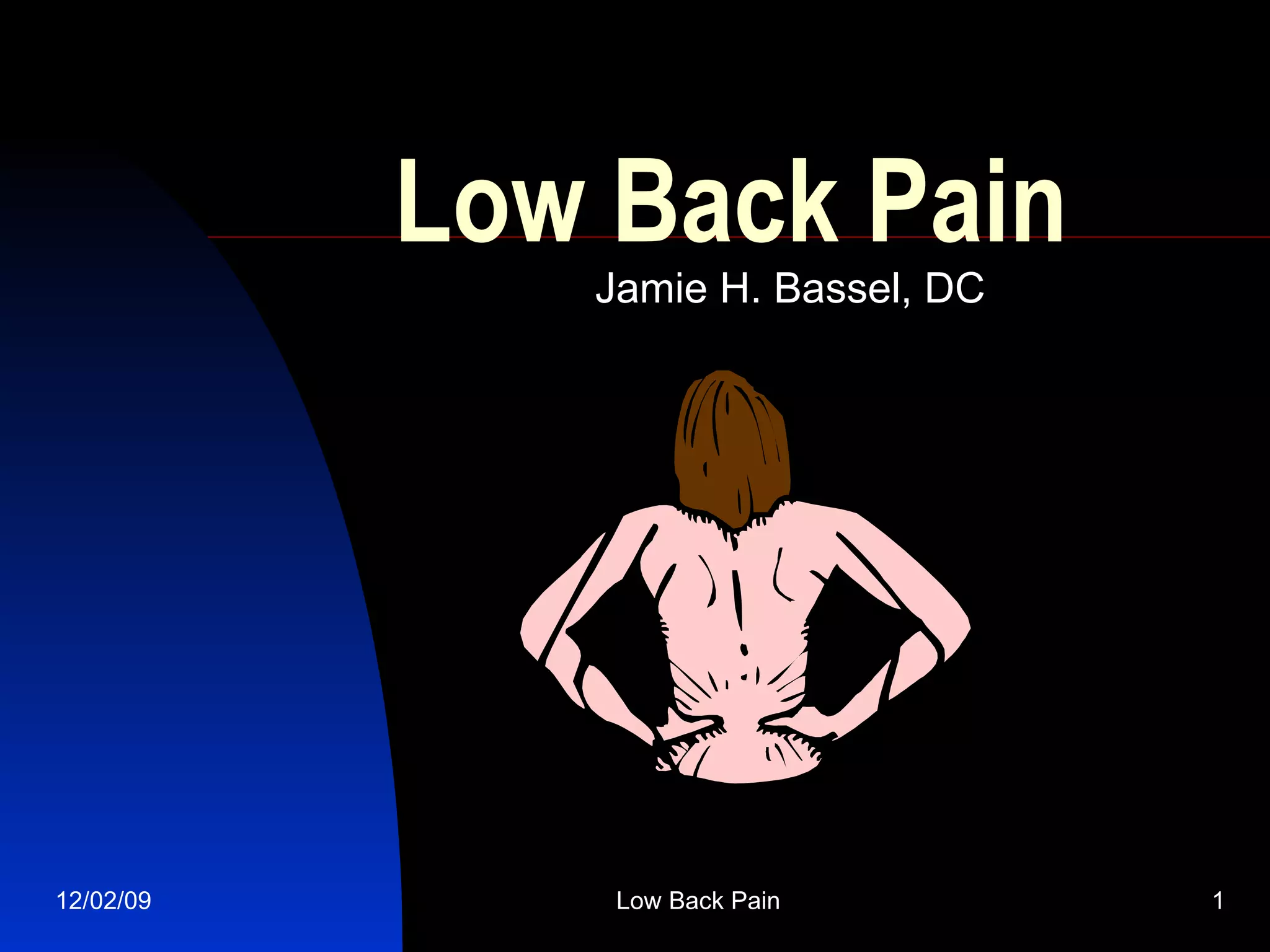
Low Back Pain  Jamie H. Bassel, DC
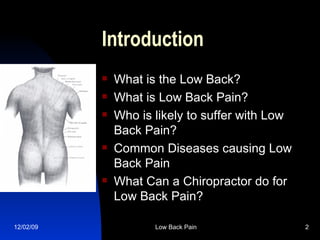
Introduction What is the Low Back? What is Low Back Pain? Who is likely to suffer with Low Back Pain? Common Diseases causing Low Back Pain What Can a Chiropractor do for Low Back Pain?
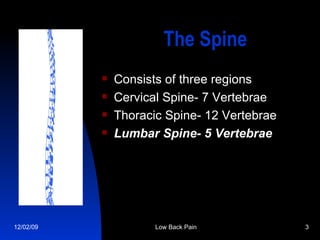
The Spine Consists of three regions Cervical Spine- 7 Vertebrae Thoracic Spine- 12 Vertebrae Lumbar Spine- 5 Vertebrae
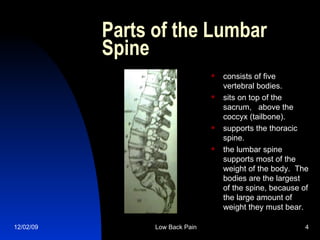
Parts of the Lumbar Spine consists of five  vertebral bodies.   sits on top of the sacrum,  above the coccyx (tailbone).   supports the thoracic spine.   the lumbar spine supports most of the weight of the body.  The bodies are the largest of the spine, because of the large amount of weight they must bear.
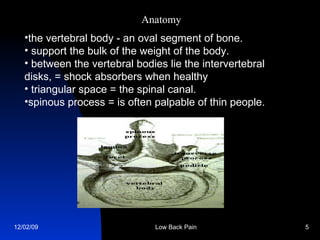
the vertebral body - an oval segment of bone.   support the bulk of the weight of the body.   between the vertebral bodies lie the intervertebral disks, = shock absorbers when healthy  triangular space = the spinal canal.   spinous process = is often palpable of thin people.   Anatomy
Did You Know? 80% of the population will experience LBP* * Extrapolated from industrial statistics, medical records and insurance figures
Types of Low Back Pain Organic or Disease Related Traumatic Mechanical Spinal Subluxations
06/07/09 Organic Causes of Low Back Pain Disease coming from the Kidney, Stomach, Pancreas, Bowel Malignancies/Cancer Bone Diseases Systemic Disorders
PLEASE   NOTE!!!!! It is extremely important to match the symptoms a patient experiences, with the symptoms one would expect based on the physical exam, and other tests. 
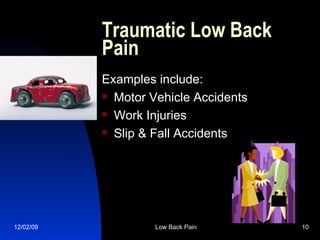
Traumatic Low Back Pain  Examples include: Motor Vehicle Accidents Work Injuries Slip & Fall Accidents
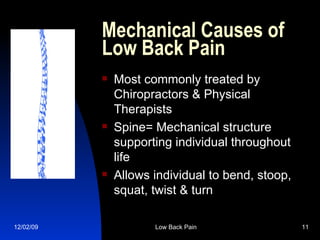
Mechanical Causes of Low Back Pain Most commonly treated by Chiropractors & Physical Therapists Spine= Mechanical structure supporting individual throughout life Allows individual to bend, stoop, squat, twist & turn
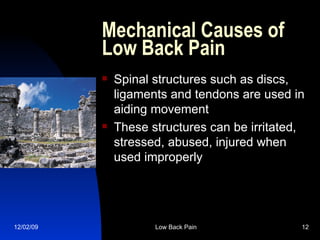
Mechanical Causes of Low Back Pain  Spinal structures such as discs, ligaments and tendons are used in aiding movement These structures can be irritated, stressed, abused, injured when used improperly
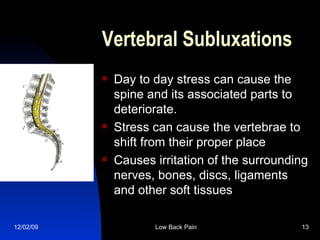
Vertebral Subluxations Day to day stress can cause the spine and its associated parts to deteriorate. Stress can cause the vertebrae to shift from their proper place Causes irritation of the surrounding nerves, bones, discs, ligaments and other soft tissues
Spine & Disc Degeneration Spinal Degeneration is like tooth decay (often painless), by the time pain is felt, the process has been going on for many years.
Spinal Degeneration Occurs in Phases 4 Phases in total Caused by years of longstanding stress placed on your spine Prevention can be accomplished through several approaches
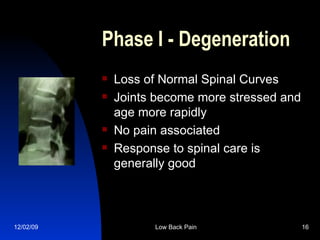
Phase I - Degeneration Loss of Normal Spinal Curves Joints become more stressed and age more rapidly No pain associated Response to spinal care is generally good
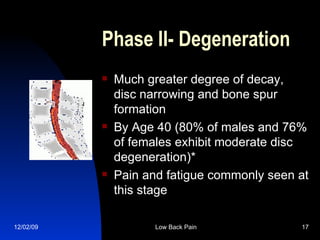
Phase II- Degeneration Much greater degree of decay, disc narrowing and bone spur formation  By Age 40 (80% of males and 76% of females exhibit moderate disc degeneration)* Pain and fatigue commonly seen at this stage
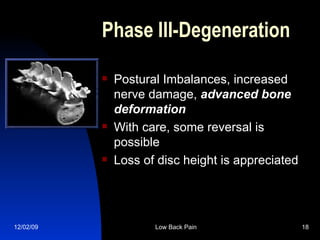
Phase III-Degeneration Postural Imbalances, increased nerve damage,  advanced bone deformation With care, some reversal is possible Loss of disc height is appreciated
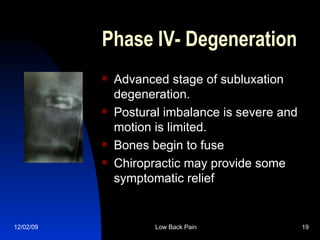
Phase IV- Degeneration Advanced stage of subluxation degeneration. Postural imbalance is severe and motion is limited.  Bones begin to fuse Chiropractic may provide some symptomatic relief
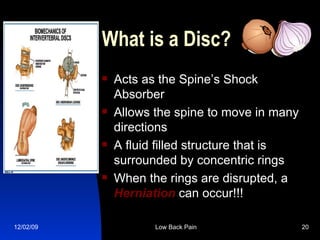
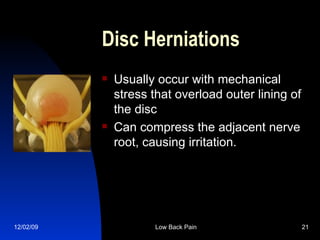
What is a Disc?  Acts as the Spine’s Shock Absorber Allows the spine to move in many directions  A fluid filled structure that is surrounded by concentric rings  When the rings are disrupted, a  Herniation  can occur!!!
Disc Herniations Usually occur with mechanical stress that overload outer lining of the disc Can compress the adjacent nerve root, causing irritation.
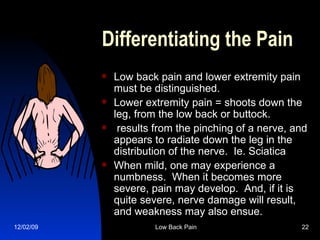
Differentiating the Pain Low back pain and lower extremity pain must be distinguished.     Lower extremity pain = shoots down the leg, from the low back or buttock.   results from the pinching of a nerve, and appears to radiate down the leg in the distribution of the nerve.  Ie. Sciatica When mild, one may experience a numbness.  When it becomes more severe, pain may develop.  And, if it is quite severe, nerve damage will result, and weakness may also ensue. 
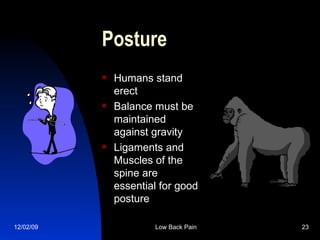
Posture Humans stand erect Balance must be maintained against gravity Ligaments and Muscles of the spine are essential for good posture
Good Posture Defined as:  Energy-economical, cosmetically acceptable stance Keeping the spine erect requires balance between ligaments and muscles. Requires the pelvis and hips to work together to balance the body’s frame
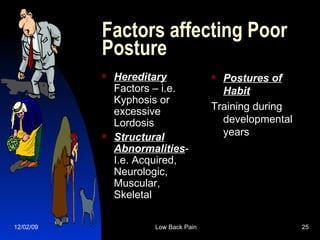
Factors affecting Poor Posture Hereditary  Factors – i.e. Kyphosis or excessive Lordosis Structural Abnormalities - I.e. Acquired, Neurologic, Muscular, Skeletal Postures of Habit Training during developmental years
Cultural Aspects of Posture ¼ of the worlds population take weight of their feet, legs and backs Chairs, Stools and Benches began being used 5000 years ago
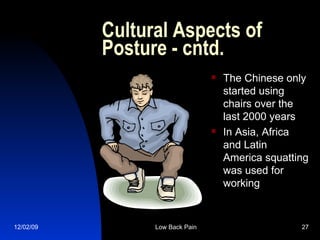
Cultural Aspects of Posture - cntd. The Chinese only started using chairs over the last 2000 years In Asia, Africa and Latin America squatting was used for working
Cultural Aspects of Posture – cntd. Standing posture influenced by the use of footwear as well as by physiologic, psychological, social, sexual, occupational and environmental factors
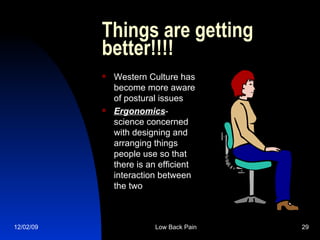
Things are getting better!!!! Western Culture has become more aware of postural issues Ergonomics - science concerned with designing and arranging things people use so that there is an efficient interaction between the two
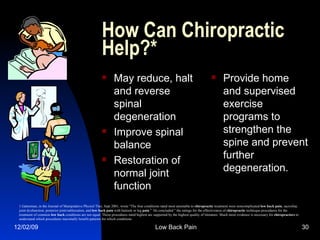
How Can Chiropractic Help?* May reduce, halt and reverse spinal degeneration Improve spinal balance Restoration of normal joint function Provide home and supervised exercise programs to strengthen the spine and prevent further degeneration. Gatterman, in the Journal of Manipulative Physiol Ther, Sept 2001, wrote "The four conditions rated most amenable to  chiropractic  treatment were noncomplicated  low   back   pain , sacroiliac joint dysfunction, posterior joint/subluxation, and  low   back   pain  with buttock or leg  pain ."  He concluded " the ratings for the effectiveness of  chiropractic  technique procedures for the treatment of common  low   back  conditions are not equal. Those procedures rated highest are supported by the highest quality of literature. Much more evidence is necessary for  chiropractors  to understand which procedures maximally benefit patients for which conditions
Prevention of Recurrent Low Back Pain Those who recover from LBP are typically those  who are at greatest  RISK  for recurrence!!!! Some factors that predispose a patient to LBP are unavoidable
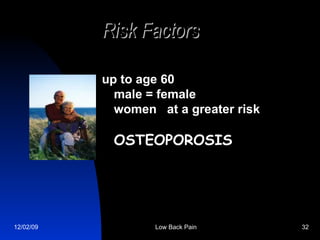
Risk Factors   up to age 60  male = female  women  at a greater risk  OSTEOPOROSIS
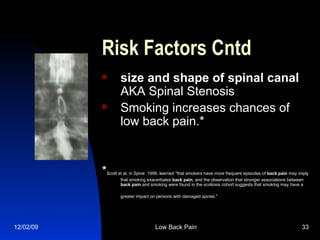
   Risk Factors Cntd size and shape of spinal canal AKA Spinal Stenosis Smoking increases chances of low back pain.* * Scott et al, in Spine  1999, learned "that smokers have more frequent episodes of  back   pain  may imply that smoking exacerbates  back   pain , and the observation that stronger associations between  back   pain  and smoking were found in the scoliosis cohort suggests that smoking may have a greater impact on persons with damaged spines."
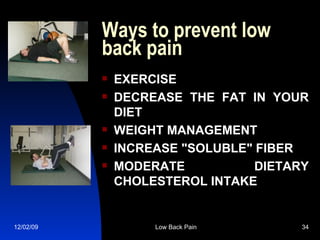
Ways to prevent low back pain    EXERCISE DECREASE THE FAT IN YOUR DIET   WEIGHT MANAGEMENT   INCREASE "SOLUBLE" FIBER   MODERATE  DIETARY CHOLESTEROL INTAKE
Questions and Answers

Low Back Pain and Chiropractic Care

  • 1.
    Low Back Pain Jamie H. Bassel, DC
  • 2.
    Introduction What isthe Low Back? What is Low Back Pain? Who is likely to suffer with Low Back Pain? Common Diseases causing Low Back Pain What Can a Chiropractor do for Low Back Pain?
  • 3.
    The Spine Consistsof three regions Cervical Spine- 7 Vertebrae Thoracic Spine- 12 Vertebrae Lumbar Spine- 5 Vertebrae
  • 4.
    Parts of theLumbar Spine consists of five vertebral bodies.  sits on top of the sacrum, above the coccyx (tailbone).  supports the thoracic spine.  the lumbar spine supports most of the weight of the body.  The bodies are the largest of the spine, because of the large amount of weight they must bear.
  • 5.
    the vertebral body- an oval segment of bone.  support the bulk of the weight of the body.  between the vertebral bodies lie the intervertebral disks, = shock absorbers when healthy triangular space = the spinal canal.  spinous process = is often palpable of thin people.  Anatomy
  • 6.
    Did You Know?80% of the population will experience LBP* * Extrapolated from industrial statistics, medical records and insurance figures
  • 7.
    Types of LowBack Pain Organic or Disease Related Traumatic Mechanical Spinal Subluxations
  • 8.
    06/07/09 Organic Causesof Low Back Pain Disease coming from the Kidney, Stomach, Pancreas, Bowel Malignancies/Cancer Bone Diseases Systemic Disorders
  • 9.
    PLEASE NOTE!!!!! It is extremely important to match the symptoms a patient experiences, with the symptoms one would expect based on the physical exam, and other tests. 
  • 10.
    Traumatic Low BackPain Examples include: Motor Vehicle Accidents Work Injuries Slip & Fall Accidents
  • 11.
    Mechanical Causes ofLow Back Pain Most commonly treated by Chiropractors & Physical Therapists Spine= Mechanical structure supporting individual throughout life Allows individual to bend, stoop, squat, twist & turn
  • 12.
    Mechanical Causes ofLow Back Pain Spinal structures such as discs, ligaments and tendons are used in aiding movement These structures can be irritated, stressed, abused, injured when used improperly
  • 13.
    Vertebral Subluxations Dayto day stress can cause the spine and its associated parts to deteriorate. Stress can cause the vertebrae to shift from their proper place Causes irritation of the surrounding nerves, bones, discs, ligaments and other soft tissues
  • 14.
    Spine & DiscDegeneration Spinal Degeneration is like tooth decay (often painless), by the time pain is felt, the process has been going on for many years.
  • 15.
    Spinal Degeneration Occursin Phases 4 Phases in total Caused by years of longstanding stress placed on your spine Prevention can be accomplished through several approaches
  • 16.
    Phase I -Degeneration Loss of Normal Spinal Curves Joints become more stressed and age more rapidly No pain associated Response to spinal care is generally good
  • 17.
    Phase II- DegenerationMuch greater degree of decay, disc narrowing and bone spur formation By Age 40 (80% of males and 76% of females exhibit moderate disc degeneration)* Pain and fatigue commonly seen at this stage
  • 18.
    Phase III-Degeneration PosturalImbalances, increased nerve damage, advanced bone deformation With care, some reversal is possible Loss of disc height is appreciated
  • 19.
    Phase IV- DegenerationAdvanced stage of subluxation degeneration. Postural imbalance is severe and motion is limited. Bones begin to fuse Chiropractic may provide some symptomatic relief
  • 20.
    What is aDisc? Acts as the Spine’s Shock Absorber Allows the spine to move in many directions A fluid filled structure that is surrounded by concentric rings When the rings are disrupted, a Herniation can occur!!!
  • 21.
    Disc Herniations Usuallyoccur with mechanical stress that overload outer lining of the disc Can compress the adjacent nerve root, causing irritation.
  • 22.
    Differentiating the PainLow back pain and lower extremity pain must be distinguished.    Lower extremity pain = shoots down the leg, from the low back or buttock.  results from the pinching of a nerve, and appears to radiate down the leg in the distribution of the nerve.  Ie. Sciatica When mild, one may experience a numbness.  When it becomes more severe, pain may develop.  And, if it is quite severe, nerve damage will result, and weakness may also ensue. 
  • 23.
    Posture Humans standerect Balance must be maintained against gravity Ligaments and Muscles of the spine are essential for good posture
  • 24.
    Good Posture Definedas: Energy-economical, cosmetically acceptable stance Keeping the spine erect requires balance between ligaments and muscles. Requires the pelvis and hips to work together to balance the body’s frame
  • 25.
    Factors affecting PoorPosture Hereditary Factors – i.e. Kyphosis or excessive Lordosis Structural Abnormalities - I.e. Acquired, Neurologic, Muscular, Skeletal Postures of Habit Training during developmental years
  • 26.
    Cultural Aspects ofPosture ¼ of the worlds population take weight of their feet, legs and backs Chairs, Stools and Benches began being used 5000 years ago
  • 27.
    Cultural Aspects ofPosture - cntd. The Chinese only started using chairs over the last 2000 years In Asia, Africa and Latin America squatting was used for working
  • 28.
    Cultural Aspects ofPosture – cntd. Standing posture influenced by the use of footwear as well as by physiologic, psychological, social, sexual, occupational and environmental factors
  • 29.
    Things are gettingbetter!!!! Western Culture has become more aware of postural issues Ergonomics - science concerned with designing and arranging things people use so that there is an efficient interaction between the two
  • 30.
    How Can ChiropracticHelp?* May reduce, halt and reverse spinal degeneration Improve spinal balance Restoration of normal joint function Provide home and supervised exercise programs to strengthen the spine and prevent further degeneration. Gatterman, in the Journal of Manipulative Physiol Ther, Sept 2001, wrote "The four conditions rated most amenable to chiropractic treatment were noncomplicated low back pain , sacroiliac joint dysfunction, posterior joint/subluxation, and low back pain with buttock or leg pain ."  He concluded " the ratings for the effectiveness of chiropractic technique procedures for the treatment of common low back conditions are not equal. Those procedures rated highest are supported by the highest quality of literature. Much more evidence is necessary for chiropractors to understand which procedures maximally benefit patients for which conditions
  • 31.
    Prevention of RecurrentLow Back Pain Those who recover from LBP are typically those who are at greatest RISK for recurrence!!!! Some factors that predispose a patient to LBP are unavoidable
  • 32.
    Risk Factors up to age 60 male = female women at a greater risk OSTEOPOROSIS
  • 33.
      RiskFactors Cntd size and shape of spinal canal AKA Spinal Stenosis Smoking increases chances of low back pain.* * Scott et al, in Spine  1999, learned "that smokers have more frequent episodes of back pain may imply that smoking exacerbates back pain , and the observation that stronger associations between back pain and smoking were found in the scoliosis cohort suggests that smoking may have a greater impact on persons with damaged spines."
  • 34.
    Ways to preventlow back pain   EXERCISE DECREASE THE FAT IN YOUR DIET WEIGHT MANAGEMENT INCREASE "SOLUBLE" FIBER MODERATE DIETARY CHOLESTEROL INTAKE
  • 35.