Autonomic nervous system
Anticholinergic Drugs/
Parasympatholytics/
Antimuscarinics
Department : Pharmacology Course: Pharmacology
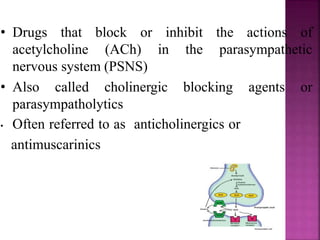
• Drugs that block or inhibit the actions of
acetylcholine (ACh) in the parasympathetic
nervous system (PSNS)
• Also called cholinergic blocking agents or
parasympatholytics
• Often referred to as anticholinergics or
antimuscarinics
• Competitive antagonists
• Compete with acetylcholine
• Block acetylcholine at the muscarinic
receptors in the PSNS
• Reversible blockade of acetylcholine at
muscarinic receptors by competitive binding
• (reversal by increasing acetylcholine or
agonist ----> decreased blockade)
• Once these drugs bind to receptors, they inhibit
nerve transmission at these receptors.
• Prototype antimuscarinic drug - derived from
Atropa belladonna (deadly nightshade) and
Datura stramonium (thorn apple)
• History:
• plant extracts were used as cosmetic eye drops
• hence the name belladonna or "beautiful lady"
in Italian
Cardiovascular effects-
• Decreased cardiovascular response to vagal
stimulation resulting in tachycardia
• Mainly, tachycardia due to antagonism of the
vagal affect.
• Vascular
– no (direct) effect
– except, dilate cutaneous vessels (red as a beet)
– block hypotensive effect of muscarinic agonists
CNS –
• At normal doses atropine stimulates medullary
centers, However, at higher doses produce
excitement, agitation, hallucinations and coma.
• Depresses vestibular excitation and has anti
motion sickness properties
• Supresses tremor and rigidity of parkinsonism
by blocking cholinergic overactivity in basal
ganglia.
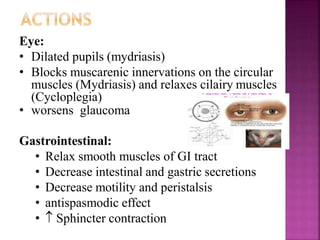
Eye:
• Dilated pupils (mydriasis)
• Blocks muscarenic innervations on the circular
muscles (Mydriasis) and relaxes cilairy muscles
(Cycloplegia)
• worsens glaucoma
Gastrointestinal:
• Relax smooth muscles of GI tract
• Decrease intestinal and gastric secretions
• Decrease motility and peristalsis
• antispasmodic effect
•  Sphincter contraction
Respiratory system -
• Decreases bronchial secretion (used as
preanesthetic Medication,COPD)
• Dilated bronchial airways (used for treatment of
Asthma)
Genitourinary -
• Relaxes detrusor muscle
• Increased constriction of internal sphincter
• Result: urinary retention
• Relaxation of smooth muscles of ureters.
• Therefore, they are contraindicated for prostate
hypertrophy patients.
Glandular –
•  Salivary secretion (Dry mouth)
•  gastric Acid (used for Peptic Ulcer )
•  Sweating  Dry skin  Fever in infants
and children.
•  Bronchial Secretion (used for COPD)
Central Nervous System Disorders-
• Parkinson’s disease – Benztropine,
Trihexyphenidyl
• Those who cannot take Levodopa
• Helpful in decreasing salivation, spasticity and
tremors
• Motion Sickness (Scopolamine)
• Drug-induced extrapyramidal reactions(due to
antipsychotics)
 CVS –
• Atropine is used to increase heart rate in
symptomatic bradycardias.
• Sinus node dysfunction
• Symptomatic second-degree heart block
• Sinus or nodal bradycardia (due to myocardial
infarction)
Respiratory system-
• Decreased secretions from nose, mouth,
pharynx, bronchi
• Relaxed smooth muscles in bronchi
and bronchioles
• Decreased airway resistance
• Bronchodilation
Respiratory agents are used to treat:
• Exercise-induced bronchospasms
• Chronic bronchitis
• Asthma
• Chronic obstructive pulmonary disease
• Ipratropium as inhalation (or Tiotropium)
Gastrointestinal:
• Blockade of PSNS results in:
• Decreased secretions
• Relaxation of smooth muscle
• Decreased GI motility and peristalsis
Gastrointestinal agents are used to treat:
• Peptic Ulcer: Pirenzepine
• As antispasmodic :Butylscopolamine
• Irritable bowel disease: Propantheline
• GI hypersecretory states
Urologic disorders-
• Antispasmodic effects seen in overactive
bladder and in urinary incontinence -
Oxybutynin
• Detrusor hyper-reflexia,
• Enuresis
-Increase bladder capacity
-Decrease bladder pressure
Opthalmological Disorders-
• Homatropine,tropicamide
• Accurate measurement of refractive error in
uncooperative patients (e.g, children)
• Examination of retina (Mydriasis)
Body System
Cardiovascular
CNS
Side/Adverse Effects
Increased heart rate,
dysrhythmias
CNS excitation, restlessness,
irritability, disorientation,
hallucinations,delirium
Body System
Eye
Gastrointestinal
Side/Adverse Effects
Dilated pupils, decreased
visual accommodation,
increased intraocular pressure
Decreased salivation,
decreased gastric secretions,
decreased motility
Body System
Genitourinary
Side/Adverse Effects
Urinary retention
Glandular Decreased sweating
Respiratory Decreased bronchial secretions
• Anticholinergic overdose syndrome (Belladona
poisoning- consumption of seeds or berries of
belladona or dhatura plant) is characterized by:
Hyperthermia, delirium, dry mouth, tacycardia,
ileus, urinary retention. Seizures, coma and
respiratory arrest may occur.
• Treatment – Gastric lavage with tannic acid,
cold sponging or ice bags, Physostigmine s.c. or
i.v., diazepam to control convulsions.
• Glaucoma
• Prostatic hypertrophy
• Urinary tract obstruction
• Gastrointestinal tract obstruction
• Infectious diarrhea
• Reflux esophagitis
• Tachyarrhythmias
• Angina
• Hyperthyroidism
• Pregnancy
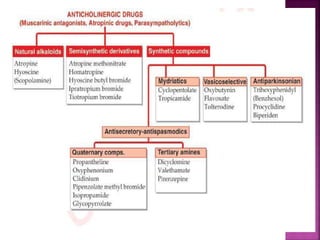
• Atropine - prototype. Antidote in OP
Poisoning.
• Ipratropium - Useful in rhinorrhea.Also
excellent bronchodilator.
• Scopolamine - depresses CNS and causes
amnesia, drowsiness, euphoria, relaxation and
sleep. Also good for motion sickness. Given
parenterally, orally and transdermally.
• Benztropine - temporary use in Parkinson’s
disease. Useful for dystonic reactions caused
by antipsychotics.
• Trihexyphenidyl - also used for treating EPS by
some antipsychotics. Contraindicated in
glaucoma.
• Flavoxate - relieves dysuria, urgency,
frequency, and pain with GU infections
• Oxybutynin - has direct antispasmodic effects
on smooth muscle and anticholinergic effects.
Decreases frequency of voiding.
Anticholinergics.pptx

Anticholinergics.pptx

  • 1.
    Autonomic nervous system AnticholinergicDrugs/ Parasympatholytics/ Antimuscarinics Department : Pharmacology Course: Pharmacology
  • 2.
    • Drugs thatblock or inhibit the actions of acetylcholine (ACh) in the parasympathetic nervous system (PSNS) • Also called cholinergic blocking agents or parasympatholytics • Often referred to as anticholinergics or antimuscarinics
  • 3.
    • Competitive antagonists •Compete with acetylcholine • Block acetylcholine at the muscarinic receptors in the PSNS • Reversible blockade of acetylcholine at muscarinic receptors by competitive binding • (reversal by increasing acetylcholine or agonist ----> decreased blockade) • Once these drugs bind to receptors, they inhibit nerve transmission at these receptors.
  • 5.
    • Prototype antimuscarinicdrug - derived from Atropa belladonna (deadly nightshade) and Datura stramonium (thorn apple) • History: • plant extracts were used as cosmetic eye drops • hence the name belladonna or "beautiful lady" in Italian
  • 6.
    Cardiovascular effects- • Decreasedcardiovascular response to vagal stimulation resulting in tachycardia • Mainly, tachycardia due to antagonism of the vagal affect. • Vascular – no (direct) effect – except, dilate cutaneous vessels (red as a beet) – block hypotensive effect of muscarinic agonists
  • 7.
    CNS – • Atnormal doses atropine stimulates medullary centers, However, at higher doses produce excitement, agitation, hallucinations and coma. • Depresses vestibular excitation and has anti motion sickness properties • Supresses tremor and rigidity of parkinsonism by blocking cholinergic overactivity in basal ganglia.
  • 8.
    Eye: • Dilated pupils(mydriasis) • Blocks muscarenic innervations on the circular muscles (Mydriasis) and relaxes cilairy muscles (Cycloplegia) • worsens glaucoma Gastrointestinal: • Relax smooth muscles of GI tract • Decrease intestinal and gastric secretions • Decrease motility and peristalsis • antispasmodic effect •  Sphincter contraction
  • 9.
    Respiratory system - •Decreases bronchial secretion (used as preanesthetic Medication,COPD) • Dilated bronchial airways (used for treatment of Asthma) Genitourinary - • Relaxes detrusor muscle • Increased constriction of internal sphincter • Result: urinary retention • Relaxation of smooth muscles of ureters. • Therefore, they are contraindicated for prostate hypertrophy patients.
  • 10.
    Glandular – • Salivary secretion (Dry mouth) •  gastric Acid (used for Peptic Ulcer ) •  Sweating  Dry skin  Fever in infants and children. •  Bronchial Secretion (used for COPD)
  • 11.
    Central Nervous SystemDisorders- • Parkinson’s disease – Benztropine, Trihexyphenidyl • Those who cannot take Levodopa • Helpful in decreasing salivation, spasticity and tremors • Motion Sickness (Scopolamine) • Drug-induced extrapyramidal reactions(due to antipsychotics)
  • 12.
     CVS – •Atropine is used to increase heart rate in symptomatic bradycardias. • Sinus node dysfunction • Symptomatic second-degree heart block • Sinus or nodal bradycardia (due to myocardial infarction)
  • 13.
    Respiratory system- • Decreasedsecretions from nose, mouth, pharynx, bronchi • Relaxed smooth muscles in bronchi and bronchioles • Decreased airway resistance • Bronchodilation Respiratory agents are used to treat: • Exercise-induced bronchospasms • Chronic bronchitis • Asthma • Chronic obstructive pulmonary disease • Ipratropium as inhalation (or Tiotropium)
  • 14.
    Gastrointestinal: • Blockade ofPSNS results in: • Decreased secretions • Relaxation of smooth muscle • Decreased GI motility and peristalsis Gastrointestinal agents are used to treat: • Peptic Ulcer: Pirenzepine • As antispasmodic :Butylscopolamine • Irritable bowel disease: Propantheline • GI hypersecretory states
  • 15.
    Urologic disorders- • Antispasmodiceffects seen in overactive bladder and in urinary incontinence - Oxybutynin • Detrusor hyper-reflexia, • Enuresis -Increase bladder capacity -Decrease bladder pressure
  • 16.
    Opthalmological Disorders- • Homatropine,tropicamide •Accurate measurement of refractive error in uncooperative patients (e.g, children) • Examination of retina (Mydriasis)
  • 17.
    Body System Cardiovascular CNS Side/Adverse Effects Increasedheart rate, dysrhythmias CNS excitation, restlessness, irritability, disorientation, hallucinations,delirium
  • 18.
    Body System Eye Gastrointestinal Side/Adverse Effects Dilatedpupils, decreased visual accommodation, increased intraocular pressure Decreased salivation, decreased gastric secretions, decreased motility
  • 19.
    Body System Genitourinary Side/Adverse Effects Urinaryretention Glandular Decreased sweating Respiratory Decreased bronchial secretions
  • 20.
    • Anticholinergic overdosesyndrome (Belladona poisoning- consumption of seeds or berries of belladona or dhatura plant) is characterized by: Hyperthermia, delirium, dry mouth, tacycardia, ileus, urinary retention. Seizures, coma and respiratory arrest may occur. • Treatment – Gastric lavage with tannic acid, cold sponging or ice bags, Physostigmine s.c. or i.v., diazepam to control convulsions.
  • 22.
    • Glaucoma • Prostatichypertrophy • Urinary tract obstruction • Gastrointestinal tract obstruction • Infectious diarrhea • Reflux esophagitis • Tachyarrhythmias • Angina • Hyperthyroidism • Pregnancy
  • 23.
    • Atropine -prototype. Antidote in OP Poisoning. • Ipratropium - Useful in rhinorrhea.Also excellent bronchodilator. • Scopolamine - depresses CNS and causes amnesia, drowsiness, euphoria, relaxation and sleep. Also good for motion sickness. Given parenterally, orally and transdermally. • Benztropine - temporary use in Parkinson’s disease. Useful for dystonic reactions caused by antipsychotics.
  • 24.
    • Trihexyphenidyl -also used for treating EPS by some antipsychotics. Contraindicated in glaucoma. • Flavoxate - relieves dysuria, urgency, frequency, and pain with GU infections • Oxybutynin - has direct antispasmodic effects on smooth muscle and anticholinergic effects. Decreases frequency of voiding.