
Spine Problem
Awareness &
Treatment
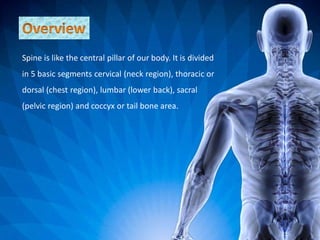
Spine is like the central pillar of our body. It is divided
in 5 basic segments cervical (neck region), thoracic or
dorsal (chest region), lumbar (lower back), sacral
(pelvic region) and coccyx or tail bone area.
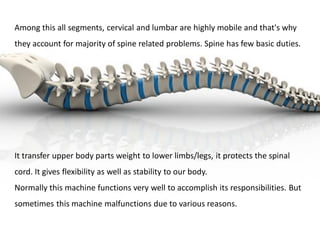
Among this all segments, cervical and lumbar are highly mobile and that's why
they account for majority of spine related problems. Spine has few basic duties.
It transfer upper body parts weight to lower limbs/legs, it protects the spinal
cord. It gives flexibility as well as stability to our body.
Normally this machine functions very well to accomplish its responsibilities. But
sometimes this machine malfunctions due to various reasons.
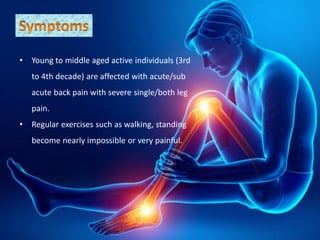
• Young to middle aged active individuals (3rd
to 4th decade) are affected with acute/sub
acute back pain with severe single/both leg
pain.
• Regular exercises such as walking, standing
become nearly impossible or very painful.
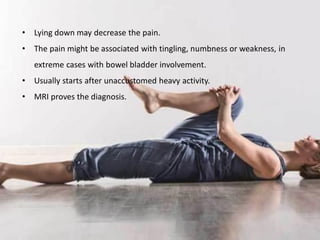
• Lying down may decrease the pain.
• The pain might be associated with tingling, numbness or weakness, in
extreme cases with bowel bladder involvement.
• Usually starts after unaccustomed heavy activity.
• MRI proves the diagnosis.
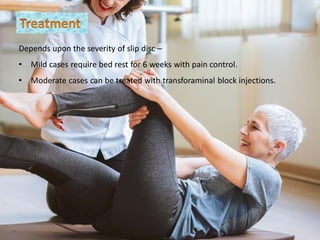
Depends upon the severity of slip disc –
• Mild cases require bed rest for 6 weeks with pain control.
• Moderate cases can be treated with transforaminal block injections.
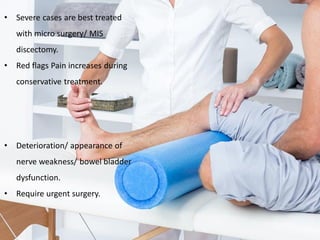
• Severe cases are best treated
with micro surgery/ MIS
discectomy.
• Red flags Pain increases during
conservative treatment.
• Deterioration/ appearance of
nerve weakness/ bowel bladder
dysfunction.
• Require urgent surgery.
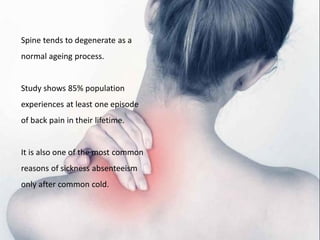
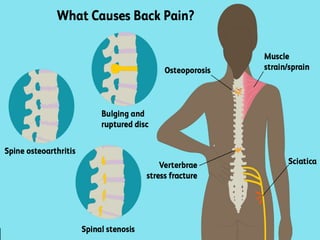
Spine tends to degenerate as a
normal ageing process.
Study shows 85% population
experiences at least one episode
of back pain in their lifetime.
It is also one of the most common
reasons of sickness absenteeism
only after common cold.
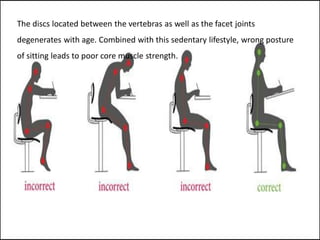
The discs located between the vertebras as well as the facet joints
degenerates with age. Combined with this sedentary lifestyle, wrong posture
of sitting leads to poor core muscle strength.
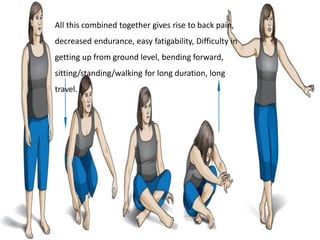
All this combined together gives rise to back pain,
decreased endurance, easy fatigability, Difficulty in
getting up from ground level, bending forward,
sitting/standing/walking for long duration, long
travel.
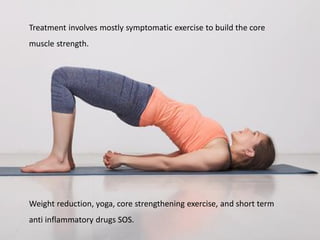
Treatment involves mostly symptomatic exercise to build the core
muscle strength.
Weight reduction, yoga, core strengthening exercise, and short term
anti inflammatory drugs SOS.
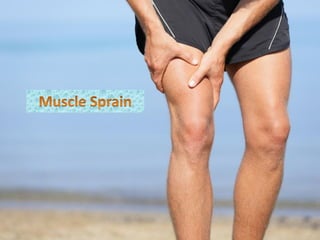
Usually affected population is a sportsman or an active individual with
unaccustomed sporting activity or heavy work.
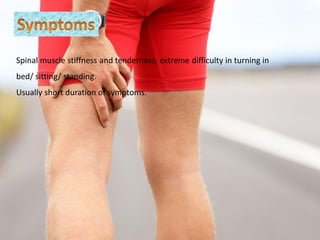
Spinal muscle stiffness and tenderness, extreme difficulty in turning in
bed/ sitting/ standing.
Usually short duration of symptoms.
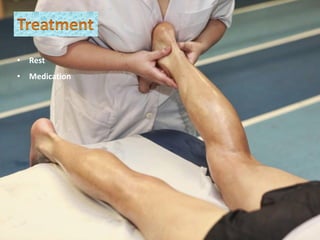
• Rest
• Medication
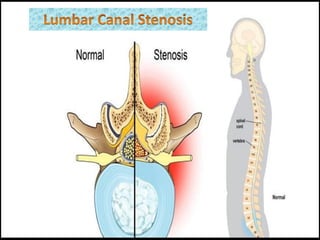
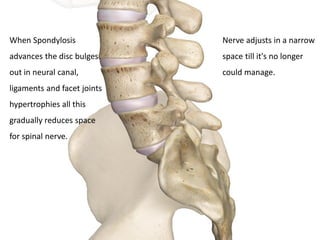
Nerve adjusts in a narrow
space till it's no longer
could manage.
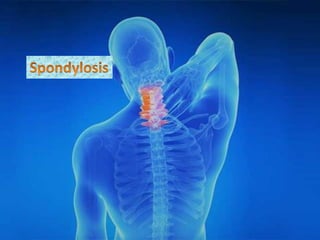
When Spondylosis
advances the disc bulges
out in neural canal,
ligaments and facet joints
hypertrophies all this
gradually reduces space
for spinal nerve.
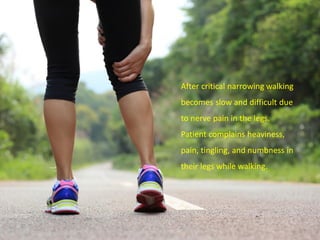
After critical narrowing walking
becomes slow and difficult due
to nerve pain in the legs.
Patient complains heaviness,
pain, tingling, and numbness in
their legs while walking.
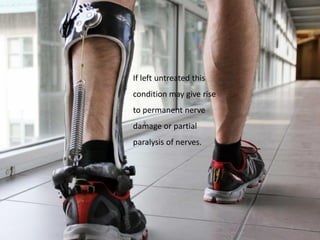
If left untreated this
condition may give rise
to permanent nerve
damage or partial
paralysis of nerves.
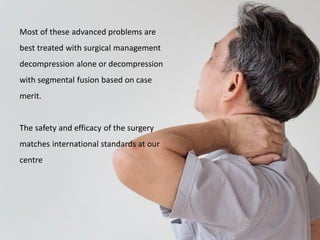
Most of these advanced problems are
best treated with surgical management
decompression alone or decompression
with segmental fusion based on case
merit.
The safety and efficacy of the surgery
matches international standards at our
centre
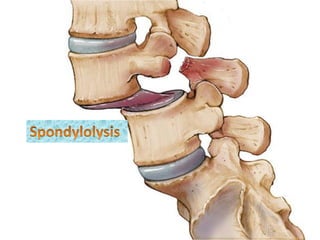
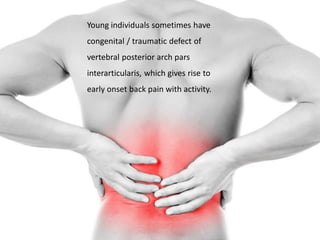
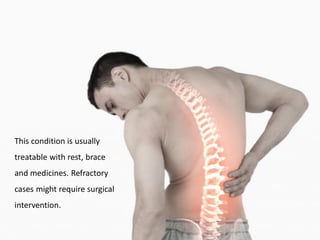
Young individuals sometimes have
congenital / traumatic defect of
vertebral posterior arch pars
interarticularis, which gives rise to
early onset back pain with activity.
This condition is usually
treatable with rest, brace
and medicines. Refractory
cases might require surgical
intervention.
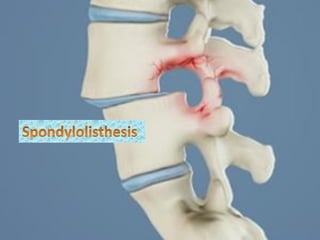
Definition - Where the superior block move forward in respect of
inferior block.
Degenerative type (more common) – occurs in older age group.
Often associated with lumbar canal stenosis. Early cases should be
given adequate conservative trial and failed/ advanced cases best
treated with surgery.
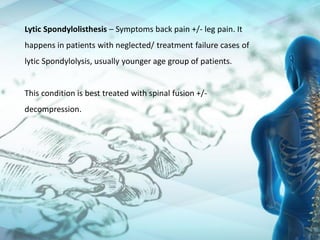
Lytic Spondylolisthesis – Symptoms back pain +/- leg pain. It
happens in patients with neglected/ treatment failure cases of
lytic Spondylolysis, usually younger age group of patients.
This condition is best treated with spinal fusion +/-
decompression.
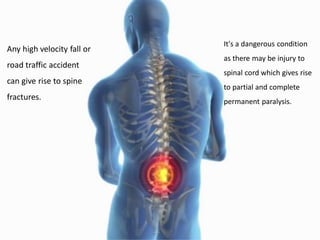
Any high velocity fall or
road traffic accident
can give rise to spine
fractures.
It's a dangerous condition
as there may be injury to
spinal cord which gives rise
to partial and complete
permanent paralysis.
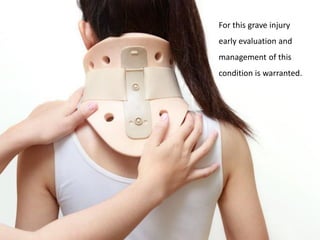
For this grave injury
early evaluation and
management of this
condition is warranted.
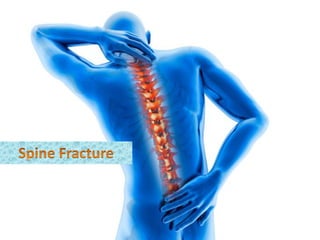
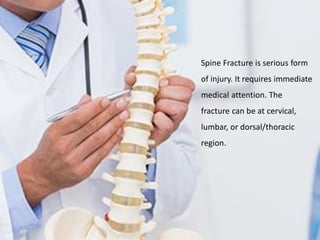
Spine Fracture is serious form
of injury. It requires immediate
medical attention. The
fracture can be at cervical,
lumbar, or dorsal/thoracic
region.
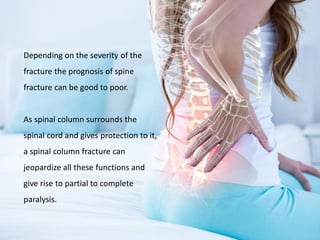
Depending on the severity of the
fracture the prognosis of spine
fracture can be good to poor.
As spinal column surrounds the
spinal cord and gives protection to it,
a spinal column fracture can
jeopardize all these functions and
give rise to partial to complete
paralysis.
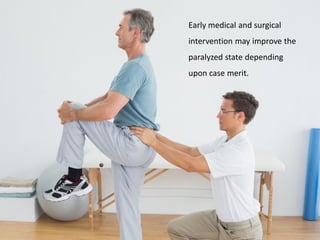
Early medical and surgical
intervention may improve the
paralyzed state depending
upon case merit.
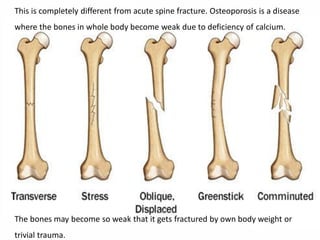
This is completely different from acute spine fracture. Osteoporosis is a disease
where the bones in whole body become weak due to deficiency of calcium.
The bones may become so weak that it gets fractured by own body weight or
trivial trauma.
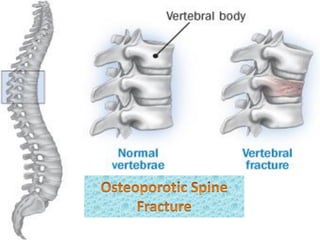
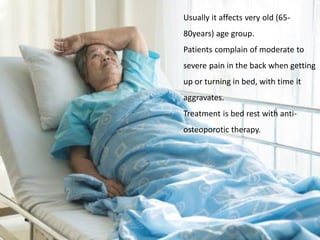
Usually it affects very old (65-
80years) age group.
Patients complain of moderate to
severe pain in the back when getting
up or turning in bed, with time it
aggravates.
Treatment is bed rest with anti-
osteoporotic therapy.
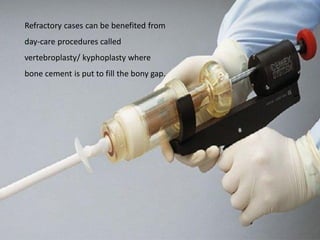
Refractory cases can be benefited from
day-care procedures called
vertebroplasty/ kyphoplasty where
bone cement is put to fill the bony gap.
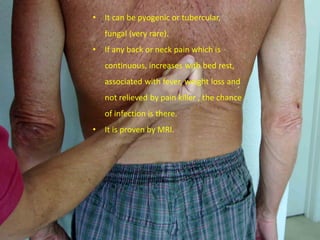
• It can be pyogenic or tubercular,
fungal (very rare).
• If any back or neck pain which is
continuous, increases with bed rest,
associated with fever, weight loss and
not relieved by pain killer , the chance
of infection is there.
• It is proven by MRI.
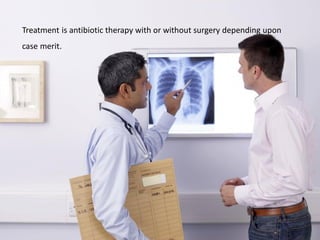
Treatment is antibiotic therapy with or without surgery depending upon
case merit.
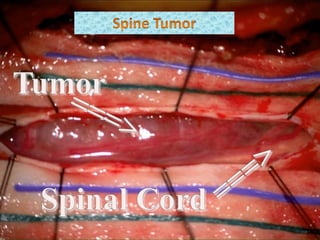
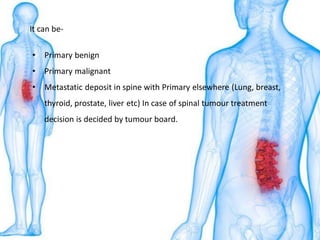
• Primary benign
• Primary malignant
• Metastatic deposit in spine with Primary elsewhere (Lung, breast,
thyroid, prostate, liver etc) In case of spinal tumour treatment
decision is decided by tumour board.
It can be-
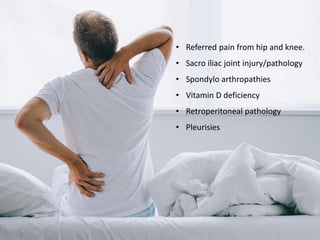
• Referred pain from hip and knee.
• Sacro iliac joint injury/pathology
• Spondylo arthropathies
• Vitamin D deficiency
• Retroperitoneal pathology
• Pleurisies
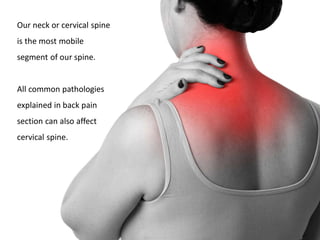
Our neck or cervical spine
is the most mobile
segment of our spine.
All common pathologies
explained in back pain
section can also affect
cervical spine.
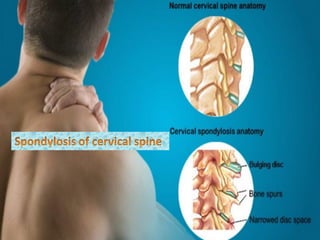
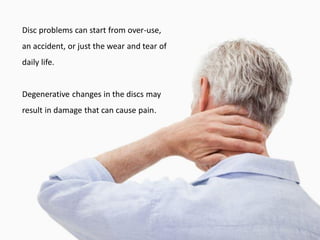
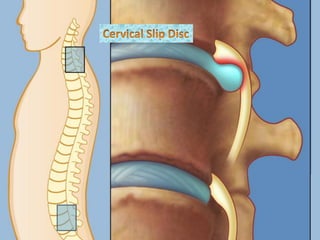
Disc problems can start from over-use,
an accident, or just the wear and tear of
daily life.
Degenerative changes in the discs may
result in damage that can cause pain.
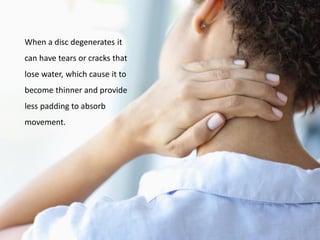
When a disc degenerates it
can have tears or cracks that
lose water, which cause it to
become thinner and provide
less padding to absorb
movement.
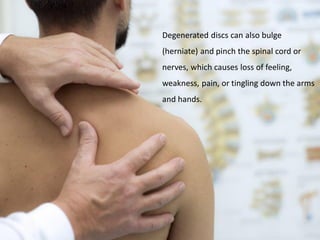
Degenerated discs can also bulge
(herniate) and pinch the spinal cord or
nerves, which causes loss of feeling,
weakness, pain, or tingling down the arms
and hands.
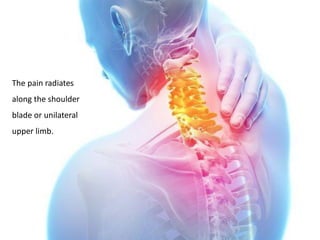
The pain radiates
along the shoulder
blade or unilateral
upper limb.
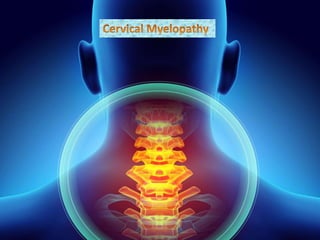
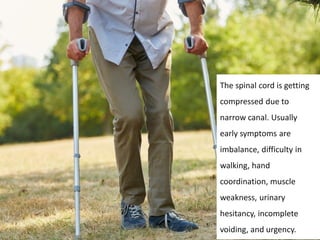
The spinal cord is getting
compressed due to
narrow canal. Usually
early symptoms are
imbalance, difficulty in
walking, hand
coordination, muscle
weakness, urinary
hesitancy, incomplete
voiding, and urgency.
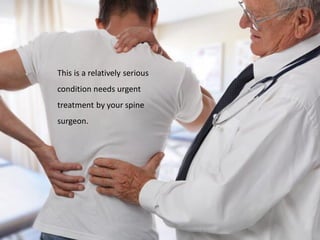
This is a relatively serious
condition needs urgent
treatment by your spine
surgeon.
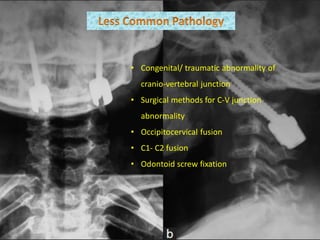
• Congenital/ traumatic abnormality of
cranio-vertebral junction
• Surgical methods for C-V junction
abnormality
• Occipitocervical fusion
• C1- C2 fusion
• Odontoid screw fixation
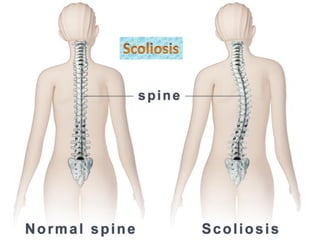
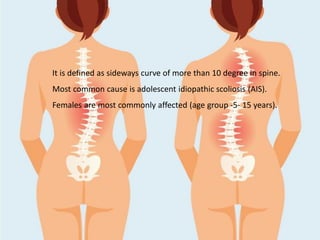
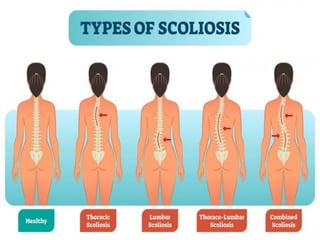
It is defined as sideways curve of more than 10 degree in spine.
Most common cause is adolescent idiopathic scoliosis (AIS).
Females are most commonly affected (age group -5- 15 years).
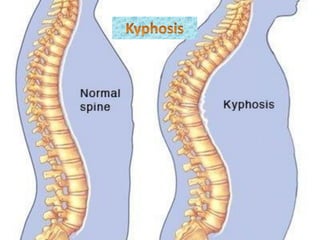
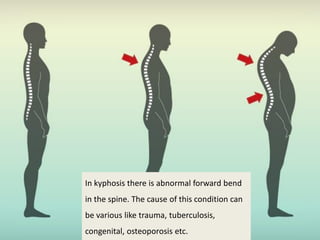
In kyphosis there is abnormal forward bend
in the spine. The cause of this condition can
be various like trauma, tuberculosis,
congenital, osteoporosis etc.
Dr Susmit Naskar
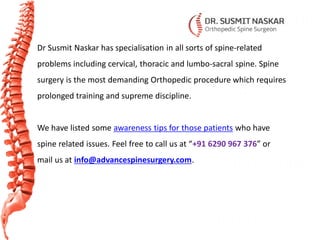
Dr Susmit Naskar has specialisation in all sorts of spine-related
problems including cervical, thoracic and lumbo-sacral spine. Spine
surgery is the most demanding Orthopedic procedure which requires
prolonged training and supreme discipline.
We have listed some awareness tips for those patients who have
spine related issues. Feel free to call us at “+91 6290 967 376” or
mail us at info@advancespinesurgery.com.
YouTube: https://youtu.be/98AjCMigVt0
Phone No: +91 6290 967 376
Email: info@advancespinesurgery.com
Website: https://advancespinesurgery.com/

Spine Problem Awareness & Treatment

  • 1.
  • 2.
    Spine is likethe central pillar of our body. It is divided in 5 basic segments cervical (neck region), thoracic or dorsal (chest region), lumbar (lower back), sacral (pelvic region) and coccyx or tail bone area.
  • 3.
    Among this allsegments, cervical and lumbar are highly mobile and that's why they account for majority of spine related problems. Spine has few basic duties. It transfer upper body parts weight to lower limbs/legs, it protects the spinal cord. It gives flexibility as well as stability to our body. Normally this machine functions very well to accomplish its responsibilities. But sometimes this machine malfunctions due to various reasons.
  • 6.
    • Young tomiddle aged active individuals (3rd to 4th decade) are affected with acute/sub acute back pain with severe single/both leg pain. • Regular exercises such as walking, standing become nearly impossible or very painful.
  • 7.
    • Lying downmay decrease the pain. • The pain might be associated with tingling, numbness or weakness, in extreme cases with bowel bladder involvement. • Usually starts after unaccustomed heavy activity. • MRI proves the diagnosis.
  • 8.
    Depends upon theseverity of slip disc – • Mild cases require bed rest for 6 weeks with pain control. • Moderate cases can be treated with transforaminal block injections.
  • 9.
    • Severe casesare best treated with micro surgery/ MIS discectomy. • Red flags Pain increases during conservative treatment. • Deterioration/ appearance of nerve weakness/ bowel bladder dysfunction. • Require urgent surgery.
  • 11.
    Spine tends todegenerate as a normal ageing process. Study shows 85% population experiences at least one episode of back pain in their lifetime. It is also one of the most common reasons of sickness absenteeism only after common cold.
  • 12.
    The discs locatedbetween the vertebras as well as the facet joints degenerates with age. Combined with this sedentary lifestyle, wrong posture of sitting leads to poor core muscle strength.
  • 13.
    All this combinedtogether gives rise to back pain, decreased endurance, easy fatigability, Difficulty in getting up from ground level, bending forward, sitting/standing/walking for long duration, long travel.
  • 14.
    Treatment involves mostlysymptomatic exercise to build the core muscle strength. Weight reduction, yoga, core strengthening exercise, and short term anti inflammatory drugs SOS.
  • 16.
    Usually affected populationis a sportsman or an active individual with unaccustomed sporting activity or heavy work.
  • 17.
    Spinal muscle stiffnessand tenderness, extreme difficulty in turning in bed/ sitting/ standing. Usually short duration of symptoms.
  • 18.
  • 20.
    Nerve adjusts ina narrow space till it's no longer could manage. When Spondylosis advances the disc bulges out in neural canal, ligaments and facet joints hypertrophies all this gradually reduces space for spinal nerve.
  • 21.
    After critical narrowingwalking becomes slow and difficult due to nerve pain in the legs. Patient complains heaviness, pain, tingling, and numbness in their legs while walking.
  • 22.
    If left untreatedthis condition may give rise to permanent nerve damage or partial paralysis of nerves.
  • 23.
    Most of theseadvanced problems are best treated with surgical management decompression alone or decompression with segmental fusion based on case merit. The safety and efficacy of the surgery matches international standards at our centre
  • 25.
    Young individuals sometimeshave congenital / traumatic defect of vertebral posterior arch pars interarticularis, which gives rise to early onset back pain with activity.
  • 26.
    This condition isusually treatable with rest, brace and medicines. Refractory cases might require surgical intervention.
  • 28.
    Definition - Wherethe superior block move forward in respect of inferior block. Degenerative type (more common) – occurs in older age group. Often associated with lumbar canal stenosis. Early cases should be given adequate conservative trial and failed/ advanced cases best treated with surgery.
  • 29.
    Lytic Spondylolisthesis –Symptoms back pain +/- leg pain. It happens in patients with neglected/ treatment failure cases of lytic Spondylolysis, usually younger age group of patients. This condition is best treated with spinal fusion +/- decompression.
  • 31.
    Any high velocityfall or road traffic accident can give rise to spine fractures. It's a dangerous condition as there may be injury to spinal cord which gives rise to partial and complete permanent paralysis.
  • 32.
    For this graveinjury early evaluation and management of this condition is warranted.
  • 33.
    Spine Fracture isserious form of injury. It requires immediate medical attention. The fracture can be at cervical, lumbar, or dorsal/thoracic region.
  • 34.
    Depending on theseverity of the fracture the prognosis of spine fracture can be good to poor. As spinal column surrounds the spinal cord and gives protection to it, a spinal column fracture can jeopardize all these functions and give rise to partial to complete paralysis.
  • 35.
    Early medical andsurgical intervention may improve the paralyzed state depending upon case merit.
  • 37.
    This is completelydifferent from acute spine fracture. Osteoporosis is a disease where the bones in whole body become weak due to deficiency of calcium. The bones may become so weak that it gets fractured by own body weight or trivial trauma.
  • 38.
    Usually it affectsvery old (65- 80years) age group. Patients complain of moderate to severe pain in the back when getting up or turning in bed, with time it aggravates. Treatment is bed rest with anti- osteoporotic therapy.
  • 39.
    Refractory cases canbe benefited from day-care procedures called vertebroplasty/ kyphoplasty where bone cement is put to fill the bony gap.
  • 41.
    • It canbe pyogenic or tubercular, fungal (very rare). • If any back or neck pain which is continuous, increases with bed rest, associated with fever, weight loss and not relieved by pain killer , the chance of infection is there. • It is proven by MRI.
  • 42.
    Treatment is antibiotictherapy with or without surgery depending upon case merit.
  • 44.
    • Primary benign •Primary malignant • Metastatic deposit in spine with Primary elsewhere (Lung, breast, thyroid, prostate, liver etc) In case of spinal tumour treatment decision is decided by tumour board. It can be-
  • 46.
    • Referred painfrom hip and knee. • Sacro iliac joint injury/pathology • Spondylo arthropathies • Vitamin D deficiency • Retroperitoneal pathology • Pleurisies
  • 48.
    Our neck orcervical spine is the most mobile segment of our spine. All common pathologies explained in back pain section can also affect cervical spine.
  • 51.
    Disc problems canstart from over-use, an accident, or just the wear and tear of daily life. Degenerative changes in the discs may result in damage that can cause pain.
  • 52.
    When a discdegenerates it can have tears or cracks that lose water, which cause it to become thinner and provide less padding to absorb movement.
  • 53.
    Degenerated discs canalso bulge (herniate) and pinch the spinal cord or nerves, which causes loss of feeling, weakness, pain, or tingling down the arms and hands.
  • 55.
    The pain radiates alongthe shoulder blade or unilateral upper limb.
  • 57.
    The spinal cordis getting compressed due to narrow canal. Usually early symptoms are imbalance, difficulty in walking, hand coordination, muscle weakness, urinary hesitancy, incomplete voiding, and urgency.
  • 58.
    This is arelatively serious condition needs urgent treatment by your spine surgeon.
  • 59.
    • Congenital/ traumaticabnormality of cranio-vertebral junction • Surgical methods for C-V junction abnormality • Occipitocervical fusion • C1- C2 fusion • Odontoid screw fixation
  • 61.
    It is definedas sideways curve of more than 10 degree in spine. Most common cause is adolescent idiopathic scoliosis (AIS). Females are most commonly affected (age group -5- 15 years).
  • 64.
    In kyphosis thereis abnormal forward bend in the spine. The cause of this condition can be various like trauma, tuberculosis, congenital, osteoporosis etc.
  • 65.
  • 66.
    Dr Susmit Naskarhas specialisation in all sorts of spine-related problems including cervical, thoracic and lumbo-sacral spine. Spine surgery is the most demanding Orthopedic procedure which requires prolonged training and supreme discipline. We have listed some awareness tips for those patients who have spine related issues. Feel free to call us at “+91 6290 967 376” or mail us at info@advancespinesurgery.com.
  • 67.
    YouTube: https://youtu.be/98AjCMigVt0 Phone No:+91 6290 967 376 Email: info@advancespinesurgery.com Website: https://advancespinesurgery.com/