A Prion Disease
Submitted By:
Gunjit Setia
Submitted to:
Dr. Zeeshan Najm
What is kuru?
Kuru is very rare disease. Kuru is found among
people from New Guinea who practiced a form of
cannibalism in which they ate the brains of dead
people as part of a funeral ritual.
History of Kuru
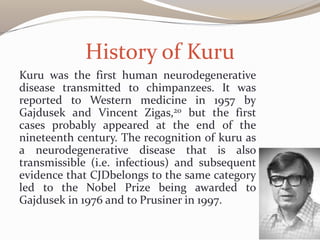
Kuru was the first human neurodegenerative
disease transmitted to chimpanzees. It was
reported to Western medicine in 1957 by
Gajdusek and Vincent Zigas,20 but the first
cases probably appeared at the end of the
nineteenth century. The recognition of kuru as
a neurodegenerative disease that is also
transmissible (i.e. infectious) and subsequent
evidence that CJDbelongs to the same category
led to the Nobel Prize being awarded to
Gajdusek in 1976 and to Prusiner in 1997.
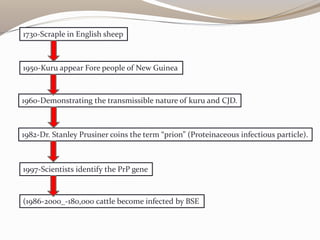
1730-Scraple in English sheep
1950-Kuru appear Fore people of New Guinea
1960-Demonstrating the transmissible nature of kuru and CJD.
1982-Dr. Stanley Prusiner coins the term “prion” (Proteinaceous infectious particle).
1997-Scientists identify the PrP gene
(1986-2000_-180,000 cattle become infected by BSE
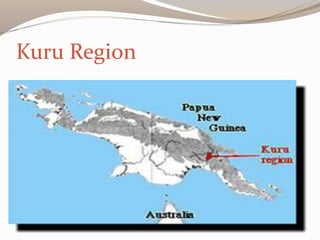
Kuru Region
Causes of Kuru
 It is caused by an infectious protein (prion) found in
contaminated human brain tissue.
 This practice stopped in 1960, but cases of kuru were
reported for many years afterward because the disease has
a long incubation period. The incubation period is the time
it takes for symptoms to appear after being exposed to the
agent that causes disease.
 Kuru causes brain and nervous system changes similar
to Creutzfeldt-Jakob disease . Similar diseases appear in
cows as bovine spongiform encephalopathy (BSE), also
called mad cow disease.
 The main risk factor for kuru is eating human brain tissue,
which can contain the infectious particles.
Symptoms
 Arm and leg pain
 Coordination problems that become severe
 Difficulty walking
 Headache
 Swallowing difficulty
 Tremors and muscle jerks
 Difficulty swallowing and being unable to feed oneself can
lead to malnutrition or starvation.
 The average incubation period is 10 to 13 years, but
incubation period of 50 years or even longer have also been
reported.

Kuru2.pptx

  • 1.
    A Prion Disease SubmittedBy: Gunjit Setia Submitted to: Dr. Zeeshan Najm
  • 2.
    What is kuru? Kuruis very rare disease. Kuru is found among people from New Guinea who practiced a form of cannibalism in which they ate the brains of dead people as part of a funeral ritual.
  • 3.
    History of Kuru Kuruwas the first human neurodegenerative disease transmitted to chimpanzees. It was reported to Western medicine in 1957 by Gajdusek and Vincent Zigas,20 but the first cases probably appeared at the end of the nineteenth century. The recognition of kuru as a neurodegenerative disease that is also transmissible (i.e. infectious) and subsequent evidence that CJDbelongs to the same category led to the Nobel Prize being awarded to Gajdusek in 1976 and to Prusiner in 1997.
  • 4.
    1730-Scraple in Englishsheep 1950-Kuru appear Fore people of New Guinea 1960-Demonstrating the transmissible nature of kuru and CJD. 1982-Dr. Stanley Prusiner coins the term “prion” (Proteinaceous infectious particle). 1997-Scientists identify the PrP gene (1986-2000_-180,000 cattle become infected by BSE
  • 5.
  • 6.
    Causes of Kuru It is caused by an infectious protein (prion) found in contaminated human brain tissue.  This practice stopped in 1960, but cases of kuru were reported for many years afterward because the disease has a long incubation period. The incubation period is the time it takes for symptoms to appear after being exposed to the agent that causes disease.  Kuru causes brain and nervous system changes similar to Creutzfeldt-Jakob disease . Similar diseases appear in cows as bovine spongiform encephalopathy (BSE), also called mad cow disease.  The main risk factor for kuru is eating human brain tissue, which can contain the infectious particles.
  • 7.
    Symptoms  Arm andleg pain  Coordination problems that become severe  Difficulty walking  Headache  Swallowing difficulty  Tremors and muscle jerks  Difficulty swallowing and being unable to feed oneself can lead to malnutrition or starvation.  The average incubation period is 10 to 13 years, but incubation period of 50 years or even longer have also been reported.