PRION DISEASES
INTRODUCTION
 word prion is derived into the word infection and protein.
 Prion diseases or transmissible spongiform encephalopathies (TSEs) are a family
of rare progressive neurodegenerative disorders (loss of structure or function of
neurons, including death of neurons)
 it affect both humans and animals.
History
 Stanley Prusiner discovered prion in
1982.
 Proteinaceous infective particles
 Glycosy specific protein of 30-KD
 Does not produce any inflammatory or
immune reaction in the host.
 Resistance to ultraviolet, standard
disinfectant.
PRION DISEASES
IN HUMAN
 CREUTZFELDT-JAKOB
DISEASE (CjD)
 KURU
 Variant CJD
 Fatal familial insomnia
 Gerstman-Straussler
Scheinker syndrome(GSS)
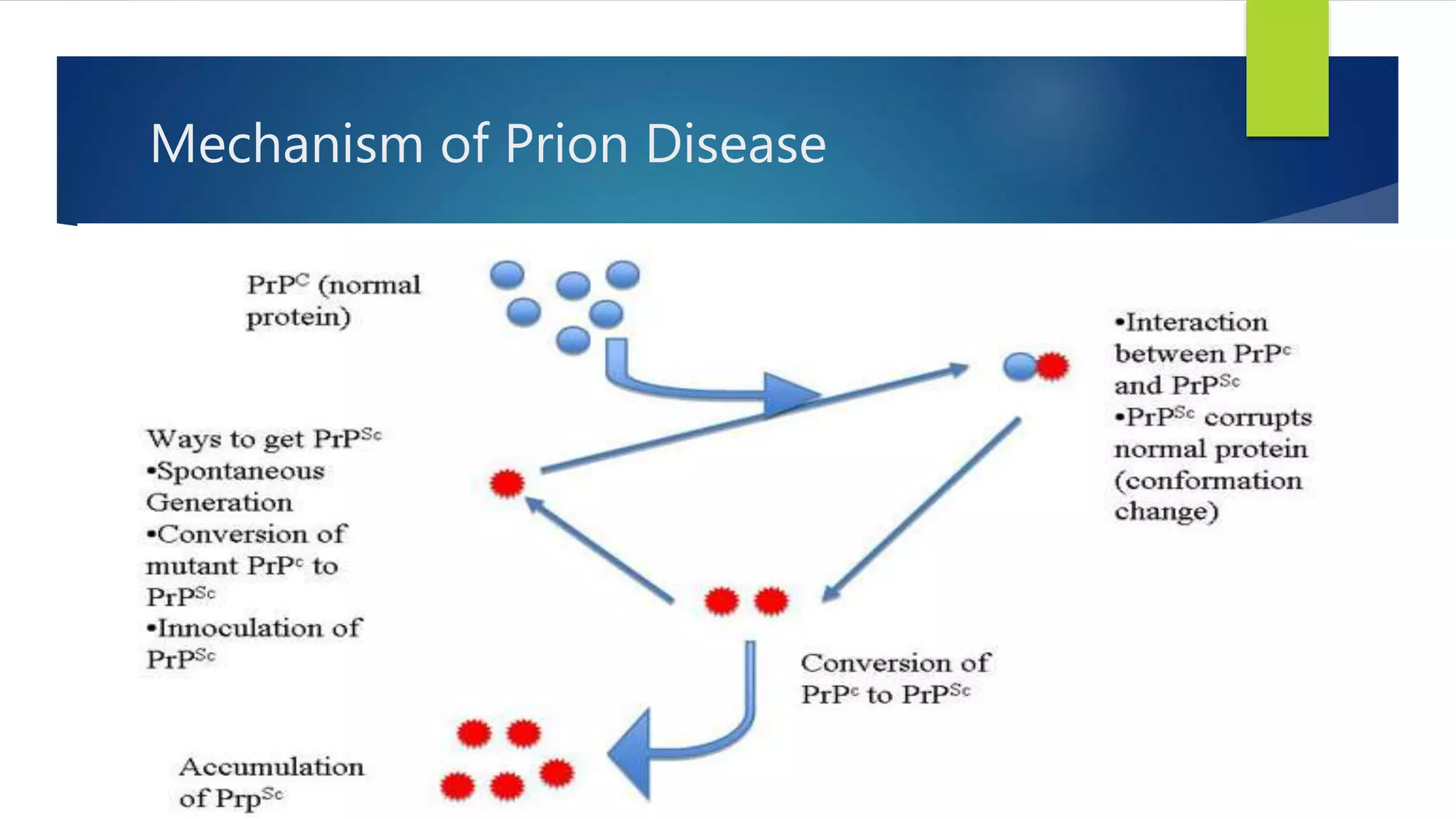
Mechanism of Prion Disease
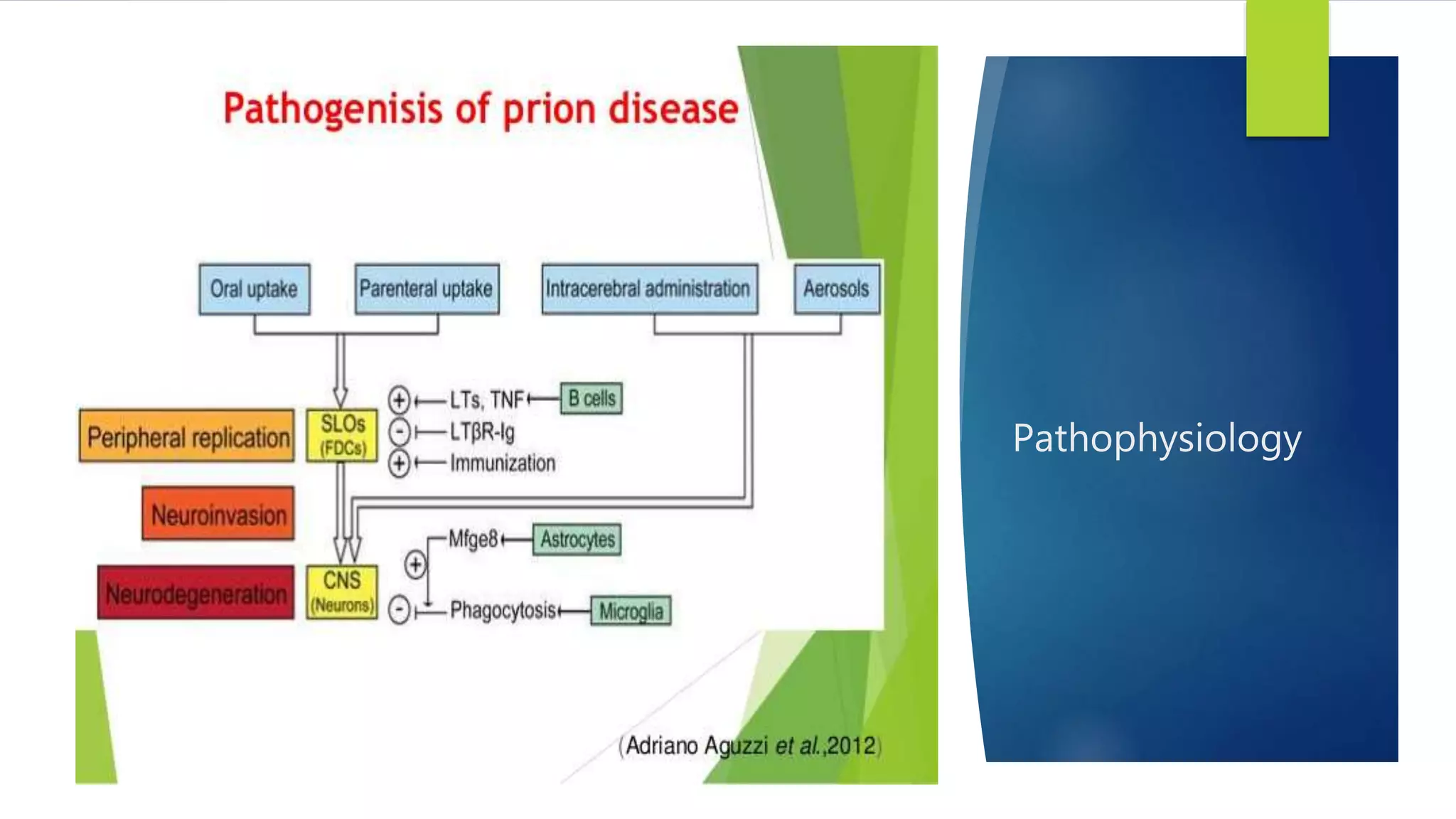
Pathophysiology
 A unifying feature of all the prionoses is neuropathy
 These illnesses affect the gray matter of the central nervous system (CNS),
 producing neuronal loss, Gliosis, characteristic spongiform change
 10% of patients with CJD, amyloid is present in the cerebellum or in the cerebral
hemispheres.
 All cases of GSS are associated with multicentric cerebellar plaques.
Pathophysiology
Classification of Prion Disease
 Prion diseases can be classified into 3 categories:
 1) Sporadic (85% to 90%)
 2) Genetic (10% to 15%)
 3) Acquired (<1%)
Sporadic Creutzfeldt-Jakob disease (sCJD
 Idiopathic (etiology is unknown but it is believed to be a spontaneous disease).
 Typically presents with cognitive complaints, lack of co-ordination or other motor
problems, behavioral/personality changes, and/or abnormalities in vision
Genetic prion diseases
Familial CJD
 More than 30 mutations found on the prion protein gene (PRNP) on chromosome 20 and are autosomal
dominant, most with complete penetrance.
 Presentation varies between type of PRNP mutation and sometimes even within a family.
 Course often longer than sCJD, but some mutations may present clinically and pathologically identically to sCJD.
Fatal familial insomnia
 Begins with increasing insomnia and psychiatric symptoms, such as anxiety.
 Progresses with hallucinations, weight loss, dementia, and eventually death.
Genetic prion diseases conti.
Gerstmann-Straussler-Scheinker
 Presentation may vary depending on the type of PRNP mutation disease phenotype and
sometimes even within a family.
 Early presentations of the disease often include behavioural changes, parkinsonian
features, or ataxia.
 Many cases have been misdiagnosed as familial Alzheimer's or Parkinson's disease
Iatrogenic CJD
 Due to medical procedures such as administration of human GH, or to contaminated surgical instruments
during corneal transplant, dura mater graft, and insertion of EEG deep brain electrodes.
 Incubation period can be as short as 1 year but is typically several years and even decades.
Kuru
 Endemic to the Fore tribe of Papua New Guinea, where practices of endocannibalism contributed to its
transmission, and was essentially eliminated with end of endocannibalism, although rare cases may still
occur, as incubation period may be as long as 50 years in some cases.
Variant CJD (vCJD)
 Acquired from consumption of beef contaminated with bovine spongiform encephalopathy (mad
disease), or transfusion of blood or blood products from a patient with pre-symptomatic or latent
 Median age of onset is around 29 years, with most cases occurring in patients in their 20s or 30s,
younger than most with sCJD.
 Initially presents with psychiatric and behavioural changes, with later symptoms of dysaesthesia,
dementia, ataxia and/or chorea, myoclonus, or dystonia.
Clinical Features of Prion Disease
Relatively late in life
Rapidly progressive demetia
Behavioural disturbanses
Ataxia
Death within one year
No effect of antimicrobials
Diagnosis
 Creutzfeldt—Jakob disease (CJD)
1. In CSF: Search for the presence of 14-3-3 and tau, two proteins
2. In DNA extracted from blood, brain, or other tissues: Search for the presence of mutation in the prion protein
gene and determine the polymorphism at codon 129.
3. In unfixed brain tissue obtained either at biopsy or autopsy: Search for the presence and establish the type of
the abnormal, protease-resistant form of the prion protein
4. On fixed brain tissue: microscopic examination by histological and immunohistochemical demonstration of the
prion protein, as well as pattern of tissue distribution
5. EEG During the course of sporadic CJD, most patients develop a characteristic finding on EEG with periodic or
pseudoperiodic paroxysms of sharp waves or spikes on a slow background
Clinical Syndrome Neoplasm Autoantibodies
Limbic encephalitis
Small cell lung carcinoma
Testicular/breast, thymoma
Anti-Hu, antiCV2,PCA-2, ANNA-3
Anti-Ma2 Anti-VGKC, anti-CV2
Cerebellar degeneration Breast, ovary, lung, others
Anti-Yo, anti-Ma, anti-Ri
Anti-Hu, anti-CV2
Opsoclonus myoclonus
Breast, ovarian, small cell carcinoma of lung
Neuroblastoma
Anti-Ri, anti-Yo, Anti-Hu,
Anti-amphiphysin Anti-Hu
Treatment
 No effective treatment has been identified for human prion diseases which are universally fatal;
supportive treatment mainstay
 Flupirtine maleate is a centrally acting, non-opioid analgesic that has displayed cytoprotective
activity in vitro in neurons treated with a prion protein fragment: better MMSe but survival not
enhanced
 Chlorpromazine and quinacrine: inhibit PrPsc formation in vitro: studies needed
 Potential targets will include the steps in the conversion of PrPc to PrPsc

Prion diseases

  • 1.
  • 2.
    INTRODUCTION  word prionis derived into the word infection and protein.  Prion diseases or transmissible spongiform encephalopathies (TSEs) are a family of rare progressive neurodegenerative disorders (loss of structure or function of neurons, including death of neurons)  it affect both humans and animals.
  • 3.
    History  Stanley Prusinerdiscovered prion in 1982.  Proteinaceous infective particles  Glycosy specific protein of 30-KD  Does not produce any inflammatory or immune reaction in the host.  Resistance to ultraviolet, standard disinfectant.
  • 4.
    PRION DISEASES IN HUMAN CREUTZFELDT-JAKOB DISEASE (CjD)  KURU  Variant CJD  Fatal familial insomnia  Gerstman-Straussler Scheinker syndrome(GSS)
  • 5.
  • 6.
    Pathophysiology  A unifyingfeature of all the prionoses is neuropathy  These illnesses affect the gray matter of the central nervous system (CNS),  producing neuronal loss, Gliosis, characteristic spongiform change  10% of patients with CJD, amyloid is present in the cerebellum or in the cerebral hemispheres.  All cases of GSS are associated with multicentric cerebellar plaques.
  • 7.
  • 8.
    Classification of PrionDisease  Prion diseases can be classified into 3 categories:  1) Sporadic (85% to 90%)  2) Genetic (10% to 15%)  3) Acquired (<1%)
  • 9.
    Sporadic Creutzfeldt-Jakob disease(sCJD  Idiopathic (etiology is unknown but it is believed to be a spontaneous disease).  Typically presents with cognitive complaints, lack of co-ordination or other motor problems, behavioral/personality changes, and/or abnormalities in vision
  • 10.
    Genetic prion diseases FamilialCJD  More than 30 mutations found on the prion protein gene (PRNP) on chromosome 20 and are autosomal dominant, most with complete penetrance.  Presentation varies between type of PRNP mutation and sometimes even within a family.  Course often longer than sCJD, but some mutations may present clinically and pathologically identically to sCJD. Fatal familial insomnia  Begins with increasing insomnia and psychiatric symptoms, such as anxiety.  Progresses with hallucinations, weight loss, dementia, and eventually death.
  • 11.
    Genetic prion diseasesconti. Gerstmann-Straussler-Scheinker  Presentation may vary depending on the type of PRNP mutation disease phenotype and sometimes even within a family.  Early presentations of the disease often include behavioural changes, parkinsonian features, or ataxia.  Many cases have been misdiagnosed as familial Alzheimer's or Parkinson's disease
  • 12.
    Iatrogenic CJD  Dueto medical procedures such as administration of human GH, or to contaminated surgical instruments during corneal transplant, dura mater graft, and insertion of EEG deep brain electrodes.  Incubation period can be as short as 1 year but is typically several years and even decades. Kuru  Endemic to the Fore tribe of Papua New Guinea, where practices of endocannibalism contributed to its transmission, and was essentially eliminated with end of endocannibalism, although rare cases may still occur, as incubation period may be as long as 50 years in some cases.
  • 13.
    Variant CJD (vCJD) Acquired from consumption of beef contaminated with bovine spongiform encephalopathy (mad disease), or transfusion of blood or blood products from a patient with pre-symptomatic or latent  Median age of onset is around 29 years, with most cases occurring in patients in their 20s or 30s, younger than most with sCJD.  Initially presents with psychiatric and behavioural changes, with later symptoms of dysaesthesia, dementia, ataxia and/or chorea, myoclonus, or dystonia.
  • 14.
    Clinical Features ofPrion Disease Relatively late in life Rapidly progressive demetia Behavioural disturbanses Ataxia Death within one year No effect of antimicrobials
  • 15.
    Diagnosis  Creutzfeldt—Jakob disease(CJD) 1. In CSF: Search for the presence of 14-3-3 and tau, two proteins 2. In DNA extracted from blood, brain, or other tissues: Search for the presence of mutation in the prion protein gene and determine the polymorphism at codon 129. 3. In unfixed brain tissue obtained either at biopsy or autopsy: Search for the presence and establish the type of the abnormal, protease-resistant form of the prion protein 4. On fixed brain tissue: microscopic examination by histological and immunohistochemical demonstration of the prion protein, as well as pattern of tissue distribution 5. EEG During the course of sporadic CJD, most patients develop a characteristic finding on EEG with periodic or pseudoperiodic paroxysms of sharp waves or spikes on a slow background
  • 16.
    Clinical Syndrome NeoplasmAutoantibodies Limbic encephalitis Small cell lung carcinoma Testicular/breast, thymoma Anti-Hu, antiCV2,PCA-2, ANNA-3 Anti-Ma2 Anti-VGKC, anti-CV2 Cerebellar degeneration Breast, ovary, lung, others Anti-Yo, anti-Ma, anti-Ri Anti-Hu, anti-CV2 Opsoclonus myoclonus Breast, ovarian, small cell carcinoma of lung Neuroblastoma Anti-Ri, anti-Yo, Anti-Hu, Anti-amphiphysin Anti-Hu
  • 17.
    Treatment  No effectivetreatment has been identified for human prion diseases which are universally fatal; supportive treatment mainstay  Flupirtine maleate is a centrally acting, non-opioid analgesic that has displayed cytoprotective activity in vitro in neurons treated with a prion protein fragment: better MMSe but survival not enhanced  Chlorpromazine and quinacrine: inhibit PrPsc formation in vitro: studies needed  Potential targets will include the steps in the conversion of PrPc to PrPsc