The Kotlin
Programming Language


             Svetlana Isakova
What? Who? Why?
   A modern language
       Statically typed
       Object-oriented
       General-purpose

   Compiler
       JVM byte code
       JavaScript (not GWT)
                               2
What? Who? Why?
   A modern language
       Statically typed
       Object-oriented
       General-purpose

   Developed by JetBrains
       Open source
       Intended for industrial use
                                      3
Dynamic vs static typing

   Dynamically typed languages
       Easier to learn
       Easier to write small programs

   Statically typed languages
       Programs run much faster
       More powerful IDE
       Easier to support huge projects

                                          4
Scala as a candidate

   Goal
       statically typed
       JVM-targeted
       concise language

   Scala
       too complicated
       too implicit
       too difficult to create a good IDE
                                             5
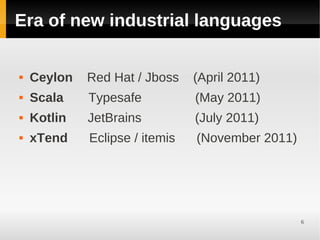
Era of new industrial languages

   Ceylon   Red Hat / Jboss    (April 2011)
   Scala    Typesafe           (May 2011)
   Kotlin   JetBrains          (July 2011)
   xTend    Eclipse / itemis   (November 2011)


                                                  6
Kotlin “Hello, world”
 fun main(args : Array<String>) {
     Greeter().greet()
 }


 class Greeter(name : String = "world") {
     val greeting = "Hello, $name!"
     fun greet() {
         println(greeting)
     }
 }                                          7
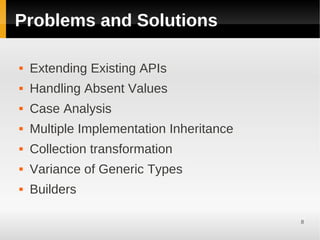
Problems and Solutions

   Extending Existing APIs
   Handling Absent Values
   Case Analysis
   Multiple Implementation Inheritance
   Collection transformation
   Variance of Generic Types
   Builders

                                          8
Extending Existing APIs


                          9
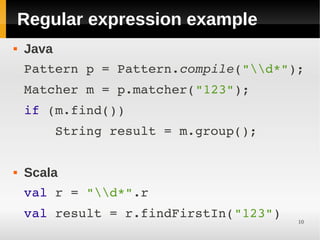
Regular expression example
   Java
    Pattern p = Pattern.compile("d*");
    Matcher m = p.matcher("123");
    if (m.find())
        String result = m.group();


   Scala
    val r = "d*".r
    val result = r.findFirstIn("123")
                                        10
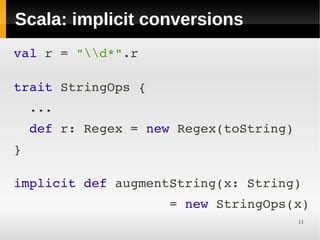
Scala: implicit conversions
val r = "d*".r
 

trait StringOps { 
  ...
  def r: Regex = new Regex(toString)
}
 

implicit def augmentString(x: String)
                    = new StringOps(x)
                                       11
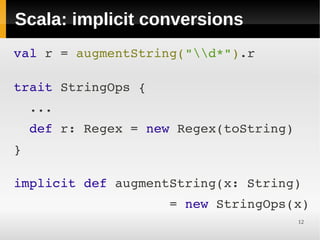
Scala: implicit conversions
val r = augmentString("d*").r
 

trait StringOps { 
  ...
  def r: Regex = new Regex(toString)
}
 

implicit def augmentString(x: String)
                    = new StringOps(x)
                                       12
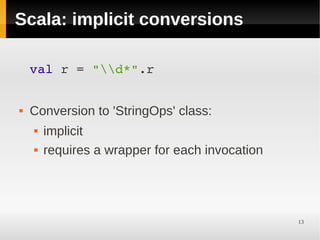
Scala: implicit conversions

    val r = "d*".r


   Conversion to 'StringOps' class:
       implicit
       requires a wrapper for each invocation


                                                 13
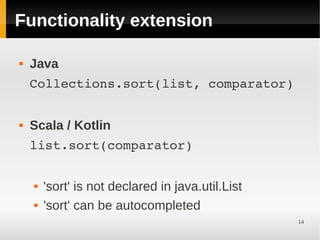
Functionality extension

   Java
    Collections.sort(list, comparator)


   Scala / Kotlin
    list.sort(comparator)


       'sort' is not declared in java.util.List
       'sort' can be autocompleted
                                                   14
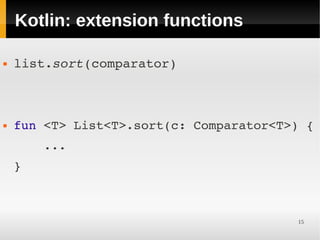
Kotlin: extension functions

   list.sort(comparator)


   fun <T> List<T>.sort(c: Comparator<T>) {
        ...
    }


                                         15
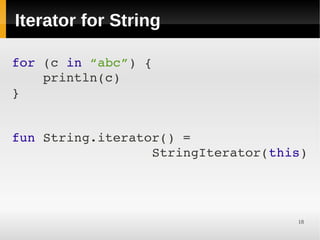
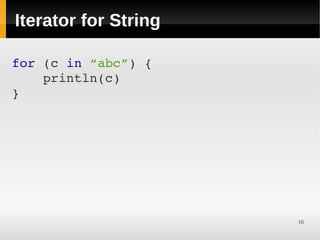
Iterator for String

for (c in “abc”) {
    println(c)
}


                      16
Iterator for String

for (c in “abc”) {
    println(c)
}


class StringIterator(val s: String) :
                         Iterator<Char> {
    private var i = 0
    override fun next() = s[i++]
    override fun hasNext() = i < s.size
}
                                       17
Iterator for String

for (c in “abc”) {
    println(c)
}


fun String.iterator() =
                  StringIterator(this)


                                    18
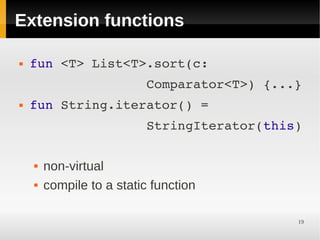
Extension functions

   fun <T> List<T>.sort(c:
                   Comparator<T>) {...}
   fun String.iterator() =
                   StringIterator(this)

       non-virtual
       compile to a static function

                                       19
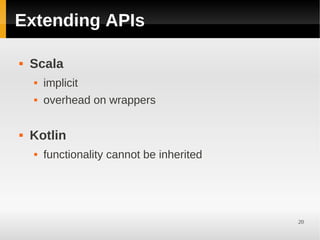
Extending APIs

   Scala
       implicit
       overhead on wrappers

   Kotlin
       functionality cannot be inherited


                                            20
Handling Absent Values


                         21
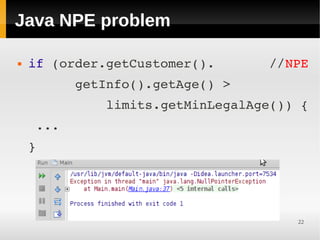
Java NPE problem

   if (order.getCustomer().       //NPE
          getInfo().getAge() >
              limits.getMinLegalAge()) {
     ... 
    }


                                      22
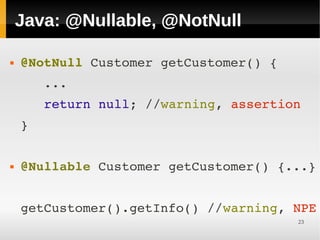
Java: @Nullable, @NotNull

   @NotNull Customer getCustomer() {
       ...
       return null; //warning, assertion
    }


   @Nullable Customer getCustomer() {...}


    getCustomer().getInfo() //warning, NPE
                                        23
Scala: Option type
   def getCustomer() : Option[Customer] 
    {…}
     

   order.getCustomer match {
       case Some(customer) =>
                    Some(customer.getInfo)
       case None => None
    }
     

                                         24
Scala: Option type
   def getCustomer() : Option[Customer] 
    {…}
     

   order.getCustomer match {
       case Some(customer) =>
                    Some(customer.getInfo)
       case None => None
    }
     

   order.getCustomer.map(_.getInfo)     25
Scala: Option type

   def getCustomer() : Option[Customer] {
      ...
      return null //no error
    }


                                        26
Scala: Option type

   def getCustomer() : Option[Customer] 
   order.getCustomer.map(_.getInfo).
                             map(_.getAge)
     

       extra objects, classes are created:
               Some(customer), Some(info), Some(age)
               classes for function literals
               objects for function literals


       inconvenient for debugging                 27
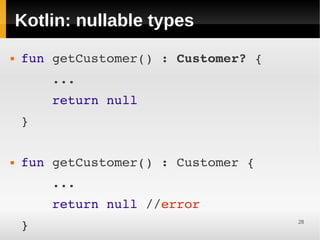
Kotlin: nullable types
   fun getCustomer() : Customer? { 
        ...
        return null
    }


   fun getCustomer() : Customer {
        ...
        return null //error
    }                                  28
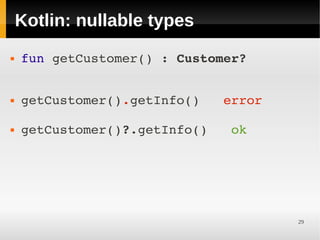
Kotlin: nullable types
   fun getCustomer() : Customer? 


   getCustomer().getInfo()   error


   getCustomer()?.getInfo()   ok


                                      29
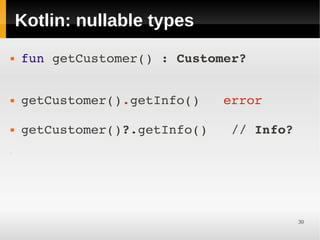
Kotlin: nullable types
   fun getCustomer() : Customer? 


   getCustomer().getInfo()   error


   getCustomer()?.getInfo()   // Info?





                                          30
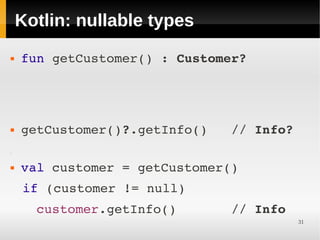
Kotlin: nullable types
   fun getCustomer() : Customer? 


   getCustomer()?.getInfo()   // Info?





   val customer = getCustomer()
    if (customer != null) 


      customer.getInfo()       // Info
                                          31
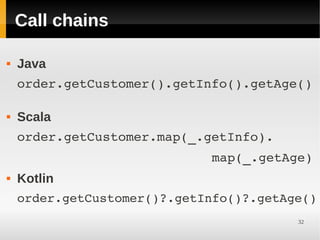
Call chains

   Java
    order.getCustomer().getInfo().getAge()
     

   Scala
    order.getCustomer.map(_.getInfo).
                             map(_.getAge)
   Kotlin
    order.getCustomer()?.getInfo()?.getAge()
                                         32
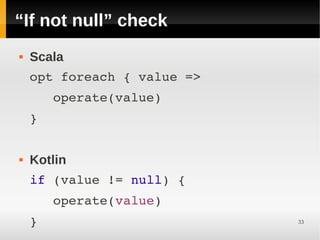
“If not null” check
   Scala
    opt foreach { value =>
       operate(value)
    }


   Kotlin
    if (value != null) {
       operate(value)
    }                        33
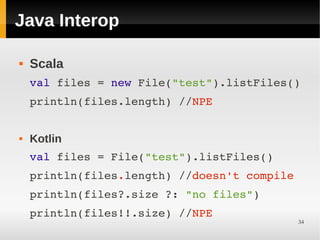
Java Interop

   Scala
    val files = new File("test").listFiles()
    println(files.length) //NPE


   Kotlin
    val files = File("test").listFiles()
    println(files.length) //doesn't compile
    println(files?.size ?: "no files")
    println(files!!.size) //NPE
                                              34
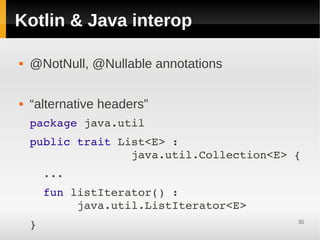
Kotlin & Java interop

   @NotNull, @Nullable annotations

   “alternative headers”
    package java.util
    public trait List<E> :                   
                   java.util.Collection<E> {
      ...
      fun listIterator() :                   
           java.util.ListIterator<E>
    }                                      35
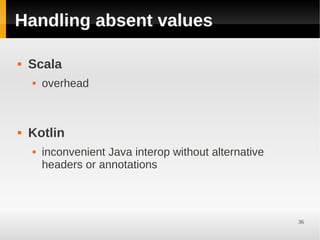
Handling absent values

   Scala
       overhead


   Kotlin
       inconvenient Java interop without alternative
        headers or annotations


                                                        36
Case Analysis


                37
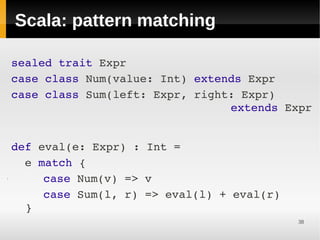
Scala: pattern matching

 
 sealed trait Expr
 
 case class Num(value: Int) extends Expr
 case class Sum(left: Expr, right: Expr)       
                                 extends Expr


    def eval(e: Expr) : Int = 
 
      e match {
●


         case Num(v) => v
         case Sum(l, r) => eval(l) + eval(r)
      }


                                               38
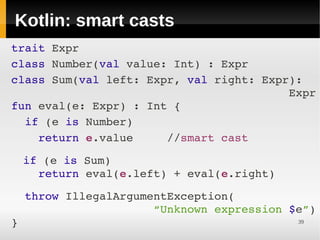
Kotlin: smart casts
 
     trait Expr
 
     class Number(val value: Int) : Expr
     class Sum(val left: Expr, val right: Expr):
                                              Expr
 
     fun eval(e: Expr) : Int {
  
       if (e is Number) 
         return e.value     //smart cast
     
  if (e is Sum) 


    return eval(e.left) + eval(e.right)


       throw IllegalArgumentException(
                          “Unknown expression $e”)
     }                                         39
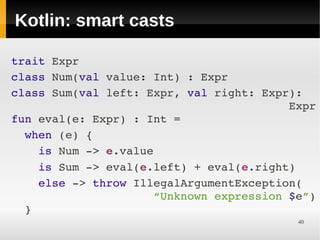
Kotlin: smart casts

 
     trait Expr
 
     class Num(val value: Int) : Expr
     class Sum(val left: Expr, val right: Expr):
                                              Expr
 
     fun eval(e: Expr) : Int =
  
       when (e) {
 
         is Num ­> e.value 
 
         is Sum ­> eval(e.left) + eval(e.right)
         else ­> throw IllegalArgumentException(
                          “Unknown expression $e”)
       }
                                               40
Multiple
Implementation
Inheritance

                 41
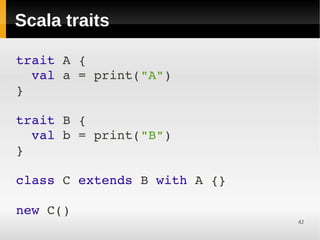
Scala traits

trait A {
  val a = print("A")
}

trait B {
  val b = print("B")
}

class C extends B with A {}

new C() 
                              42
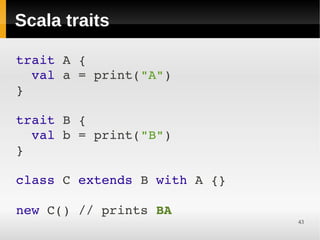
Scala traits

trait A {
  val a = print("A")
}

trait B {
  val b = print("B")
}

class C extends B with A {}

new C() // prints BA
                              43
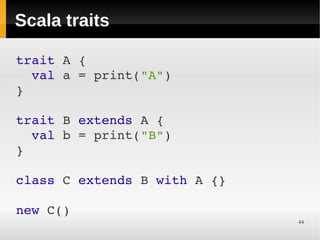
Scala traits

trait A {
  val a = print("A")
}

trait B extends A {
  val b = print("B")
}

class C extends B with A {}

new C() 
                              44
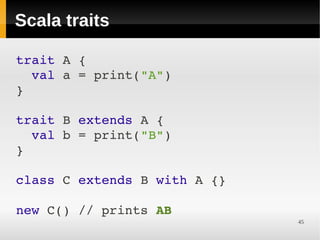
Scala traits

trait A {
  val a = print("A")
}

trait B extends A {
  val b = print("B")
}

class C extends B with A {}

new C() // prints AB
                              45
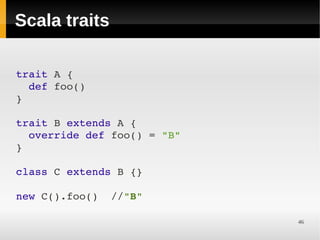
Scala traits

trait A {
  def foo()
}

trait B extends A {
  override def foo() = "B"
}

class C extends B {}

new C().foo()  //"B"

                             46
Scala traits
trait A {
  def foo()
}

trait B extends A {
  override def foo() = "B"
}

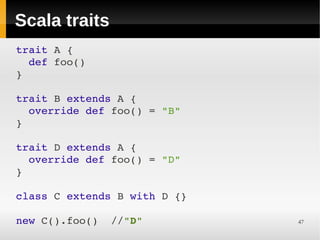
trait D extends A {
  override def foo() = "D"
}

class C extends B with D {}

new C().foo()  //"D"          47
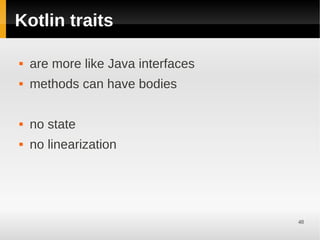
Kotlin traits

   are more like Java interfaces
   methods can have bodies

   no state
   no linearization


                                    48
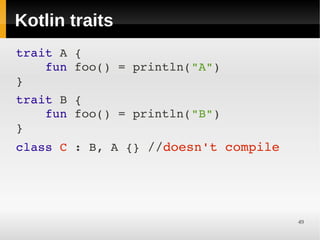
Kotlin traits
trait A {
    fun foo() = println("A")
}
 

trait B {
    fun foo() = println("B")
}


class C : B, A {} //doesn't compile


                                      49
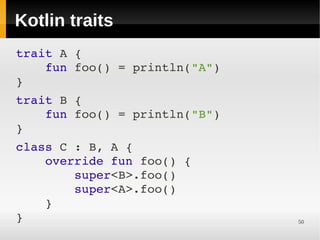
Kotlin traits
trait A {
    fun foo() = println("A")
}
 

trait B {
    fun foo() = println("B")
}
 

class C : B, A {
    override fun foo() {
        super<B>.foo()
        super<A>.foo()
    }
}                              50
Collection
transformation


                 51
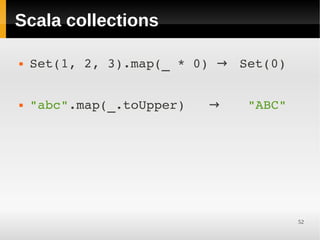
Scala collections

   Set(1, 2, 3).map(_ * 0) →  Set(0)


   "abc".map(_.toUpper)   →    "ABC"


                                        52
Scala collections

   Set(1, 2, 3).map(_ * 0) →  Set(0)


   "abc".map(_.toUpper)   →    "ABC"

   trait TraversableLike[+A, +Repr] {
    def map[B, That](f: A => B)(implicit bf: 
          CanBuildFrom[Repr, B, That]): That 
    }

                                           53
Kotlin approach


   'map', 'filter' always return immutable list


                                               54
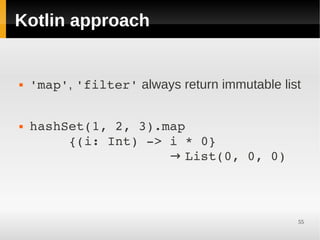
Kotlin approach


   'map', 'filter' always return immutable list


   hashSet(1, 2, 3).map                
         {(i: Int) ­> i * 0}            
                      → List(0, 0, 0)


                                               55
Kotlin approach


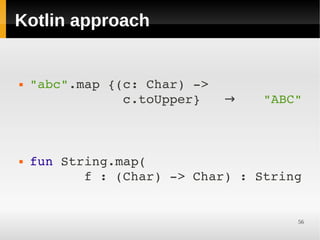
   "abc".map {(c: Char) ­>             
                c.toUpper}   →     "ABC"


   fun String.map(                     
           f : (Char) ­> Char) : String


                                      56
Lazy computations

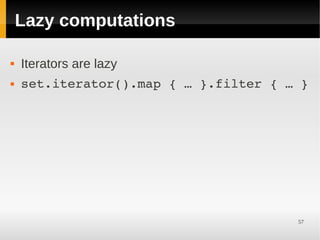
   Iterators are lazy
   set.iterator().map { … }.filter { … }


                                       57
Lazy computations

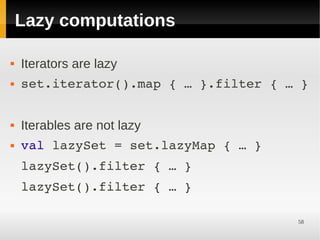
   Iterators are lazy
   set.iterator().map { … }.filter { … }


   Iterables are not lazy
   val lazySet = set.lazyMap { … }
    lazySet().filter { … }
    lazySet().filter { … }

                                       58
Variance
of Generic Types


                   59
Scala. Declaration site variance
   class List[+T] { 
      //only produces T
      def head() : T 
      def tail() : List[T]
    }
   class Comparable[­T] { 
      //only consumes T
      def compare(t1 : T, t2: T)
    }                              60
Kotlin. Declaration site variance
   class List<out T> { 
      //only produces T
      fun head() : T 
      fun tail() : List[T]
    }
   class Comparable<in T> { 
      //only consumes T
      fun compare(t1 : T, t2: T)
    }                               61
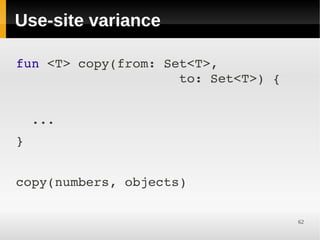
Use-site variance

fun <T> copy(from: Set<T>,           
                     to: Set<T>) {


  ...
}


copy(numbers, objects)

                                    62
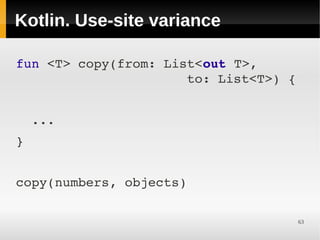
Kotlin. Use-site variance

fun <T> copy(from: List<out T>,      
                      to: List<T>) {


  ...
}


copy(numbers, objects)

                                    63
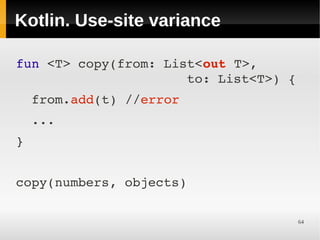
Kotlin. Use-site variance

fun <T> copy(from: List<out T>,      
                      to: List<T>) {
  from.add(t) //error
  ...
}


copy(numbers, objects) 

                                    64
Scala. Use-site variance


def copy[T](from: Set[_ <: T],       
                       to: Set[T]) {
  ...
}


copy(numbers, objects)

                                    65
Scala. Existential types


def copy[T](from:
     Set[X] forSome { type X <: T }, 
                     to: Set[T]) {
  ...
}


copy(numbers, objects)
                                    66
Builders


           67
Builders in Groovy

html {
   head {
      title "XML encoding with Groovy"
   }

   body {
      h1 "XML encoding with Groovy"
      p "this format can be used as an
                alternative markup to XML"
      /* an element with attributes and text content */
      ahref:'http://groovy.codehaus.org'["Groovy"]
   }
}

                                                      68
Builders in Kotlin

html {
   head {
      title { + "XML encoding with Kotlin" }
   }

   body {
      h1 { + "XML encoding with Kotlin" }
      p { + "this format this format is now type­safe" }

      /* an element with attributes and text content */
      a(href = "http://kotlin.jetbrains.org")["Kotlin"]
   }
}

                                                      69
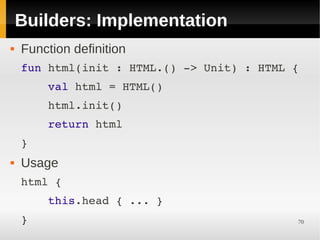
Builders: Implementation
   Function definition
    fun html(init : HTML.() ­> Unit) : HTML {
        val html = HTML()
        html.init()
        return html
    }
   Usage
    html {
        this.head { ... }
    }                                       70
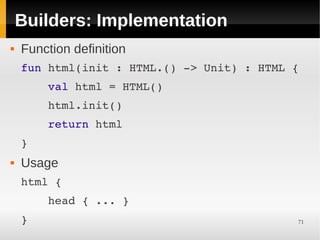
Builders: Implementation
   Function definition
    fun html(init : HTML.() ­> Unit) : HTML {
        val html = HTML()
        html.init()
        return html
    }
   Usage
    html {
        head { ... }
    }                                       71
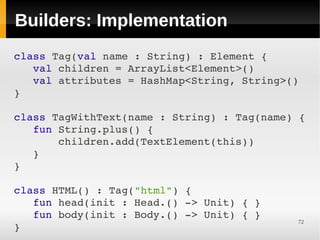
Builders: Implementation
class Tag(val name : String) : Element {
   val children = ArrayList<Element>()
   val attributes = HashMap<String, String>()
}
 
class TagWithText(name : String) : Tag(name) {
   fun String.plus() {
       children.add(TextElement(this))
   }
}
 
class HTML() : Tag("html") {
   fun head(init : Head.() ­> Unit) { }
   fun body(init : Body.() ­> Unit) { }
                                             72
}
Builders in Kotlin

html {
   head {
      title { + "XML encoding with Kotlin" }
   }

   body {
      h1 { + "XML encoding with Kotlin" }
      p { + "this format this format is now type­safe" }

      /* an element with attributes and text content */
      a(href = "http://kotlin.jetbrains.org")["Kotlin"]
   }
}

                                                      73
Resources
   Home page
      http://kotlin.jetbrains.org

   Web Demo
      http://kotlin­demo.jetbrains.com

   Blog
      http://blog.jetbrains.com/kotlin

   Forum
      Kotlin at http://devnet.jetbrains.com   74
Interesting links

   Marius Eriksen “Effective Scala”
      http://twitter.github.com/effectivescala/


   Yang Zhang “True Scala complexity”
      http://yz.mit.edu/wp/true­scala­complexity/


   Joshua Suereth D. “Scala in Depth”
      http://www.amazon.com/Scala­Depth­Joshua­Suereth­
      D/dp/1935182706

                                                          75
Thank you!

Светлана Исакова «Язык Kotlin»