Scala workshop
                   Created by
    Fredrik Vraalsen (fredrik@vraalsen.no)
                       and
  Alf Kristian Støyle (alf.kristian@gmail.com)

                   Adapted
Bert Van Vreckem (bert.vanvreckem@hogent.be)
If I were to pick a language to use
today other than Java, it would be
                Scala.

          James Gosling
Scala, it must be stated, is the current heir
apparent to the Java throne. No other language
   on the JVM seems as capable of being a
   "replacement for Java" as Scala, and the
momentum behind Scala is now unquestionable.

      Charlies Olivier Nutter - JRuby lead
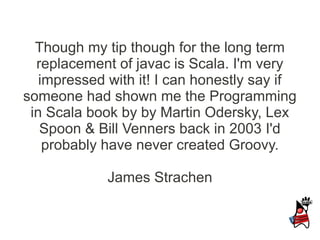
Though my tip though for the long term
  replacement of javac is Scala. I'm very
   impressed with it! I can honestly say if
someone had shown me the Programming
 in Scala book by by Martin Odersky, Lex
   Spoon & Bill Venners back in 2003 I'd
    probably have never created Groovy.

             James Strachen
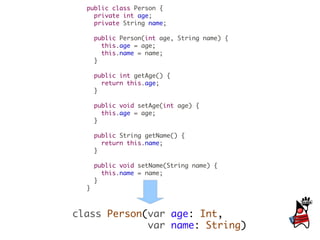
public class Person {
    private int age;
    private String name;

      public Person(int age, String name) {
        this.age = age;
        this.name = name;
      }

      public int getAge() {
        return this.age;
      }

      public void setAge(int age) {
        this.age = age;
      }

      public String getName() {
        return this.name;
      }

      public void setName(String name) {
        this.name = name;
      }
  }


class Person(var age: Int,
             var name: String)
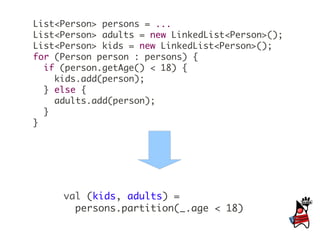
List<Person> persons = ...
List<Person> adults = new LinkedList<Person>();
List<Person> kids = new LinkedList<Person>();
for (Person person : persons) {
  if (person.getAge() < 18) {
    kids.add(person);
  } else {
    adults.add(person);
  }
}


     val (kids, adults) =
       persons.partition(_.age < 18)
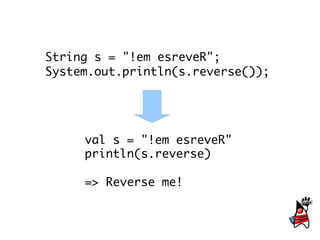
String s = "!em esreveR";
System.out.println(s.reverse());


     val s = "!em esreveR"
     println(s.reverse)

     => Reverse me!
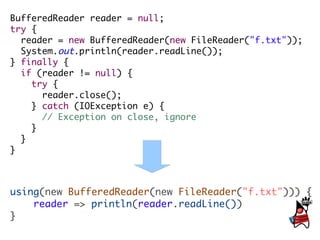
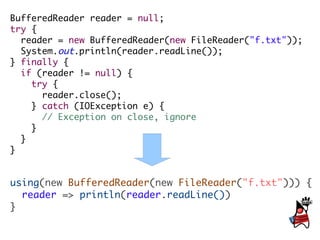
BufferedReader reader = null;
try {
  reader = new BufferedReader(new FileReader("f.txt"));
  System.out.println(reader.readLine());
} finally {
  if (reader != null) {
    try {
      reader.close();
    } catch (IOException e) {
      // Exception on close, ignore
    }
  }
}


using(new BufferedReader(new FileReader("f.txt"))) {
    reader => println(reader.readLine())
}
I will never forget these words: "With great power
  comes great responsibility." This is my gift, my
         curse. Who am I? I'm Spider-man.
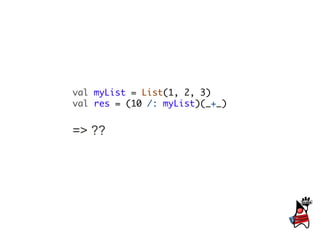
val myList = List(1, 2, 3)
val res = (10 /: myList)(_+_)


=> ??
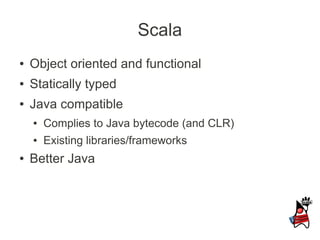
Scala
●   Object oriented and functional
●   Statically typed
●   Java compatible
    ●   Complies to Java bytecode (and CLR)
    ●   Existing libraries/frameworks
●   Better Java
Todays schedule
●   Basic syntax
●   REPL, IDEs and setup
●   First class functions
●   Pattern matching
●   OO and traits
●   Functional programming
●   Higher order functions
Scala basics
;
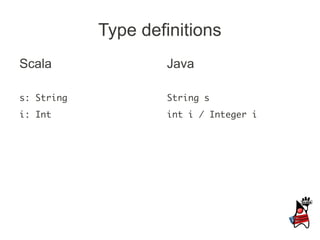
Type definitions
Scala               Java

s: String           String s
i: Int              int i / Integer i
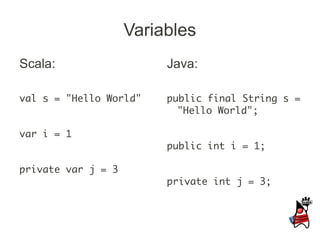
Variables
Scala:                   Java:

val s = "Hello World"    public final String s =
                           "Hello World";

var i = 1
                         public int i = 1;

private var j = 3
                         private int j = 3;
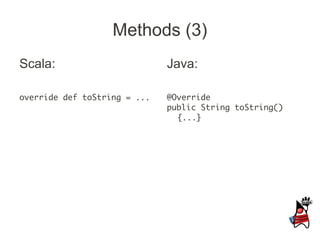
Methods (3)
Scala:                        Java:

override def toString = ...   @Override
                              public String toString()
                                {...}
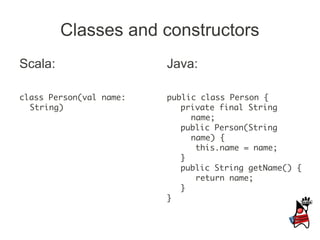
Classes and constructors
Scala:                   Java:

class Person(val name:   public class Person {
  String)                   private final String
                              name;
                            public Person(String
                              name) {
                               this.name = name;
                            }
                            public String getName() {
                               return name;
                            }
                         }
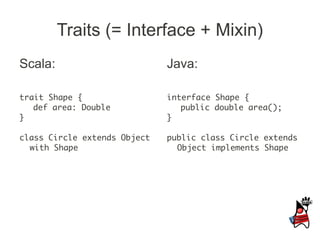
Traits (= Interface + Mixin)
Scala:                        Java:

trait Shape {                 interface Shape {
   def area: Double              public double area();
}                             }

class Circle extends Object   public class Circle extends
  with Shape                    Object implements Shape
No “static” in Scala
Scala:                           Java:

object PersonUtil {              public class PersonUtil {
  val ageLimit = 18                 public static final int
                                      AGE_LIMIT = 18;

    def countPersons(                public static int
      persons: List[Person]) =         countPersons(
      ...                                List<Person> persons)
}                                    {
                                         ...
                                     }
                                 }
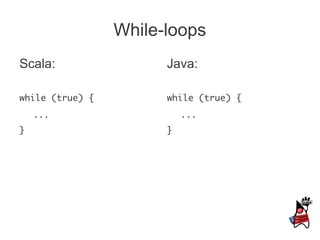
While-loops
Scala:                 Java:

while (true) {         while (true) {
    ...                    ...
}                      }
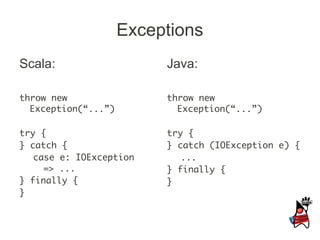
Exceptions
Scala:                    Java:

throw new                 throw new
  Exception(“...”)          Exception(“...”)

try {                     try {
} catch {                 } catch (IOException e) {
   case e: IOException       ...
     => ...               } finally {
} finally {               }
}
Varargs
def foo(values: String*){ }     public void foo(String... values){ }


foo("bar", "baz")               foo("bar", "baz");


val arr = Array("bar", "baz")   String[] arr =
                                  new String[]{"bar", "baz"}
foo(arr: _*)                    foo(arr);
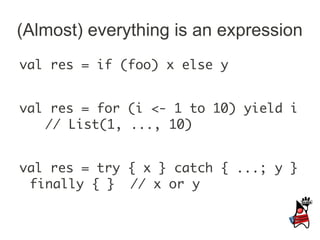
(Almost) everything is an expression
val res = if (foo) x else y


val res = for (i <- 1 to 10) yield i
   // List(1, ..., 10)


val res = try { x } catch { ...; y }
 finally { } // x or y
Generics
Scala:             Java:

List[String]       List<String>
Tuples
Scala:                   Java:

val tuple: Tuple2[Int,   Pair<Integer, String> tuple
  String] =                = new Pair<Integer,
                           String>(1, “apple”)
  (1, “apple”)


val quadruple =
                         ... yeah right... ;-)
  (2, “orange”, 0.5d,
    false)
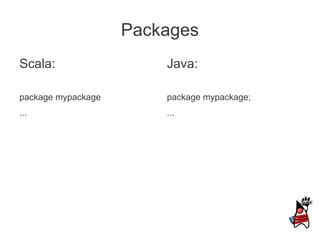
Packages
Scala:                  Java:

package mypackage       package mypackage;
...                     ...
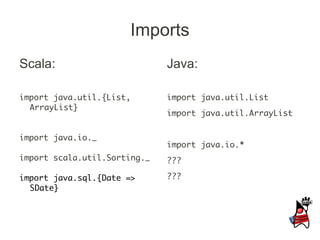
Imports
Scala:                        Java:

import java.util.{List,       import java.util.List
  ArrayList}
                              import java.util.ArrayList


import java.io._
                              import java.io.*
import scala.util.Sorting._   ???

import java.sql.{Date =>      ???
  SDate}
REPL, IDE and setup
REPL: Read-Eval-Print Loop
●   Command line shell for on-the-fly execution of
    Scala statements
●
    $ cd ${SCALA_HOME}/bin
    $ scala
    ●   Windows, e.g. C:Program FilesScala 2.8.0
    ●   Linux, e.g. /opt/scala or /usr/local/scala
IDE
●   They are all !#$&§? compared to what you are
    used to with Java support
    ●   Netbeans (very good) but bad in other areas...
    ●   IntelliJ IDEA (pretty good) but slow compilation,
        bonus community edition is free (with Scala)
    ●   Eclipse (not all that good) but very fast when
        working
Netbeans 6.9.x installation
●   Download plugins
    http://sf.net/projects/erlybird/files/nb-scala/6.9v1.1.0/
●   In NetBeans "Tools" | "Plugins",
     ●   click on "Downloaded" tab title,
     ●   click on "Add Plugins..." button,
     ●   choose the directory where the Scala plugins are unzipped,
     ●   select all listed *.nbm files, following the instructions.
●   Set ${SCALA_HOME} or %SCALA_HOME% environment variable
●   Edit ${NETBEANS_HOME}/etc/netbeans.conf
     ●   Add "-J-Dscala.home=/opt/scala" to
         netbeans_default_options
●   More info: http://wiki.netbeans.org/Scala
Tasks (20 min)
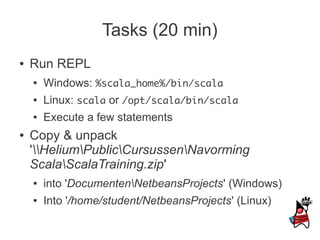
●   Run REPL
    ●   Windows: %scala_home%/bin/scala
    ●   Linux: scala or /opt/scala/bin/scala
    ●   Execute a few statements
●   Copy & unpack
    'HeliumPublicCursussenNavorming
    ScalaScalaTraining.zip'
    ●   into 'DocumentenNetbeansProjects' (Windows)
    ●   Into '/home/student/NetbeansProjects' (Linux)
Tasks (20 min)
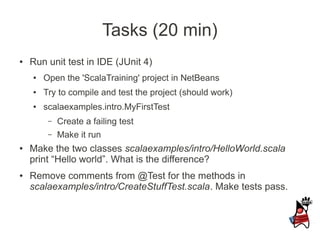
●   Run unit test in IDE (JUnit 4)
    ●   Open the 'ScalaTraining' project in NetBeans
    ●   Try to compile and test the project (should work)
    ●   scalaexamples.intro.MyFirstTest
         –   Create a failing test
         –   Make it run
●   Make the two classes scalaexamples/intro/HelloWorld.scala
    print “Hello world”. What is the difference?
●   Remove comments from @Test for the methods in
    scalaexamples/intro/CreateStuffTest.scala. Make tests pass.
First class functions

val even = Function[Int, Boolean] {
    def apply(i: Int) = i % 2 == 0
}

val even: (Int => Boolean) = (i: Int) => i % 2 == 0
val even = (i: Int) => i % 2 == 0

even.apply(42)       // true
even(13)             // false
First class functions
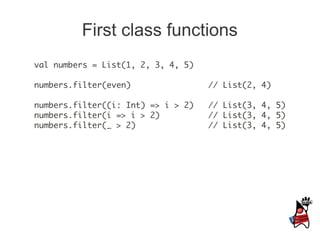
val numbers = List(1, 2, 3, 4, 5)

numbers.filter(even)                // List(2, 4)

numbers.filter((i: Int) => i > 2)   // List(3, 4, 5)
numbers.filter(i => i > 2)          // List(3, 4, 5)
numbers.filter(_ > 2)               // List(3, 4, 5)
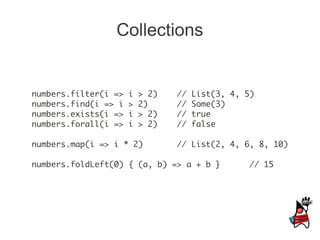
Collections


numbers.filter(i =>   i   > 2)   //   List(3, 4, 5)
numbers.find(i => i   >   2)     //   Some(3)
numbers.exists(i =>   i   > 2)   //   true
numbers.forall(i =>   i   > 2)   //   false

numbers.map(i => i * 2)          // List(2, 4, 6, 8, 10)

numbers.foldLeft(0) { (a, b) => a + b }          // 15
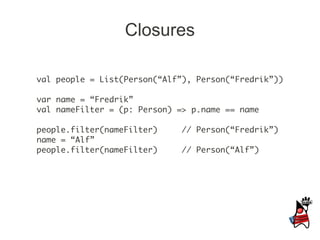
Closures

val people = List(Person(“Alf”), Person(“Fredrik”))

var name = “Fredrik”
val nameFilter = (p: Person) => p.name == name

people.filter(nameFilter)     // Person(“Fredrik”)
name = “Alf”
people.filter(nameFilter)     // Person(“Alf”)
Tasks (30 min)
●   Open the 'first-class-functions' project
●   Tests in package
    scalaexamples.firstclassfunctions
●   Add @Test to one and one method
●   Follow instructions in the code
●   Make the tests pass
Pattern matching
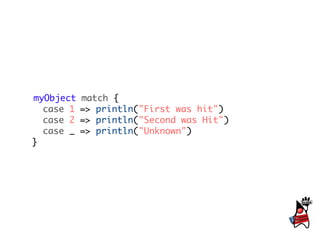
myObject   match {
  case 1   => println("First was hit")
  case 2   => println("Second was Hit")
  case _   => println("Unknown")
}
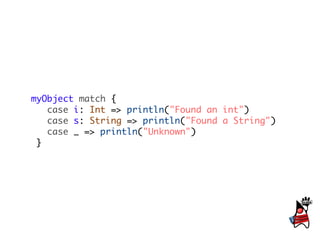
myObject match {
   case i: Int => println("Found an int")
   case s: String => println("Found a String")
   case _ => println("Unknown")
 }
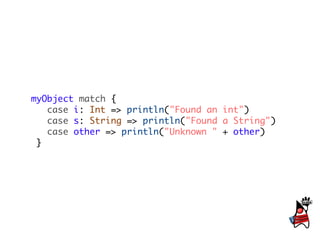
myObject match {
   case i: Int => println("Found an int")
   case s: String => println("Found a String")
   case other => println("Unknown " + other)
 }
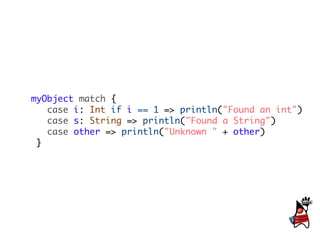
myObject match {
   case i: Int if i == 1 => println("Found an int")
   case s: String => println("Found a String")
   case other => println("Unknown " + other)
 }
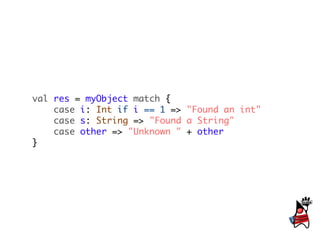
val res = myObject match {
    case i: Int if i == 1 => "Found an int"
    case s: String => "Found a String"
    case other => "Unknown " + other
}
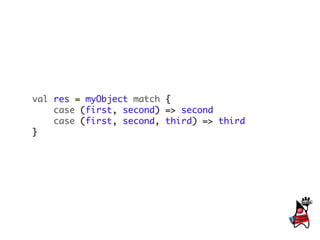
val res = myObject match {
    case (first, second) => second
    case (first, second, third) => third
}
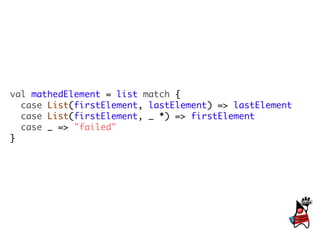
val mathedElement = list match {
  case List(firstElement, lastElement) => lastElement
  case List(firstElement, _ *) => firstElement
  case _ => "failed"
}
def length(list: List[_]): Int =
  list match {
    case Nil => 0
    case head :: tail => 1 + length(tail)
  }
public static Integer getSecondOr0(List<Integer> list) {
    if (list != null && list.size() >= 2) {
        return list.get(1);
    } else {
        return 0;
    }
}


def second_or_0(list:List[Int]) = list match {
  case List(_, x, _*) => x
  case _ => 0
}
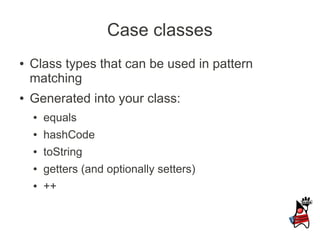
Case classes
●   Class types that can be used in pattern
    matching
●   Generated into your class:
    ●   equals
    ●   hashCode
    ●   toString
    ●   getters (and optionally setters)
    ●   ++
abstract class Person(name: String)
case class Man(name: String) extends Person(name)
case class Woman(name: String, children: List[Person])
  extends Person(name)
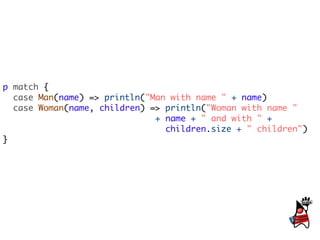
p match {
  case Man(name) => println("Man with name " + name)
  case Woman(name, children) => println("Woman with name "
                              + name + " and with " +
                                children.size + " children")
}
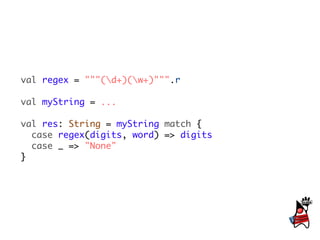
val regex = """(d+)(w+)""".r

val myString = ...

val res: String = myString match {
  case regex(digits, word) => digits
  case _ => "None"
}
val regex = """(d+)(w+)""".r

val myString = ...

val res: Option[String] = myString match {
  case regex(digit, word) => Some(digit)
  case _ => None
}
The Option type, never again
           NullPointerException
●   Option has two possible values
    ●   Some(value)
    ●   None


    val someOption: Option[String] = Some("value")
    val noOption:   Option[String] = None
def getValue(s: Any): Option[String]


getValue(object) match {
  case Some(value) => println(value)
  case None => println("Nothing")
}


val result = getValue(object).getOrElse("Nothing")
Tasks (30 min)
●   Open the 'pattern-matching' project
●   Tests in package
    scalaexamples.patternmatching
●   Add @Test to one and one method
●   Follow instructions in the code
●   Make the tests pass
Object orientation and
        traits
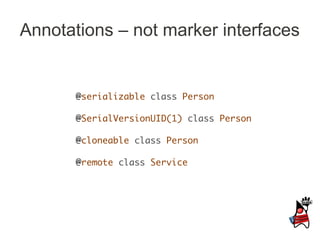
Annotations – not marker interfaces


       @serializable class Person

       @SerialVersionUID(1) class Person

       @cloneable class Person

       @remote class Service
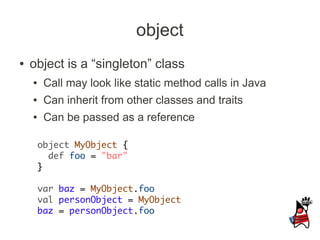
object
●   object is a “singleton” class
    ●    Call may look like static method calls in Java
    ●    Can inherit from other classes and traits
    ●    Can be passed as a reference

        object MyObject {
          def foo = "bar"
        }

        var baz = MyObject.foo
        val personObject = MyObject
        baz = personObject.foo
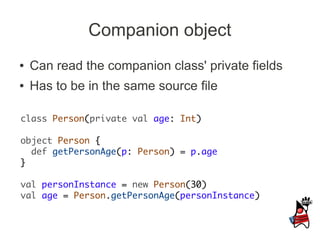
Companion object
●   Can read the companion class' private fields
●   Has to be in the same source file

class Person(private val age: Int)

object Person {
  def getPersonAge(p: Person) = p.age
}

val personInstance = new Person(30)
val age = Person.getPersonAge(personInstance)
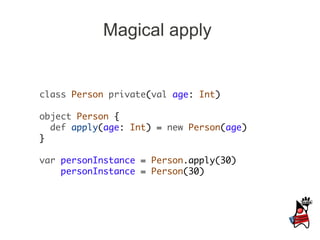
Magical apply


class Person private(val age: Int)

object Person {
  def apply(age: Int) = new Person(age)
}

var personInstance = Person.apply(30)
    personInstance = Person(30)
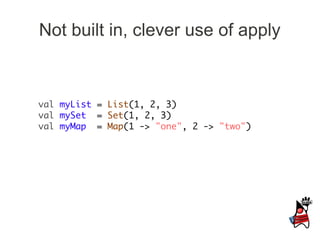
Not built in, clever use of apply


val myList = List(1, 2, 3)
val mySet = Set(1, 2, 3)
val myMap = Map(1 -> "one", 2 -> "two")
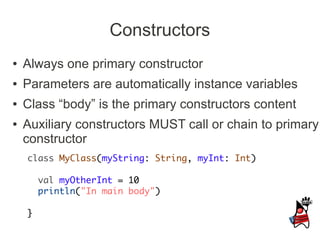
Constructors
●   Always one primary constructor
●   Parameters are automatically instance variables
●   Class “body” is the primary constructors content
●   Auxiliary constructors MUST call or chain to primary
    constructor
    class MyClass(myString: String, myInt: Int)

        val myOtherInt = 10
        println("In main body")

    }
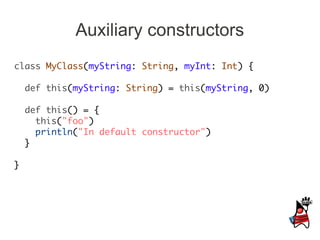
Auxiliary constructors
class MyClass(myString: String, myInt: Int) {

    def this(myString: String) = this(myString, 0)

    def this() = {
      this("foo")
      println("In default constructor")
    }

}
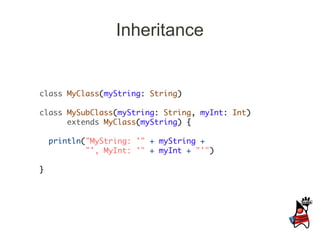
Inheritance


class MyClass(myString: String)

class MySubClass(myString: String, myInt: Int)
      extends MyClass(myString) {

    println("MyString: '" + myString +
            "', MyInt: '" + myInt + "'")

}
Inheritance
●   Single class inheritance
●   Multiple trait mixins
Syntax


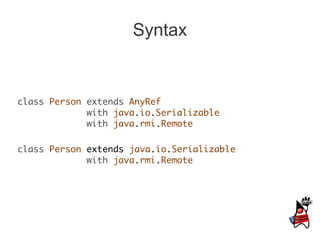
class Person extends AnyRef
             with java.io.Serializable
             with java.rmi.Remote

class Person extends java.io.Serializable
             with java.rmi.Remote
Traits
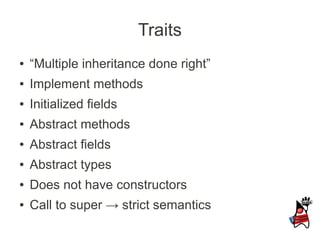
●   “Multiple inheritance done right”
●   Implement methods
●   Initialized fields
●   Abstract methods
●   Abstract fields
●   Abstract types
●   Does not have constructors
●   Call to super → strict semantics
scala.Ordered trait

trait Ordered[A] {
  def compare(that: A): Int

    def   <    (that:   A):   Boolean   =   (this   compare   that)   <    0
    def   >    (that:   A):   Boolean   =   (this   compare   that)   >    0
    def   <=   (that:   A):   Boolean   =   (this   compare   that)   <=   0
    def   >=   (that:   A):   Boolean   =   (this   compare   that)   >=   0
}
The Ordered trait

class Person(private val age: Int)
      extends Ordered[Person] {

    def compare(other: Person) =
      this.age - other.age
}


val person1 = new Person(21)
val person2 = new Person(31)
person1 < person2 // true
person1 <= person2 // true
person1 >= person2 // false
“Dynamic mixins”


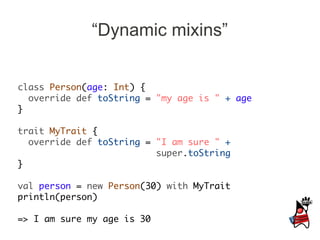
class Person(age: Int) {
  override def toString = "my age is " + age
}

trait MyTrait {
  override def toString = "I am sure " +
                          super.toString
}

val person = new Person(30) with MyTrait
println(person)

=> I am sure my age is 30
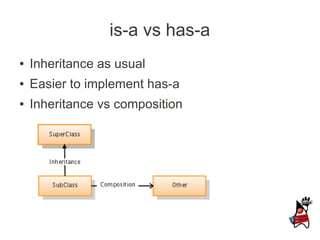
is-a vs has-a
●   Inheritance as usual
●   Easier to implement has-a
●   Inheritance vs composition
Tasks (30 min)
●   Open 'oo-traits' project
●   Tests under scalaexamples
    ●   companionobject
    ●   inheritance
    ●   traits
●   Add @Test to one and one method
●   Follow instructions in code
●   Make tests pass
Functional programming
“Functional programming”
●   First class functions
●   Pattern matching
●   Higher order functions
Functional programming
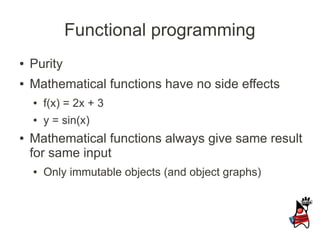
●   Purity
●   Mathematical functions have no side effects
    ●   f(x) = 2x + 3
    ●   y = sin(x)
●   Mathematical functions always give same result
    for same input
    ●   Only immutable objects (and object graphs)
In practice
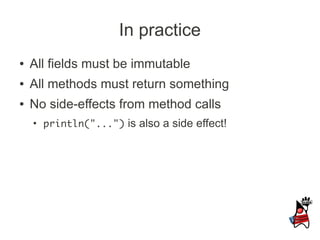
●   All fields must be immutable
●   All methods must return something
●   No side-effects from method calls
    ●
        println("...") is also a side effect!
List
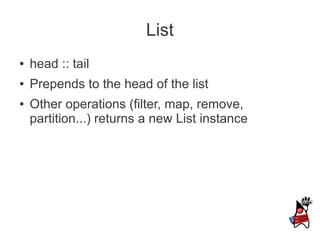
●   head :: tail
●   Prepends to the head of the list
●   Other operations (filter, map, remove,
    partition...) returns a new List instance
scala.collection.immutable
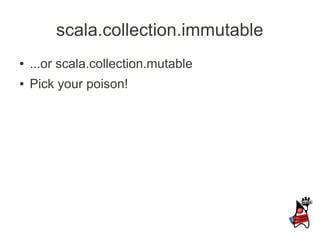
●   ...or scala.collection.mutable
●   Pick your poison!
Scala 2.8
●   Case classes get copy methods
●   Constructors and methods get
    ●   named parameters
        def resize(width: Int, height: Int) = { ... }
        resize(height = 42, width = 120)
    ●   default parameters
        def f(elems: List[Int], x: Int = 0,
              cond: Boolean = true)
        f(List(1))
        f(Nil, cond = false)
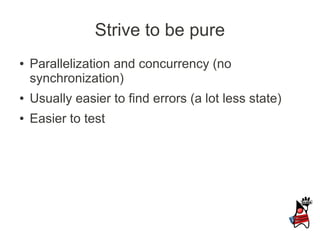
Strive to be pure
●   Parallelization and concurrency (no
    synchronization)
●   Usually easier to find errors (a lot less state)
●   Easier to test
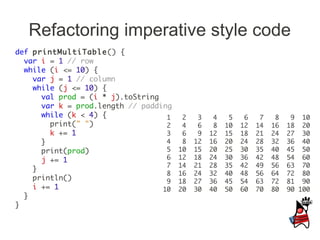
Refactoring imperative style code
def printMultiTable () {
  var i = 1 // row
  while (i <= 10) {
    var j = 1 // column
    while (j <= 10) {
      val prod = (i * j).toString
      var k = prod.length // padding
      while (k < 4) {              1    2    3    4    5    6    7    8    9 10
        print(" ")                 2    4    6    8   10   12   14   16   18 20
        k += 1                     3    6    9   12   15   18   21   24   27 30
      }                            4    8   12   16   20   24   28   32   36 40
      print(prod)                  5   10   15   20   25   30   35   40   45 50
      j += 1                       6   12   18   24   30   36   42   48   54 60
                                   7   14   21   28   35   42   49   56   63 70
    }
                                   8   16   24   32   40   48   56   64   72 80
    println()                      9   18   27   36   45   54   63   72   81 90
    i += 1                        10   20   30   40   50   60   70   80   90 100
  }
}
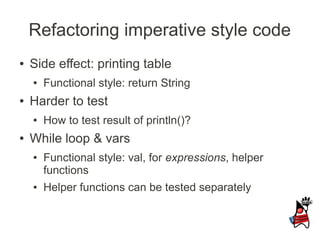
Refactoring imperative style code
●   Side effect: printing table
    ●   Functional style: return String
●   Harder to test
    ●   How to test result of println()?
●   While loop & vars
    ●   Functional style: val, for expressions, helper
        functions
    ●   Helper functions can be tested separately
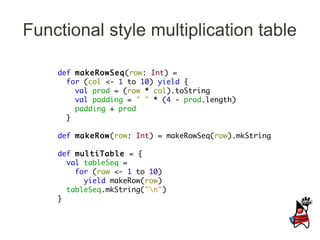
Functional style multiplication table

    def makeRowSeq(row: Int) =
      for (col <- 1 to 10) yield {
        val prod = (row * col).toString
        val padding = " " * (4 - prod.length)
        padding + prod
      }

    def makeRow(row: Int) = makeRowSeq(row).mkString

    def multiTable = {
      val tableSeq =
        for (row <- 1 to 10)
          yield makeRow(row)
      tableSeq.mkString("n")
    }
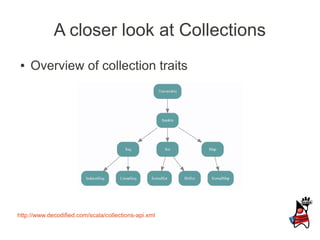
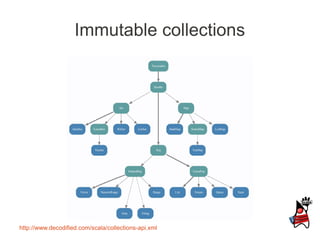
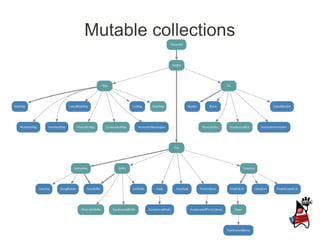
A closer look at Collections
 ●   Overview of collection traits


http://www.decodified.com/scala/collections-api.xml
Traversable
●    One abstract method:
     def foreach[U](f: Elem => U)
●    50+ concrete methods
      ●   Addition, mapping, conversion, copying, size info,
          element retrieval, sub-collection retrieval,
          subdivision, element tests, folds, string operations,
          view


    http://www.scala-lang.org/api/
    http://www.scala-lang.org/docu/files/collections-api/
Iterable
●   Abstract method iterator
●   Default implementation of foreach:
    def foreach[U](f:Elem => U): Unit = {
      val it = iterator
      while (it.hasNext) f(it.next())
    }
    ●   Subclasses may override
●   Some concrete methods
    ●   Subcollections, "zippers", comparison
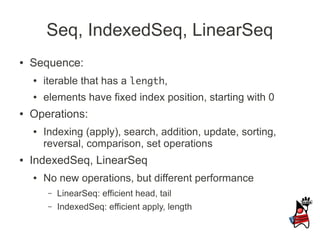
Seq, IndexedSeq, LinearSeq
●   Sequence:
    ●   iterable that has a length,
    ●   elements have fixed index position, starting with 0
●   Operations:
    ●   Indexing (apply), search, addition, update, sorting,
        reversal, comparison, set operations
●   IndexedSeq, LinearSeq
    ●   No new operations, but different performance
         –   LinearSeq: efficient head, tail
         –   IndexedSeq: efficient apply, length
Sets, SortedSet
●   Set = iterable that contain no duplicates
    ●   Operations for tests, addition, removal, set
        operations
●   SortedSet
    ●   Iterator/foreach visit elements in given ordering
    ●   Default implementation: binary tree
Maps
●   Map = collection of pairs of keys and values
    e.g. Map("x" -> 24, "y" -> 25, "z" -> 26)
    ●   Operations for lookup, addition/update, removal,
        subcollections, transformations
Immutable collections


http://www.decodified.com/scala/collections-api.xml
Mutable collections
Higher order functions
●   Functions which take functions as parameters
    and/or return functions
Higher order functions
Short summary of first class functions:
val even: (Int => Boolean) = (i: Int) => i % 2 == 0


Same type definition:
def test(numbers: List[Int], f: Int => Boolean) = ...


Call:
test(List(1, 2, 3), (i: Int) => i % 2 == 0)
Higher order functions

def test(numbers: List[Int],
         f: Int => Boolean) =
  numbers.map(tall => f(tall))


// List[Boolean]
Higher order functions
Functions with several parameters must list them
in parenthesis:


def test(l: List[String],
         f: (Int, String) => Boolean)
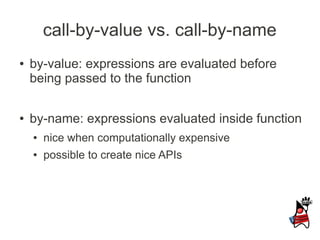
call-by-value vs. call-by-name
●   by-value: expressions are evaluated before
    being passed to the function

●   by-name: expressions evaluated inside function
    ●   nice when computationally expensive
    ●   possible to create nice APIs
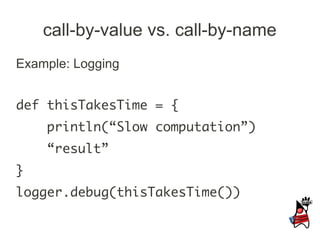
call-by-value vs. call-by-name
Example: Logging


def thisTakesTime = {
    println(“Slow computation”)
    “result”
}
logger.debug(thisTakesTime())
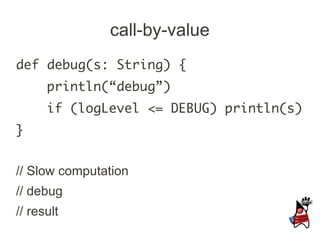
call-by-value
def debug(s: String) {
      println(“debug”)
      if (logLevel <= DEBUG) println(s)
}


// Slow computation
// debug
// result
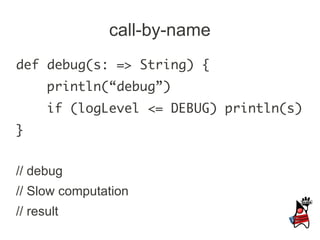
call-by-name
def debug(s: => String) {
      println(“debug”)
      if (logLevel <= DEBUG) println(s)
}


// debug
// Slow computation
// result
BufferedReader reader = null;
try {
  reader = new BufferedReader(new FileReader("f.txt"));
  System.out.println(reader.readLine());
} finally {
  if (reader != null) {
    try {
      reader.close();
    } catch (IOException e) {
      // Exception on close, ignore
    }
  }
}


using(new BufferedReader(new FileReader("f.txt"))) {
  reader => println(reader.readLine())
}
def using[T <: { def close() }, A]
         (closeable: T)
         (f: T => A) = {
  try {
    f(closeable)
  } finally {
    if (closeable != null) {
      try {
        closeable.close()
      }
      catch {
        case e: Exception =>
          // Do something clever!?
      }
    }
  }
}
Tasks (30 min)
●   Open 'higher-order-functions' project
●   Tests in scalaexamples.higherorderfunctions
●   Add @Test to one and one method
●   Implement missing functions in PersonFilter
    and so on.
●   Follow instructions in code
●   Make tests pass
Where to go next?
Advanced topics
●   Type inference
●   Implicit conversions
●   Extractors
●   Annotations
●   XML
●   Parallel programming with Actors
●   Domain Specific Languages (DSLs)
●   GUI programming with Scala Swing
Exercises
●   Solutions to exercises:
    http://github.com/javaBin/scala-training-code/zipball/solutions
●   99 Scala Problems:
    http://aperiodic.net/phil/scala/s-99/
Bert's Scala bookmarks:
http://www.delicious.com/bertvv/scala
A lot of blogs


http://www.planetscala.com/
Mailing lists

        scala@listes.epfl.ch
  scala-announce@listes.epfl.ch
     scala-user@listes.epfl.ch
    scala-debate@listes.epfl.ch
     scala-tools@listes.epfl.ch
   scala-internals@listes.epfl.ch

http://www.scala-lang.org/node/199
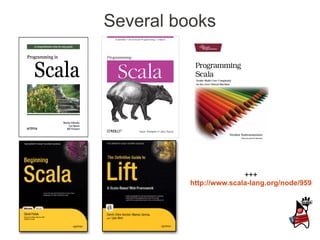
Several books


                         +++
          http://www.scala-lang.org/node/959
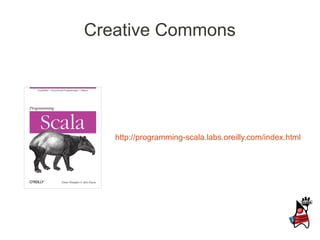
Creative Commons


   http://programming-scala.labs.oreilly.com/index.html
http://www.scala-lang.org/
Creative Commons
         Attribution 3.0 Unported

                     Scala Training Code
       http://github.com/javaBin/scala-training-code
  git clone git://github.com/javaBin/scala-training-code


                     Scala Training Slides
       http://github.com/javaBin/scala-training-slides
git clone git://github.com/javaBin/scala-training-slides.git

Workshop Scala

  • 1.
    Scala workshop Created by Fredrik Vraalsen (fredrik@vraalsen.no) and Alf Kristian Støyle (alf.kristian@gmail.com) Adapted Bert Van Vreckem (bert.vanvreckem@hogent.be)
  • 2.
    If I wereto pick a language to use today other than Java, it would be Scala. James Gosling
  • 3.
    Scala, it mustbe stated, is the current heir apparent to the Java throne. No other language on the JVM seems as capable of being a "replacement for Java" as Scala, and the momentum behind Scala is now unquestionable. Charlies Olivier Nutter - JRuby lead
  • 4.
    Though my tipthough for the long term replacement of javac is Scala. I'm very impressed with it! I can honestly say if someone had shown me the Programming in Scala book by by Martin Odersky, Lex Spoon & Bill Venners back in 2003 I'd probably have never created Groovy. James Strachen
  • 5.
    public class Person{ private int age; private String name; public Person(int age, String name) { this.age = age; this.name = name; } public int getAge() { return this.age; } public void setAge(int age) { this.age = age; } public String getName() { return this.name; } public void setName(String name) { this.name = name; } } class Person(var age: Int, var name: String)
  • 6.
    List<Person> persons =... List<Person> adults = new LinkedList<Person>(); List<Person> kids = new LinkedList<Person>(); for (Person person : persons) { if (person.getAge() < 18) { kids.add(person); } else { adults.add(person); } } val (kids, adults) = persons.partition(_.age < 18)
  • 7.
    String s ="!em esreveR"; System.out.println(s.reverse()); val s = "!em esreveR" println(s.reverse) => Reverse me!
  • 8.
    BufferedReader reader =null; try { reader = new BufferedReader(new FileReader("f.txt")); System.out.println(reader.readLine()); } finally { if (reader != null) { try { reader.close(); } catch (IOException e) { // Exception on close, ignore } } } using(new BufferedReader(new FileReader("f.txt"))) { reader => println(reader.readLine()) }
  • 9.
    I will neverforget these words: "With great power comes great responsibility." This is my gift, my curse. Who am I? I'm Spider-man.
  • 10.
    val myList =List(1, 2, 3) val res = (10 /: myList)(_+_) => ??
  • 11.
    Scala ● Object oriented and functional ● Statically typed ● Java compatible ● Complies to Java bytecode (and CLR) ● Existing libraries/frameworks ● Better Java
  • 12.
    Todays schedule ● Basic syntax ● REPL, IDEs and setup ● First class functions ● Pattern matching ● OO and traits ● Functional programming ● Higher order functions
  • 13.
  • 14.
  • 15.
    Type definitions Scala Java s: String String s i: Int int i / Integer i
  • 16.
    Variables Scala: Java: val s = "Hello World" public final String s = "Hello World"; var i = 1 public int i = 1; private var j = 3 private int j = 3;
  • 17.
    Methods (3) Scala: Java: override def toString = ... @Override public String toString() {...}
  • 18.
    Classes and constructors Scala: Java: class Person(val name: public class Person { String) private final String name; public Person(String name) { this.name = name; } public String getName() { return name; } }
  • 19.
    Traits (= Interface+ Mixin) Scala: Java: trait Shape { interface Shape { def area: Double public double area(); } } class Circle extends Object public class Circle extends with Shape Object implements Shape
  • 20.
    No “static” inScala Scala: Java: object PersonUtil { public class PersonUtil { val ageLimit = 18 public static final int AGE_LIMIT = 18; def countPersons( public static int persons: List[Person]) = countPersons( ... List<Person> persons) } { ... } }
  • 21.
    While-loops Scala: Java: while (true) { while (true) { ... ... } }
  • 22.
    Exceptions Scala: Java: throw new throw new Exception(“...”) Exception(“...”) try { try { } catch { } catch (IOException e) { case e: IOException ... => ... } finally { } finally { } }
  • 23.
    Varargs def foo(values: String*){} public void foo(String... values){ } foo("bar", "baz") foo("bar", "baz"); val arr = Array("bar", "baz") String[] arr = new String[]{"bar", "baz"} foo(arr: _*) foo(arr);
  • 24.
    (Almost) everything isan expression val res = if (foo) x else y val res = for (i <- 1 to 10) yield i // List(1, ..., 10) val res = try { x } catch { ...; y } finally { } // x or y
  • 25.
    Generics Scala: Java: List[String] List<String>
  • 26.
    Tuples Scala: Java: val tuple: Tuple2[Int, Pair<Integer, String> tuple String] = = new Pair<Integer, String>(1, “apple”) (1, “apple”) val quadruple = ... yeah right... ;-) (2, “orange”, 0.5d, false)
  • 27.
    Packages Scala: Java: package mypackage package mypackage; ... ...
  • 28.
    Imports Scala: Java: import java.util.{List, import java.util.List ArrayList} import java.util.ArrayList import java.io._ import java.io.* import scala.util.Sorting._ ??? import java.sql.{Date => ??? SDate}
  • 29.
  • 30.
    REPL: Read-Eval-Print Loop ● Command line shell for on-the-fly execution of Scala statements ● $ cd ${SCALA_HOME}/bin $ scala ● Windows, e.g. C:Program FilesScala 2.8.0 ● Linux, e.g. /opt/scala or /usr/local/scala
  • 31.
    IDE ● They are all !#$&§? compared to what you are used to with Java support ● Netbeans (very good) but bad in other areas... ● IntelliJ IDEA (pretty good) but slow compilation, bonus community edition is free (with Scala) ● Eclipse (not all that good) but very fast when working
  • 32.
    Netbeans 6.9.x installation ● Download plugins http://sf.net/projects/erlybird/files/nb-scala/6.9v1.1.0/ ● In NetBeans "Tools" | "Plugins", ● click on "Downloaded" tab title, ● click on "Add Plugins..." button, ● choose the directory where the Scala plugins are unzipped, ● select all listed *.nbm files, following the instructions. ● Set ${SCALA_HOME} or %SCALA_HOME% environment variable ● Edit ${NETBEANS_HOME}/etc/netbeans.conf ● Add "-J-Dscala.home=/opt/scala" to netbeans_default_options ● More info: http://wiki.netbeans.org/Scala
  • 33.
    Tasks (20 min) ● Run REPL ● Windows: %scala_home%/bin/scala ● Linux: scala or /opt/scala/bin/scala ● Execute a few statements ● Copy & unpack 'HeliumPublicCursussenNavorming ScalaScalaTraining.zip' ● into 'DocumentenNetbeansProjects' (Windows) ● Into '/home/student/NetbeansProjects' (Linux)
  • 34.
    Tasks (20 min) ● Run unit test in IDE (JUnit 4) ● Open the 'ScalaTraining' project in NetBeans ● Try to compile and test the project (should work) ● scalaexamples.intro.MyFirstTest – Create a failing test – Make it run ● Make the two classes scalaexamples/intro/HelloWorld.scala print “Hello world”. What is the difference? ● Remove comments from @Test for the methods in scalaexamples/intro/CreateStuffTest.scala. Make tests pass.
  • 35.
  • 36.
    First class functions valeven = Function[Int, Boolean] { def apply(i: Int) = i % 2 == 0 } val even: (Int => Boolean) = (i: Int) => i % 2 == 0 val even = (i: Int) => i % 2 == 0 even.apply(42) // true even(13) // false
  • 37.
    First class functions valnumbers = List(1, 2, 3, 4, 5) numbers.filter(even) // List(2, 4) numbers.filter((i: Int) => i > 2) // List(3, 4, 5) numbers.filter(i => i > 2) // List(3, 4, 5) numbers.filter(_ > 2) // List(3, 4, 5)
  • 38.
    Collections numbers.filter(i => i > 2) // List(3, 4, 5) numbers.find(i => i > 2) // Some(3) numbers.exists(i => i > 2) // true numbers.forall(i => i > 2) // false numbers.map(i => i * 2) // List(2, 4, 6, 8, 10) numbers.foldLeft(0) { (a, b) => a + b } // 15
  • 39.
    Closures val people =List(Person(“Alf”), Person(“Fredrik”)) var name = “Fredrik” val nameFilter = (p: Person) => p.name == name people.filter(nameFilter) // Person(“Fredrik”) name = “Alf” people.filter(nameFilter) // Person(“Alf”)
  • 40.
    Tasks (30 min) ● Open the 'first-class-functions' project ● Tests in package scalaexamples.firstclassfunctions ● Add @Test to one and one method ● Follow instructions in the code ● Make the tests pass
  • 41.
  • 42.
    myObject match { case 1 => println("First was hit") case 2 => println("Second was Hit") case _ => println("Unknown") }
  • 43.
    myObject match { case i: Int => println("Found an int") case s: String => println("Found a String") case _ => println("Unknown") }
  • 44.
    myObject match { case i: Int => println("Found an int") case s: String => println("Found a String") case other => println("Unknown " + other) }
  • 45.
    myObject match { case i: Int if i == 1 => println("Found an int") case s: String => println("Found a String") case other => println("Unknown " + other) }
  • 46.
    val res =myObject match { case i: Int if i == 1 => "Found an int" case s: String => "Found a String" case other => "Unknown " + other }
  • 47.
    val res =myObject match { case (first, second) => second case (first, second, third) => third }
  • 48.
    val mathedElement =list match { case List(firstElement, lastElement) => lastElement case List(firstElement, _ *) => firstElement case _ => "failed" }
  • 49.
    def length(list: List[_]):Int = list match { case Nil => 0 case head :: tail => 1 + length(tail) }
  • 50.
    public static IntegergetSecondOr0(List<Integer> list) { if (list != null && list.size() >= 2) { return list.get(1); } else { return 0; } } def second_or_0(list:List[Int]) = list match { case List(_, x, _*) => x case _ => 0 }
  • 51.
    Case classes ● Class types that can be used in pattern matching ● Generated into your class: ● equals ● hashCode ● toString ● getters (and optionally setters) ● ++
  • 52.
    abstract class Person(name:String) case class Man(name: String) extends Person(name) case class Woman(name: String, children: List[Person]) extends Person(name)
  • 53.
    p match { case Man(name) => println("Man with name " + name) case Woman(name, children) => println("Woman with name " + name + " and with " + children.size + " children") }
  • 54.
    val regex ="""(d+)(w+)""".r val myString = ... val res: String = myString match { case regex(digits, word) => digits case _ => "None" }
  • 55.
    val regex ="""(d+)(w+)""".r val myString = ... val res: Option[String] = myString match { case regex(digit, word) => Some(digit) case _ => None }
  • 56.
    The Option type,never again NullPointerException ● Option has two possible values ● Some(value) ● None val someOption: Option[String] = Some("value") val noOption: Option[String] = None
  • 57.
    def getValue(s: Any):Option[String] getValue(object) match { case Some(value) => println(value) case None => println("Nothing") } val result = getValue(object).getOrElse("Nothing")
  • 58.
    Tasks (30 min) ● Open the 'pattern-matching' project ● Tests in package scalaexamples.patternmatching ● Add @Test to one and one method ● Follow instructions in the code ● Make the tests pass
  • 59.
  • 60.
    Annotations – notmarker interfaces @serializable class Person @SerialVersionUID(1) class Person @cloneable class Person @remote class Service
  • 61.
    object ● object is a “singleton” class ● Call may look like static method calls in Java ● Can inherit from other classes and traits ● Can be passed as a reference object MyObject { def foo = "bar" } var baz = MyObject.foo val personObject = MyObject baz = personObject.foo
  • 62.
    Companion object ● Can read the companion class' private fields ● Has to be in the same source file class Person(private val age: Int) object Person { def getPersonAge(p: Person) = p.age } val personInstance = new Person(30) val age = Person.getPersonAge(personInstance)
  • 63.
    Magical apply class Personprivate(val age: Int) object Person { def apply(age: Int) = new Person(age) } var personInstance = Person.apply(30) personInstance = Person(30)
  • 64.
    Not built in,clever use of apply val myList = List(1, 2, 3) val mySet = Set(1, 2, 3) val myMap = Map(1 -> "one", 2 -> "two")
  • 65.
    Constructors ● Always one primary constructor ● Parameters are automatically instance variables ● Class “body” is the primary constructors content ● Auxiliary constructors MUST call or chain to primary constructor class MyClass(myString: String, myInt: Int) val myOtherInt = 10 println("In main body") }
  • 66.
    Auxiliary constructors class MyClass(myString:String, myInt: Int) { def this(myString: String) = this(myString, 0) def this() = { this("foo") println("In default constructor") } }
  • 67.
    Inheritance class MyClass(myString: String) classMySubClass(myString: String, myInt: Int) extends MyClass(myString) { println("MyString: '" + myString + "', MyInt: '" + myInt + "'") }
  • 68.
    Inheritance ● Single class inheritance ● Multiple trait mixins
  • 69.
    Syntax class Person extendsAnyRef with java.io.Serializable with java.rmi.Remote class Person extends java.io.Serializable with java.rmi.Remote
  • 70.
    Traits ● “Multiple inheritance done right” ● Implement methods ● Initialized fields ● Abstract methods ● Abstract fields ● Abstract types ● Does not have constructors ● Call to super → strict semantics
  • 71.
    scala.Ordered trait trait Ordered[A]{ def compare(that: A): Int def < (that: A): Boolean = (this compare that) < 0 def > (that: A): Boolean = (this compare that) > 0 def <= (that: A): Boolean = (this compare that) <= 0 def >= (that: A): Boolean = (this compare that) >= 0 }
  • 72.
    The Ordered trait classPerson(private val age: Int) extends Ordered[Person] { def compare(other: Person) = this.age - other.age } val person1 = new Person(21) val person2 = new Person(31) person1 < person2 // true person1 <= person2 // true person1 >= person2 // false
  • 73.
    “Dynamic mixins” class Person(age:Int) { override def toString = "my age is " + age } trait MyTrait { override def toString = "I am sure " + super.toString } val person = new Person(30) with MyTrait println(person) => I am sure my age is 30
  • 74.
    is-a vs has-a ● Inheritance as usual ● Easier to implement has-a ● Inheritance vs composition
  • 75.
    Tasks (30 min) ● Open 'oo-traits' project ● Tests under scalaexamples ● companionobject ● inheritance ● traits ● Add @Test to one and one method ● Follow instructions in code ● Make tests pass
  • 76.
  • 77.
    “Functional programming” ● First class functions ● Pattern matching ● Higher order functions
  • 78.
    Functional programming ● Purity ● Mathematical functions have no side effects ● f(x) = 2x + 3 ● y = sin(x) ● Mathematical functions always give same result for same input ● Only immutable objects (and object graphs)
  • 79.
    In practice ● All fields must be immutable ● All methods must return something ● No side-effects from method calls ● println("...") is also a side effect!
  • 80.
    List ● head :: tail ● Prepends to the head of the list ● Other operations (filter, map, remove, partition...) returns a new List instance
  • 81.
    scala.collection.immutable ● ...or scala.collection.mutable ● Pick your poison!
  • 82.
    Scala 2.8 ● Case classes get copy methods ● Constructors and methods get ● named parameters def resize(width: Int, height: Int) = { ... } resize(height = 42, width = 120) ● default parameters def f(elems: List[Int], x: Int = 0, cond: Boolean = true) f(List(1)) f(Nil, cond = false)
  • 83.
    Strive to bepure ● Parallelization and concurrency (no synchronization) ● Usually easier to find errors (a lot less state) ● Easier to test
  • 84.
    Refactoring imperative stylecode def printMultiTable () { var i = 1 // row while (i <= 10) { var j = 1 // column while (j <= 10) { val prod = (i * j).toString var k = prod.length // padding while (k < 4) { 1 2 3 4 5 6 7 8 9 10 print(" ") 2 4 6 8 10 12 14 16 18 20 k += 1 3 6 9 12 15 18 21 24 27 30 } 4 8 12 16 20 24 28 32 36 40 print(prod) 5 10 15 20 25 30 35 40 45 50 j += 1 6 12 18 24 30 36 42 48 54 60 7 14 21 28 35 42 49 56 63 70 } 8 16 24 32 40 48 56 64 72 80 println() 9 18 27 36 45 54 63 72 81 90 i += 1 10 20 30 40 50 60 70 80 90 100 } }
  • 85.
    Refactoring imperative stylecode ● Side effect: printing table ● Functional style: return String ● Harder to test ● How to test result of println()? ● While loop & vars ● Functional style: val, for expressions, helper functions ● Helper functions can be tested separately
  • 86.
    Functional style multiplicationtable def makeRowSeq(row: Int) = for (col <- 1 to 10) yield { val prod = (row * col).toString val padding = " " * (4 - prod.length) padding + prod } def makeRow(row: Int) = makeRowSeq(row).mkString def multiTable = { val tableSeq = for (row <- 1 to 10) yield makeRow(row) tableSeq.mkString("n") }
  • 87.
    A closer lookat Collections ● Overview of collection traits http://www.decodified.com/scala/collections-api.xml
  • 88.
    Traversable ● One abstract method: def foreach[U](f: Elem => U) ● 50+ concrete methods ● Addition, mapping, conversion, copying, size info, element retrieval, sub-collection retrieval, subdivision, element tests, folds, string operations, view http://www.scala-lang.org/api/ http://www.scala-lang.org/docu/files/collections-api/
  • 89.
    Iterable ● Abstract method iterator ● Default implementation of foreach: def foreach[U](f:Elem => U): Unit = { val it = iterator while (it.hasNext) f(it.next()) } ● Subclasses may override ● Some concrete methods ● Subcollections, "zippers", comparison
  • 90.
    Seq, IndexedSeq, LinearSeq ● Sequence: ● iterable that has a length, ● elements have fixed index position, starting with 0 ● Operations: ● Indexing (apply), search, addition, update, sorting, reversal, comparison, set operations ● IndexedSeq, LinearSeq ● No new operations, but different performance – LinearSeq: efficient head, tail – IndexedSeq: efficient apply, length
  • 91.
    Sets, SortedSet ● Set = iterable that contain no duplicates ● Operations for tests, addition, removal, set operations ● SortedSet ● Iterator/foreach visit elements in given ordering ● Default implementation: binary tree
  • 92.
    Maps ● Map = collection of pairs of keys and values e.g. Map("x" -> 24, "y" -> 25, "z" -> 26) ● Operations for lookup, addition/update, removal, subcollections, transformations
  • 93.
  • 94.
  • 95.
  • 96.
    Higher order functions ● Functions which take functions as parameters and/or return functions
  • 97.
    Higher order functions Shortsummary of first class functions: val even: (Int => Boolean) = (i: Int) => i % 2 == 0 Same type definition: def test(numbers: List[Int], f: Int => Boolean) = ... Call: test(List(1, 2, 3), (i: Int) => i % 2 == 0)
  • 98.
    Higher order functions deftest(numbers: List[Int], f: Int => Boolean) = numbers.map(tall => f(tall)) // List[Boolean]
  • 99.
    Higher order functions Functionswith several parameters must list them in parenthesis: def test(l: List[String], f: (Int, String) => Boolean)
  • 100.
    call-by-value vs. call-by-name ● by-value: expressions are evaluated before being passed to the function ● by-name: expressions evaluated inside function ● nice when computationally expensive ● possible to create nice APIs
  • 101.
    call-by-value vs. call-by-name Example:Logging def thisTakesTime = { println(“Slow computation”) “result” } logger.debug(thisTakesTime())
  • 102.
    call-by-value def debug(s: String){ println(“debug”) if (logLevel <= DEBUG) println(s) } // Slow computation // debug // result
  • 103.
    call-by-name def debug(s: =>String) { println(“debug”) if (logLevel <= DEBUG) println(s) } // debug // Slow computation // result
  • 104.
    BufferedReader reader =null; try { reader = new BufferedReader(new FileReader("f.txt")); System.out.println(reader.readLine()); } finally { if (reader != null) { try { reader.close(); } catch (IOException e) { // Exception on close, ignore } } } using(new BufferedReader(new FileReader("f.txt"))) { reader => println(reader.readLine()) }
  • 105.
    def using[T <:{ def close() }, A] (closeable: T) (f: T => A) = { try { f(closeable) } finally { if (closeable != null) { try { closeable.close() } catch { case e: Exception => // Do something clever!? } } } }
  • 106.
    Tasks (30 min) ● Open 'higher-order-functions' project ● Tests in scalaexamples.higherorderfunctions ● Add @Test to one and one method ● Implement missing functions in PersonFilter and so on. ● Follow instructions in code ● Make tests pass
  • 107.
  • 108.
    Advanced topics ● Type inference ● Implicit conversions ● Extractors ● Annotations ● XML ● Parallel programming with Actors ● Domain Specific Languages (DSLs) ● GUI programming with Scala Swing
  • 109.
    Exercises ● Solutions to exercises: http://github.com/javaBin/scala-training-code/zipball/solutions ● 99 Scala Problems: http://aperiodic.net/phil/scala/s-99/
  • 110.
  • 111.
    A lot ofblogs http://www.planetscala.com/
  • 112.
    Mailing lists scala@listes.epfl.ch scala-announce@listes.epfl.ch scala-user@listes.epfl.ch scala-debate@listes.epfl.ch scala-tools@listes.epfl.ch scala-internals@listes.epfl.ch http://www.scala-lang.org/node/199
  • 113.
    Several books +++ http://www.scala-lang.org/node/959
  • 114.
    Creative Commons http://programming-scala.labs.oreilly.com/index.html
  • 115.
  • 116.
    Creative Commons Attribution 3.0 Unported Scala Training Code http://github.com/javaBin/scala-training-code git clone git://github.com/javaBin/scala-training-code Scala Training Slides http://github.com/javaBin/scala-training-slides git clone git://github.com/javaBin/scala-training-slides.git