Kotlin: forse è la volta buona
Jug Day - Trento 19/05/2018
Davide Cerbo
10+ years of experience
Full-stack
DevDay co-founder
I write code, I see people
Chi sono
Disclaimer
Here we have a lot of println, and some jokes.
My wife said that they aren’t funny.
C’era una volta OAK
It was 1992 and in Italy there
was a big scandal: Tangentopoli.
C’era una volta OAK Java
Borns in 1995
and now can
drink beers.
Il grande problema
Backward
compatibility
(The art of killing your app because the
environment evolves while you can’t)
JDK 1.0 (21 January 1996)
JDK 1.1 (19 February 1997)
J2SE 1.2 (8 December 1998)
J2SE 1.3 (8 May 2000)
J2SE 1.4 (6 February 2002)
J2SE 5.0 (30 September 2004)
Java SE 6 (11 December 2006)
Java SE 7 (28 July 2011)
Java SE 8 (18 March 2014)
Java SE 9 (26 September 2017)
Java Se 10 (20 March 2018)
JVM != Java
JAVA JVM
Machine code is not enought?
Assembly languages
Machine code
Logic languages
(Prolog)
Functional languages
(Haskell)
Procedural languages
(C / Pascal)
Object-oriented languages
(Java)
The Case for Kotlin and Ceylon by Russel Winder
https://www.youtube.com/watch?v=cFL_DDXBkJQ
Why Kotlin?
So, why not Scala?
Kotlin is a better Java while Scala is more powerful than Java, and
probably than Kotlin. But, Kotlin borns in the industry for the industry
and it evolves with the industry in mind, while Scala borns at the
university and it is adapted to the industry. Unfortunately, I work for
the industry.
https://agilewombat.com/2016/02/01/scala-vs-kotlin/
https://superkotlin.com/kotlin-vs-scala/
So, why not, another one time, Scala?
Scala can interact with Java at the library level, meaning that Java
programs can use Scala libraries (objects and functions) and Scala
libraries can use Java libraries (objects and methods). But Scala
and Java programs must be built as separate projects, with distinct
build chains. Kotlin is different because it integrates with Java
programs at the source level. You can mix Java and Kotlin source
files in the same projects with a single build chain.
(The joy of Kotlin - Pierre Yves Saumont)
Java
Kotlin
Kotlin is a statically-typed programming
language that runs on the Java Virtual Machine
and also can be compiled to JavaScript source
code or uses the LLVM compiler infrastructure.
https://dzone.com/articles/why-learn-kotlin-infographic
Predicatability not performance:https://www.youtube.com/watch?v=ExkNNsDn6Vg
Since 2010 (2012): KOTLIN!
100% interoperable
with Java ☕
~40% less lines of
code than Java
Easy to learn, if you
know Java
JetBrains
It’s safe
Apache 2 ⛺
PerformancePredictability
04 January 2017
Introducing Kotlin support
in Spring Framework 5.0
https://spring.io/blog/2017/01/04/introducing-kotlin-support-in-spring-framework-5-0
https://github.com/sdeleuze/spring-kotlin-deepdive
17 May 2017
Kotlin on Android. Now official
https://blog.jetbrains.com/kotlin/2017/05/kotlin-on-android-now-official/
http://nilhcem.com/swift-is-like-kotlin/
https://blog.jetbrains.com/kotlin/category/native/
https://github.com/JetBrains/kotlin-native
31 March 2017
Kotlin / Native borns!
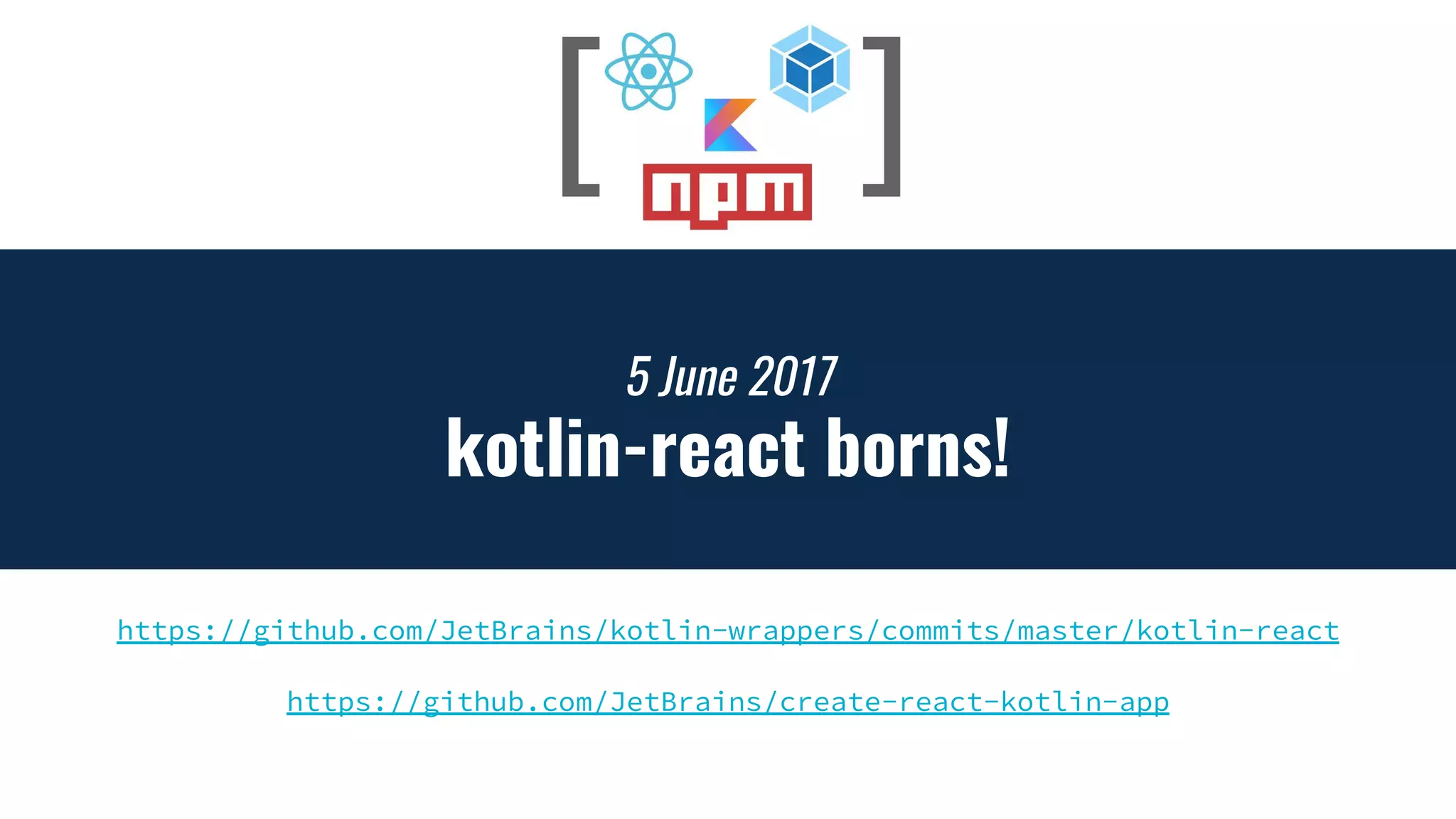
5 June 2017
kotlin-react borns!
https://github.com/JetBrains/kotlin-wrappers/commits/master/kotlin-react
https://github.com/JetBrains/create-react-kotlin-app
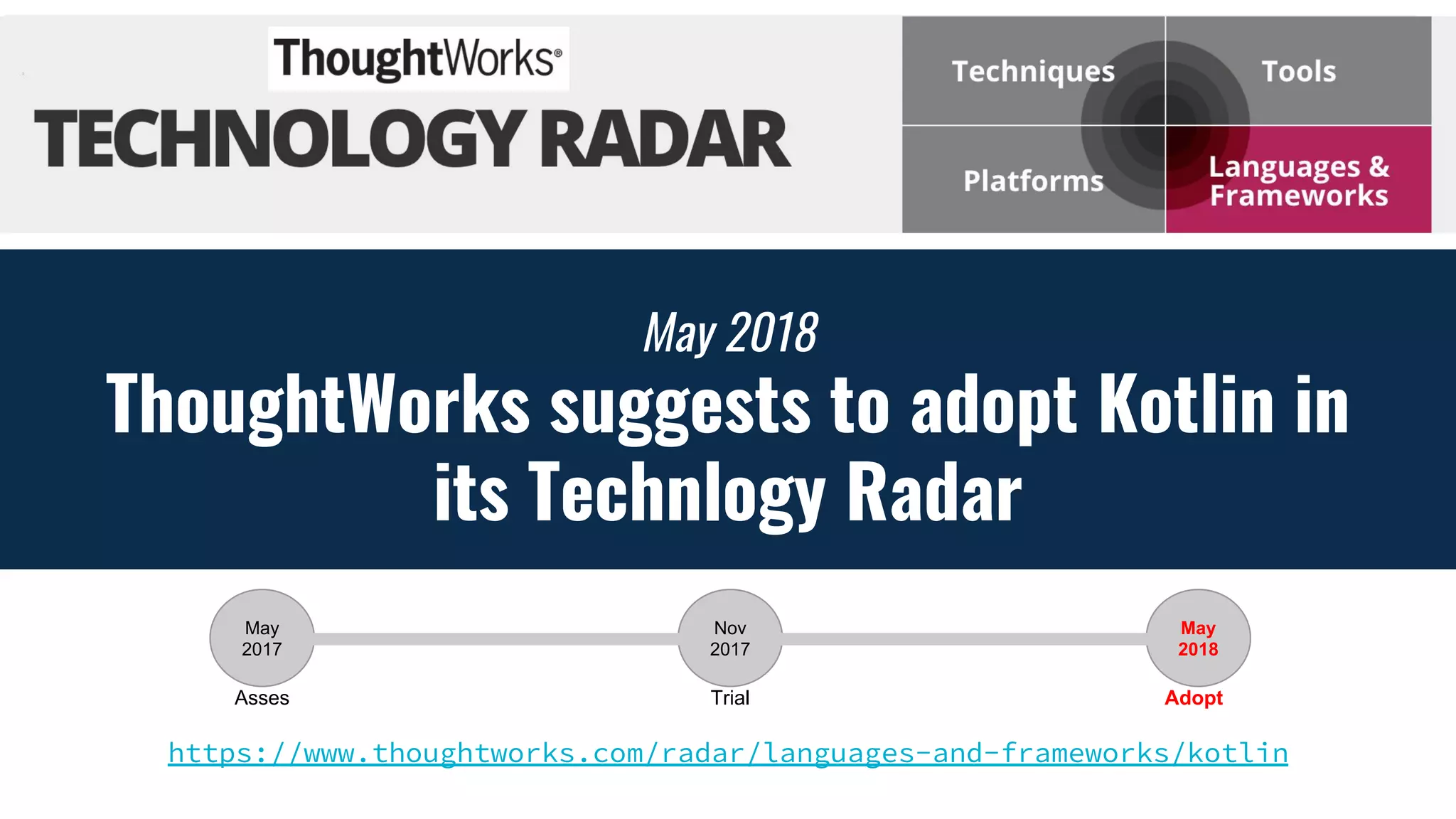
May 2018
ThoughtWorks suggests to adopt Kotlin in
its Technlogy Radar
https://www.thoughtworks.com/radar/languages-and-frameworks/kotlin
May
2017
Nov
2017
May
2018
TrialAsses Adopt
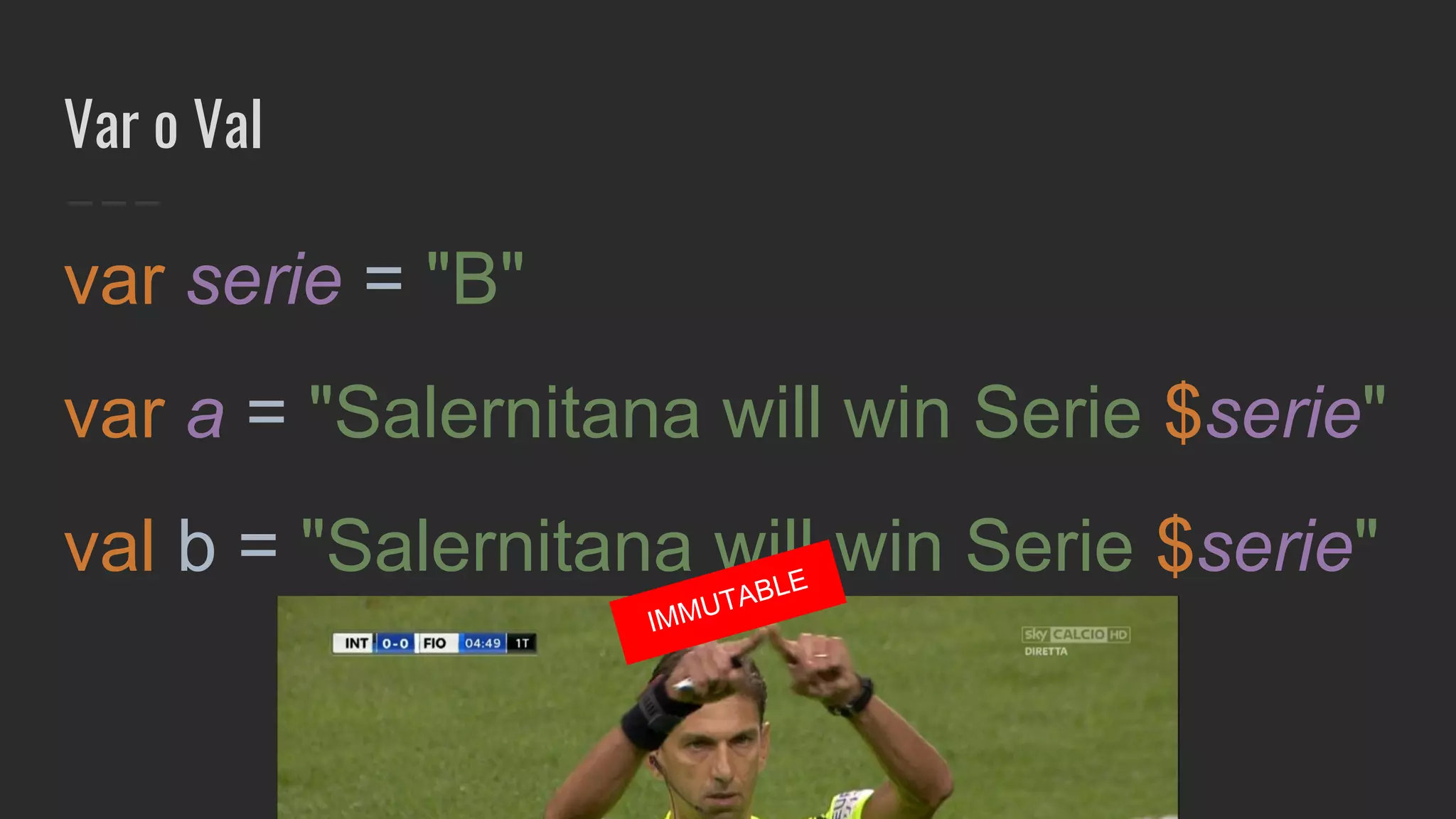
Var o Val
var serie = "B"
var a = "Salernitana will win Serie $serie"
val b = "Salernitana will win Serie $serie"
IMMUTABLE
Fun
fun main(args: Array<String>){
hello("Davide", "Salerno")
}
fun hello(name: String, city: String){
println("Hello $name from $city")
}
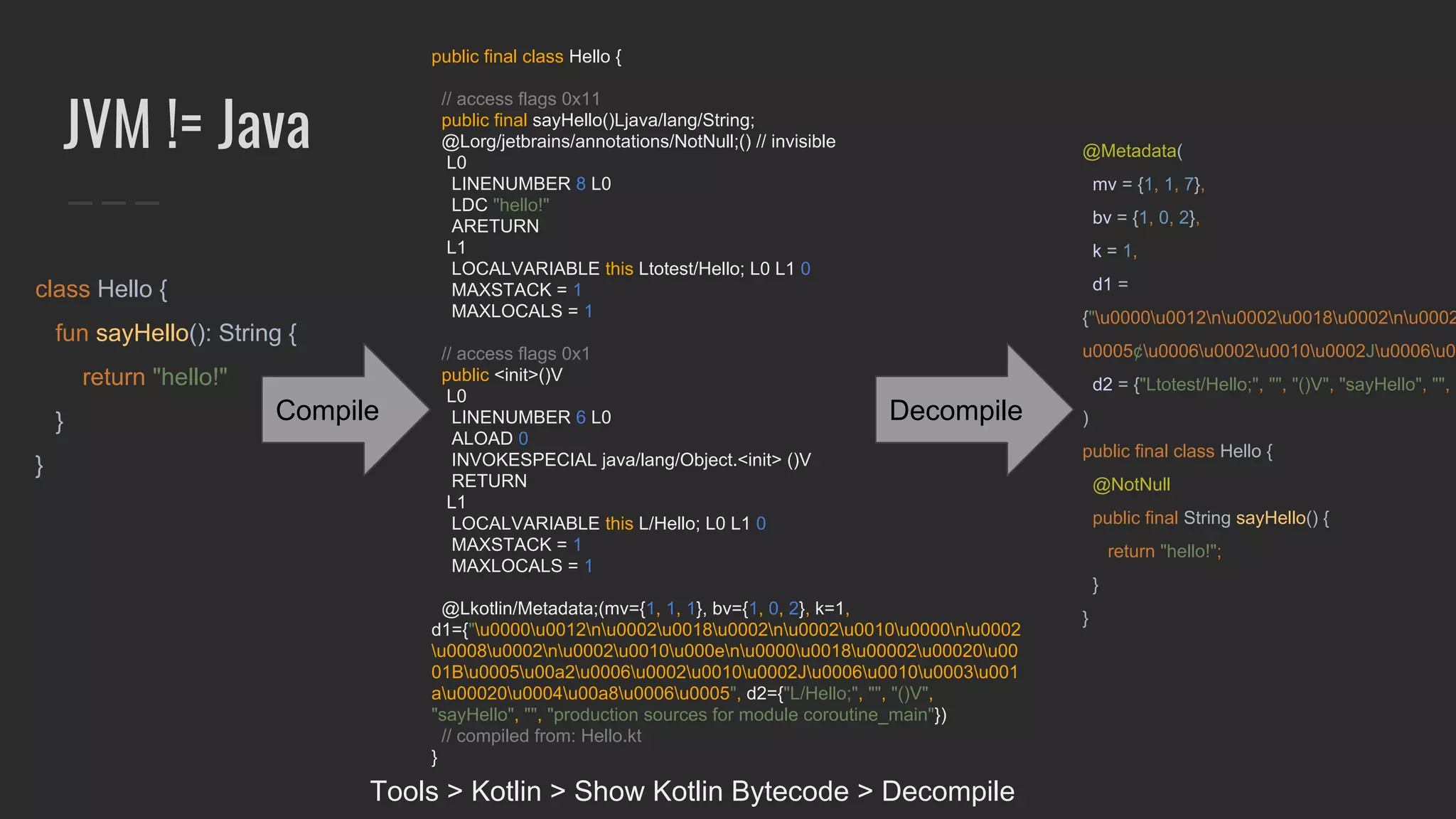
JVM != Java
class Hello {
fun sayHello(): String {
return "hello!"
}
}
public final class Hello {
// access flags 0x11
public final sayHello()Ljava/lang/String;
@Lorg/jetbrains/annotations/NotNull;() // invisible
L0
LINENUMBER 8 L0
LDC "hello!"
ARETURN
L1
LOCALVARIABLE this Ltotest/Hello; L0 L1 0
MAXSTACK = 1
MAXLOCALS = 1
// access flags 0x1
public <init>()V
L0
LINENUMBER 6 L0
ALOAD 0
INVOKESPECIAL java/lang/Object.<init> ()V
RETURN
L1
LOCALVARIABLE this L/Hello; L0 L1 0
MAXSTACK = 1
MAXLOCALS = 1
@Lkotlin/Metadata;(mv={1, 1, 1}, bv={1, 0, 2}, k=1,
d1={"u0000u0012nu0002u0018u0002nu0002u0010u0000nu0002
u0008u0002nu0002u0010u000enu0000u0018u00002u00020u00
01Bu0005u00a2u0006u0002u0010u0002Ju0006u0010u0003u001
au00020u0004u00a8u0006u0005", d2={"L/Hello;", "", "()V",
"sayHello", "", "production sources for module coroutine_main"})
// compiled from: Hello.kt
}
@Metadata(
mv = {1, 1, 7},
bv = {1, 0, 2},
k = 1,
d1 =
{"u0000u0012nu0002u0018u0002nu0002
u0005¢u0006u0002u0010u0002Ju0006u00
d2 = {"Ltotest/Hello;", "", "()V", "sayHello", "", "
)
public final class Hello {
@NotNull
public final String sayHello() {
return "hello!";
}
}
Compile Decompile
Tools > Kotlin > Show Kotlin Bytecode > Decompile
Fun fun functions
fun hello(name: String, city: String = "Salerno") = println("Hello $name from $city")
hello("Davide", "Salerno")
hello(name = "Davide")
hello(city = "Salerno", name = "Valentina")
fun Int.multilpy(x: Int): Int = this * x // 5.multilpy(10)
infix fun Int.multilpy(x: Int): Int = this * x // 5 multilpy 10
Also helps with refactoring!
E gli operatori?
data class Point(val x: Int, val y: Int) {
operator fun plus(a: Point) = Point(x + a.x, y + a.y)
}
operator fun Point.unaryMinus() = Point(-x, -y)
val point = Point(10, 20)
println(point + point + point) //Point(x=30, y=60)
println(-point) // Point(x=-10, y=-20)
Tailrec
● Recursion, in some language, can cause: StackOverflow!
● Reduce stack execution.
● Tailrec will resolve this issue only if the recursive call is the last one.
● It transforms your code in imperative code. Less readable, but more fast.
● Performance improvement
fun factorial(n: Long): Long = if (n <= 1L) n else n * factorial(n - 1)
tailrec fun factorial(n: Long, accumulator: Long = 1): Long = if (n <= 1L) accumulator
else factorial(n - 1, accumulator * n)
Tailrec cannot
applicable
“If” will return the verified condition value
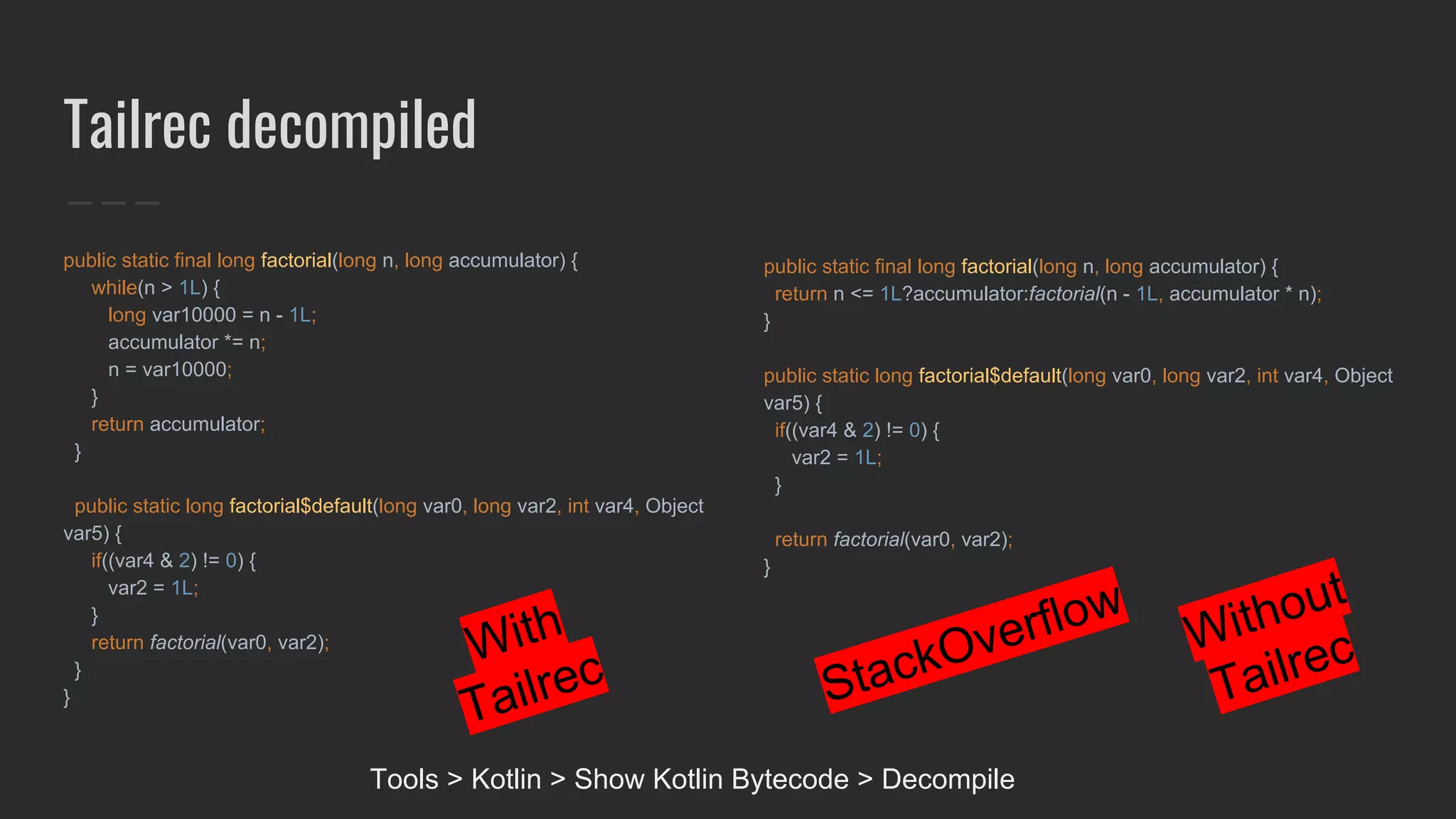
Tailrec decompiled
public static final long factorial(long n, long accumulator) {
while(n > 1L) {
long var10000 = n - 1L;
accumulator *= n;
n = var10000;
}
return accumulator;
}
public static long factorial$default(long var0, long var2, int var4, Object
var5) {
if((var4 & 2) != 0) {
var2 = 1L;
}
return factorial(var0, var2);
}
}
public static final long factorial(long n, long accumulator) {
return n <= 1L?accumulator:factorial(n - 1L, accumulator * n);
}
public static long factorial$default(long var0, long var2, int var4, Object
var5) {
if((var4 & 2) != 0) {
var2 = 1L;
}
return factorial(var0, var2);
}
With
Tailrec
Without
Tailrec
StackOverflow
Tools > Kotlin > Show Kotlin Bytecode > Decompile
“If” is an expression, not a construct,
i.e. it returns a value.
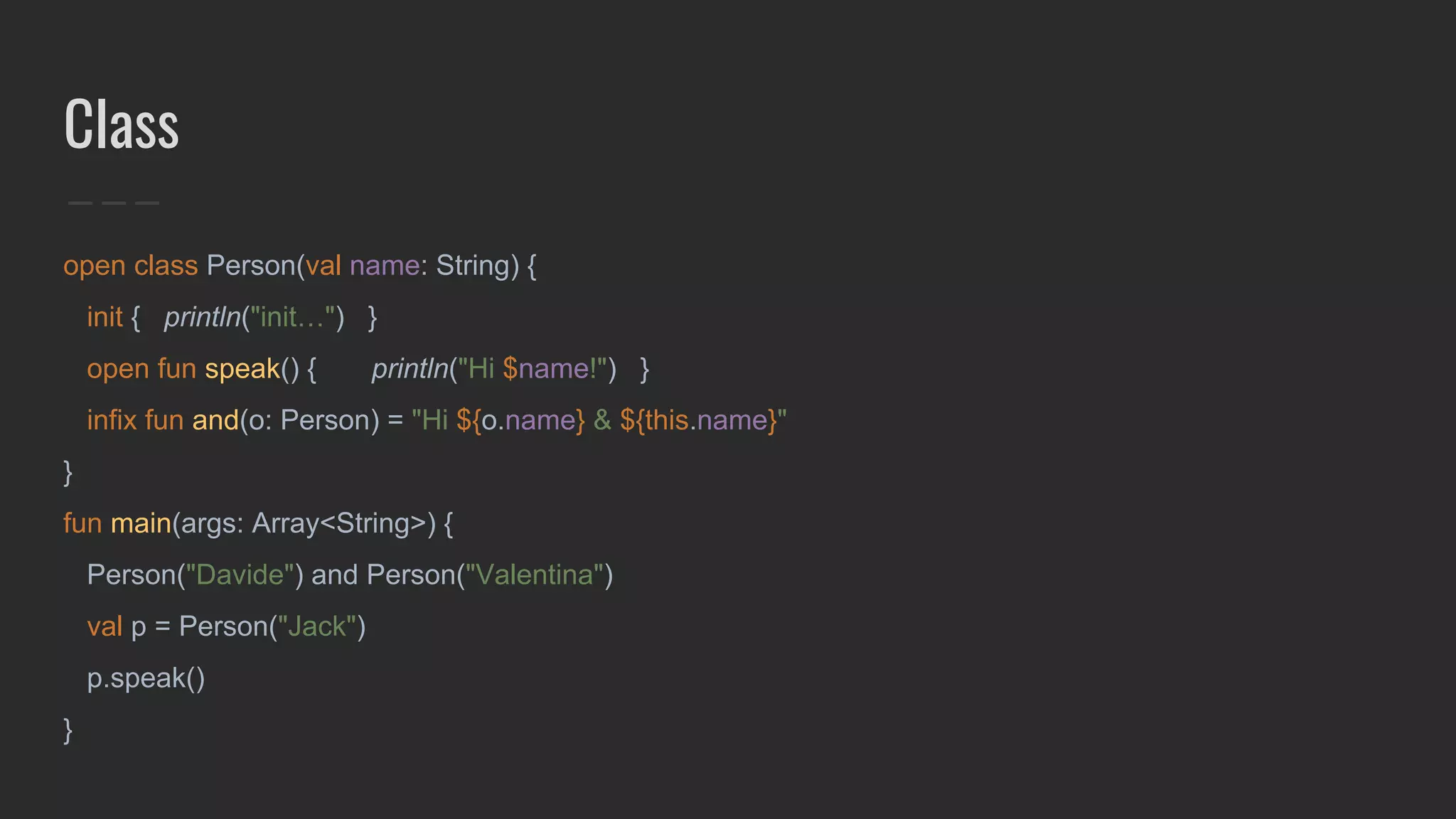
Class
open class Person(val name: String) {
init { println("init…") }
open fun speak() { println("Hi $name!") }
infix fun and(o: Person) = "Hi ${o.name} & ${this.name}"
}
fun main(args: Array<String>) {
Person("Davide") and Person("Valentina")
val p = Person("Jack")
p.speak()
}
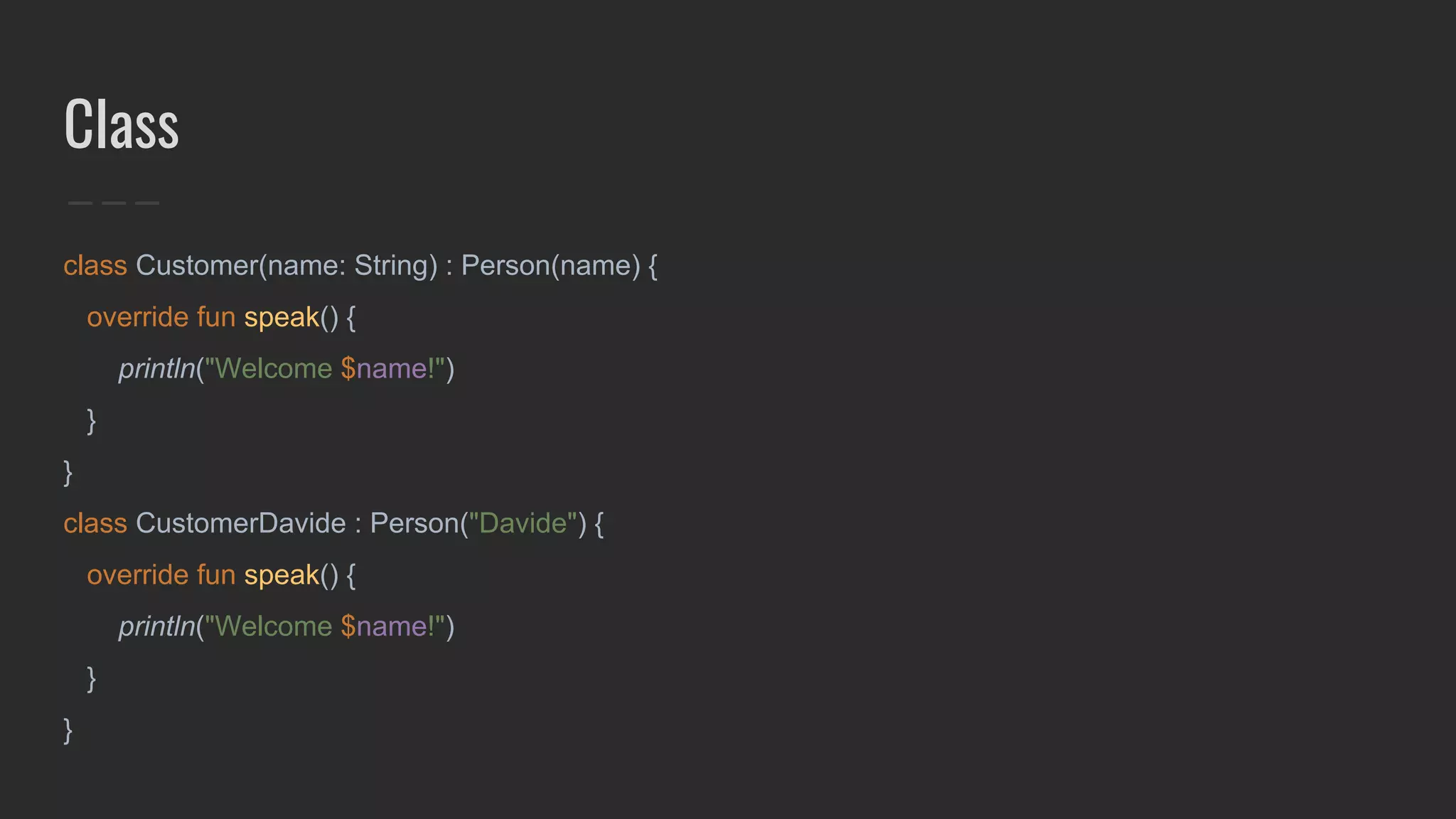
Class
class Customer(name: String) : Person(name) {
override fun speak() {
println("Welcome $name!")
}
}
class CustomerDavide : Person("Davide") {
override fun speak() {
println("Welcome $name!")
}
}
Equals, hashCode, toString e copy, nevermore!
data class User(val name: String, val age: Int)
val davide = User("Davide", 35)
val davideJunior = davide.copy(age=0)
fun main(args: Array<String>) {
val (name, age) = davide
println("$name $age years old")
}
deconstructing
Nothing is equal as appear
data class Point(val x: Int, val y: Int)
val a = Point(1, 2)
val b = Point(1, 2)
val c = a
println(a === b) // false
println(a == b) // true
println(a === c) // true
println(a == c) // true
Check the reference
.equals(...)
Lambda
fun main(args: Array<String>) {
arrayOf("Valentina", "Davide").forEach { println("Hello $it!") }
val ints =(1..3)
val logger = { msg: Any -> println("log $msg") }
ints.map { value -> value * 2 }.map { v -> logger(v) }
ints.map { it * 2 }.map { logger(it) }
}
Lambda
class Customer(val name: String) {
fun forEach(action: (char: Char) -> Unit) = name.forEach(action)
fun upperCaseAndConcat(callback: () -> String) = "${callback()} $name".toUpperCase()
}
fun main(args: Array<String>) {
val customer = Customer("Davide")
customer.forEach { println(it.toInt()) } //68 97 118 105 100 101
println(customer.upperCaseAndConcat { "Cerbo" }) //CERBO DAVIDE
}
The type with only one value: the Unit
object. This type corresponds to the void
type in Java.
Lambda Java -> Java 8 -> Kotlin
public class MapsTest {
private Map<String, Integer> scores = new HashMap<String, Integer>() {
{
put("Jack", 12);
put("Jill", 15);
put("Tom", 11);
put("Darla", 15);
put("TOM", 11);
put("Nick", 15);
put("Nancy", 11);
}
};
@Test
void maxNumberOfLetters() {
assertAll(
() -> assertEquals(4, (int) MapsK.maxNumberOfLetters(scores).get(12))
, () -> assertEquals(5, (int) MapsK.maxNumberOfLetters(scores).get(15))
, () -> assertEquals(5, (int) MapsK.maxNumberOfLetters(scores).get(11))
); } }
12: Jack
15: Jill. Darla, Nick
11: Tom, Tom, Nancy
12: 4
15: 5
11: 5
Lambda Java -> Java 8 -> Kotlin
public static Map<Integer, Integer> maxNumberOfLetters(Map<String, Integer> scores)
{
Map<Integer, Integer> byScores = new HashMap<>();
for (String name : scores.keySet())
{
int score = scores.get(name);
int maxLength = 0;
if (byScores.containsKey(score))
maxLength = byScores.get(score);
maxLength = maxLength < name.length() ? name.length() : maxLength;
byScores.put(score, maxLength);
}
return byScores;
}
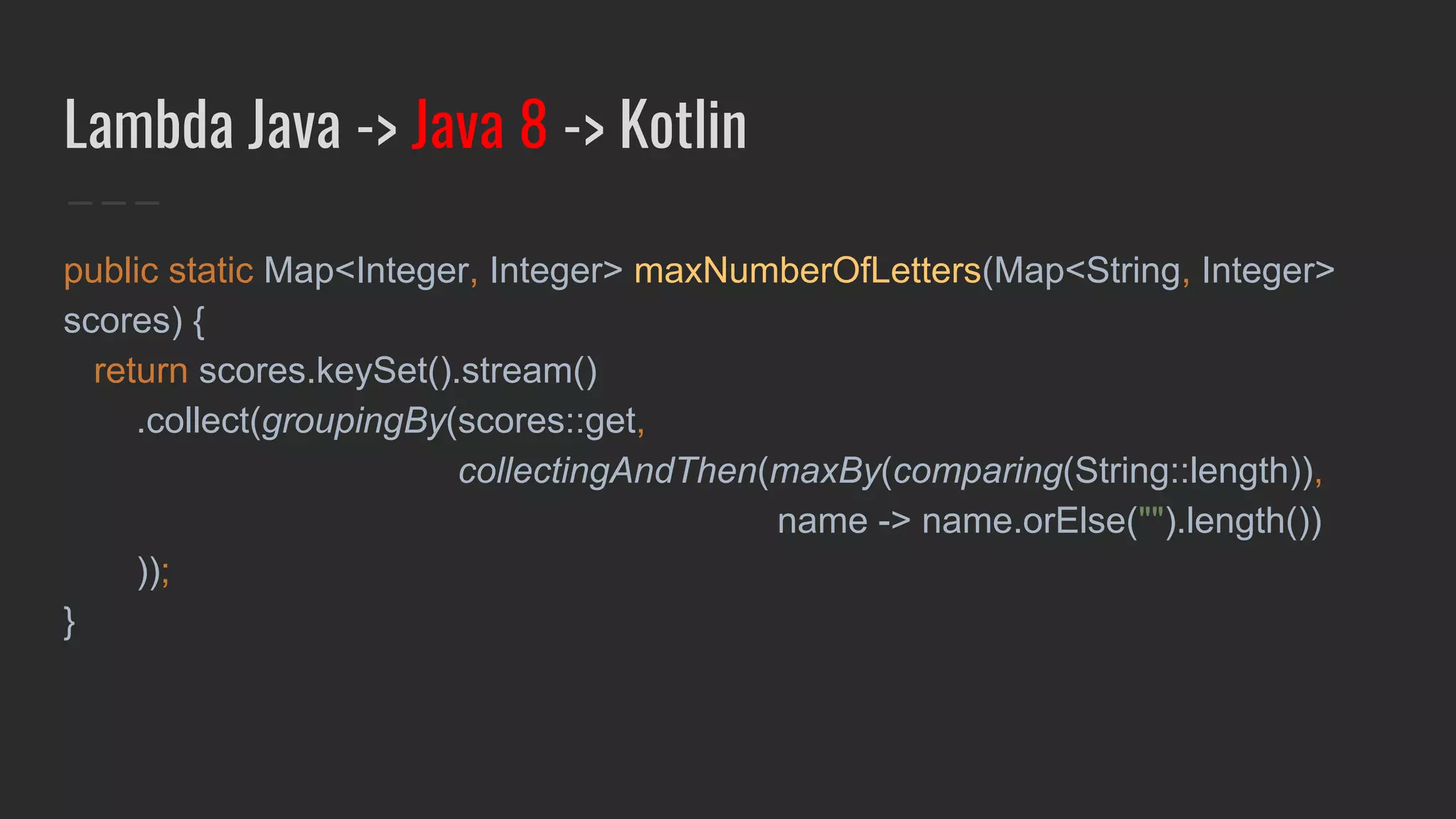
Lambda Java -> Java 8 -> Kotlin
public static Map<Integer, Integer> maxNumberOfLetters(Map<String, Integer>
scores) {
return scores.keySet().stream()
.collect(groupingBy(scores::get,
collectingAndThen(maxBy(comparing(String::length)),
name -> name.orElse("").length())
));
}
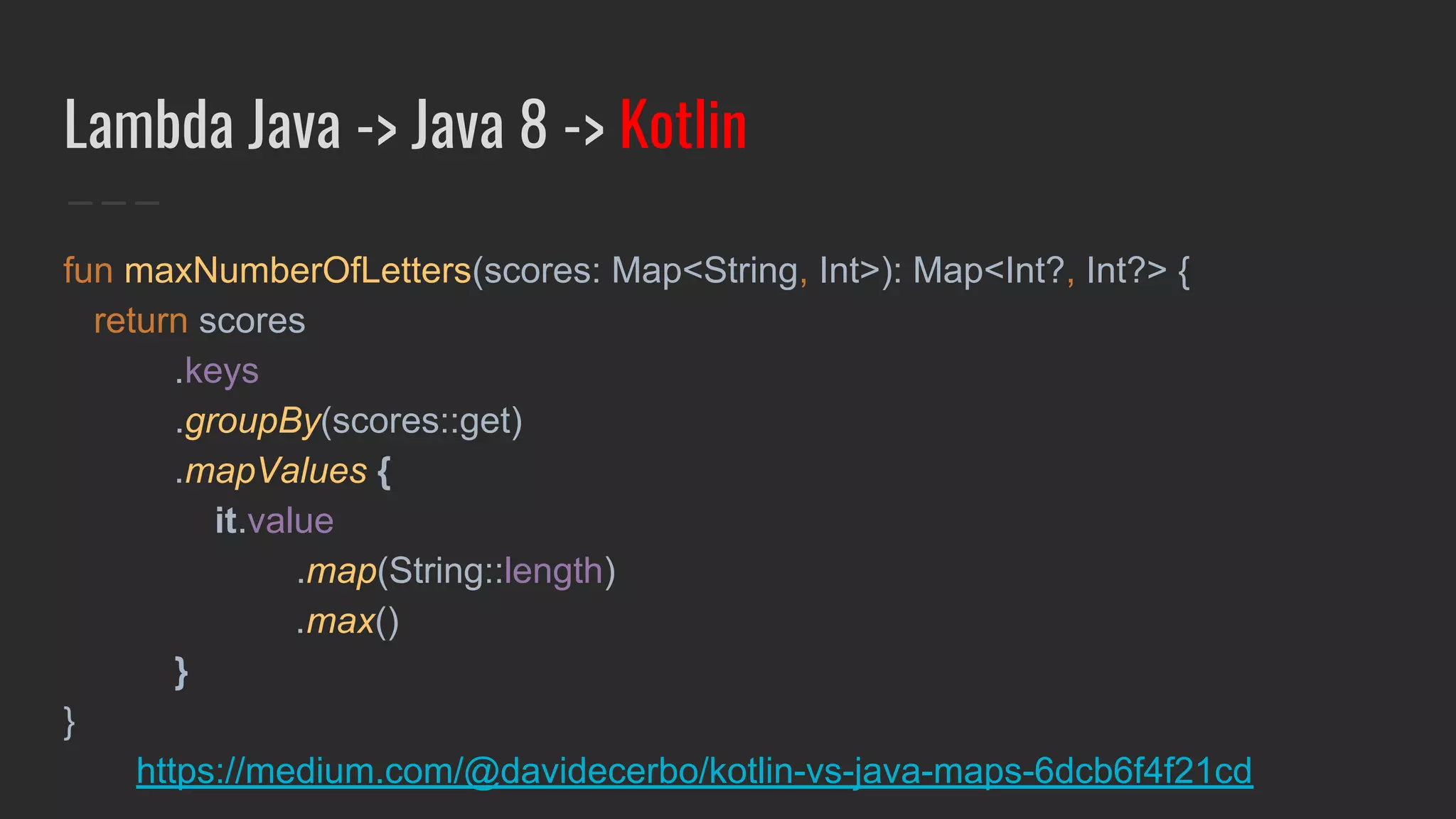
Lambda Java -> Java 8 -> Kotlin
fun maxNumberOfLetters(scores: Map<String, Int>): Map<Int?, Int?> {
return scores
.keys
.groupBy(scores::get)
.mapValues {
it.value
.map(String::length)
.max()
}
}
https://medium.com/@davidecerbo/kotlin-vs-java-maps-6dcb6f4f21cd
Lambda & Function Label
fun forEachTest() {
val numbers = 1..100
numbers.forEach {
if (it == 25) {
return
}
println("index $it")
}
println("Hello")
}
fun forEachTest() {
val numbers = 1..100
numbers.forEach {
if (it == 25) {
return@forEach
}
println("index $it")
}
println("Hello")
}
Vs.
Tell me when, when?
fun describe(obj: Any): String = when (obj) {
1 -> "One"
"Hello" -> "Greeting"
is Long -> "Long"
!is String -> "Not a string"
else -> "Unknown"
}
describe(Person("davide"))
Null is safe!
var testA:String = "ciao"
var testB:String? = "ciao"
testB = null
println("a0 ${testA.length}")
println("b0 ${testB.length}")
// ^ Not safe! Compile time error! ^
println("b1 ${testB?.length}")
println("b2 ${testB!!.length}")
// ^ KotlinNullPointerException ^
// NPE Lovers
Null is safe!
val nullableList: List<Int?> = listOf(1, 2, null, 4)
val intList: List<Int> = nullableList.filterNotNull() // [1, 2, 4]
val aInt: Int? = b as? Int
// If b is null, normally we will have a NullPointerException, while if the type is
different we will have a ClassCastExeption. Using “as?” we haven’t an exception,
we will have a null value assigned to the aInt value.
Null is safe!
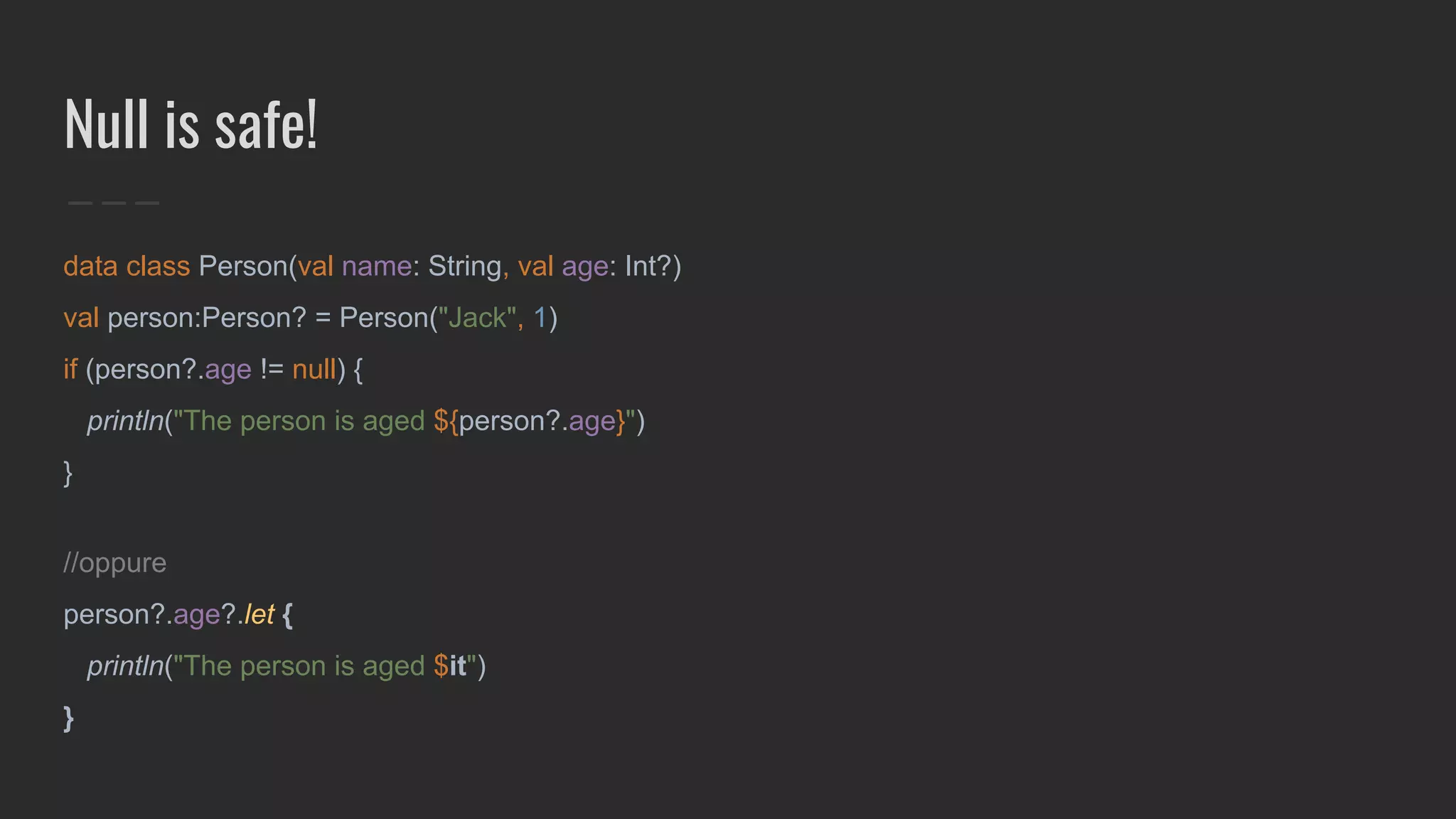
data class Person(val name: String, val age: Int?)
val person:Person? = Person("Jack", 1)
if (person?.age != null) {
println("The person is aged ${person?.age}")
}
//oppure
person?.age?.let {
println("The person is aged $it")
}
?:
Elvis operatorIt is the replacement to “Optional.getOrElse” in Java
val davide = Person(testA)
val elvis = Person(testB ?: "Elvis")
println(jack.name)
Kotlin forces you to handle it or to take full
responsibility.
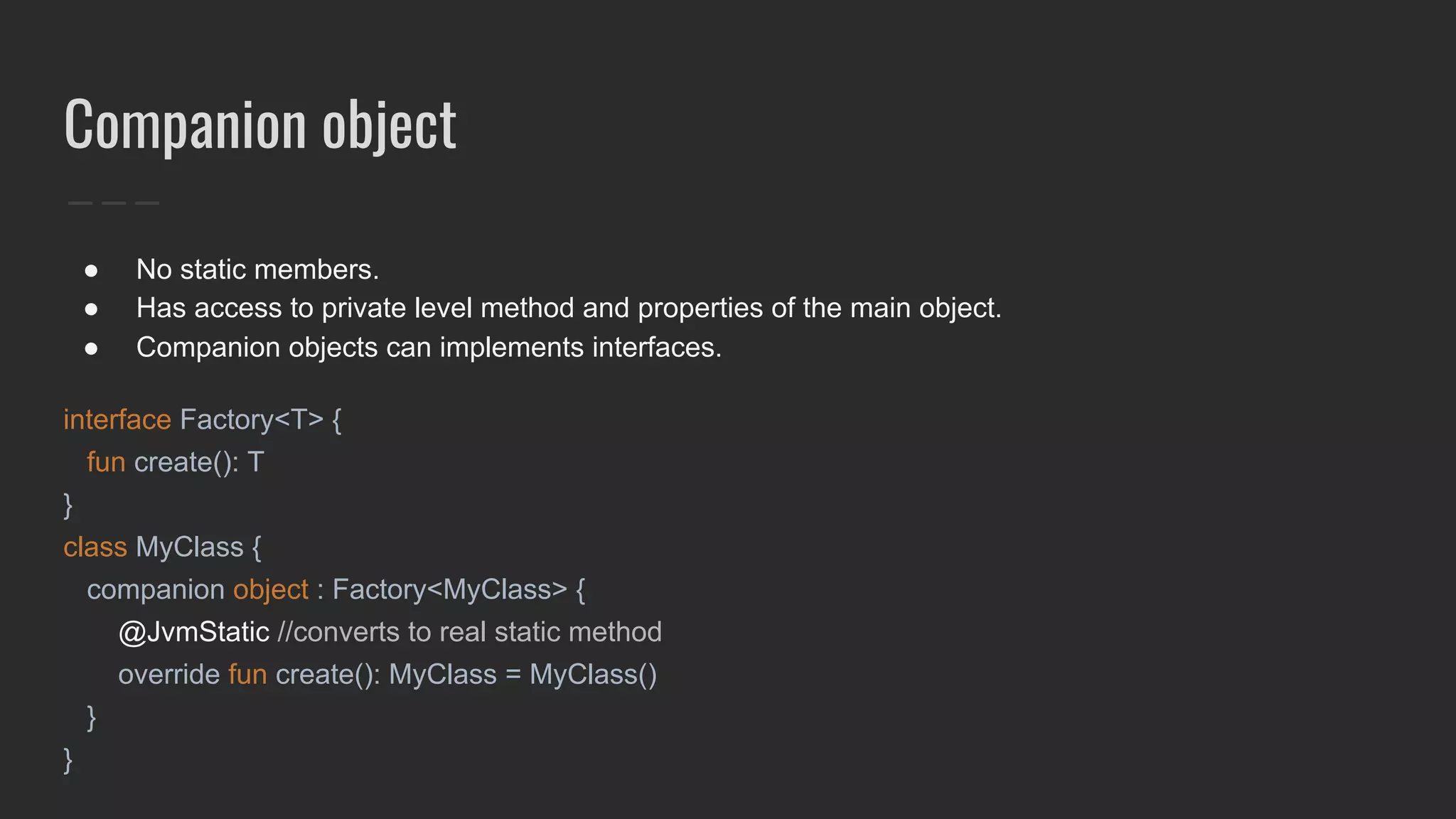
Companion object
● No static members.
● Has access to private level method and properties of the main object.
● Companion objects can implements interfaces.
interface Factory<T> {
fun create(): T
}
class MyClass {
companion object : Factory<MyClass> {
@JvmStatic //converts to real static method
override fun create(): MyClass = MyClass()
}
}
Visibility Modifiers
private - means visible inside this class only (including
all its members);
protected — same as private + visible in subclasses too;
Override protected method are still protected.
internal — any client inside this module who sees the
declaring class sees its internal members. A module is a set
of Kotlin files compiled together;
public — any client who sees the declaring class sees its
public members. (Default)
Exception
Kotlin does not have checked exceptions
throw is an expression
val s = person.name ?: throw
IllegalArgumentException("Name required")
Property: Get & Set
class Strange(var value: Long) {
var strangeValue: Long
get() = value * 2
set(value){
if(value > 5) this.value = value
}
}
fun main(args: Array<String>) {
val customer = Strange(10)
println(customer.strangeValue) //20
customer.strangeValue = 3
println(customer.strangeValue) //20
customer.strangeValue = 6
println(customer.strangeValue) //12
}
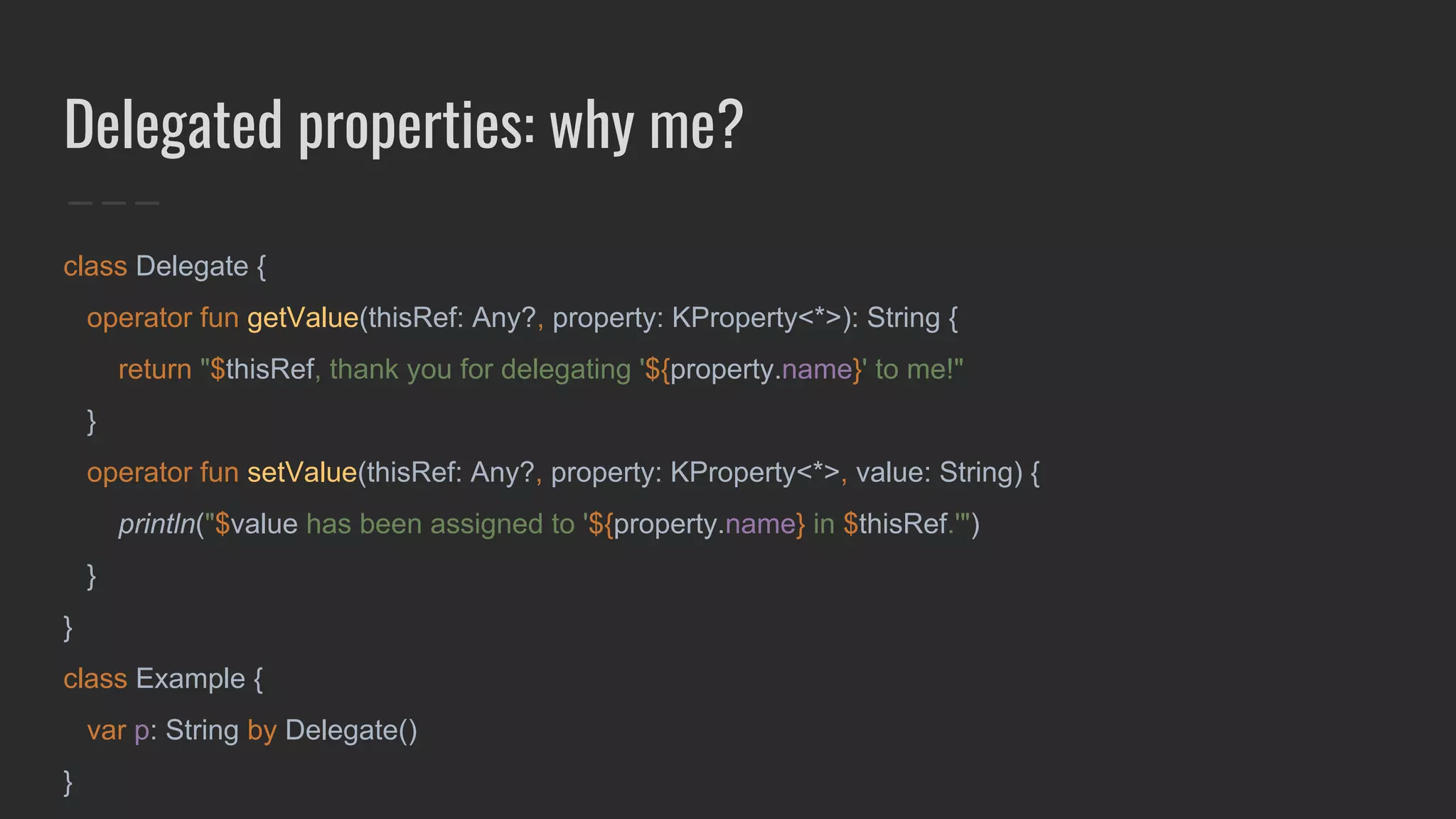
Delegated properties: why me?
class Delegate {
operator fun getValue(thisRef: Any?, property: KProperty<*>): String {
return "$thisRef, thank you for delegating '${property.name}' to me!"
}
operator fun setValue(thisRef: Any?, property: KProperty<*>, value: String) {
println("$value has been assigned to '${property.name} in $thisRef.'")
}
}
class Example {
var p: String by Delegate()
}
Delegated properties: the lazy & the observable
val lazyValue: String by lazy {
println("computed!")
"Hello"
}
fun main(args: Array<String>) {
println(lazyValue)
println(lazyValue)
}
class User {
var n: String by Delegates.observable("empty") {
prop, old, new -> println("$old -> $new")
}
}
fun main(args: Array<String>) {
val user = User()
user.n = "first"
user.n = "second"
}
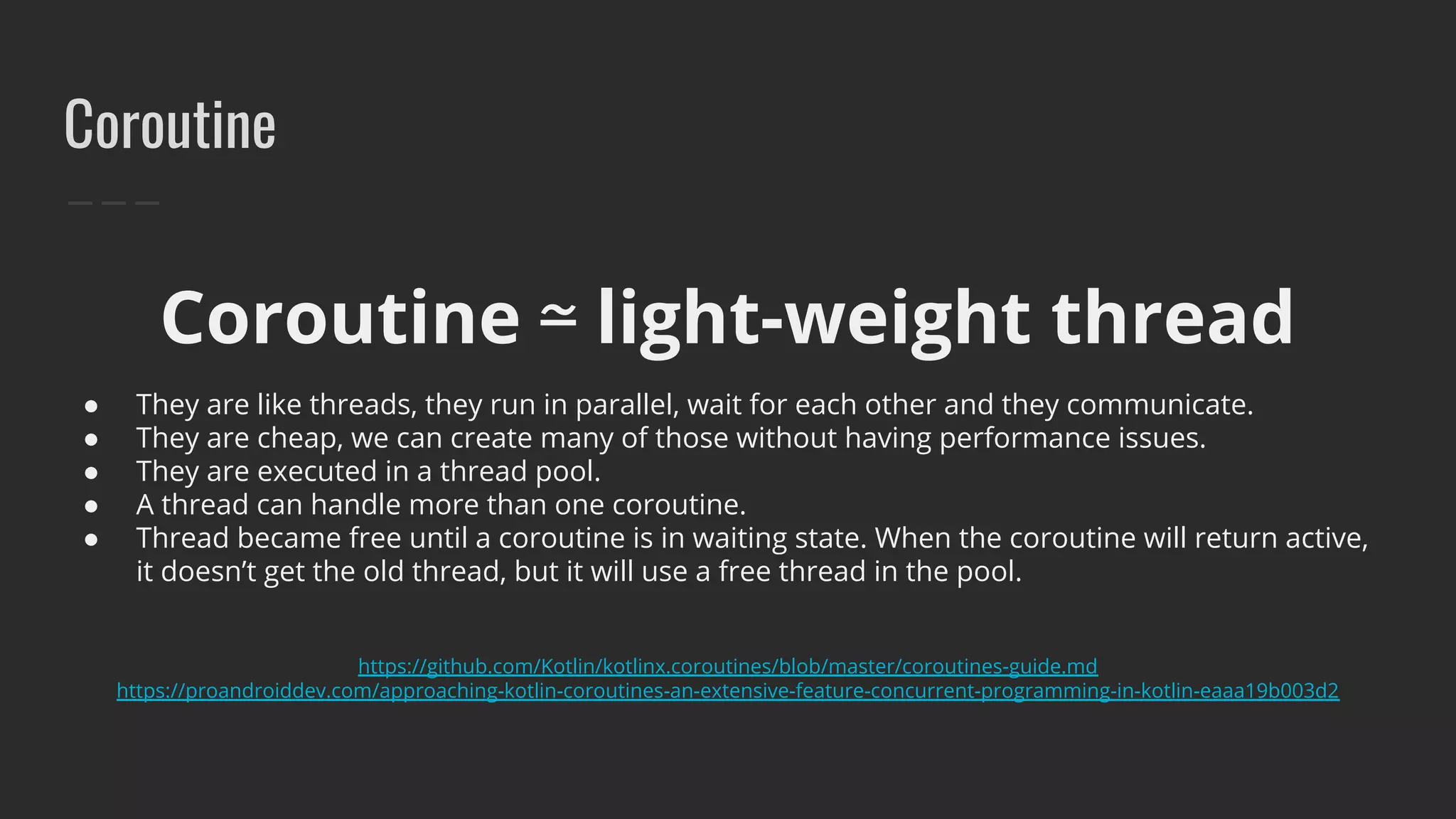
Coroutine
Coroutine ⋍ light-weight thread
● They are like threads, they run in parallel, wait for each other and they communicate.
● They are cheap, we can create many of those without having performance issues.
● They are executed in a thread pool.
● A thread can handle more than one coroutine.
● Thread became free until a coroutine is in waiting state. When the coroutine will return active,
it doesn’t get the old thread, but it will use a free thread in the pool.
https://github.com/Kotlin/kotlinx.coroutines/blob/master/coroutines-guide.md
https://proandroiddev.com/approaching-kotlin-coroutines-an-extensive-feature-concurrent-programming-in-kotlin-eaaa19b003d2
Coroutine is humble
fun main(args: Array<String>) = runBlocking {
val jobs = List(100_000) {
launch {
delay(1000L)
print(".")
}
}
jobs.forEach { it.join() }
}
fun main(args: Array<String>) {
val jobs = List(100_000) {
thread(start = true) {
Thread.sleep(1000L)
print(".")
}
}
jobs.forEach { it.join() }
}
OUT OF MEMORY!!!
Coroutine: suspend, async / await
fun main(args: Array<String>) = runBlocking<Unit> {
val time = measureTimeMillis {
val one = doSomethingUsefulOne()
val two = doSomethingUsefulTwo()
println("The answer is ${one + two}")
}
println("Completed in $time ms")
}
suspend fun doSomethingUsefulOne(): Int {
delay(1000L)
return 13
}
suspend fun doSomethingUsefulTwo(): Int {
delay(1000L)
return 29
}
fun main(args: Array<String>) = runBlocking<Unit> {
val time = measureTimeMillis {
val one = async { doSomethingUsefulOne() }
val two = async { doSomethingUsefulTwo() }
println("The answer is ${one.await() + two.await()}")
}
println("Completed in $time ms")
}
suspend fun doSomethingUsefulOne(): Int {
delay(1000L)
return 13
}
suspend fun doSomethingUsefulTwo(): Int {
delay(1000L)
return 29
}
~2 sec.
~1 sec.
Coroutine is the basement
Coroutine
Actors
Communication
Sequence
Process
?
Now is the time to remember that Kotlin is good
because the trade-off between synthesis and
readable code is really good.
Automatic restart
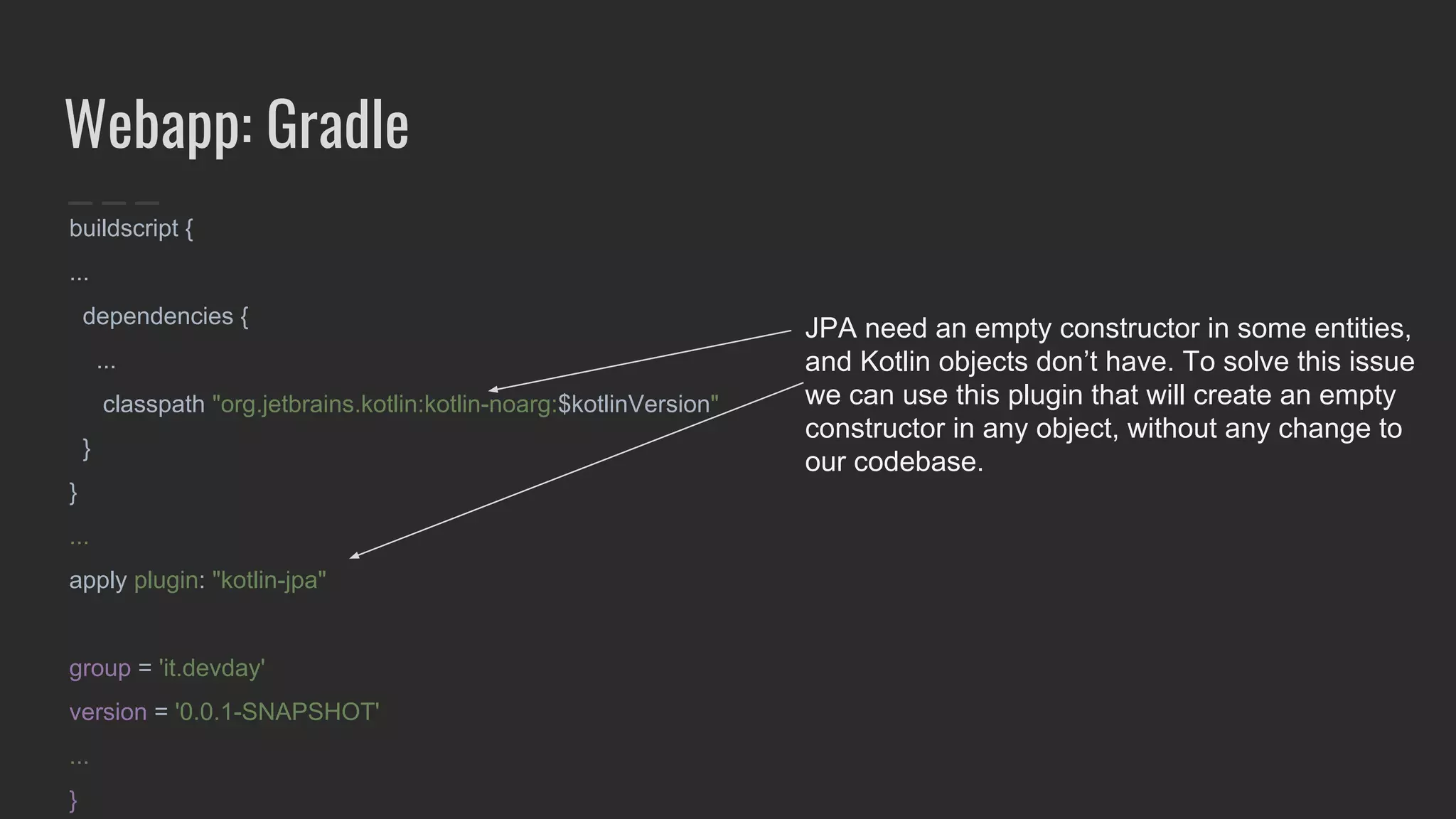
Webapp: Gradle
buildscript {
...
dependencies {
...
classpath "org.jetbrains.kotlin:kotlin-noarg:$kotlinVersion"
}
}
...
apply plugin: "kotlin-jpa"
group = 'it.devday'
version = '0.0.1-SNAPSHOT'
...
}
JPA need an empty constructor in some entities,
and Kotlin objects don’t have. To solve this issue
we can use this plugin that will create an empty
constructor in any object, without any change to
our codebase.
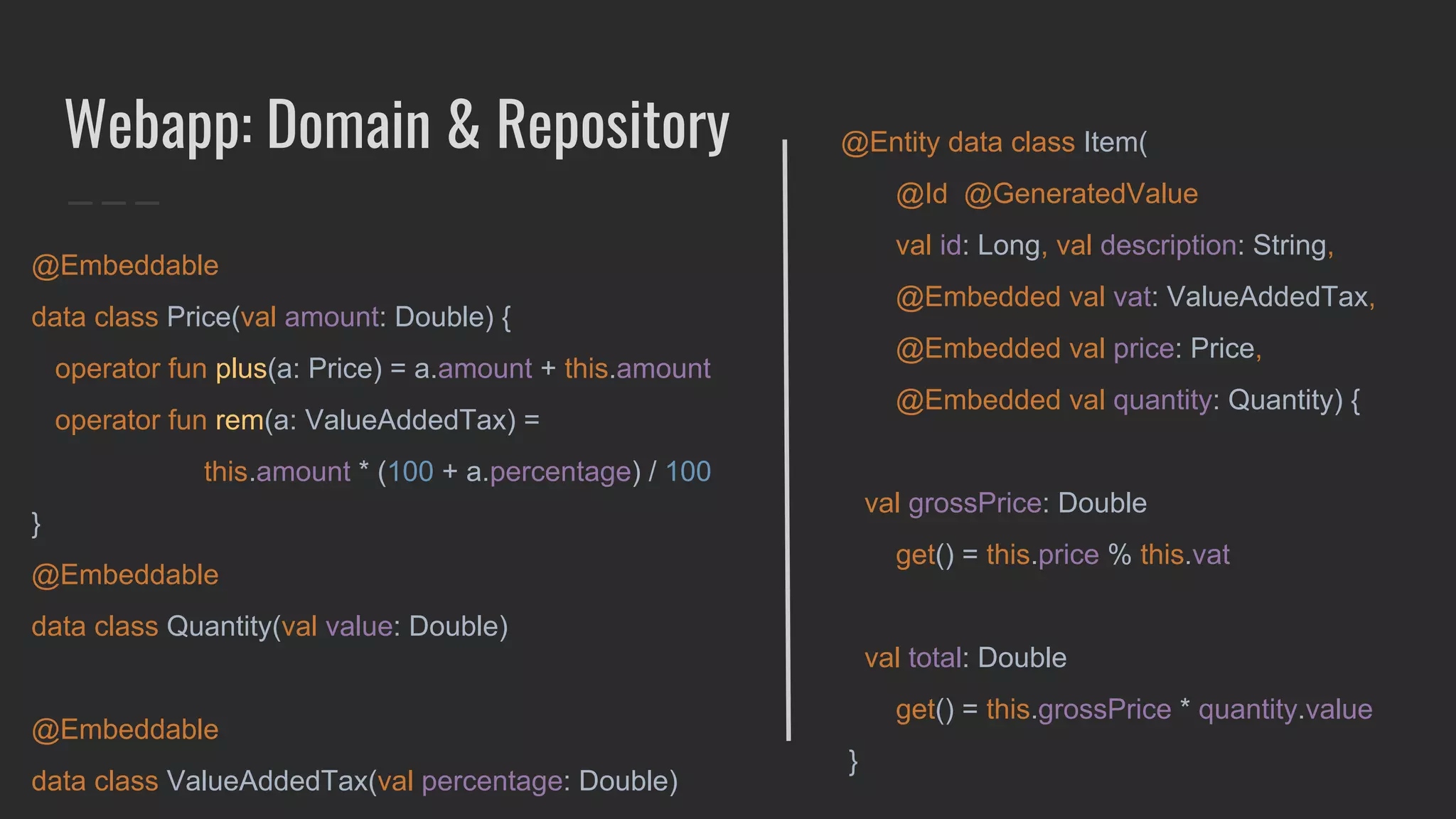
Webapp: Domain & Repository
import it.devday.kotlincodemotion.domain.Contact
import org.springframework.data....JpaRepository
interface ItemRepository: JpaRepository<Item, Long>
import javax.persistence.Entity
import javax.persistence.GeneratedValue
import javax.persistence.Id
@Entity
data class Item(
@Id @GeneratedValue
val id: Long,
val description: String,
val vat: Double,
val price: Double,
val quantity: Double)
Webapp: Domain & Repository
@Embeddable
data class Price(val amount: Double) {
operator fun plus(a: Price) = a.amount + this.amount
operator fun rem(a: ValueAddedTax) =
this.amount * (100 + a.percentage) / 100
}
@Embeddable
data class Quantity(val value: Double)
@Embeddable
data class ValueAddedTax(val percentage: Double)
@Entity data class Item(
@Id @GeneratedValue
val id: Long, val description: String,
@Embedded val vat: ValueAddedTax,
@Embedded val price: Price,
@Embedded val quantity: Quantity) {
val grossPrice: Double
get() = this.price % this.vat
val total: Double
get() = this.grossPrice * quantity.value
}
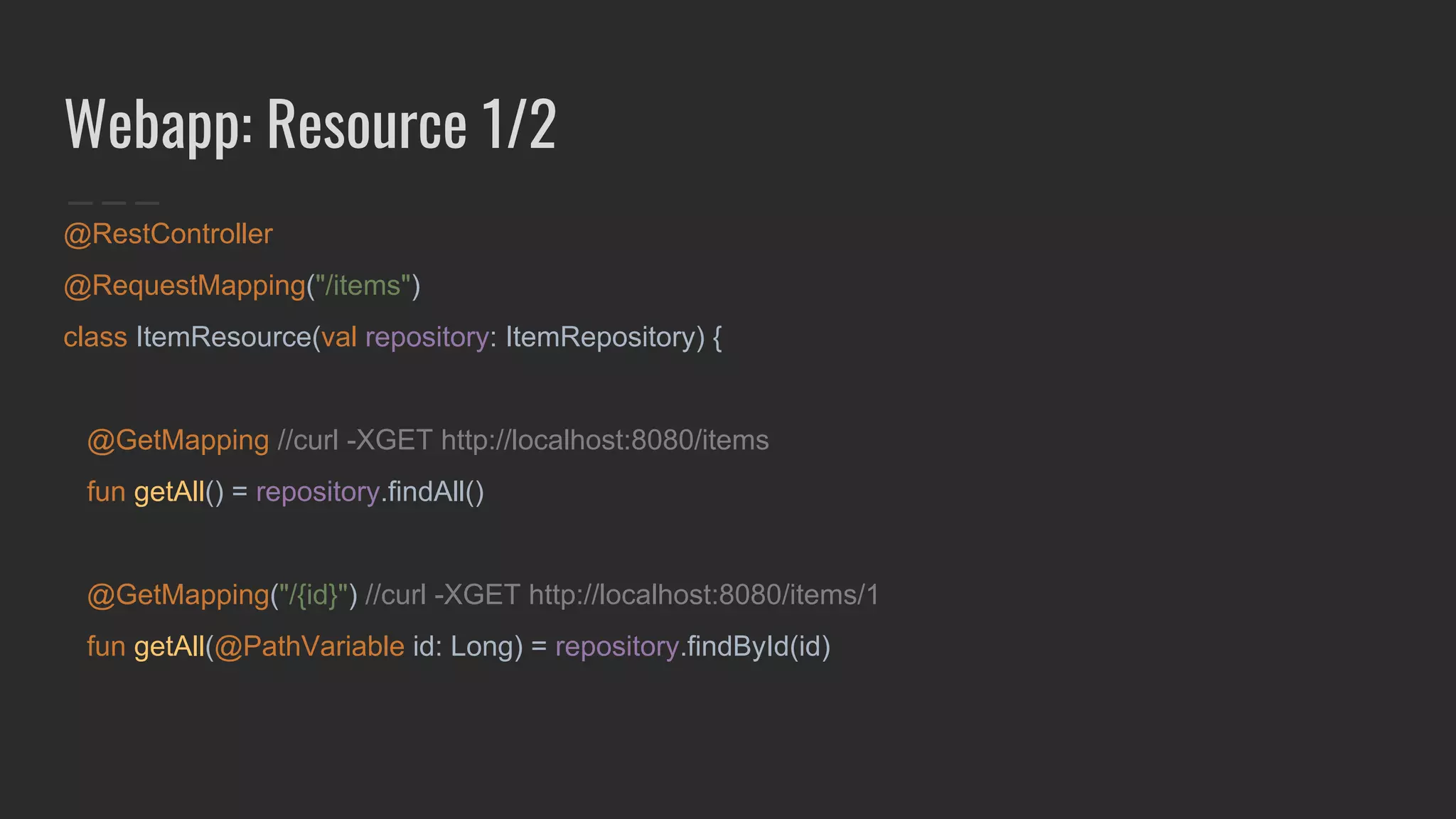
Webapp: Resource 1/2
@RestController
@RequestMapping("/items")
class ItemResource(val repository: ItemRepository) {
@GetMapping //curl -XGET http://localhost:8080/items
fun getAll() = repository.findAll()
@GetMapping("/{id}") //curl -XGET http://localhost:8080/items/1
fun getAll(@PathVariable id: Long) = repository.findById(id)
Webapp: Resource 2/2
@PostMapping //curl -XPOST http://localhost:8080/items -H 'Content-Type: application/json' -d
'{"description":"Kotlin in action", "vat":{"percentage":10}, "price":{"amount":1.5}, "quantity":{"value":"10"}}'
fun insert(@RequestBody item: Item) = repository.save(item)
@DeleteMapping("/{id}") //curl -XDELETE http://localhost:8080/items/1
fun delete(@PathVariable id: Long) {
val item = repository.findById(id).unwrap()
item?.let { repository.delete(item) }
}
}
wait...unwrap() doesn’t exist on Optional class
Webapp: Application
@SpringBootApplication
class KotlinApplication
fun <T> Optional<T>.unwrap(): T? = orElse(null)
fun main(args: Array<String>) {
runApplication<KotlinApplication>(*args)
}
unwrap()!
array is passed element by element, it is used with vararg arguments
public inline fun <reified T : kotlin.Any> runApplication(vararg args: kotlin.String)
The generic type will be available in the method. Wow!
Webapp: Where is my Repository?
@RestController
@RequestMapping("/items")
class ItemResource() {
@GetMapping //curl -XGET http://localhost:8080/items
fun getAll() = Item.findAll()
@GetMapping("/{id}") //curl -XGET http://localhost:8080/items/1
fun getAll(@PathVariable id: Long) = Item.findById(id)
…...
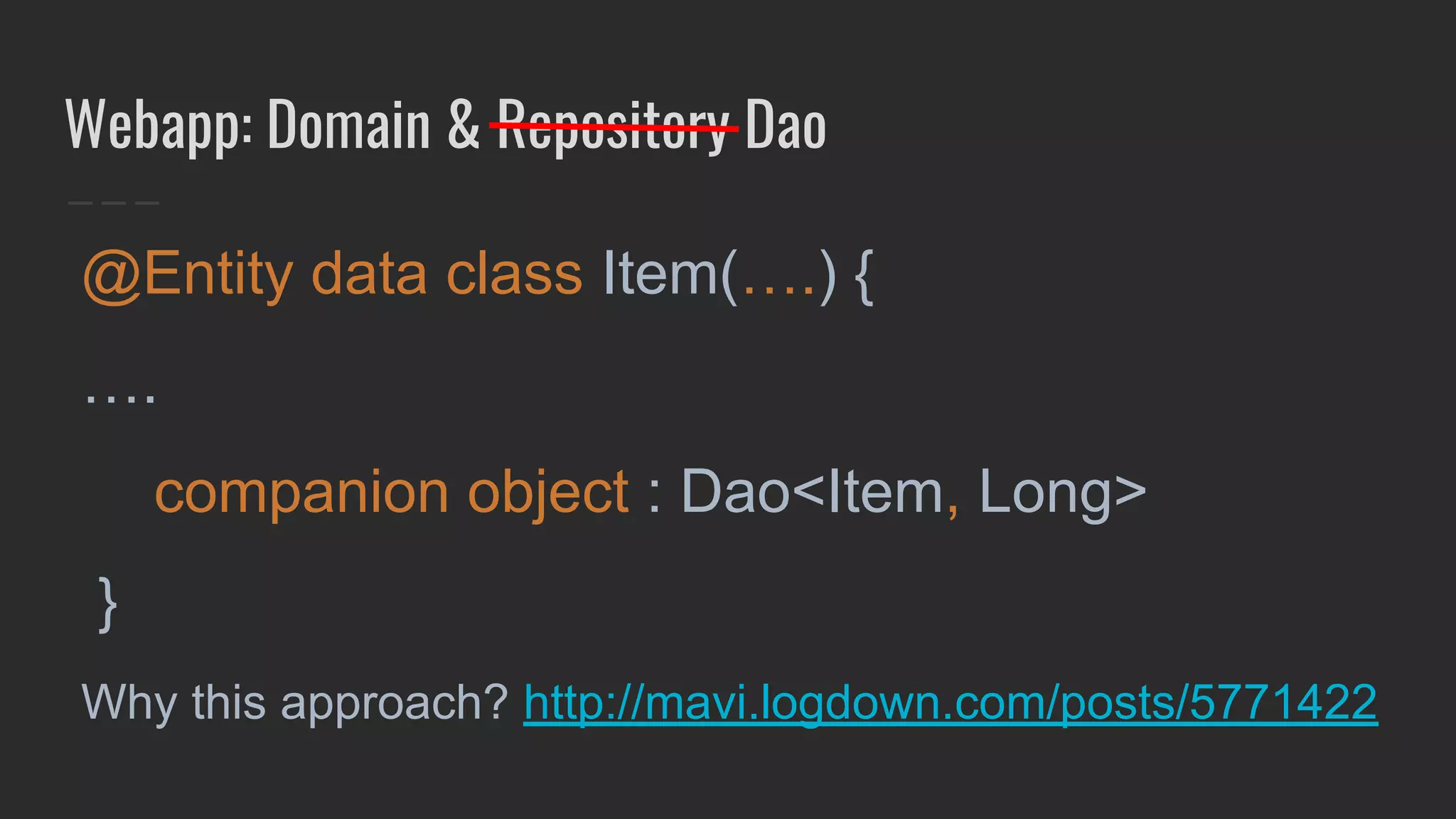
Webapp: Domain & Repository Dao
@Entity data class Item(….) {
….
companion object : Dao<Item, Long>
}
Why this approach? http://mavi.logdown.com/posts/5771422
interface Dao<T, K>
inline fun <reified T : Any, K> Dao<T, K>.findById(id: K):
T = Db.exec { em -> em.find(T::class.java, id) } as T
inline fun <reified T : Any, K> Dao<T, K>.save(item: T):
Unit = Db.exec { em -> tx(em) { em.persist(item) } } as
Unit
...
….
fun tx(em: EntityManager, c: () -> Any): Any {
try {
em.transaction.begin()
val result = c()
em.transaction.commit()
return result
} finally {
em.close()
}
}
Webapp: Domain & Repository Dao
@Component
object Db : ApplicationContextAware {
var ac: ApplicationContext? = null
override fun setApplicationContext(applicationContext: ApplicationContext) {
ac = applicationContext!!
}
fun exec(callback: (em: EntityManager) -> Any): Any {
return callback(ac!!.getBean(EntityManagerFactory::class.java).createEntityManager())
} }
Webapp: Domain & Repository Dao
? ? ?
@davide_cerbo
@devdayit
http://slack.devday.it
http://medium.com/@davidecerbo
Everything is here:
https://github.com/jesty/kotlin-fossavotabona
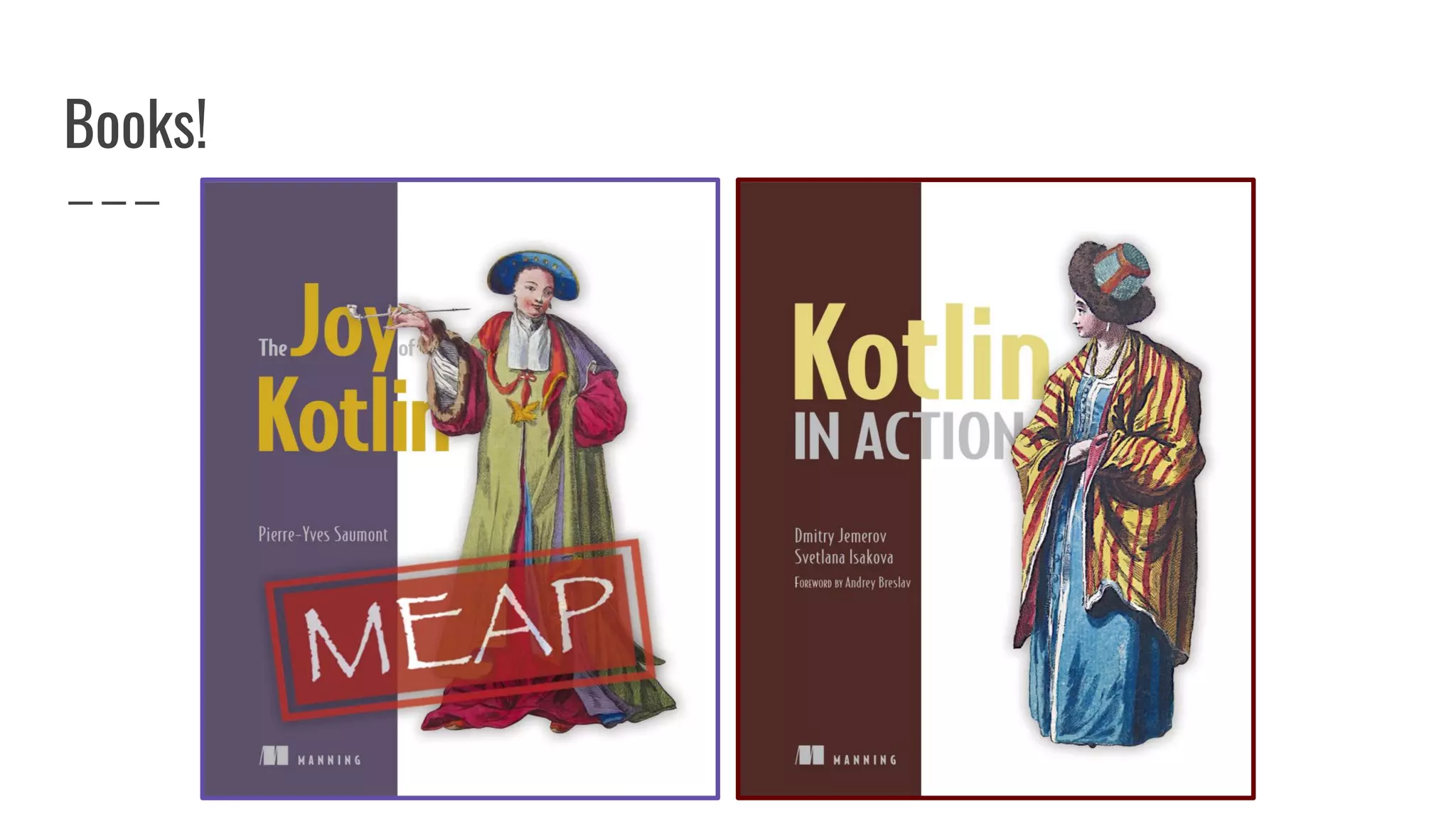
Books!
Useful resources
https://kotlinlang.org/docs/reference/
https://spring.io/blog/2017/01/04/introducing-kotlin-support-in-spring-framework-5-0
https://blog.jetbrains.com/kotlin/2017/05/kotlin-on-android-now-official/
https://dev.to/lovis/gang-of-four-patterns-in-kotlin
https://github.com/volodymyrprokopyuk/kotlin-sdp
https://github.com/gradle/gradle-script-kotlin
https://speakerdeck.com/sdeleuze/functional-web-applications-with-spring-and-kotlin
https://kotlinlang.org/docs/tutorials/httpservlets.html
http://thetechnocafe.com/more-about-functions-in-kotlin/
https://nklmish.wordpress.com/2017/10/22/deprecated-in-kotlin/
https://kotlinlang.org/docs/tutorials/command-line.html
https://agilewombat.com/2016/02/01/scala-vs-kotlin/
https://superkotlin.com/kotlin-vs-scala/
https://kotlinlang.org/docs/reference/type-safe-builders.html

Kotlin: forse è la volta buona (Trento)

  • 1.
    Kotlin: forse èla volta buona Jug Day - Trento 19/05/2018
  • 2.
    Davide Cerbo 10+ yearsof experience Full-stack DevDay co-founder I write code, I see people Chi sono
  • 3.
    Disclaimer Here we havea lot of println, and some jokes. My wife said that they aren’t funny.
  • 4.
    C’era una voltaOAK It was 1992 and in Italy there was a big scandal: Tangentopoli.
  • 5.
    C’era una voltaOAK Java Borns in 1995 and now can drink beers.
  • 6.
    Il grande problema Backward compatibility (Theart of killing your app because the environment evolves while you can’t) JDK 1.0 (21 January 1996) JDK 1.1 (19 February 1997) J2SE 1.2 (8 December 1998) J2SE 1.3 (8 May 2000) J2SE 1.4 (6 February 2002) J2SE 5.0 (30 September 2004) Java SE 6 (11 December 2006) Java SE 7 (28 July 2011) Java SE 8 (18 March 2014) Java SE 9 (26 September 2017) Java Se 10 (20 March 2018)
  • 7.
  • 8.
    Machine code isnot enought? Assembly languages Machine code Logic languages (Prolog) Functional languages (Haskell) Procedural languages (C / Pascal) Object-oriented languages (Java) The Case for Kotlin and Ceylon by Russel Winder https://www.youtube.com/watch?v=cFL_DDXBkJQ
  • 9.
  • 10.
    So, why notScala? Kotlin is a better Java while Scala is more powerful than Java, and probably than Kotlin. But, Kotlin borns in the industry for the industry and it evolves with the industry in mind, while Scala borns at the university and it is adapted to the industry. Unfortunately, I work for the industry. https://agilewombat.com/2016/02/01/scala-vs-kotlin/ https://superkotlin.com/kotlin-vs-scala/
  • 11.
    So, why not,another one time, Scala? Scala can interact with Java at the library level, meaning that Java programs can use Scala libraries (objects and functions) and Scala libraries can use Java libraries (objects and methods). But Scala and Java programs must be built as separate projects, with distinct build chains. Kotlin is different because it integrates with Java programs at the source level. You can mix Java and Kotlin source files in the same projects with a single build chain. (The joy of Kotlin - Pierre Yves Saumont)
  • 12.
  • 13.
    Kotlin is astatically-typed programming language that runs on the Java Virtual Machine and also can be compiled to JavaScript source code or uses the LLVM compiler infrastructure.
  • 14.
    https://dzone.com/articles/why-learn-kotlin-infographic Predicatability not performance:https://www.youtube.com/watch?v=ExkNNsDn6Vg Since2010 (2012): KOTLIN! 100% interoperable with Java ☕ ~40% less lines of code than Java Easy to learn, if you know Java JetBrains It’s safe Apache 2 ⛺ PerformancePredictability
  • 15.
    04 January 2017 IntroducingKotlin support in Spring Framework 5.0 https://spring.io/blog/2017/01/04/introducing-kotlin-support-in-spring-framework-5-0 https://github.com/sdeleuze/spring-kotlin-deepdive
  • 16.
    17 May 2017 Kotlinon Android. Now official https://blog.jetbrains.com/kotlin/2017/05/kotlin-on-android-now-official/ http://nilhcem.com/swift-is-like-kotlin/
  • 17.
  • 18.
    5 June 2017 kotlin-reactborns! https://github.com/JetBrains/kotlin-wrappers/commits/master/kotlin-react https://github.com/JetBrains/create-react-kotlin-app
  • 19.
    May 2018 ThoughtWorks suggeststo adopt Kotlin in its Technlogy Radar https://www.thoughtworks.com/radar/languages-and-frameworks/kotlin May 2017 Nov 2017 May 2018 TrialAsses Adopt
  • 21.
    Var o Val varserie = "B" var a = "Salernitana will win Serie $serie" val b = "Salernitana will win Serie $serie" IMMUTABLE
  • 22.
    Fun fun main(args: Array<String>){ hello("Davide","Salerno") } fun hello(name: String, city: String){ println("Hello $name from $city") }
  • 23.
    JVM != Java classHello { fun sayHello(): String { return "hello!" } } public final class Hello { // access flags 0x11 public final sayHello()Ljava/lang/String; @Lorg/jetbrains/annotations/NotNull;() // invisible L0 LINENUMBER 8 L0 LDC "hello!" ARETURN L1 LOCALVARIABLE this Ltotest/Hello; L0 L1 0 MAXSTACK = 1 MAXLOCALS = 1 // access flags 0x1 public <init>()V L0 LINENUMBER 6 L0 ALOAD 0 INVOKESPECIAL java/lang/Object.<init> ()V RETURN L1 LOCALVARIABLE this L/Hello; L0 L1 0 MAXSTACK = 1 MAXLOCALS = 1 @Lkotlin/Metadata;(mv={1, 1, 1}, bv={1, 0, 2}, k=1, d1={"u0000u0012nu0002u0018u0002nu0002u0010u0000nu0002 u0008u0002nu0002u0010u000enu0000u0018u00002u00020u00 01Bu0005u00a2u0006u0002u0010u0002Ju0006u0010u0003u001 au00020u0004u00a8u0006u0005", d2={"L/Hello;", "", "()V", "sayHello", "", "production sources for module coroutine_main"}) // compiled from: Hello.kt } @Metadata( mv = {1, 1, 7}, bv = {1, 0, 2}, k = 1, d1 = {"u0000u0012nu0002u0018u0002nu0002 u0005¢u0006u0002u0010u0002Ju0006u00 d2 = {"Ltotest/Hello;", "", "()V", "sayHello", "", " ) public final class Hello { @NotNull public final String sayHello() { return "hello!"; } } Compile Decompile Tools > Kotlin > Show Kotlin Bytecode > Decompile
  • 24.
    Fun fun functions funhello(name: String, city: String = "Salerno") = println("Hello $name from $city") hello("Davide", "Salerno") hello(name = "Davide") hello(city = "Salerno", name = "Valentina") fun Int.multilpy(x: Int): Int = this * x // 5.multilpy(10) infix fun Int.multilpy(x: Int): Int = this * x // 5 multilpy 10 Also helps with refactoring!
  • 25.
    E gli operatori? dataclass Point(val x: Int, val y: Int) { operator fun plus(a: Point) = Point(x + a.x, y + a.y) } operator fun Point.unaryMinus() = Point(-x, -y) val point = Point(10, 20) println(point + point + point) //Point(x=30, y=60) println(-point) // Point(x=-10, y=-20)
  • 26.
    Tailrec ● Recursion, insome language, can cause: StackOverflow! ● Reduce stack execution. ● Tailrec will resolve this issue only if the recursive call is the last one. ● It transforms your code in imperative code. Less readable, but more fast. ● Performance improvement fun factorial(n: Long): Long = if (n <= 1L) n else n * factorial(n - 1) tailrec fun factorial(n: Long, accumulator: Long = 1): Long = if (n <= 1L) accumulator else factorial(n - 1, accumulator * n) Tailrec cannot applicable “If” will return the verified condition value
  • 27.
    Tailrec decompiled public staticfinal long factorial(long n, long accumulator) { while(n > 1L) { long var10000 = n - 1L; accumulator *= n; n = var10000; } return accumulator; } public static long factorial$default(long var0, long var2, int var4, Object var5) { if((var4 & 2) != 0) { var2 = 1L; } return factorial(var0, var2); } } public static final long factorial(long n, long accumulator) { return n <= 1L?accumulator:factorial(n - 1L, accumulator * n); } public static long factorial$default(long var0, long var2, int var4, Object var5) { if((var4 & 2) != 0) { var2 = 1L; } return factorial(var0, var2); } With Tailrec Without Tailrec StackOverflow Tools > Kotlin > Show Kotlin Bytecode > Decompile
  • 28.
    “If” is anexpression, not a construct, i.e. it returns a value.
  • 29.
    Class open class Person(valname: String) { init { println("init…") } open fun speak() { println("Hi $name!") } infix fun and(o: Person) = "Hi ${o.name} & ${this.name}" } fun main(args: Array<String>) { Person("Davide") and Person("Valentina") val p = Person("Jack") p.speak() }
  • 30.
    Class class Customer(name: String): Person(name) { override fun speak() { println("Welcome $name!") } } class CustomerDavide : Person("Davide") { override fun speak() { println("Welcome $name!") } }
  • 31.
    Equals, hashCode, toStringe copy, nevermore! data class User(val name: String, val age: Int) val davide = User("Davide", 35) val davideJunior = davide.copy(age=0) fun main(args: Array<String>) { val (name, age) = davide println("$name $age years old") } deconstructing
  • 32.
    Nothing is equalas appear data class Point(val x: Int, val y: Int) val a = Point(1, 2) val b = Point(1, 2) val c = a println(a === b) // false println(a == b) // true println(a === c) // true println(a == c) // true Check the reference .equals(...)
  • 33.
    Lambda fun main(args: Array<String>){ arrayOf("Valentina", "Davide").forEach { println("Hello $it!") } val ints =(1..3) val logger = { msg: Any -> println("log $msg") } ints.map { value -> value * 2 }.map { v -> logger(v) } ints.map { it * 2 }.map { logger(it) } }
  • 34.
    Lambda class Customer(val name:String) { fun forEach(action: (char: Char) -> Unit) = name.forEach(action) fun upperCaseAndConcat(callback: () -> String) = "${callback()} $name".toUpperCase() } fun main(args: Array<String>) { val customer = Customer("Davide") customer.forEach { println(it.toInt()) } //68 97 118 105 100 101 println(customer.upperCaseAndConcat { "Cerbo" }) //CERBO DAVIDE } The type with only one value: the Unit object. This type corresponds to the void type in Java.
  • 35.
    Lambda Java ->Java 8 -> Kotlin public class MapsTest { private Map<String, Integer> scores = new HashMap<String, Integer>() { { put("Jack", 12); put("Jill", 15); put("Tom", 11); put("Darla", 15); put("TOM", 11); put("Nick", 15); put("Nancy", 11); } }; @Test void maxNumberOfLetters() { assertAll( () -> assertEquals(4, (int) MapsK.maxNumberOfLetters(scores).get(12)) , () -> assertEquals(5, (int) MapsK.maxNumberOfLetters(scores).get(15)) , () -> assertEquals(5, (int) MapsK.maxNumberOfLetters(scores).get(11)) ); } } 12: Jack 15: Jill. Darla, Nick 11: Tom, Tom, Nancy 12: 4 15: 5 11: 5
  • 36.
    Lambda Java ->Java 8 -> Kotlin public static Map<Integer, Integer> maxNumberOfLetters(Map<String, Integer> scores) { Map<Integer, Integer> byScores = new HashMap<>(); for (String name : scores.keySet()) { int score = scores.get(name); int maxLength = 0; if (byScores.containsKey(score)) maxLength = byScores.get(score); maxLength = maxLength < name.length() ? name.length() : maxLength; byScores.put(score, maxLength); } return byScores; }
  • 37.
    Lambda Java ->Java 8 -> Kotlin public static Map<Integer, Integer> maxNumberOfLetters(Map<String, Integer> scores) { return scores.keySet().stream() .collect(groupingBy(scores::get, collectingAndThen(maxBy(comparing(String::length)), name -> name.orElse("").length()) )); }
  • 38.
    Lambda Java ->Java 8 -> Kotlin fun maxNumberOfLetters(scores: Map<String, Int>): Map<Int?, Int?> { return scores .keys .groupBy(scores::get) .mapValues { it.value .map(String::length) .max() } } https://medium.com/@davidecerbo/kotlin-vs-java-maps-6dcb6f4f21cd
  • 39.
    Lambda & FunctionLabel fun forEachTest() { val numbers = 1..100 numbers.forEach { if (it == 25) { return } println("index $it") } println("Hello") } fun forEachTest() { val numbers = 1..100 numbers.forEach { if (it == 25) { return@forEach } println("index $it") } println("Hello") } Vs.
  • 40.
    Tell me when,when? fun describe(obj: Any): String = when (obj) { 1 -> "One" "Hello" -> "Greeting" is Long -> "Long" !is String -> "Not a string" else -> "Unknown" } describe(Person("davide"))
  • 41.
    Null is safe! vartestA:String = "ciao" var testB:String? = "ciao" testB = null println("a0 ${testA.length}") println("b0 ${testB.length}") // ^ Not safe! Compile time error! ^ println("b1 ${testB?.length}") println("b2 ${testB!!.length}") // ^ KotlinNullPointerException ^ // NPE Lovers
  • 42.
    Null is safe! valnullableList: List<Int?> = listOf(1, 2, null, 4) val intList: List<Int> = nullableList.filterNotNull() // [1, 2, 4] val aInt: Int? = b as? Int // If b is null, normally we will have a NullPointerException, while if the type is different we will have a ClassCastExeption. Using “as?” we haven’t an exception, we will have a null value assigned to the aInt value.
  • 43.
    Null is safe! dataclass Person(val name: String, val age: Int?) val person:Person? = Person("Jack", 1) if (person?.age != null) { println("The person is aged ${person?.age}") } //oppure person?.age?.let { println("The person is aged $it") }
  • 44.
    ?: Elvis operatorIt isthe replacement to “Optional.getOrElse” in Java val davide = Person(testA) val elvis = Person(testB ?: "Elvis") println(jack.name)
  • 45.
    Kotlin forces youto handle it or to take full responsibility.
  • 46.
    Companion object ● Nostatic members. ● Has access to private level method and properties of the main object. ● Companion objects can implements interfaces. interface Factory<T> { fun create(): T } class MyClass { companion object : Factory<MyClass> { @JvmStatic //converts to real static method override fun create(): MyClass = MyClass() } }
  • 47.
    Visibility Modifiers private -means visible inside this class only (including all its members); protected — same as private + visible in subclasses too; Override protected method are still protected. internal — any client inside this module who sees the declaring class sees its internal members. A module is a set of Kotlin files compiled together; public — any client who sees the declaring class sees its public members. (Default)
  • 48.
    Exception Kotlin does nothave checked exceptions throw is an expression val s = person.name ?: throw IllegalArgumentException("Name required")
  • 49.
    Property: Get &Set class Strange(var value: Long) { var strangeValue: Long get() = value * 2 set(value){ if(value > 5) this.value = value } } fun main(args: Array<String>) { val customer = Strange(10) println(customer.strangeValue) //20 customer.strangeValue = 3 println(customer.strangeValue) //20 customer.strangeValue = 6 println(customer.strangeValue) //12 }
  • 50.
    Delegated properties: whyme? class Delegate { operator fun getValue(thisRef: Any?, property: KProperty<*>): String { return "$thisRef, thank you for delegating '${property.name}' to me!" } operator fun setValue(thisRef: Any?, property: KProperty<*>, value: String) { println("$value has been assigned to '${property.name} in $thisRef.'") } } class Example { var p: String by Delegate() }
  • 51.
    Delegated properties: thelazy & the observable val lazyValue: String by lazy { println("computed!") "Hello" } fun main(args: Array<String>) { println(lazyValue) println(lazyValue) } class User { var n: String by Delegates.observable("empty") { prop, old, new -> println("$old -> $new") } } fun main(args: Array<String>) { val user = User() user.n = "first" user.n = "second" }
  • 52.
    Coroutine Coroutine ⋍ light-weightthread ● They are like threads, they run in parallel, wait for each other and they communicate. ● They are cheap, we can create many of those without having performance issues. ● They are executed in a thread pool. ● A thread can handle more than one coroutine. ● Thread became free until a coroutine is in waiting state. When the coroutine will return active, it doesn’t get the old thread, but it will use a free thread in the pool. https://github.com/Kotlin/kotlinx.coroutines/blob/master/coroutines-guide.md https://proandroiddev.com/approaching-kotlin-coroutines-an-extensive-feature-concurrent-programming-in-kotlin-eaaa19b003d2
  • 53.
    Coroutine is humble funmain(args: Array<String>) = runBlocking { val jobs = List(100_000) { launch { delay(1000L) print(".") } } jobs.forEach { it.join() } } fun main(args: Array<String>) { val jobs = List(100_000) { thread(start = true) { Thread.sleep(1000L) print(".") } } jobs.forEach { it.join() } } OUT OF MEMORY!!!
  • 54.
    Coroutine: suspend, async/ await fun main(args: Array<String>) = runBlocking<Unit> { val time = measureTimeMillis { val one = doSomethingUsefulOne() val two = doSomethingUsefulTwo() println("The answer is ${one + two}") } println("Completed in $time ms") } suspend fun doSomethingUsefulOne(): Int { delay(1000L) return 13 } suspend fun doSomethingUsefulTwo(): Int { delay(1000L) return 29 } fun main(args: Array<String>) = runBlocking<Unit> { val time = measureTimeMillis { val one = async { doSomethingUsefulOne() } val two = async { doSomethingUsefulTwo() } println("The answer is ${one.await() + two.await()}") } println("Completed in $time ms") } suspend fun doSomethingUsefulOne(): Int { delay(1000L) return 13 } suspend fun doSomethingUsefulTwo(): Int { delay(1000L) return 29 } ~2 sec. ~1 sec.
  • 55.
    Coroutine is thebasement Coroutine Actors Communication Sequence Process ?
  • 56.
    Now is thetime to remember that Kotlin is good because the trade-off between synthesis and readable code is really good.
  • 57.
  • 58.
    Webapp: Gradle buildscript { ... dependencies{ ... classpath "org.jetbrains.kotlin:kotlin-noarg:$kotlinVersion" } } ... apply plugin: "kotlin-jpa" group = 'it.devday' version = '0.0.1-SNAPSHOT' ... } JPA need an empty constructor in some entities, and Kotlin objects don’t have. To solve this issue we can use this plugin that will create an empty constructor in any object, without any change to our codebase.
  • 59.
    Webapp: Domain &Repository import it.devday.kotlincodemotion.domain.Contact import org.springframework.data....JpaRepository interface ItemRepository: JpaRepository<Item, Long> import javax.persistence.Entity import javax.persistence.GeneratedValue import javax.persistence.Id @Entity data class Item( @Id @GeneratedValue val id: Long, val description: String, val vat: Double, val price: Double, val quantity: Double)
  • 60.
    Webapp: Domain &Repository @Embeddable data class Price(val amount: Double) { operator fun plus(a: Price) = a.amount + this.amount operator fun rem(a: ValueAddedTax) = this.amount * (100 + a.percentage) / 100 } @Embeddable data class Quantity(val value: Double) @Embeddable data class ValueAddedTax(val percentage: Double) @Entity data class Item( @Id @GeneratedValue val id: Long, val description: String, @Embedded val vat: ValueAddedTax, @Embedded val price: Price, @Embedded val quantity: Quantity) { val grossPrice: Double get() = this.price % this.vat val total: Double get() = this.grossPrice * quantity.value }
  • 61.
    Webapp: Resource 1/2 @RestController @RequestMapping("/items") classItemResource(val repository: ItemRepository) { @GetMapping //curl -XGET http://localhost:8080/items fun getAll() = repository.findAll() @GetMapping("/{id}") //curl -XGET http://localhost:8080/items/1 fun getAll(@PathVariable id: Long) = repository.findById(id)
  • 62.
    Webapp: Resource 2/2 @PostMapping//curl -XPOST http://localhost:8080/items -H 'Content-Type: application/json' -d '{"description":"Kotlin in action", "vat":{"percentage":10}, "price":{"amount":1.5}, "quantity":{"value":"10"}}' fun insert(@RequestBody item: Item) = repository.save(item) @DeleteMapping("/{id}") //curl -XDELETE http://localhost:8080/items/1 fun delete(@PathVariable id: Long) { val item = repository.findById(id).unwrap() item?.let { repository.delete(item) } } } wait...unwrap() doesn’t exist on Optional class
  • 63.
    Webapp: Application @SpringBootApplication class KotlinApplication fun<T> Optional<T>.unwrap(): T? = orElse(null) fun main(args: Array<String>) { runApplication<KotlinApplication>(*args) } unwrap()! array is passed element by element, it is used with vararg arguments public inline fun <reified T : kotlin.Any> runApplication(vararg args: kotlin.String) The generic type will be available in the method. Wow!
  • 64.
    Webapp: Where ismy Repository? @RestController @RequestMapping("/items") class ItemResource() { @GetMapping //curl -XGET http://localhost:8080/items fun getAll() = Item.findAll() @GetMapping("/{id}") //curl -XGET http://localhost:8080/items/1 fun getAll(@PathVariable id: Long) = Item.findById(id) …...
  • 65.
    Webapp: Domain &Repository Dao @Entity data class Item(….) { …. companion object : Dao<Item, Long> } Why this approach? http://mavi.logdown.com/posts/5771422
  • 66.
    interface Dao<T, K> inlinefun <reified T : Any, K> Dao<T, K>.findById(id: K): T = Db.exec { em -> em.find(T::class.java, id) } as T inline fun <reified T : Any, K> Dao<T, K>.save(item: T): Unit = Db.exec { em -> tx(em) { em.persist(item) } } as Unit ... …. fun tx(em: EntityManager, c: () -> Any): Any { try { em.transaction.begin() val result = c() em.transaction.commit() return result } finally { em.close() } } Webapp: Domain & Repository Dao
  • 67.
    @Component object Db :ApplicationContextAware { var ac: ApplicationContext? = null override fun setApplicationContext(applicationContext: ApplicationContext) { ac = applicationContext!! } fun exec(callback: (em: EntityManager) -> Any): Any { return callback(ac!!.getBean(EntityManagerFactory::class.java).createEntityManager()) } } Webapp: Domain & Repository Dao
  • 68.
  • 69.
  • 70.
  • 71.
    Useful resources https://kotlinlang.org/docs/reference/ https://spring.io/blog/2017/01/04/introducing-kotlin-support-in-spring-framework-5-0 https://blog.jetbrains.com/kotlin/2017/05/kotlin-on-android-now-official/ https://dev.to/lovis/gang-of-four-patterns-in-kotlin https://github.com/volodymyrprokopyuk/kotlin-sdp https://github.com/gradle/gradle-script-kotlin https://speakerdeck.com/sdeleuze/functional-web-applications-with-spring-and-kotlin https://kotlinlang.org/docs/tutorials/httpservlets.html http://thetechnocafe.com/more-about-functions-in-kotlin/ https://nklmish.wordpress.com/2017/10/22/deprecated-in-kotlin/ https://kotlinlang.org/docs/tutorials/command-line.html https://agilewombat.com/2016/02/01/scala-vs-kotlin/ https://superkotlin.com/kotlin-vs-scala/ https://kotlinlang.org/docs/reference/type-safe-builders.html