




Flexible
Types
in
Kotlin
Andrey Breslav
JetBrains
* http://www.v3.co.uk/IMG/686/292686/flexible-working-1.jpg
http://kotlinlang.org
* http://www.v3.co.uk/IMG/686/292686/flexible-working-1.jpg* http://resizing.flixster.com/X2ini4ixLj_y12UNKHZrkZVKm80=/800x1200/dkpu1ddg7pbsk.cloudfront.net/movie/11/18/94/11189423_ori.jpg
Is the glass full?
* http://examinetheglass.com/wp-content/uploads/2011/08/glass-of-water1.jpg
* http://glsindia.com/wp-content/uploads/2013/08/team_fortress_2__the_engineer_by_onosaka_yuha-d47vyqv1.jpg
Full enough
Practically,
it’s full
+
* http://www.howtovanish.com/wp-content/uploads/2011/01/Safe.jpg
Safety Features
 Nullable Types
 Read-Only Collections
 Invariant Arrays
 Raw Types
+
Interoperability
 Kotlin can call Java
 No overhead in code
 No runtime overhead
 No preventing intended uses of
Java APIs
* http://staffingstream.wpengine.netdna-cdn.com/wp-content/uploads/2013/01/integration.jpg
+
Example: Arrays
// Java
class Util {
public static int countNonNull(Object[] arr) {…}
}
// Kotlin
val strings = arrayOf(“a”, “b”)
Util.countNonNull(strings)
+
* http://staffingstream.wpengine.netdna-cdn.com/wp-content/uploads/2013/01/integration.jpg
Interoperability
 Kotlin can call Java
 No overhead in code
 No runtime overhead
 No preventing intended uses of
Java APIs
 Pure Kotlin’s safety should not be
compromised
+
The Ultimate Disappointment
Nulls
* http://www.maciejratajski.com/sites/default/files/work/image/ratajski-knowledge-1.jpg
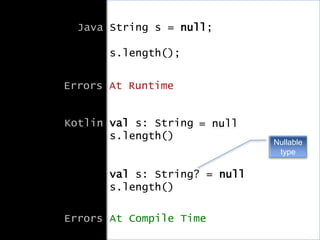
Java String s = null;
s.length();
Errors At Runtime
Kotlin val s: String
s.length()
val s: String? = null
s.length()
Errors At Compile Time
= null
Nullable
type
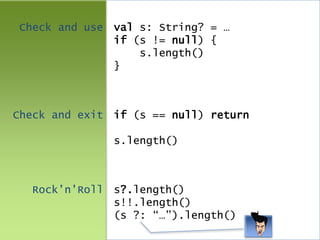
Check and use val s: String? = …
if (s != null) {
s.length()
}
Check and exit if (s == null) return
s.length()
Rock’n’Roll s?.length()
s!!.length()
(s ?: “…”).length()
Kotlin is good with nulls
What about
Java?
+
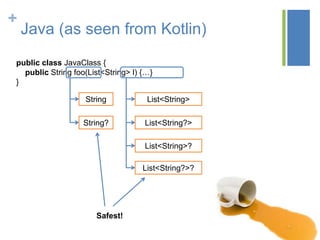
Java (as seen from Kotlin)
public class JavaClass {
public String foo(List<String> l) {…}
}
String
String?
List<String>
List<String?>
List<String>?
List<String?>?
Safest!
+
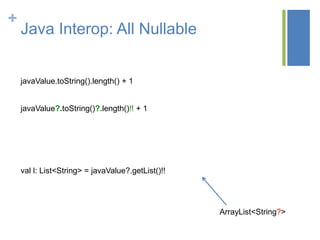
Java Interop: All Nullable
javaValue.toString().length() + 1
javaValue?.toString()?.length()!! + 1
val l: List<String> = javaValue?.getList()!!
ArrayList<String?>
Your safest
option doesn’t
work!
+
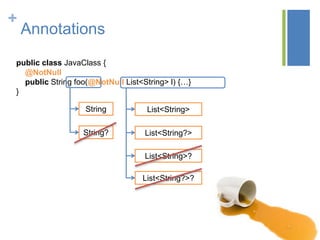
Annotations
public class JavaClass {
@NotNull
public String foo(@NotNull List<String> l) {…}
}
String
String?
List<String>
List<String?>
List<String>?
List<String?>?
Annotations are
cumbersome
AND
don’t really help!
+
Pick Two
 Null-safety
 Convenience
 Java Interop
Flexible Types!
Thanks to
Dr. Ross Tate of
+
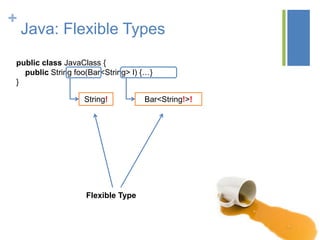
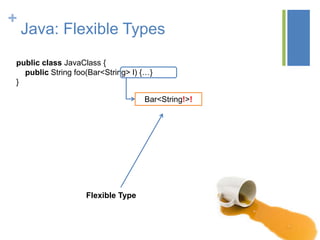
Java: Flexible Types
public class JavaClass {
public String foo(Bar<String> l) {…}
}
String! Bar<String!>!
Flexible Type
+
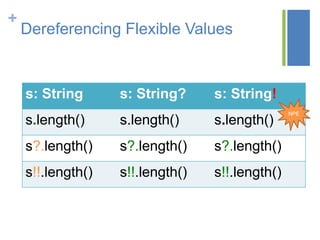
Dereferencing Flexible Values
s: String s: String? s: String!
s.length() s.length() s.length()
s?.length() s?.length() s?.length()
s!!.length() s!!.length() s!!.length()
NPE
+
Assignability
String String?
String!
Flexible Type
NPE
+
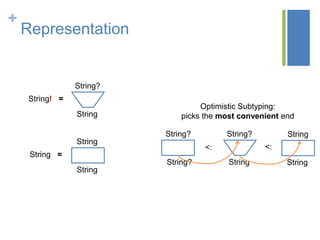
Representation
String! =
String?
String
String =
String
String
Optimistic Subtyping:
picks the most convenient end
String?
String
<:
String
String
String?
String?
<:
+
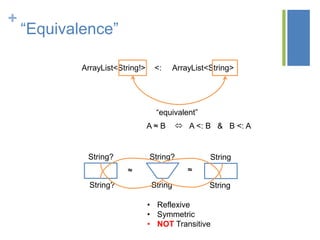
ArrayList<String!> <: ArrayList<String>
“Equivalence”
A ≈ B  A <: B & B <: A
String?
String
≈
String
String
String?
String?
≈
“equivalent”
• Reflexive
• Symmetric
• NOT Transitive
+
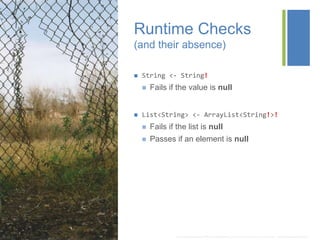
Runtime Checks
(and their absence)
 String <- String!
 Fails if the value is null
 List<String> <- ArrayList<String!>!
 Fails if the list is null
 Passes if an element is null
* http://img06.deviantart.net/1744/i/2013/082/5/b/there_s_a_hole_in_the_fence_where_i_used_to_see__by_tricyclemishap-d5z1u3w.jpg
+
Some Notes
 Flexible Types are Not Denotable!
 String! is notation, not syntax
 Pure Kotlin is Null-Safe
 Kotlin+Java is as safe as Java
 Annotations Still Applicable
 @NotNull String in Java becomes String in Kotlin
+
Arrays
* http://www.performing-musician.com/pm/feb09/images/TechNotes_03_WideLine_array.jpg
There are many Java APIs that talk about arrays,
which will never change
-- John Rose
+
Kotlin Arrays
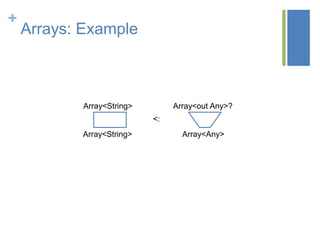
 Array<T> is invariant
 Array<String> >:< Array<Any>
 Array<out T> is a covariant projection
 similar to Array<? extends T>
 Array<out T> <: Array<Any>
 Can’t call arr.set(x)
Array<out Foo!>?
Array<Foo!>
Foo[] =>
+
Arrays: Example
Array<out Any>?
Array<Any>
Array<String>
Array<String>
<:
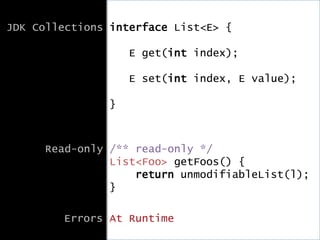
JDK Collections interface List<E> {
E get(int index);
E set(int index, E value);
}
Read-only /** read-only */
List<Foo> getFoos() {
return unmodifiableList(l);
}
Errors At Runtime
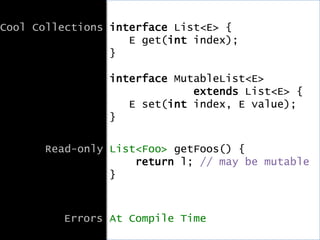
Cool Collections interface List<E> {
E get(int index);
}
interface MutableList<E>
extends List<E> {
E set(int index, E value);
}
Read-only List<Foo> getFoos() {
return l; // may be mutable
}
Errors At Compile Time
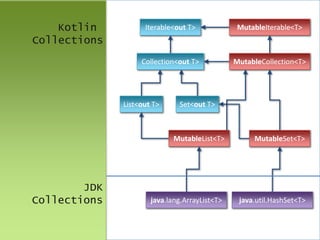
Iterable<out T>
Collection<out T>
List<out T> Set<out T>
MutableIterable<T>
MutableCollection<T>
MutableList<T> MutableSet<T>
java.lang.ArrayList<T> java.util.HashSet<T>
Kotlin
Collections
JDK
Collections
+
Java: Flexible Types
public class JavaClass {
public String foo(Bar<String> l) {…}
}
Bar<String!>!
Flexible Type
+
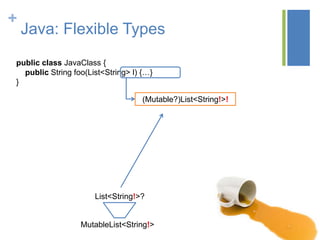
Java: Flexible Types
public class JavaClass {
public String foo(List<String> l) {…}
}
(Mutable?)List<String!>!
List<String!>?
MutableList<String!>
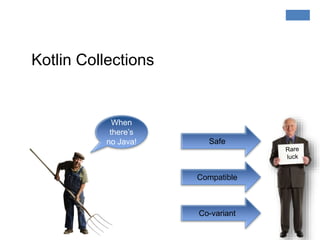
Kotlin Collections
Safe
Compatible
Co-variant
When
there’s
no Java!
+
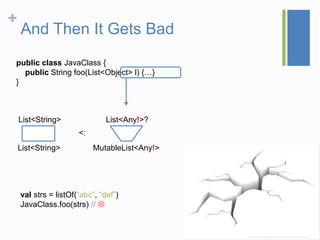
And Then It Gets Bad
public class JavaClass {
public String foo(List<Object> l) {…}
}
List<Any!>?
MutableList<Any!>
List<String>
List<String>
<:
* http://www.psdgraphics.com/file/cracked-floor-background.jpg
val strs = listOf(“abc”, “def”)
JavaClass.foo(strs) // 
+
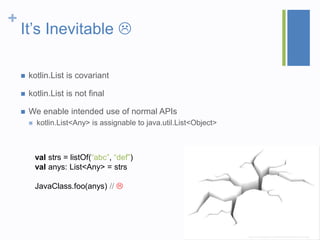
It’s Inevitable 
val strs = listOf(“abc”, “def”)
val anys: List<Any> = strs
JavaClass.foo(anys) // 
* http://www.psdgraphics.com/file/cracked-floor-background.jpg
 kotlin.List is covariant
 kotlin.List is not final
 We enable intended use of normal APIs
 kotlin.List<Any> is assignable to java.util.List<Object>
+
Not Even
As Safe As Java
* http://huntonit.com/media/12233/Huntonit-Design-Hole-in-wal.jpg
Safe enough
+
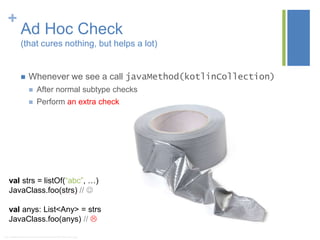
Ad Hoc Check
(that cures nothing, but helps a lot)
 Whenever we see a call javaMethod(kotlinCollection)
 After normal subtype checks
 Perform an extra check
* http://digitalsophisticate.com/wp-content/uploads/2013/09/Duct-Tape-2.jpg
val strs = listOf(“abc”, …)
JavaClass.foo(strs) // 
val anys: List<Any> = strs
JavaClass.foo(anys) // 
+
Runtime Checks
(and their absence)
 MutableList <- (Mutable)List
 Fails if the value is not mutable
 No checks for the list contents
 Where “mutable” means
 All Java collection implementations
 including unmodifiable*() 
 Kotlin classes that extend Mutable*
* http://img06.deviantart.net/1744/i/2013/082/5/b/there_s_a_hole_in_the_fence_where_i_used_to_see__by_tricyclemishap-d5z1u3w.jpg
* http://i.ytimg.com/vi/K92S_n79ETk/maxresdefault.jpg
+
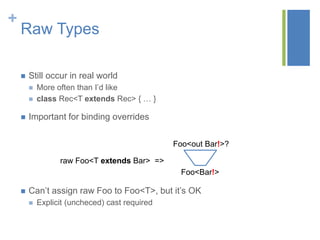
Raw Types
 Still occur in real world
 More often than I’d like
 class Rec<T extends Rec> { … }
 Important for binding overrides
 Can’t assign raw Foo to Foo<T>, but it’s OK
 Explicit (uncheced) cast required
Foo<out Bar!>?
Foo<Bar!>
raw Foo<T extends Bar> =>
+
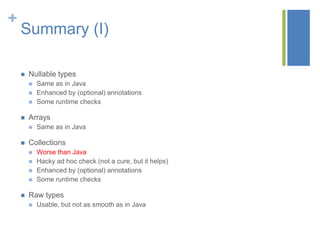
Summary (I)
 Nullable types
 Same as in Java
 Enhanced by (optional) annotations
 Some runtime checks
 Arrays
 Same as in Java
 Collections
 Worse than Java
 Hacky ad hoc check (not a cure, but it helps)
 Enhanced by (optional) annotations
 Some runtime checks
 Raw types
 Usable, but not as smooth as in Java
+
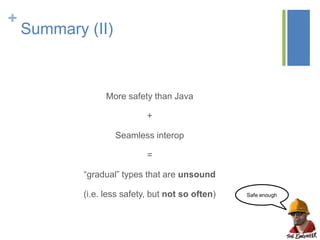
Summary (II)
More safety than Java
+
Seamless interop
=
“gradual” types that are unsound
(i.e. less safety, but not so often) Safe enough
http://kotlinlang.org
+
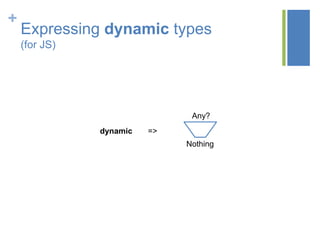
Expressing dynamic types
(for JS)
Any?
Nothing
dynamic =>

Flexible Types in Kotlin - JVMLS 2015