Java To Kotlin A Refactoring Guidebook 1st Edition Duncan Mcgregor
Java To Kotlin A Refactoring Guidebook 1st Edition Duncan Mcgregor
Java To Kotlin A Refactoring Guidebook 1st Edition Duncan Mcgregor
Java To Kotlin A Refactoring Guidebook 1st Edition Duncan Mcgregor
Java To Kotlin A Refactoring Guidebook 1st Edition Duncan Mcgregor
1.
Java To KotlinA Refactoring Guidebook 1st
Edition Duncan Mcgregor download
https://ebookbell.com/product/java-to-kotlin-a-refactoring-
guidebook-1st-edition-duncan-mcgregor-34411616
Explore and download more ebooks at ebookbell.com
2.
Here are somerecommended products that we believe you will be
interested in. You can click the link to download.
Java To Kotlin Duncan Mcgregor
https://ebookbell.com/product/java-to-kotlin-duncan-mcgregor-232322304
Java To C A Primer Charlie Mcdowell Jorgen Villadsen
https://ebookbell.com/product/java-to-c-a-primer-charlie-mcdowell-
jorgen-villadsen-33554968
Java To Python Vishnevskiy Igor
https://ebookbell.com/product/java-to-python-vishnevskiy-igor-5726242
From Java To Ruby Things Every Manager Should Know Bruce A Tate
https://ebookbell.com/product/from-java-to-ruby-things-every-manager-
should-know-bruce-a-tate-931420
3.
From Java ToC Glenn Rowe
https://ebookbell.com/product/from-java-to-c-glenn-rowe-1286552
From Java To C A Developers Guide 1st Heng Ngee Mok
https://ebookbell.com/product/from-java-to-c-a-developers-guide-1st-
heng-ngee-mok-980034
Oracle Xsql Combining Sql Oracle Text Xslt And Java To Publish Dynamic
Web Content Michael D Thomas
https://ebookbell.com/product/oracle-xsql-combining-sql-oracle-text-
xslt-and-java-to-publish-dynamic-web-content-michael-d-thomas-983410
Java How To Program 6th Edition Harvey Deitel Paul Deitel
https://ebookbell.com/product/java-how-to-program-6th-edition-harvey-
deitel-paul-deitel-48775266
Java Ee To Jakarta Ee 10 Recipes Josh Juneau Tarun Telang
https://ebookbell.com/product/java-ee-to-jakarta-ee-10-recipes-josh-
juneau-tarun-telang-51678168
Praise for JavatoKotlin
Natand Duncan open the book by saying they wish this book had existed
when they adopted Kotlin. I completely agree. The book takes their experiences,
their trials and errors, and helps you, the reader, to be on the right path. It definitely is a
book that should be on anyone’s shelf coming to Kotlin from the JVM ecosystem.
An enjoyable read, and an even better reference guide!
—Hadi Hariri, JetBrains
To take familiar good old Java code and see it transform, incrementally, into concise, clear,
expressive and easy to maintain Kotlin code is a wonderful way to learn the language.
Benefit from the experience McGregor and Pryce have distilled in this book.
—Dr. Venkat Subramaniam, award-winning author
and founder of Agile Developer, Inc.
The fastest way to upgrade your skills from Java to Kotlin. Essential
reading for any professional Java developer.
—Dawn Griffiths and David Griffiths,
authors of Head First Kotlin
9.
Duncan McGregor andNat Pryce
Java to Kotlin
A Refactoring Guidebook
Boston Farnham Sebastopol Tokyo
Beijing Boston Farnham Sebastopol Tokyo
Beijing
Preface
Hello, this isDuncan and Nat. As you’re reading this preface, you’re probably trying
to decide whether to invest some hours into reading the rest of this book. So let’s cut
to the chase:
This book won’t teach you to program computers in Kotlin.
We started writing a book that would, but it soon became clear that Kotlin is a large
language, and so the book was going to take longer to write than we wanted. There
are also already some great books in that space, and we don’t like competing against
great.
We decided instead to make our lives easier by concentrating on teaching Kotlin to
Java developers, based on a workshop that we run called Refactoring to Kotlin. This
teaches the Kotlin language by converting existing code and is (according to our mar‐
keting material) designed for Java teams wanting to leverage their existing knowledge
to accelerate their Kotlin adoption.
We started writing that book, but it soon became clear that Kotlin is still a large lan‐
guage, and so we would still be writing for a long time. We also found that motivated
and experienced Java developers can pick up most of Kotlin very quickly. It felt
patronizing to plow our way through language features that our target readers will
probably just appreciate and adopt as soon as they see them. So we abandoned that
idea, and as a result:
This book won’t teach you the Kotlin language.
So why should you read it? Because we have written the book we wish was available
when we first adopted Kotlin. We are experienced programmers who know Java and
the Java ecosystem well. We hope you are too. Like us, you probably have experience
in a number of other languages. You’ve learned the basics of Kotlin, and you recog‐
nize that to get the best out of the language you will need to design your systems dif‐
ferently. You have found that some things that are cumbersome in Java are much
xi
18.
easier in Kotlin,and that some features, such as checked exceptions, are not there at
all. You don’t want to end up merely writing Java code in Kotlin syntax.
Perhaps you have skin in the game. Maybe you’re in a technical leadership position,
or have successfully convinced your team to adopt Kotlin. You might have spent some
political capital to get Kotlin into the project. Now you need to ensure that the transi‐
tion goes smoothly.
You may be responsible for a Java codebase and want to ensure that introducing Kot‐
lin won’t destabilize its existing, business-critical code. Or you may be starting a Kot‐
lin project from scratch but realize your design instincts turn more readily to Java
and objects than to Kotlin and functions.
If this is you, as it was us, then you’ve come to the right place. This book will help you
adapt your thinking and designs to take advantage of Kotlin. That’s not enough,
though, because you have existing code that you need to maintain and enhance. So
we also show how to migrate that code from Java to Kotlin syntax, and from Java to
Kotlin thinking, incrementally and safely, using the automated refactoring tools built
into the IntelliJ IDE.
How This Book Is Organized
This book is about how to transition from Java to Kotlin, mainly focused on code but
touching on projects and organizations. Each chapter addresses an aspect of this tran‐
sition, looking at some aspect of typical Java projects that can be improved on the
journey. They are named in the pattern Java Way to Kotlin Way, where we recom‐
mend that you prefer the latter over the former. Maybe Kotlin makes easier an
approach that was difficult in Java, or Kotlin discourages an approach that is common
in Java to guide design in a direction that is less error-prone, more concise, and more
tool-friendly.
We don’t just recommend you adopt the Kotlin way though; the chapters also show
how to make the transformation. Not by just rewriting the Java, but by gradually
refactoring it to Kotlin it in a way that is safe and allows us to maintain a mixed lan‐
guage codebase.
How Did We Choose the Topics?
We began by analyzing Java and Kotlin developers’ use of their respective languages
and conducting interviews to identify areas of difference and confusion. This was
backed by a machine learning analysis of 33,459 open source Java and Kotlin codeba‐
ses. These identified candidates that we labeled in the thing-to-another-thing form
before ranking them according to frequency and developer-pain-quotient in order to
establish which should make the cut. Finally, we ordered the surviving topics by…
xii | Preface
19.
…it’s no good,we can’t lie to you.
The truth is that we started by choosing topics that we wanted to write about, and
that we felt would be interesting and informative. Chapter 15, Encapsulated Collec‐
tions to Type Aliases, Chapter 9, Multi- to Single-Expression Functions, and Chapter 20,
Performing I/O to Passing Data are typical of these chapters. We also looked for places
where the grain of Kotlin and Java differ significantly, because those were the places
where we found we learned most by asking why they were different. This led to chap‐
ters like Chapter 4, Optional to Nullable, Chapter 6, Java to Kotlin Collections, and
Chapter 8, Static Methods to Top-Level Functions.
As we wrote those chapters, other topics presented themselves and were added to the
list. In particular, as we wrote the refactoring steps for a chapter, we often found our‐
selves making changes to code that we felt deserved their own chapter. Chapter 13,
Streams to Iterables to Sequences, Chapter 10, Functions to Extension Functions, and
Chapter 11, Methods to Properties are examples of these.
The result of this process is by no means exhaustive. If you have already skimmed the
table of contents or index, you will find important topics unaddressed. Take co-
routines for example: this paragraph is the only reference to this huge subject,
because we have found that they haven’t changed the way that we write server-side
code, so we didn’t want to write about them. There are also topics that we would like
to have covered if only we had space and time, including: builders, domain-specific
languages, reflection, dependency injection frameworks, transactions…the list goes
on!
We hope that what we have written about is interesting to you. It is largely a book of
tactics rather than strategies, concentrating on the small battles that we can win from
our place in the trenches, rather than what might be achieved by directing whole divi‐
sions. As larger themes emerge, we will try to connect them, though, and to bring
things together in the final chapter, Chapter 23, Continuing the Journey, where we talk
about what we have learned during the writing process.
Complexity
How should we judge the internal quality of our software? Assuming that it does what
our customers want or need it to do, how can we compare two potential implementa‐
tions, or decide whether a change makes one better or worse? The answer that your
authors choose is complexity. Other things being equal, we favor simple designs that
yield predictable behavior.
Of course to some extent, simplicity and complexity are in the eye of the beholder.
Your authors do have slightly different personal preferences and so sometimes disa‐
gree over whether one implementation or another is better. Where that happens, we
sometimes explore the alternatives in the relevant chapter. However, we do both have
Preface | xiii
20.
a shared beliefin the power of functional programming to reduce the complexity of
our systems, especially when combined with object-oriented (OO) message passing.
Java has been moving in this direction over the years. Scala ran toward functional
programming but away from OO. We find that the grain of Kotlin lets us mix func‐
tional and object programming in a way that reduces complexity and brings out the
best in mere mortal developers.
Perfect Code
On the subject of mere mortals, we should address code quality. It is sorely tempting
to aim for perfection when committing code to a book. We know that you will be
judging us by the code here, and like many developers, a great deal of our own self-
worth is tied up in the quality of the work we produce.
At the same time, we are engineers not artists. Our job is to balance scope, schedule,
and cost for our customers. No one but us really cares about the quality of the code
except when it affects one of these three higher values.
So in our examples, we have tried to show realistic production code. The starting
points are sometimes not as good as we might like; we are, after all, trying to show
ways of improving them. Often refactorings will make things worse before they get
better, so definitely don’t judge us by code in the middle of a chapter. By the end of a
chapter, our aim is to have code that is good enough, but not so perfect that we could
be accused of wasting our clients’ money.
That said, we have a policy of applying cost-effective changes to tidy up, even once we
have covered the topic we set out to illustrate, and more than once we have invented a
topic, and written a chapter just to leave the code in a state that we’re happy with. In
the end, we are artists as well as engineers.
Code Formatting
Our code follows (our interpretation of) the standard coding conventions of Java and
Kotlin where possible.
The practical line length for printed code samples is much shorter than the 120 char‐
acters we usually use in an IDE these days, so we have had to split lines more often
than usual to make the code fit in the page width. Our production code might have
four or five parameters or arguments on a line; in this book we will often only have
one. Through formatting the examples for the page, we have come to like the more
vertical style. We find that Kotlin naturally seems to want to take more vertical space
than Java, but even Java readability seems improved by shorter lines, more breaks,
and more visual alignment. Certainly scrolling sideways is almost as inconvenient in
an IDE as in a book, and our pairing sessions are improved by less scrolling and more
xiv | Preface
21.
side-by-side windows. Oneline per parameter also greatly improves diffs between
code versions. We hope that at the very least you don’t find it too painful to read, and
if you don’t, then try it for your own code.
We will sometimes hide code that isn’t relevant to the discussion. A line that starts
with an ellipsis of three dots indicates that we have omitted some code for clarity or
brevity. For example:
fun Money(amount: String, currency: Currency) =
Money(BigDecimal(amount), currency)
... and other convenience overloads
Conventions Used in This Book
The following typographical conventions are used in this book:
Italic
Indicates new terms, URLs, email addresses, filenames, and file extensions.
Constant width
Used for program listings, as well as within paragraphs to refer to program ele‐
ments such as variable or function names, databases, data types, environment
variables, statements, and keywords.
This element signifies a tip or suggestion.
This element signifies a general note.
This element indicates a warning or caution.
Preface | xv
22.
Using Code Examples
Mostof the code examples in the book (the ones from the refactoring sections) can be
accessed online on GitHub. The reference is immediately after the code, like this:
class TableReaderAcceptanceTests {
@Test
fun test() {
}
}
Example 0.1 [table-reader.1:src/test/java/travelator/tablereader/TableReaderAcceptanceTests.kt]
If you are reading this on a device, the reference should be a hyperlink to that version
of the file on GitHub. On real paper, you can click all you like; nothing will happen,
sorry. But if you take the example number, in this case 0.1, and type it into a form on
the book’s website, it will show you links that take you to the same place.
In Git, the different code examples (these sometimes span multiple chapters) evolve
in separate branches. The steps are tagged—table-reader.1 is the tag in this case. The
GitHub link is to code with that tag, so you can view the file shown (src/test/java/trav‐
elator/tablereader/TableReaderAcceptanceTests.kt here) and the others in the example
at that version. You can also select other tags to see the different versions, and differ‐
ent branches to see different examples. For quicker navigation, you can clone the
repository, open it in IntelliJ, and use the Git tool window to switch branches and
versions.
The code examples are not real! The codebase builds and passes its
tests, but it is fictional. There are places where the examples don’t
join up properly, and others where if you peek behind the curtain
you will see us wiggling the levers. We have tried to be honest, but
prefer to ship!
If you have a technical question or a problem using the code examples, visit the
book’s website or email bookquestions@oreilly.com.
This book is here to help you get your job done. In general, if example code is offered
with this book, you may use it in your programs and documentation. You do not
need to contact us for permission unless you’re reproducing a significant portion of
the code. For example, writing a program that uses several chunks of code from this
book does not require permission. Selling or distributing examples from O’Reilly
books does require permission. Answering a question by citing this book and quoting
example code does not require permission. Incorporating a significant amount of
example code from this book into your product’s documentation does require
permission.
xvi | Preface
23.
We appreciate, butgenerally do not require, attribution. An attribution usually
includes the title, author, publisher, and ISBN. For example: “Java to Kotlin by Dun‐
can McGregor and Nat Pryce (O’Reilly). Copyright 2021 Duncan McGregor and Nat
Pryce, 978-1-492-08227-9.”
If you feel your use of code examples falls outside fair use or the permission given
above, feel free to contact us at permissions@oreilly.com.
O’Reilly Online Learning
For more than 40 years, O’Reilly Media has provided technol‐
ogy and business training, knowledge, and insight to help
companies succeed.
Our unique network of experts and innovators share their knowledge and expertise
through books, articles, conferences, and our online learning platform. O’Reilly’s
online learning platform gives you on-demand access to live training courses, in-
depth learning paths, interactive coding environments, and a vast collection of text
and video from O’Reilly and 200+ other publishers. For more information, please
visit http://oreilly.com.
How to Contact Us
Please address comments and questions concerning this book to the publisher:
O’Reilly Media, Inc.
1005 Gravenstein Highway North
Sebastopol, CA 95472
800-998-9938 (in the United States or Canada)
707-829-0515 (international or local)
707-829-0104 (fax)
We have a web page for this book, where we list errata, examples, and any additional
information. You can access this page at https://oreil.ly/java-to-kotlin.
Email bookquestions@oreilly.com to comment or ask technical questions about this
book.
For news and information about our books and courses, visit http://www.oreilly.com.
Find us on Facebook: http://facebook.com/oreilly
Follow us on Twitter: http://twitter.com/oreillymedia
Watch us on YouTube: http://youtube.com/oreillymedia
Preface | xvii
24.
Acknowledgments
Thank you toHadi Hariri for suggesting to O’Reilly that we should write a book, and
to Zan McQuade for believing him. Thank you to our editor Sarah Grey, who had to
live with the consequences, and Kerin Forsyth and Kate Galloway for tidying every‐
thing up and actually getting it published.
Many friends and colleagues, and some lovely strangers, reviewed drafts ranging
from early and uncoordinated to tantalizingly nearly complete. Thank you to Yana
Afanasyeva, Jack Bolles, David Denton, Bruce Eckel, Dmitry Kandalov, Kevin Peel,
James Richardson, Ivan Sanchez, Jordan Stewart, Robert Stoll, Christoph Sturm,
Łukasz Wycisk, and Daniel Zappold and to our technical reviewers, Uberto Barbini,
James Harmon, Mark Maynard, and Augusto Rodriguez. We really appreciate all your
suggestions, encouragement, and candor.
Extreme Programming revolutionized the way that write software—we all owe a debt
of gratitude to Ward Cunningham and Kent Beck. Thank you also to Martin Fowler,
without whom this book might not have been written. In the UK the eXtreme Tues‐
day Club has been innovating on these ideas since 1999, and has attracted a cabal of
developers. We are lucky to have worked with, and learned from, many talented
members of this group. If you have a problem, if no one else can help, and if you can
find them, maybe you can hire them.
Duncan’s Bit
I don’t think my wife will ever understand what I do for a living, and there’s no
chance that she will read the rest of this book, but she will probably get this far. So
thank you, Jo McGregor, for putting up with me writing rather than spending time
with you, and talking about writing when I was spending time with you. I couldn’t
have done it without your support and encouragement. Thank you also to our two
wonderful sons, Callum and Alistair, who make us so proud.
Thank you to Vickie Kennish for taking a keen interest in becoming the mother of an
author, checking on progress during our COVID lockdown walks. My late father,
John, would I’m sure have played it more casual, but be bragging about the book to
his friends. Also gone but not forgotten is our beautiful cat Sweet Pea, who kept me
company through most of the writing but died just before it was finished.
The friendship and support of Robin Helliwell has been a constant throughout my
adult life. Likewise, my sister Lucy Seal, and many other family members too numer‐
ous to list individually. In my professional life, in addition to those who gave
feedback, thank you to Alan Dyke, Richard Care, and Gareth Sylvester-Bradley, all
influential and supportive beyond the call of duty.
xviii | Preface
25.
Nat’s Bit
When Itold my wife, Lamaan, that I was planning to write another book, her imme‐
diate reaction was not one of horror. For that, and for her constant encouragement, I
owe her many thanks.
Hat tip to my sister, Lois Pryce, and brother-in-law, Austin Vince, whose motorcycle
journeys, books, and films inspired the overland travel planning application used in
the worked example code.
And thanks to Oliver and Alex. Now that the book is finished, I am once again avail‐
able for consultancy in music and games programming.
Preface | xix
27.
CHAPTER 1
Introduction
The Grainof a Programming Language
Like wood, a programming language has a grain. In both carpentry and program‐
ming, when you work with the grain, things go smoothly. When you work against the
grain, things are more difficult. When you work against the grain of a programming
language, you have to write more code than necessary, performance suffers, you are
more likely to introduce defects, you usually have to override convenient defaults,
and you have to fight against the tooling every step of the way.
Going against the grain involves constant effort with an uncertain payoff.
For example, it has always been possible to write Java code in a functional style, but
few programmers did before Java 8—for good reasons.
Here’s Kotlin code that calculates the sum of a list of numbers by folding the list with
the addition operator:
val sum = numbers.fold(0, Int::plus)
Let’s compare that to what was required in Java 1.0 to do the same.
The mists of time will pass over you while transporting you to 1995…
Java 1.0 does not have first-class functions, so we have to implement functions as
objects and define our own interfaces for different types of function. For example, the
addition function takes two arguments, so we have to define the type of two-
argument functions:
public interface Function2 {
Object apply(Object arg1, Object arg2);
}
1
28.
Then we haveto write the fold higher-order function, hiding the iteration and muta‐
tion required by the Vector class. (The 1995 Java standard library doesn’t yet include
the Collections Framework.)
public class Vectors {
public static Object fold(Vector l, Object initial, Function2 f) {
Object result = initial;
for (int i = 0; i < l.size(); i++) {
result = f.apply(result, l.get(i));
}
return result;
}
... and other operations on vectors
}
We have to define a separate class for every function we want to pass to our fold
function. The addition operator can’t be passed around as a value, and the language
has no method references, lambdas, or closures at this time, not even inner classes.
Nor does Java 1.0 have generics or autoboxing—we have to cast the arguments to the
expected type and write the boxing between reference types and primitives:
public class AddIntegers implements Function2 {
public Object apply(Object arg1, Object arg2) {
int i1 = ((Integer) arg1).intValue();
int i2 = ((Integer) arg2).intValue();
return new Integer(i1 + i2);
}
}
And, finally, we can use all that to calculate the sum:
int sum = ((Integer) Vectors.fold(counts, new Integer(0), new AddIntegers()))
.intValue();
That’s a lot of effort for what is a single expression in a mainstream language in 2020.
But that’s not the end of it. Because Java doesn’t have standard function types, we can’t
easily combine different libraries written in a functional style. We have to write
adapter classes to map between the function types defined in different libraries. And,
because the virtual machine has no JIT and a simple garbage collector, our functional
code has worse performance than the imperative alternative:
int sum = 0;
for (int i = 0; i < counts.size(); i++) {
sum += ((Integer)counts.get(i)).intValue();
}
In 1995, there is just not enough benefit to justify the effort of writing Java in a func‐
tional style. Java programmers found it easier to write imperative code that iterated
over collections and mutated state.
2 | Chapter 1: Introduction
29.
Writing functional codegoes against the grain of Java 1.0.
A language’s grain forms over time as its designers and users build a common under‐
standing of how language features interact and encode their understanding and pref‐
erences in libraries that others build upon. The grain influences the way that
programmers write code in the language, which influences the evolution of the lan‐
guage and its libraries and programming tools, changing the grain, altering the way
that programmers write code in the language, on and on in a continual cycle of
mutual feedback and evolution.
For example, as we move forward through time, Java 1.1 adds anonymous inner
classes to the language, and Java 2 adds the Collections Framework to the standard
library. Anonymous inner classes mean that we don’t need to write a named class for
each function we want to pass to our fold function, but the resulting code is arguably
harder to read:
int sum = ((Integer) Lists.fold(counts, new Integer(0),
new Function2() {
public Object apply(Object arg1, Object arg2) {
int i1 = ((Integer) arg1).intValue();
int i2 = ((Integer) arg2).intValue();
return new Integer(i1 + i2);
}
})).intValue();
Functional idioms still go against the grain of Java 2.
Fast-forward to 2004, and Java 5 is the next release that significantly changes the lan‐
guage. It adds generics and autoboxing, which improve type safety and reduce boiler‐
plate code:
public interface Function2<A, B, R> {
R apply(A arg1, B arg2);
}
int sum = Lists.fold(counts, 0,
new Function2<Integer, Integer, Integer>() {
@Override
public Integer apply(Integer arg1, Integer arg2) {
return arg1 + arg2;
}
});
Java developers often use Google’s Guava library to add some common higher-order
functions over collections (although fold is not among them), but even the authors of
Guava recommend writing imperative code by default, because it has better perfor‐
mance and is usually easier to read.
Functional programming still goes largely against the grain of Java 5, but we can see
the start of a trend.
The Grain of a Programming Language | 3
30.
Java 8 addsanonymous functions (aka lambda expressions) and method references to
the language, and the Streams API to the standard library. The compiler and virtual
machine optimize lambdas to avoid the performance overhead of anonymous inner
classes. The Streams API fully embraces functional idioms, finally allowing:
int sum = counts.stream().reduce(0, Integer::sum);
However, it isn’t entirely plain sailing. We still can’t pass the addition operator as a
parameter to the Streams reduce function, but we have the standard library function
Integer::sum that does the same thing. Java’s type system still creates awkward edge
cases because of its distinction between reference and primitive types. The Streams
API is missing some common higher-order functions that we would expect to find if
coming from a functional language (or even Ruby). Checked exceptions don’t play
well with the Streams API and functional programming in general. And making
immutable classes with value semantics still involves a lot of boilerplate code. But
with Java 8, Java has fundamentally changed to make a functional style work, if not
completely with the grain of the language, at least not against it.
The releases after Java 8 add a variety of smaller language and library features that
support more functional programming idioms, but nothing that changes our sum
calculation. And that brings us back to the present day.
In the case of Java, the grain of the language, and the way programmers adapted to it,
evolved through several distinct programming styles.
An Opinionated History of Java Programming Style
Like ancient poets, we divide the development of Java programming style into four
distinct ages: Primeval, Beans, Enterprise, and Modern.
Primeval Style
Originally intended for use in domestic appliances and interactive TV, Java only took
off when Netscape adopted Java applets in its hugely popular Navigator browser. Sun
released the Java development kit 1.0, Microsoft included Java in Internet Explorer,
and suddenly everyone with a web browser had a Java runtime environment. Interest
in Java as a programming language exploded.
The fundamentals of Java were in place by this time:
• The Java virtual machine and its bytecode and class file format
• Primitive and reference types, null references, garbage collection
• Classes and interfaces, methods and control flow statements
• Checked exceptions for error handling, the abstract windowing toolkit
4 | Chapter 1: Introduction
31.
• Classes fornetworking with internet and web protocols
• The loading and linking of code at runtime, sandboxed by a security manager
However, Java wasn’t yet ready for general-purpose programming: the JVM was slow
and the standard library sparse.
Java looked like a cross between C++ and Smalltalk, and those two languages influ‐
enced the Java programming style of the time. The “getFoo/setFoo” and “AbstractSin‐
gletonProxyFactoryBean” conventions that programmers of other languages poke fun
at were not yet widespread.
One of Java’s unsung innovations was an official coding convention that spelled out
how programmers should name packages, classes, methods, and variables. C and
C++ programmers followed a seemingly infinite variety of coding conventions, and
code that combined multiple libraries ended up looking like a right dog’s dinner
somewhat inconsistent. Java’s one true coding convention meant that Java program‐
mers could seamlessly integrate strangers’ libraries into their programs, and encour‐
aged the growth of a vibrant open source community that continues to this day.
Bean Style
After Java’s initial success, Sun set out to make it a practical tool for building applica‐
tions. Java 1.1 (1996) added language features (most notably inner classes), improved
the runtime (most notably just-in-time compilation and reflection), and extended the
standard library. Java 1.2 (1998) added a standard collections API and the Swing
cross-platform GUI framework, which ensured Java applications looked and felt
equally awkward on every desktop operating system.
At this time, Sun was eying Microsoft’s and Borland’s domination of corporate soft‐
ware development. Java had the potential to be a strong competitor to Visual Basic
and Delphi. Sun added a slew of APIs that were heavily inspired by Microsoft APIs:
JDBC for data base access (equivalent to Microsoft’s ODBC), Swing for desktop GUI
programming (equivalent to Microsoft’s MFC), and the framework that had the
greatest influence on Java programming style, JavaBeans.
The JavaBeans API was Sun’s answer to Microsoft’s ActiveX component model for
low-code, graphical, drag-and-drop programming. Windows programmers could use
ActiveX components in their Visual Basic programs or embed them in office docu‐
ments or web pages on their corporate intranet. Despite how easy it was to use
ActiveX components, they were notoriously difficult to write. JavaBeans were much
easier; you merely had to follow some additional coding conventions for your Java
class to be considered a “bean” that could be instantiated and configured in a graphi‐
cal designer. The promise of “Write once, run anywhere” meant you would also be
able to use—or sell—JavaBean components on any operating system, not just
Windows.
An Opinionated History of Java Programming Style | 5
32.
For a classto be a JavaBean, it needed to have a constructor that took no arguments,
be serializable, and declare an API made up of public properties that could be read
and optionally written, methods that could be invoked, and events that objects of the
class would emit. The idea was that programmers would instantiate beans in a graph‐
ical application designer, configure them by setting their properties, and connect
events emitted by beans to the methods of other beans. By default, the Beans API
defined properties by pairs of methods whose names started with get and set. This
default could be overridden, but doing so required the programmer to write more
classes of boilerplate code. Programmers usually went to the effort only when retro‐
fitting existing classes to act as JavaBeans. In new code, it was much easier to go with
the grain.
The drawback of Beans style is that it relies heavily on mutable state and requires
more of that state to be public than plain old Java objects do, because visual builder
tools could not pass parameters to an object’s constructor, but instead had to set
properties. User interface components work well as beans, because they can safely be
initialized with default content and styling and adjusted after construction. When we
have classes that have no reasonable defaults, treating them in the same way is error-
prone, because the type checker can’t tell us when we have provided all the required
values. The Beans conventions make writing correct code harder, and changes in
dependencies can silently break client code.
In the end, graphical composition of JavaBeans did not become mainstream, but the
coding conventions stuck. Java programmers followed the JavaBean conventions even
when they had no intention of their class being used as a JavaBean. Beans had an
enormous, lasting, and not entirely positive influence on Java programming style.
Enterprise Style
Java did eventually spread through the enterprise. It didn’t replace Visual Basic on the
corporate desktop as expected, but rather unseated C++ as the server-side language of
choice. In 1998, Sun released Java 2 Enterprise Edition (then known as J2EE, now
JakartaEE), a suite of standard APIs for programming server-side, transaction pro‐
cessing systems.
The J2EE APIs suffer from abstraction inversion. The JavaBeans and applets APIs also
suffer from abstraction inversion—they both disallow passing parameters to con‐
structors, for example—but it is far more severe in J2EE. J2EE applications don’t have
a single entry point. They are composed of many small components whose lifetime is
managed by an application container, and are exposed to one another through a JNDI
name service. Applications need a lot of boilerplate code and mutable state to look up
the resources they depend on. Programmers responded by inventing dependency
injection (DI) frameworks that did all the resource lookup and binding, and managed
6 | Chapter 1: Introduction
33.
lifetimes. The mostsuccessful of these is Spring. It builds upon the JavaBeans coding
conventions and uses reflection to compose applications from Bean-like objects.
Abstraction Inversion
Abstraction inversion is an architectural flaw in which a software platform prevents
client code from using lower-level mechanisms that it requires. This forces program‐
mers to reimplement those lower-level mechanisms using the higher-level facilities
exposed by the platform’s API, which in turn uses the very features being reimple‐
mented. The result is unnecessary code, poor performance, and additional mainte‐
nance and testing costs.
Take, for example, J2EE servlets. In the Servlet API, the servlet container, not the web
application, was responsible for instantiating servlet objects. In fact, the web applica‐
tion wasn’t written in Java at all; it was an XML file that listed the classes that the serv‐
let container would instantiate. So every servlet had to have a no-argument
constructor, and the web application couldn’t initialize its servlets by passing objects
to their constructors.
Instead, you had to write a ServletContextListener that created objects required by
the application’s servlets and stored them as named, untyped attributes of the Servlet
Context:
public class ExampleServletContextListener
implements ServletContextListener {
public void contextInitialized(ServletContextEvent contextEvent) {
ServletContext context = contextEvent.getServletContext();
context.setAttribute("example.httpClient", createHttpClient());
context.setAttribute("example.template", new URITemplate(
context.getInitParameter("example.template")));
...
}
...
}
Servlets initialized themselves by looking for the objects they needed in the context
and casting them to the expected type:
public class ExampleServlet extends HttpServlet {
private HttpClient httpClient;
private URITemplate routeServiceTemplate;
...
public void init(ServletConfig config) throws ServletException {
super.init(config);
ServletContext context = config.getServletContext();
this.httpClient =
(HttpClient) context.getAttribute("example.httpClient");
An Opinionated History of Java Programming Style | 7
34.
this.routeServiceTemplate =
(URITemplate) context.getAttribute("example.template");
...
}
...
}
That’sa lot of effort to achieve what you could do with a constructor call if the Servlet
API didn’t prevent you from doing so. And the constructor call would be type
checked. It’s no wonder that Java programmers found dependency injection frame‐
works to be an improvement!
The Servlet API finally allowed web applications to instantiate servlets and pass
dependencies to their constructors in version 3.0, more than 20 years after the Servlet
API was first published.
In terms of programming style, DI frameworks encourage programmers to eschew
direct use of the new keyword and instead rely on the framework to instantiate
objects. The Android APIs also exhibit abstraction inversion, and Android program‐
mers also turn to DI frameworks to help them write to the APIs. DI frameworks’
focus on mechanism over domain modeling leads to enterprisey class names such as
Spring’s infamous AbstractSingletonProxyFactoryBean.
On the plus side, though, the Enterprise Era saw the release of Java 5, which added
generics and autoboxing to the language, the most significant change to date. This era
also saw a massive uptake of open source libraries in the Java community, powered by
the Maven packaging conventions and central package repository. The availability of
top-notch open source libraries fueled the adoption of Java for business-critical appli‐
cation development, and led to more open source libraries, in a virtuous circle. This
was followed by best-in-class development tools, including the IntelliJ IDE, which we
use in this book.
Modern Style
Java 8 brought the next big change to the language—lambdas—and significant addi‐
tions to the standard library to take advantage of them. The Streams API encouraged
a functional programming style, in which processing is performed by transforming
streams of immutable values rather than changing the state of mutable objects. A new
date/time API ignored JavaBeans coding conventions for property accessors and fol‐
lowed coding conventions common to the Primeval Age.
The growth of the cloud platforms meant that programmers didn’t need to deploy
their servers into JavaEE application containers. Lightweight web application frame‐
works let programmers write a main function to compose their applications. Many
server-side programmers stopped using DI frameworks—function and object
8 | Chapter 1: Introduction
35.
composition were goodenough—so DI frameworks released greatly simplified APIs
to stay relevant. With no DI framework or mutable state, there’s less need to follow
JavaBean coding conventions. Within a single codebase, exposing fields of immutable
values works fine, because the IDE can encapsulate a field behind accessors in an
instant if they’re needed.
Java 9 introduced modules, but so far they have not seen widespread adoption outside
the JDK itself. The most exciting thing about recent Java releases has been the modu‐
larization of the JDK and removal of seldom-used modules, such as CORBA, from
the JDK into optional extensions.
The Future
The future of Java promises more features to make Modern Style easier to apply:
records, pattern matching, user-defined value types, and eventually the unification of
primitive and reference types into a uniform type system.
However, this is a challenging effort that will take many years to complete. Java
started off with some deep-seated inconsistencies and edge cases that are hard to
unify into clean abstractions while staying backward compatible. Kotlin has the bene‐
fit of 25 years of hindsight, and a clean slate from which to start afresh.
The Grain of Kotlin
Kotlin is a young language, but it clearly has a different grain than Java.
When we wrote this, the “Why Kotlin” section of the Kotlin home page gave four
design goals: concise, safe, interoperable, and tool-friendly. The designers of the lan‐
guage and its standard library also encoded implicit preferences that contribute to
these design goals. These preferences include:
Kotlin prefers the transformation of immutable data to mutation of state.
Data classes make it easy to define new types with value semantics. The standard
library makes it easier and more concise to transform collections of immutable
data than to iterate and mutate data in place.
Kotlin prefers behavior to be explicit.
For example, there is no implicit coercion between types, even from smaller to
larger range. Java implicitly converts int values to long values, because there is no
loss of precision. In Kotlin, you have to call Int.toLong() explicitly. The prefer‐
ence for explicitness is especially strong when it comes to control flow. Although
you can overload arithmetic and comparison operators for your own types, you
cannot overload the shortcut logical operators (&& and ||), because that would
allow you to define different control flow.
The Grain of Kotlin | 9
36.
Kotlin prefers staticover dynamic binding.
Kotlin encourages a type-safe, compositional coding style. Extension functions
are bound statically. By default, classes are not extensible and methods are not
polymorphic. You must explicitly opt in to polymorphism and inheritance. If you
want to use reflection, you have to add a platform-specific library dependency.
Kotlin is designed from the outset to be used with a language-aware IDE that
statically analyzes the code to guide the programmer, automate navigation, and
automate program transformation.
Kotlin doesn’t like special cases.
Compared to Java, Kotlin has fewer special cases that interact in unpredictable
ways. There is no distinction between primitive and reference types. There is no
void type for functions that return but do not return a value; functions in Kotlin
either return a value or never return at all. Extension functions allow you to add
new operations to existing types that look the same at the call point. You can
write new control structures as inline functions, and the break, continue, and
return statements act the same as they do in built-in control structures.
Kotlin breaks its own rules to make migration easier.
The Kotlin language has features to allow idiomatic Java and Kotlin code to coex‐
ist in the same codebase. Some of those features remove guarantees provided by
the type checker and should only be used to interoperate with legacy Java. For
example, lateinit opens a hole in the type system so that Java dependency injec‐
tion frameworks that initialize objects by reflection can inject values through the
encapsulation boundaries that are normally enforced by the compiler. If you
declare a property as lateinit var, it’s up to you to ensure the code initializes the
property before reading it. The compiler will not catch your mistakes.
When we, Nat and Duncan, revisit the earliest code we wrote in Kotlin, it tends to
look like Java dressed in Kotlin syntax. We came to Kotlin after years writing a lot of
Java and had ingrained habits that affected how we wrote Kotlin code. We wrote
unnecessary boilerplate, didn’t make good use of the standard library, and avoided
using null because we weren’t yet used to the type checker enforcing null safety. The
Scala programmers on our team went too far the other way—their code looked like
Kotlin trying to be Scala, cosplaying as Haskell. None of us had yet found the sweet
spot that comes from working with the grain of Kotlin.
The path to idiomatic Kotlin is complicated by the Java code we have to keep working
along the way. In practice, it is not enough just to learn Kotlin. We have to work with
the different grains of Java and Kotlin, being sympathetic to both as we gradually
transition from one to the other.
10 | Chapter 1: Introduction
37.
Refactoring to Kotlin
Whenwe started our journey to Kotlin, we were responsible for maintaining and
enhancing business-critical systems. We were never able to focus only on converting
our Java codebase to Kotlin. We always had to migrate code to Kotlin at the same time
as changing the system to meet new business needs, maintaining a mixed Java/Kotlin
codebase as we did so. We managed the risk by working in small changes, making
each easy to understand and cheap to discard if we found out it broke something.
Our process was first to convert Java code to Kotlin, giving us a Java-esque design in
Kotlin syntax. We then incrementally applied Kotlin language features to make the
code increasingly easy to understand, more type safe, more concise, and with a more
compositional structure that is easier to change without unpleasant surprises.
Small, safe, reversible changes that improved the design: we refactored from idiomatic
Java to idiomatic Kotlin.
Refactoring between languages is usually harder than refactoring within a single lan‐
guage because refactoring tools do not work well across the boundaries between the
languages, if they work at all. Porting logic from one language to another must be
done manually, which takes longer and introduces more risk. Once multiple lan‐
guages are in use, the language boundary impedes refactoring because when you
refactor code in one language, the IDE does not update dependent code written in
other languages to be compatible.
What makes the combination of Java and Kotlin unique is the (relatively) seamless
boundary between the two languages. Thanks to the design of the Kotlin language,
the way it is mapped to the JVM platform, and JetBrains’ investment in developer
tooling, refactoring Java to Kotlin and refactoring a combined Java/Kotlin codebase is
almost as easy as refactoring in a single codebase.
Our experience has been that we can refactor Java to Kotlin without affecting produc‐
tivity, and that productivity then accelerates as we convert more of the codebase to
Kotlin.
Refactoring Principles
The practice of refactoring has come a long way since its initial popularization in
Martin Fowler’s book, Refactoring: Improving the Design of Existing Code (Addison-
Wesley), published in 1999. This book had to detail manual steps for even simple
refactorings like renaming identifiers but notes that some state-of-the-art develop‐
ment environments were beginning to provide automated support to reduce such
drudgery. Nowadays we expect our tools to automate even complicated scenarios
such as extracting an interface or changing function signatures.
Refactoring to Kotlin | 11
38.
These individual refactoringsrarely stand alone though. Now that the building-block
refactorings can be performed automatically, we have the time and energy to combine
them to make larger-scale changes to our codebase. When the IDE does not have dis‐
tinct user-interface actions for a large-scale transformation we wish to do, we have to
perform it as a sequence of more granular refactorings. We use the IDE’s automatic
refactoring whenever we can, and fall back on text editing when the IDE does not
automate a transformation we need.
It’s tedious and error-prone to refactor by editing text. To reduce the risk, and our
boredom, we minimize the amount of text editing we have to do. If we must edit text,
we prefer that edit to affect a single expression. So we use automatic refactorings to
transform the code so that is possible, edit one expression, and then use automatic
refactorings to tidy back up to the final state we’re aiming for.
The first time we describe a large-scale refactoring, we’ll go through it step by step
and show how the code changes at each step. This takes quite a lot of space on the
page and will take a bit of reading time to follow. In practice, however, these large
refactorings are quick to apply. They typically take a few seconds, a few minutes at
most.
We expect the refactorings published here to date quite quickly as tools improve. The
individual IDE steps may be renamed, and some combinations might be imple‐
mented as single refactorings in their own right. Experiment in your context to find
ways of gradually and safely transforming your code that are better than those we
present, and then share them with the world too.
We Assume Good Test Coverage
As Martin Fowler says in Refactoring: Improving the Design of Existing Code: “[I]f you
want to refactor, the essential precondition is having solid tests.” Good test coverage
ensures that the code transformations we want to only improve design have not inad‐
vertently changed our system’s behavior. In this book, we assume that you have good
test coverage. We do not cover how to write automated tests. Other authors have
addressed these topics in more detail than we could in this book, for example: Test-
Driven Development By Example by Kent Beck (Addison-Wesley) and Growing
Object-Oriented Software Guided By Tests by Steve Freeman and Nat Pryce (Addison-
Wesley). We do, however, show how to apply Kotlin features to improve our tests.
As we walk through multistep code transformations, we won’t always say when we
run the tests. Assume that we run our tests after every change that we show that com‐
piles, no matter how small.
If your system does not already have good test coverage, it can be difficult (and
expensive) to retrofit tests to the code because the logic you want to test is entangled
with other aspects of the system. You’re in a chicken and egg situation: you have to
12 | Chapter 1: Introduction
39.
refactor to beable to add tests so that you can safely refactor. Again, other authors
have addressed these topics in more detail than we could, for example: Working Effec‐
tively with Legacy Code by Michael Feathers (Pearson).
We’ve listed more books about these topics in the Bibliography.
We Commit for Git Bisect
Just as we don’t explicitly state when we run our tests, nor do we explicitly state when
we commit our changes. Assume we commit our changes whenever they have added
value to the code, no matter how small.
We know our test suite isn’t perfect. If we accidentally break something that is not
caught by our tests, we want to find the commit that introduced the fault and fix it as
quickly as we can.
The git bisect command automates that search. We write a new test that demon‐
strates the error, and git bisect does a binary search of the history to find the first
commit that makes that test fail.
If the commits in our history are large, and contain a mishmash of unrelated changes,
git bisect won’t help as much as it could. It cannot tell which of the source changes
within a commit introduced the error. If commits mix refactoring and changes to
behavior, reverting a bad refactoring step is likely to break other behavior in the
system.
Therefore, we commit small, focused changes that separate refactorings from each
other, and from changes to behavior, to make it easy to understand what changed and
fix any erroneous change. For the same reason, we very rarely squash commits.
We prefer to commit changes straight onto the mainline branch—
“trunk-based development”—but changing code in a sequence of
small, independent commits is just as beneficial when working in
branches and merging less frequently.
What Are We Working On?
In the chapters that follow, we take examples from the codebase of Travelator, a fic‐
tional application for planning and booking international surface travel. Our (still fic‐
tional) users plan routes by sea, rail, and road; search for places to stay and sights to
see; compare their options by price, time, and spectacle; and finally book their trips,
all from web and mobile frontends that invoke backend services via HTTP.
What Are We Working On? | 13
40.
Each chapter pullsan informative example from a different part of the Travelator sys‐
tem, but they share common domain concepts: money, currency conversion, jour‐
neys, itineraries, bookings, and so on.
Our aim is that, like our Travelator application, this book will help you plan your
journey from Java to Kotlin.
Let’s Get Started!
Enough chitchat. You’re probably itching to convert all that Java to Kotlin. We’ll start
in the next chapter by adding Kotlin support to our project’s build file.
14 | Chapter 1: Introduction
41.
CHAPTER 2
Java toKotlin Projects
What is the first step of the journey from pure Java to a mixed and then
increasingly Kotlin codebase?
Strategy
The first time we, Nat and Duncan, introduced Kotlin to a Java codebase, we were
members of a small team that included six developers, building a relatively greenfield
project. We had already deployed some web applications with Kotlin, but our enter‐
prise architects insisted that we write the new system in Java 8. This was shortly after
Kotlin 1.0 had been released, but before Google announced that Kotlin was an official
language for Android, so the architects were understandably wary about committing
to a language with an uncertain future for a strategic system that they expected to be
around for decades.
In Java, we leaned toward a functional approach, designing the core application
domain model as immutable data types transformed by pipelines. However, we kept
bumping into Java’s limitations: the verbosity required to implement immutable value
types, the distinction between primitive and reference types, null references, and
Streams lacking common higher-order functions. Meanwhile, we could see Kotlin
being adopted at an ever-increasing rate across the industry and even within the
company. When we saw Google’s announcement, we decided to start converting our
Java to Kotlin.
Our judgment was that starting in the core domain model would give us the biggest
bang for our buck. Kotlin’s data classes shrank the code significantly, in some cases
replacing hundreds of lines of code with a single declaration. We started carefully,
using IntelliJ to convert a small value class that had no dependencies on other classes
beyond those in the standard library, and examined how that affected the rest of our
15
42.
Java codebase. Ithad no effect at all! Emboldened by this success, we picked up the
pace. Whenever a new feature needed changes to a Java domain model class, we
would first convert it to a Kotlin data class, commit the conversion, and then imple‐
ment the feature.
As more of the domain model logic became pure Kotlin, we were able to make better
use of Kotlin features. For example, we replaced calls to the Stream API with Kotlin’s
standard functions on collections and sequences. The biggest improvement though,
was replacing our use of Java’s Optional type with nullable references. This simplified
our code and gave us greater confidence in its null safety.
Another project in the company adopted Kotlin for a different reason. They had a
mature Java system that was built on a dependency injection framework. The devel‐
opers found that the framework’s use of reflection and annotations made the code
difficult to understand and navigate in the IDE. Kotlin’s lightweight syntax for clo‐
sures offered a way to define the structure of their application and distinguish
between object graphs instantiated for the whole application, for each HTTP request,
or for each database transaction. They gradually refactored the underpinnings of
their system from a framework that obscured the architecture to a style that com‐
posed functions and made the architecture visible in the code. This work became the
http4k web programming toolkit.
As these two examples show, your choice of starting point should depend on a num‐
ber of factors, including why your team is adopting Kotlin, how large the codebase is,
and how frequently it changes. You know your project and can decide what is most
important to change.
If you are choosing Kotlin for its language features, it makes sense to convert the
classes you are working in most frequently, as we did in our first project. If you are
choosing Kotlin to use a specific library, then it makes sense to start writing Kotlin
against the API, annotate it to make your Kotlin code convenient to the Java code in
the rest of the app, and continue from there.
In a small team it’s easy to establish the Kotlin coding style for your system (beyond
the standard style guide), for instance, error handling conventions, how code is to be
organized into files, what should be a top-level declaration and what should be in an
object, and so on.
Above a certain size, you run the risk of Kotlin code becoming inconsistent as people
establish their own conventions in different parts of the system. So it may be worth
starting with a small subteam working in one area of the system, who establish con‐
ventions and build up a body of example code. Once there are some established con‐
ventions, you can expand the effort to the rest of the team and other parts of the
system.
16 | Chapter 2: Java to Kotlin Projects
43.
In the restof this book, we will examine in detail how to progress, how to keep your
Java code maintainable while you are introducing Kotlin that it depends upon, and
how to take advantage of Kotlin’s features to simplify the code further after IntelliJ has
performed its conversion magic. But all that follows the first small step.
Adding Kotlin Support to a Java Build
If we want to refactor our Java to Kotlin, the first change we must make is to give
ourselves the ability to write Kotlin code in our codebase. Happily, the Kotlin build
tools and IDE make this very straightforward. It takes a few additional lines in our
Gradle build configuration for it to compile Kotlin as well as Java. IntelliJ will pick up
that configuration when we resync the build file, allowing us to navigate, autocom‐
plete, and refactor across both languages almost seamlessly.
To add Kotlin to our Gradle build, we need to add the Kotlin plug-in. There is a dif‐
ferent plug-in for each target that Kotlin supports (JVM, JavaScript, and native code),
and a plug-in for building multiplatform projects. Because we have a Java project, we
can ignore other platforms and use the Kotlin JVM plug-in.
We also need to add the Kotlin standard library to our dependencies and specify the
minimum JVM version that the output bytecode will support. Our project targets
JDK 11 (the latest LTS at the time of writing). At the time of writing, the Kotlin com‐
piler can generate bytecode compatible with JDK 1.6 or JDK 1.8. JDK 1.8 bytecode is
more efficient and runs fine on JDK 11, so we will pick that.
Kotlin Versions
The Kotlin language and standard library are still maturing, but
JetBrains policy is to provide a clear migration path. The current
version of Kotlin was 1.3 when we started writing this book. As we
finish it, 1.5 has just been released, deprecating some standard APIs
used in our code examples! We have chosen not to migrate to their
replacements, so that the code is able to run on Kotlin 1.4 and 1.5.
Here are the relevant parts of our build.gradle before the changes:
plugins {
id("java")
}
java.sourceCompatibility = JavaVersion.VERSION_11
java.targetCompatibility = JavaVersion.VERSION_11
... and other project settings ...
dependencies {
implementation "com.fasterxml.jackson.core:jackson-databind:2.10.0"
implementation "com.fasterxml.jackson.datatype:jackson-datatype-jsr310:2.10.0"
Adding Kotlin Support to a Java Build | 17
44.
implementation "com.fasterxml.jackson.datatype:jackson-datatype-jdk8:2.10.0"
... andthe rest of our app's implementation dependencies
testImplementation "org.junit.jupiter:junit-jupiter-api:5.4.2"
testImplementation "org.junit.jupiter:junit-jupiter-params:5.4.2"
testRuntimeOnly "org.junit.jupiter:junit-jupiter-engine:5.5.2"
testRuntimeOnly "org.junit.platform:junit-platform-launcher:1.4.2"
... and the rest of our app's test dependencies
}
... and the rest of our build rules
Example 2.1 [projects.0:build.gradle]
After we have added the Kotlin plug-in, our build file looks like this:
plugins {
id 'org.jetbrains.kotlin.jvm' version "1.5.0"
}
java.sourceCompatibility = JavaVersion.VERSION_11
java.targetCompatibility = JavaVersion.VERSION_11
... and other project settings ...
dependencies {
implementation "org.jetbrains.kotlin:kotlin-stdlib-jdk8"
... and the rest of our app's dependencies
}
tasks.withType(org.jetbrains.kotlin.gradle.tasks.KotlinCompile) {
kotlinOptions {
jvmTarget = "11"
javaParameters = true
freeCompilerArgs = ["-Xjvm-default=all"]
}
}
... and the rest of our build rules
Example 2.2 [projects.1:build.gradle]
Given those changes, we can rerun our build, and see that…
…the build still works!
If we resync the Gradle project in IntelliJ (this may happen automatically on saving),
we can run our tests and programs within the IDE.
Our tests still pass, so we haven’t broken anything, but neither have we proved that we
can use Kotlin in our project. Let’s test that by writing a “hello world” program. We
create a file, HelloWorld.kt, in the root package of our Java source tree, src/main/java:
18 | Chapter 2: Java to Kotlin Projects
45.
fun main() {
println("hello,world")
}
Example 2.3 [projects.2:src/main/java/HelloWorld.kt]
Where to Put Kotlin Source
The Kotlin build plug-in adds additional source roots, src/main/
kotlin and src/test/kotlin, and compiles Kotlin source files found in
any of their subdirectories.
It will also compile Kotlin source found in Java source trees, in par‐
ticular src/main/java and src/test/java. Although you can separate
your source files by language, putting Java files in the java directo‐
ries and Kotlin into kotlin, in practice your authors don’t bother. It’s
nice to be able to look into a directory and see all the source for the
corresponding package rather than casting around the filesystem.
To make this work, though, we keep Kotlin source in directories
mirroring the package structure rather than taking advantage of
Kotlin’s ability to have files in a single directory but multiple
packages.
In a similar vein, while Kotlin does allow multiple public classes to
be defined in a single class, when we are mixing Java and Kotlin in
a project, we tend to stick to one class per file for consistency.
We can run that within the IDE by clicking the little green arrow in the lefthand mar‐
gin next to fun main().
We can run our build and then run it from the command line with the java com‐
mand. Compiling the source file named HelloWorld.kt creates a Java class file named
HelloWorldKt. We’ll look into how Kotlin source gets translated into Java class files in
more detail later, but for now, we can run our program with the java command, like
so:
$ java -cp build/classes/kotlin/main HelloWorldKt
hello, world
It lives!
Let’s delete HelloWorld.kt—it’s done its job—commit and push.
We now have the option to use Kotlin in our project; the first part of this chapter gives
some pointers to where to start using it.
Adding Kotlin Support to a Java Build | 19
46.
Other Build Systems
We’vechosen to show the changes necessary to add Kotlin support to a Gradle build
here, but you can use Maven or Ant by following the instructions provided in the
Tools section of the Kotlin documentation. This also gives instructions for using the
command-line compiler, kotlinc.
If you use Gradle, there is the option to use Kotlin, rather than the traditional Groovy,
as the build definition language. This has the advantage of providing better tool
support through strong typing, at the expense of having to translate historical Stack‐
Overflow answers into a new language.
As we are Java and Kotlin developers rather than Java and Groovy developers, your
authors start new projects with the Kotlin DSL, but we don’t feel the need to convert
existing Groovy builds, at least not immediately. As with the Java and Kotlin in pro‐
duction code, we can mix and match Kotlin and Groovy in our build, so this is a con‐
version that we can take our time over. We don’t recommend that you switch your
build from Groovy to Kotlin as your first act of conversion, and certainly don’t look to
us to write a Groovy to Kotlin Gradle book!
Moving On
We expect the technical information in this chapter to date very quickly, as neither
Gradle nor its plug-ins have a very stable interface. Your current Java build file is also
almost certainly incompatible with our example in some crucial way. Despite this,
though, adding Kotlin to a Java build is generally straightforward.
Devising a strategy for moving code from Java to Kotlin is more complicated and
context specific. Or at least differently complicated and context specific. Individual
projects should examine where Java is and isn’t working for them, and where using
Kotlin would alleviate problems and improve the code. You might choose to dive in
and write some Kotlin from scratch, or to convert an existing Java class to Kotlin. In
the spirit of this book, the latter is the approach we’ll take in Chapter 3, Java to Kotlin
Classes.
20 | Chapter 2: Java to Kotlin Projects
47.
CHAPTER 3
Java toKotlin Classes
The class is the basic unit of code organization in Java. How do we convert our
Java classes to Kotlin, and what differences will we see when we have?
In this book, we’ll work together on the code in Travelator, our fictional trip-planning
web app. Imagine that we have a feature to implement, but we want to take the
opportunity to make our code a little better before we do. You’re pairing with one of
Nat or Duncan (choose your favorite, just don’t let Nat know). The pair is the we in
our refactoring discussions; not just your author, but also you as part of the team
working on Travelator. Welcome aboard!
Source Code
We have published the Travelator source code in a public Git repository. “Using Code
Examples” on page xvi details how to access it.
Because this book is about refactoring, the important details are the changes, both
between single commits and over longer intervals. We have tried to show everything
you need to make sense of the code here in print; it helps to imagine that the last code
sample shown is in the active editor pane as we talk about the changes we are about to
make. If we have failed to make it make sense, or you just feel the need for more
detail, then you can check out the code and follow along in IntelliJ.
A Simple Value Type
Let’s jump into the deep end of the codebase and convert some of our existing Java to
Kotlin, starting with EmailAddress. This is a value type that holds the two parts of, you
guessed it, an email address:
21
48.
public class EmailAddress{
private final String localPart;
private final String domain;
public static EmailAddress parse(String value) {
var atIndex = value.lastIndexOf('@');
if (atIndex < 1 || atIndex == value.length() - 1)
throw new IllegalArgumentException(
"EmailAddress must be two parts separated by @"
);
return new EmailAddress(
value.substring(0, atIndex),
value.substring(atIndex + 1)
);
}
public EmailAddress(String localPart, String domain) {
this.localPart = localPart;
this.domain = domain;
}
public String getLocalPart() {
return localPart;
}
public String getDomain() {
return domain;
}
@Override
public boolean equals(Object o) {
if (this == o) return true;
if (o == null || getClass() != o.getClass()) return false;
EmailAddress that = (EmailAddress) o;
return localPart.equals(that.localPart) &&
domain.equals(that.domain);
}
@Override
public int hashCode() {
return Objects.hash(localPart, domain);
}
@Override
public String toString() {
return localPart + "@" + domain;
}
}
Example 3.1 [classes.0:src/main/java/travelator/EmailAddress.java]
This class is very simple; it does nothing more than wrap two strings and provides no
operations of its own. Even so, it has a lot of code:
22 | Chapter 3: Java to Kotlin Classes
49.
Values are immutable,so the class declares its fields as final.
There is a static factory method to parse an EmailAddress from a string; this calls
the primary constructor.
The fields are initialized in a constructor.
The accessor methods of its properties follow the JavaBean naming conventions.
The class implements the equals and hashCode methods to ensure that two
EmailAddress values with equal fields compare as equal.
toString returns the canonical form.
Your authors come from the school of Java that assumes that everything we pass,
store, or return is not null unless explicitly indicated otherwise. You can’t see that
convention, because it results in an absence of @Nullable annotations or null checks of
parameters (Chapter 4 discusses nullability). What you can see is the amount of
boilerplate code required to express a value composed of two other values. Happily,
our IDE generated the equals and hashCode methods for us, but we have to remember
to delete and regenerate those methods if we change the fields of the class to avoid
confusing bugs.
So much for the Java; we’re here for the Kotlin. How do we convert? Helpfully, IntelliJ
has an action called “Convert Java File to Kotlin File”. When we invoke it, IntelliJ
offers to change other files if necessary to keep things consistent. Because the conver‐
sion can potentially modify files throughout the project, it’s best to say yes.
Make sure you have no uncommitted changes before converting
Java source to Kotlin so that you can easily see the impact of the
conversion on the rest of your codebase and revert the conversion
if it does something you didn’t expect.
In this case, IntelliJ doesn’t have to change any other files. It has replaced our
EmailAddress.java file with EmailAddress.kt in the same directory, though:
class EmailAddress(val localPart: String, val domain: String) {
override fun equals(o: Any?): Boolean {
if (this === o) return true
if (o == null || javaClass != o.javaClass) return false
val that = o as EmailAddress
return localPart == that.localPart && domain == that.domain
}
override fun hashCode(): Int {
return Objects.hash(localPart, domain)
A Simple Value Type | 23
50.
}
override fun toString():String {
return "$localPart@$domain"
}
companion object {
@JvmStatic
fun parse(value: String): EmailAddress {
val atIndex = value.lastIndexOf('@')
require(!(atIndex < 1 || atIndex == value.length - 1)) {
"EmailAddress must be two parts separated by @"
}
return EmailAddress(
value.substring(0, atIndex),
value.substring(atIndex + 1)
)
}
}
}
Example 3.2 [classes.2:src/main/java/travelator/EmailAddress.kt]
The Kotlin class is noticeably more succinct because it declares its properties in the
primary constructor: the parameters after the class name. Parameters marked val are
considered properties and so stand in for all this Java:
private final String localPart;
private final String domain;
public EmailAddress(String localPart, String domain) {
this.localPart = localPart;
this.domain = domain;
}
public String getLocalPart() {
return localPart;
}
public String getDomain() {
return domain;
}
Example 3.3 [classes.1:src/main/java/travelator/EmailAddress.java]
The primary constructor syntax is convenient, but it does interfere with the scanabil‐
ity of the class. Java classes that follow the standard coding conventions always define
their elements in the same order: class name, superclass, interfaces, and then, within
the class body, fields, constructors, and methods. This makes it easy to skim-read the
class and quickly locate the features you’re interested in.
24 | Chapter 3: Java to Kotlin Classes
51.
It’s not quiteso easy to find the parts of a Kotlin class. A Kotlin class definition has a
header part with the class name, primary constructor (which can contain parameters
and/or property definitions), superclass (which may also be the call to the superclass’s
constructor), and interfaces. Then, within the class body, there are more properties
and more constructors, methods, and companion objects.
Coming from Java, Nat and Duncan definitely found it harder to read classes at first,
and although we got used to it eventually, we still find it hard at times to format
classes for maximum readability, especially if there is a lot going on in the header
part. One easy fix is to lay out the constructor parameter list line by line. With the
cursor inside the parameter list, we can do that with Alt-Enter and “Put parameters
on separate lines”. Sometimes a blank line after the header part helps, too:
class EmailAddress(
val localPart: String,
val domain: String
) {
override fun equals(o: Any?): Boolean {
if (this === o) return true
if (o == null || javaClass != o.javaClass) return false
val that = o as EmailAddress
return localPart == that.localPart && domain == that.domain
}
override fun hashCode(): Int {
return Objects.hash(localPart, domain)
}
override fun toString(): String {
return "$localPart@$domain"
}
companion object {
@JvmStatic
fun parse(value: String): EmailAddress {
val atIndex = value.lastIndexOf('@')
require(!(atIndex < 1 || atIndex == value.length - 1)) {
"EmailAddress must be two parts separated by @"
}
return EmailAddress(
value.substring(0, atIndex),
value.substring(atIndex + 1)
)
}
}
}
Example 3.4 [classes.3:src/main/java/travelator/EmailAddress.kt]
A Simple Value Type | 25
52.
One place whereKotlin is noticeably less succinct than Java is where it uses compan‐
ion objects to host static state and methods, in this case parse(). In Kotlin, we often
prefer top-level state and functions to these class-scoped members. Chapter 8 dis‐
cusses the pros and cons.
We currently have Java code that uses the static method, for example, the tests:
public class EmailAddressTests {
@Test
public void parsing() {
assertEquals(
new EmailAddress("fred", "example.com"),
EmailAddress.parse("fred@example.com")
);
}
@Test
public void parsingFailures() {
assertThrows(
IllegalArgumentException.class,
() -> EmailAddress.parse("@")
);
...
}
...
}
Example 3.5 [classes.0:src/test/java/travelator/EmailAddressTests.java]
The companion object, combined with the @JVMStatic annotation, means this didn’t
have to change when we converted the class to Kotlin, so we’ll leave parse as it is for
now. We’ll discuss how to refactor to top-level functions in Chapter 8.
If you’re new to Kotlin, you may wonder what happened to the getLocalPart() and
getDomain() accessor methods. Declaring the domain property causes the compiler to
generate a private domain field and a getDomain() method so that Java code can still call
it. Here is a little throwaway code to support a marketing plan:
public class Marketing {
public static boolean isHotmailAddress(EmailAddress address) {
return address.getDomain().equalsIgnoreCase("hotmail.com");
}
}
Example 3.6 [classes.3:src/main/java/travelator/Marketing.java]
26 | Chapter 3: Java to Kotlin Classes
53.
You can seethat Java is accessing the domain property through the getDomain()
method. Conversely, when the class was Java and had an explicit getDomain() method,
Kotlin code could have called it as address.domain. We’ll discuss properties in more
detail in Chapter 11.
So far, converting our class to Kotlin has saved us 14 lines of code, but we aren’t done
yet. Value types like this are so useful, but so tedious to get right and keep right, that
Kotlin supports them at a language level. If we mark the class with the data modifier,
the compiler generates any undefined equals, hashCode, and toString methods for us.
That reduces the EmailAddress class to:
data class EmailAddress(
val localPart: String,
val domain: String
) {
override fun toString(): String {
return "$localPart@$domain"
}
companion object {
@JvmStatic
fun parse(value: String): EmailAddress {
val atIndex = value.lastIndexOf('@')
require(!(atIndex < 1 || atIndex == value.length - 1)) {
"EmailAddress must be two parts separated by @"
}
return EmailAddress(
value.substring(0, atIndex),
value.substring(atIndex + 1)
)
}
}
}
Example 3.7 [classes.4:src/main/java/travelator/EmailAddress.kt]
We don’t want the generated toString() method, so we define the one we do
want.
Frankly, that parse method still rankles; it’s taking up a disproportionate amount of
space for the work it is doing. We’ll finally relieve this tension in Chapter 9. For now,
though, we’re done with converting our EmailAddress Java class to Kotlin.
A Simple Value Type | 27
54.
The Limitations ofData Classes
A drawback of data classes is that they offer no encapsulation. We saw how the com‐
piler generates equals, hashCode, and toString methods for data classes but didn’t
mention that it also generates a copy method that creates a new copy of the value with
different values for one or more of its properties.
For example, the following code creates a copy of an EmailAddress with a localPart of
“postmaster” and the same domain:
val postmasterEmail = customerEmail.copy(localPart = "postmaster")
For many types, this is very convenient. However, when a class abstracts its internal
representation or maintains invariants between its properties, that copy method
allows client code direct access to the internal state of a value, which can break its
invariants.
Let’s look at an abstract data type in the Travelator application, the Money class:
public class Money {
private final BigDecimal amount;
private final Currency currency;
private Money(BigDecimal amount, Currency currency) {
this.amount = amount;
this.currency = currency;
}
public static Money of(BigDecimal amount, Currency currency) {
return new Money(
amount.setScale(currency.getDefaultFractionDigits()),
currency);
}
... and convenience overloads
public BigDecimal getAmount() {
return amount;
}
public Currency getCurrency() {
return currency;
}
@Override
public boolean equals(Object o) {
if (this == o) return true;
if (o == null || getClass() != o.getClass()) return false;
Money money = (Money) o;
return amount.equals(money.amount) &&
currency.equals(money.currency);
28 | Chapter 3: Java to Kotlin Classes
CHAPTER XVI
On theday set for the trial of the Regan murder case the court-room
at Mont-Mer was crowded. Long before ten o'clock men and women
were flocking into the building, eager for the most desirable seats.
Residents from some of the country districts brought their lunches
and prepared to spend the day.
The court-house was an antique structure heated only by wood
stoves, but the fur-coated and the threadbare rubbed elbows and
were oblivious of drafts. For it is in the audience chamber of a
criminal court that those who seek will find the true democracy. One
touch of sensation makes the whole world kin.
A few hours before the trial Clinton Morgan arrived in town and was
permitted to see the prisoner. The vigilance of the Mont-Mer officials
did not preclude visitors, rather welcomed them as a possible means
of gaining valuable information from the suspected murderer when
he was off his guard. Dayton, who was in conference with his client
when Clinton entered, was immensely relieved by the appearance of
this new actor in the drama. "This thing seems to me to be a little
too one-sided, professor," he remarked when introductions were
over. "The court-room over there is jammed with people who expect
to see us done to death. It's good to have an ally loom up in the
offing."
He left them alone for a few moments while they waited for the
sheriff, and Clinton measured his friend with an anxious eye. "I don't
know what you could have thought of me for not coming sooner," he
said, "but I couldn't possibly get away. You look all in, man. Haven't
they been giving you anything to eat?"
"As much as I wanted." As he returned the grip of his hand, Kenwick
was wondering if Clinton Morgan suspected that this encounter, in a
57.
prison cell, betweenhimself and the brother of Marcreta filled his
cup of humiliation to the brim. Her name was not mentioned by
either of them. Clinton's whole attention was centered upon the
developments in the case.
"You're not going to take the stand yourself, are you, Kenwick?" he
questioned, standing with one foot upon the backless chair.
"I was, but Dayton has advised against it."
"Absolutely. You'd be at an immense disadvantage."
"I suppose so. I can furnish proof from Dr. Gregson Bennet, in the
city, that I'm perfectly normal now. But after all, that doesn't really
count for much with anybody but myself. It was such an immense
comfort to me when he made the examination. I came away from
his office feeling that it was going to clear up everything. But no
matter what science says, I'll always be at a disadvantage."
Clinton laid a hand upon his shoulder. Ever since his first sight of him
he had been trying to conceal the fact that Kenwick's altered
appearance was a shock to him. And like the attempts of most
straightforward men, the effort had been a failure. "Why, buck up,
man," he admonished now. "They can't convict you, you know; not
under—the circumstances. You haven't been thinking that?"
"I've been thinking a good many things since I came back to Mont-
Mer," Kenwick answered slowly. "You see, Morgan, I know more now
than I did when I was trying to ferret this thing out up in the city.
For one thing, I know a little more about my adversary. As I've
figured out this story now, it goes something like this.
"After that adventure out at Rest Hollow, Glover found himself in a
hole. But there were three ways out of it for him. If he wanted to
retain the grip that I think he has upon my estate, he had to choose
between these. The first one was to make it appear that I was dead.
This seems, at first thought, to be a hazardous venture, but it was
not so difficult in my case as it would have been under normal
58.
circumstances. And whenhe first decided to take it I think he
supposed that I was dead. He had every reason to think so. The
man to whom he had entrusted me had mysteriously disappeared,
and he had some strange woman come down and identify as himself
a stranger who had been killed in an automobile tragedy; a very
easy thing, in reality, you see. When Glover discovered, upon inquiry
around town, that there had been such an accident, he concluded
that I had been killed and that the man who was responsible for it
was afraid to let him know and had made his escape after having
himself declared dead. I haven't a doubt that Glover thought I was
the man who was shipped up to San Francisco in a casket. And
believing this, the whole thing seemed to play right into his hands.
He knew, of course, that he couldn't keep his hold on my fortune
forever, but he wanted to play the game until he got as much as he
could out of it.
"But suddenly he discovered, by some means, that his whole
hypothesis was wrong. He discovered that I was alive, and what was
infinitely more appalling, that I was apparently restored to
competency. He had been willing to risk my possible reappearance,
you see, for if I were ever discovered wandering about deranged
somewhere, I would have no means of identifying myself and, after
a medical examination, would simply be committed to some
institution. He would not have to connect himself with that at all. But
since I had come to life mentally as well as physically, he had to take
the second course—prove me irresponsible and have me sent to an
asylum. How he went about this I don't know, but I'm sure that he
must have attempted it. And I don't know either why he failed, for
as I look back now upon some of my moves I can see that they
might have appeared—erratic."
"I think," Clinton told him dryly, "that any of us could furnish
convincing proof that we have been, at certain periods of our lives,
dangerous to the public safety."
But Kenwick went on, unheeding this attempted solace.
59.
"At any rate,Glover apparently failed in this attempt. So in order to
get himself out of this mess, there is only one thing now for him to
do." He broke off, eying his visitor with somber eyes. "You know
what that is, Morgan. In order to save himself, he must prove me to
be a cold-blooded murderer. Can he do it? Why shouldn't he? I'm
certainly not in a position to offer any convincing opposition. A
contemptuous pity is what I have read in the eyes of every person
whom I've seen since this thing came to light. I don't suppose there
is a person in this town who thinks I am innocent. I don't know
whether Dayton himself does."
"But what motive could you have had for murder, Kenwick? You say
that you never saw this Regan in your life."
"I say so, but what does my testimony amount to? And especially
what does it amount to when I am trying to save my own skin? I
told you once, Morgan, and I tell you again that it's impossible for a
man to live down my sort of a past. He may get his eyes back out of
the bramble-bush, but he'll never be able to make the world believe
that he can really see with them. I feel sorry for Dayton. He's
working day and night on this case, and he's a nice fellow. But he
hasn't got any chance to make good on it. I feel sorry for him."
"I have been thinking," Clinton mused, "that there might be
something out at Rest Hollow that would furnish a clue to help solve
the question to the satisfaction of the jury, as to just when you
arrived at that house, how long you stayed, and so on."
"The place is full of clues, of course," Kenwick admitted. "But by this
time they have all been carefully arranged. Dayton went out there,
and he told me that the public are not being admitted to the
grounds at all. The place is under guard night and day. There may
be danger there for Glover; I don't know anything about that, of
course, but he knows. And whatever else you may say about him,
you can't say that he has been asleep on this job."
60.
The door openedto admit the sheriff. He shook hands with Clinton
Morgan and nodded to Kenwick. In absolute silence the trio walked
through the semitropical grounds to the court-house. As they
entered the packed audience chamber the buzz of conversation
stopped, and in deathly silence Roger Kenwick took his place.
The barrage of eyes leveled upon him was only partly visible through
the haze that for the first few moments blurred his vision. He told
himself that it was like that last charge, through blinding smoke, that
he had made across No-Man's-Land. Then the scene cleared and
individual faces emerged from the mist. There were the weather-
beaten faces of ranch workers, the smug, complacent faces of those
whom life has petted, the resolute faces of those who have come to
see grim justice administered. Among them, here and there, was a
scattering of veiled faces; women eager to see, but ashamed of
being seen. Kenwick wondered contemptuously if some of the
writers of the perfumed notes were among these.
During his dispassionate survey of the spectators he was acutely
conscious of the presence of a man sitting at the far end of the table
around which the lawyers were assembled. He had felt this
personality when he first entered, but had reserved his attention
until the blur of his surroundings should clear. Now he turned slowly
in his chair and looked straight into the "tiger eyes" of Richard
Glover. There was neither anger nor appeal in his own face; only a
curious, questioning expression. An anthropologist who has
stumbled upon some strange human relic unknown to his research
might wear such an expression. Any physiognomist could have read
in Kenwick's gaze the question, "What is this all about?"
And here again his adversary had him at a disadvantage. For his was
not the mobile temperament which gives visible response to its
emotional experiences. Life played upon Kenwick as upon a highly
strung instrument, and drew from him whatever notes she needed in
the universal symphony. But Richard Glover permitted no hand but
his own to manipulate the keys of his life-board.
61.
It was teno'clock now but the trial seemed long in beginning. The
judge had barely noticed Kenwick's entrance and continued an
inaudible conversation with some one at his high desk. The district
attorney, a florid little man who seemed to find difficulty in keeping
on his eye-glasses, fussed with a mass of papers at the end of the
long table and spoke occasionally to the bald-headed man on his
right, who was evidently his colleague. Dayton leaned back in his
chair and tapped the table impatiently with his pencil. Kenwick was
surprised to see that the nervousness which his attorney had shown
when he had visited him in jail seemed now to have completely
disappeared.
There was an eminent surgeon among Kenwick's New York
acquaintances who suffered from a nervous malady that was akin to
palsy, and yet who, in the vital crisis of an operation, had a hand as
steady as an embedded rock. He found himself wondering curiously
now whether Dayton would develop under pressure an abnormal
sagacity. Some miracle would have to intervene if he was to be
saved from the ravenous clutches of fate.
Other persons were entering the court-room now and taking places
that had evidently been reserved for them. Dayton leaned over and
presented them at long distance to his client. "That fellow that just
came in is Gifford, the undertaker. He got the jolt of his life when
this thing blew up. Don't think he'll be much of a witness. He gets
rattled. That chap with him is Dr. Markham. Ever see him before?"
Kenwick nodded. "He bandaged my leg that night in the drug-store.
He'll remember it, too, for he was a little suspicious at the time that
the sprain was older than I admitted. And I think he knew the man
whose name I chanced to give as mine."
"Yes, that was a bad break, your chancing upon the name of Rogers.
A fellow by that name was visiting out at the Paddington place, and
although the doctor had never seen him, he had an engagement to
play golf with him that afternoon out at the country club. Fortunately
the man himself left town the next day so it wasn't as bad as it
62.
might have been.But it was an unfortunate thing, such a beast of a
thing, that you should have given an assumed name at all."
"I suppose so. But that one seemed safe enough; it was my own
name backwards. And I'd been through enough during the last
twenty-four hours to make me cautious and secretive. And as it
turned out, the taking of another name was the thing to do, Dayton.
If I had hurled 'Roger Kenwick' into that group, I imagine that some
one would have made connections and turned me over to the lunacy
commission. My guardian angel was on the job when I decided to
keep my identity a secret that night."
Dayton surveyed him with obvious satisfaction. It was a good sign
that Kenwick had thrown off some of his former apathy. And yet
there still remained a cold indifference about him, a sort of
contemptuous disregard of the crowded room, that for a man of
Kenwick's caliber and social position seemed to him inexplicable. He
had an uncomfortable conviction that this inscrutable self-possession
would not take well with the jury; that it somehow gave credence to
the theory of the prosecution that the prisoner was a hardened
criminal. The local reporters were already busy with their pencils.
And Dayton could visualize a paragraph in the evening sheet
beginning, "Roger Kenwick himself showed a complete indifference
to the proceedings which——"
The conference with the judge had ended and he was rapping for
order. The charge against the prisoner was read and the tedious task
of impaneling the jury began. Dayton paid little attention to the
formal process of getting the legal machinery into action, except to
object in a decisive voice to three or four of the prospective
jurymen. Aside from these interruptions, he continued to identify the
various witnesses to his client, in an impersonal, entertaining
manner, like the official guide on a personally conducted excursion.
A short, ruddy man in long overcoat entered and cast impatient eyes
about the room for a seat. One was immediately brought in for him
from an adjoining room. "Annisen, ex-coroner," Dayton explained.
63.
"He's got afine position now as health officer somewhere in
Missouri. He hated like hell to come back and get mixed up in this
fracas. You see, he never was a howling success out here; made the
mistake of knocking the climate when he first came out, and no
southern California town can stand for that. And then, he had too
many irons in the fire all the time, and neglected his official position
sometimes. I have a haunting suspicion myself that he didn't spend
any too much of his valuable time over the examination of your
supposed remains. We don't need to fear him; he'll be a reluctant
witness."
He swung about in his chair to announce himself satisfied with the
twelve men who had been selected to try the case, and then
engaged for a moment in conversation with the district attorney.
Kenwick turned his gaze to the window where he could see the date-
palms from a new angle, their curving leaves motionless now in the
still wintry air. The swinging doors of the court-room fanned
incessantly back and forth, but he no longer felt any interest in the
hostile faces of the witnesses. His mind was wandering back along
the sun-lighted path of his boyhood to the days when he had
mother, father, and brother, and had never suspected that he would
ever lose any of them. It was a good thing, though, he told himself
bitterly, a good thing that they were gone; that the last of the
Kenwicks should go down in disgrace without spreading the
cankerous taint to anyone else of that proud name. The imminent
exposé appeared to him all at once in the guise of a mighty tree,
which was holding its place in the earth only by a single supporting
root. Now that root was to be chopped away. The house of Kenwick
was to fall. But in its fall it would harm no one else. For the tree had
long stood alone, solitary and leafless amid the white wastes of life.
He became aware at last that the buzzing noise of the court-room
had increased. There seemed to be some new excitement in the air.
He brought his eyes back from the courtyard and glanced inquiringly
at Dayton. But he had leaned forward in response to a curt signal
from the district attorney. Every one except the jurymen was talking
64.
in low toneswith some one else. In their double row of seats the
twelve newly-sworn judges sat solemnly silent, freighted with a
sense of their responsibility.
Whence the news came Kenwick never knew, for during the
moments just preceding he had been deep in reverie and had lost
connection with his surroundings. But whatever it was, it seemed all
at once to be upon every one's tongue. Those who did not know
were eagerly seeking information from their neighbors. Kenwick's
eyes swept the room, puzzled. Dayton would doubtless tell him
when he finished his conference. But before he had time to gain the
knowledge from this source, it was hurled at the court-room from
behind the lawyer's table. The district attorney evidently deemed this
the only way to quiet the increasing tumult. He got to his feet, and
flapping the fugitive eye-glasses between his fingers, faced the
judge and made one brief statement, unembellished by explanation
or judicial comment.
"Your Honor, news has just been received from a reliable source that
the house at Rest Hollow has burned to the ground!"
65.
CHAPTER XVII
The caseof the people of the State of California against Roger
Kenwick opened with the testimony of Richard Glover, chief witness
for the prosecution. Glover took the stand quietly and told his story
in lucid, clear-cut sentences, pausing occasionally to recall some
obscure detail or make certain of a date. The court reporter found it
easy to take down his unhurried statements. From time to time the
"freckled" eyes of the narrator rested upon the man in the prisoner's
box with an impersonal, dispassionate glance. And always he met
those of Kenwick fixed upon his face with a sort of awed fascination.
Just so might the victim of a snake-charmer watch him while he
disclosed the secret of his power.
Richard Glover told how on the afternoon of February 10, 1918, he
had been summoned to the home of Everett Kenwick in New York
and entrusted with a commission. He was not known to the elder
Kenwick, personally, he said, but had been a boyhood friend of
Isabel Kenwick, his wife. Prompted by her recommendation, Mr.
Kenwick had chosen him for the delicate family confidence which
they imparted.
It appeared that the younger brother and only living relative of
Everett had enlisted in the service, and after several months of
severe fighting at the front had been wounded. He had been sent to
a convalescent home in England where his physical health had been
almost completely restored. But the surgeons had discovered that
the blow on his head had caused a pressure upon the brain, which
they deemed incurable by means of surgery, and which they said
would ultimately result in some form of mental aberration. So they
had sent him back to New York, diagnosed as a permanent invalid,
and had recommended that a close watch be kept upon him until
such time as it might be necessary to commit him to an institution.
66.
During the firstfew weeks after his return it became apparent to the
brother and sister-in-law that this diagnosis of the unfortunate
young man's condition was correct. He was given isolated quarters
upon the third floor of the house and unostentatiously watched.
Letters which he wrote were intercepted and his friends notified that
he had become irresponsible. Valuables and possessions which had
been intimately associated with his past life were removed from his
reach, since they appeared to confuse him and hasten his mental
collapse. At the time when he, Glover, was summoned to the
Kenwick home, prominent brain specialists had been consulted and
had agreed that an operation would be extremely dangerous to the
patient and might not succeed in restoring him to normality. And Mr.
Kenwick, after what must have been weeks of painful pondering,
had decided not to risk it but to follow the advice of the physicians
and provide for his brother unremitting guardianship. Mrs. Kenwick
had strongly favored a private sanitarium, but to this her husband
would not consent. He was stricken with grief and was determined
that Roger Kenwick's share of the family estate should be spent
upon his comfort. And he refused to relinquish all hope of his
brother's ultimate recovery. In spite of the consensus of professional
opinion to the contrary, he still clung to the hope that the patient,
aided by rest and youth, would recuperate. And he was a shrewd
enough business man to realize that private sanitariums for the
mentally disabled thrive in proportion to the number of incurables
which they maintain. Complete recovery for his brother was the last
thing that he might expect if he surrendered him to the mercies of
such an asylum.
And so he had commissioned the witness to rent for him the
California home of Charles Raeburn, an old family friend, who had
built it for his bride about twelve years before, but had closed it and
returned East following her tragic suicide there a few months after
their marriage. Raeburn had offered it to the Kenwicks with the
stipulation that the apartments which had been his wife's boudoir
and sitting-room should not be used. And Everett Kenwick accepted
the suggestion, feeling that if he were in his brother's position he
67.
would wish tobe as far away as possible from the surroundings in
which he had grown up, and particularly from the curious eyes of
former acquaintances. Glover had undertaken the errand and
departed immediately for Mont-Mer to open the house and employ a
suitable caretaker.
"Just a moment, Mr. Glover." It was Dayton who interrupted him.
"On the occasion of your call at the Kenwick home, did you see—the
patient?"
"I did not. They had particularly chosen a time for the interview
when he was undergoing treatment at a physician's office."
"Why did they object to your seeing him?"
"I don't think they did object, but they felt that it would be unwise
just at that time. The young man was obsessed with the idea that
the house was full of strange people; that there was a constant
stream of guests coming and going. There was no reason why I
should see him, so they planned to avoid a meeting."
"As a matter of fact did you ever see him while he was under your
surveillance?"
"No."
"On what occasion did you first see him?"
"On a street in San Francisco about two months ago."
"On that occasion did he see you?"
"I think not."
"Proceed."
The witness went on to relate how he had departed that same
evening from New York, had opened up the house at Mont-Mer, and
secured the services of a man whom he chanced to meet on the
68.
train and whowas able to produce evidence that he had once been
head physician at a Los Angeles sanitarium.
Here Dayton cut in again. "What was the name of this man?"
"Edward Marstan."
"Proceed."
Arrangements having been made with him, the witness
communicated with Everett Kenwick, according to agreement, and
the patient was sent West in care of an attendant, one Thomas
Bailey, now deceased. Glover himself had been in Los Angeles at the
time of their arrival, but had received word from Marstan that the
patient was properly installed at the Raeburn residence, and the
attendant returned to New York.
Dayton's voice interposed once more. "Is the Charles Raeburn home
known by any other name, Mr. Glover?"
"Yes—by the name of Rest Hollow."
"Proceed."
"My own concern in the affair was simply that of business manager,"
the witness continued, "so I remained in Los Angeles for I could
manage the financial end of it just as well from that short distance."
The district attorney suddenly broke the thread of the story here.
"Then you deliberately avoided an encounter with the patient?"
"I did."
"Why?"
"The maladies which are classed as mental are particularly
repugnant to me. I was under no obligation to see him, and I had a
business of my own to which this was merely a side issue."
69.
"But it istrue, is it not," Dayton cut in, "that you received a
generous salary from Mr. Everett Kenwick for this—long distance
supervision?"
"I received from him an allowance to be spent upon the upkeep of
the grounds, the comfort of the patient, the wages of an attendant,
and so on. I sent him a monthly statement of the bills when I had
received and checked them."
"You say you had another business; what was it?"
"Publicity writer for the Golden State Land Co. of Los Angeles."
"They own large mineral spring holdings in our neighboring county
on the south, do they not?"
"Yes."
"And how long had you been interested with them at the time of this
interview at the Kenwick home?"
"About six months, I think."
"Did Mr. Kenwick know of this other business interest?"
"Certainly. That is one thing that led to his choosing me as his agent.
He knew that I was permanently located in southern California and
that I had established myself with a reputable company. It was a
guarantee of permanence—and character."
"One moment longer, Mr. Glover, before you go on. Was the elder Mr.
Kenwick aware of the fact that while you were in his employ you
never visited Rest Hollow but once?"
"I did visit Rest Hollow. I went there every month to see that the
place was properly kept up and the attendant on duty. But I always
went at night. I held my interviews with Dr. Marstan alone."
"Go on."
70.
The narrative skippednow to the following November when the
witness told of having received a communication from Dr. Marstan
informing him that, owing to a mechanical accident, Roger Kenwick
had recovered his sanity; that he, the physician, had carefully tested
him and was fully convinced of this. It had been impossible just at
that time for Glover himself to go to Mont-Mer as he was ill. And
before he had had time to send more than a brief note in reply, the
attendant wrote again saying that his former patient was bitterly
opposed to having his brother know of his recovery, and had
threatened him, the doctor, if he betrayed the news. Kenwick, he
said, wished to use his present position to get more money out of
his brother for some investment that he was then planning, for he
knew that in case his recovery were known, it would be a long time
before the court would grant him the control of his property, and his
father's will had provided that he was not to inherit his half of the
estate until he should have reached the age of twenty-five.
The witness had not thought it expedient to notify Dr. Marstan of the
elder Kenwick's death, so that he could not report this to the patient.
They had evidently had hot words upon the subject of the disclosure
of the patient's condition, Marstan being highly scrupulous and not
being willing to retain his position as keeper when it was merely
nominal, an arrangement upon which the young man himself
insisted.
In order to prevent the patient from carrying out some sinister
threat, Marstan had locked his charge into the house and gone into
town probably to consult a lawyer upon the proper course for him to
pursue. This much he could surmise from a half-written letter which
the witness himself had found on the evening that he returned to
Mont-Mer.
"And that was the state of things when you arrived at Rest Hollow
on the evening of November 21?" Dayton asked.
"That was the state of things."
71.
"Describe the conditionof the house and grounds on the evening of
the tragedy."
The witness did so, with the same unhurried attention to detail.
"And when you came upon the body of the dead man under the
dining-room window, why did you conclude that it was your former
charge, Roger Kenwick?"
"Every circumstance seemed to point to it. And I found upon the
body possessions that seemed unmistakable evidence."
"Describe those possessions."
"A wrist-watch with the initials R.K. upon the inside; a silver match-
case with the one initial K.; a linen handkerchief with that initial."
"But you said, did you not, in the early part of your testimony, that
the patient's personal possessions had been taken from him when
he became incompetent?"
"They had. But all of his things were in Doctor Marstan's possession.
They were in his apartments, and any normal person could easily
have found them, and naturally Kenwick would have demanded
them."
"Had you ever seen a picture of Roger Kenwick to aid you in your
identification of his body?"
"No. But I knew his age, and it seemed to correspond exactly with
that of the dead man. Furthermore he looked like a person who was
wasted by ill health. I hadn't a doubt that it was he."
"How did you think that he had met his death?"
"By suicide. I believed then that the doctor had been mistaken and
that he had not made a complete recovery."
"When did you begin to suspect, Mr. Glover, that instead of being
dead, the prisoner was a deliberate murderer?"
72.
"Not until Idiscovered that he had made his escape from Rest
Hollow. I saw his name on a hotel register in San Francisco and I
became alarmed and put a detective on his track, for I felt
responsible for him and was not convinced that he should be at
large. But the detective reported to me that Kenwick showed
absolutely no signs of abnormality. Then I came down here and
followed the back trail. And I discovered that Marstan had been
killed in an automobile accident on the day when he had come into
town for legal aid. By inquiring of the gardener at Rest Hollow I
learned that he had seen a young man out under the dining-room
window talking to Kenwick early in the afternoon. The prisoner was
entreating this stranger to let him out and——"
"Let that witness give his own testimony. That will do, Mr. Glover."
Then, as he was about to leave the stand, "No, just a minute. You
say it was about midnight when you discovered the body. Did you
notify the coroner?"
"That was my first impulse; but I found that the telephone was out
of order, so I decided to wait until it was light before going in for
him. But in the morning, just as I finished dressing, he came. He
told me that he had been notified by some one else."
"By whom?"
"I don't know. He said that he was out of town when the message
came in, and found it awaiting him when he returned. I got the
impression that he didn't know himself who had reported the
tragedy."
This last testimony corresponded in every detail with that given by
Annisen, who described minutely his findings upon the body, the
discovery, a short distance away, of the loaded revolver with a shot
fired out of it, and the haggard condition of the face, indicating long
invalidism. The body, he said, had lain in the morgue until the
following afternoon and been viewed by scores of the morbidly
curious. Not one person had recognized it, nor apparently
73.
entertained the slightestsuspicion that it was not the unfortunate
inmate of Rest Hollow. And so he had felt justified in accepting
Richard Glover's declaration of the dead man's identity. He knew that
the patient's keeper had been killed in an automobile accident the
day before, and every circumstance seemed to point to a suicidal
frenzy.
His story was followed by that of a gawky, frightened-looking boy
who kept his eyes riveted upon the prosecution's chief witness while
he talked. He disclaimed all knowledge of the arrangements
concerning the patient's guardianship, his business being merely to
care for the garden and furnace. He had never come into close
contact with the patient himself; had only seen him at a distance
sometimes, wandering about the grounds alone. He had always
seemed perfectly quiet and harmless, but he, the gardener, had
been afraid that he might some time have a "spell" such as he had
heard of in similar cases, and so had kept carefully out of his way.
In the late afternoon of November 21, he reported, when he
returned from a far corner of the place where he had been pruning,
he had found the patient lying in a faint on the floor of the garage.
With some effort he had dragged him into the house and left him in
the drawing-room, after bandaging his swollen leg as well as he
could and forcing part of a glass of whisky down his throat. Then he
had departed, after first making sure that the doors and windows on
the ground floor were securely fastened. Late the following
afternoon he had seen the prisoner standing at the dining-room
window and had heard him call out in a threatening way to him. A
moment afterward, without the slightest warning, the patient had
doubled his fist and smashed the pane of glass to fragments.
Convinced that this was one of the "spells" which he had dreaded,
he had waited until he thought the patient was in bed and had then
returned and boarded up the window.
Here Dayton interrupted. "And you believed the man in the house to
be ill and alone, and yet you felt no concern about his care?"
74.
"I didn't thinkhe was alone. I had seen a woman around the place
that afternoon, and I thought she was his nurse."
A murmur swept around the breathless court-room. Everybody in the
audience made some comment to his neighbor upon this new
development. The judge rapped sharply for order. "Go on,"
commanded the district attorney.
The witness proceeded to relate that he had gone to bed that night
feeling nervous over the patient's conduct and had resolved to give
up his employment at Rest Hollow. About eleven o'clock he had been
roused from a fitful sleep by a knock at his door. Upon opening it he
had found Gifford, the undertaker, standing on the threshold. Here
he endeavored to recollect the exact words of the night caller, and
after a moment's pause, produced the greeting: "Get up, boy. Do
you know that there's been murder committed on this place to-
night?" With Gifford he had hurried around to the dining-room side
of the house and had discovered the dead body lying there under an
oleander bush, near the very window which the patient had so
unaccountably broken that same afternoon. Terrified, he had not
paused to give the body even a fleeting glance, but had stumbled
back to his room and made a hasty bundle of his clothes,
determined not to pass another hour on that place. He remembered
Gifford calling after him that he was not going to touch the body
until the coroner had seen it. Ten minutes later he had fled, leaving
his door unlocked behind him.
He was dismissed from the stand, and after a moment of whispered
parley, came the demand, "Call Arnold Rogers."
A young man wearing heavy-rimmed glasses took the stand and told
of his encounter with the prisoner on the evening of November 21.
He described the scene at the gate in careful detail, halting
frequently to correct himself. The district attorney interrupted him in
mid-sentence.
75.
"Did it strikeyou at any time during the dialogue, Mr. Rogers, that
the man inside the grounds might be—irrational?"
"Yes, but that idea did not occur to me until the end of the interview.
Being a complete stranger in the community, I knew nothing about
him, of course, but his voice and method of appeal struck me as
being a little abnormal, and when I was starting away and he
stretched a letter through the gate and asked me to mail it for him I
was convinced that he was not rational. I was formerly a director at
one our State hospitals for the insane and I know that the mania of
patients to write letters and ask visitors to mail them is one of the
commonest symptoms of their affliction."
"And so you paid no attention to that appeal?"
"I was escorting a lady. I planned to take her home first and then
return or send somebody. My car was disabled and I felt responsible
for my companion."
"Who was the lady?"
"My sister, Mrs. Paddington. I was visiting at her home. And when
we had gone on our way she told me, what I had already begun to
suspect, that the inmate of Rest Hollow was a mental invalid; that he
was well cared for, and although the case was pathetic, we need feel
under no obligation to return. His attendant, we reasoned, had
already discovered him by that time and taken him back to the
house. We had both dismissed him from our minds when about half
an hour later a woman rushed up to our door, breathless from a long
trip by foot, and told us that the inmate of Rest Hollow had killed
himself; that she had found him lying dead under the dining-room
window. I don't remember just who 'phoned the news in to the
proper authorities, but I think it was she. My sister offered to send
her into town in one of her cars, and did so. We never knew her
name nor saw her again."
"And you credited the woman's story as it stood?"
76.
"We saw noreason to doubt it. It fitted exactly with our encounter
at the gate. The time was a coincidence, too. We assumed that the
young man's attendant had not arrived in time to save him from
suicide. And there was another reason, too, why we did not care to
give the matter more intensive investigation." He stopped and
glanced appealingly at his questioner, but there was no relenting in
the lawyer's eyes. "My sister had a guest visiting her to whom the
name of Roger Kenwick brought—unhappy associations. She was
unfortunately present at the arrival of the woman from Rest Hollow,
and after the shock of the announcement was over we carefully
avoided all further discussion of the tragedy. The following morning,
in courtesy to our guest, I went over to the Raeburn house with
some flowers from the Utopia gardens, and verified the report that
the patient was dead. The next day my sister's friend left for her
home in San Francisco and we considered the affair a closed
incident."
The testimony of the other witnesses for the prosecution was given
in due order, and the case summed up against Roger Kenwick
charged him with having laid a deliberate plot to murder Marstan,
his former keeper, he being the only man, he thought, who could
interfere with his financial plans, and prevent him from playing upon
his brother's chivalric affection.
It was pointed out that only a month before his recovery the
Kenwick estate had trebled its value, owing to the fact that leather
goods, which were the source of the Kenwick income, had trebled in
value since the beginning of the war. From newspaper accounts and
discussions with Marstan himself, the recovered patient had shrewdly
sized up the situation and laid his plans. It was previously stated
that the elder Kenwick had, before his brother's misfortune, kept a
jealous grip upon the family purse, and that during his college days
at the State University, Roger Kenwick had been obliged to eke out
his allowance by doing newspaper work on one of the San Francisco
dailies. Only in his softened mood was Everett Kenwick to be
counted upon for continued generosity.
77.
On the dayof the tragedy, the ward had watched Marstan closely
and had seen him depart for town. Earlier in the afternoon he had
himself shown signs of violence in order to sustain the impression
that he was still irresponsible. Kenwick's plan to kill his warden was
perfectly safe, for he knew that if the crime ever came to light he
could be cleared on an insanity charge. His worse punishment would
be commitment to an institution, from which he could later be
released by proving himself cured.
On the way out from town the doctor's car had pitched over a cliff,
killing him instantly. Kenwick, ignorant of the tragedy and lying in
wait for his victim, saw a man steal in late at night through the side
entrance. No callers ever came to the place, so having no doubt that
it was the returning warden, he had crept up behind him in the
darkness and shot him in the head with the revolver which his
attendant always kept loaded for an emergency, and which the
patient by spying upon his warden one night, had discovered.
A few minutes previous to the murder he had played a skilful part at
the front gate, holding up the first person who passed and telling an
incoherent story which he knew, coming from him, would not be
believed, and which would be of valuable assistance in case it were
ever necessary to prove an insanity charge.
When he discovered that he had killed the wrong man, he adopted a
plan which proved him not only rational but unusually astute. From a
previous conversation with the dead man, whom he now recognized
as a fellow who had once come in to assist with some work on the
car, he knew him to be a stranger in the community. He knew
himself to be equally unknown, except by name, and it was an easy
matter to exchange identities. So Kenwick had transferred to the
dead man certain of his own personal possessions which he
discovered after his mental recovery. He had selected these carefully
and with diabolical cunning, placed them in the other man's pockets,
and then made his escape from the place either by foot or in the
wagon of the undertaker, which must by this time have arrived.
78.
Welcome to ourwebsite – the perfect destination for book lovers and
knowledge seekers. We believe that every book holds a new world,
offering opportunities for learning, discovery, and personal growth.
That’s why we are dedicated to bringing you a diverse collection of
books, ranging from classic literature and specialized publications to
self-development guides and children's books.
More than just a book-buying platform, we strive to be a bridge
connecting you with timeless cultural and intellectual values. With an
elegant, user-friendly interface and a smart search system, you can
quickly find the books that best suit your interests. Additionally,
our special promotions and home delivery services help you save time
and fully enjoy the joy of reading.
Join us on a journey of knowledge exploration, passion nurturing, and
personal growth every day!
ebookbell.com




![978-1-492-08227-9
[LSI]
Java to Kotlin
by Duncan McGregor and Nat Pryce
Copyright © 2021 Duncan McGregor and Nat Pryce. All rights reserved.
Printed in the United States of America.
Published by O’Reilly Media, Inc., 1005 Gravenstein Highway North, Sebastopol, CA 95472.
O’Reilly books may be purchased for educational, business, or sales promotional use. Online editions are
also available for most titles (http://oreilly.com). For more information, contact our corporate/institutional
sales department: 800-998-9938 or corporate@oreilly.com.
Acquisitions Editor: Suzanne McQuade
Development Editor: Sarah Grey
Production Editor: Kate Galloway
Copyeditor: nSight, Inc.
Proofreader: Sonia Saruba
Indexer: Judith McConville
Interior Designer: David Futato
Cover Designer: Karen Montgomery
Illustrator: Kate Dullea
August 2021: First Edition
Revision History for the First Edition
2021-08-13: First Release
See http://oreilly.com/catalog/errata.csp?isbn=9781492082279 for release details.
The O’Reilly logo is a registered trademark of O’Reilly Media, Inc. Java to Kotlin, the cover image, and
related trade dress are trademarks of O’Reilly Media, Inc.
The views expressed in this work are those of the authors, and do not represent the publisher’s views.
While the publisher and the authors have used good faith efforts to ensure that the information and
instructions contained in this work are accurate, the publisher and the authors disclaim all responsibility
for errors or omissions, including without limitation responsibility for damages resulting from the use of
or reliance on this work. Use of the information and instructions contained in this work is at your own
risk. If any code samples or other technology this work contains or describes is subject to open source
licenses or the intellectual property rights of others, it is your responsibility to ensure that your use
thereof complies with such licenses and/or rights.](https://image.slidesharecdn.com/17205808-250523102550-2d8e92b8/85/Java-To-Kotlin-A-Refactoring-Guidebook-1st-Edition-Duncan-Mcgregor-10-320.jpg)
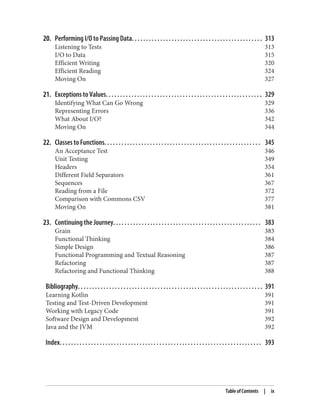

![Using Code Examples
Most of the code examples in the book (the ones from the refactoring sections) can be
accessed online on GitHub. The reference is immediately after the code, like this:
class TableReaderAcceptanceTests {
@Test
fun test() {
}
}
Example 0.1 [table-reader.1:src/test/java/travelator/tablereader/TableReaderAcceptanceTests.kt]
If you are reading this on a device, the reference should be a hyperlink to that version
of the file on GitHub. On real paper, you can click all you like; nothing will happen,
sorry. But if you take the example number, in this case 0.1, and type it into a form on
the book’s website, it will show you links that take you to the same place.
In Git, the different code examples (these sometimes span multiple chapters) evolve
in separate branches. The steps are tagged—table-reader.1 is the tag in this case. The
GitHub link is to code with that tag, so you can view the file shown (src/test/java/trav‐
elator/tablereader/TableReaderAcceptanceTests.kt here) and the others in the example
at that version. You can also select other tags to see the different versions, and differ‐
ent branches to see different examples. For quicker navigation, you can clone the
repository, open it in IntelliJ, and use the Git tool window to switch branches and
versions.
The code examples are not real! The codebase builds and passes its
tests, but it is fictional. There are places where the examples don’t
join up properly, and others where if you peek behind the curtain
you will see us wiggling the levers. We have tried to be honest, but
prefer to ship!
If you have a technical question or a problem using the code examples, visit the
book’s website or email bookquestions@oreilly.com.
This book is here to help you get your job done. In general, if example code is offered
with this book, you may use it in your programs and documentation. You do not
need to contact us for permission unless you’re reproducing a significant portion of
the code. For example, writing a program that uses several chunks of code from this
book does not require permission. Selling or distributing examples from O’Reilly
books does require permission. Answering a question by citing this book and quoting
example code does not require permission. Incorporating a significant amount of
example code from this book into your product’s documentation does require
permission.
xvi | Preface](https://image.slidesharecdn.com/17205808-250523102550-2d8e92b8/85/Java-To-Kotlin-A-Refactoring-Guidebook-1st-Edition-Duncan-Mcgregor-22-320.jpg)



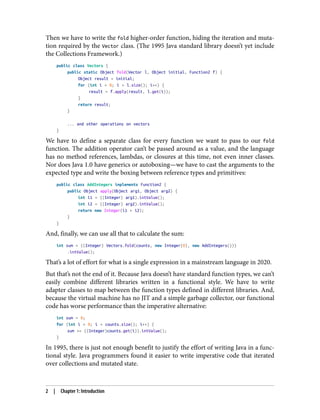
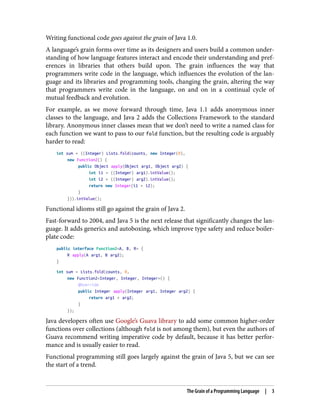
![These individual refactorings rarely stand alone though. Now that the building-block
refactorings can be performed automatically, we have the time and energy to combine
them to make larger-scale changes to our codebase. When the IDE does not have dis‐
tinct user-interface actions for a large-scale transformation we wish to do, we have to
perform it as a sequence of more granular refactorings. We use the IDE’s automatic
refactoring whenever we can, and fall back on text editing when the IDE does not
automate a transformation we need.
It’s tedious and error-prone to refactor by editing text. To reduce the risk, and our
boredom, we minimize the amount of text editing we have to do. If we must edit text,
we prefer that edit to affect a single expression. So we use automatic refactorings to
transform the code so that is possible, edit one expression, and then use automatic
refactorings to tidy back up to the final state we’re aiming for.
The first time we describe a large-scale refactoring, we’ll go through it step by step
and show how the code changes at each step. This takes quite a lot of space on the
page and will take a bit of reading time to follow. In practice, however, these large
refactorings are quick to apply. They typically take a few seconds, a few minutes at
most.
We expect the refactorings published here to date quite quickly as tools improve. The
individual IDE steps may be renamed, and some combinations might be imple‐
mented as single refactorings in their own right. Experiment in your context to find
ways of gradually and safely transforming your code that are better than those we
present, and then share them with the world too.
We Assume Good Test Coverage
As Martin Fowler says in Refactoring: Improving the Design of Existing Code: “[I]f you
want to refactor, the essential precondition is having solid tests.” Good test coverage
ensures that the code transformations we want to only improve design have not inad‐
vertently changed our system’s behavior. In this book, we assume that you have good
test coverage. We do not cover how to write automated tests. Other authors have
addressed these topics in more detail than we could in this book, for example: Test-
Driven Development By Example by Kent Beck (Addison-Wesley) and Growing
Object-Oriented Software Guided By Tests by Steve Freeman and Nat Pryce (Addison-
Wesley). We do, however, show how to apply Kotlin features to improve our tests.
As we walk through multistep code transformations, we won’t always say when we
run the tests. Assume that we run our tests after every change that we show that com‐
piles, no matter how small.
If your system does not already have good test coverage, it can be difficult (and
expensive) to retrofit tests to the code because the logic you want to test is entangled
with other aspects of the system. You’re in a chicken and egg situation: you have to
12 | Chapter 1: Introduction](https://image.slidesharecdn.com/17205808-250523102550-2d8e92b8/85/Java-To-Kotlin-A-Refactoring-Guidebook-1st-Edition-Duncan-Mcgregor-38-320.jpg)
![implementation "com.fasterxml.jackson.datatype:jackson-datatype-jdk8:2.10.0"
... and the rest of our app's implementation dependencies
testImplementation "org.junit.jupiter:junit-jupiter-api:5.4.2"
testImplementation "org.junit.jupiter:junit-jupiter-params:5.4.2"
testRuntimeOnly "org.junit.jupiter:junit-jupiter-engine:5.5.2"
testRuntimeOnly "org.junit.platform:junit-platform-launcher:1.4.2"
... and the rest of our app's test dependencies
}
... and the rest of our build rules
Example 2.1 [projects.0:build.gradle]
After we have added the Kotlin plug-in, our build file looks like this:
plugins {
id 'org.jetbrains.kotlin.jvm' version "1.5.0"
}
java.sourceCompatibility = JavaVersion.VERSION_11
java.targetCompatibility = JavaVersion.VERSION_11
... and other project settings ...
dependencies {
implementation "org.jetbrains.kotlin:kotlin-stdlib-jdk8"
... and the rest of our app's dependencies
}
tasks.withType(org.jetbrains.kotlin.gradle.tasks.KotlinCompile) {
kotlinOptions {
jvmTarget = "11"
javaParameters = true
freeCompilerArgs = ["-Xjvm-default=all"]
}
}
... and the rest of our build rules
Example 2.2 [projects.1:build.gradle]
Given those changes, we can rerun our build, and see that…
…the build still works!
If we resync the Gradle project in IntelliJ (this may happen automatically on saving),
we can run our tests and programs within the IDE.
Our tests still pass, so we haven’t broken anything, but neither have we proved that we
can use Kotlin in our project. Let’s test that by writing a “hello world” program. We
create a file, HelloWorld.kt, in the root package of our Java source tree, src/main/java:
18 | Chapter 2: Java to Kotlin Projects](https://image.slidesharecdn.com/17205808-250523102550-2d8e92b8/85/Java-To-Kotlin-A-Refactoring-Guidebook-1st-Edition-Duncan-Mcgregor-44-320.jpg)
![fun main() {
println("hello, world")
}
Example 2.3 [projects.2:src/main/java/HelloWorld.kt]
Where to Put Kotlin Source
The Kotlin build plug-in adds additional source roots, src/main/
kotlin and src/test/kotlin, and compiles Kotlin source files found in
any of their subdirectories.
It will also compile Kotlin source found in Java source trees, in par‐
ticular src/main/java and src/test/java. Although you can separate
your source files by language, putting Java files in the java directo‐
ries and Kotlin into kotlin, in practice your authors don’t bother. It’s
nice to be able to look into a directory and see all the source for the
corresponding package rather than casting around the filesystem.
To make this work, though, we keep Kotlin source in directories
mirroring the package structure rather than taking advantage of
Kotlin’s ability to have files in a single directory but multiple
packages.
In a similar vein, while Kotlin does allow multiple public classes to
be defined in a single class, when we are mixing Java and Kotlin in
a project, we tend to stick to one class per file for consistency.
We can run that within the IDE by clicking the little green arrow in the lefthand mar‐
gin next to fun main().
We can run our build and then run it from the command line with the java com‐
mand. Compiling the source file named HelloWorld.kt creates a Java class file named
HelloWorldKt. We’ll look into how Kotlin source gets translated into Java class files in
more detail later, but for now, we can run our program with the java command, like
so:
$ java -cp build/classes/kotlin/main HelloWorldKt
hello, world
It lives!
Let’s delete HelloWorld.kt—it’s done its job—commit and push.
We now have the option to use Kotlin in our project; the first part of this chapter gives
some pointers to where to start using it.
Adding Kotlin Support to a Java Build | 19](https://image.slidesharecdn.com/17205808-250523102550-2d8e92b8/85/Java-To-Kotlin-A-Refactoring-Guidebook-1st-Edition-Duncan-Mcgregor-45-320.jpg)
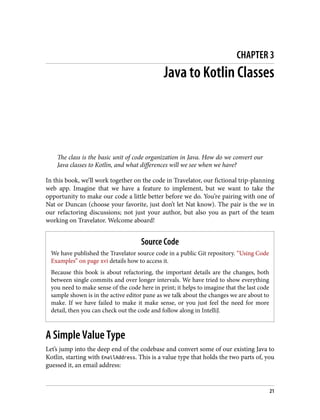
![public class EmailAddress {
private final String localPart;
private final String domain;
public static EmailAddress parse(String value) {
var atIndex = value.lastIndexOf('@');
if (atIndex < 1 || atIndex == value.length() - 1)
throw new IllegalArgumentException(
"EmailAddress must be two parts separated by @"
);
return new EmailAddress(
value.substring(0, atIndex),
value.substring(atIndex + 1)
);
}
public EmailAddress(String localPart, String domain) {
this.localPart = localPart;
this.domain = domain;
}
public String getLocalPart() {
return localPart;
}
public String getDomain() {
return domain;
}
@Override
public boolean equals(Object o) {
if (this == o) return true;
if (o == null || getClass() != o.getClass()) return false;
EmailAddress that = (EmailAddress) o;
return localPart.equals(that.localPart) &&
domain.equals(that.domain);
}
@Override
public int hashCode() {
return Objects.hash(localPart, domain);
}
@Override
public String toString() {
return localPart + "@" + domain;
}
}
Example 3.1 [classes.0:src/main/java/travelator/EmailAddress.java]
This class is very simple; it does nothing more than wrap two strings and provides no
operations of its own. Even so, it has a lot of code:
22 | Chapter 3: Java to Kotlin Classes](https://image.slidesharecdn.com/17205808-250523102550-2d8e92b8/85/Java-To-Kotlin-A-Refactoring-Guidebook-1st-Edition-Duncan-Mcgregor-48-320.jpg)
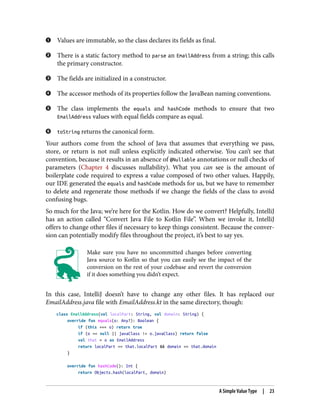
![}
override fun toString(): String {
return "$localPart@$domain"
}
companion object {
@JvmStatic
fun parse(value: String): EmailAddress {
val atIndex = value.lastIndexOf('@')
require(!(atIndex < 1 || atIndex == value.length - 1)) {
"EmailAddress must be two parts separated by @"
}
return EmailAddress(
value.substring(0, atIndex),
value.substring(atIndex + 1)
)
}
}
}
Example 3.2 [classes.2:src/main/java/travelator/EmailAddress.kt]
The Kotlin class is noticeably more succinct because it declares its properties in the
primary constructor: the parameters after the class name. Parameters marked val are
considered properties and so stand in for all this Java:
private final String localPart;
private final String domain;
public EmailAddress(String localPart, String domain) {
this.localPart = localPart;
this.domain = domain;
}
public String getLocalPart() {
return localPart;
}
public String getDomain() {
return domain;
}
Example 3.3 [classes.1:src/main/java/travelator/EmailAddress.java]
The primary constructor syntax is convenient, but it does interfere with the scanabil‐
ity of the class. Java classes that follow the standard coding conventions always define
their elements in the same order: class name, superclass, interfaces, and then, within
the class body, fields, constructors, and methods. This makes it easy to skim-read the
class and quickly locate the features you’re interested in.
24 | Chapter 3: Java to Kotlin Classes](https://image.slidesharecdn.com/17205808-250523102550-2d8e92b8/85/Java-To-Kotlin-A-Refactoring-Guidebook-1st-Edition-Duncan-Mcgregor-50-320.jpg)
![It’s not quite so easy to find the parts of a Kotlin class. A Kotlin class definition has a
header part with the class name, primary constructor (which can contain parameters
and/or property definitions), superclass (which may also be the call to the superclass’s
constructor), and interfaces. Then, within the class body, there are more properties
and more constructors, methods, and companion objects.
Coming from Java, Nat and Duncan definitely found it harder to read classes at first,
and although we got used to it eventually, we still find it hard at times to format
classes for maximum readability, especially if there is a lot going on in the header
part. One easy fix is to lay out the constructor parameter list line by line. With the
cursor inside the parameter list, we can do that with Alt-Enter and “Put parameters
on separate lines”. Sometimes a blank line after the header part helps, too:
class EmailAddress(
val localPart: String,
val domain: String
) {
override fun equals(o: Any?): Boolean {
if (this === o) return true
if (o == null || javaClass != o.javaClass) return false
val that = o as EmailAddress
return localPart == that.localPart && domain == that.domain
}
override fun hashCode(): Int {
return Objects.hash(localPart, domain)
}
override fun toString(): String {
return "$localPart@$domain"
}
companion object {
@JvmStatic
fun parse(value: String): EmailAddress {
val atIndex = value.lastIndexOf('@')
require(!(atIndex < 1 || atIndex == value.length - 1)) {
"EmailAddress must be two parts separated by @"
}
return EmailAddress(
value.substring(0, atIndex),
value.substring(atIndex + 1)
)
}
}
}
Example 3.4 [classes.3:src/main/java/travelator/EmailAddress.kt]
A Simple Value Type | 25](https://image.slidesharecdn.com/17205808-250523102550-2d8e92b8/85/Java-To-Kotlin-A-Refactoring-Guidebook-1st-Edition-Duncan-Mcgregor-51-320.jpg)
![One place where Kotlin is noticeably less succinct than Java is where it uses compan‐
ion objects to host static state and methods, in this case parse(). In Kotlin, we often
prefer top-level state and functions to these class-scoped members. Chapter 8 dis‐
cusses the pros and cons.
We currently have Java code that uses the static method, for example, the tests:
public class EmailAddressTests {
@Test
public void parsing() {
assertEquals(
new EmailAddress("fred", "example.com"),
EmailAddress.parse("fred@example.com")
);
}
@Test
public void parsingFailures() {
assertThrows(
IllegalArgumentException.class,
() -> EmailAddress.parse("@")
);
...
}
...
}
Example 3.5 [classes.0:src/test/java/travelator/EmailAddressTests.java]
The companion object, combined with the @JVMStatic annotation, means this didn’t
have to change when we converted the class to Kotlin, so we’ll leave parse as it is for
now. We’ll discuss how to refactor to top-level functions in Chapter 8.
If you’re new to Kotlin, you may wonder what happened to the getLocalPart() and
getDomain() accessor methods. Declaring the domain property causes the compiler to
generate a private domain field and a getDomain() method so that Java code can still call
it. Here is a little throwaway code to support a marketing plan:
public class Marketing {
public static boolean isHotmailAddress(EmailAddress address) {
return address.getDomain().equalsIgnoreCase("hotmail.com");
}
}
Example 3.6 [classes.3:src/main/java/travelator/Marketing.java]
26 | Chapter 3: Java to Kotlin Classes](https://image.slidesharecdn.com/17205808-250523102550-2d8e92b8/85/Java-To-Kotlin-A-Refactoring-Guidebook-1st-Edition-Duncan-Mcgregor-52-320.jpg)
![You can see that Java is accessing the domain property through the getDomain()
method. Conversely, when the class was Java and had an explicit getDomain() method,
Kotlin code could have called it as address.domain. We’ll discuss properties in more
detail in Chapter 11.
So far, converting our class to Kotlin has saved us 14 lines of code, but we aren’t done
yet. Value types like this are so useful, but so tedious to get right and keep right, that
Kotlin supports them at a language level. If we mark the class with the data modifier,
the compiler generates any undefined equals, hashCode, and toString methods for us.
That reduces the EmailAddress class to:
data class EmailAddress(
val localPart: String,
val domain: String
) {
override fun toString(): String {
return "$localPart@$domain"
}
companion object {
@JvmStatic
fun parse(value: String): EmailAddress {
val atIndex = value.lastIndexOf('@')
require(!(atIndex < 1 || atIndex == value.length - 1)) {
"EmailAddress must be two parts separated by @"
}
return EmailAddress(
value.substring(0, atIndex),
value.substring(atIndex + 1)
)
}
}
}
Example 3.7 [classes.4:src/main/java/travelator/EmailAddress.kt]
We don’t want the generated toString() method, so we define the one we do
want.
Frankly, that parse method still rankles; it’s taking up a disproportionate amount of
space for the work it is doing. We’ll finally relieve this tension in Chapter 9. For now,
though, we’re done with converting our EmailAddress Java class to Kotlin.
A Simple Value Type | 27](https://image.slidesharecdn.com/17205808-250523102550-2d8e92b8/85/Java-To-Kotlin-A-Refactoring-Guidebook-1st-Edition-Duncan-Mcgregor-53-320.jpg)