Foreign Language
-Korean Language-
INFO-SHEET1:
OVERVIEW
Dr. Rosemarie S. Guirre
FL Trainer
Prepared By: Dr. Rosemarie S. Guirre (FL Trainer)
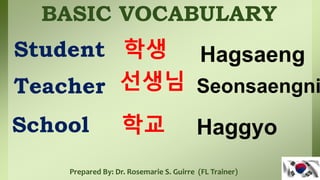
BASIC VOCABULARY
Student
Prepared By: Dr. Rosemarie S. Guirre (FL Trainer)
학생 Hagsaeng
Teacher 선생님 Seonsaengni
School 학교 Haggyo
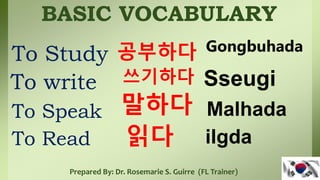
BASIC VOCABULARY
To Study
To write
To Speak
공부하다
쓰기하다
말하다
Gongbuhada
Sseugi
Malhada
Prepared By: Dr. Rosemarie S. Guirre (FL Trainer)
읽다
To Read ilgda
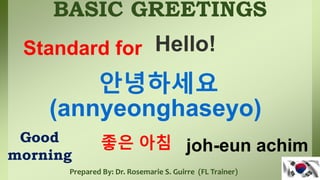
BASIC GREETINGS
Prepared By: Dr. Rosemarie S. Guirre (FL Trainer)
안녕하세요
(annyeonghaseyo)
Standard for Hello!
Good
morning
좋은 아침 joh-eun achim
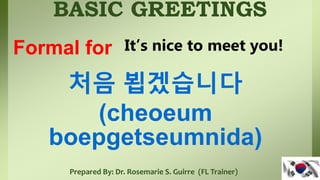
BASIC GREETINGS
Prepared By: Dr. Rosemarie S. Guirre (FL Trainer)
처음 뵙겠습니다
(cheoeum
boepgetseumnida)
Formal for It’s nice to meet you!
BASIC GREETINGS
Prepared By: Dr. Rosemarie S. Guirre (FL Trainer)
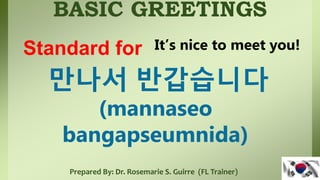
만나서 반갑습니다
(mannaseo
bangapseumnida)
Standard for It’s nice to meet you!
BASIC VOCABULARY
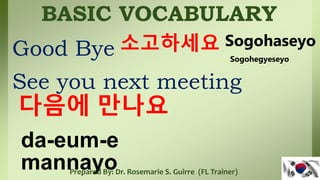
Good Bye
See you next meeting
소고하세요
다음에 만나요
Sogohaseyo
da-eum-e
mannayo
Prepared By: Dr. Rosemarie S. Guirre (FL Trainer)
Sogohegyeseyo
Prepared By: Dr. Rosemarie S. Guirre (FL Trainer)
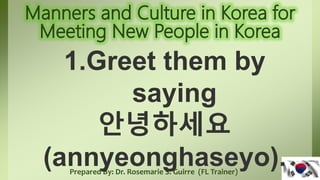
1.Greet them by
saying
안녕하세요
(annyeonghaseyo).
Prepared By: Dr. Rosemarie S. Guirre (FL Trainer)
2. Bow as you greet
them
Prepared By: Dr. Rosemarie S. Guirre (FL Trainer)
3. If you shake hands,
use your right hand or
both hands.
Prepared By: Dr. Rosemarie S. Guirre (FL Trainer)
4. Address them by their
title or family name.
bow as you greet
them
Prepared By: Dr. Rosemarie S. Guirre (FL Trainer)
CHOSŎNN,
Prepared By: Dr. Rosemarie S. Guirre (FL Trainer)
OR HANJA
MUNTCHA
Prepared By: Dr. Rosemarie S. Guirre (FL Trainer)
EXAMPLE: HANGEUL
Prepared By: Dr. Rosemarie S. Guirre (FL Trainer)
4.CONSONANTS
Prepared By: Dr. Rosemarie S. Guirre (FL Trainer)
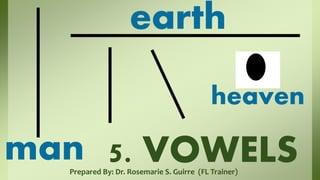
5. VOWELS
man
earth
heaven
Prepared By: Dr. Rosemarie S. Guirre (FL Trainer)
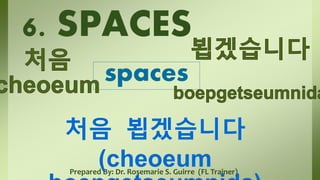
6. SPACES
spaces
처음 뵙겠습니다
(cheoeum
at the beginning, in
the middle, or at the
end of a syllable.
Prepared By: Dr. Rosemarie S. Guirre (FL Trainer)
오늘의 연구의
끝
Prepared By: Dr. Rosemarie S. Guirre (FL Trainer)
Sogohaseyo Sogohegyeseyo
학생
선생님

KOREAN LANGUAGE OVERVIEW한국어 개요

Editor's Notes

  • #12 It is important in Korean culture to be polite and show respect towards others. First impressions are everything.
  • #13 This is a sign of respect and politeness. If you’re already acquainted then just a head nod should do.
  • #14 When you shake hands, use your right hand or both hands. You can show more respect by bowing and touching your left hand to your right or grabbing your stomach with your left hand.
  • #15 Koreans do not refer to each other by their first name unless they are close and even then they often go by ‘언니 (eonni)’, ‘오빠 (oppa)’ and so on. When you are meeting a new person use their title or family name unless they say otherwise.
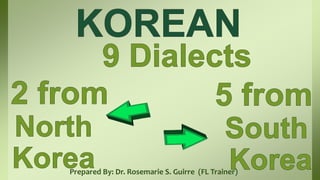
  • #17 Korean is spoken by more than 75 million people worldwide. The majority of the speakers live in South and North Korea, where it is the official language. It has its own language family with no other known modern languages in it. Korean has nine different dialects. Both South and North Korea have their own standard Korean dialects, which are used in an official setting. In the South, it is Seoul’s dialect. In the North, it is Seoul’s dialect mixed with Pyeongyang’s region’s dialect. Additionally, there are two more dialects in use in North Korea and five more dialects in use in South Korea. Of these, the most different from standard Korean is the dialect used on Jeju Island. Because of all of the time apart after the Korean War
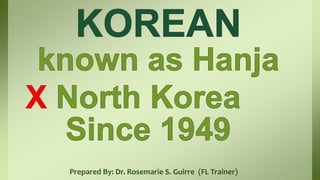
  • #18 The earliest forms of the language have likely existed since the Stone Age, although the specific history of the language remains a mystery. Chinese characters were introduced to the region in the first century BC. They were adapted to the language and became known as Hanja (한자). In North Korea, however, Hanja has officially not been used since 1949. Many words borrowed from Chinese have been replaced with native Korean words in the North. The Chinese loan words still used in and are written in Hangul now. You can find Hanja in special situations such as dictionaries.
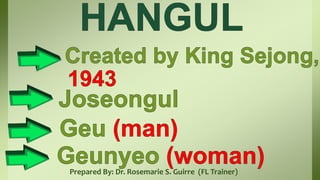
  • #19 the Korean alphabet, was created by King Sejong in 1443. In North Korea, it’s called Joseongul. It finally became the most important writing system in both North and South Korea after World War 2 and the Korean War. Technically, there is no gender in Korean grammar. This means words are not categorized separately. And because you only need a verb in your sentence, you don’t need to write “he” or “she” in your sentence as you would in English.
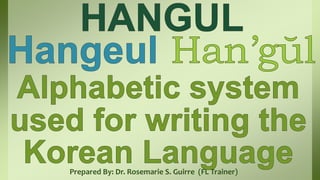
  • #20 Hangul (Korean: “Great Script”) spelled Hangeul or Han’gŭl, alphabetic system used for writing the Korean language. It has an alphabet with individual sounds for each letter, and the letters are read from left to right and top to bottom. There are individual syllables.
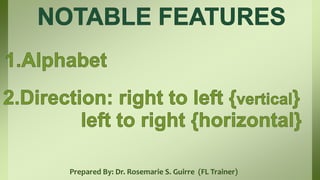
  • #21 1. Type of writing system: alphabet 2. Direction of writing: Until the 1980s Korean was usually written from right to left in vertical columns. Since then writing from left to right in horizontal lines has become popular, and today the majority of texts are written horizontally.
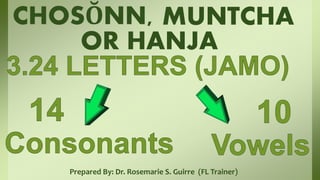
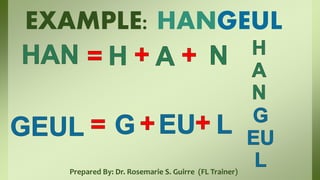
  • #22 The system, known as  Chosŏnn muntcha or Hanja in North Korea, it consists of 24 letters (originally 28), including 14 consonants and 10 vowels. 3. Number of letters: 24 (jamo): 14 consonants and 10 vowels. The letters are combined together into syllable blocks. For example, Hangeul is written: 한 (han) = ᄒ (h) + ᅡ (a) + ᄂ (n) and 글 (geul) = ᄀ (g) + ᅳ (eu) + ᄅ (l)
  • #23 The system, known as  Chosŏnn muntcha or Hanja in North Korea, it consists of 24 letters (originally 28), including 14 consonants and 10 vowels. 3. Number of letters: 24 (jamo): 14 consonants and 10 vowels. The letters are combined together into syllable blocks. For example, Hangeul is written: 한 (han) = ᄒ (h) + ᅡ (a) + ᄂ (n) and 글 (geul) = ᄀ (g) + ᅳ (eu) + ᄅ (l)
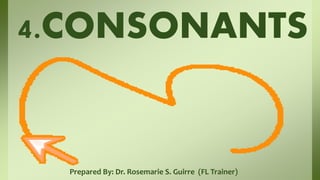
  • #24 4. The shapes of the consonants g/k, n, s, m and ng are graphical representations of the speech organs used to pronounce them. Other consonants were created by adding extra lines to the basic shapes. The consonant characters are formed with curved or angled lines.
  • #25 5. The shapes of the vowels are based on three elements: man (a vertical line), earth (a horizontal line) and heaven (a dot). In modern Hangeul the heavenly dot has mutated into a short line. The vowels are composedof vertical or horizontal straight lines together with short lines on either side of the main line.
  • #26 6. Spaces are placed between words, which can be made up of one or more syllables.
  • #27 7. The sounds of some consonants change depending on whether they appear at the beginning, in the middle, or at the end of a syllable.
  • #28 oneurui yonjou kkeut