Quick Review
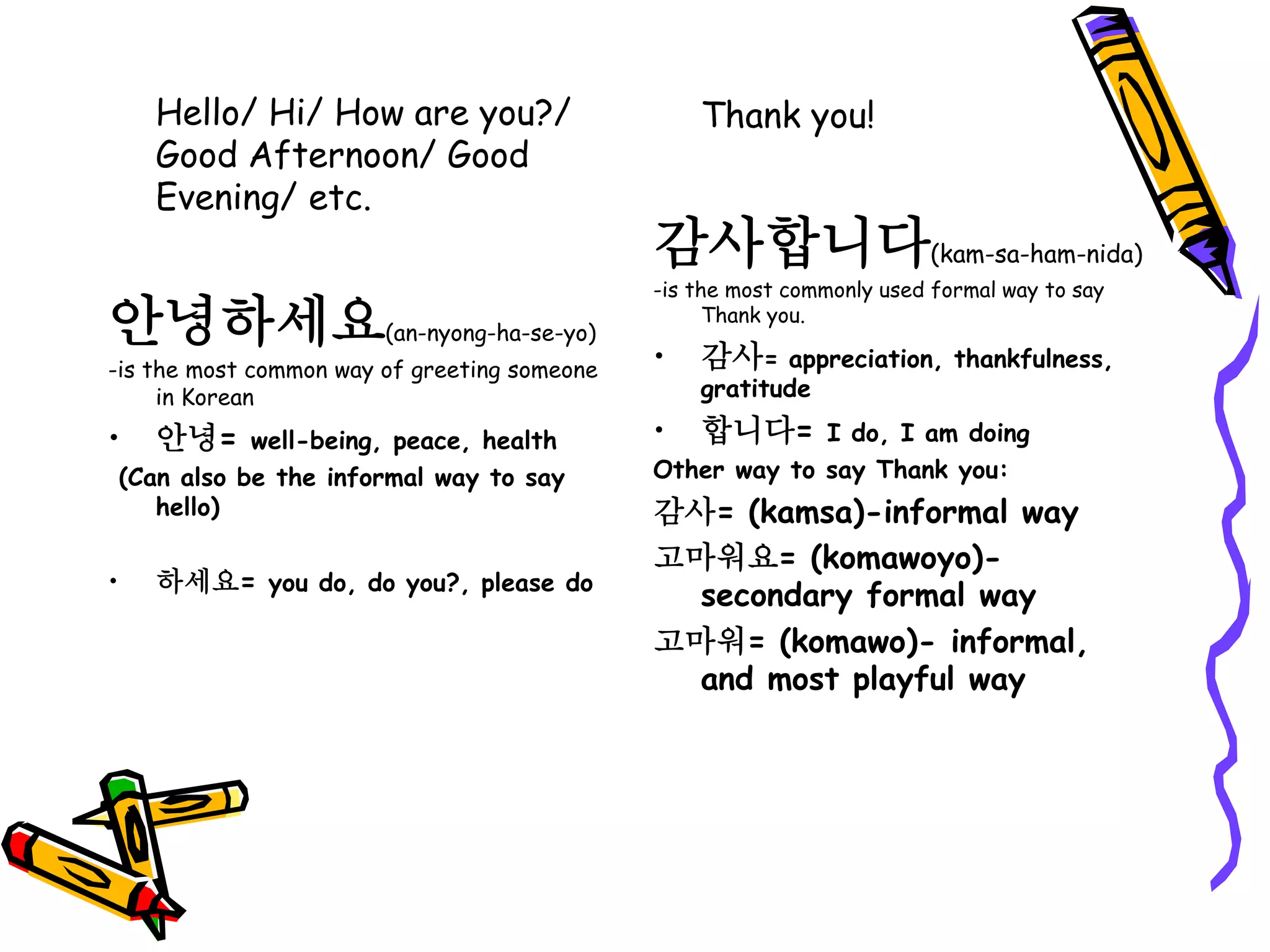
Hello/ Hi/ How are you?/
Good Afternoon/ Good
Evening/ etc.
안녕하세요(an-nyong-ha-se-yo)
-is the most common way of greeting someone
in Korean
• 안녕= well-being, peace, health
(Can also be the informal way to say
hello)
• 하세요= you do, do you?, please do
Thank you!
감사합니다(kam-sa-ham-nida)
-is the most commonly used formal way to say
Thank you.
• 감사= appreciation, thankfulness,
gratitude
• 합니다= I do, I am doing
Other way to say Thank you:
감사= (kamsa)-informal way
고마워요= (komawoyo)-
secondary formal way
고마워= (komawo)- informal,
and most playful way
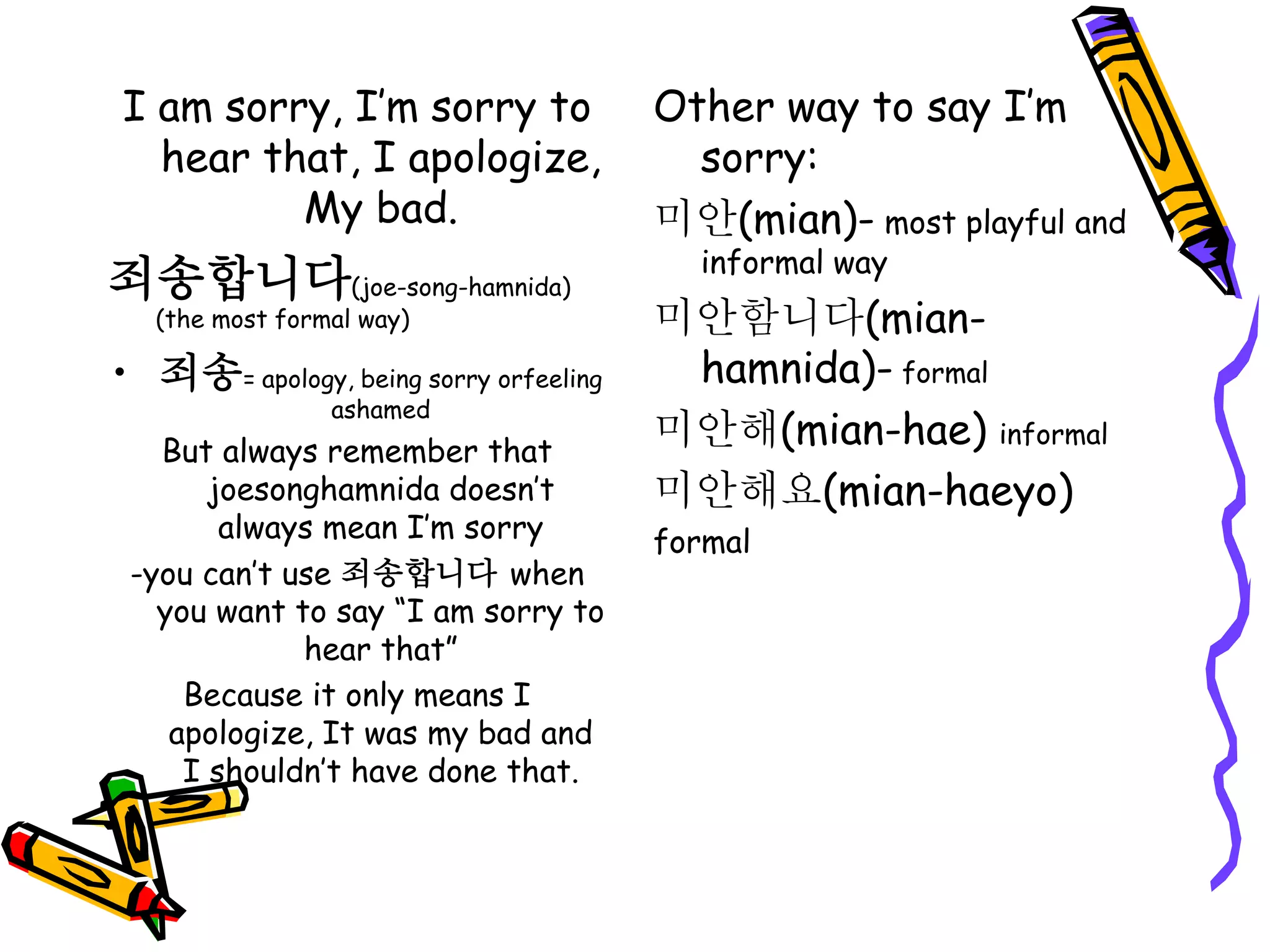
I am sorry, I’m sorry to
hear that, I apologize,
My bad.
죄송합니다(joe-song-hamnida)
(the most formal way)
• 죄송= apology, being sorry orfeeling
ashamed
But always remember that
joesonghamnida doesn’t
always mean I’m sorry
-you can’t use 죄송합니다 when
you want to say “I am sorry to
hear that”
Because it only means I
apologize, It was my bad and
I shouldn’t have done that.
Other way to say I’m
sorry:
미안(mian)- most playful and
informal way
미안함니다(mian-
hamnida)- formal
미안해(mian-hae) informal
미안해요(mian-haeyo)
formal
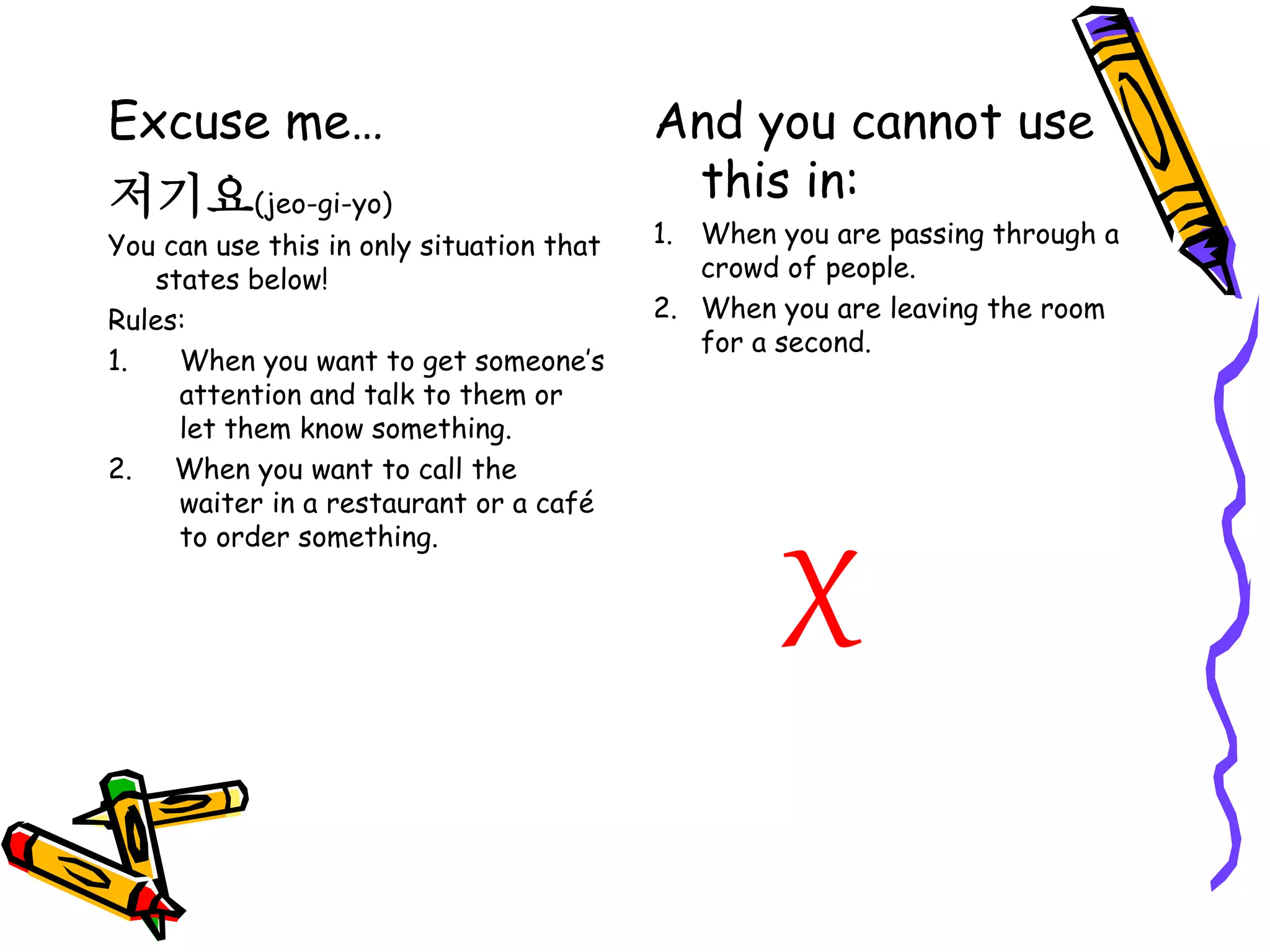
Excuse me…
저기요(jeo-gi-yo)
You can use this in only situation that
states below!
Rules:
1. When you want to get someone’s
attention and talk to them or
let them know something.
2. When you want to call the
waiter in a restaurant or a café
to order something.
And you cannot use
this in:
1. When you are passing through a
crowd of people.
2. When you are leaving the room
for a second.
X
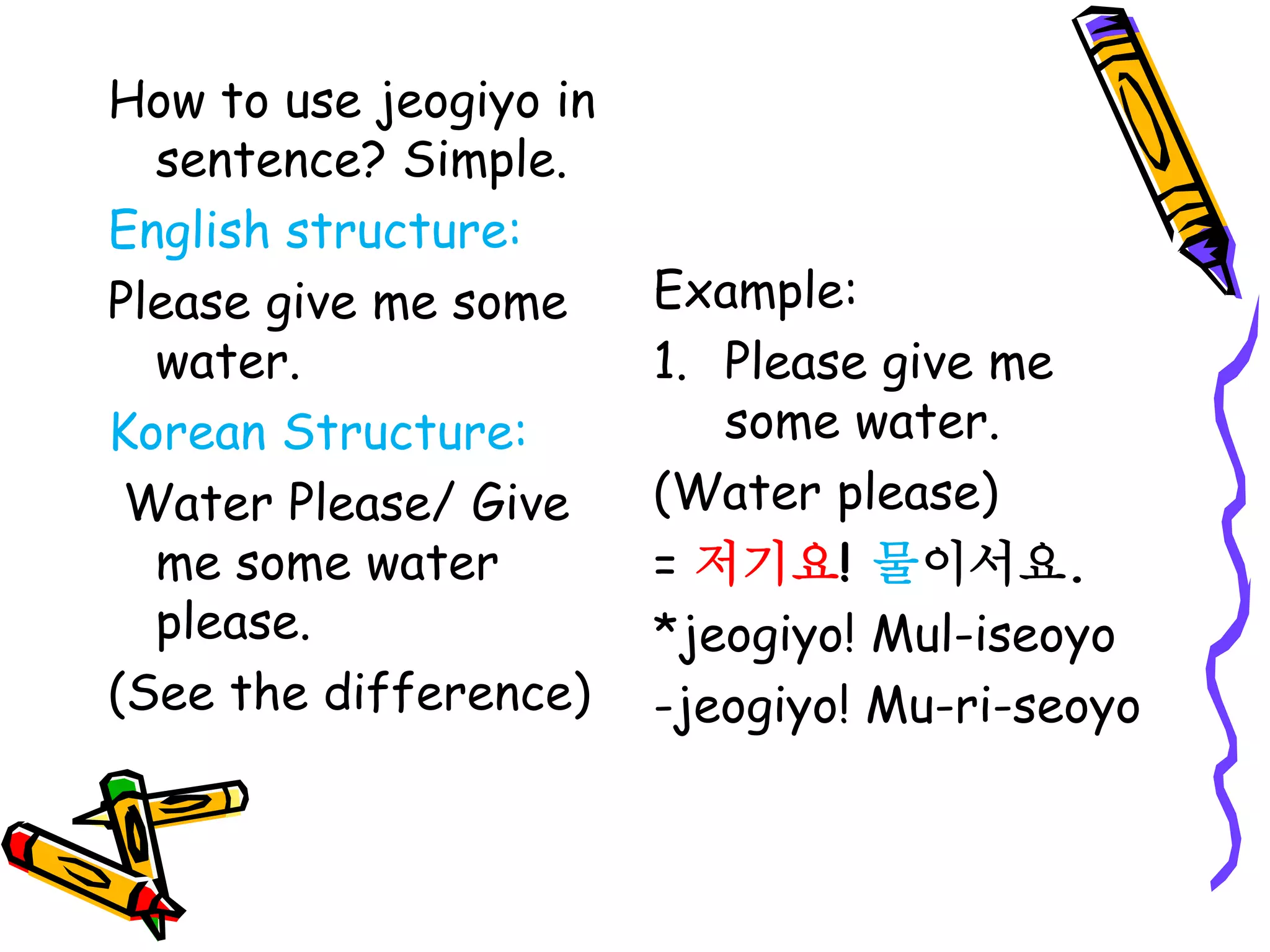
How to use jeogiyo in
sentence? Simple.
English structure:
Please give me some
water.
Korean Structure:
Water Please/ Give
me some water
please.
(See the difference)
Example:
1. Please give me
some water.
(Water please)
= 저기요! 물이서요.
*jeogiyo! Mul-iseoyo
-jeogiyo! Mu-ri-seoyo
Thank you!
Free Korean Lesson!
2015!

Quick review

  • 1.
  • 2.
    Hello/ Hi/ Howare you?/ Good Afternoon/ Good Evening/ etc. 안녕하세요(an-nyong-ha-se-yo) -is the most common way of greeting someone in Korean • 안녕= well-being, peace, health (Can also be the informal way to say hello) • 하세요= you do, do you?, please do Thank you! 감사합니다(kam-sa-ham-nida) -is the most commonly used formal way to say Thank you. • 감사= appreciation, thankfulness, gratitude • 합니다= I do, I am doing Other way to say Thank you: 감사= (kamsa)-informal way 고마워요= (komawoyo)- secondary formal way 고마워= (komawo)- informal, and most playful way
  • 3.
    I am sorry,I’m sorry to hear that, I apologize, My bad. 죄송합니다(joe-song-hamnida) (the most formal way) • 죄송= apology, being sorry orfeeling ashamed But always remember that joesonghamnida doesn’t always mean I’m sorry -you can’t use 죄송합니다 when you want to say “I am sorry to hear that” Because it only means I apologize, It was my bad and I shouldn’t have done that. Other way to say I’m sorry: 미안(mian)- most playful and informal way 미안함니다(mian- hamnida)- formal 미안해(mian-hae) informal 미안해요(mian-haeyo) formal
  • 4.
    Excuse me… 저기요(jeo-gi-yo) You canuse this in only situation that states below! Rules: 1. When you want to get someone’s attention and talk to them or let them know something. 2. When you want to call the waiter in a restaurant or a café to order something. And you cannot use this in: 1. When you are passing through a crowd of people. 2. When you are leaving the room for a second. X
  • 5.
    How to usejeogiyo in sentence? Simple. English structure: Please give me some water. Korean Structure: Water Please/ Give me some water please. (See the difference) Example: 1. Please give me some water. (Water please) = 저기요! 물이서요. *jeogiyo! Mul-iseoyo -jeogiyo! Mu-ri-seoyo
  • 6.