Foreign Language
-Korean Language-
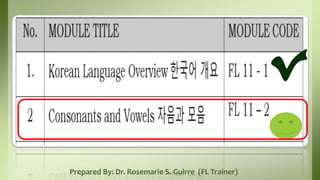
INFO-SHEET 2: Consonants
and Vowels 자음과 모음
Dr. Rosemarie S. Guirre
FL Trainer
Prepared By: Dr. Rosemarie S. Guirre (FL Trainer)
CHOSŎNN,
Prepared By: Dr. Rosemarie S. Guirre (FL Trainer)
OR HANJA
MUNTCHA
Prepared By: Dr. Rosemarie S. Guirre (FL Trainer)
CONSONANTS
Prepared By: Dr. Rosemarie S. Guirre (FL Trainer)
VOWELS
Prepared By: Dr. Rosemarie S. Guirre (FL Trainer)
CHOSŎNN,
Prepared By: Dr. Rosemarie S. Guirre (FL Trainer)
OR HANJA
MUNTCHA
Prepared By: Dr. Rosemarie S. Guirre (FL Trainer)
EXAMPLE: HANGEUL
Prepared By: Dr. Rosemarie S. Guirre (FL Trainer)
4.CONSONANTS
Prepared By: Dr. Rosemarie S. Guirre (FL Trainer)
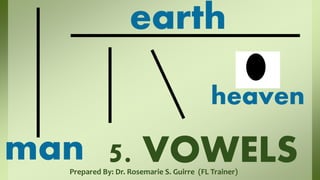
5. VOWELS
man
earth
heaven
Prepared By: Dr. Rosemarie S. Guirre (FL Trainer)
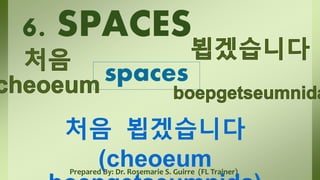
6. SPACES
spaces
처음 뵙겠습니다
(cheoeum
at the beginning, in
the middle, or at the
end of a syllable.
Prepared By: Dr. Rosemarie S. Guirre (FL Trainer)
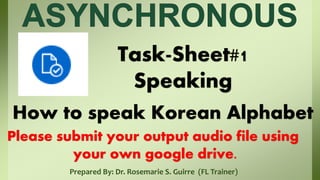
Task-Sheet#1
Speaking
How to speak Korean Alphabet
Please submit your output audio file using
your own google drive.
Korean Language: Notable Features

Korean Language: Notable Features

Editor's Notes

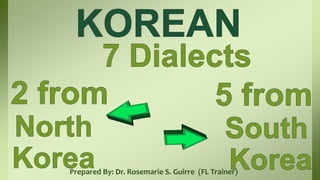
  • #5 Some other commonly spoken languages in South Korea are English, Japanese, Chinese, and Russian.
  • #6 the Korean alphabet, was created by King Sejong in 1443. In North Korea, it’s called Joseongul. It finally became the most important writing system in both North and South Korea after World War 2 and the Korean War.
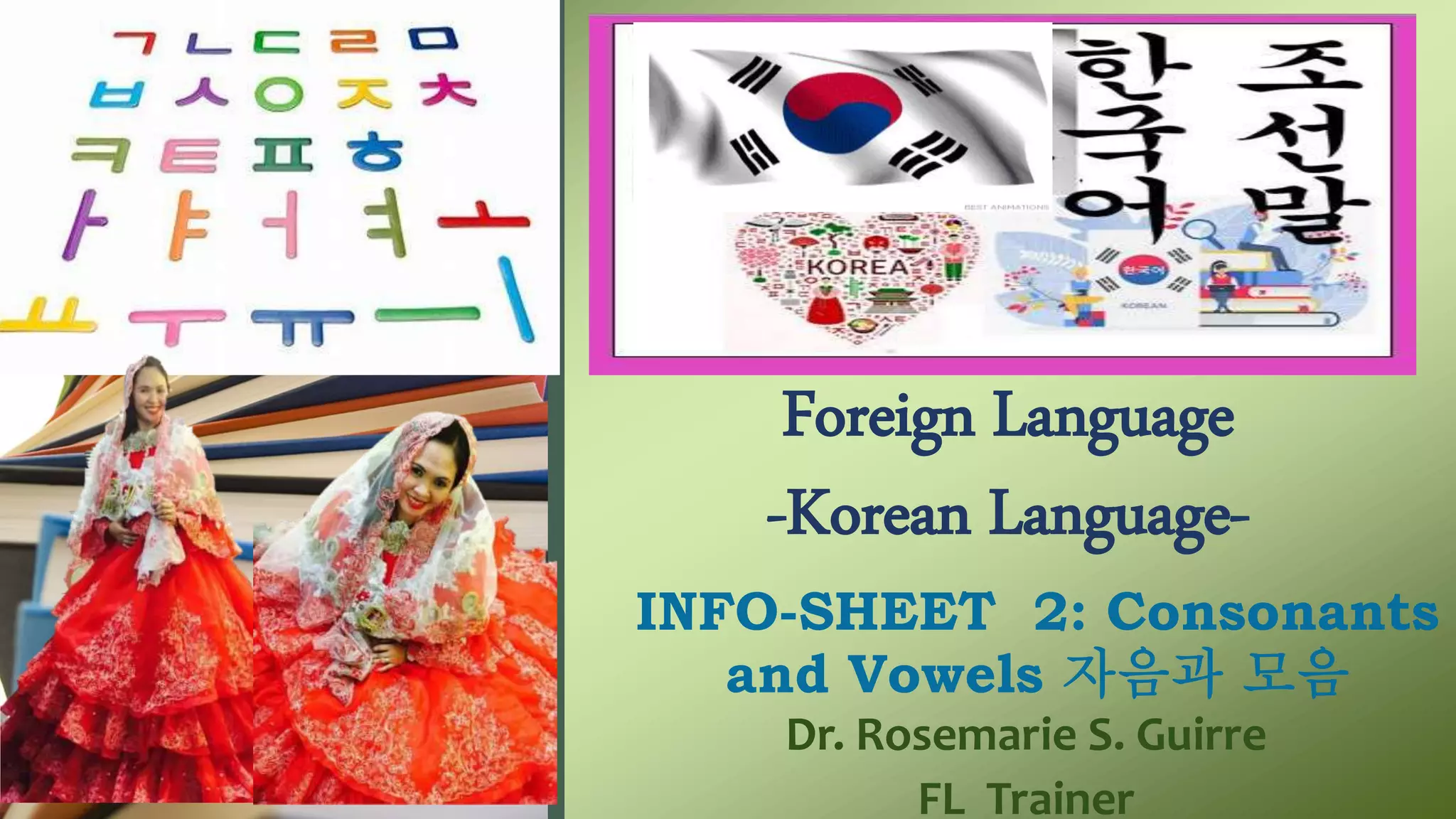
  • #7 Hangul (Korean: “Great Script”) spelled Hangeul or Han’gŭl, alphabetic system used for writing the Korean language. It has an alphabet with individual sounds for each letter, and the letters are read from left to right and top to bottom. There are individual syllables.
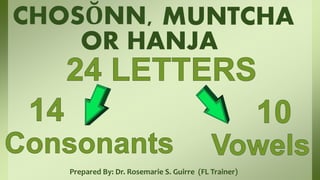
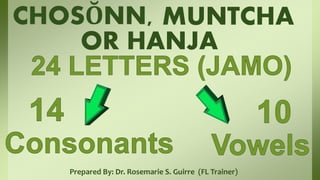
  • #8 The system, known as  Chosŏnn muntcha or Hanja in North Korea, it consists of 24 letters (originally 28), including 14 consonants and 10 vowels.
  • #9 The consonant characters are formed with curved or angled lines.
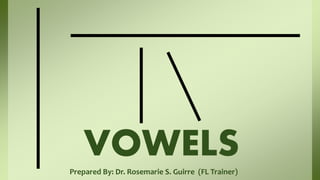
  • #10 The vowels are composed of vertical or horizontal straight lines together with short lines on either side of the main line.
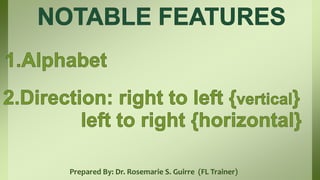
  • #11 1. Type of writing system: alphabet 2. Direction of writing: Until the 1980s Korean was usually written from right to left in vertical columns. Since then writing from left to right in horizontal lines has become popular, and today the majority of texts are written horizontally.
  • #12 The system, known as  Chosŏnn muntcha or Hanja in North Korea, it consists of 24 letters (originally 28), including 14 consonants and 10 vowels. 3. Number of letters: 24 (jamo): 14 consonants and 10 vowels
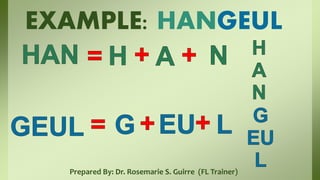
  • #13 The system, known as  Chosŏnn muntcha or Hanja in North Korea, it consists of 24 letters (originally 28), including 14 consonants and 10 vowels. 3. Number of letters: 24 (jamo): 14 consonants and 10 vowels. The letters are combined together into syllable blocks. For example, Hangeul is written: 한 (han) = ᄒ (h) + ᅡ (a) + ᄂ (n) and 글 (geul) = ᄀ (g) + ᅳ (eu) + ᄅ (l)
  • #14 4. The shapes of the consonants g/k, n, s, m and ng are graphical representations of the speech organs used to pronounce them. Other consonants were created by adding extra lines to the basic shapes. The consonant characters are formed with curved or angled lines.
  • #15 5. The shapes of the vowels are based on three elements: man (a vertical line), earth (a horizontal line) and heaven (a dot). In modern Hangeul the heavenly dot has mutated into a short line. The vowels are composedof vertical or horizontal straight lines together with short lines on either side of the main line.
  • #16 6. Spaces are placed between words, which can be made up of one or more syllables.
  • #17 7. The sounds of some consonants change depending on whether they appear at the beginning, in the middle, or at the end of a syllable.