PARK, Jungwoo
September 4, 2023
Basic Korean 1
√ Introduction to course
√ KME (Hangeul) Chapter 1, 2, 3
√ Native Number
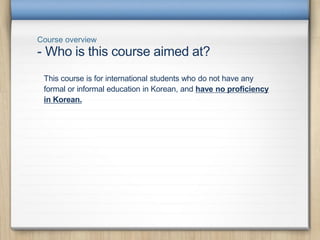
Course overview
This course is for international students who do not have any
formal or informal education in Korean, and have no proficiency
in Korean.
- Who is this course aimed at?
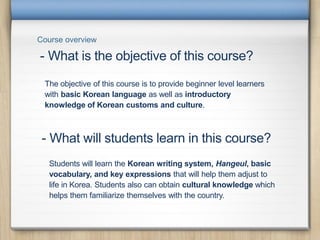
Course overview
- What is the objective of this course?
The objective of this course is to provide beginner level learners
with basic Korean language as well as introductory
knowledge of Korean customs and culture.
- What will students learn in this course?
Students will learn the Korean writing system, Hangeul, basic
vocabulary, and key expressions that will help them adjust to
life in Korea. Students also can obtain cultural knowledge which
helps them familiarize themselves with the country.
Course overview
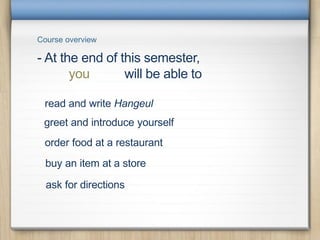
- At the end of this semester,
you will be able to
read and write Hangeul
greet and introduce yourself
order food at a restaurant
buy an item at a store
ask for directions
Textbook
Chapter 1 Six Basic Vowels
Chapter 2 Three Basic Consonants
Chapter 3 Six Basic Consonants
Chapter 4 Final Consonants
Chapter 5 Four [y] Vowels
Chapter 6 Two Basic Vowels & Two [y] Vowels
Chapter 7 Four Aspirated Consonants
Chapter 8 Seven Compound Vowels
Chapter 9 Five Tensed Consonants
Chapter 10 Final Consonants & Double Final
Consonants
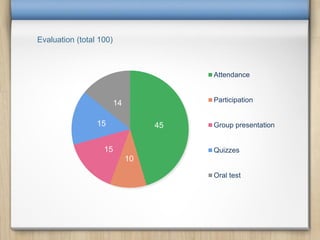
Evaluation (total 100)
45
10
15
15
14
Attendance
Participation
Group presentation
Quizzes
Oral test
Evaluation
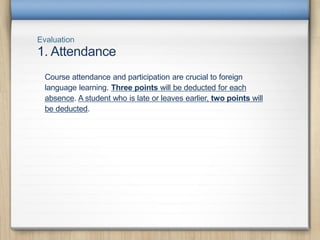
1. Attendance
Course attendance and participation are crucial to foreign
language learning. Three points will be deducted for each
absence. A student who is late or leaves earlier, two points will
be deducted.
Evaluation
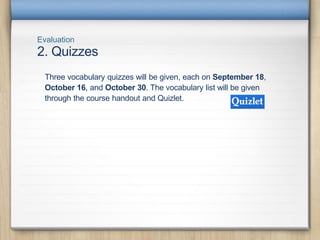
2. Quizzes
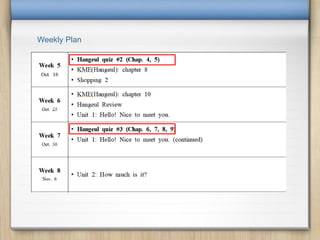
Three vocabulary quizzes will be given, each on September 18,
October 16, and October 30. The vocabulary list will be given
through the course handout and Quizlet.
Evaluation
3. Group presentation
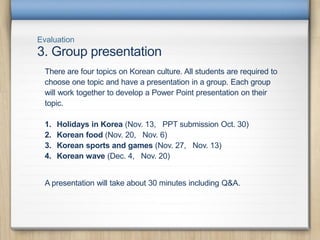
There are four topics on Korean culture. All students are required to
choose one topic and have a presentation in a group. Each group
will work together to develop a Power Point presentation on their
topic.
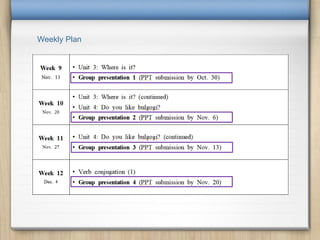
1. Holidays in Korea (Nov. 13, PPT submission Oct. 30)
2. Korean food (Nov. 20, Nov. 6)
3. Korean sports and games (Nov. 27, Nov. 13)
4. Korean wave (Dec. 4, Nov. 20)
A presentation will take about 30 minutes including Q&A.
Evaluation
3. Group presentation
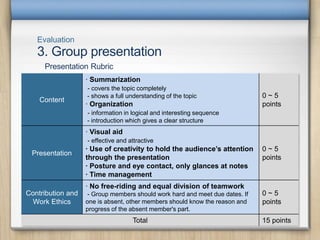
Presentation Rubric
Content
∙ Summarization
- covers the topic completely
- shows a full understanding of the topic
∙ Organization
- information in logical and interesting sequence
- introduction which gives a clear structure
0 ~ 5
points
Presentation
∙ Visual aid
- effective and attractive
∙ Use of creativity to hold the audience’s attention
through the presentation
∙ Posture and eye contact, only glances at notes
∙ Time management
0 ~ 5
points
Contribution and
Work Ethics
∙ No free-riding and equal division of teamwork
- Group members should work hard and meet due dates. If
one is absent, other members should know the reason and
progress of the absent member's part.
0 ~ 5
points
Total 15 points
Evaluation
3. Group presentation
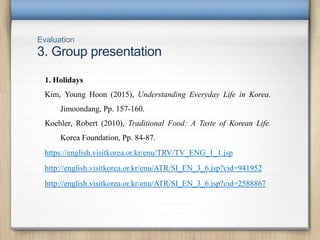
1. Holidays
Kim, Young Hoon (2015), Understanding Everyday Life in Korea.
Jimoondang, Pp. 157-160.
Koehler, Robert (2010), Traditional Food: A Taste of Korean Life.
Korea Foundation, Pp. 84-87.
https://english.visitkorea.or.kr/enu/TRV/TV_ENG_1_1.jsp
http://english.visitkorea.or.kr/enu/ATR/SI_EN_3_6.jsp?cid=941952
http://english.visitkorea.or.kr/enu/ATR/SI_EN_3_6.jsp?cid=2588867
Evaluation
3. Group presentation
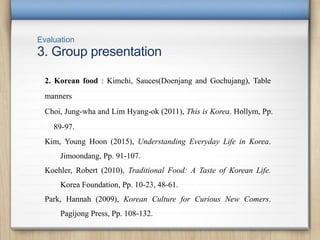
2. Korean food : Kimchi, Sauces(Doenjang and Gochujang), Table
manners
Choi, Jung-wha and Lim Hyang-ok (2011), This is Korea. Hollym, Pp.
89-97.
Kim, Young Hoon (2015), Understanding Everyday Life in Korea.
Jimoondang, Pp. 91-107.
Koehler, Robert (2010), Traditional Food: A Taste of Korean Life.
Korea Foundation, Pp. 10-23, 48-61.
Park, Hannah (2009), Korean Culture for Curious New Comers.
Pagijong Press, Pp. 108-132.
Evaluation
3. Group presentation
3. Korean sports and games : Traditional games, Taekwondo
Park, Hannah (2009), Korean Culture for Curious New Comers.
Pagijong Press, Pp. 264-274.
Randall, Karl (2011), Modern and Traditional Korean Games &
Sports. Hollym,
Evaluation
3. Group presentation
4. Korean wave : Movie, drama, K-pop music, Korean wave in your
countries
Park, Hannah (2009), Korean Culture for Curious New Comers.
Pagijong Press, Pp. 247-260.
Tudor, Daniel (2012), Korea: The impossible country. Tuttle
Publishing, Pp. 229-249.
https://www.korea.net/AboutKorea/Culture-and-the-Arts/Hallyu
Evaluation
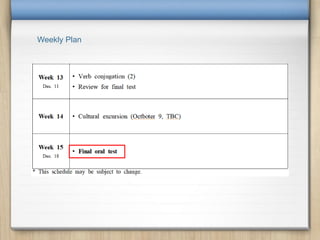
4. Final oral test (Dec. 18)
Students will have one-on-one oral test with the professor.
Questions for the oral test will be given later.
DOs & DON’Ts
Dos
√ Bing the textbook and course handout to every lecture.
√ Repeat after me.
√ Be an active participant.
√ Ask questions anytime.
Don’ts
√ Use of any materials irrelevant to instruction (e.g., cell phones,
materials for other courses) is not allowed.
√ NO food allowed in class
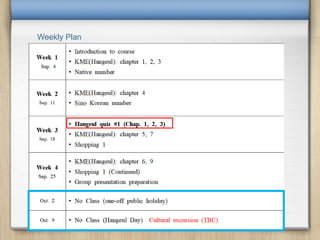
Weekly Plan
Weekly Plan
Weekly Plan
Weekly Plan
√ Introduction to course
√ KME (Hangeul) Chapter 1, 2, 3
√ Native Number
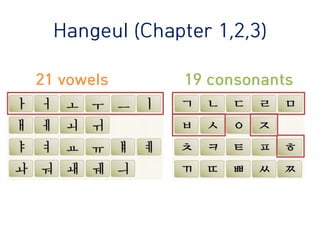
Hangeul (Chapter 1,2,3)
21 vowels 19 consonants
Consonant
ㅁ
[m]
마
ma
p. 36
Consonant
ㄴ
[n]
나
na
p. 36
Consonant
ㄹ
[r/l]
라
ra
When ㄹ is the first or final sound of a syllable, it is pronounced similar to
[l] in English. However, when ㄹ follows a vowel, the pronunciation changes.
This sound is written as [r], but it is not pronounced like the English [r].
ex. 라(la) vs 나라(nara)
p. 36
Vowel
ㅏ
[a]
아
a
When you write, a vowel cannot stand alone.
Either a consonant or a soundless ㅇ must be written in front of a vowel
na 나 a ㅏ (X) 아 (O)
p. 28
Vowel
ㅓ
[eo]
어
eo
p. 28
Vowel
ㅣ
[i]
이
i
p. 28
Vowel
ㅗ
[o]
오
o
Vertical vowel ㅏ ㅓ ㅣ 아 어 이
Horizontal vowel ㅗ ㅜ ㅡ 오 우 으
p. 28
Vowel
ㅜ
[u]
우
u
p. 28
Vowel
ㅡ
[eu]
으
eu
p. 28
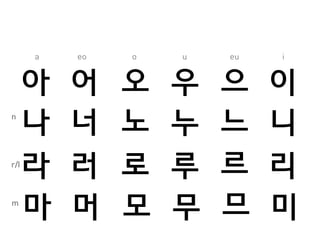
아 어 오 우 으 이
나
라
너 노 누 느 니
러 로 루 르 리
a eo o u eu i
n
r/l
m
마 머 모 무 므 미
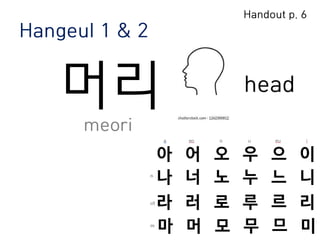
Hangeul 1 & 2
머리
meori
head
Handout p. 6
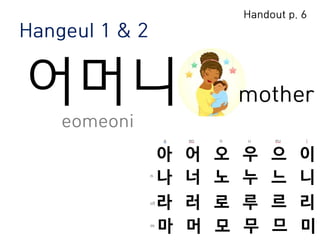
Hangeul 1 & 2
어머니 mother
eomeoni
Handout p. 6
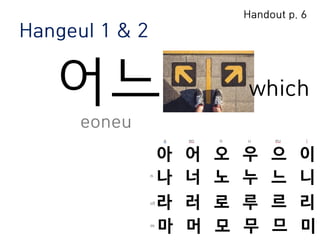
Hangeul 1 & 2
어느 which
eoneu
Handout p. 6
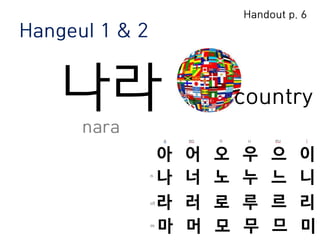
Hangeul 1 & 2
나라
nara
country
Handout p. 6
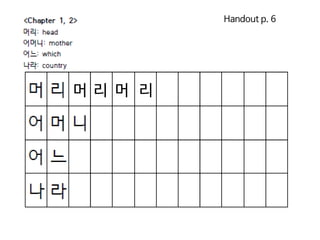
Handout p. 6
머 리 머 리
ㅂ
[p/b]
바
ba
p. 46
ㄷ
[t/d]
다
da
p. 46
ㅅ
[s]
사
sa
(X)
p. 47
ㅈ
[ch/j]
자
ja
p. 47
ㄱ
[k/g]
가
ga
가, 거, 고, 구, 그, 기
p. 47
ㅎ
[h]
하
ha
ㅎ
(O)
p. 47
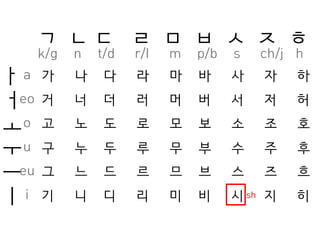
ㄱ ㄴ ㄷ ㄹ ㅁ ㅂ ㅅ ㅈ ㅎ
k/g n t/d r/l m p/b s ch/j h
ㅏ
ㅓ
ㅗ
ㅜ
ㅡ
ㅣ
a
eo
o
u
eu
i
가 나 다 라 마 바 사 자 하
거 너 더 러 머 버 서 저 허
고 노 도 로 모 보 소 조 호
구 누 두 루 무 부 수 주 후
그 느 드 르 므 브 스 즈 흐
기 니 디 리 미 비 시 지 히
sh
Vowel
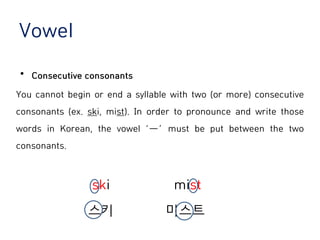
⦁ Consecutive consonants
You cannot begin or end a syllable with two (or more) consecutive
consonants (ex. ski, mist). In order to pronounce and write those
words in Korean, the vowel ‘ㅡ’ must be put between the two
consonants.
ski mist
스키 미스트
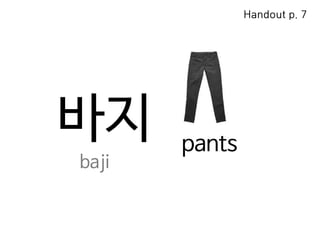
바지 pants
baji
Handout p. 7
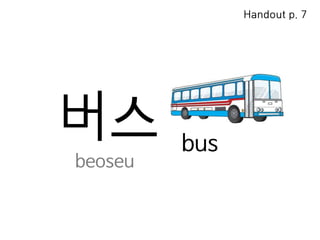
버스 bus
beoseu
Handout p. 7
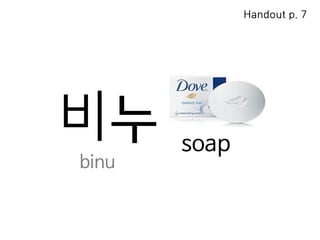
비누 soap
binu
Handout p. 7
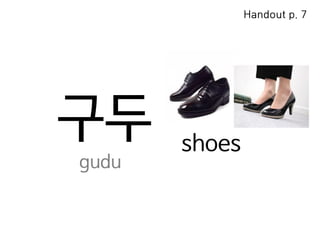
구두 shoes
gudu
Handout p. 7
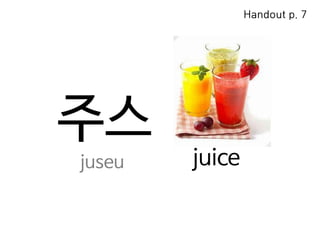
주스
juice
juseu
Handout p. 7
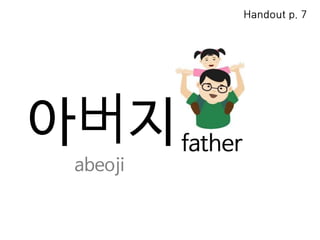
아버지father
abeoji
Handout p. 7
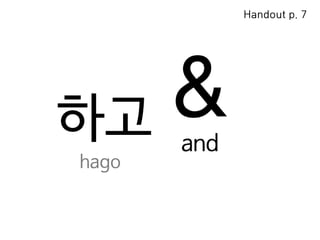
하고 and
hago
Handout p. 7
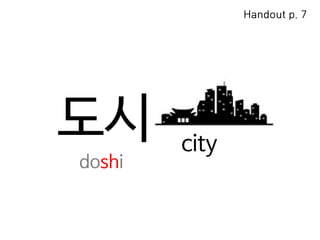
도시 city
doshi
Handout p. 7
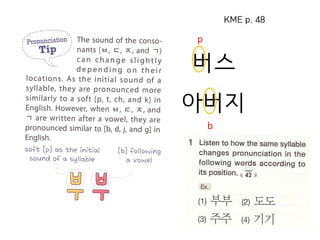
KME p. 48
버스
아버지
p
b
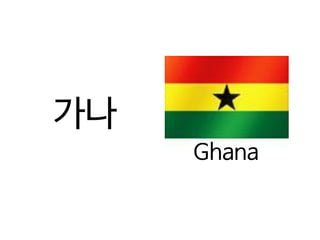
가나
Ghana
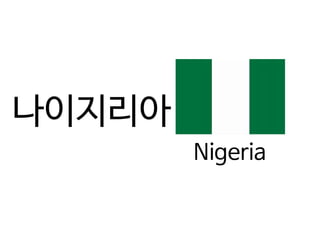
나이지리아
Nigeria
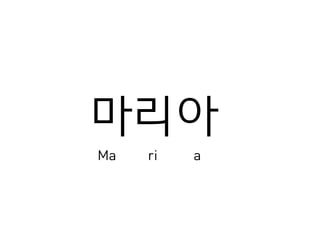
마리아
Ma ri a
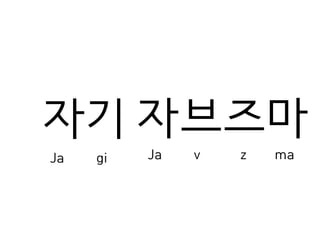
자기
Ja gi
자브즈마
Ja v z ma
√ Introduction to course
√ KME (Hangeul) Chapter 1, 2, 3
√ Review & Native Number
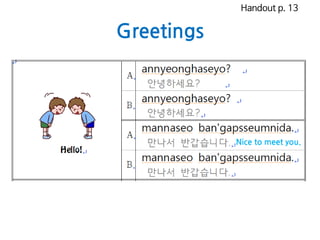
Greetings
Nice to meet you.
Handout p. 13
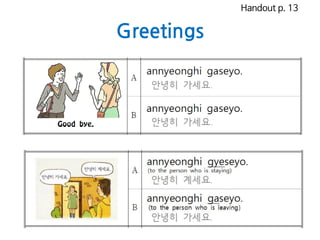
Greetings
Handout p. 13
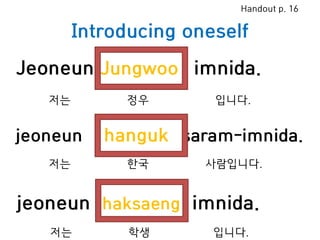
Introducing oneself
Jeoneun Jungwoo imnida.
jeoneun hanguk saram-imnida.
jeoneun haksaeng imnida.
저는 정우 입니다.
저는 한국 사람입니다.
Handout p. 16
저는 학생 입니다.
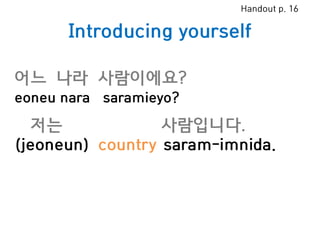
Introducing yourself
저는 사람입니다.
(jeoneun) country saram-imnida.
어느 나라 사람이에요?
eoneu nara saramieyo?
Handout p. 16
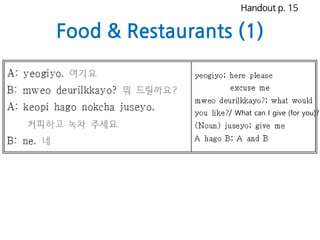
Food & Restaurants (1)
/ What can I give (for you)?
Handout p. 15
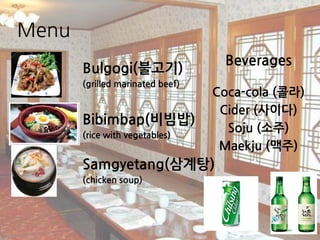
Menu
Bulgogi(불고기)
(grilled marinated beef)
Bibimbap(비빔밥)
(rice with vegetables)
Samgyetang(삼계탕)
(chicken soup)
Beverages
Coca-cola (콜라)
Cider (사이다)
Soju (소주)
Maekju (맥주)
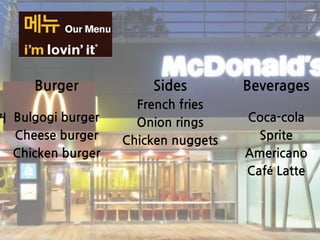
Burger
Bulgogi burger
Cheese burger
Chicken burger
Sides
French fries
Onion rings
Chicken nuggets
Beverages
Coca-cola
Sprite
Americano
Café Latte
거
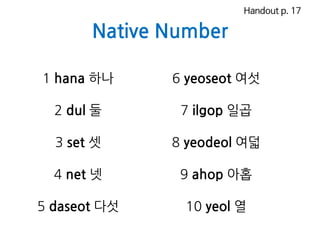
Native Number
1 hana 하나
2 dul 둘
3 set 셋
4 net 넷
5 daseot 다섯
6 yeoseot 여섯
7 ilgop 일곱
8 yeodeol 여덟
9 ahop 아홉
10 yeol 열
Handout p. 17

Introduction to Basic Korean language pdf