


KOREAN II
reading booklet
PIMSLEUR
SIMON & SCHUSTER’S
®
Graphic Design: Maia Kennedy
© and ‰ Recorded Program 2007 Simon & Schuster, Inc.
© Reading Booklet 2007 Simon & Schuster, Inc.
Pimsleur® is an imprint of Simon & Schuster Audio,
a division of Simon & Schuster, Inc. Mfg. in USA.
All rights reserved.
Travelers should always check with their
nation's State Department for current
advisories on local conditions before
traveling abroad.
iii
korean II
Voices
English-Speaking Instructor . . . . . . . .  Ray Brown
Korean-Speaking Instructor . . . . . .  Jungyong Ryu
Female Korean Speaker  . . . . . . . . . . . Jaemin Roh
Male Korean Speaker . . . . . . . . . . .  Bongyoul Lee
Course Writers
Jaemin Roh ◆ Kimiko Ise Abramoff
Course Editors
Masako D’Auria ◆ Beverly D. Heinle
Reviewer
Eunju Bang
Executive Editor
Beverly D. Heinle
Producer & Director
Sarah H. McInnis
Recording Engineers
Peter S. Turpin ◆ Kelly Saux
Simon & Schuster Studios, Concord, MA
acknowledgments
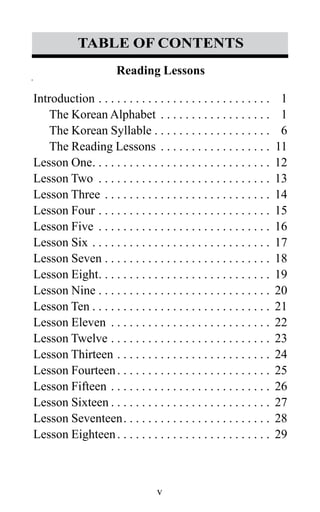
v
Reading Lessons
Introduction. . . . . . . . . . . . . . . . . . . . . . . . . . . . . 1
The Korean Alphabet . . . . . . . . . . . . . . . . . . . 1
The Korean Syllable  . . . . . . . . . . . . . . . . . . . 6
The Reading Lessons . . . . . . . . . . . . . . . . . .  11
Lesson One . . . . . . . . . . . . . . . . . . . . . . . . . . . . . 12
Lesson Two . . . . . . . . . . . . . . . . . . . . . . . . . . . . . 13
Lesson Three. . . . . . . . . . . . . . . . . . . . . . . . . . . . 14
Lesson Four. . . . . . . . . . . . . . . . . . . . . . . . . . . . . 15
Lesson Five . . . . . . . . . . . . . . . . . . . . . . . . . . . . . 16
Lesson Six. . . . . . . . . . . . . . . . . . . . . . . . . . . . . . 17
Lesson Seven . . . . . . . . . . . . . . . . . . . . . . . . . . . 18
Lesson Eight . . . . . . . . . . . . . . . . . . . . . . . . . . . . 19
Lesson Nine . . . . . . . . . . . . . . . . . . . . . . . . . . . . 20
Lesson Ten  . . . . . . . . . . . . . . . . . . . . . . . . . . . . . 21
Lesson Eleven . . . . . . . . . . . . . . . . . . . . . . . . . . . 22
Lesson Twelve. . . . . . . . . . . . . . . . . . . . . . . . . . . 23
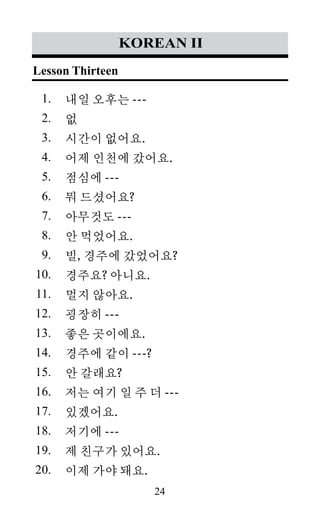
Lesson Thirteen. . . . . . . . . . . . . . . . . . . . . . . . . . 24
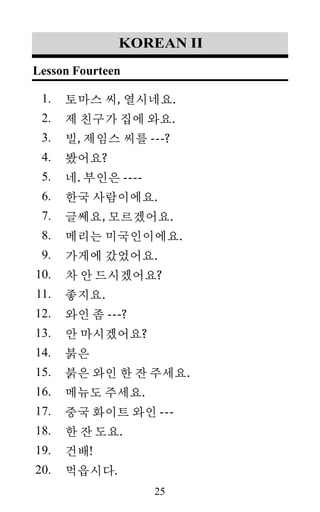
Lesson Fourteen . . . . . . . . . . . . . . . . . . . . . . . . . 25
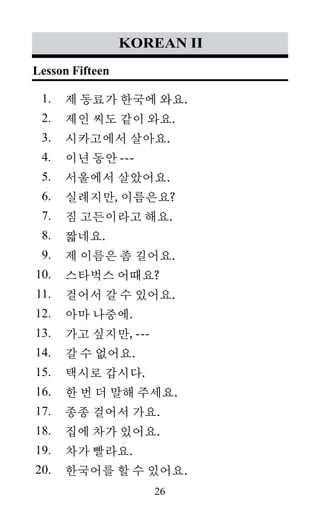
Lesson Fifteen. . . . . . . . . . . . . . . . . . . . . . . . . . . 26
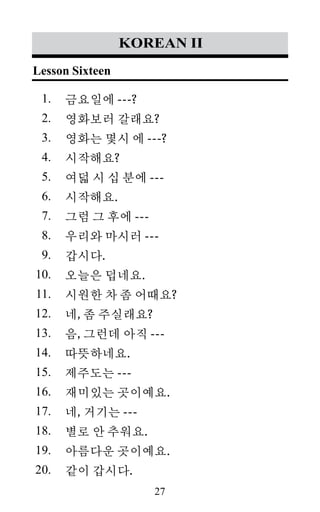
Lesson Sixteen  . . . . . . . . . . . . . . . . . . . . . . . . . . 27
Lesson Seventeen . . . . . . . . . . . . . . . . . . . . . . . . 28
Lesson Eighteen . . . . . . . . . . . . . . . . . . . . . . . . . 29
table of contents
korean II
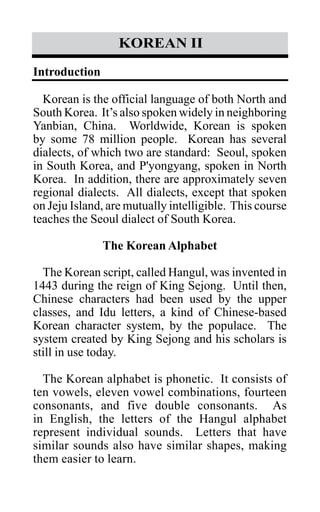
Introduction
Korean is the official language of both North and
South Korea. It’s also spoken widely in neighboring
Yanbian, China. Worldwide, Korean is spoken
by some 78 million people. Korean has several
dialects, of which two are standard: Seoul, spoken
in South Korea, and P'yongyang, spoken in North
Korea. In addition, there are approximately seven
regional dialects. All dialects, except that spoken
on Jeju Island, are mutually intelligible. This course
teaches the Seoul dialect of South Korea.
The Korean Alphabet
The Korean script, called Hangul, was invented in
1443 during the reign of King Sejong. Until then,
Chinese characters had been used by the upper
classes, and Idu letters, a kind of Chinese-based
Korean character system, by the populace. The
system created by King Sejong and his scholars is
still in use today.
The Korean alphabet is phonetic. It consists of
ten vowels, eleven vowel combinations, fourteen
consonants, and five double consonants. As
in English, the letters of the Hangul alphabet
represent individual sounds. Letters that have
similar sounds also have similar shapes, making
them easier to learn.
2
korean II
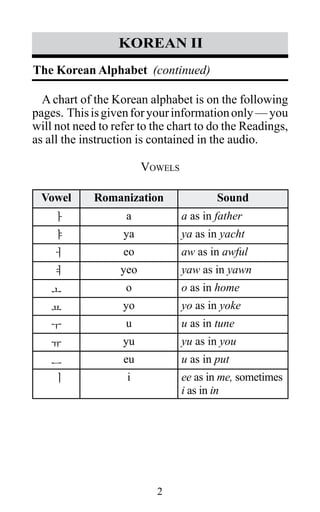
A chart of the Korean alphabet is on the following
pages. Thisisgivenforyourinformationonly—you
will not need to refer to the chart to do the Readings,
as all the instruction is contained in the audio.
Vowels
	
Vowel Romanization Sound
ㅏ a a as in father
ㅑ ya ya as in yacht
ㅓ eo aw as in awful
ㅕ yeo yaw as in yawn
ㅗ o o as in home
ㅛ yo yo as in yoke
ㅜ u u as in tune
ㅠ yu yu as in you
ㅡ eu u as in put
ㅣ i ee as in me, sometimes
i as in in
The Korean Alphabet (continued)
3
korean II
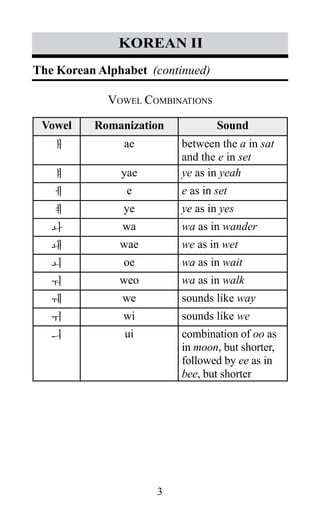
Vowel Combinations
Vowel Romanization Sound
ㅐ ae between the a in sat
and the e in set
ㅒ yae ye as in yeah
ㅔ e e as in set
ㅖ ye ye as in yes
ㅘ wa wa as in wander
ㅙ wae we as in wet
ㅚ oe wa as in wait
ㅝ weo wa as in walk
ㅞ we sounds like way
ㅟ wi sounds like we
ㅢ ui combination of oo as
in moon, but shorter,
followed by ee as in
bee, but shorter
The Korean Alphabet (continued)
4
korean II
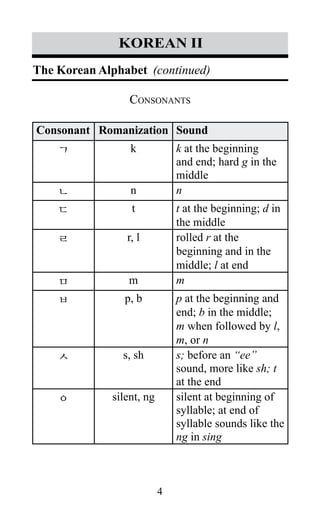
Consonants
Consonant Romanization Sound
ㄱ k k at the beginning
and end; hard g in the
middle
ㄴ n n
ㄷ t t at the beginning; d in
the middle
ㄹ r, l rolled r at the
beginning and in the
middle; l at end
ㅁ m m
ㅂ p, b p at the beginning and
end; b in the middle;
m when followed by l,
m, or n
ㅅ s, sh s; before an “ee”
sound, more like sh; t
at the end
ㅇ silent, ng silent at beginning of
syllable; at end of
syllable sounds like the
ng in sing
The Korean Alphabet (continued)
5
korean II
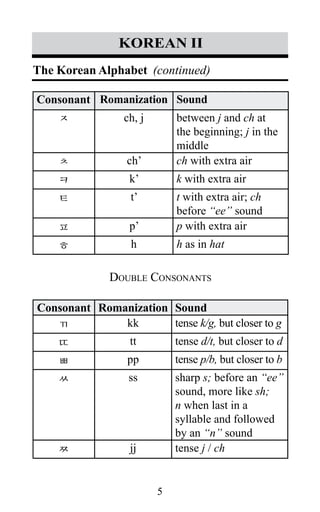
Consonant Romanization Sound
ㅈ ch, j between j and ch at
the beginning; j in the
middle
ㅊ ch’ ch with extra air
ㅋ k’ k with extra air
ㅌ t’ t with extra air; ch
before “ee” sound
ㅍ p’ p with extra air
ㅎ h h as in hat
Double Consonants
Consonant Romanization Sound
ㄲ kk tense k/g, but closer to g
ㄸ tt tense d/t, but closer to d
ㅃ pp tense p/b, but closer to b
ㅆ ss sharp s; before an “ee”
sound, more like sh;
n when last in a
syllable and followed
by an “n” sound
ㅉ jj tense j / ch
The Korean Alphabet (continued)
6
korean II
The Korean Syllable
Thebasicunitof writtenKorean is thesyllable. All
Korean words can be viewed as blocks of syllables.
Each syllable block is like a square of a fixed size.
There are two basic syllable blocks: consonant-
vowel, and consonant-vowel-consonant.
The way letters are arranged in a syllable block
depends upon the vowel in the syllable. Vowels can
be viewed as horizonal, vertical, or a combination
of both.
Korean syllable blocks follow four basic rules.
Understanding these rules makes it easier to
recognize letters in a syllable, and thereby to read
Korean. The four basic rules follow.
The Korean Syllable
7
korean II
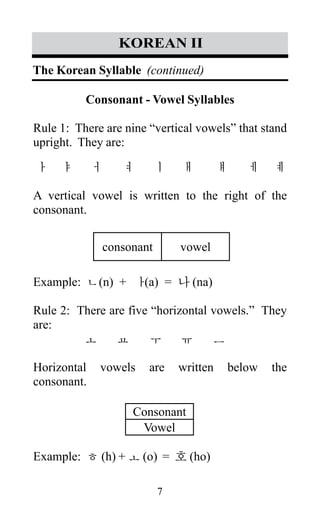
Consonant - Vowel Syllables
Rule 1: There are nine “vertical vowels” that stand
upright. They are:
ㅏ	 ㅑ	 ㅓ	 ㅕ	 ㅣ	 ㅐ	 ㅒ	 ㅔ	 ㅖ
A vertical vowel is written to the right of the
consonant.
consonant vowel
Example: ㄴ(n)  +  ㅏ(a)  = 나 (na)
Rule 2: There are five “horizontal vowels.” They
are:
	 ㅗ	 ㅛ	 ㅜ	 ㅠ	 ㅡ
Horizontal vowels are written below the
consonant.
Consonant
Vowel
Example: ㅎ (h) + ㅗ (o)  = 호 (ho)
The Korean Syllable (continued)
8
korean II
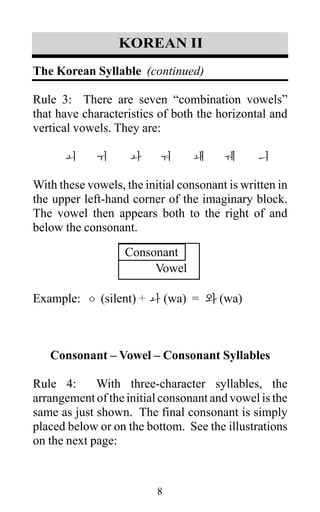
Rule 3: There are seven “combination vowels”
that have characteristics of both the horizontal and
vertical vowels. They are:
	 ㅚ	 ㅟ	 ㅘ	 ㅝ	 ㅙ	 ㅞ	 ㅢ
With these vowels, the initial consonant is written in
the upper left-hand corner of the imaginary block.
The vowel then appears both to the right of and
below the consonant.
Example: ㅇ (silent) + ㅘ (wa) = 와 (wa)
Consonant – Vowel – Consonant Syllables
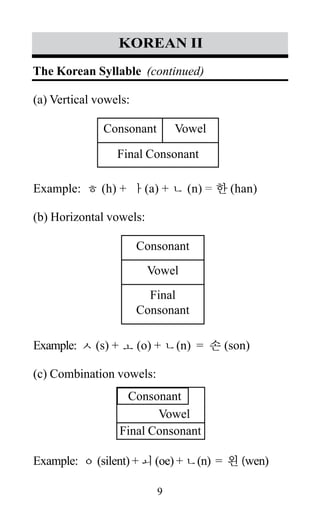
Rule 4: With three-character syllables, the
arrangement of the initial consonant and vowel is the
same as just shown. The final consonant is simply
placed below or on the bottom. See the illustrations
on the next page:
The Korean Syllable (continued)
Consonant
Vowel
9
korean II
(a) Vertical vowels:
Consonant Vowel
Final Consonant
Example: ㅎ (h) + ㅏ (a) + ㄴ (n) = 한 (han)
(b) Horizontal vowels:
Consonant
Vowel
Final
Consonant
Example: ㅅ (s) + ㅗ (o) + ㄴ(n) = 손 (son)
(c) Combination vowels:
Example: ㅇ (silent) + ㅚ(oe) + ㄴ(n) = 왼(wen)
The Korean Syllable (continued)
Consonant
Vowel
Final Consonant
10
korean II
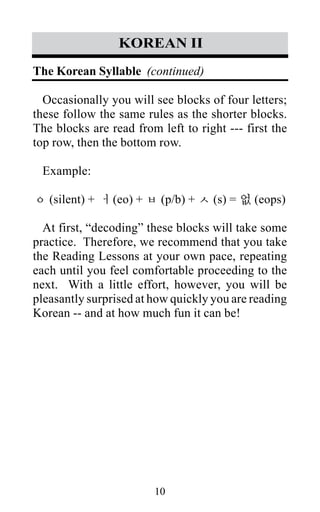
Occasionally you will see blocks of four letters;
these follow the same rules as the shorter blocks.
The blocks are read from left to right --- first the
top row, then the bottom row.
Example:
ㅇ (silent) + ㅓ (eo) + ㅂ (p/b) + ㅅ (s) = 없 (eops)
At first, “decoding” these blocks will take some
practice. Therefore, we recommend that you take
the Reading Lessons at your own pace, repeating
each until you feel comfortable proceeding to the
next. With a little effort, however, you will be
pleasantly surprised at how quickly you are reading
Korean -- and at how much fun it can be!
The Korean Syllable (continued)
11
korean II
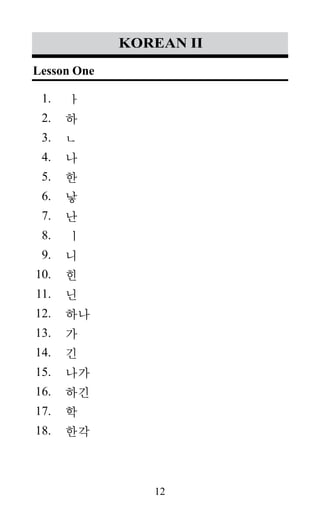
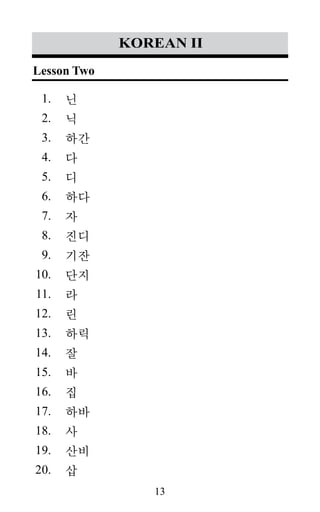
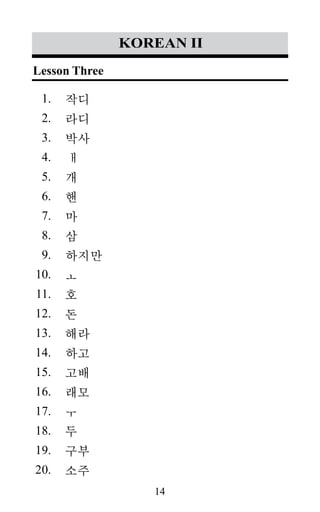
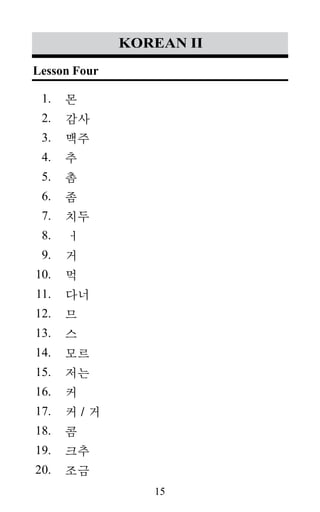
There are eighteen Reading Lessons. The first ten
Reading Lessons are a review of Level I. They will
give you a solid introduction for reading Korean. In
the final eight Lessons, you’ll have a chance to try
“reading” words, phrases, and sentences you have
learned in the course.
The recorded portion of the reading materials
for Korean II is at the end of the program. You
can do the Readings as is most convenient
for you. They can be done individually after every
other unit or so, or done entirely after completing
the full thirty units. Instructions on how to proceed
are recorded along with the Readings.
Remember, you can repeat the lessons as often as
you wish until you can read the Hangul letters with
some fluency.
The Reading Lessons
12
korean II
ㅏ
하
ㄴ
나
한
낳
난
ㅣ
니
힌
닌
하나
가
긴
나가
하긴
학
한각
Lesson One
1.
2.
3.
4.
5.
6.
7.
8.
9.
10.
11.
12.
13.
14.
15.
16.
17.
18.
13
1.
2.
3.
4.
5.
6.
7.
8.
9.
10.
11.
12.
13.
14.
15.
16.
17.
18.
19.
20.
korean II
닌
닉
하간
다
디
하다
자
진디
기잔
단지
라
린
하릭
잘
바
집
하바
사
산비
삽
Lesson Two
14
1.
2.
3.
4.
5.
6.
7.
8.
9.
10.
11.
12.
13.
14.
15.
16.
17.
18.
19.
20.
korean II
작디
라디
박사
ㅐ
개
핸
마
삼
하지만
ㅗ
호
돈
해라
하고
고배
래모
ㅜ
두
구부
소주
Lesson Three
15
1.
2.
3.
4.
5.
6.
7.
8.
9.
10.
11.
12.
13.
14.
15.
16.
17.
18.
19.
20.
korean II
몬
감사
맥주
추
촘
좀
치두
ㅓ
거
먹
다너
므
스
모르
저는
커
커 / 거
콤
크추
조금
Lesson Four
16
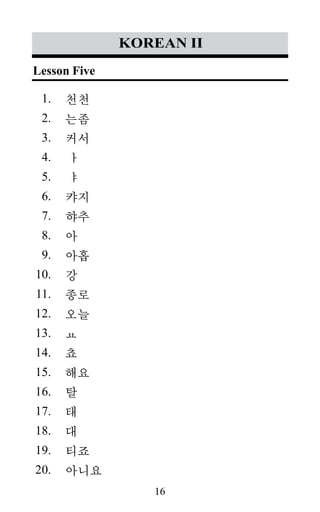
1.
2.
3.
4.
5.
6.
7.
8.
9.
10.
11.
12.
13.
14.
15.
16.
17.
18.
19.
20.
korean II
천천
는좀
커서
ㅏ
ㅑ
캬지
햐추
아
아홉
강
종로
오늘
ㅛ
쵸
해요
탈
태
대
티죠
아니요
Lesson Five
17
1.
2.
3.
4.
5.
6.
7.
8.
9.
10.
11.
12.
13.
14.
15.
16.
17.
18.
19.
20.
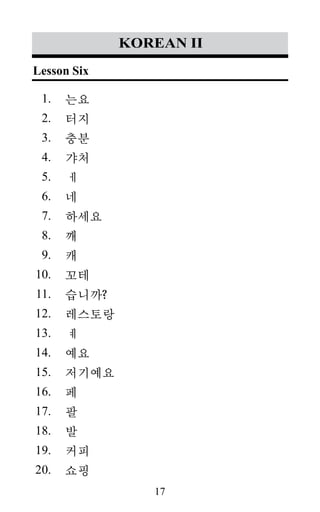
korean II
는요
터지
충분
갸처
ㅔ
네
하세요
깨
캐
꼬테
습니까?
레스토랑
ㅖ
예요
저기예요
페
팔
발
커피
쇼핑
Lesson Six
18
1.
2.
3.
4.
5.
6.
7.
8.
9.
10.
11.
12.
13.
14.
15.
16.
17.
18.
19.
20.
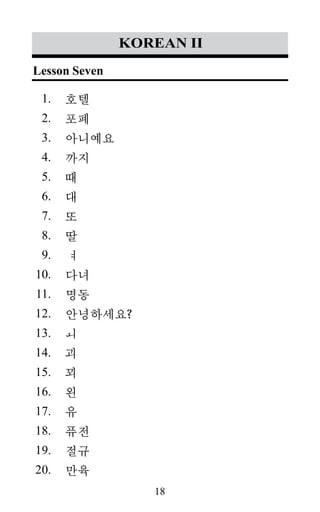
korean II
호텔
포폐
아니예요
까지
때
대
또
딸
ㅕ
다녀
명동
안녕하세요?
ㅚ
괴
꾀
왼
유
퓨전
절규
만육
Lesson Seven
19
1.
2.
3.
4.
5.
6.
7.
8.
9.
10.
11.
12.
13.
14.
15.
16.
17.
18.
19.
20.
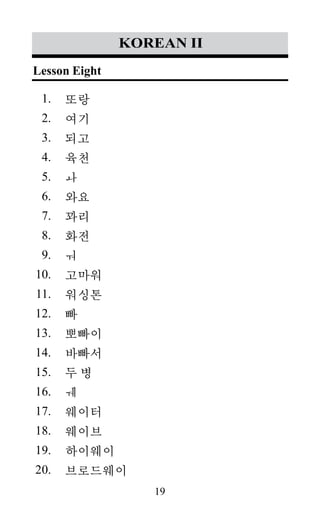
korean II
또랑
여기
되고
육천
ㅘ
와요
꽈리
화전
ㅝ
고마워
워싱톤
빠
뽀빠이
바빠서
두 병
ㅞ
웨이터
웨이브
하이웨이
브로드웨이
Lesson Eight
20
1.
2.
3.
4.
5.
6.
7.
8.
9.
10.
11.
12.
13.
14.
15.
16.
17.
18.
19.
20.
korean II
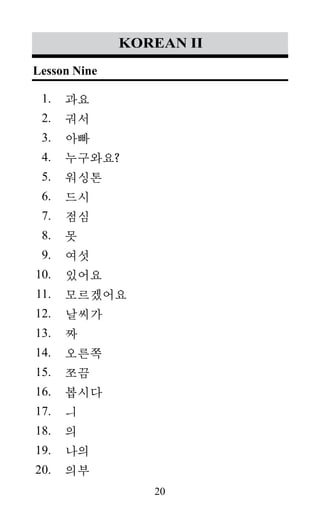
과요
궈서
아빠
누구와요?
워싱톤
드시
점심
못
여섯
있어요
모르겠어요
날씨가
짜
오른쪽
쪼끔
봅시다
ㅢ
의
나의
의부
Lesson Nine
21
1.
2.
3.
4.
5.
6.
7.
8.
9.
10.
11.
12.
13.
14.
15.
16.
17.
18.
19.
20.
korean II
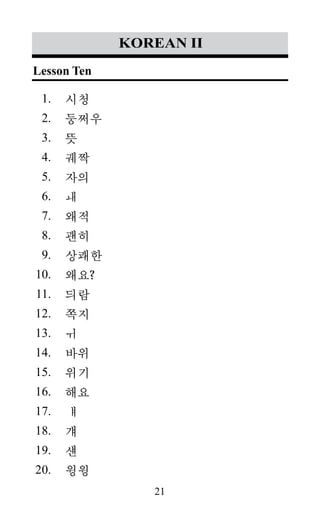
시청
둥쩌우
뜻
궤짝
자의
ㅙ
왜적
괜히
상쾌한
왜요?
듸람
쪽지
ㅟ
바위
위기
해요
ㅒ
걔
섄
윙윙
Lesson Ten
22
1.
2.
3.
4.
5.
6.
7.
8.
9.
10.
11.
12.
13.
14.
15.
16.
17.
18.
19.
20.
korean II
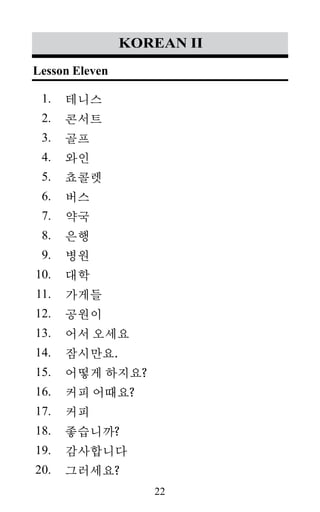
테니스
콘서트
골프
와인
쵸콜렛
버스
약국
은행
병원
대학
가게들
공원이
어서 오세요
잠시만요.
어떻게 하지요?
커피 어때요?
커피
좋습니까?
감사합니다
그러세요?
Lesson Eleven
23
1.
2.
3.
4.
5.
6.
7.
8.
9.
10.
11.
12.
13.
14.
15.
16.
17.
18.
19.
20.
korean II
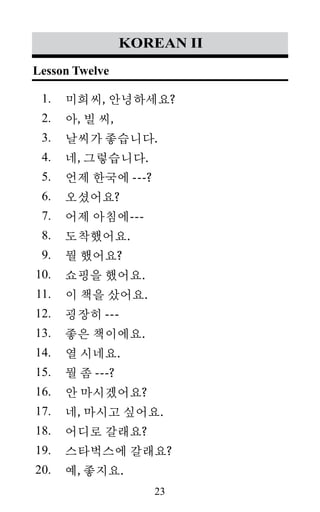
미희씨, 안녕하세요?
아, 빌 씨,
날씨가 좋습니다.
네, 그렇습니다.
언제 한국에 ---?
오셨어요?
어제 아침에---
도착했어요.
뭘 했어요?
쇼핑을 했어요.
이 책을 샀어요.
굉장히 ---
좋은 책이에요.
열 시네요.
뭘 좀 ---?
안 마시겠어요?
네, 마시고 싶어요.
어디로 갈래요?
스타벅스에 갈래요?
예, 좋지요.
Lesson Twelve
24
1.
2.
3.
4.
5.
6.
7.
8.
9.
10.
11.
12.
13.
14.
15.
16.
17.
18.
19.
20.
korean II
내일 오후는 ---
없
시간이 없어요.
어제 인천에 갔어요.
점심에 ---
뭐 드셨어요?
아무것도 ---
안 먹었어요.
빌, 경주에 갔었어요?
경주요? 아니요.
멀지 않아요.
굉장히 ---
좋은 곳이에요.
경주에 같이 ---?
안 갈래요?
저는 여기 일 주 더 ---
있겠어요.
저기에 ---
제 친구가 있어요.
이제 가야 돼요.
Lesson Thirteen
25
1.
2.
3.
4.
5.
6.
7.
8.
9.
10.
11.
12.
13.
14.
15.
16.
17.
18.
19.
20.
korean II
토마스 씨, 열시네요.
제 친구가 집에 와요.
빌, 제임스 씨를 ---?
봤어요?
네. 부인은 ----
한국 사람이에요.
글쎄요, 모르겠어요.
메리는 미국인이에요.
가게에 갔었어요.
차 안 드시겠어요?
좋지요.
와인 좀 ---?
안 마시겠어요?
붉은
붉은 와인 한 잔 주세요.
메뉴도 주세요.
중국 화이트 와인 ---
한 잔 도요.
건배!
먹읍시다.
Lesson Fourteen
26
1.
2.
3.
4.
5.
6.
7.
8.
9.
10.
11.
12.
13.
14.
15.
16.
17.
18.
19.
20.
korean II
제 동료가 한국에 와요.
제인 씨도 같이 와요.
시카고에서 살아요.
이년 동안 ---
서울에서 살았어요.
실례지만, 이름은요?
짐 고든이라고 해요.
짧네요.
제 이름은 좀 길어요.
스타벅스 어때요?
걸어서 갈 수 있어요.
아마 나중에.
가고 싶지만, ---
갈 수 없어요.
택시로 갑시다.
한 번 더 말해 주세요.
종종 걸어서 가요.
집에 차가 있어요.
차가 빨라요.
한국어를 할 수 있어요.
Lesson Fifteen
27
1.
2.
3.
4.
5.
6.
7.
8.
9.
10.
11.
12.
13.
14.
15.
16.
17.
18.
19.
20.
korean II
금요일에 ---?
영화보러 갈래요?
영화는 몇시 에 ---?
시작해요?
여덟 시 십 분에 ---
시작해요.
그럼 그 후에 ---
우리와 마시러 ---
갑시다.
오늘은 덥네요.
시원한 차 좀 어때요?
네, 좀 주실래요?
음, 그런데 아직 ---
따뜻하네요.
제주도는 ---
재미있는 곳이예요.
네, 거기는 ---
별로 안 추워요.
아름다운 곳이예요.
같이 갑시다.
Lesson Sixteen
28
1.
2.
3.
4.
5.
6.
7.
8.
9.
10.
11.
12.
13.
14.
15.
16.
17.
18.
19.
20.
korean II
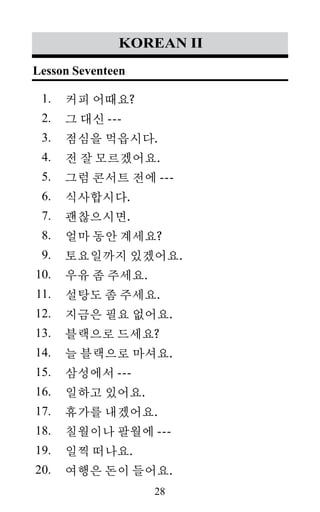
커피 어때요?
그 대신 ---
점심을 먹읍시다.
전 잘 모르겠어요.
그럼 콘서트 전에 ---
식사합시다.
괜찮으시면.
얼마 동안 계세요?
토요일까지 있겠어요.
우유 좀 주세요.
설탕도 좀 주세요.
지금은 필요 없어요.
블랙으로 드세요?
늘 블랙으로 마셔요.
삼성에서 ---
일하고 있어요.
휴가를 내겠어요.
칠월이나 팔월에 ---
일찍 떠나요.
여행은 돈이 들어요.
Lesson Seventeen
29
1.
2.
3.
4.
5.
6.
7.
8.
9.
10.
11.
12.
13.
14.
15.
16.
17.
18.
19.
20.
korean II
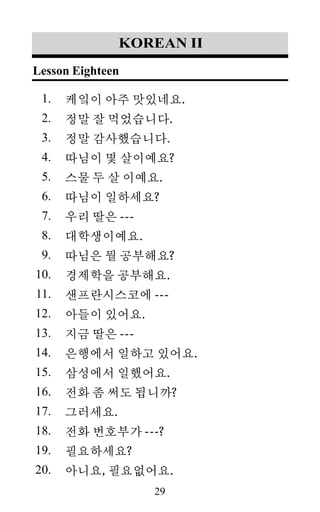
케잌이 아주 맛있네요.
정말 잘 먹었습니다.
정말 감사했습니다.
따님이 몇 살이예요?
스물 두 살 이예요.
따님이 일하세요?
우리 딸은 ---
대학생이예요.
따님은 뭘 공부해요?
경제학을 공부해요.
샌프란시스코에 ---
아들이 있어요.
지금 딸은 ---
은행에서 일하고 있어요.
삼성에서 일했어요.
전화 좀 써도 됩니까?
그러세요.
전화 번호부가 ---?
필요하세요?
아니요, 필요없어요.
Lesson Eighteen
For more information, call
1-800-831-5497 or visit us at
www.Pimsleur.com

combination