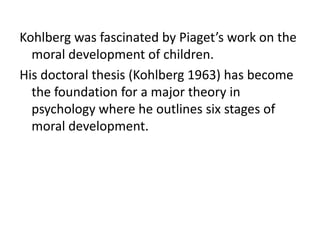
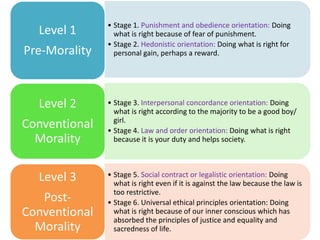
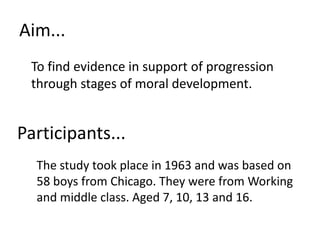
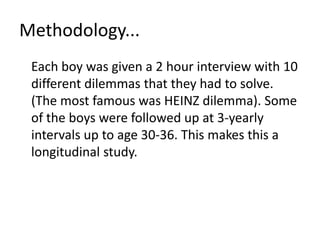
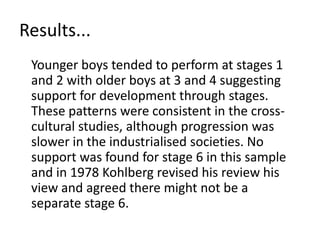
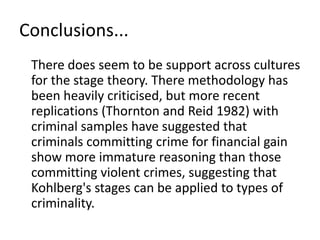
Kohlberg was fascinated by Piaget's work on moral development in children. His 1963 doctoral thesis outlined six stages of moral development and aimed to find evidence of progression through these stages. The study involved 58 boys aged 7-16 from Chicago who were given moral dilemmas to solve in interviews over several years. Younger boys tended to reason at earlier stages while older boys used later stage reasoning, providing support for Kohlberg's stage theory of moral development. While the methodology has been criticized, later studies found criminals committing financially-motivated crimes displayed more immature moral reasoning than violent criminals.




![Piaget Moral[1]](https://cdn.slidesharecdn.com/ss_thumbnails/piagetmoral1-1222635187507929-9-thumbnail.jpg?width=640&height=640&fit=bounds)


