Yochelson and SamenowA study of thinking patterns in criminals
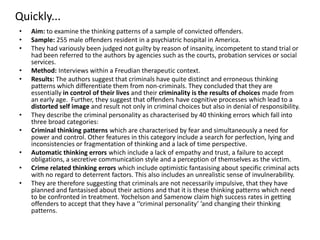
	The evidence base for criminal thinking patterns has been heavily influenced by the work of two doctors working with criminals in a mental hospital. Their project spanned 14 years and has been published in stages in a series of books.
Aims...To understand the make-up of the criminal personality.
To establish techniques that could be used to alter the personality disorders that produce crime.
To encourage an understanding of legal responsibility.
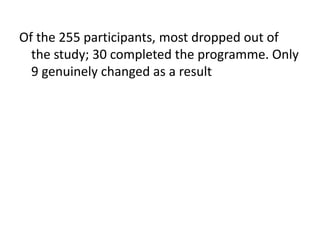
To establish techniques that can be effective in preventing criminal behaviour. Participants...	The study was based on 255 male participants from various backgrounds: black, white, those from the inner city, those from the suburbs, wealthy, poor, etc. Were all evaluated. The population of studied offenders was composed of those confined to the hospital who has been found guilty but because of there insanity were considered more suited to indefinite secure treatment, as well as a roughly equal number of convicted criminals who were not confined to the institution. If they were found not guilty by reason of insanity, the prisoners are not sent to prison but instead to a secure mental hospital as in the case in the UK.
Participants continued...	They are not considered incapable of guilt because they do not meet the criteria for mensrea, even though they have committed a criminal act. The other criminals did not use the plea. There was no control group of non-criminals to see if they also has these thought patterns.
Methodology...	A series of interviews was conducted with the participants over a seven year period.
Selected findings...According to Yochelson and Samenow, criminals...Are restless, dissatisfied and irritable
While at school, considered requests from their teachers and parents as impositions
Continually set themselves apart from others

Yochelson and samenow

  • 1.
    Yochelson and SamenowAstudy of thinking patterns in criminals
  • 2.
    The evidence basefor criminal thinking patterns has been heavily influenced by the work of two doctors working with criminals in a mental hospital. Their project spanned 14 years and has been published in stages in a series of books.
  • 3.
    Aims...To understand themake-up of the criminal personality.
  • 4.
    To establish techniquesthat could be used to alter the personality disorders that produce crime.
  • 5.
    To encourage anunderstanding of legal responsibility.
  • 6.
    To establish techniquesthat can be effective in preventing criminal behaviour. Participants... The study was based on 255 male participants from various backgrounds: black, white, those from the inner city, those from the suburbs, wealthy, poor, etc. Were all evaluated. The population of studied offenders was composed of those confined to the hospital who has been found guilty but because of there insanity were considered more suited to indefinite secure treatment, as well as a roughly equal number of convicted criminals who were not confined to the institution. If they were found not guilty by reason of insanity, the prisoners are not sent to prison but instead to a secure mental hospital as in the case in the UK.
  • 7.
    Participants continued... They arenot considered incapable of guilt because they do not meet the criteria for mensrea, even though they have committed a criminal act. The other criminals did not use the plea. There was no control group of non-criminals to see if they also has these thought patterns.
  • 8.
    Methodology... A series ofinterviews was conducted with the participants over a seven year period.
  • 9.
    Selected findings...According toYochelson and Samenow, criminals...Are restless, dissatisfied and irritable
  • 10.
    While at school,considered requests from their teachers and parents as impositions
  • 11.