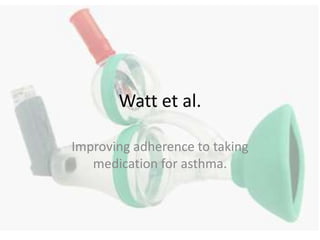
Watt et al. Improving adherence to taking medication for asthma.
Aim	To see if using a Funhaler cam improve children’s adherence to taking medication for asthma.
Methodology	A filed experiment, although as it involves children with asthma it can also qualify as a quasi-experiment. The experiment sets up two conditions, then uses self-report to measure adherence rates.
Participants	32 Australian children (10 boys and 22 females) aged 1.5 to 6 years with a mean age of 3.2 years. They has all been diagnosed with asthma and prescribed drugs delivered by pressurised metered dose inhaler (pMDI). The parents gave unformed consent.
Design	A repeated measures design as each participant has one week using a normal pMDI inhaler then on week using the Funhaler.
Procedure	Each child was given a pMDI to use for one week, and the parents were given a questionnaire to complete. The second week, the children used a Funhaler, and the parents were given a questionnaire with matched questions at the end of the second week. The Funhaler has incentive toys (spinner and whistle) which function best when the child uses the deep breathing pattern that ensures the effective inhalation of the medication.
Findings	38% of more parents were found to have medicated their children the previous day when using the Funhaler, compared to the existing treatment.
Conclusions	Previous research has given reasons for non-adherence in children with asthma, such as boredom, forgetfulness and apathy. The Funhaler set out to remedy this by reinforcing correct usage of the inhaler with a spinner and a whistle. This sis improve adherence to the medication. So by making the medical regime fun, adherence, certainly in children, cam be improved.

Watt et al

  • 1.
    Watt et al.Improving adherence to taking medication for asthma.
  • 2.
    Aim To see ifusing a Funhaler cam improve children’s adherence to taking medication for asthma.
  • 3.
    Methodology A filed experiment,although as it involves children with asthma it can also qualify as a quasi-experiment. The experiment sets up two conditions, then uses self-report to measure adherence rates.
  • 4.
    Participants 32 Australian children(10 boys and 22 females) aged 1.5 to 6 years with a mean age of 3.2 years. They has all been diagnosed with asthma and prescribed drugs delivered by pressurised metered dose inhaler (pMDI). The parents gave unformed consent.
  • 5.
    Design A repeated measuresdesign as each participant has one week using a normal pMDI inhaler then on week using the Funhaler.
  • 6.
    Procedure Each child wasgiven a pMDI to use for one week, and the parents were given a questionnaire to complete. The second week, the children used a Funhaler, and the parents were given a questionnaire with matched questions at the end of the second week. The Funhaler has incentive toys (spinner and whistle) which function best when the child uses the deep breathing pattern that ensures the effective inhalation of the medication.
  • 7.
    Findings 38% of moreparents were found to have medicated their children the previous day when using the Funhaler, compared to the existing treatment.
  • 8.
    Conclusions Previous research hasgiven reasons for non-adherence in children with asthma, such as boredom, forgetfulness and apathy. The Funhaler set out to remedy this by reinforcing correct usage of the inhaler with a spinner and a whistle. This sis improve adherence to the medication. So by making the medical regime fun, adherence, certainly in children, cam be improved.