Andreas Schmidt FZI Research Center for Information Technologies Knowledge Maturing and the Participatory Enterprise Online Educa 2008 Berlin, December 2008 [email_address] http://andreas.schmidt.name http://mature-ip.eu
Outline From top-down to bottom-up approaches  to learning in organizations Knowledge maturing & the gardening metaphor Technologies Summary MATURE - Continuous Social Learning in Knowledge Networks
From top-down approaches … Many approaches to learning are based on  a top-down philosophy Teaching at universities Installing a Learning Management System Implementing a human resource development strategy But this has often led to Lack of motivation on the user side Slow and cumbersome processes Unused potential of learner/employee creativity MATURE - Continuous Social Learning in Knowledge Networks
…  to bottom-up processes? But most learning experiences do not take place in a top-down manner: We learn from colleagues & friends in discussions We learn with others while developing an idea and solving problems at hand We learn from resources not designed as learning support And nobody has organized this learning Why not  broaden our perspective on learning  with a clear focus on bottom-up processes? MATURE - Continuous Social Learning in Knowledge Networks
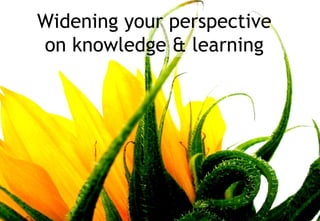
MATURE - Continuous Social Learning in Knowledge Networks Widening your perspective on knowledge & learning
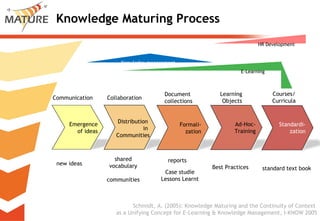
Knowledge Maturing Process new ideas shared vocabulary communities Best Practices standard text book Collaboration Courses/ Curricula Learning  Objects Communication Document  collections reports Case studie Lessons Learnt Distribution  in  Communities Emergence of ideas Formali- zation Ad-Hoc- Training Standardi- zation Schmidt, A. (2005): Knowledge Maturing and the Continuity of Context  as a Unifying Concept for E-Learning & Knowledge Management, I-KNOW 2005 Knowledge management E-Learning HR Development
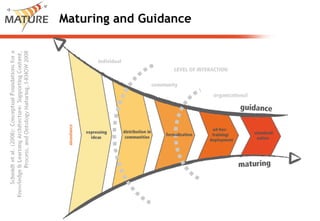
Maturing and Guidance MATURE - Continuous Social Learning in Knowledge Networks
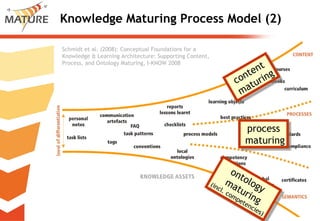
Knowledge Maturing Process Model (2) MATURE - Continuous Social Learning in Knowledge Networks content maturing ontology maturing (incl. competencies) process maturing Schmidt et al. (2008): Conceptual Foundations for a Knowledge & Learning Architecture: Supporting Content, Process, and Ontology Maturing, I-KNOW 2008
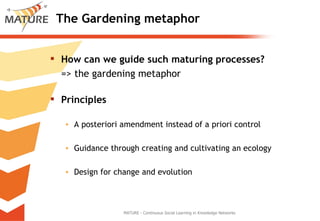
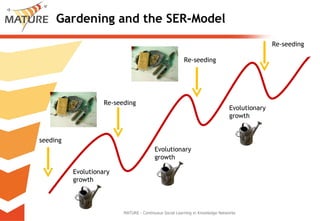
The Gardening metaphor How can we guide such maturing processes? => the gardening metaphor Principles A posteriori amendment instead of a priori control Guidance through creating and cultivating an ecology Design for change and evolution MATURE - Continuous Social Learning in Knowledge Networks
Gardening and the SER-Model MATURE - Continuous Social Learning in Knowledge Networks seeding Re-seeding Re-seeding Re-seeding Evolutionary growth Evolutionary growth Evolutionary growth
Participatory culture This requires a changing culture toward more  participation The organization needs to  encourage  the individual employee  to bring in her ideas,  to develop them with their peers,  and the organization needs to  take up  those activities and guide their further development towards a shared goal.  MATURE - Continuous Social Learning in Knowledge Networks
MATURE - Continuous Social Learning in Knowledge Networks Technologies
Technologies (1) Open wiki technology  replacing regulated document management systems,  and even semantic wiki systems (such as the Semantic MediaWiki) replacing traditional databases  Tagging‐based systems  and community based consolidation of vocabularies (SOBOLEO)  [Braun et al., 2007] instead of taxonomies defined in a top‐down manner  People tagging  approaches  [Braun & Schmidt, 2008] instead of over‐engineered competence or skills management systems (or employee yellow pages) MATURE - Continuous Social Learning in Knowledge Networks
Technologies (2) Mashups  as a design paradigm where the end user can easily set up the combination of data and services from different systems instead of heavy‐weight and centralized integration paradigms  Personal learning environments  [Attwell, 2007] consisting of loosely coupled tools and services (and mashups) that can be arranged and used in a truly personal way Flexible knowledge services   [Schmidt et al., 2008] that feed the mashups and PLEs with analyses of implicit (e.g., context) and explicit (e.g., ranking) usage data, similarities and connections between different activities etc.  MATURE - Continuous Social Learning in Knowledge Networks
MATURE - Continuous Social Learning in Knowledge Networks Summary
Conclusions The  Knowledge Maturing Process  describes learning in organizations as interconnected individual learning processes. Maturing is a bottom-up activity Guidance through „gardening“ Requires a change towards  participatory culture MATURE IP  (10 Mio €, 12 partners, 2008-2012) Empirical foundations for knowledge maturing Personal Learning Environments and organizational guidance Mashups & reusable knowledge services MATURE - Continuous Social Learning in Knowledge Networks
MATURE - Continuous Social Learning in Knowledge Networks Contact: Scientific Coordinator Andreas Schmidt [email_address] http://andreas.schmidt.name Join as an associate partner

Knowledge Maturing and the Participatory Enterprise

  • 1.
    Andreas Schmidt FZIResearch Center for Information Technologies Knowledge Maturing and the Participatory Enterprise Online Educa 2008 Berlin, December 2008 [email_address] http://andreas.schmidt.name http://mature-ip.eu
  • 2.
    Outline From top-downto bottom-up approaches to learning in organizations Knowledge maturing & the gardening metaphor Technologies Summary MATURE - Continuous Social Learning in Knowledge Networks
  • 3.
    From top-down approaches… Many approaches to learning are based on a top-down philosophy Teaching at universities Installing a Learning Management System Implementing a human resource development strategy But this has often led to Lack of motivation on the user side Slow and cumbersome processes Unused potential of learner/employee creativity MATURE - Continuous Social Learning in Knowledge Networks
  • 4.
    … tobottom-up processes? But most learning experiences do not take place in a top-down manner: We learn from colleagues & friends in discussions We learn with others while developing an idea and solving problems at hand We learn from resources not designed as learning support And nobody has organized this learning Why not broaden our perspective on learning with a clear focus on bottom-up processes? MATURE - Continuous Social Learning in Knowledge Networks
  • 5.
    MATURE - ContinuousSocial Learning in Knowledge Networks Widening your perspective on knowledge & learning
  • 6.
    Knowledge Maturing Processnew ideas shared vocabulary communities Best Practices standard text book Collaboration Courses/ Curricula Learning Objects Communication Document collections reports Case studie Lessons Learnt Distribution in Communities Emergence of ideas Formali- zation Ad-Hoc- Training Standardi- zation Schmidt, A. (2005): Knowledge Maturing and the Continuity of Context as a Unifying Concept for E-Learning & Knowledge Management, I-KNOW 2005 Knowledge management E-Learning HR Development
  • 7.
    Maturing and GuidanceMATURE - Continuous Social Learning in Knowledge Networks
  • 8.
    Knowledge Maturing ProcessModel (2) MATURE - Continuous Social Learning in Knowledge Networks content maturing ontology maturing (incl. competencies) process maturing Schmidt et al. (2008): Conceptual Foundations for a Knowledge & Learning Architecture: Supporting Content, Process, and Ontology Maturing, I-KNOW 2008
  • 9.
    The Gardening metaphorHow can we guide such maturing processes? => the gardening metaphor Principles A posteriori amendment instead of a priori control Guidance through creating and cultivating an ecology Design for change and evolution MATURE - Continuous Social Learning in Knowledge Networks
  • 10.
    Gardening and theSER-Model MATURE - Continuous Social Learning in Knowledge Networks seeding Re-seeding Re-seeding Re-seeding Evolutionary growth Evolutionary growth Evolutionary growth
  • 11.
    Participatory culture Thisrequires a changing culture toward more participation The organization needs to encourage the individual employee to bring in her ideas, to develop them with their peers, and the organization needs to take up those activities and guide their further development towards a shared goal. MATURE - Continuous Social Learning in Knowledge Networks
  • 12.
    MATURE - ContinuousSocial Learning in Knowledge Networks Technologies
  • 13.
    Technologies (1) Openwiki technology replacing regulated document management systems, and even semantic wiki systems (such as the Semantic MediaWiki) replacing traditional databases Tagging‐based systems and community based consolidation of vocabularies (SOBOLEO) [Braun et al., 2007] instead of taxonomies defined in a top‐down manner People tagging approaches [Braun & Schmidt, 2008] instead of over‐engineered competence or skills management systems (or employee yellow pages) MATURE - Continuous Social Learning in Knowledge Networks
  • 14.
    Technologies (2) Mashups as a design paradigm where the end user can easily set up the combination of data and services from different systems instead of heavy‐weight and centralized integration paradigms Personal learning environments [Attwell, 2007] consisting of loosely coupled tools and services (and mashups) that can be arranged and used in a truly personal way Flexible knowledge services [Schmidt et al., 2008] that feed the mashups and PLEs with analyses of implicit (e.g., context) and explicit (e.g., ranking) usage data, similarities and connections between different activities etc. MATURE - Continuous Social Learning in Knowledge Networks
  • 15.
    MATURE - ContinuousSocial Learning in Knowledge Networks Summary
  • 16.
    Conclusions The Knowledge Maturing Process describes learning in organizations as interconnected individual learning processes. Maturing is a bottom-up activity Guidance through „gardening“ Requires a change towards participatory culture MATURE IP (10 Mio €, 12 partners, 2008-2012) Empirical foundations for knowledge maturing Personal Learning Environments and organizational guidance Mashups & reusable knowledge services MATURE - Continuous Social Learning in Knowledge Networks
  • 17.
    MATURE - ContinuousSocial Learning in Knowledge Networks Contact: Scientific Coordinator Andreas Schmidt [email_address] http://andreas.schmidt.name Join as an associate partner