
Conceptual Foundations for a Service-Oriented Knowledge & Learning Architecture: Supporting Content, Process, and Ontology Maturing  Andreas Schmidt Knut Hinkelmann Stefanie Lindstaedt Tobias Ley Ronald Maier Uwe Riss http://mature-ip.eu I-KNOW 2008 Special Track on Knowledge Services September 3, 2008
Outline Motivation why we need a service-oriented knowledge & learning architecture  Conceptual foundations Knowledge maturing process model Seeding-Evolutionary Growth-Reseeding model Implications Maturing services: seeding, growth, reseeding Conclusions MATURE - Continuous Social Learning in Knowledge Networks
Motivation
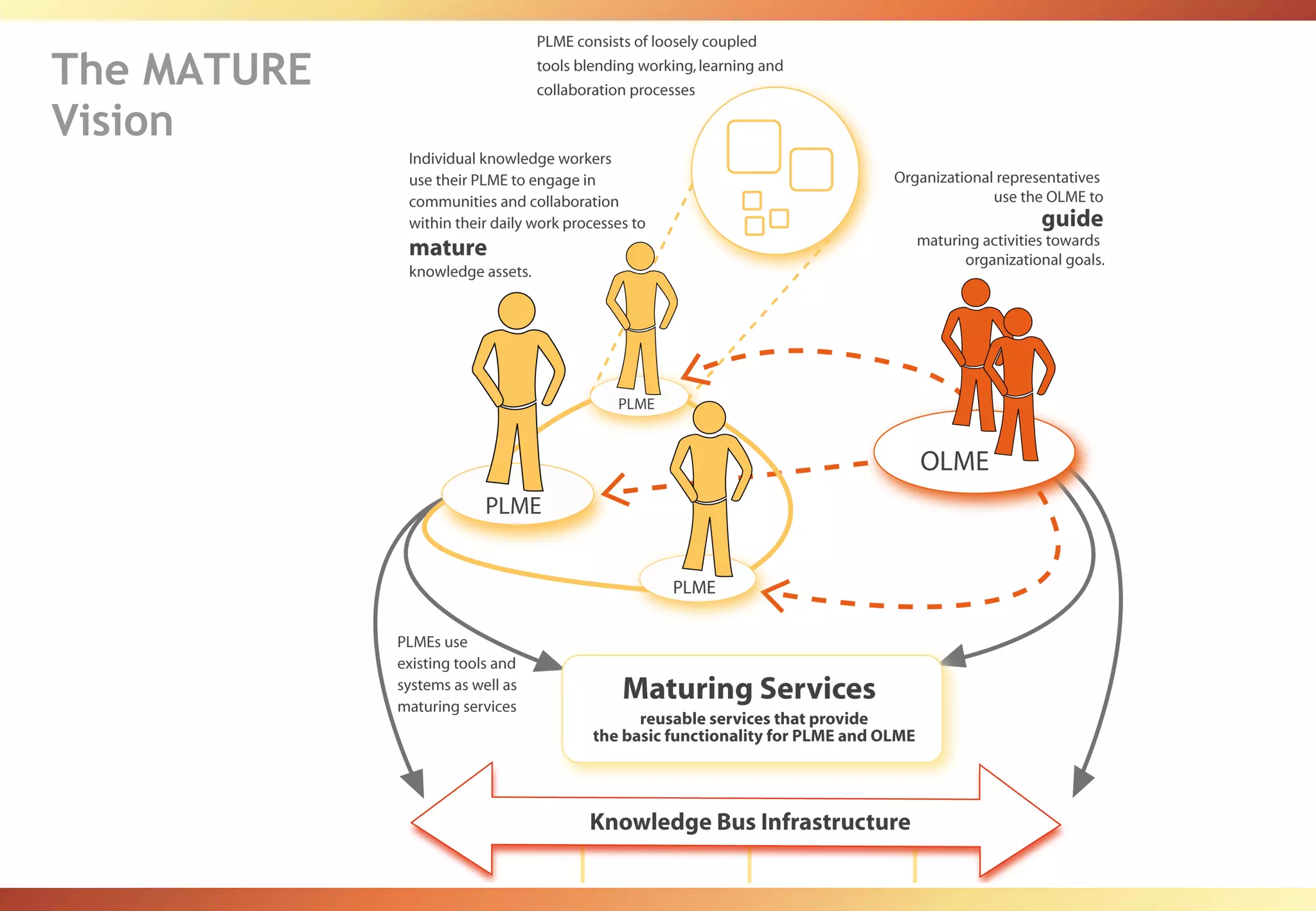
Motivation Agility of enterprises as a key success factor requires Leveraging the employees‘ creativity and hands-on experience Improving the sharing of knowledge within and across company borders Support with a new form of organizational guidance Instead of top-down approaches we need a balance of top-down and bottom-up developments for learning support Bring together the efficiency of organizations and the engagement and user empowerment  MATURE - Continuous Social Learning in Knowledge Networks
The MATURE Vision
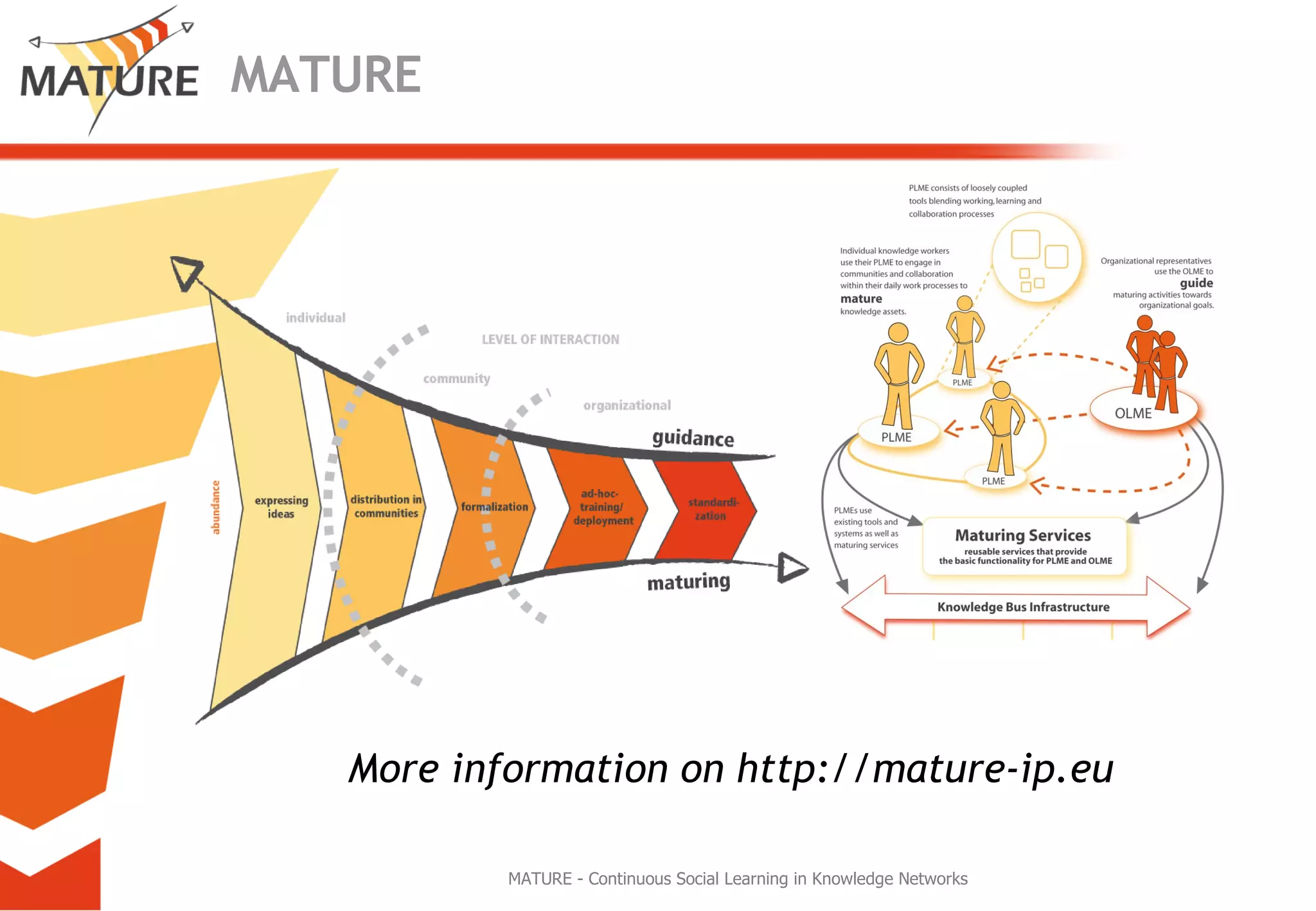
Need for service-oriented infrastructure Such mashup toolsets like the PLME and OLME have to be flexible and extensible This will only work with a service-oriented infrastructure that provides basic and rather generic functionality But how should such an infrastructure look like? What are conceptual foundations? MATURE - Continuous Social Learning in Knowledge Networks
MATURE - Continuous Social Learning in Knowledge Networks http://mature-ip.eu Conceptual Foundations
Knowledge Maturing Process Model MATURE - Continuous Social Learning in Knowledge Networks Based on [Schmidt, 2005] and [Maier & Schmidt, 2007]
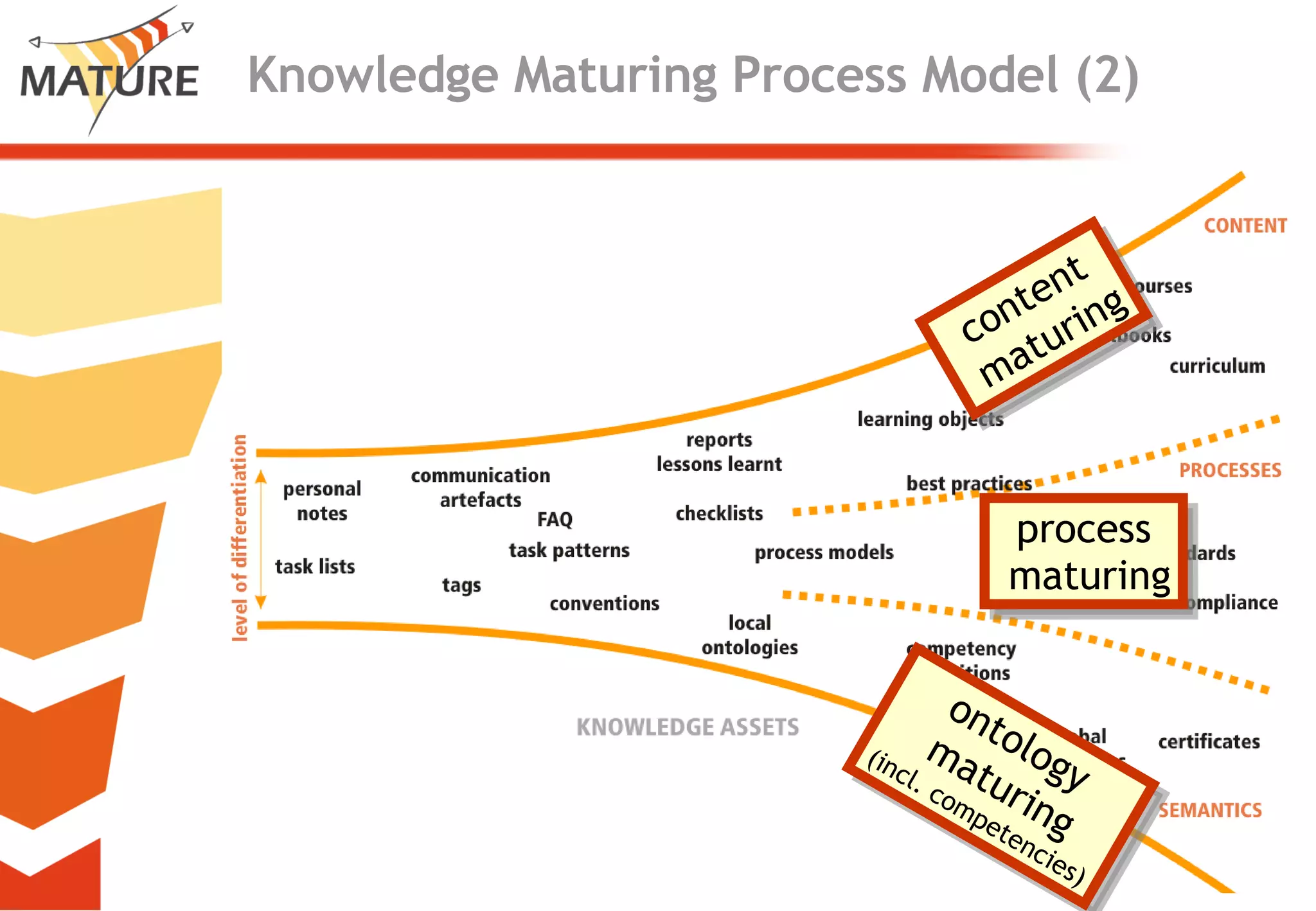
Knowledge Maturing Process Model (2) MATURE - Continuous Social Learning in Knowledge Networks content maturing ontology maturing (incl. competencies) process maturing
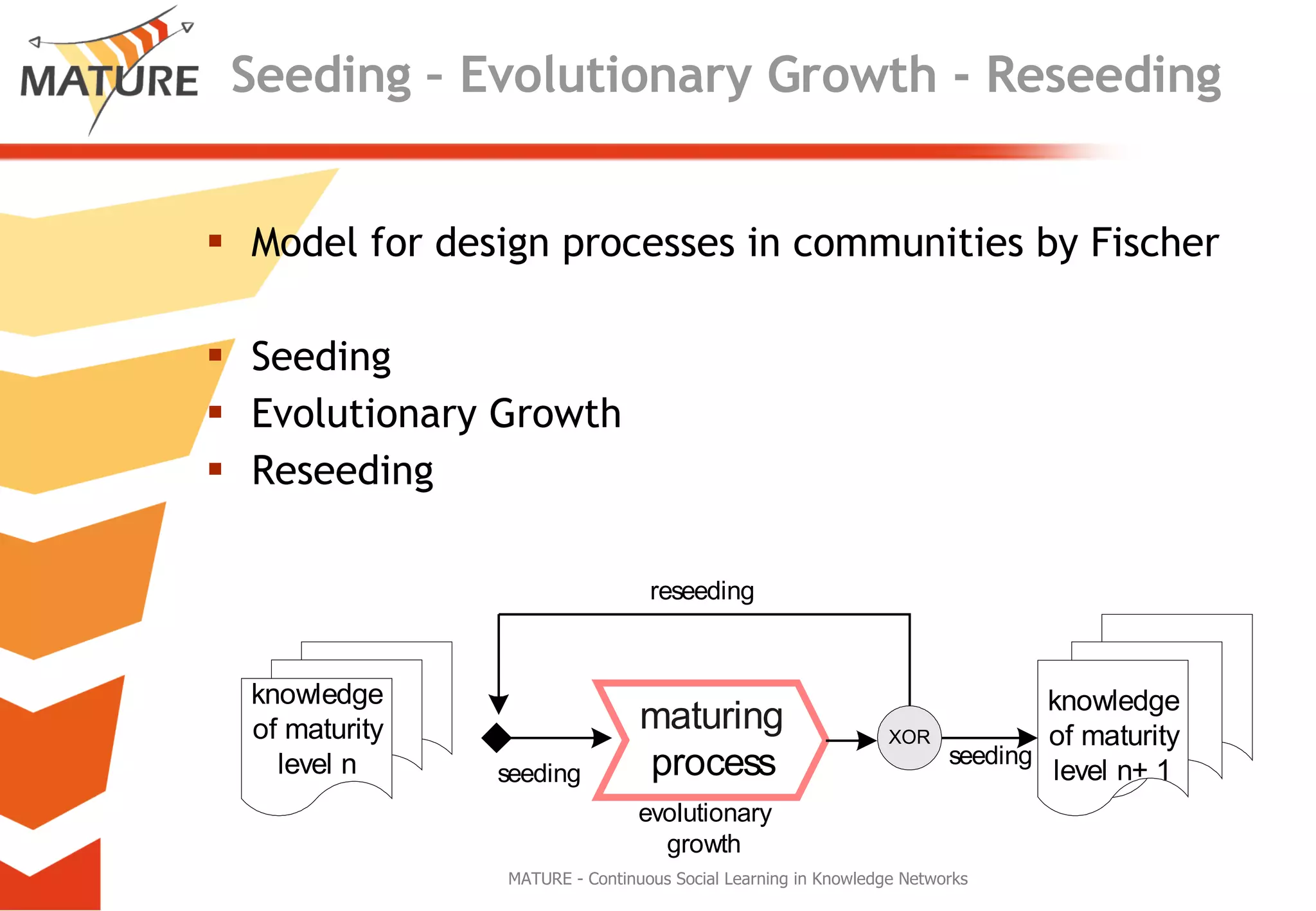
Seeding – Evolutionary Growth - Reseeding Model for design processes in communities by Fischer Seeding Evolutionary Growth Reseeding MATURE - Continuous Social Learning in Knowledge Networks
MATURE - Continuous Social Learning in Knowledge Networks Implications on  the service architecture
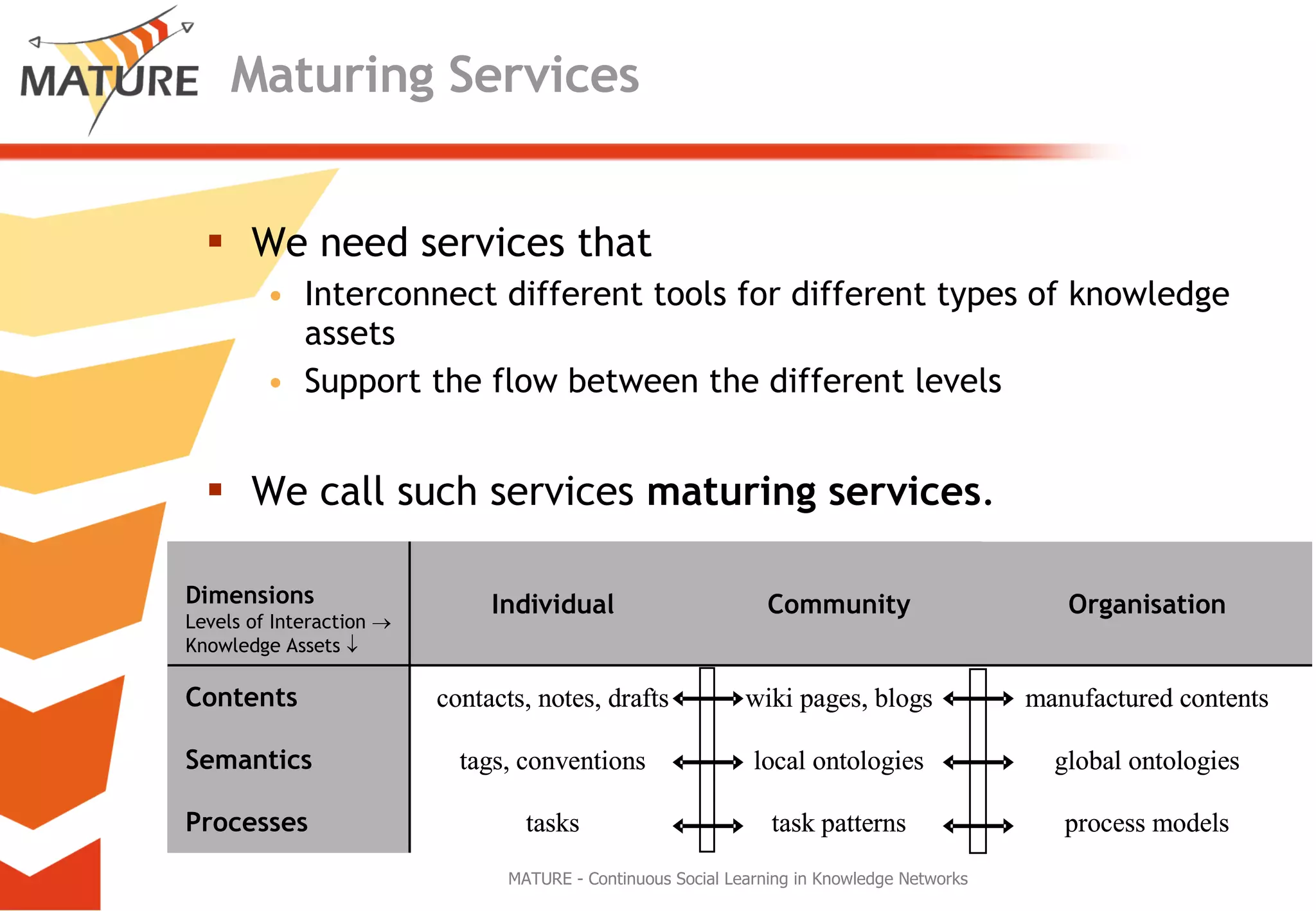
Maturing Services We need services that Interconnect different tools for different types of knowledge assets Support the flow between the different levels We call such services  maturing services . MATURE - Continuous Social Learning in Knowledge Networks
Maturing Services: Seeding Service enable the user to set up and  initialize   knowledge units and structures within a community associative network based on document similarities user models based on social network analysis  recommendation based on user model and associative network MATURE - Continuous Social Learning in Knowledge Networks
Maturing Services: Growth Services Allows users to add new knowledge units (e.g. documents or users),  to adapt their characteristics (e.g. the users’ competencies)  to provide comments  to change the system behaviour. based on the Web2.0 paradigm  User-generated content Exploiting collective usage data MATURE - Continuous Social Learning in Knowledge Networks
Maturing Services: Reseeding Services allow the user  to analyse and visualize the collective activities of the community to negotiate between conceptualizations of different users and  to  change the underlying structures and functionalities . MATURE - Continuous Social Learning in Knowledge Networks
Conclusions Maturing services enable the creation of learning environments as a set of loosely coupled tools. The knowledge maturing process model  structures the learning landscape (from informal to formal) and focuses on the dynamics, the interaction and transitions between different forms of learning and knowledge. The SER model inspires types of system invention The approach  create a flexible and dynamic knowledge and learning architecture combines bottom-up, end-user driven activities with organizational guidance. MATURE - Continuous Social Learning in Knowledge Networks
MATURE More information on http://mature-ip.eu MATURE - Continuous Social Learning in Knowledge Networks

Conceptual Foundations for a Knowledge & Learning Architecture: Supporting Content, Process, and Ontology Maturing

  • 1.
    Conceptual Foundations fora Service-Oriented Knowledge & Learning Architecture: Supporting Content, Process, and Ontology Maturing Andreas Schmidt Knut Hinkelmann Stefanie Lindstaedt Tobias Ley Ronald Maier Uwe Riss http://mature-ip.eu I-KNOW 2008 Special Track on Knowledge Services September 3, 2008
  • 2.
    Outline Motivation whywe need a service-oriented knowledge & learning architecture Conceptual foundations Knowledge maturing process model Seeding-Evolutionary Growth-Reseeding model Implications Maturing services: seeding, growth, reseeding Conclusions MATURE - Continuous Social Learning in Knowledge Networks
  • 3.
  • 4.
    Motivation Agility ofenterprises as a key success factor requires Leveraging the employees‘ creativity and hands-on experience Improving the sharing of knowledge within and across company borders Support with a new form of organizational guidance Instead of top-down approaches we need a balance of top-down and bottom-up developments for learning support Bring together the efficiency of organizations and the engagement and user empowerment MATURE - Continuous Social Learning in Knowledge Networks
  • 5.
  • 6.
    Need for service-orientedinfrastructure Such mashup toolsets like the PLME and OLME have to be flexible and extensible This will only work with a service-oriented infrastructure that provides basic and rather generic functionality But how should such an infrastructure look like? What are conceptual foundations? MATURE - Continuous Social Learning in Knowledge Networks
  • 7.
    MATURE - ContinuousSocial Learning in Knowledge Networks http://mature-ip.eu Conceptual Foundations
  • 8.
    Knowledge Maturing ProcessModel MATURE - Continuous Social Learning in Knowledge Networks Based on [Schmidt, 2005] and [Maier & Schmidt, 2007]
  • 9.
    Knowledge Maturing ProcessModel (2) MATURE - Continuous Social Learning in Knowledge Networks content maturing ontology maturing (incl. competencies) process maturing
  • 10.
    Seeding – EvolutionaryGrowth - Reseeding Model for design processes in communities by Fischer Seeding Evolutionary Growth Reseeding MATURE - Continuous Social Learning in Knowledge Networks
  • 11.
    MATURE - ContinuousSocial Learning in Knowledge Networks Implications on the service architecture
  • 12.
    Maturing Services Weneed services that Interconnect different tools for different types of knowledge assets Support the flow between the different levels We call such services maturing services . MATURE - Continuous Social Learning in Knowledge Networks
  • 13.
    Maturing Services: SeedingService enable the user to set up and initialize knowledge units and structures within a community associative network based on document similarities user models based on social network analysis recommendation based on user model and associative network MATURE - Continuous Social Learning in Knowledge Networks
  • 14.
    Maturing Services: GrowthServices Allows users to add new knowledge units (e.g. documents or users), to adapt their characteristics (e.g. the users’ competencies) to provide comments to change the system behaviour. based on the Web2.0 paradigm User-generated content Exploiting collective usage data MATURE - Continuous Social Learning in Knowledge Networks
  • 15.
    Maturing Services: ReseedingServices allow the user to analyse and visualize the collective activities of the community to negotiate between conceptualizations of different users and to change the underlying structures and functionalities . MATURE - Continuous Social Learning in Knowledge Networks
  • 16.
    Conclusions Maturing servicesenable the creation of learning environments as a set of loosely coupled tools. The knowledge maturing process model structures the learning landscape (from informal to formal) and focuses on the dynamics, the interaction and transitions between different forms of learning and knowledge. The SER model inspires types of system invention The approach create a flexible and dynamic knowledge and learning architecture combines bottom-up, end-user driven activities with organizational guidance. MATURE - Continuous Social Learning in Knowledge Networks
  • 17.
    MATURE More informationon http://mature-ip.eu MATURE - Continuous Social Learning in Knowledge Networks