MATURE Continuous Social Learning in Knowledge Networks Knowledge Maturing Model v3 ( WP 1) UIBK, FZI 2 nd  Annual Review May 5-6, 2010, Barcelona http://mature-ip.eu
Main route year 2 Function of the model & procedure in year 2 Focussed state of the art analysis Knowledge Maturing Model Landscape Knowledge maturing indicators Knowledge maturing activities Guidance Phase model v3 Conclusions & Outlook MATURE - Continuous Social Learning in Knowledge Networks
Function of the model Conceptual anchor for the project and multiple boundary objects between the different strands of research, development and evaluation activities Framework for analysis of company contexts, for interventions and the assessment of their effects Foundation for systematic design of supporting solutions MATURE - Continuous Social Learning in Knowledge Networks
Process year 2 MATURE - Continuous Social Learning in Knowledge Networks
MATURE - Continuous Social Learning in Knowledge Networks Focussed state of  the art analysis
Is knowledge maturing a process of continuous evolutionary change? Christensen: dichotomy between sustaining and disruptive innovation sustaining innovation  corresponds to an evolutionary development of knowledge disruptive innovation  has as a prerequisite that you have built up a new strand of knowledge (i.e., “revolutionary” knowledge development) before becoming an innovation Consequence:  Evolutionary support : functionality for easily changing things, collecting feedback and filtering of new ideas  Revolutionary support : creating rooms for new developments, not constrained by existing knowledge structures, starting again from scratch.  MATURE - Continuous Social Learning in Knowledge Networks
Is more mature always better? Knowledge can enable and constrain effective action More knowledge is better: a questionable assumption Reflects a similar discussion on information Information demand, logistics, overload, filtering (for action) Sedimentation also has two sides Increases confidence of knowledge workers, identify “solid knowledge rocks” out of the waves of transient knowledge Increases core rigidity Balancing by strategy & guidance It is not more knowledge, but  selected knowledge that is more mature that counts in our model. MATURE - Continuous Social Learning in Knowledge Networks
What is the role of artefacts for knowledge maturing? Boundary objects = “objects that both inhabit several communities of practice and satisfy the informational requirements of each of them” requires robustness on the one side, but also interpretative flexibility MATURE - Continuous Social Learning in Knowledge Networks
MATURE - Continuous Social Learning in Knowledge Networks The knowledge maturing model landscape
Knowledge Maturing  Criteria & Indicators MATURE - Continuous Social Learning in Knowledge Networks
MATURE - Continuous Social Learning in Knowledge Networks
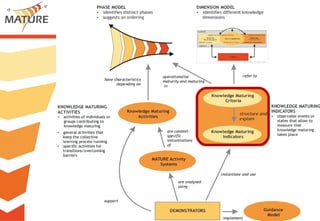
Knowledge maturing indicators operationalise  the notion of knowledge maturing  how can we observe or assess knowledge maturing?  provide a  basis for guidance activities  in a closed-loop approach:  how can we systematically and traceably intervene into knowledge maturing with the help of guidance activities? help shaping goals and measures in  broader initiatives for knowledge management   how can we align interventions into knowledge maturing with the portfolio of management instruments already in use in an organisation? Are  based on context-dependent assumptions  no universal indicators, but a “construction kit” MATURE - Continuous Social Learning in Knowledge Networks
Problems with Indicators v1 First version defined on the basis of the ethnographic studies However: Not clear what they actually measure and how it relates to knowledge maturing Differentiation needed between State-based (measuring maturity) and event-based (measuring maturing) indicators Levels of granularity (knowledge maturing of a certain piece of knowledge vs. knowledge maturing processes in a company in general) MATURE - Continuous Social Learning in Knowledge Networks
Criteria Artefact-related  measure something related to any form of artefact  Individual capability-related  individual’s experience, competence, or knowledge. Sociofact-related  quality of social interaction or meta-competencies on a collective level Alignment of artefacts and cognifacts.  aligning the maturity or formality of artefacts with the maturity of the cognifacts, avoiding over- and under-formalization. Impact & Results.  measure maturity of knowledge through the output it generates MATURE - Continuous Social Learning in Knowledge Networks
Artefact-related MATURE - Continuous Social Learning in Knowledge Networks
Sociofact-related MATURE - Continuous Social Learning in Knowledge Networks
Guidance MATURE - Continuous Social Learning in Knowledge Networks
MATURE - Continuous Social Learning in Knowledge Networks
Guidance any influence on the direction (“goal”) or the quality of knowledge maturing processes by entities not directly involved in them .  can range from  an unintended “influence” (e.g., via the mere existence of artefacts)  via explicit shaping of context conditions (e.g., giving room for collaboration, recommendation of artefacts)  up to direct interventions into the setting of goals or even operational procedures (e.g., decisions on what to pursue and what to discard, prescription of artefacts).  not limited to persons as the “guiding” entity MATURE - Continuous Social Learning in Knowledge Networks
Forms of guidance Artefact-based guidance Awareness of existence Legitimation, commitment Quality and usefulness Level of formality Sociofact-based guidance Culture Collaboration and communication structures Shared practices Managerial guidance Setting goals and thus giving priority Shape work environment and work organisation Organise and coach learning processes MATURE - Continuous Social Learning in Knowledge Networks
Knowledge Maturing Phase Model MATURE - Continuous Social Learning in Knowledge Networks
MATURE - Continuous Social Learning in Knowledge Networks
Phase Model v3 Splitting an instructional and an experimental path (major strands from interviews) Separating large-scale roll-out from the standardisation phase without necessarily a wider standardisation (major need for clarification in the interviews) Institutionalization has two perspectives: external (black box; output specification, service, product)  internal perspective (white box; process, practice, roles, responsibilities, feedback mechanisms etc.) MATURE - Continuous Social Learning in Knowledge Networks
MATURE - Continuous Social Learning in Knowledge Networks
Conclusions MATURE - Continuous Social Learning in Knowledge Networks
Summary Improved understanding through theoretical work as well as reflection in empirical work Take-up of experiences made with demonstrators Major extension of the Knowledge Maturing Model into a Landscape of Models Refining of Concepts of Knowledge Maturing Impact on Coordination of Year 3 Activities Prototype development Evaluation In-depth Study Conceptual refinement of KMMM MATURE - Continuous Social Learning in Knowledge Networks
Advancing the state of the art Knowledge maturing model landscape provides a unique system for Analysing knowledge development processes and their existing barriers (motivational, organisational etc.) Identifying key activities to improve Designing socio-technical systems intending to overcome barriers Making knowledge maturing and the effects of intervention measurable Linking knowledge maturing to other organisational functions MATURE - Continuous Social Learning in Knowledge Networks
Future plans Guidelines for knowledge maturing support Alignment of KM indicators with standard reporting system (KPIs) Consideration of complementary initiatives, such as innovation management, quality management, high performance management Interventions and levers as proposals for guidance activities MATURE - Continuous Social Learning in Knowledge Networks

Knowledge Maturing Model v3

  • 1.
    MATURE Continuous SocialLearning in Knowledge Networks Knowledge Maturing Model v3 ( WP 1) UIBK, FZI 2 nd Annual Review May 5-6, 2010, Barcelona http://mature-ip.eu
  • 2.
    Main route year2 Function of the model & procedure in year 2 Focussed state of the art analysis Knowledge Maturing Model Landscape Knowledge maturing indicators Knowledge maturing activities Guidance Phase model v3 Conclusions & Outlook MATURE - Continuous Social Learning in Knowledge Networks
  • 3.
    Function of themodel Conceptual anchor for the project and multiple boundary objects between the different strands of research, development and evaluation activities Framework for analysis of company contexts, for interventions and the assessment of their effects Foundation for systematic design of supporting solutions MATURE - Continuous Social Learning in Knowledge Networks
  • 4.
    Process year 2MATURE - Continuous Social Learning in Knowledge Networks
  • 5.
    MATURE - ContinuousSocial Learning in Knowledge Networks Focussed state of the art analysis
  • 6.
    Is knowledge maturinga process of continuous evolutionary change? Christensen: dichotomy between sustaining and disruptive innovation sustaining innovation corresponds to an evolutionary development of knowledge disruptive innovation has as a prerequisite that you have built up a new strand of knowledge (i.e., “revolutionary” knowledge development) before becoming an innovation Consequence: Evolutionary support : functionality for easily changing things, collecting feedback and filtering of new ideas Revolutionary support : creating rooms for new developments, not constrained by existing knowledge structures, starting again from scratch. MATURE - Continuous Social Learning in Knowledge Networks
  • 7.
    Is more maturealways better? Knowledge can enable and constrain effective action More knowledge is better: a questionable assumption Reflects a similar discussion on information Information demand, logistics, overload, filtering (for action) Sedimentation also has two sides Increases confidence of knowledge workers, identify “solid knowledge rocks” out of the waves of transient knowledge Increases core rigidity Balancing by strategy & guidance It is not more knowledge, but selected knowledge that is more mature that counts in our model. MATURE - Continuous Social Learning in Knowledge Networks
  • 8.
    What is therole of artefacts for knowledge maturing? Boundary objects = “objects that both inhabit several communities of practice and satisfy the informational requirements of each of them” requires robustness on the one side, but also interpretative flexibility MATURE - Continuous Social Learning in Knowledge Networks
  • 9.
    MATURE - ContinuousSocial Learning in Knowledge Networks The knowledge maturing model landscape
  • 10.
    Knowledge Maturing Criteria & Indicators MATURE - Continuous Social Learning in Knowledge Networks
  • 11.
    MATURE - ContinuousSocial Learning in Knowledge Networks
  • 12.
    Knowledge maturing indicatorsoperationalise the notion of knowledge maturing how can we observe or assess knowledge maturing? provide a basis for guidance activities in a closed-loop approach: how can we systematically and traceably intervene into knowledge maturing with the help of guidance activities? help shaping goals and measures in broader initiatives for knowledge management how can we align interventions into knowledge maturing with the portfolio of management instruments already in use in an organisation? Are based on context-dependent assumptions no universal indicators, but a “construction kit” MATURE - Continuous Social Learning in Knowledge Networks
  • 13.
    Problems with Indicatorsv1 First version defined on the basis of the ethnographic studies However: Not clear what they actually measure and how it relates to knowledge maturing Differentiation needed between State-based (measuring maturity) and event-based (measuring maturing) indicators Levels of granularity (knowledge maturing of a certain piece of knowledge vs. knowledge maturing processes in a company in general) MATURE - Continuous Social Learning in Knowledge Networks
  • 14.
    Criteria Artefact-related measure something related to any form of artefact Individual capability-related individual’s experience, competence, or knowledge. Sociofact-related quality of social interaction or meta-competencies on a collective level Alignment of artefacts and cognifacts. aligning the maturity or formality of artefacts with the maturity of the cognifacts, avoiding over- and under-formalization. Impact & Results. measure maturity of knowledge through the output it generates MATURE - Continuous Social Learning in Knowledge Networks
  • 15.
    Artefact-related MATURE -Continuous Social Learning in Knowledge Networks
  • 16.
    Sociofact-related MATURE -Continuous Social Learning in Knowledge Networks
  • 17.
    Guidance MATURE -Continuous Social Learning in Knowledge Networks
  • 18.
    MATURE - ContinuousSocial Learning in Knowledge Networks
  • 19.
    Guidance any influenceon the direction (“goal”) or the quality of knowledge maturing processes by entities not directly involved in them . can range from an unintended “influence” (e.g., via the mere existence of artefacts) via explicit shaping of context conditions (e.g., giving room for collaboration, recommendation of artefacts) up to direct interventions into the setting of goals or even operational procedures (e.g., decisions on what to pursue and what to discard, prescription of artefacts). not limited to persons as the “guiding” entity MATURE - Continuous Social Learning in Knowledge Networks
  • 20.
    Forms of guidanceArtefact-based guidance Awareness of existence Legitimation, commitment Quality and usefulness Level of formality Sociofact-based guidance Culture Collaboration and communication structures Shared practices Managerial guidance Setting goals and thus giving priority Shape work environment and work organisation Organise and coach learning processes MATURE - Continuous Social Learning in Knowledge Networks
  • 21.
    Knowledge Maturing PhaseModel MATURE - Continuous Social Learning in Knowledge Networks
  • 22.
    MATURE - ContinuousSocial Learning in Knowledge Networks
  • 23.
    Phase Model v3Splitting an instructional and an experimental path (major strands from interviews) Separating large-scale roll-out from the standardisation phase without necessarily a wider standardisation (major need for clarification in the interviews) Institutionalization has two perspectives: external (black box; output specification, service, product) internal perspective (white box; process, practice, roles, responsibilities, feedback mechanisms etc.) MATURE - Continuous Social Learning in Knowledge Networks
  • 24.
    MATURE - ContinuousSocial Learning in Knowledge Networks
  • 25.
    Conclusions MATURE -Continuous Social Learning in Knowledge Networks
  • 26.
    Summary Improved understandingthrough theoretical work as well as reflection in empirical work Take-up of experiences made with demonstrators Major extension of the Knowledge Maturing Model into a Landscape of Models Refining of Concepts of Knowledge Maturing Impact on Coordination of Year 3 Activities Prototype development Evaluation In-depth Study Conceptual refinement of KMMM MATURE - Continuous Social Learning in Knowledge Networks
  • 27.
    Advancing the stateof the art Knowledge maturing model landscape provides a unique system for Analysing knowledge development processes and their existing barriers (motivational, organisational etc.) Identifying key activities to improve Designing socio-technical systems intending to overcome barriers Making knowledge maturing and the effects of intervention measurable Linking knowledge maturing to other organisational functions MATURE - Continuous Social Learning in Knowledge Networks
  • 28.
    Future plans Guidelinesfor knowledge maturing support Alignment of KM indicators with standard reporting system (KPIs) Consideration of complementary initiatives, such as innovation management, quality management, high performance management Interventions and levers as proposals for guidance activities MATURE - Continuous Social Learning in Knowledge Networks