IT and Knowledge
Management
M         t

Application of Scholarly-Practice-Leadership
(SPL) Model
Dr. Alain Nkoyock

Website:
W b it www.nkoyock.net
                 k    k t
Blog: http://blog.nkoyock.net
Email: alain.nkoyock@yahoo.com
Follow me on LinkedIn, Facebook, and Twitter
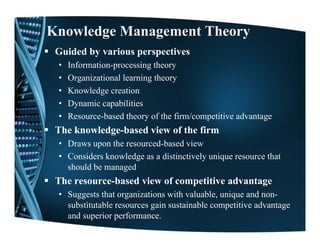
Knowledge Management Theory
 Guided by various perspectives
 •   Information-processing theory
 •   Organizational learning theory
 •   Knowledge creation
 •   Dynamic capabilities
       y        p
 •   Resource-based theory of the firm/competitive advantage
 The knowledge-based view of the firm
 • Draws upon the resourced-based view
 • Considers knowledge as a distinctively unique resource that
   should be managed
                 g
 The resource-based view of competitive advantage
 • Suggests that organizations with valuable, unique and non-
   substitutable resources gain sustainable competitive advantage
   and superior performance.
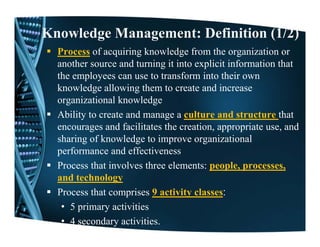
Knowledge Management: Definition (1/2)
  Process of acquiring knowledge from the organization or
  another source and turning it into explicit information that
  the employees can use to transform into their own
  knowledge allowing them to create and increase
  organizational knowledge
  Ability to create and manage a culture and structure that
  encourages and facilitates the creation, appropriate use, and
  sharing of knowledge to improve organizational
  performance and effectiveness
  Process that involves three elements: people, p
                                         p p , processes,   ,
  and technology
  Process that comprises 9 activity classes:
   • 5 primary activities
   • 4 secondary activities.
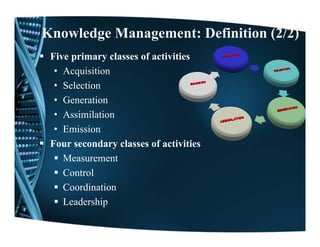
Knowledge Management: Definition (2/2)
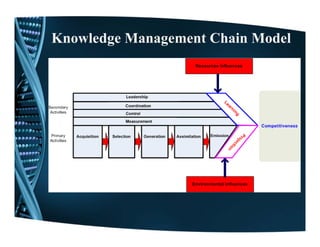
 Five primary classes of activities
  • Acquisition
  • Selection
  • Generation
  • Assimilation
  • Emission
 Four secondary classes of activities
    Measurement
    Control
    C t l
    Coordination
    Leadership
Knowledge Management Chain Model
       g      g
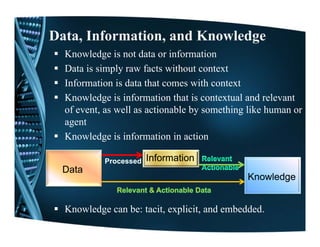
Data, Information, and Knowledge
  Knowledge is not data or information
  Data is simply raw facts without context
  Information is data that comes with context
  Knowledge is information that is contextual and relevant
  of event, as well as actionable by something like human or
   f      t      ll      ti bl b         thi lik h
  agent
  Knowledge is information in action

                     Information
 Data
                                              Knowledge


  Knowledge can be: tacit, explicit, and embedded.
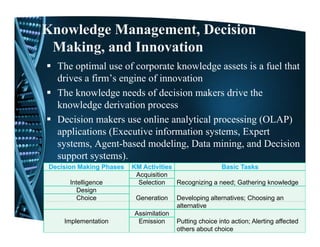
Knowledge Management, Decision
 Making,
 Making and Innovation
  The optimal use of corporate knowledge assets is a fuel that
  drives
  dri es a firm’s engine of innovation
                            inno ation
  The knowledge needs of decision makers drive the
  knowledge derivation process
  Decision makers use online analytical processing (OLAP)
  applications (Executive information systems, Expert
  systems, Agent-based modeling, Data mining, and Decision
  support systems).
Decision Making Phases
              g          KM Activities                Basic Tasks
                          Acquisition
      Intelligence         Selection   Recognizing a need; Gathering knowledge
        Design
        Choice            Generation    Developing alternatives; Choosing an
                                               p g                      g
                                        alternative
                         Assimilation
    Implementation        Emission      Putting choice into action; Alerting affected
                                        others about choice
KM and Operational Needs
Process workers perform day-to-day operations following
specific business operational needs
These operational systems demand procedural specificity
and support corporate mission-critical processes
Process workers use O li transaction processing (OLTP)
P           k        Online t       ti          i
systems /Transaction processing systems (TPS)
Examples of OLTPs: airline customer reservation systems,
online banking systems, financial applications, payroll,
manufacturing, inventory and human resources.
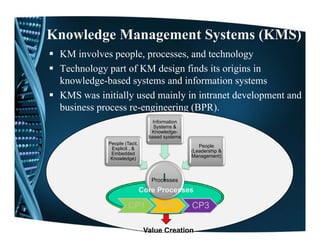
Knowledge Management Systems (KMS)
 KM involves people, processes, and technology
 Technology part of KM design finds its origins in
 knowledge-based systems and information systems
 KMS was initially used mainly in intranet development and
 business process re-engineering (BPR)
                                 (BPR).
                                 Information
                                 Systems &
                                Knowledge-
                               based systems
                                       y
            People (Tacit,
                                                  People
             Explicit , &
                                               (Leadership &
             Embedded
                                               Management)
             Knowledge)


                                Processes
                             Core Processes

                     CP1           CP2         CP3

                              Value Creation
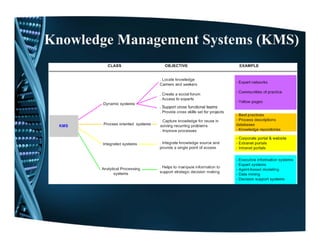
Knowledge Management Systems (KMS)
       g      g       y      (   )
Thanks

             Dr. Alain Nkoyock

        Website:
        W b it www.nkoyock.net
                          k    k t
        Blog: http://blog.nkoyock.net
      Email: alain.nkoyock@yahoo.com
Follow me on LinkedIn, Facebook, and Twitter

Knowledge Management: The SPL Model 1.0

  • 1.
    IT and Knowledge Management M t Application of Scholarly-Practice-Leadership (SPL) Model Dr. Alain Nkoyock Website: W b it www.nkoyock.net k k t Blog: http://blog.nkoyock.net Email: alain.nkoyock@yahoo.com Follow me on LinkedIn, Facebook, and Twitter
  • 2.
    Knowledge Management Theory Guided by various perspectives • Information-processing theory • Organizational learning theory • Knowledge creation • Dynamic capabilities y p • Resource-based theory of the firm/competitive advantage The knowledge-based view of the firm • Draws upon the resourced-based view • Considers knowledge as a distinctively unique resource that should be managed g The resource-based view of competitive advantage • Suggests that organizations with valuable, unique and non- substitutable resources gain sustainable competitive advantage and superior performance.
  • 3.
    Knowledge Management: Definition(1/2) Process of acquiring knowledge from the organization or another source and turning it into explicit information that the employees can use to transform into their own knowledge allowing them to create and increase organizational knowledge Ability to create and manage a culture and structure that encourages and facilitates the creation, appropriate use, and sharing of knowledge to improve organizational performance and effectiveness Process that involves three elements: people, p p p , processes, , and technology Process that comprises 9 activity classes: • 5 primary activities • 4 secondary activities.
  • 4.
    Knowledge Management: Definition(2/2) Five primary classes of activities • Acquisition • Selection • Generation • Assimilation • Emission Four secondary classes of activities Measurement Control C t l Coordination Leadership
  • 5.
  • 6.
    Data, Information, andKnowledge Knowledge is not data or information Data is simply raw facts without context Information is data that comes with context Knowledge is information that is contextual and relevant of event, as well as actionable by something like human or f t ll ti bl b thi lik h agent Knowledge is information in action Information Data Knowledge Knowledge can be: tacit, explicit, and embedded.
  • 7.
    Knowledge Management, Decision Making, Making and Innovation The optimal use of corporate knowledge assets is a fuel that drives dri es a firm’s engine of innovation inno ation The knowledge needs of decision makers drive the knowledge derivation process Decision makers use online analytical processing (OLAP) applications (Executive information systems, Expert systems, Agent-based modeling, Data mining, and Decision support systems). Decision Making Phases g KM Activities Basic Tasks Acquisition Intelligence Selection Recognizing a need; Gathering knowledge Design Choice Generation Developing alternatives; Choosing an p g g alternative Assimilation Implementation Emission Putting choice into action; Alerting affected others about choice
  • 8.
    KM and OperationalNeeds Process workers perform day-to-day operations following specific business operational needs These operational systems demand procedural specificity and support corporate mission-critical processes Process workers use O li transaction processing (OLTP) P k Online t ti i systems /Transaction processing systems (TPS) Examples of OLTPs: airline customer reservation systems, online banking systems, financial applications, payroll, manufacturing, inventory and human resources.
  • 9.
    Knowledge Management Systems(KMS) KM involves people, processes, and technology Technology part of KM design finds its origins in knowledge-based systems and information systems KMS was initially used mainly in intranet development and business process re-engineering (BPR) (BPR). Information Systems & Knowledge- based systems y People (Tacit, People Explicit , & (Leadership & Embedded Management) Knowledge) Processes Core Processes CP1 CP2 CP3 Value Creation
  • 10.
  • 11.
    Thanks Dr. Alain Nkoyock Website: W b it www.nkoyock.net k k t Blog: http://blog.nkoyock.net Email: alain.nkoyock@yahoo.com Follow me on LinkedIn, Facebook, and Twitter