Challenges of Africa Development?
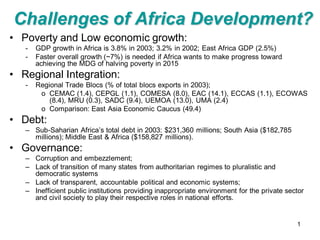
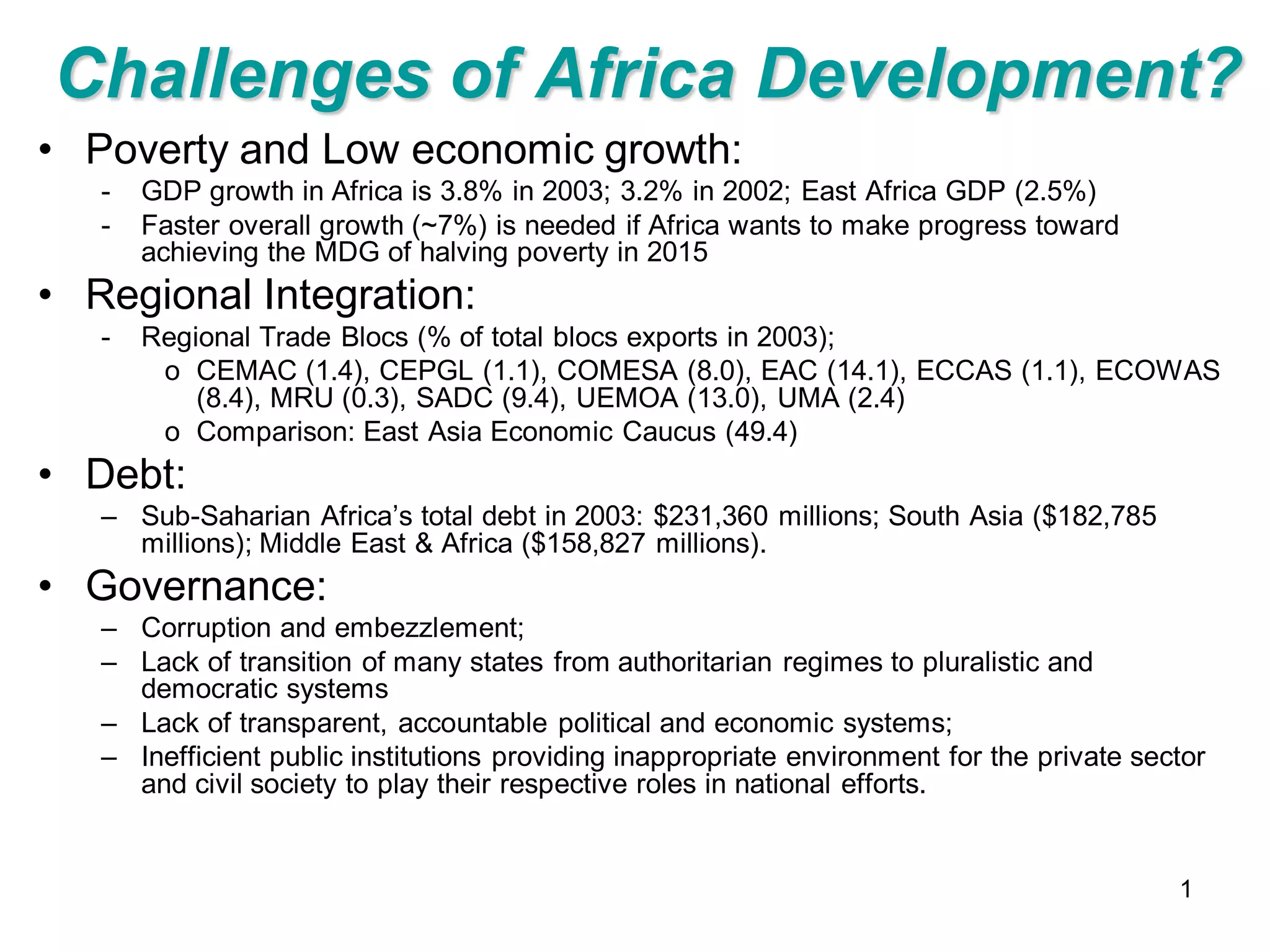
• Poverty and Low economic growth:
   -   GDP growth in Africa is 3.8% in 2003; 3.2% in 2002; East Africa GDP (2.5%)
   -   Faster overall growth (~7%) is needed if Africa wants to make progress toward
       achieving the MDG of halving poverty in 2015
• Regional Integration:
   -   Regional Trade Blocs (% of total blocs exports in 2003);
        o CEMAC (1.4), CEPGL (1.1), COMESA (8.0), EAC (14.1), ECCAS (1.1), ECOWAS
           (8.4), MRU (0.3), SADC (9.4), UEMOA (13.0), UMA (2.4)
        o Comparison: East Asia Economic Caucus (49.4)
• Debt:
   – Sub-Saharian Africa’s total debt in 2003: $231,360 millions; South Asia ($182,785
     millions); Middle East & Africa ($158,827 millions).
• Governance:
   – Corruption and embezzlement;
   – Lack of transition of many states from authoritarian regimes to pluralistic and
     democratic systems
   – Lack of transparent, accountable political and economic systems;
   – Inefficient public institutions providing inappropriate environment for the private sector
     and civil society to play their respective roles in national efforts.


                                                                                            1
Challenges of Africa Development?
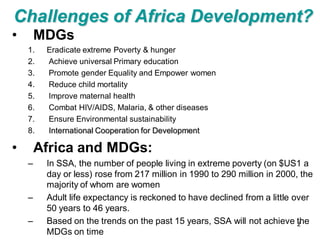
•       MDGs
    1.   Eradicate extreme Poverty & hunger
    2.   Achieve universal Primary education
    3.   Promote gender Equality and Empower women
    4.   Reduce child mortality
    5.   Improve maternal health
    6.   Combat HIV/AIDS, Malaria, & other diseases
    7.   Ensure Environmental sustainability
    8.   International Cooperation for Development

•       Africa and MDGs:
    –    In SSA, the number of people living in extreme poverty (on $US1 a
         day or less) rose from 217 million in 1990 to 290 million in 2000, the
         majority of whom are women
    –    Adult life expectancy is reckoned to have declined from a little over
         50 years to 46 years.
    –    Based on the trends on the past 15 years, SSA will not achieve the2
         MDGs on time
Challenges of Africa Development?
• Low economic growth:
 - GDP growth in Africa is 3.8% in 2003; 3.2% in
   2002; East Africa GDP (2.5%)
 - Faster overall growth (~7%) is needed if Africa
   wants to make progress toward achieving the
   MDG of halving poverty in 2015
 - The median share of income or consumption
   going to the poorest 20% of the population in
   sub-saharian Africa is 4.9%
 - Africa faces a financing gap of 10 to 20% of GDP
   to reach the Goals.

                                                 3
Challenges of Africa Development?
• Low Regional Integration:
  - Multiplicity of Regional Institutions Groupings
  - Lack of regional infrastructures
  - Low Regional Trade Blocs and market integration
    (% of total blocs exports in 2003);
     oCEMAC (1.4), CEPGL (1.1), COMESA (8.0),
      EAC (14.1), ECCAS (1.1), ECOWAS (8.4),
      MRU (0.3), SADC (9.4), UEMOA (13.0), UMA
      (2.4)
     oComparison: East Asia Economic Caucus
      (49.4)

                                                 4
Challenges of Africa Development?
• Debt:
 • Irresponsible borrowing by governments that
   destabilizes the macro-economic environments
   and create unsustainable foreign debt
 • Improper debt management and procurement
   procedures
 • Poor conditions for Highly indebted poor
   countries (HIPC)
 • Sub-Saharian Africa’s total debt in 2003:
   $231,360 millions compare to South Asia
   ($182,785 millions) or Middle East & Africa
   ($158,827 millions).
                                                  5
Challenges of Africa Development?
• Governance:
 – Corruption and embezzlement;
 – Lack of transition of many states from
   authoritarian regimes to pluralistic and
   democratic systems
 – Lack of transparent, accountable political and
   economic systems;
 – Inefficient public institutions providing
   inappropriate environment for the private sector
   and civil society to play their respective roles in
   national efforts.

                                                     6
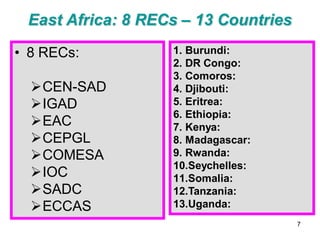
East Africa: 8 RECs – 13 Countries

• 8 RECs:          1. Burundi:
                   2. DR Congo:
                   3. Comoros:
  CEN-SAD         4. Djibouti:
  IGAD            5. Eritrea:
                   6. Ethiopia:
  EAC             7. Kenya:
  CEPGL           8. Madagascar:
  COMESA          9. Rwanda:
                   10.Seychelles:
  IOC             11.Somalia:
  SADC            12.Tanzania:
  ECCAS           13.Uganda:
                                      7
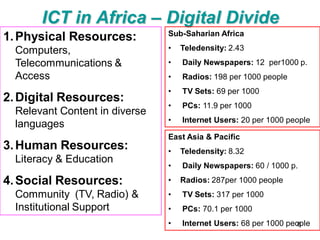
ICT in Africa – Digital Divide
                                Sub-Saharian Africa
1. Physical Resources:
  Computers,                    •   Teledensity: 2.43
  Telecommunications &          •   Daily Newspapers: 12 per1000 p.
  Access                        •   Radios: 198 per 1000 people
                                •   TV Sets: 69 per 1000
2. Digital Resources:
                                •   PCs: 11.9 per 1000
  Relevant Content in diverse
                                •   Internet Users: 20 per 1000 people
  languages
                                East Asia & Pacific
3. Human Resources:             •   Teledensity: 8.32
  Literacy & Education
                                •   Daily Newspapers: 60 / 1000 p.

4. Social Resources:            •   Radios: 287per 1000 people
  Community (TV, Radio) &       •   TV Sets: 317 per 1000
  Institutional Support         •   PCs: 70.1 per 1000
                                •   Internet Users: 68 per 1000 people
                                                                   8
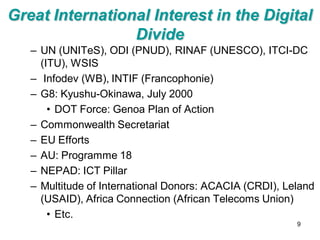
Great International Interest in the Digital
                 Divide
   – UN (UNITeS), ODI (PNUD), RINAF (UNESCO), ITCI-DC
     (ITU), WSIS
   – Infodev (WB), INTIF (Francophonie)
   – G8: Kyushu-Okinawa, July 2000
       • DOT Force: Genoa Plan of Action
   – Commonwealth Secretariat
   – EU Efforts
   – AU: Programme 18
   – NEPAD: ICT Pillar
   – Multitude of International Donors: ACACIA (CRDI), Leland
     (USAID), Africa Connection (African Telecoms Union)
       • Etc.
                                                         9
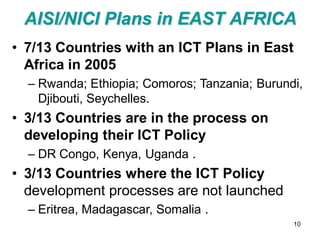
AISI/NICI Plans in EAST AFRICA
• 7/13 Countries with an ICT Plans in East
  Africa in 2005
  – Rwanda; Ethiopia; Comoros; Tanzania; Burundi,
    Djibouti, Seychelles.
• 3/13 Countries are in the process on
  developing their ICT Policy
  – DR Congo, Kenya, Uganda .
• 3/13 Countries where the ICT Policy
  development processes are not launched
  – Eritrea, Madagascar, Somalia .
                                               10

ICT4D

  • 1.
    Challenges of AfricaDevelopment? • Poverty and Low economic growth: - GDP growth in Africa is 3.8% in 2003; 3.2% in 2002; East Africa GDP (2.5%) - Faster overall growth (~7%) is needed if Africa wants to make progress toward achieving the MDG of halving poverty in 2015 • Regional Integration: - Regional Trade Blocs (% of total blocs exports in 2003); o CEMAC (1.4), CEPGL (1.1), COMESA (8.0), EAC (14.1), ECCAS (1.1), ECOWAS (8.4), MRU (0.3), SADC (9.4), UEMOA (13.0), UMA (2.4) o Comparison: East Asia Economic Caucus (49.4) • Debt: – Sub-Saharian Africa’s total debt in 2003: $231,360 millions; South Asia ($182,785 millions); Middle East & Africa ($158,827 millions). • Governance: – Corruption and embezzlement; – Lack of transition of many states from authoritarian regimes to pluralistic and democratic systems – Lack of transparent, accountable political and economic systems; – Inefficient public institutions providing inappropriate environment for the private sector and civil society to play their respective roles in national efforts. 1
  • 2.
    Challenges of AfricaDevelopment? • MDGs 1. Eradicate extreme Poverty & hunger 2. Achieve universal Primary education 3. Promote gender Equality and Empower women 4. Reduce child mortality 5. Improve maternal health 6. Combat HIV/AIDS, Malaria, & other diseases 7. Ensure Environmental sustainability 8. International Cooperation for Development • Africa and MDGs: – In SSA, the number of people living in extreme poverty (on $US1 a day or less) rose from 217 million in 1990 to 290 million in 2000, the majority of whom are women – Adult life expectancy is reckoned to have declined from a little over 50 years to 46 years. – Based on the trends on the past 15 years, SSA will not achieve the2 MDGs on time
  • 3.
    Challenges of AfricaDevelopment? • Low economic growth: - GDP growth in Africa is 3.8% in 2003; 3.2% in 2002; East Africa GDP (2.5%) - Faster overall growth (~7%) is needed if Africa wants to make progress toward achieving the MDG of halving poverty in 2015 - The median share of income or consumption going to the poorest 20% of the population in sub-saharian Africa is 4.9% - Africa faces a financing gap of 10 to 20% of GDP to reach the Goals. 3
  • 4.
    Challenges of AfricaDevelopment? • Low Regional Integration: - Multiplicity of Regional Institutions Groupings - Lack of regional infrastructures - Low Regional Trade Blocs and market integration (% of total blocs exports in 2003); oCEMAC (1.4), CEPGL (1.1), COMESA (8.0), EAC (14.1), ECCAS (1.1), ECOWAS (8.4), MRU (0.3), SADC (9.4), UEMOA (13.0), UMA (2.4) oComparison: East Asia Economic Caucus (49.4) 4
  • 5.
    Challenges of AfricaDevelopment? • Debt: • Irresponsible borrowing by governments that destabilizes the macro-economic environments and create unsustainable foreign debt • Improper debt management and procurement procedures • Poor conditions for Highly indebted poor countries (HIPC) • Sub-Saharian Africa’s total debt in 2003: $231,360 millions compare to South Asia ($182,785 millions) or Middle East & Africa ($158,827 millions). 5
  • 6.
    Challenges of AfricaDevelopment? • Governance: – Corruption and embezzlement; – Lack of transition of many states from authoritarian regimes to pluralistic and democratic systems – Lack of transparent, accountable political and economic systems; – Inefficient public institutions providing inappropriate environment for the private sector and civil society to play their respective roles in national efforts. 6
  • 7.
    East Africa: 8RECs – 13 Countries • 8 RECs: 1. Burundi: 2. DR Congo: 3. Comoros: CEN-SAD 4. Djibouti: IGAD 5. Eritrea: 6. Ethiopia: EAC 7. Kenya: CEPGL 8. Madagascar: COMESA 9. Rwanda: 10.Seychelles: IOC 11.Somalia: SADC 12.Tanzania: ECCAS 13.Uganda: 7
  • 8.
    ICT in Africa– Digital Divide Sub-Saharian Africa 1. Physical Resources: Computers, • Teledensity: 2.43 Telecommunications & • Daily Newspapers: 12 per1000 p. Access • Radios: 198 per 1000 people • TV Sets: 69 per 1000 2. Digital Resources: • PCs: 11.9 per 1000 Relevant Content in diverse • Internet Users: 20 per 1000 people languages East Asia & Pacific 3. Human Resources: • Teledensity: 8.32 Literacy & Education • Daily Newspapers: 60 / 1000 p. 4. Social Resources: • Radios: 287per 1000 people Community (TV, Radio) & • TV Sets: 317 per 1000 Institutional Support • PCs: 70.1 per 1000 • Internet Users: 68 per 1000 people 8
  • 9.
    Great International Interestin the Digital Divide – UN (UNITeS), ODI (PNUD), RINAF (UNESCO), ITCI-DC (ITU), WSIS – Infodev (WB), INTIF (Francophonie) – G8: Kyushu-Okinawa, July 2000 • DOT Force: Genoa Plan of Action – Commonwealth Secretariat – EU Efforts – AU: Programme 18 – NEPAD: ICT Pillar – Multitude of International Donors: ACACIA (CRDI), Leland (USAID), Africa Connection (African Telecoms Union) • Etc. 9
  • 10.
    AISI/NICI Plans inEAST AFRICA • 7/13 Countries with an ICT Plans in East Africa in 2005 – Rwanda; Ethiopia; Comoros; Tanzania; Burundi, Djibouti, Seychelles. • 3/13 Countries are in the process on developing their ICT Policy – DR Congo, Kenya, Uganda . • 3/13 Countries where the ICT Policy development processes are not launched – Eritrea, Madagascar, Somalia . 10