What is an Organization?
• An Organization Defined
– A deliberate arrangement of people to
accomplish some specific purpose
• Common Characteristics of Organizations
– Have a distinct purpose (goal)
– Composed of people
– Have a deliberate structure
Types of Organizations
• Formal
• Informal
• Government
• Companies
• NGOs
• Philanthropic
• Religious
Why study organizations and
management?
• Living in present
• Building the future
• Remembering the past
Why Study Management?
• The Value of Studying Management
– The universality of management
• Good management is needed in all organizations.
– The reality of work
• Employees either manage or are managed.
– Rewards and challenges of being a manager
• Management offers challenging, exciting and
creative opportunities for meaningful and fulfilling
work.
• Successful managers receive significant monetary
rewards for their efforts.
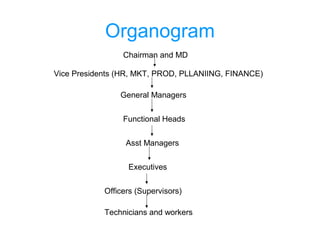
Organogram
Chairman and MD
Vice Presidents (HR, MKT, PROD, PLLANIING, FINANCE)
General Managers
Functional Heads
Asst Managers
Executives
Officers (Supervisors)
Technicians and workers
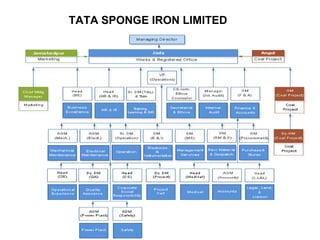
TATA SPONGE IRON LIMITED
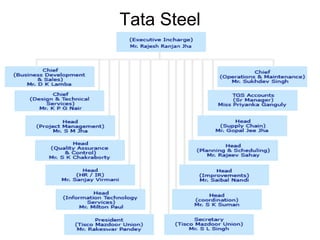
Tata Steel
Management as a specialty in time
and human relationships
• Time:
• Management is an attempt to create a
desirable future, keeping the past and the
present in mind
• Management is practiced in and is a
reflection of a particular historical era
• Management is a practice that produces
consequences and effects that emerge
overtime.
Who is a manager?
– Someone who works with and through other
people by coordinating and integrating their
work activities in order to accomplish
organizational goals.
Classifying Managers
• First-line Managers
– Are at the lowest level of management and manage
the work of non-managerial employees.
Eg. Clerical supervisor, Foreman, Technical supervisor
• Middle Managers
– Manage the work of first-line managers. Functional
heads, Asst. Managers etc.
• Top Managers
– Are responsible for making organization-wide
decisions and establishing plans and goals that affect
the entire organization.
– Executives, Chief executive officer, President and
Vice-President
Functional and General Managers
• A function is a collection of similar activities
• For eg HR – recruitment, promotion, transfer,
termination etc.
• Functional Managers: is responsible for only one
function area such as production, marketing, or
finance
• General manages: He oversees a complex unit
such as company etc. Is responsible for all the
activities of that unit s production, marketing, HR
etc
Management level and skills
• Technical skills – ability to use the procedures,
techniques and knowledge of a specialized field
eg. Surgeons, engineers musicians etc
• Human skills – ability to work with, understand,
and motivate other people as individuals or in
groups.
• Conceptual skills – ability to coordinate and
integrate all of an organization’s interests and
activities.
Importance of Human relationships
• Managers act in relationships that are two-
way streets; each party is influenced by
the other – colleagues, subordinates
• Managers act in relationships that have
spillover effects for other people, for better
and for worse
• Managers juggle multiple simultaneous
relationships
What Do Managers Do?
• Management Roles Approach
• Interpersonal roles
• Figurehead, leader, liaison
Informational roles
• Monitor, disseminator, spokesperson
– Decisional roles
• Disturbance handler, resource allocator,
negotiator
General Skills for Managers
• Conceptual skills
– A manager’s mental ability to coordinate all of the
organization’s interests and activities
• Interpersonal skills
– A manager’s ability to work with, understand, mentor,
and motivate others, both individually and in groups
• Technical skills
– A manager’s ability to use the tools, procedures, and
techniques of a specialized field
• Political skills
– A manager’s ability to build a power base and
establish the right connections
Specific Skills for Managers
• Behaviors related to a manager’s
effectiveness:
– Controlling the organization’s environment and
its resources.
– Organizing and coordinating.
– Handling information.
– Providing for growth and development.
– Motivating employees and handling conflicts.
– Strategic problem solving.
How The Manager’s Job Is Changing
• The Increasing Importance of Customers
– Customers: the reason that organizations exist
• Managing customer relationships is the
responsibility of all managers and employees.
• Consistent high quality customer service is essential
for survival.
• Innovation
– Doing things differently, exploring new territory,
and taking risks
• Managers should encourage employees to be
aware of and act on opportunities for innovation.
What Is Management?
• Managerial Concerns
– Efficiency
• “Doing things right”
– Getting the most output
for the least inputs
– Effectiveness
• “Doing the right things”
– Attaining organizational
goals
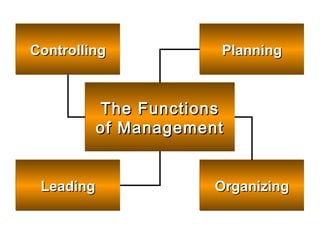
The FunctionsThe Functions
of Managementof Management
The FunctionsThe Functions
of Managementof Management
PlanningPlanningPlanningPlanningControllingControllingControllingControlling
LeadingLeadingLeadingLeading OrganizingOrganizingOrganizingOrganizing
The management process
• Planning
– A primary functional managerial activity that involves:
• Defining the organization’s goals
• Establishing an overall strategy for achieving those goals
• Developing a comprehensive set of plans to integrate and
coordinate organizational work.
• Purposes of Planning
– Provides direction
– Reduces uncertainty
– Minimizes waste and redundancy
– Sets the standards for controlling
Planning (Cont)
• Plans are guides by which
• 1) the organization obtains and commits the resources
required to reach its objectives
• 2) members of the organization carry on activities
consistent with the chosen objectives and procedures
• 3) progress toward the objectives is monitored and
measure so that the corrective action can be taken if
progress is unsatisfactory
– Types of planning
• Strategic Plans (What business to do?)
– Apply to the entire organization.
– Establish the organization’s overall goals.
– Seek to position the organization in terms of its environment.
– Cover extended periods of time.
Planning (Cont)
• Operational Plans (Where to establish the plant?)
– Specify the details of how the overall goals are to be
achieved.
– Cover short time period
• Long-Term Plans (What new products can be
added?)
– Plans with time frames extending beyond three years
• Short-Term Plans
Plans with time frames on one year or less
• Specific Plans (Level of quality)
• Plans that are clearly defined and leave no room
for interpretation
Planning (Cont)
• Directional Plans (How to market the product?)
– Flexible plans that set out general guidelines, provide
focus, yet allow discretion in implementation.
• Single-Use Plan (How to tackle an accident)
– A one-time plan specifically designed to meet the
need of a unique situation.
• Standing Plans (How to maintain the inventory?)
– Ongoing plans that provide guidance for activities
performed repeatedly.
Management Processes
• Organizing
– Includes determining
what tasks to be done,
who is to do them,
how the tasks are to be grouped,
who reports to whom, and
where decisions are to be made
Management Processes (cont’d)
• Leading
– Includes motivating employees, directing the
activities of others, selecting the most effective
communication channel, and resolving
conflicts
• Controlling
– The process of monitoring performance,
comparing it with goals, and
correcting any significant
deviations

Chapter 1 managing and managers

  • 1.
    What is anOrganization? • An Organization Defined – A deliberate arrangement of people to accomplish some specific purpose • Common Characteristics of Organizations – Have a distinct purpose (goal) – Composed of people – Have a deliberate structure
  • 2.
    Types of Organizations •Formal • Informal • Government • Companies • NGOs • Philanthropic • Religious
  • 3.
    Why study organizationsand management? • Living in present • Building the future • Remembering the past
  • 4.
    Why Study Management? •The Value of Studying Management – The universality of management • Good management is needed in all organizations. – The reality of work • Employees either manage or are managed. – Rewards and challenges of being a manager • Management offers challenging, exciting and creative opportunities for meaningful and fulfilling work. • Successful managers receive significant monetary rewards for their efforts.
  • 5.
    Organogram Chairman and MD VicePresidents (HR, MKT, PROD, PLLANIING, FINANCE) General Managers Functional Heads Asst Managers Executives Officers (Supervisors) Technicians and workers
  • 6.
  • 7.
  • 8.
    Management as aspecialty in time and human relationships • Time: • Management is an attempt to create a desirable future, keeping the past and the present in mind • Management is practiced in and is a reflection of a particular historical era • Management is a practice that produces consequences and effects that emerge overtime.
  • 9.
    Who is amanager? – Someone who works with and through other people by coordinating and integrating their work activities in order to accomplish organizational goals.
  • 10.
    Classifying Managers • First-lineManagers – Are at the lowest level of management and manage the work of non-managerial employees. Eg. Clerical supervisor, Foreman, Technical supervisor • Middle Managers – Manage the work of first-line managers. Functional heads, Asst. Managers etc. • Top Managers – Are responsible for making organization-wide decisions and establishing plans and goals that affect the entire organization. – Executives, Chief executive officer, President and Vice-President
  • 11.
    Functional and GeneralManagers • A function is a collection of similar activities • For eg HR – recruitment, promotion, transfer, termination etc. • Functional Managers: is responsible for only one function area such as production, marketing, or finance • General manages: He oversees a complex unit such as company etc. Is responsible for all the activities of that unit s production, marketing, HR etc
  • 12.
    Management level andskills • Technical skills – ability to use the procedures, techniques and knowledge of a specialized field eg. Surgeons, engineers musicians etc • Human skills – ability to work with, understand, and motivate other people as individuals or in groups. • Conceptual skills – ability to coordinate and integrate all of an organization’s interests and activities.
  • 13.
    Importance of Humanrelationships • Managers act in relationships that are two- way streets; each party is influenced by the other – colleagues, subordinates • Managers act in relationships that have spillover effects for other people, for better and for worse • Managers juggle multiple simultaneous relationships
  • 14.
    What Do ManagersDo? • Management Roles Approach • Interpersonal roles • Figurehead, leader, liaison Informational roles • Monitor, disseminator, spokesperson – Decisional roles • Disturbance handler, resource allocator, negotiator
  • 15.
    General Skills forManagers • Conceptual skills – A manager’s mental ability to coordinate all of the organization’s interests and activities • Interpersonal skills – A manager’s ability to work with, understand, mentor, and motivate others, both individually and in groups • Technical skills – A manager’s ability to use the tools, procedures, and techniques of a specialized field • Political skills – A manager’s ability to build a power base and establish the right connections
  • 16.
    Specific Skills forManagers • Behaviors related to a manager’s effectiveness: – Controlling the organization’s environment and its resources. – Organizing and coordinating. – Handling information. – Providing for growth and development. – Motivating employees and handling conflicts. – Strategic problem solving.
  • 17.
    How The Manager’sJob Is Changing • The Increasing Importance of Customers – Customers: the reason that organizations exist • Managing customer relationships is the responsibility of all managers and employees. • Consistent high quality customer service is essential for survival. • Innovation – Doing things differently, exploring new territory, and taking risks • Managers should encourage employees to be aware of and act on opportunities for innovation.
  • 18.
    What Is Management? •Managerial Concerns – Efficiency • “Doing things right” – Getting the most output for the least inputs – Effectiveness • “Doing the right things” – Attaining organizational goals
  • 19.
    The FunctionsThe Functions ofManagementof Management The FunctionsThe Functions of Managementof Management PlanningPlanningPlanningPlanningControllingControllingControllingControlling LeadingLeadingLeadingLeading OrganizingOrganizingOrganizingOrganizing
  • 20.
    The management process •Planning – A primary functional managerial activity that involves: • Defining the organization’s goals • Establishing an overall strategy for achieving those goals • Developing a comprehensive set of plans to integrate and coordinate organizational work. • Purposes of Planning – Provides direction – Reduces uncertainty – Minimizes waste and redundancy – Sets the standards for controlling
  • 21.
    Planning (Cont) • Plansare guides by which • 1) the organization obtains and commits the resources required to reach its objectives • 2) members of the organization carry on activities consistent with the chosen objectives and procedures • 3) progress toward the objectives is monitored and measure so that the corrective action can be taken if progress is unsatisfactory – Types of planning • Strategic Plans (What business to do?) – Apply to the entire organization. – Establish the organization’s overall goals. – Seek to position the organization in terms of its environment. – Cover extended periods of time.
  • 22.
    Planning (Cont) • OperationalPlans (Where to establish the plant?) – Specify the details of how the overall goals are to be achieved. – Cover short time period • Long-Term Plans (What new products can be added?) – Plans with time frames extending beyond three years • Short-Term Plans Plans with time frames on one year or less • Specific Plans (Level of quality) • Plans that are clearly defined and leave no room for interpretation
  • 23.
    Planning (Cont) • DirectionalPlans (How to market the product?) – Flexible plans that set out general guidelines, provide focus, yet allow discretion in implementation. • Single-Use Plan (How to tackle an accident) – A one-time plan specifically designed to meet the need of a unique situation. • Standing Plans (How to maintain the inventory?) – Ongoing plans that provide guidance for activities performed repeatedly.
  • 24.
    Management Processes • Organizing –Includes determining what tasks to be done, who is to do them, how the tasks are to be grouped, who reports to whom, and where decisions are to be made
  • 25.
    Management Processes (cont’d) •Leading – Includes motivating employees, directing the activities of others, selecting the most effective communication channel, and resolving conflicts • Controlling – The process of monitoring performance, comparing it with goals, and correcting any significant deviations

Editor's Notes

  • #16 Conceptual skills refer to the ability to analyze and diagnose complex situations. They help managers to coordinate all of the interests and activities of the organization. Interpersonal skills encompass the ability to to work with, understand, mentor, and motivate others. All managers must have t echnical skills to apply specialized knowledge and expertise. Managers need p olitical skills to establish the right connections or to build a “power base.” Given that all managers perform the four management functions, to some degree, what are the critical areas related to managerial competence? Effective managers must be proficient in the following four general skills areas:
  • #17 Research has also identified specific sets of behaviors that explain more than 50 percent of a manager’s effectiveness. Handling conflicts and motivating employees . Effective managers maximize positive on-the-job situations and minimize conflicts so that employees feel motivated to do their best work. Strategic problem solving . Managers take responsibility for their decisions and ensure that subordinates use effective decision-making skills. Handling information . Managers use information and communication channels for identifying problems, understanding environmental changes, and making effective decisions. Growth and development . Managers use continual learning on the job to provide for the personal growth and development of themselves and their employees. Controlling the organization’s environment and resources . Effective managers are proactive and stay ahead of environmental changes. They base decisions on clear, up-to-date, accurate knowledge of the organization’s objectives. Organizing and coordinating . Managers organize around tasks and coordinate interdependent relationships among tasks wherever they exist
  • #20 The following management functions can be used to classify the manager’s job. Planning means defining an organization’s goals, establishing an overall strategy for achieving these goals, and developing comprehensive plans to integrate and coordinate activities. Organizing includes determining what tasks must be done, who will do them, how the tasks will be grouped, who will report to whom, and where decisions will be made. Leading includes motivating and directing employees, and communicating and resolving conflicts. Controlling means monitoring performance, comparing results and goals, and making corrections.