KM STRATEGY and MEASUREMENTS 
CHAPTER 9 
Kimiz Dalkir 
2005
KM STRATEGY & MEASUREMENTS 
KM Cycles (Zack, Bukowitz) 
KM Model (Nonaka – Takeuchi) 
KM Capture & Codify 
KM Sharing 
KM Application 
•Learning Organization 
•Organization Culture 
•Organization Maturity 
KM Tools 
KM Team 
KM Teaching Group - Universitas TELKOM 
05/12/2013 
2 
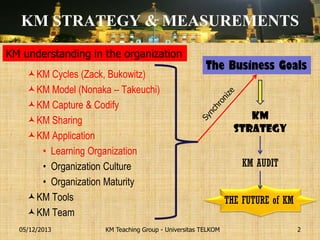
KM 
Strategy 
The Business Goals 
THE FUTURE of KM 
KM AUDIT 
KM understanding in the organization
KM STRATEGY & METRICS 
Discuss two things ; 
A ‘perfect’ KM strategy that is linked to the overall business objectives of the organization 
A good metrics (measurement) framework to monitor progress toward those organizational goals 
Importance of KM Strategy 
Provides the building blocks 
Used to achieve organizational learning & continuous improvement 
Thru the avoidance of wasting time repeating mistakes & make everyone aware of new & better ways of thinking & doinag 
KM Teaching Group - Universitas TELKOM 
05/12/2013 
3
KM STRATEGY & METRICS 
Two objectives of KM are innovation and reuse 
Innovation (& creativity) 
Generation of new knowledge or new linkages between existing knowledge 
Involves lateral thinking such as seeing an analogy in a completely different context. 
Reuse is seen as dull, routine, and unproductive work. In fact, reuse forms the basis for organizational learning and should be viewed more as a dissemination of innovation. 
KM Teaching Group - Universitas TELKOM 
05/12/2013 
4
KM Teaching Group - Universitas TELKOM 
05/12/2013 
5 
Masjid Agung Pekanbaru Riau, April 2013
ORGANIZATIONAL MEMORY 
Organizational learning and knowledge management are heavily dependent on organizational memory 
Emphasizes “the support of the human user by providing, maintaining, and distributing relevant information and knowledge” 
While organizational memory depends on the individual memories of organization members, the rules, procedures, beliefs, and cultures are preserved over time through socialization and control 
KM Teaching Group - Universitas TELKOM 
05/12/2013 
6
ORGANIZATIONAL MEMORY 
Organizational memory should not be a passive information system, but must be an intelligent assistant to the user 
Abecker et al. (1999) created a model to show how organizational memory assists knowledge-management activities. 
Short term knowledge efforts should concentrate on short term knowledge preservation, facilitated through best practice data bases, lessons-learned archives, or expert systems. 
In long-term efforts, organizational memory should support knowledge creation and organizational learning 
KM Teaching Group - Universitas TELKOM 
05/12/2013 
7
ORGANIZATIONAL MEMORY 
KM Teaching Group - Universitas TELKOM 
05/12/2013 
8 
http://www.ou.edu/deptcomm/dodjcc/groups/02b1/02b1litreview.htm
ORGANIZATIONAL MEMORY 
Organizations keep forgetting what they have done in the past and why they have done it. 
Building organizational memory systems generally failed because 
Required additional documentation effort with no clear short-term benefit, 
Did not provide an effective index or structure to the mass of information collected in the system 
Organizational memory extends and amplifies this asset by capturing, organizing, disseminating, and reusing the knowledge created by its employees 
KM Teaching Group - Universitas TELKOM 
05/12/2013 
9
ORGANIZATIONAL MEMORY 
These organizations have a difficulty to learn, owing to an inability to represent critical aspects of what they know  Organization stupidity or corporate amnesia (Sutton – 2003) 
Organizational learning and the accumulation of knowledge will be a source of immediate health as well as longterms survival 
Organizational memory must play a key role in KM strategy 
KM Teaching Group - Universitas TELKOM 
05/12/2013 
10
ORGANIZATIONAL MEMORY 
Current notions of organizational memory 
Assume a repository of artifacts. 
Focus on preserving, organizing, indexing, and retrieving only the formal knowledge as it is stored in documents and databases 
Formal knowledge sometimes is sufficient, but often knowledge worker face with the problems with no clear definition or the ever changing problems 
Formal documents are not rich enough to support knowledge work 
Organizational memory consists only formal knowledge is bare and lifeless 
KM Teaching Group - Universitas TELKOM 
05/12/2013 
11
ORGANIZATIONAL MEMORY 
An organizational memory system (like human memory) should therefore have the capacity to recall whatever is relevant and salient to the moment 
The volumes of corporate knowledge accessible online will increase, which will make it even more difficult to pinpoint those particular items relevant to users 
KM strategy should address the cultural and technical factors that influence effective organizational memory management 
Cultural barriers 
Technical barriers 
KM Teaching Group - Universitas TELKOM 
05/12/2013 
12
ORGANIZATIONAL MEMORY 
Cultural barriers 
A cultural emphasis on artifacts and results to the exclusion of process. 
Resistance to knowledge capture because of the effort required, the fear of litigation, and the fear of loss of job security. 
Resistance to knowledge reuse because of the effort required, and the low likelihood of finding relevant knowledge. 
KM Teaching Group - Universitas TELKOM 
05/12/2013 
13
ORGANIZATIONAL MEMORY 
Technical barriers 
How to make the knowledge capture process easy or even transparent. 
How to make retrieval and reuse easy or even transparent. 
How to ensure the relevance and intelligibility (i.e., through sufficient context) of retrieved knowledge 
KM Teaching Group - Universitas TELKOM 
05/12/2013 
14
ORGANIZATIONAL MEMORY 
The challenge is to design an organizational memory system that offers sufficient short-term payoffs to knowledge workers who will use the system, 
both to capture knowledge as they are creating it and to look for and reuse existing knowledge, 
as well as a system that is compatible with the long-term, sustainable KM strategic objectives of the organization 
KM Teaching Group - Universitas TELKOM 
05/12/2013 
15
KM Teaching Group - Universitas TELKOM 
05/12/2013 
16 
Masjid Agung Pekanbaru Riau, April 2013
KM DRIVERS 
Retirement of key personnel 
The unrecorded event-specific, organization-specific and time-specific ‘how’ of know-how that characterizes any organization's ability to perform - walks out of the front door on a regular basis 
The need for innovation to compete in dynamic, challenging business environment 
The need for internal efficiencies in order to reduce costs & efforts 
KM Teaching Group - Universitas TELKOM 
05/12/2013 
17
FRAMEWORK 
External structure initiatives  acquire knowledge from outside sources such as customers, sharing knowledge to others 
Internal structure initiatives  create knowledge-sharing culture, capture individual tacit knowledge, create revenue from existing knowledge, store, spread, reuse 
Competence initiatives  setup careers based on KM, create knowledge transfer environment 
(Sveiby – 2001) 
KM Teaching Group - Universitas TELKOM 
05/12/2013 
18
FRAMEWORK 
Three sources of intangible assets (Lev – 2001) ; 
Discovery (new thing, new way, new method, new tools) 
Organizational practices 
Human resources competencies 
Read p. 249. What is the topic of Monsanto example? 
A good KM strategy should identify : 
The key needs and issues within the organization 
Provide a framework for addressing these issues 
KM Teaching Group - Universitas TELKOM 
05/12/2013 
19
KM STRATEGIES 
The resources and skills required to develop a KM strategy depend on 
The size and complexity of the organizational unit 
The depth of information gathering and analysis. 
The ideal mix of skills on the KM strategy team would be 
KM expert  to access to people who are knowledgeable about the organization 
KM advocate  who will “sell” the strategy to the senior member of management who mandated the strategy development 
The differences of KM expert VS KM advocate??? 
KM Teaching Group - Universitas TELKOM 
05/12/2013 
20
KM STRATEGIES 
A KM strategy is an approach to define objectives & operational strategy with specialized KM principles and approaches (Srikantajah and Koenig, 2000). 
Identifying how the organization can best leverage its knowledge resources. 
What tools required 
KM strategies answer : 
Which KM approaches, will bring the most value to the organization? 
How can the organization prioritize alternatives when any one or several of the alternatives are appealing and resources are limited 
KM Teaching Group - Universitas TELKOM 
05/12/2013 
21
KM STRATEGIES 
A KM strategy is used to define an action to overcome gap 
Defining organization current state and the desired business objectives  gap analysis 
What is the components that KM strategy needs to possess? Open and read p. 251-252 
The road map typically represents a three- to five-year strategy with clear milestones or targets to be achieved throughout that time (what do you think???) 
KM Teaching Group - Universitas TELKOM 
05/12/2013 
22
KM STRATEGIES 
Current state of the organization assessed using 
Information gathering from a variety of sources or key documents (e.g., annual report) 
Interviewing key stakeholders (e.g., senior managers, human resources, information technology, and major business unit managers) 
How about desired business objectives? 
…………………………. 
…………………………. 
…………………………. 
KM Teaching Group - Universitas TELKOM 
05/12/2013 
23
KM STRATEGY ROADMAP 
Address the questions of ; 
How to manage knowledge for the benefit of the business? 
How to manage explicit & tacit knowledge priorities? 
How the processes, people, products, services, organizational memory, relationships, & knowledge assets be identified as high priority knowledge levers to focus on? 
What is the clear or direct link between KM levers & business objectives? 
What are some quick wins (early relatively inexpensive KM successes)? 
How will KM capability be sustained over the long term (e.g., defined KM roles)? 
KM Teaching Group - Universitas TELKOM 
05/12/2013 
24
KM STRATEGY ROADMAP 
One key component of a sustainable KM program is the efficient and effective management of organizational memory 
Other key components are ; 
KM roles and responsibility (KM team) 
Framework to evaluate KM initiatives success 
KM Teaching Group - Universitas TELKOM 
05/12/2013 
25
KM Teaching Group - Universitas TELKOM 
05/12/2013 
26 
Masjid Agung Pekanbaru Riau, April 2013
KM  Management of knowledge resources and processes with an objective to improve competitive advantages and organizational performance 
Performance measurement is crucial in KM as it serves as the foundation that enables an organization to evaluate, control, and improve its knowledge processes. 
Measuring knowledge as an intangible capital will be difficult 
05 Desember 2013 
KM Teaching Group - MBTI 2012 
27 
KM MEASUREMENT
The measurement system must meet the requirement ; 
Management  set goals and objectives for managing assets 
Assessment of monetary dollar value — to know the actual influence of these efforts on company value 
05 Desember 2013 
KM Teaching Group - MBTI 2012 
28 
MEASUREMENT CHALLENGE
Professor Baruch Lev’s method for assessing assets 
Find quantitative dollar results (the actual annual earnings of a company, deduct the customary yield on physical assets of that industry, and the result is the contribution of the intangible assets). 
Still, not satisfying the need to measure the knowledge 
In spite of sophisticated financial reports, it is often difficult to determine the real value of a company in terms of the total sum of its assets (tangible and intangible) 
05 Desember 2013 
KM Teaching Group - MBTI 2012 
29 
MEASUREMENT CHALLENGE
Professor Baruch Lev’s method for assessing assets 
Coca Cola. 
Discounting the extensive value of the sugar, water, bottling facilities, and distribution system, 
The company’s value lies in the formula to make Coke and in the brand awareness the company has established. 
05 Desember 2013 
KM Teaching Group - MBTI 2012 
30 
MEASUREMENT CHALLENGE
05 Desember 2013 
KM Teaching Group - MBTI 2012 
31 
MEASUREMENT CHALLENGE 
Use knowledge 
Review knowledge 
Create knowledge 
Capture knowledge 
Sharing knowledge 
Store knowledge 
Knowledge audit

Knowledge Management Strategies

  • 1.
    KM STRATEGY andMEASUREMENTS CHAPTER 9 Kimiz Dalkir 2005
  • 2.
    KM STRATEGY &MEASUREMENTS KM Cycles (Zack, Bukowitz) KM Model (Nonaka – Takeuchi) KM Capture & Codify KM Sharing KM Application •Learning Organization •Organization Culture •Organization Maturity KM Tools KM Team KM Teaching Group - Universitas TELKOM 05/12/2013 2 KM Strategy The Business Goals THE FUTURE of KM KM AUDIT KM understanding in the organization
  • 3.
    KM STRATEGY &METRICS Discuss two things ; A ‘perfect’ KM strategy that is linked to the overall business objectives of the organization A good metrics (measurement) framework to monitor progress toward those organizational goals Importance of KM Strategy Provides the building blocks Used to achieve organizational learning & continuous improvement Thru the avoidance of wasting time repeating mistakes & make everyone aware of new & better ways of thinking & doinag KM Teaching Group - Universitas TELKOM 05/12/2013 3
  • 4.
    KM STRATEGY &METRICS Two objectives of KM are innovation and reuse Innovation (& creativity) Generation of new knowledge or new linkages between existing knowledge Involves lateral thinking such as seeing an analogy in a completely different context. Reuse is seen as dull, routine, and unproductive work. In fact, reuse forms the basis for organizational learning and should be viewed more as a dissemination of innovation. KM Teaching Group - Universitas TELKOM 05/12/2013 4
  • 5.
    KM Teaching Group- Universitas TELKOM 05/12/2013 5 Masjid Agung Pekanbaru Riau, April 2013
  • 6.
    ORGANIZATIONAL MEMORY Organizationallearning and knowledge management are heavily dependent on organizational memory Emphasizes “the support of the human user by providing, maintaining, and distributing relevant information and knowledge” While organizational memory depends on the individual memories of organization members, the rules, procedures, beliefs, and cultures are preserved over time through socialization and control KM Teaching Group - Universitas TELKOM 05/12/2013 6
  • 7.
    ORGANIZATIONAL MEMORY Organizationalmemory should not be a passive information system, but must be an intelligent assistant to the user Abecker et al. (1999) created a model to show how organizational memory assists knowledge-management activities. Short term knowledge efforts should concentrate on short term knowledge preservation, facilitated through best practice data bases, lessons-learned archives, or expert systems. In long-term efforts, organizational memory should support knowledge creation and organizational learning KM Teaching Group - Universitas TELKOM 05/12/2013 7
  • 8.
    ORGANIZATIONAL MEMORY KMTeaching Group - Universitas TELKOM 05/12/2013 8 http://www.ou.edu/deptcomm/dodjcc/groups/02b1/02b1litreview.htm
  • 9.
    ORGANIZATIONAL MEMORY Organizationskeep forgetting what they have done in the past and why they have done it. Building organizational memory systems generally failed because Required additional documentation effort with no clear short-term benefit, Did not provide an effective index or structure to the mass of information collected in the system Organizational memory extends and amplifies this asset by capturing, organizing, disseminating, and reusing the knowledge created by its employees KM Teaching Group - Universitas TELKOM 05/12/2013 9
  • 10.
    ORGANIZATIONAL MEMORY Theseorganizations have a difficulty to learn, owing to an inability to represent critical aspects of what they know  Organization stupidity or corporate amnesia (Sutton – 2003) Organizational learning and the accumulation of knowledge will be a source of immediate health as well as longterms survival Organizational memory must play a key role in KM strategy KM Teaching Group - Universitas TELKOM 05/12/2013 10
  • 11.
    ORGANIZATIONAL MEMORY Currentnotions of organizational memory Assume a repository of artifacts. Focus on preserving, organizing, indexing, and retrieving only the formal knowledge as it is stored in documents and databases Formal knowledge sometimes is sufficient, but often knowledge worker face with the problems with no clear definition or the ever changing problems Formal documents are not rich enough to support knowledge work Organizational memory consists only formal knowledge is bare and lifeless KM Teaching Group - Universitas TELKOM 05/12/2013 11
  • 12.
    ORGANIZATIONAL MEMORY Anorganizational memory system (like human memory) should therefore have the capacity to recall whatever is relevant and salient to the moment The volumes of corporate knowledge accessible online will increase, which will make it even more difficult to pinpoint those particular items relevant to users KM strategy should address the cultural and technical factors that influence effective organizational memory management Cultural barriers Technical barriers KM Teaching Group - Universitas TELKOM 05/12/2013 12
  • 13.
    ORGANIZATIONAL MEMORY Culturalbarriers A cultural emphasis on artifacts and results to the exclusion of process. Resistance to knowledge capture because of the effort required, the fear of litigation, and the fear of loss of job security. Resistance to knowledge reuse because of the effort required, and the low likelihood of finding relevant knowledge. KM Teaching Group - Universitas TELKOM 05/12/2013 13
  • 14.
    ORGANIZATIONAL MEMORY Technicalbarriers How to make the knowledge capture process easy or even transparent. How to make retrieval and reuse easy or even transparent. How to ensure the relevance and intelligibility (i.e., through sufficient context) of retrieved knowledge KM Teaching Group - Universitas TELKOM 05/12/2013 14
  • 15.
    ORGANIZATIONAL MEMORY Thechallenge is to design an organizational memory system that offers sufficient short-term payoffs to knowledge workers who will use the system, both to capture knowledge as they are creating it and to look for and reuse existing knowledge, as well as a system that is compatible with the long-term, sustainable KM strategic objectives of the organization KM Teaching Group - Universitas TELKOM 05/12/2013 15
  • 16.
    KM Teaching Group- Universitas TELKOM 05/12/2013 16 Masjid Agung Pekanbaru Riau, April 2013
  • 17.
    KM DRIVERS Retirementof key personnel The unrecorded event-specific, organization-specific and time-specific ‘how’ of know-how that characterizes any organization's ability to perform - walks out of the front door on a regular basis The need for innovation to compete in dynamic, challenging business environment The need for internal efficiencies in order to reduce costs & efforts KM Teaching Group - Universitas TELKOM 05/12/2013 17
  • 18.
    FRAMEWORK External structureinitiatives  acquire knowledge from outside sources such as customers, sharing knowledge to others Internal structure initiatives  create knowledge-sharing culture, capture individual tacit knowledge, create revenue from existing knowledge, store, spread, reuse Competence initiatives  setup careers based on KM, create knowledge transfer environment (Sveiby – 2001) KM Teaching Group - Universitas TELKOM 05/12/2013 18
  • 19.
    FRAMEWORK Three sourcesof intangible assets (Lev – 2001) ; Discovery (new thing, new way, new method, new tools) Organizational practices Human resources competencies Read p. 249. What is the topic of Monsanto example? A good KM strategy should identify : The key needs and issues within the organization Provide a framework for addressing these issues KM Teaching Group - Universitas TELKOM 05/12/2013 19
  • 20.
    KM STRATEGIES Theresources and skills required to develop a KM strategy depend on The size and complexity of the organizational unit The depth of information gathering and analysis. The ideal mix of skills on the KM strategy team would be KM expert  to access to people who are knowledgeable about the organization KM advocate  who will “sell” the strategy to the senior member of management who mandated the strategy development The differences of KM expert VS KM advocate??? KM Teaching Group - Universitas TELKOM 05/12/2013 20
  • 21.
    KM STRATEGIES AKM strategy is an approach to define objectives & operational strategy with specialized KM principles and approaches (Srikantajah and Koenig, 2000). Identifying how the organization can best leverage its knowledge resources. What tools required KM strategies answer : Which KM approaches, will bring the most value to the organization? How can the organization prioritize alternatives when any one or several of the alternatives are appealing and resources are limited KM Teaching Group - Universitas TELKOM 05/12/2013 21
  • 22.
    KM STRATEGIES AKM strategy is used to define an action to overcome gap Defining organization current state and the desired business objectives  gap analysis What is the components that KM strategy needs to possess? Open and read p. 251-252 The road map typically represents a three- to five-year strategy with clear milestones or targets to be achieved throughout that time (what do you think???) KM Teaching Group - Universitas TELKOM 05/12/2013 22
  • 23.
    KM STRATEGIES Currentstate of the organization assessed using Information gathering from a variety of sources or key documents (e.g., annual report) Interviewing key stakeholders (e.g., senior managers, human resources, information technology, and major business unit managers) How about desired business objectives? …………………………. …………………………. …………………………. KM Teaching Group - Universitas TELKOM 05/12/2013 23
  • 24.
    KM STRATEGY ROADMAP Address the questions of ; How to manage knowledge for the benefit of the business? How to manage explicit & tacit knowledge priorities? How the processes, people, products, services, organizational memory, relationships, & knowledge assets be identified as high priority knowledge levers to focus on? What is the clear or direct link between KM levers & business objectives? What are some quick wins (early relatively inexpensive KM successes)? How will KM capability be sustained over the long term (e.g., defined KM roles)? KM Teaching Group - Universitas TELKOM 05/12/2013 24
  • 25.
    KM STRATEGY ROADMAP One key component of a sustainable KM program is the efficient and effective management of organizational memory Other key components are ; KM roles and responsibility (KM team) Framework to evaluate KM initiatives success KM Teaching Group - Universitas TELKOM 05/12/2013 25
  • 26.
    KM Teaching Group- Universitas TELKOM 05/12/2013 26 Masjid Agung Pekanbaru Riau, April 2013
  • 27.
    KM  Managementof knowledge resources and processes with an objective to improve competitive advantages and organizational performance Performance measurement is crucial in KM as it serves as the foundation that enables an organization to evaluate, control, and improve its knowledge processes. Measuring knowledge as an intangible capital will be difficult 05 Desember 2013 KM Teaching Group - MBTI 2012 27 KM MEASUREMENT
  • 28.
    The measurement systemmust meet the requirement ; Management  set goals and objectives for managing assets Assessment of monetary dollar value — to know the actual influence of these efforts on company value 05 Desember 2013 KM Teaching Group - MBTI 2012 28 MEASUREMENT CHALLENGE
  • 29.
    Professor Baruch Lev’smethod for assessing assets Find quantitative dollar results (the actual annual earnings of a company, deduct the customary yield on physical assets of that industry, and the result is the contribution of the intangible assets). Still, not satisfying the need to measure the knowledge In spite of sophisticated financial reports, it is often difficult to determine the real value of a company in terms of the total sum of its assets (tangible and intangible) 05 Desember 2013 KM Teaching Group - MBTI 2012 29 MEASUREMENT CHALLENGE
  • 30.
    Professor Baruch Lev’smethod for assessing assets Coca Cola. Discounting the extensive value of the sugar, water, bottling facilities, and distribution system, The company’s value lies in the formula to make Coke and in the brand awareness the company has established. 05 Desember 2013 KM Teaching Group - MBTI 2012 30 MEASUREMENT CHALLENGE
  • 31.
    05 Desember 2013 KM Teaching Group - MBTI 2012 31 MEASUREMENT CHALLENGE Use knowledge Review knowledge Create knowledge Capture knowledge Sharing knowledge Store knowledge Knowledge audit