
What’s My Communication Style?
How to Get Along with(Almost) Anyone
PEGGY F. GREENBERG
PRESIDENT, PEGGY GREENBERG TRAINING AND CONSULTING
Roadmap for
today’s session
Introductions
 What is communication?
 What is your communication “style”?
 The four styles: Strengths and trouble spots
 Interacting with individuals and team members with
different styles
 How to quickly gauge the style of a new acquaintance
 Questions and wrap up
First, a little
about me…
o Worked as Director of Training for various health care
organizations in Boston, Baltimore and Washington, DC
o Director of the Office of Education and Training at US
Senate
o Executive Coach and Consultant
o Conduct Training Seminars for various organizations
o Online Moderator for business, management and
communication topics
Now. . . A little about YOU!
Poll: In which of the following major
industries do you work?
Government
Manufacturing
High Tech/Telecomm/IT
Financial/Banking/Real Estate
Health Care
A little more about you!
Poll: What is your primary role in your
organization?
Team Member, Specialist or
Subject Expert
Supervisor
Project/Team/Unit Manager
Mid-management
Upper management or
executive team
What is Communication???
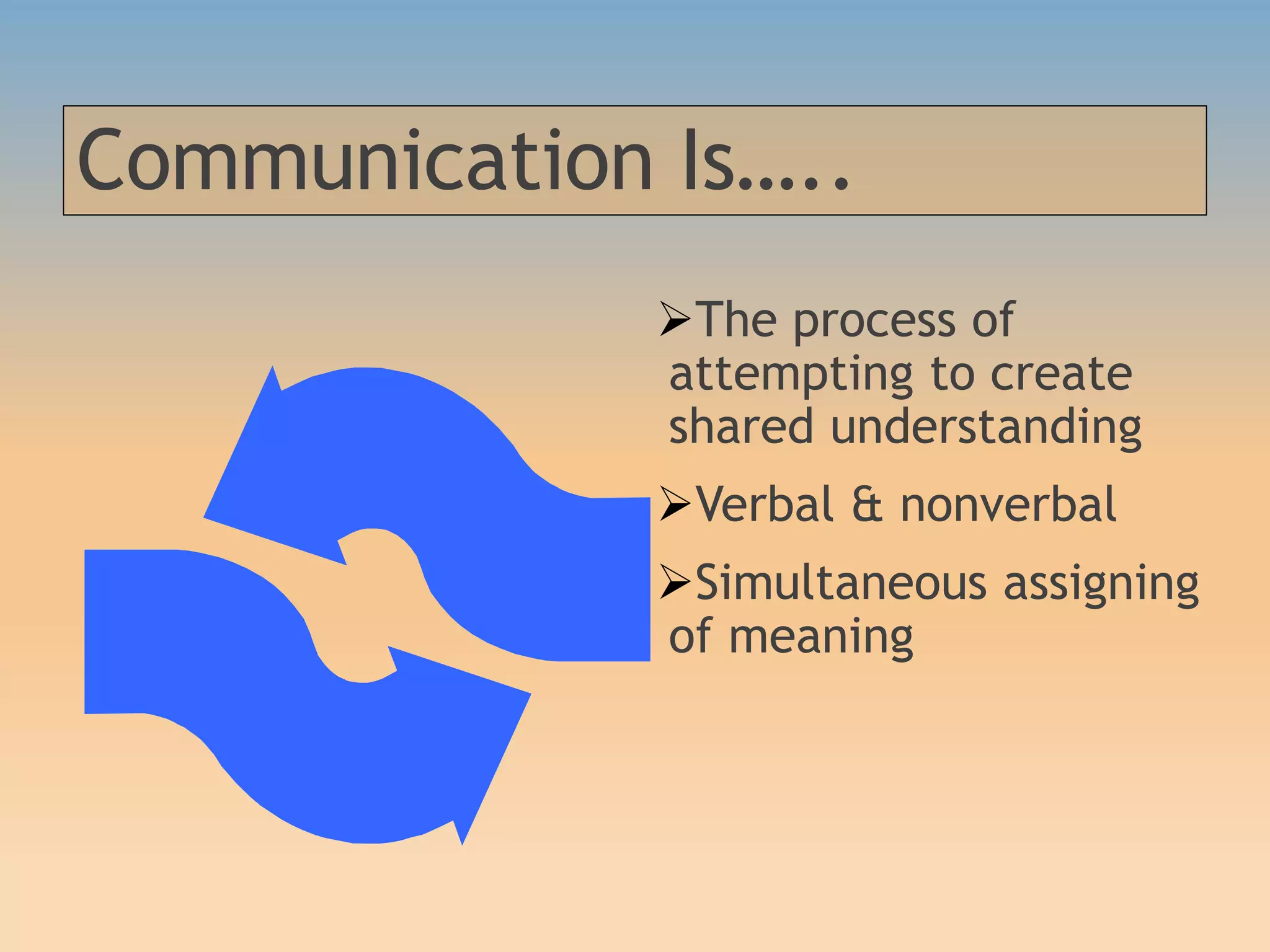
Communication Is…..
The process of
attempting to create
shared understanding
Verbal & nonverbal
Simultaneous assigning
of meaning
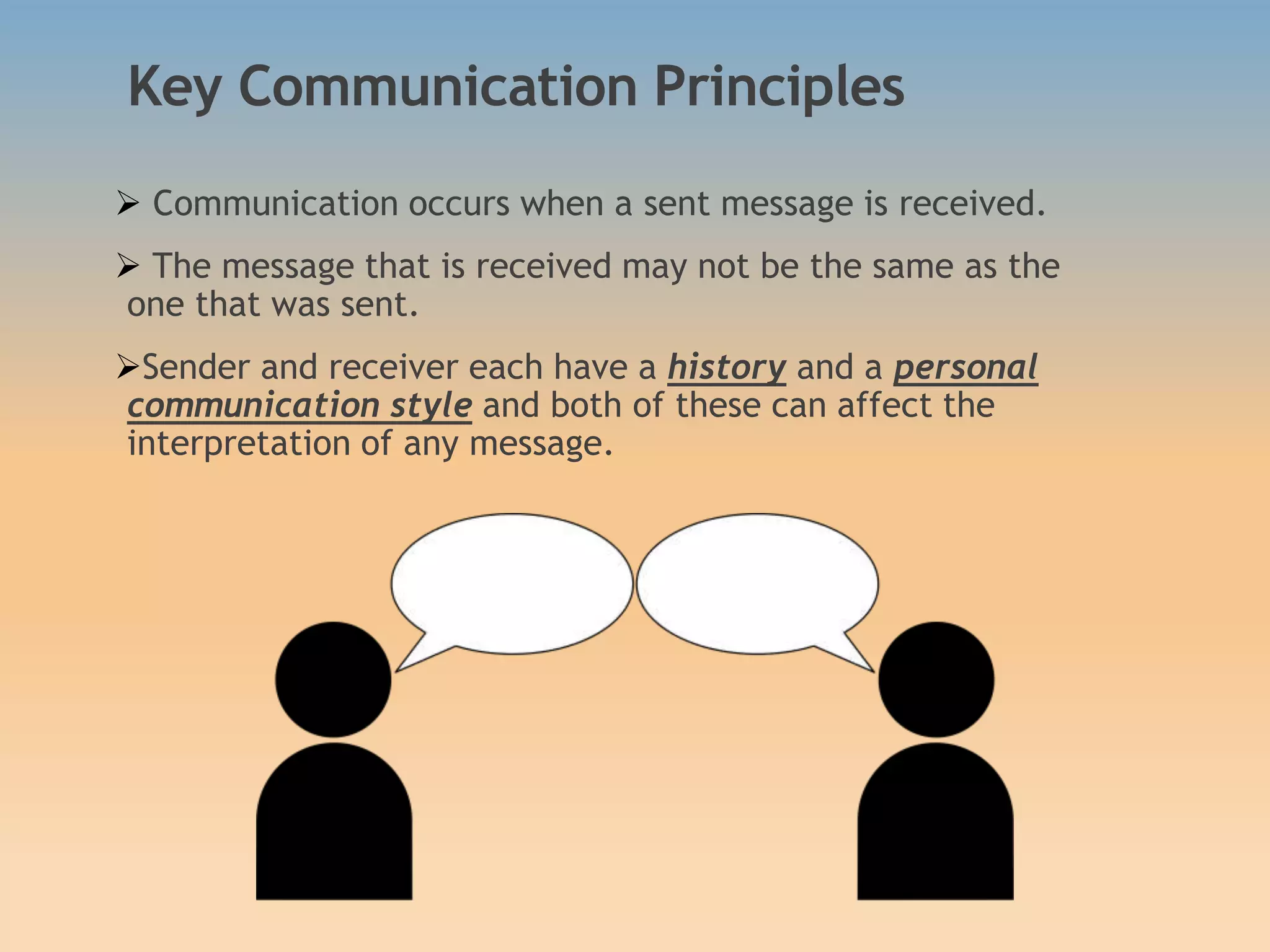
Key Communication Principles
 Communication occurs when a sent message is received.
 The message that is received may not be the same as the
one that was sent.
Sender and receiver each have a history and a personal
communication style and both of these can affect the
interpretation of any message.
Four types of communication:
 Verbal – words have different meanings to different
people based on age, experience and background
(semantics).
 Paraverbal – includes pace of speech, tone,
intensity, irony, sarcasm, etc.
 Body Language – stance, handshake, eye contact,
facial expressions, gesturing, touch, etc.
 Personal Space – intimate, personal, social and
public are some examples, as well as how you
decorate and organize your office.
A Guide for Effective Communication
It is unavoidable
Contains content & info about the
content
Produces conflict yet it is the only
method for resolving conflict
Circular & complex
Happens within an individual’s frame
of reference
Semantics matter!
Why bother?
Communication or miscommunication is cited as the #1 reason
why:
Relationships fail
Job performance is not what it needs to be
Sales are lost
Customer service in so many organizations fails to satisfy the
customers
Why bother?
“As soon as you move one step up from the
bottom, your effectiveness depends on you
your ability to reach others through the
spoken and written word.”
Peter Drucker
“Communication…the human connection…is the key to
personal and career success.”
Paul J. Meyer
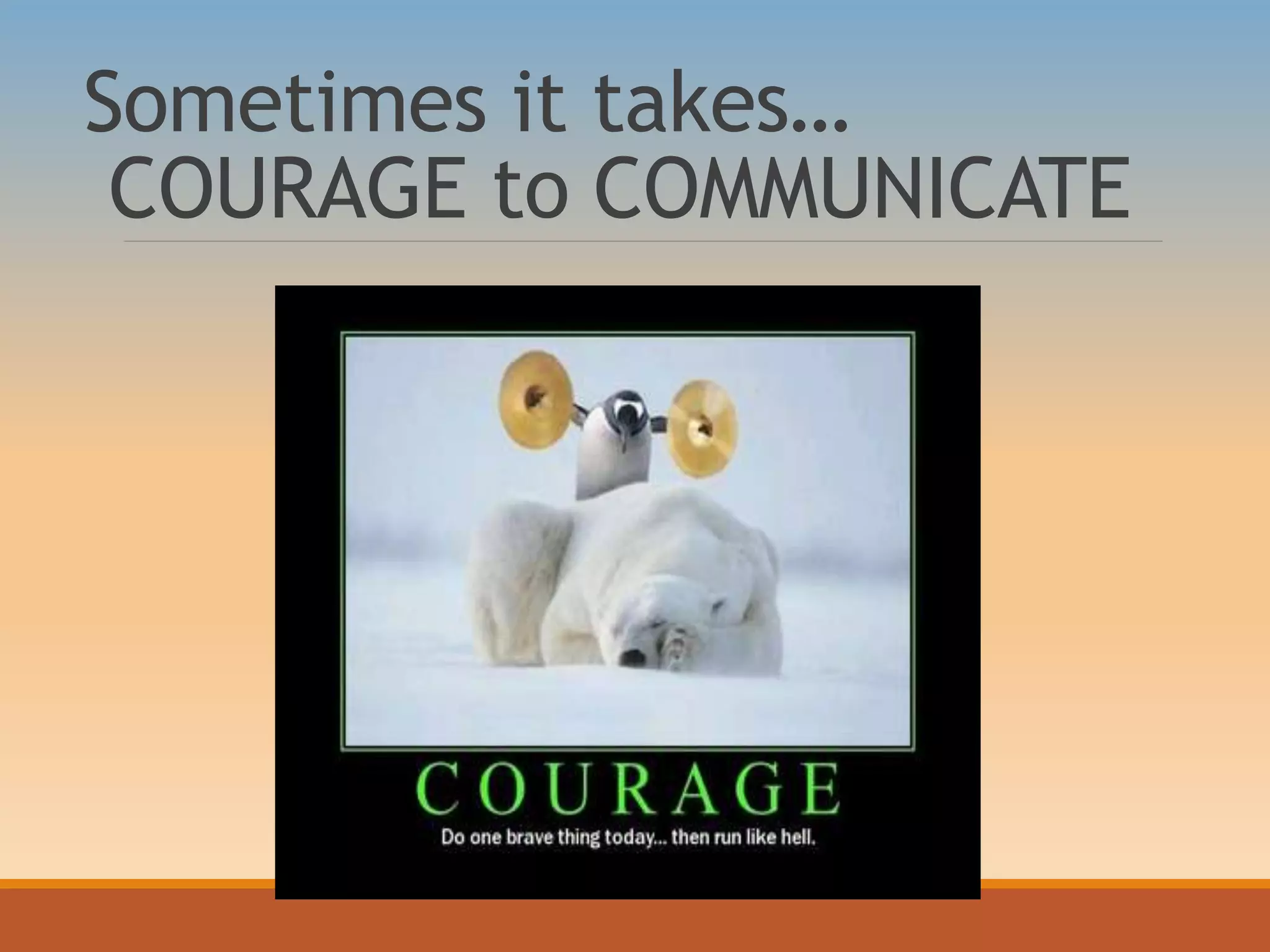
Sometimes it takes…
COURAGE to COMMUNICATE
What is “communication style”?
 How people act when they can do things
their own way—the way that is most natural
to them.
Behavior so consistent that it is predictable.
Behavior that seems “typical,” part of their
personality, or you expect it most of the time.
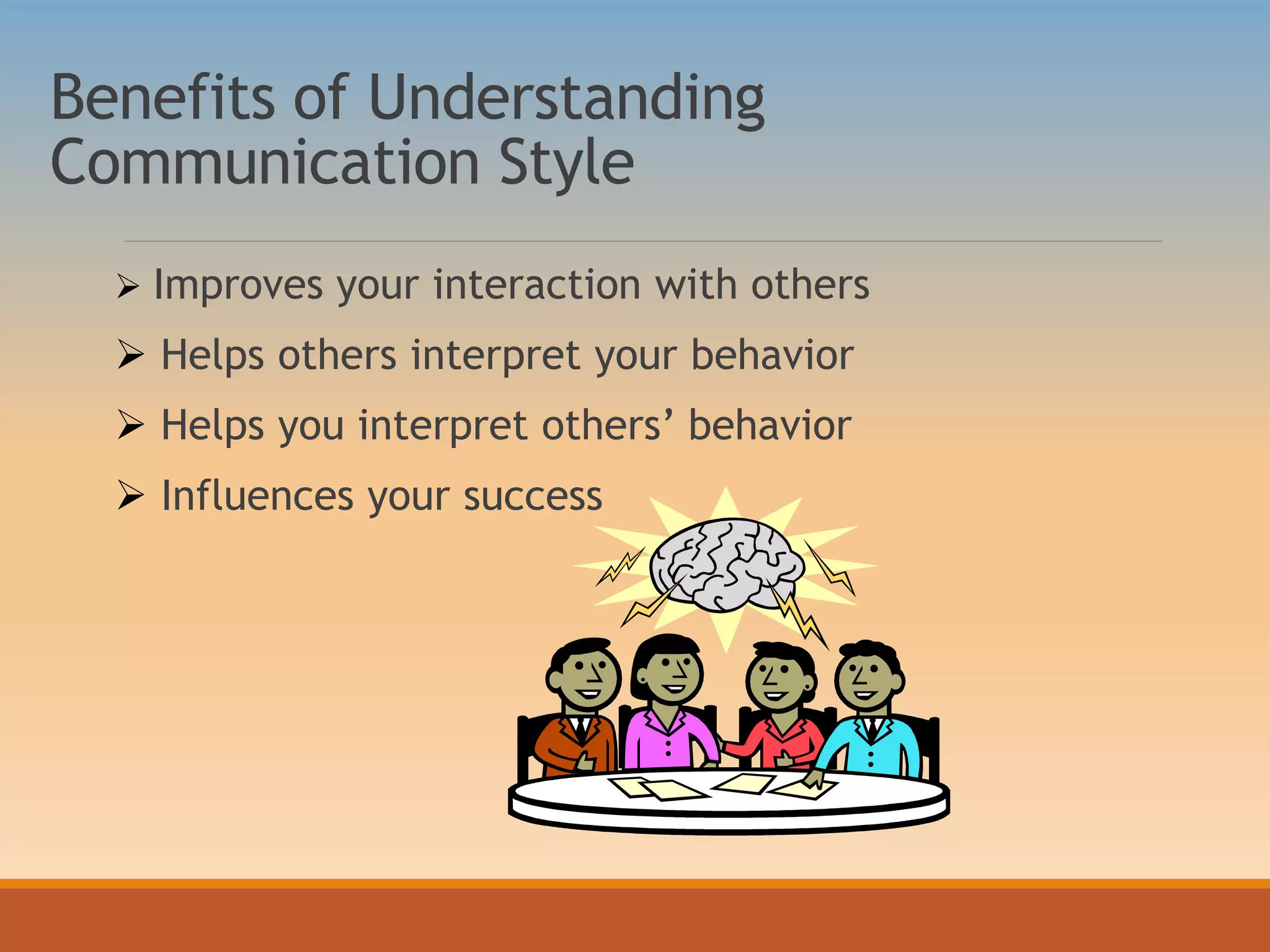
Benefits of Understanding
Communication Style
 Improves your interaction with others
 Helps others interpret your behavior
 Helps you interpret others’ behavior
 Influences your success
What’s Your
Communication Style?
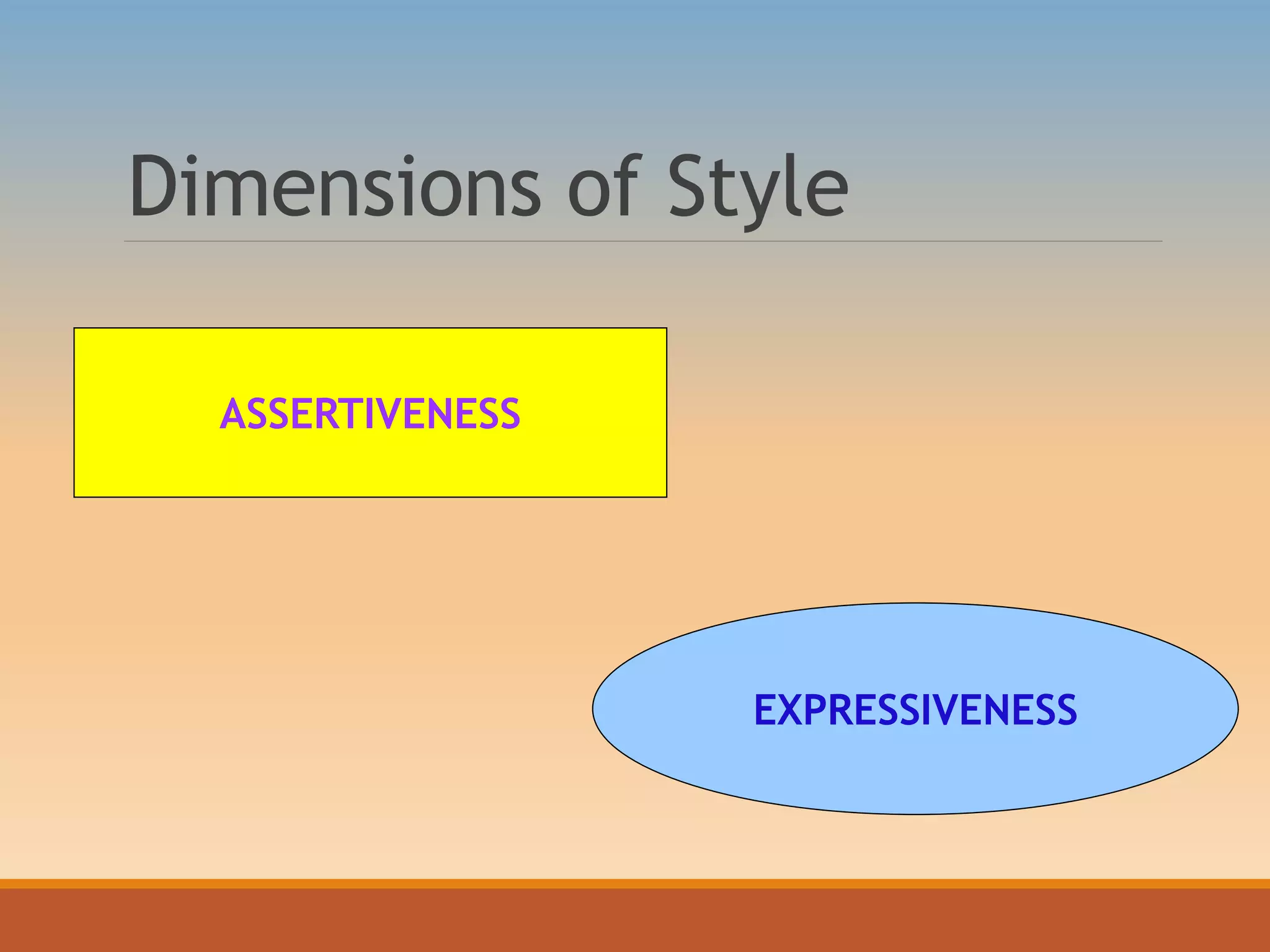
Dimensions of Style
ASSERTIVENESS
EXPRESSIVENESS
SYSTEMATIC CONSIDERATE
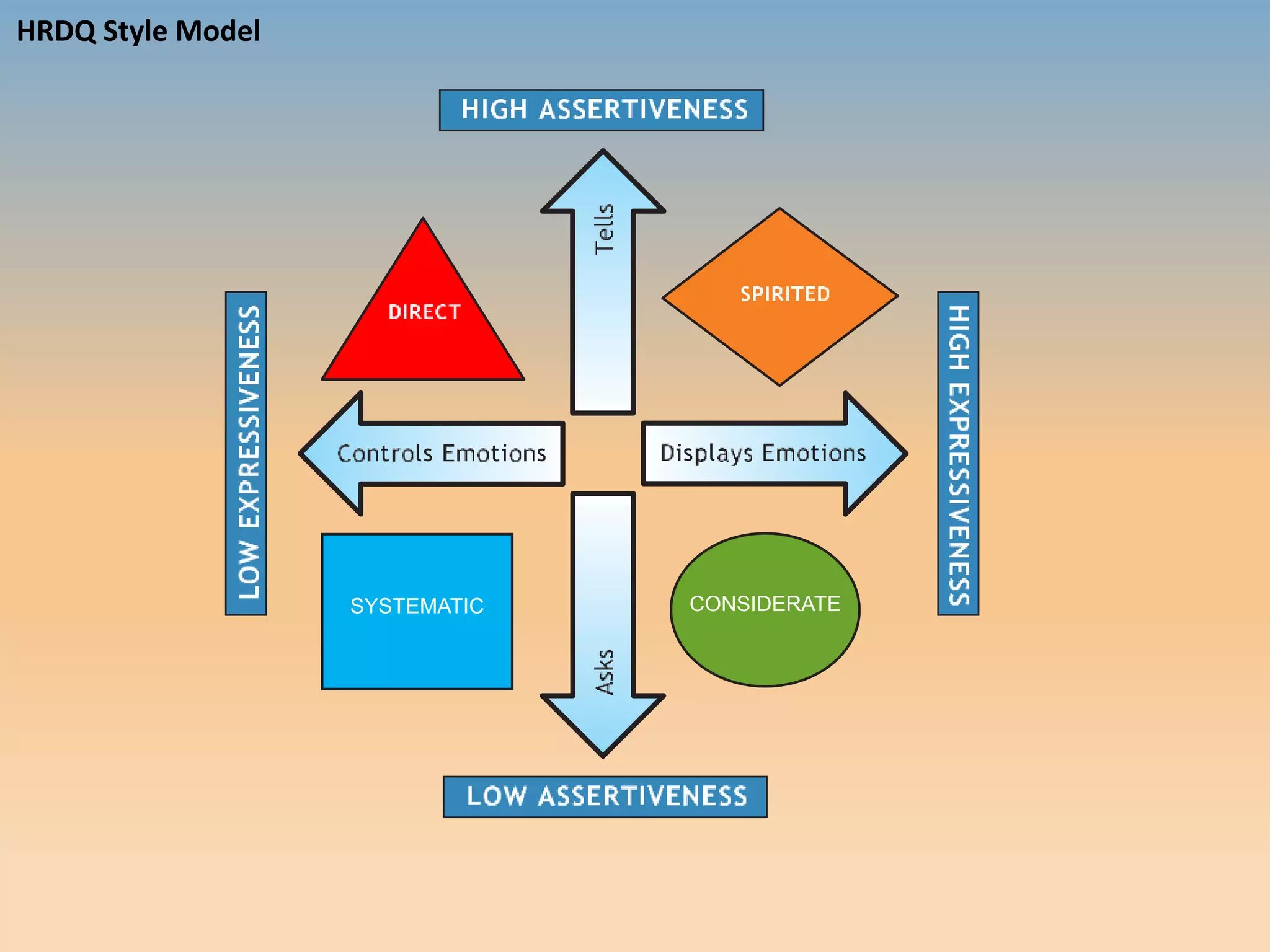
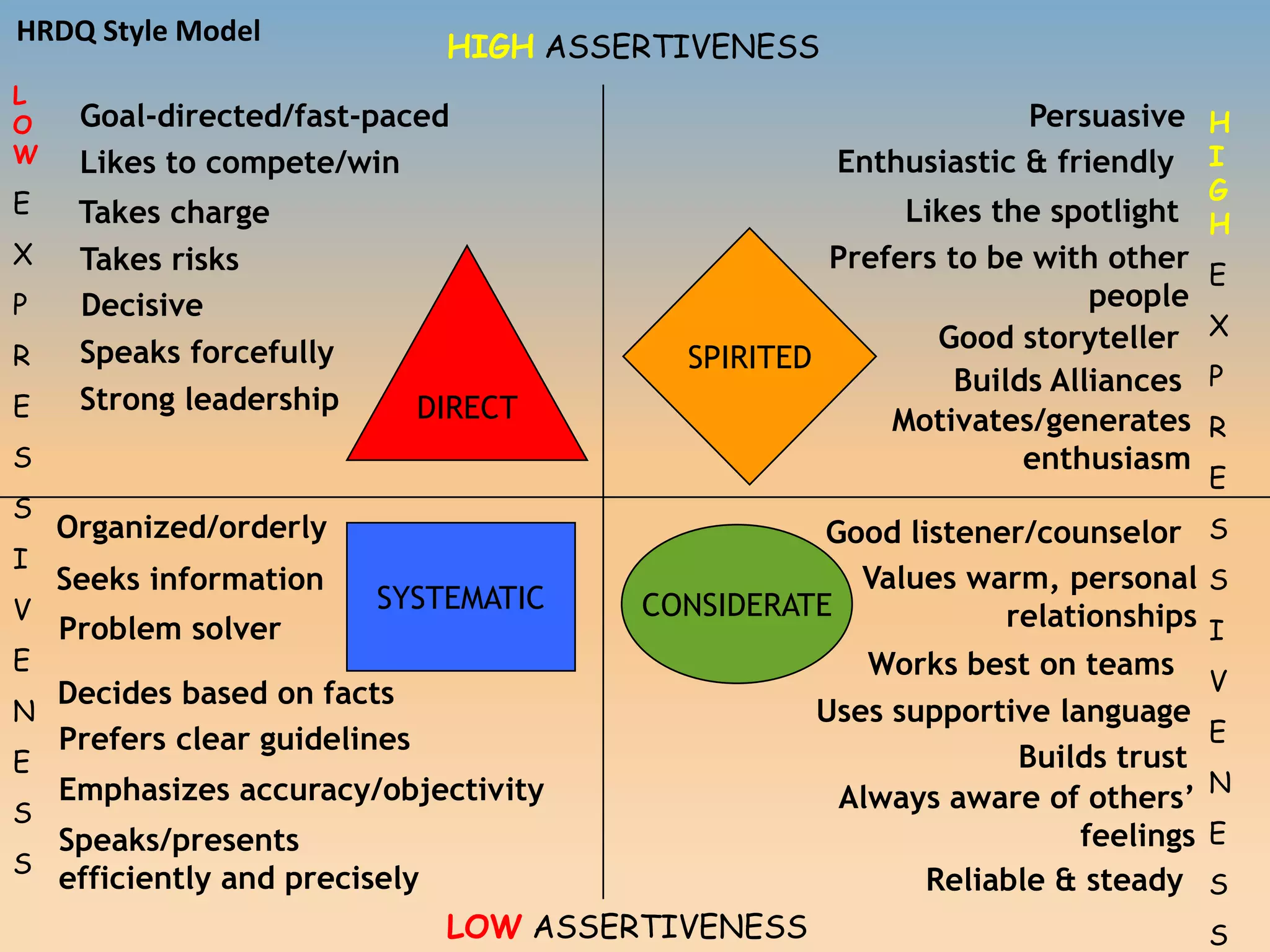
HRDQ Style Model
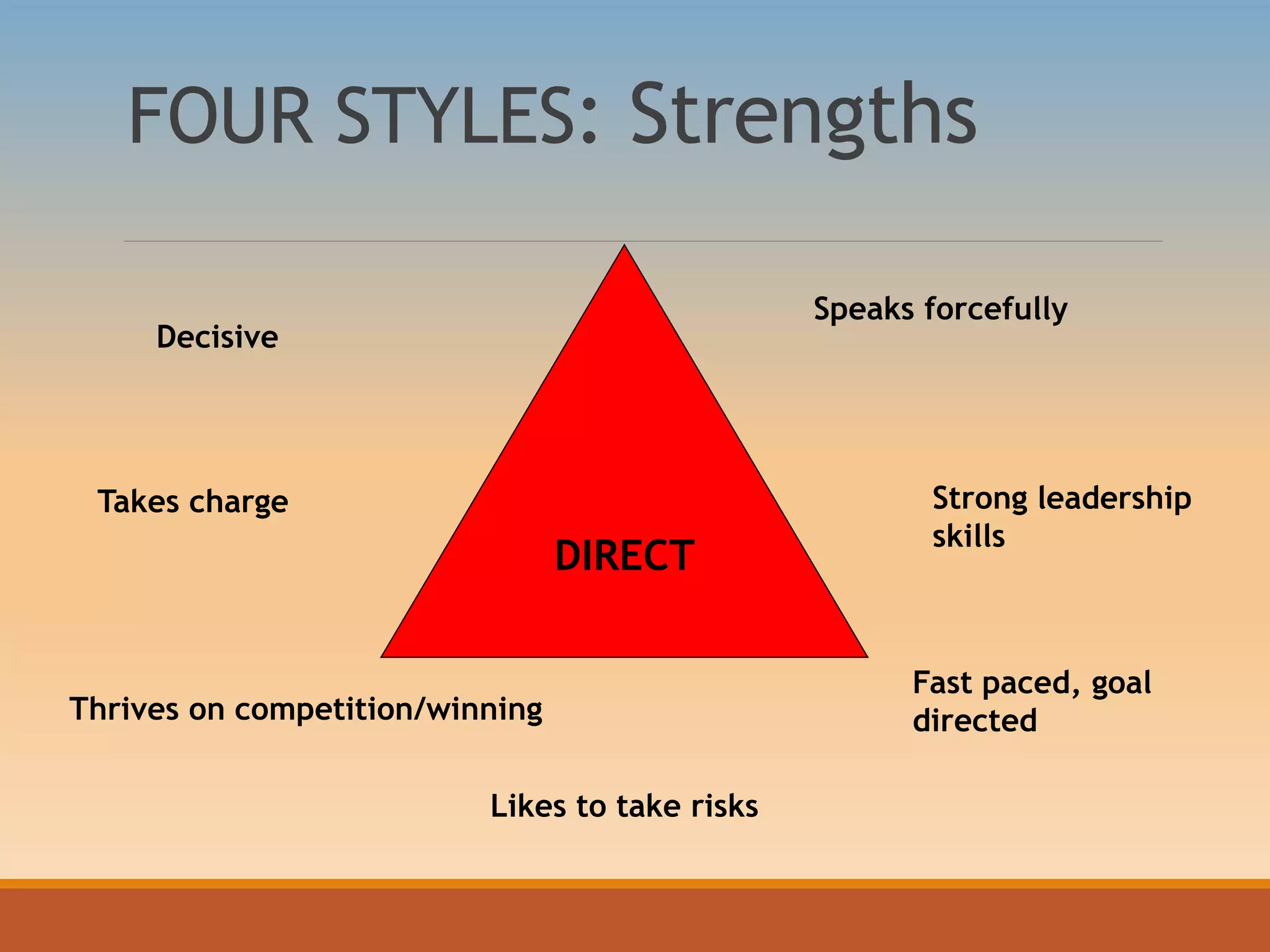
FOUR STYLES: Strengths
DIRECT
Takes charge
Thrives on competition/winning
Fast paced, goal
directed
Strong leadership
skills
Likes to take risks
Speaks forcefully
Decisive
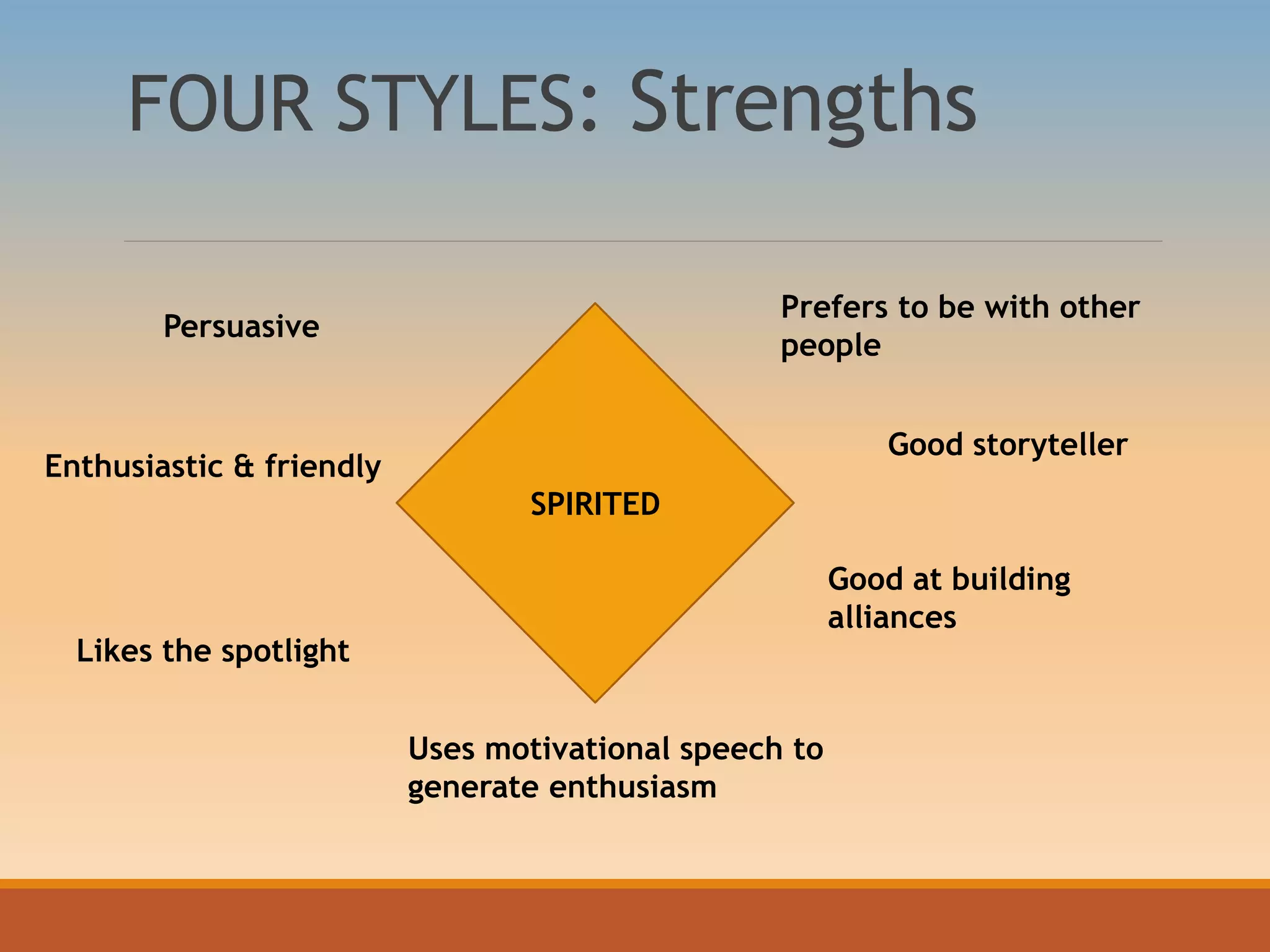
Enthusiastic & friendly
Likes the spotlight
Good storyteller
Good at building
alliances
Uses motivational speech to
generate enthusiasm
SPIRITED
Persuasive
Prefers to be with other
people
FOUR STYLES: Strengths
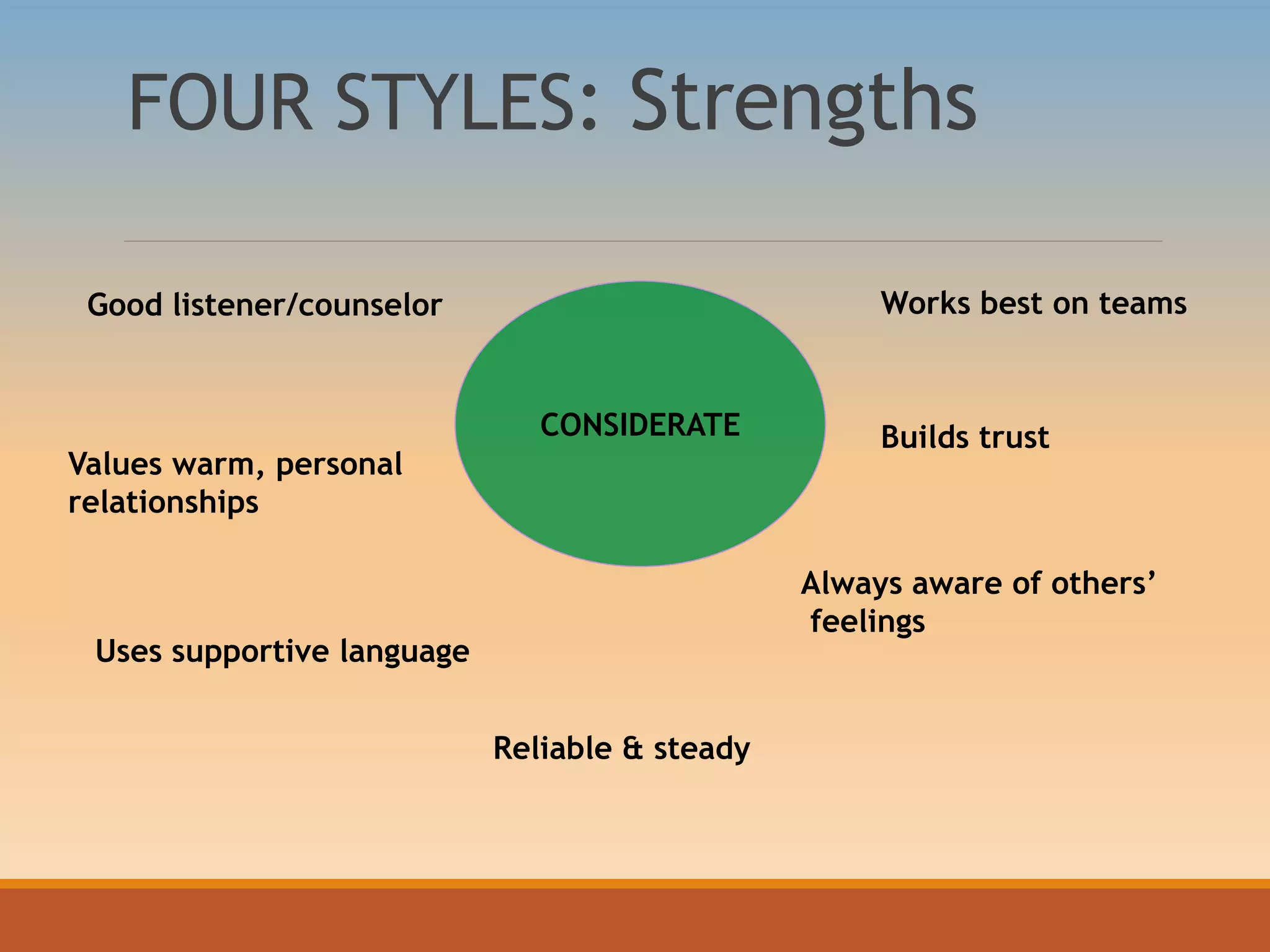
CONSIDERATE
Values warm, personal
relationships
Good listener/counselor Works best on teams
Always aware of others’
feelings
Reliable & steady
Uses supportive language
Builds trust
FOUR STYLES: Strengths
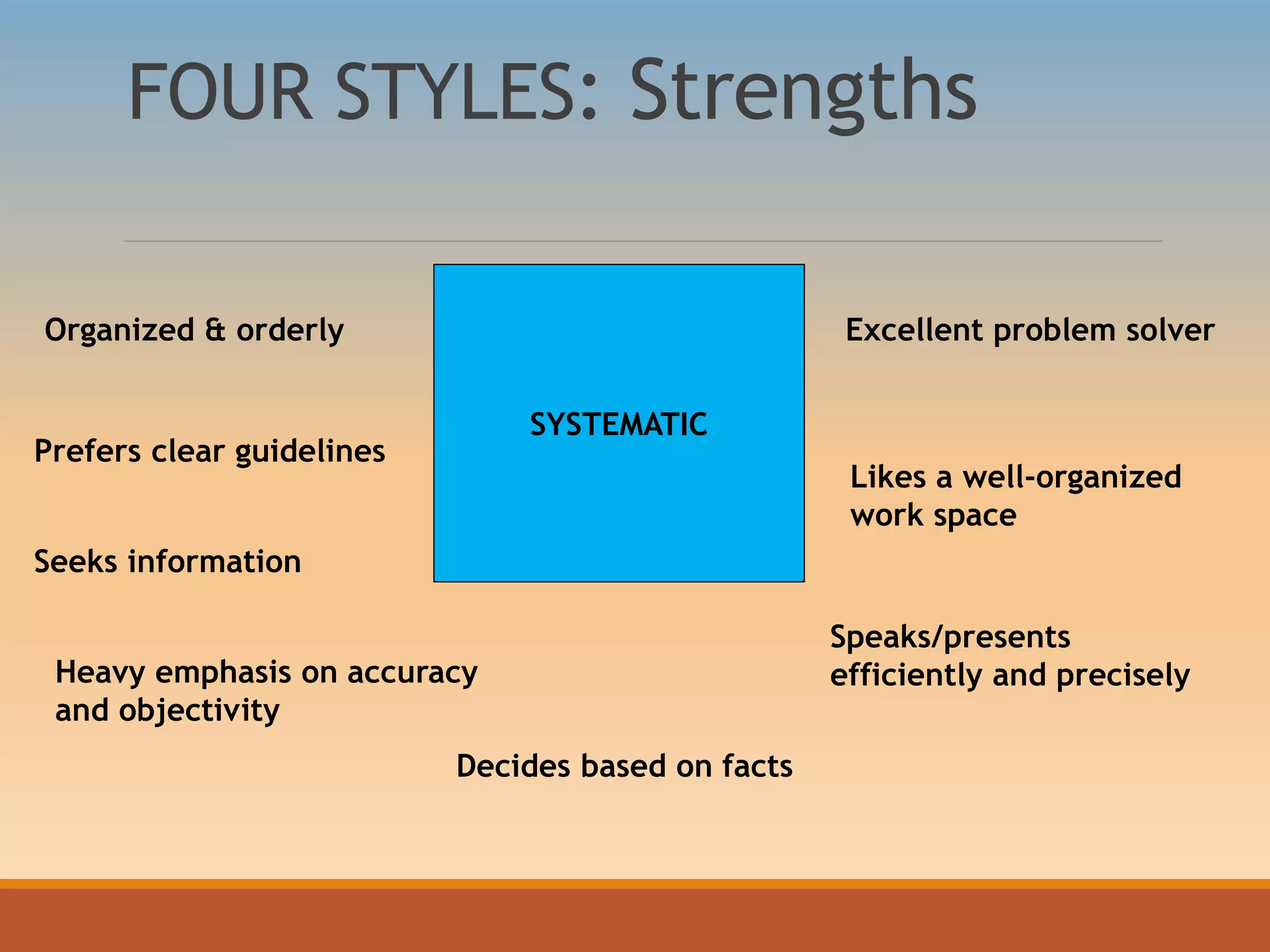
SYSTEMATIC
Heavy emphasis on accuracy
and objectivity
Decides based on facts
Excellent problem solverOrganized & orderly
Prefers clear guidelines
Seeks information
Likes a well-organized
work space
Speaks/presents
efficiently and precisely
FOUR STYLES: Strengths
DIRECT
SYSTEMATIC CONSIDERATE
HIGH ASSERTIVENESS
LOW ASSERTIVENESS
L
O
W
E
X
P
R
E
S
S
I
V
E
N
E
S
S
H
I
G
H
E
X
P
R
E
S
S
I
V
E
N
E
S
S
HRDQ Style Model
SPIRITED
Decisive
Takes charge
Likes to compete/win
Speaks forcefully
Strong leadership
Goal-directed/fast-paced
Takes risks
Persuasive
Enthusiastic & friendly
Likes the spotlight
Motivates/generates
enthusiasm
Prefers to be with other
people
Good storyteller
Builds Alliances
Good listener/counselor
Values warm, personal
relationships
Uses supportive language
Works best on teams
Builds trust
Always aware of others’
feelings
Reliable & steady
Organized/orderly
Decides based on facts
Seeks information
Prefers clear guidelines
Problem solver
Emphasizes accuracy/objectivity
Speaks/presents
efficiently and precisely
Poll: What do you think your
predominant style is?
Direct
Spirited
Systematic
Considerate
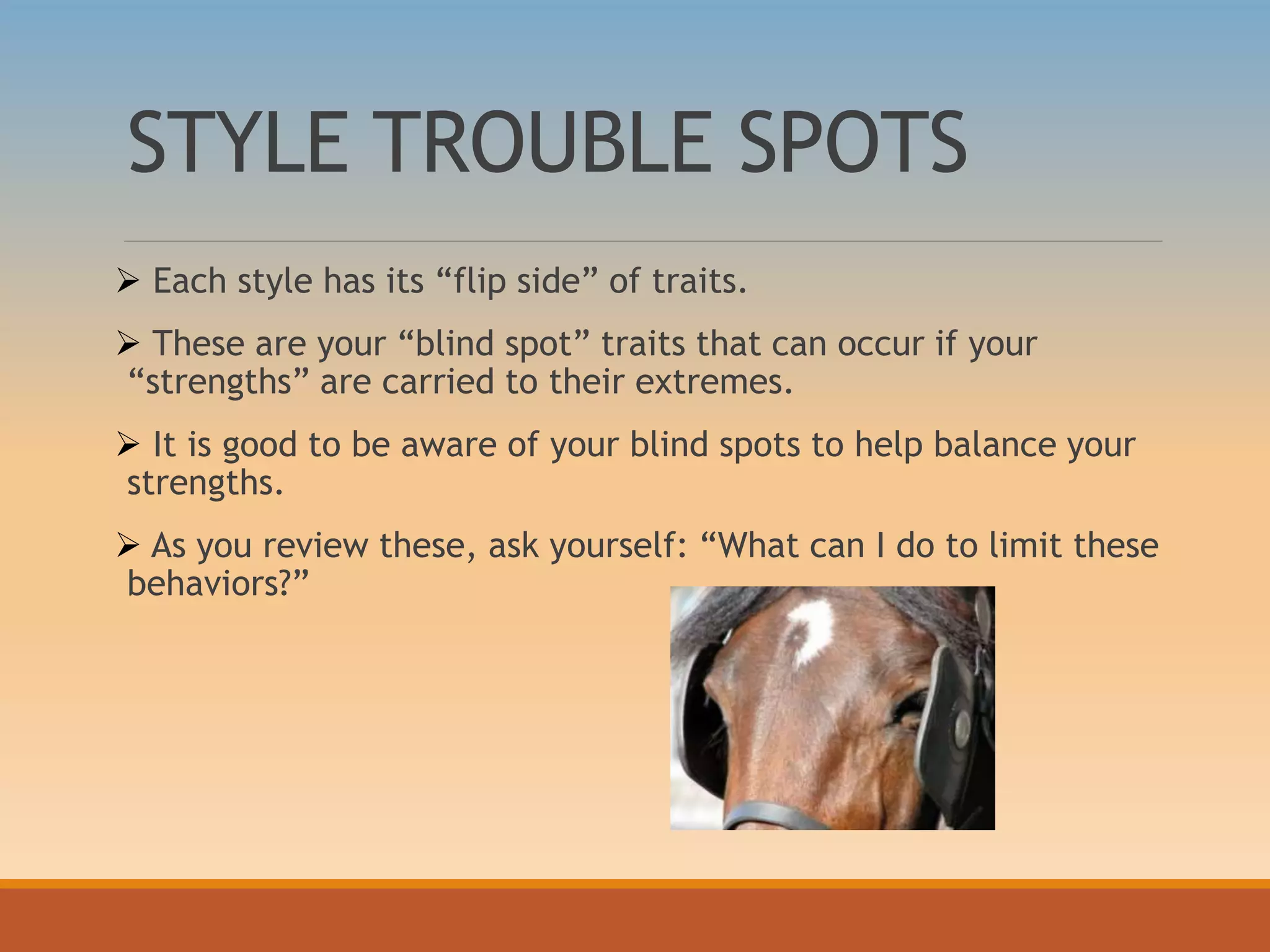
STYLE TROUBLE SPOTS
 Each style has its “flip side” of traits.
 These are your “blind spot” traits that can occur if your
“strengths” are carried to their extremes.
 It is good to be aware of your blind spots to help balance your
strengths.
 As you review these, ask yourself: “What can I do to limit these
behaviors?”
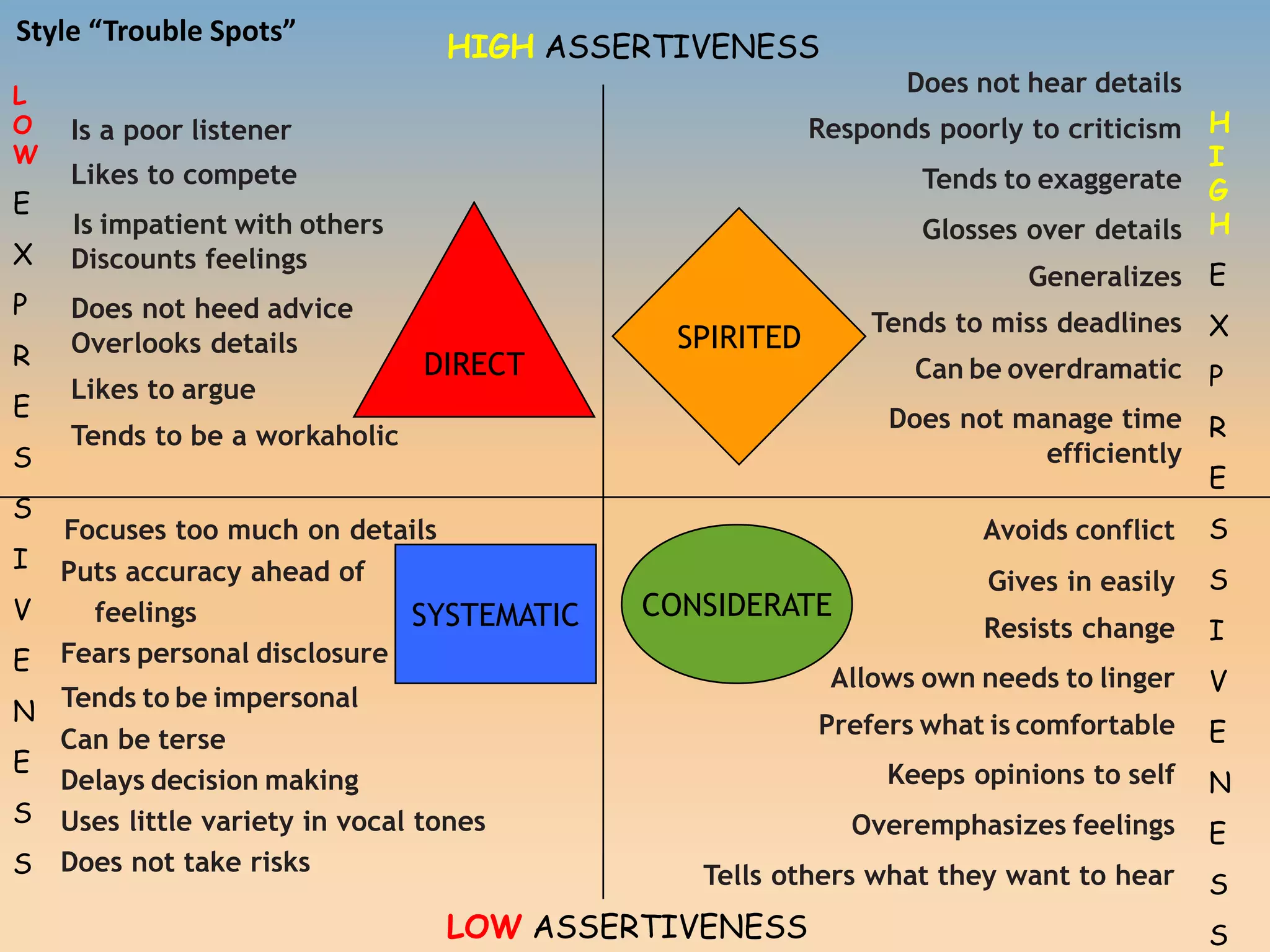
DIRECT
SYSTEMATIC CONSIDERATE
HIGH ASSERTIVENESS
LOW ASSERTIVENESS
L
O
W
E
X
P
R
E
S
S
I
V
E
N
E
S
S
H
I
G
H
E
X
P
R
E
S
S
I
V
E
N
E
S
S
Style “Trouble Spots”
SPIRITED
Is a poor listener
Likes to compete
Is impatient with others
Discounts feelings
Does not heed advice
Overlooks details
Likes to argue
Tends to be a workaholic
Does not hear details
Responds poorly to criticism
Tends to exaggerate
Glosses over details
Generalizes
Tends to miss deadlines
Can be overdramatic
Does not manage time
efficiently
Avoids conflict
Gives in easily
Resists change
Allows own needs to linger
Prefers what is comfortable
Keeps opinions to self
Overemphasizes feelings
Tells others what they want to hear
Focuses too much on details
Puts accuracy ahead of
feelings
Fears personal disclosure
Tends to be impersonal
Can be terse
Delays decision making
Uses little variety in vocal tones
Does not take risks
What about the communication style of
other people in my office (or home)?
 The reality is: Your boss and work colleagues
(and yes, your family members) will often be
a different style than your own.
 The next question is: How do we get along
with people having different communication
styles?
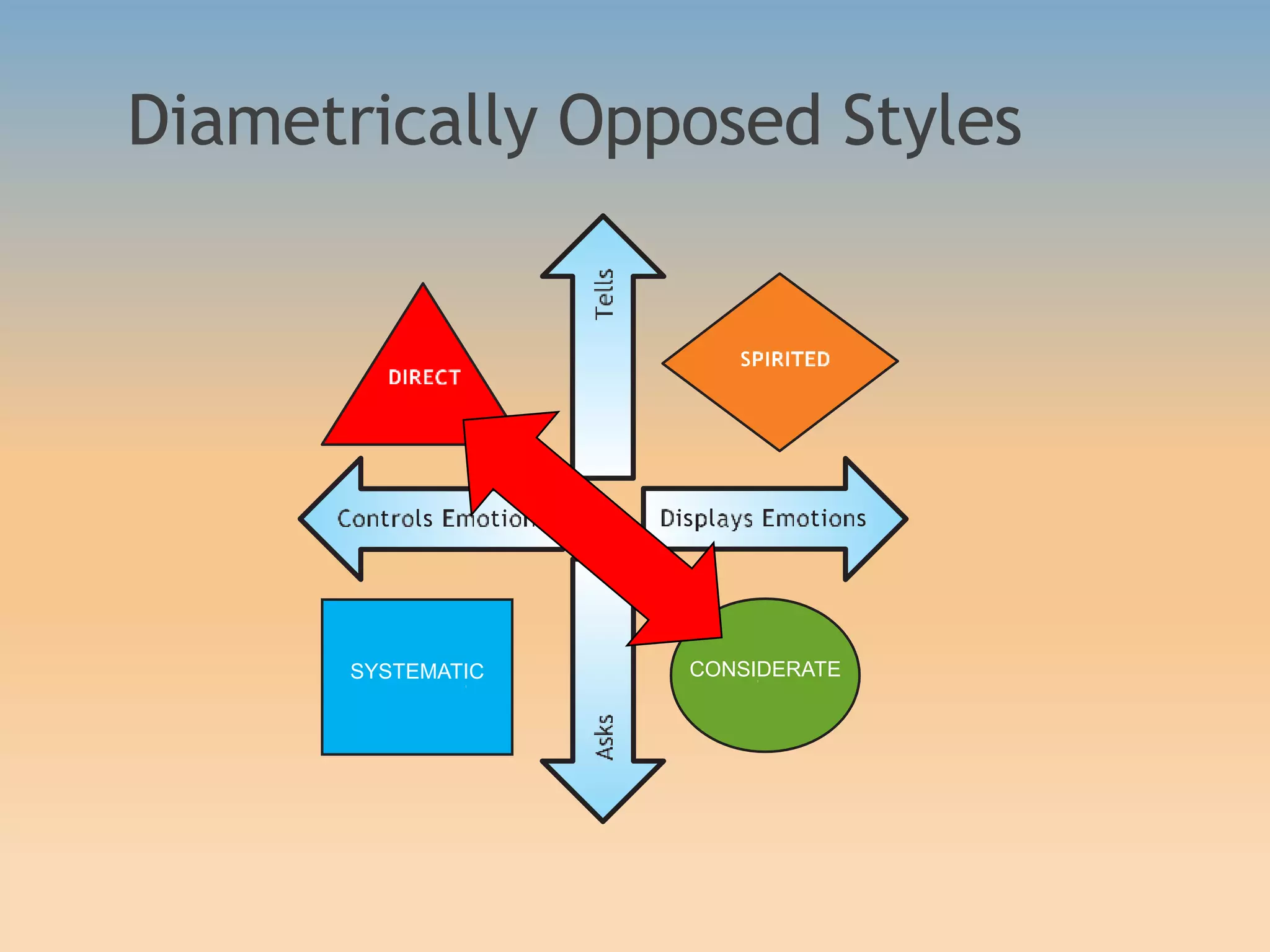
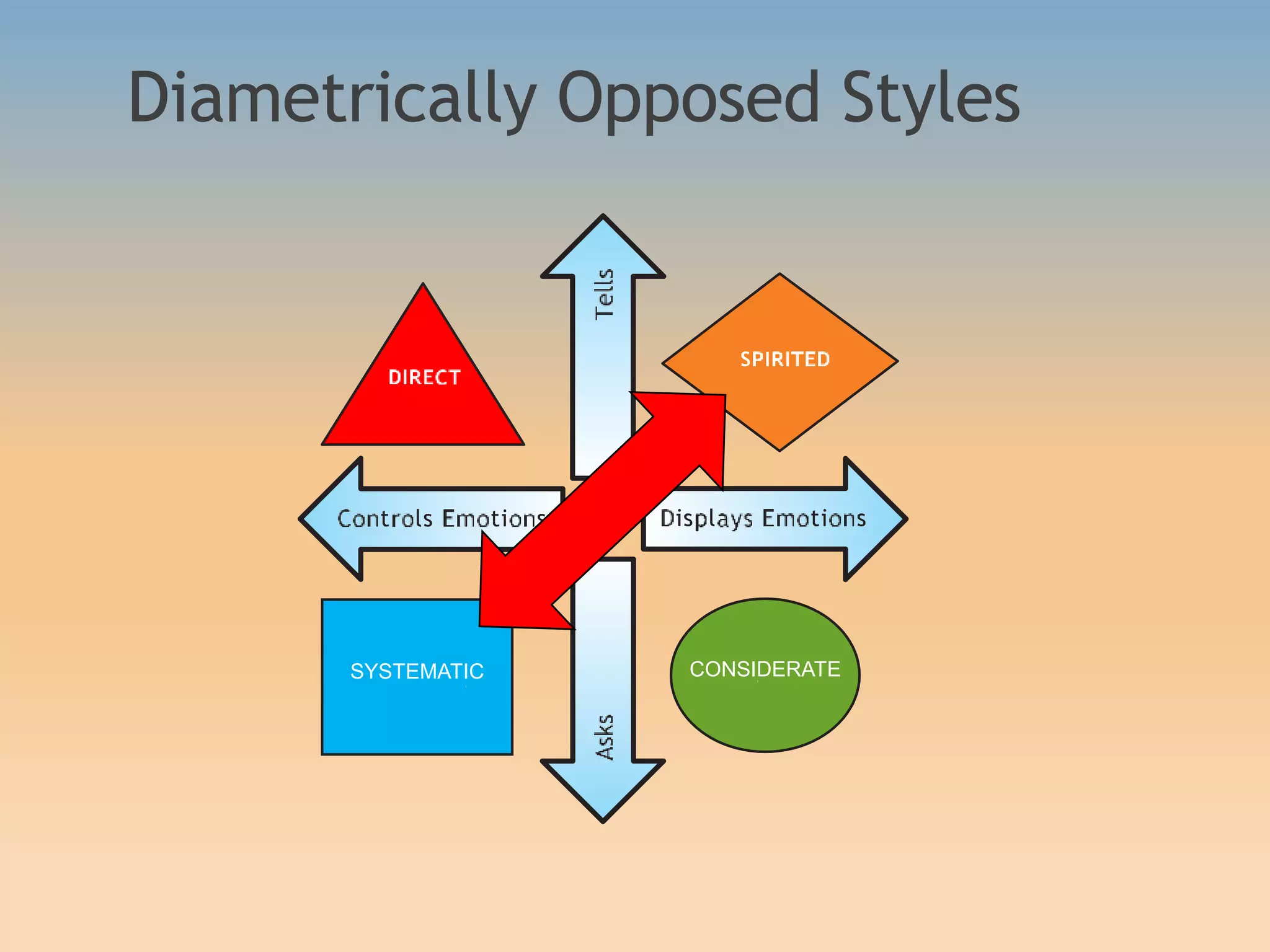
Diametrically Opposed Styles
SYSTEMATIC CONSIDERATE
Diametrically Opposed Styles
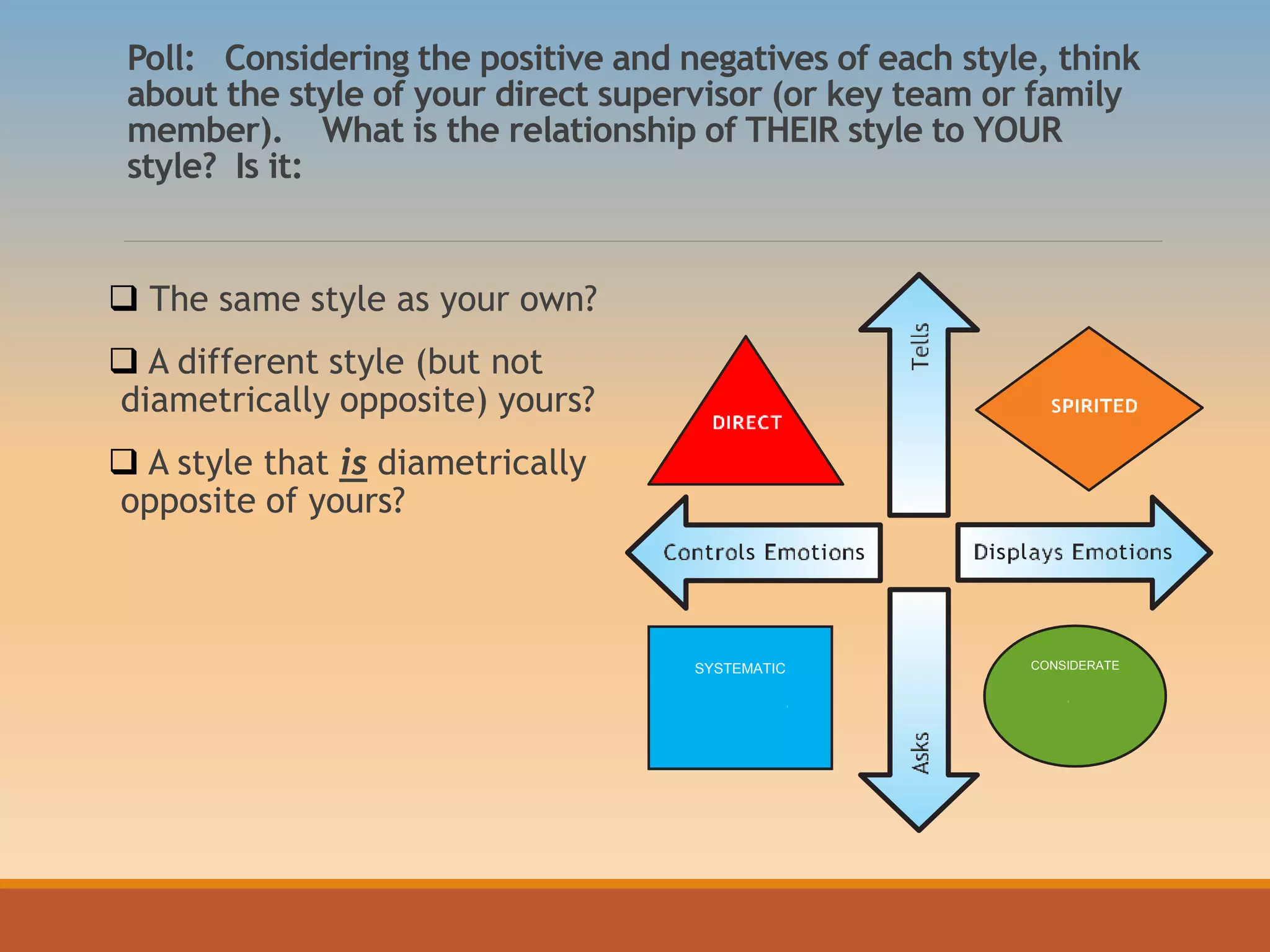
Poll: Considering the positive and negatives of each style, think
about the style of your direct supervisor (or key team or family
member). What is the relationship of THEIR style to YOUR
style? Is it:
 The same style as your own?
 A different style (but not
diametrically opposite) yours?
 A style that is diametrically
opposite of yours?
SYSTEMATIC CONSIDERATE
Communication styles in teams…
There is no right or wrong style…we need all four types
The best teams are ones that have similar representation from
all four styles
We vastly improve our chances of successfully connecting and
communicating with another when we “style flex”
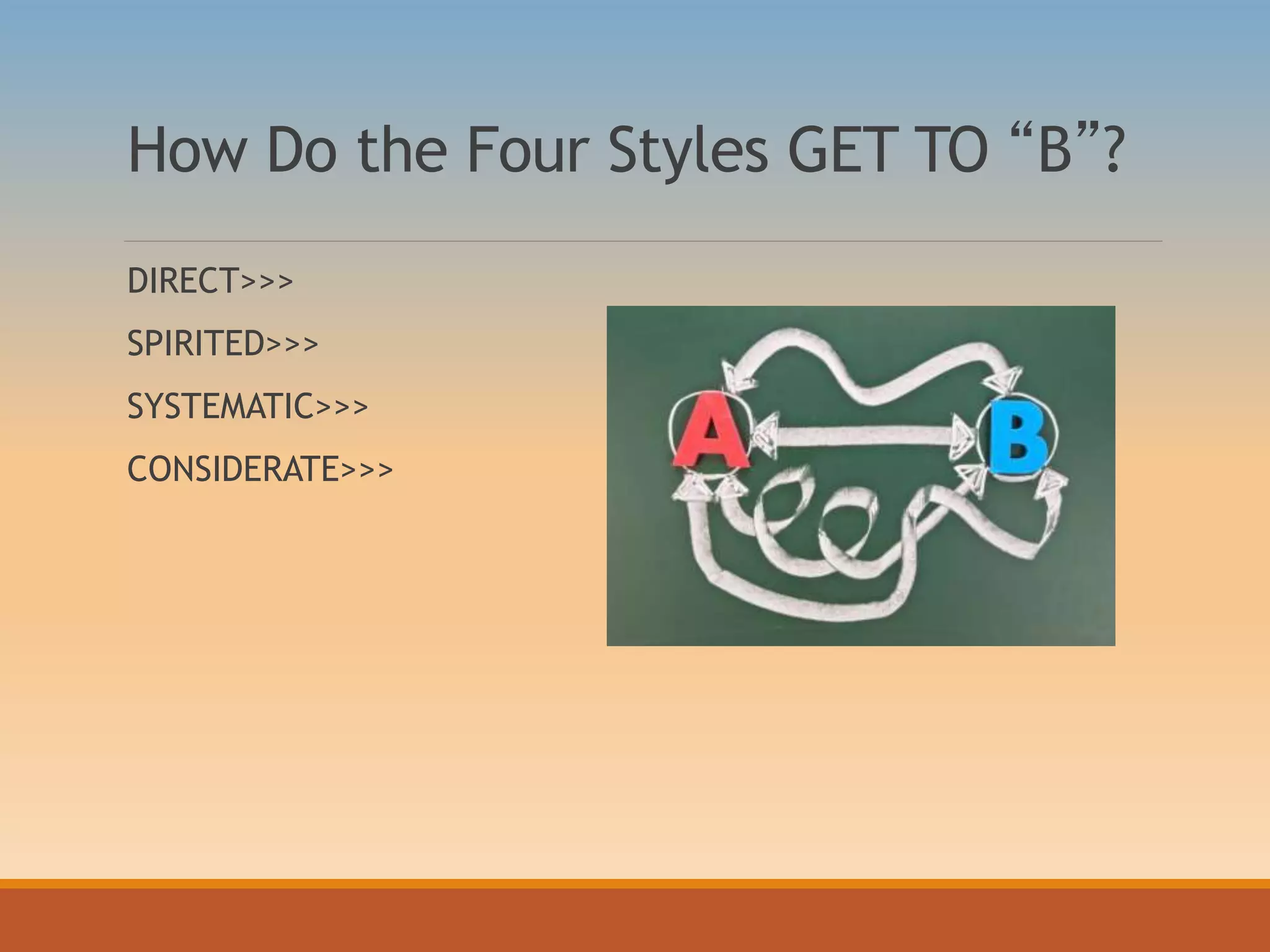
How Do the Four Styles GET TO “B”?
DIRECT>>>
SPIRITED>>>
SYSTEMATIC>>>
CONSIDERATE>>>
Style “Flexing”
 It helps to know how to “adapt” or “flex” your communication
style according to the person you are interacting with.
 Just like gradually improving your trouble spots, it does take
effort to flex to another style.
 Payoff: Can make the difference between a
successful/productive interaction and an
unsuccessful/unproductive one.
 Practice makes perfect!
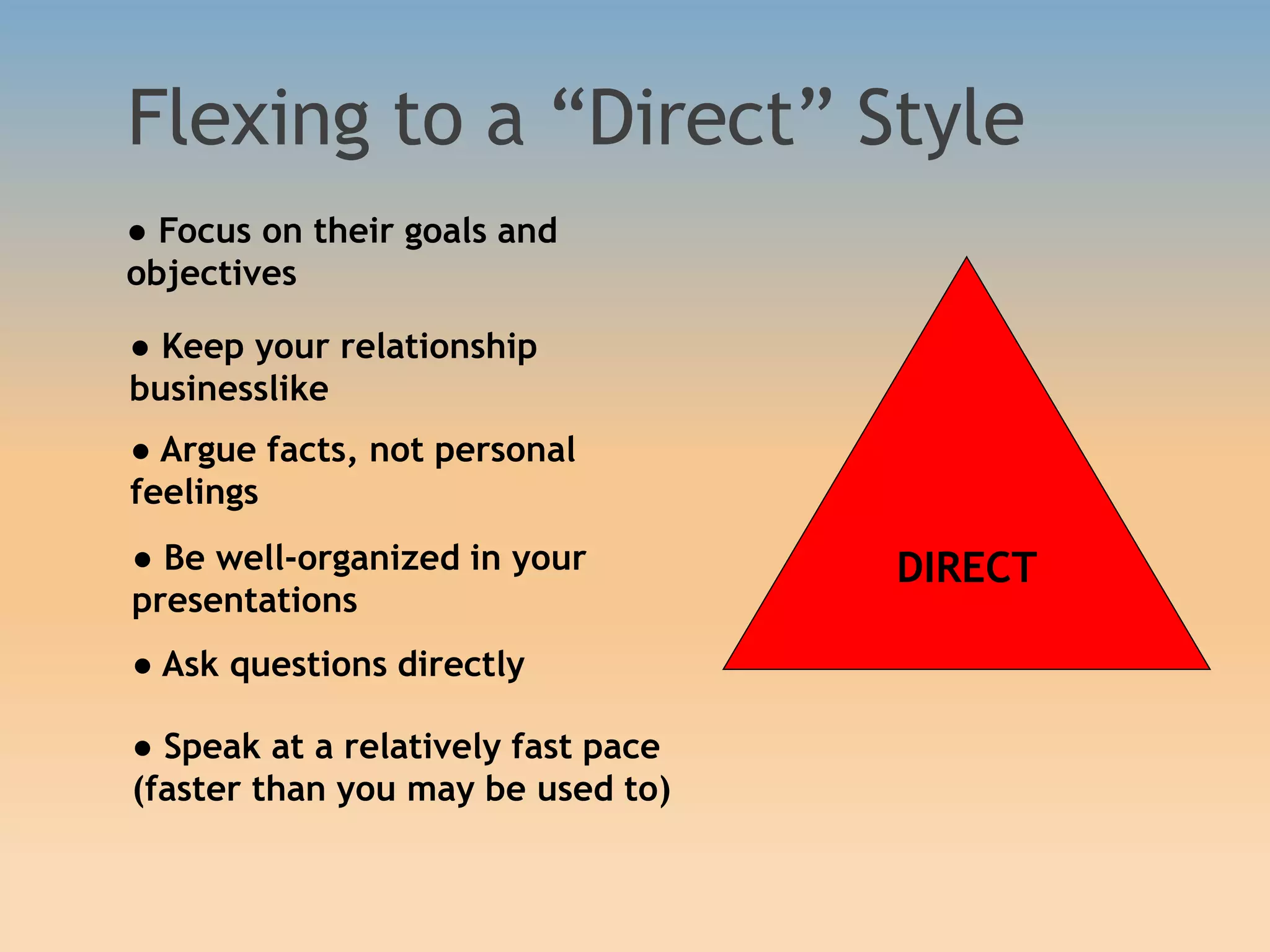
Flexing to a “Direct” Style
DIRECT
● Focus on their goals and
objectives
● Keep your relationship
businesslike
● Argue facts, not personal
feelings
● Be well-organized in your
presentations
● Ask questions directly
● Speak at a relatively fast pace
(faster than you may be used to)
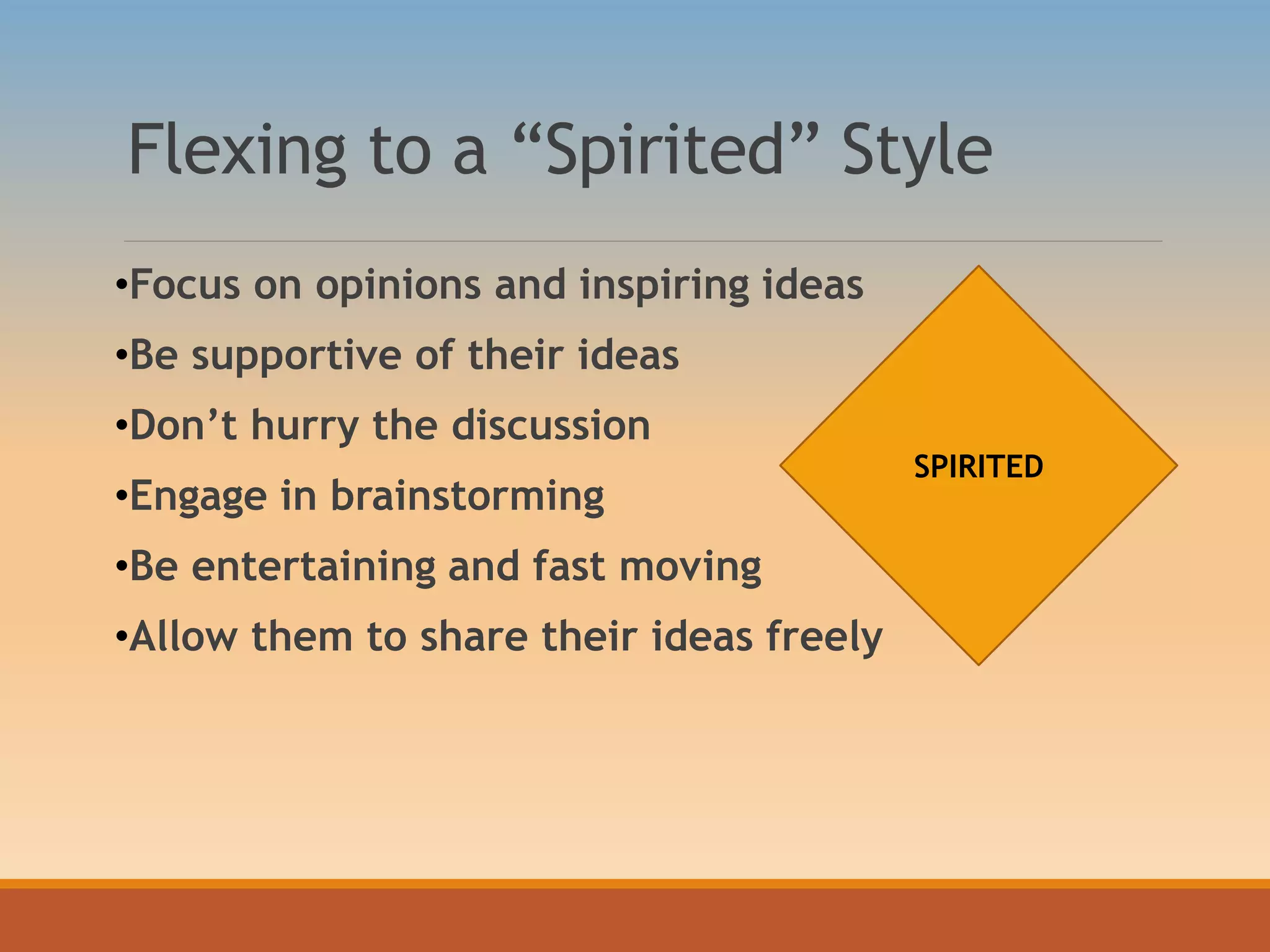
Flexing to a “Spirited” Style
•Focus on opinions and inspiring ideas
•Be supportive of their ideas
•Don’t hurry the discussion
•Engage in brainstorming
•Be entertaining and fast moving
•Allow them to share their ideas freely
SPIRITED
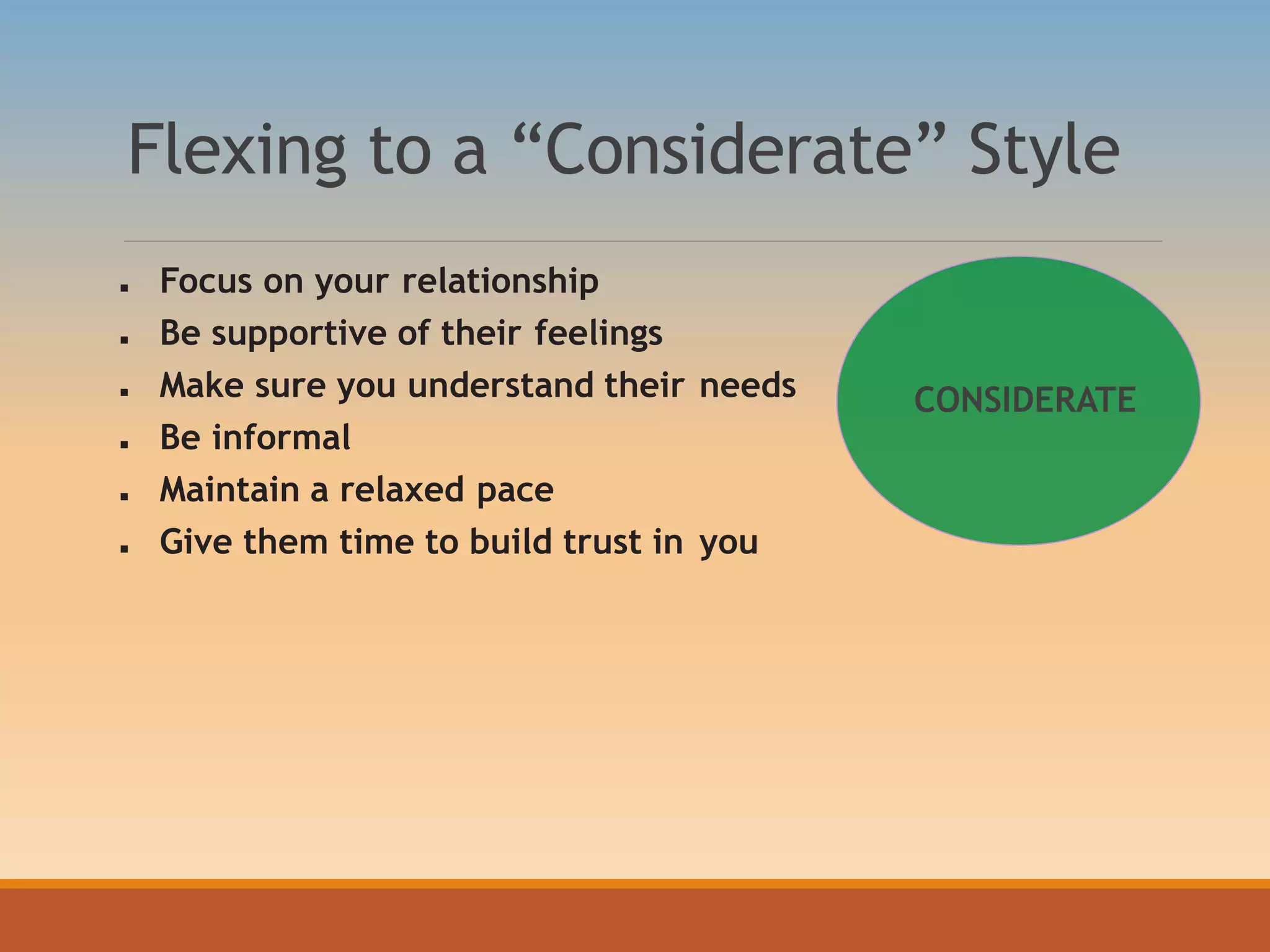
Flexing to a “Considerate” Style
 Focus on your relationship
 Be supportive of their feelings
 Make sure you understand their needs
 Be informal
 Maintain a relaxed pace
 Give them time to build trust in you
CONSIDERATE
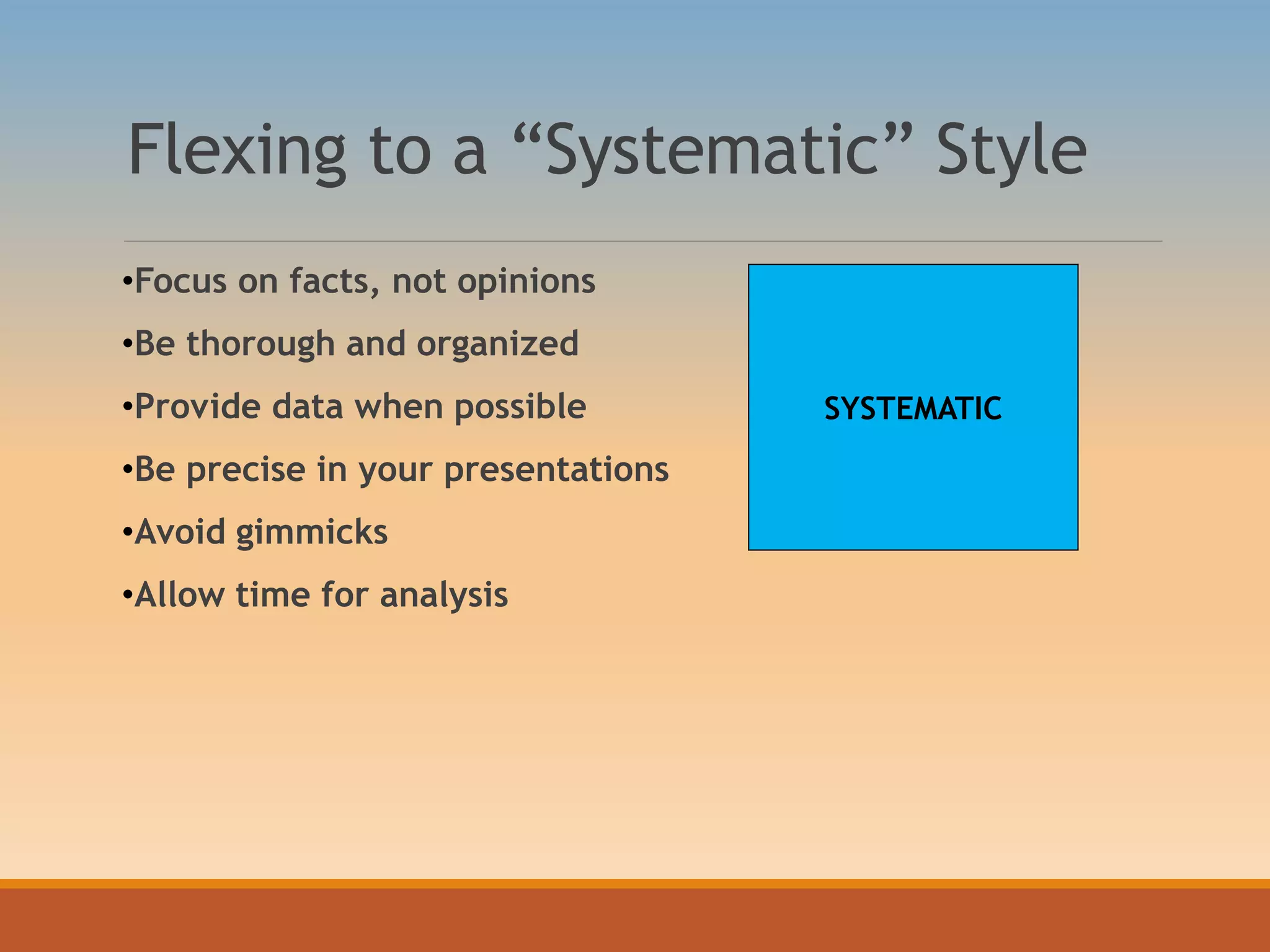
Flexing to a “Systematic” Style
•Focus on facts, not opinions
•Be thorough and organized
•Provide data when possible
•Be precise in your presentations
•Avoid gimmicks
•Allow time for analysis
SYSTEMATIC
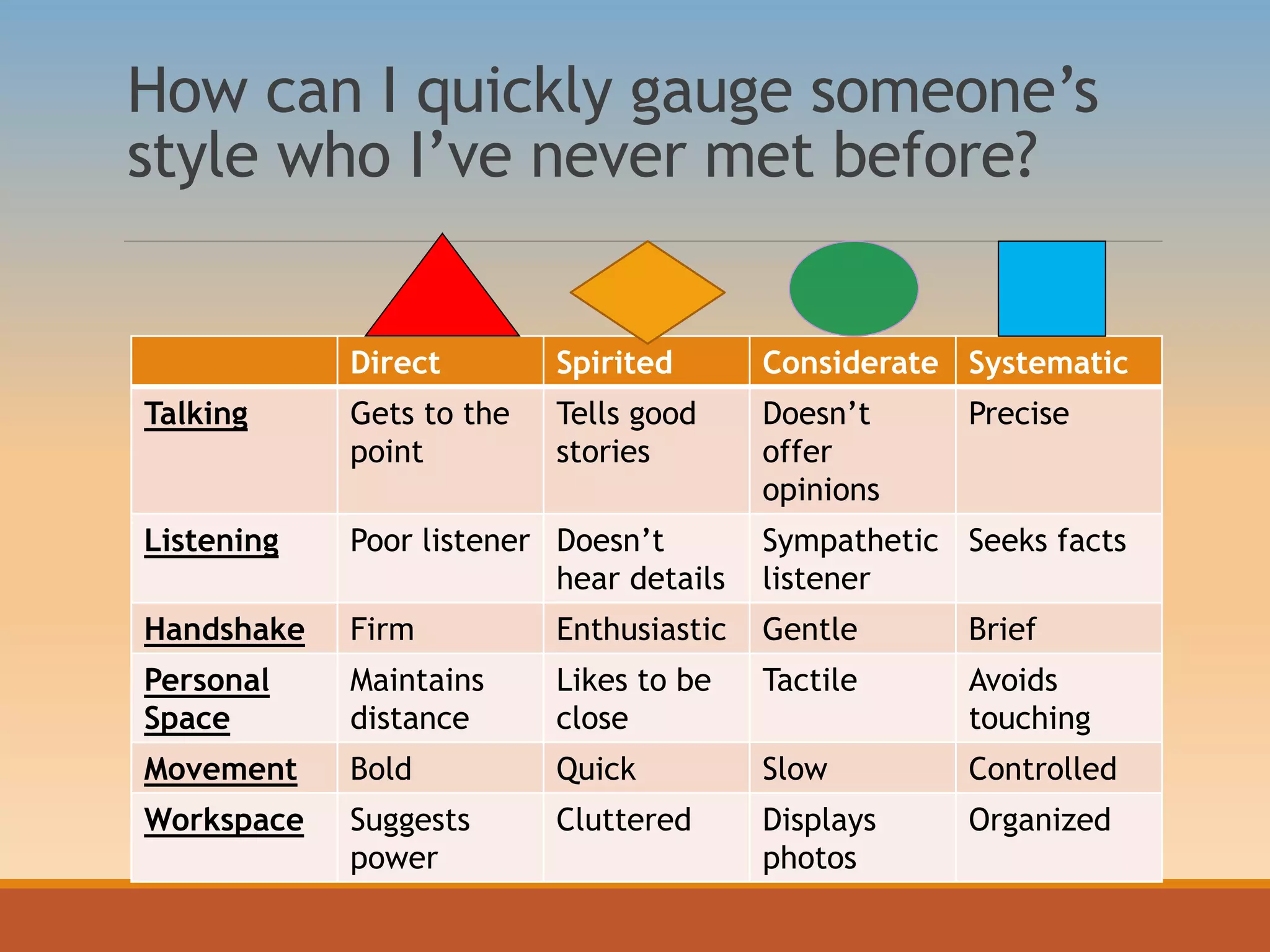
How can I quickly gauge someone’s
style who I’ve never met before?
Direct Spirited Considerate Systematic
Talking Gets to the
point
Tells good
stories
Doesn’t
offer
opinions
Precise
Listening Poor listener Doesn’t
hear details
Sympathetic
listener
Seeks facts
Handshake Firm Enthusiastic Gentle Brief
Personal
Space
Maintains
distance
Likes to be
close
Tactile Avoids
touching
Movement Bold Quick Slow Controlled
Workspace Suggests
power
Cluttered Displays
photos
Organized
Remember…
 Your dominant style is the one that feels the most natural to
you when you are enjoying your work/life.
 There is no right style.
 The best teams have representation of all styles.
 It helps to know your “trouble spots” and practice improving.
 You can flex to accommodate other people’s styles to have
more successful interchanges.
 We all get to point “B.” It is just a matter of “how.”
Thank you for joining
us today!
Feel free to contact me with any additional questions.
GOOD LUCK!!!
Peggy Greenberg Training & Consulting
Newburyport, MA
peggyfg128@gmail.com
978-255-1168 301-412-6054
Learning Outcomes
• Identify a preference for one of four
communication styles
• Uncover the characteristics of each style
• Discover how style affects
communication
• Learn how to "speed read" a person's
dominant communication style
• Understand how to "flex" style for
effective communication with others
Enter WMCS18 at checkout.
www.HRDQStore.com | 800-633-4533
What's My Communication Style?

What’s My Communication Style: How to Get Along with (Almost) Anyone

  • 1.
    What’s My CommunicationStyle? How to Get Along with(Almost) Anyone PEGGY F. GREENBERG PRESIDENT, PEGGY GREENBERG TRAINING AND CONSULTING
  • 2.
    Roadmap for today’s session Introductions What is communication?  What is your communication “style”?  The four styles: Strengths and trouble spots  Interacting with individuals and team members with different styles  How to quickly gauge the style of a new acquaintance  Questions and wrap up
  • 3.
    First, a little aboutme… o Worked as Director of Training for various health care organizations in Boston, Baltimore and Washington, DC o Director of the Office of Education and Training at US Senate o Executive Coach and Consultant o Conduct Training Seminars for various organizations o Online Moderator for business, management and communication topics
  • 4.
    Now. . .A little about YOU! Poll: In which of the following major industries do you work? Government Manufacturing High Tech/Telecomm/IT Financial/Banking/Real Estate Health Care
  • 5.
    A little moreabout you! Poll: What is your primary role in your organization? Team Member, Specialist or Subject Expert Supervisor Project/Team/Unit Manager Mid-management Upper management or executive team
  • 6.
  • 7.
    Communication Is….. The processof attempting to create shared understanding Verbal & nonverbal Simultaneous assigning of meaning
  • 8.
    Key Communication Principles Communication occurs when a sent message is received.  The message that is received may not be the same as the one that was sent. Sender and receiver each have a history and a personal communication style and both of these can affect the interpretation of any message.
  • 9.
    Four types ofcommunication:  Verbal – words have different meanings to different people based on age, experience and background (semantics).  Paraverbal – includes pace of speech, tone, intensity, irony, sarcasm, etc.  Body Language – stance, handshake, eye contact, facial expressions, gesturing, touch, etc.  Personal Space – intimate, personal, social and public are some examples, as well as how you decorate and organize your office.
  • 10.
    A Guide forEffective Communication It is unavoidable Contains content & info about the content Produces conflict yet it is the only method for resolving conflict Circular & complex Happens within an individual’s frame of reference Semantics matter!
  • 11.
    Why bother? Communication ormiscommunication is cited as the #1 reason why: Relationships fail Job performance is not what it needs to be Sales are lost Customer service in so many organizations fails to satisfy the customers
  • 12.
    Why bother? “As soonas you move one step up from the bottom, your effectiveness depends on you your ability to reach others through the spoken and written word.” Peter Drucker “Communication…the human connection…is the key to personal and career success.” Paul J. Meyer
  • 13.
  • 14.
    What is “communicationstyle”?  How people act when they can do things their own way—the way that is most natural to them. Behavior so consistent that it is predictable. Behavior that seems “typical,” part of their personality, or you expect it most of the time.
  • 15.
    Benefits of Understanding CommunicationStyle  Improves your interaction with others  Helps others interpret your behavior  Helps you interpret others’ behavior  Influences your success
  • 16.
  • 17.
  • 18.
  • 19.
    FOUR STYLES: Strengths DIRECT Takescharge Thrives on competition/winning Fast paced, goal directed Strong leadership skills Likes to take risks Speaks forcefully Decisive
  • 20.
    Enthusiastic & friendly Likesthe spotlight Good storyteller Good at building alliances Uses motivational speech to generate enthusiasm SPIRITED Persuasive Prefers to be with other people FOUR STYLES: Strengths
  • 21.
    CONSIDERATE Values warm, personal relationships Goodlistener/counselor Works best on teams Always aware of others’ feelings Reliable & steady Uses supportive language Builds trust FOUR STYLES: Strengths
  • 22.
    SYSTEMATIC Heavy emphasis onaccuracy and objectivity Decides based on facts Excellent problem solverOrganized & orderly Prefers clear guidelines Seeks information Likes a well-organized work space Speaks/presents efficiently and precisely FOUR STYLES: Strengths
  • 23.
    DIRECT SYSTEMATIC CONSIDERATE HIGH ASSERTIVENESS LOWASSERTIVENESS L O W E X P R E S S I V E N E S S H I G H E X P R E S S I V E N E S S HRDQ Style Model SPIRITED Decisive Takes charge Likes to compete/win Speaks forcefully Strong leadership Goal-directed/fast-paced Takes risks Persuasive Enthusiastic & friendly Likes the spotlight Motivates/generates enthusiasm Prefers to be with other people Good storyteller Builds Alliances Good listener/counselor Values warm, personal relationships Uses supportive language Works best on teams Builds trust Always aware of others’ feelings Reliable & steady Organized/orderly Decides based on facts Seeks information Prefers clear guidelines Problem solver Emphasizes accuracy/objectivity Speaks/presents efficiently and precisely
  • 24.
    Poll: What doyou think your predominant style is? Direct Spirited Systematic Considerate
  • 25.
    STYLE TROUBLE SPOTS Each style has its “flip side” of traits.  These are your “blind spot” traits that can occur if your “strengths” are carried to their extremes.  It is good to be aware of your blind spots to help balance your strengths.  As you review these, ask yourself: “What can I do to limit these behaviors?”
  • 26.
    DIRECT SYSTEMATIC CONSIDERATE HIGH ASSERTIVENESS LOWASSERTIVENESS L O W E X P R E S S I V E N E S S H I G H E X P R E S S I V E N E S S Style “Trouble Spots” SPIRITED Is a poor listener Likes to compete Is impatient with others Discounts feelings Does not heed advice Overlooks details Likes to argue Tends to be a workaholic Does not hear details Responds poorly to criticism Tends to exaggerate Glosses over details Generalizes Tends to miss deadlines Can be overdramatic Does not manage time efficiently Avoids conflict Gives in easily Resists change Allows own needs to linger Prefers what is comfortable Keeps opinions to self Overemphasizes feelings Tells others what they want to hear Focuses too much on details Puts accuracy ahead of feelings Fears personal disclosure Tends to be impersonal Can be terse Delays decision making Uses little variety in vocal tones Does not take risks
  • 27.
    What about thecommunication style of other people in my office (or home)?  The reality is: Your boss and work colleagues (and yes, your family members) will often be a different style than your own.  The next question is: How do we get along with people having different communication styles?
  • 28.
  • 29.
  • 30.
    Poll: Considering thepositive and negatives of each style, think about the style of your direct supervisor (or key team or family member). What is the relationship of THEIR style to YOUR style? Is it:  The same style as your own?  A different style (but not diametrically opposite) yours?  A style that is diametrically opposite of yours? SYSTEMATIC CONSIDERATE
  • 31.
    Communication styles inteams… There is no right or wrong style…we need all four types The best teams are ones that have similar representation from all four styles We vastly improve our chances of successfully connecting and communicating with another when we “style flex”
  • 32.
    How Do theFour Styles GET TO “B”? DIRECT>>> SPIRITED>>> SYSTEMATIC>>> CONSIDERATE>>>
  • 33.
    Style “Flexing”  Ithelps to know how to “adapt” or “flex” your communication style according to the person you are interacting with.  Just like gradually improving your trouble spots, it does take effort to flex to another style.  Payoff: Can make the difference between a successful/productive interaction and an unsuccessful/unproductive one.  Practice makes perfect!
  • 34.
    Flexing to a“Direct” Style DIRECT ● Focus on their goals and objectives ● Keep your relationship businesslike ● Argue facts, not personal feelings ● Be well-organized in your presentations ● Ask questions directly ● Speak at a relatively fast pace (faster than you may be used to)
  • 35.
    Flexing to a“Spirited” Style •Focus on opinions and inspiring ideas •Be supportive of their ideas •Don’t hurry the discussion •Engage in brainstorming •Be entertaining and fast moving •Allow them to share their ideas freely SPIRITED
  • 36.
    Flexing to a“Considerate” Style  Focus on your relationship  Be supportive of their feelings  Make sure you understand their needs  Be informal  Maintain a relaxed pace  Give them time to build trust in you CONSIDERATE
  • 37.
    Flexing to a“Systematic” Style •Focus on facts, not opinions •Be thorough and organized •Provide data when possible •Be precise in your presentations •Avoid gimmicks •Allow time for analysis SYSTEMATIC
  • 38.
    How can Iquickly gauge someone’s style who I’ve never met before? Direct Spirited Considerate Systematic Talking Gets to the point Tells good stories Doesn’t offer opinions Precise Listening Poor listener Doesn’t hear details Sympathetic listener Seeks facts Handshake Firm Enthusiastic Gentle Brief Personal Space Maintains distance Likes to be close Tactile Avoids touching Movement Bold Quick Slow Controlled Workspace Suggests power Cluttered Displays photos Organized
  • 39.
    Remember…  Your dominantstyle is the one that feels the most natural to you when you are enjoying your work/life.  There is no right style.  The best teams have representation of all styles.  It helps to know your “trouble spots” and practice improving.  You can flex to accommodate other people’s styles to have more successful interchanges.  We all get to point “B.” It is just a matter of “how.”
  • 40.
    Thank you forjoining us today! Feel free to contact me with any additional questions. GOOD LUCK!!! Peggy Greenberg Training & Consulting Newburyport, MA peggyfg128@gmail.com 978-255-1168 301-412-6054
  • 41.
    Learning Outcomes • Identifya preference for one of four communication styles • Uncover the characteristics of each style • Discover how style affects communication • Learn how to "speed read" a person's dominant communication style • Understand how to "flex" style for effective communication with others Enter WMCS18 at checkout. www.HRDQStore.com | 800-633-4533 What's My Communication Style?