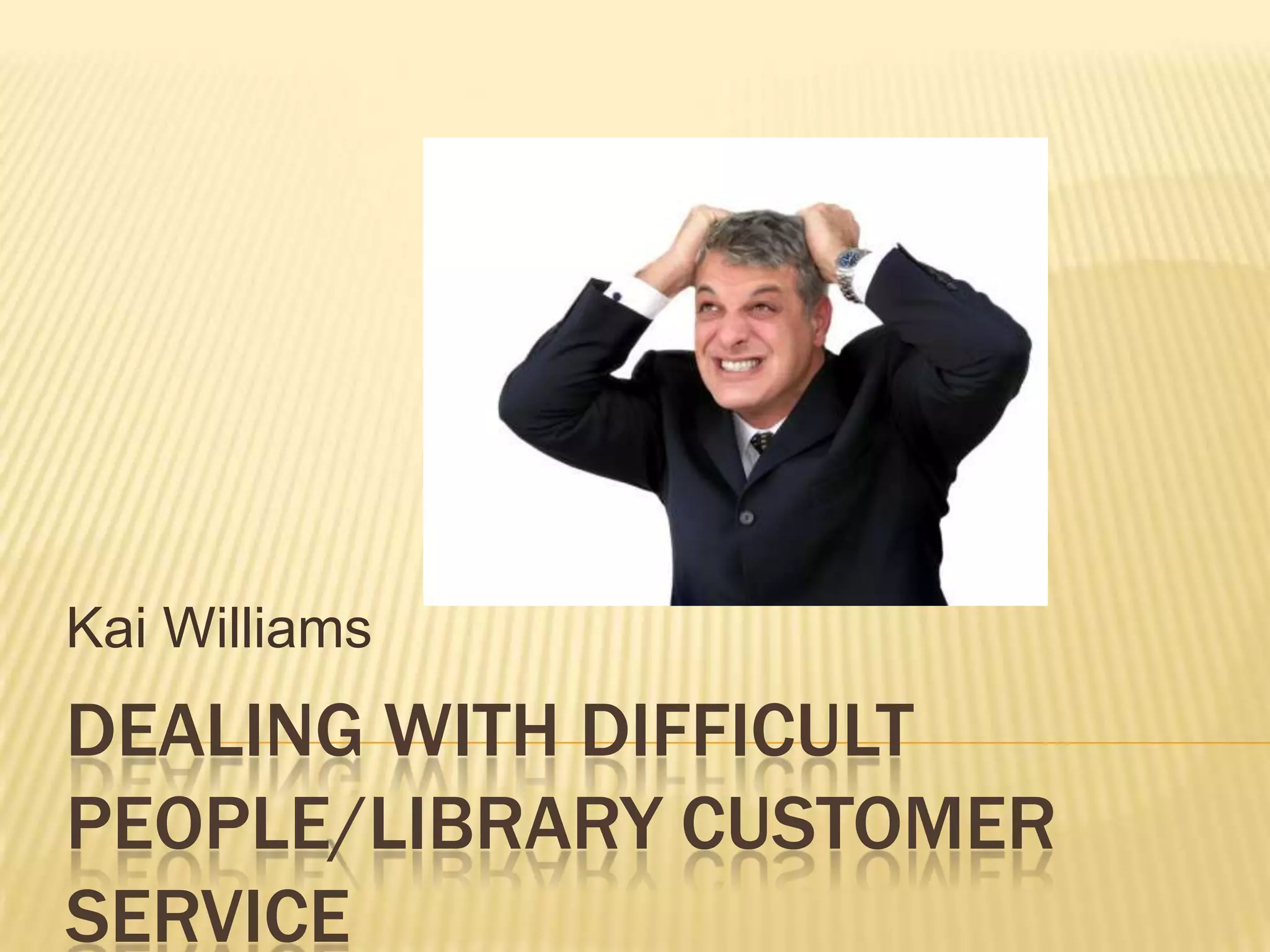
DEALING WITH DIFFICULT
PEOPLE/LIBRARY CUSTOMER
SERVICE
Kai Williams
WHO IS A DIFFICULT PERSON?
 Someone who has a complaint
 Someone dissatisfied with service
 Gives staff a hard time
 Feels they have to yell or make a scene to
get what they want
 Doesn’t like to hear “no”
 Makes your job difficult
PERSONALITIES
Introvert Extrovert
PERSONALITIES
Thinker
-”In God We Trust, All Others Use
Data”
-Emotional Characteristic: Fear
(Critical)
-Need Fulfillment: Information
- Fear: Fear
PERSONALITIES
Relator
- “If It Ain’t Broke, Don’t Fix It”
- Emotional Characteristic:
Non-Demonstrative
- Need Fulfillment: Security
- Fear: Loss of Security
PERSONALITIES
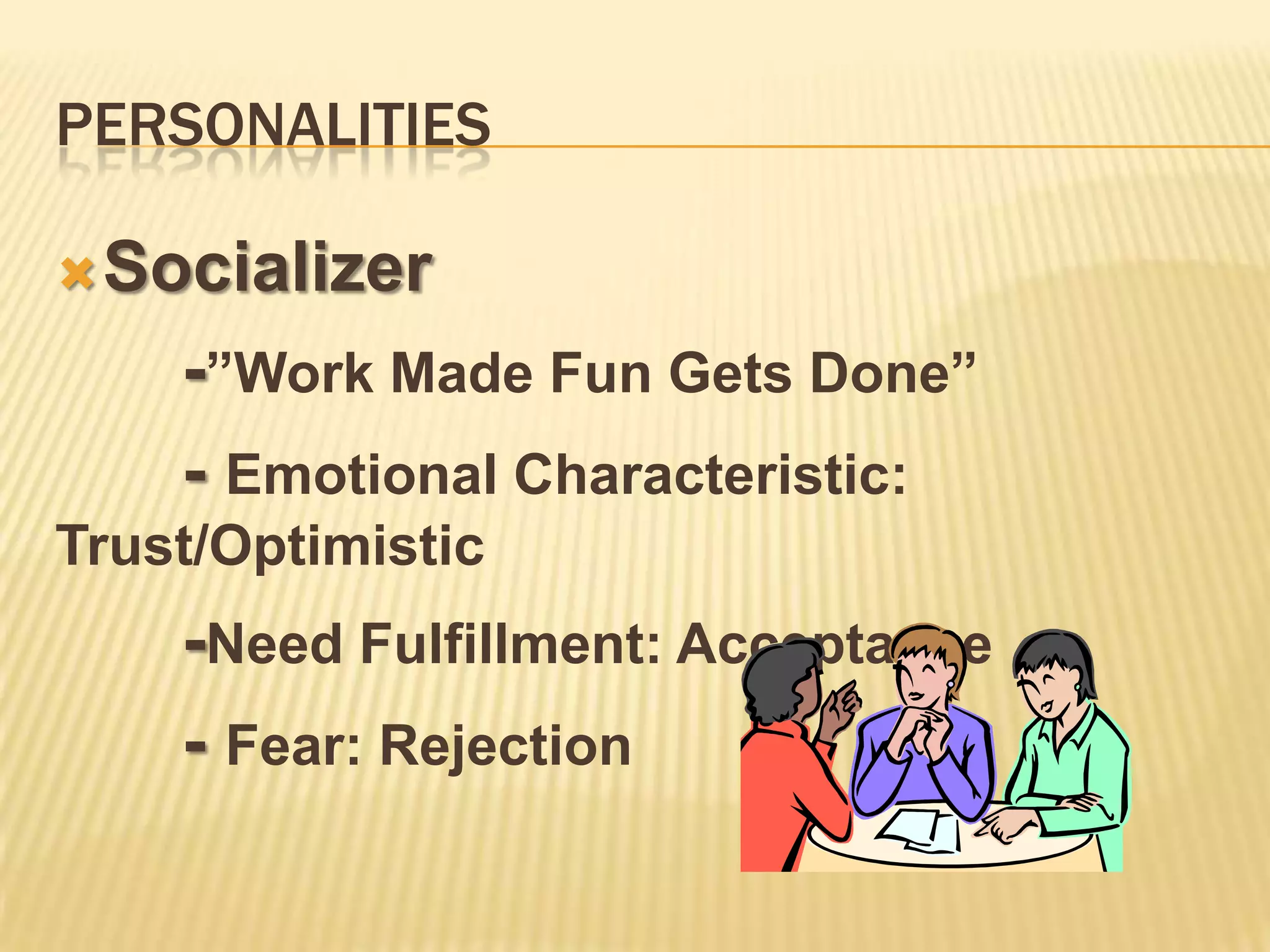
Socializer
-”Work Made Fun Gets Done”
- Emotional Characteristic:
Trust/Optimistic
-Need Fulfillment: Acceptance
- Fear: Rejection
PERSONALITIES
Driver
- “Be Brief, Be Bright, Be Gone”
- Emotional Characteristic: Anger
- Need Fulfillment: Results
- Fear: Taken Advantage Of
TYPES OF DIFFICULT PATRONS
 Mr./Ms. Nice Guy/Girl
 Quiet Types
 School Yard Bullies
 Wait and See Types
 Mr./Mrs. Know –It-All
 Nothing’s Ever Good Enough Types
WHAT MAKES A PATRON DIFFICULT
 Lack of good customer service
 Didn’t feel that their needs were met
 Personality conflict
 Having a bad day
WHAT DO PATRONS WANT
1. Accessibility
2. Availability
3. Affability
4. Agreeability
5. Accountability
6. Adaptability
7. Ability
To summarize: Nice People; Easy
Process
HOW NOT TO SAY “NO”
 Filter
-choose your words wisely
 “Can-Can” rule
-let them know what you can
acknowledge and what you can do
*Only time that you can say “no” is if the
request is impossible or illegal*
HOW TO DEAL WITH DIFFICULT
PEOPLE/PATRONS
 Four steps to Communicate with Difficult
Person
1. Establish a Direction-begin with end in mind
2. Focus on the pattern of communication
3. Be flexible
4. Commit to a solution
HOW TO DEAL WITH DIFFICULT
PEOPLE/PATRONS
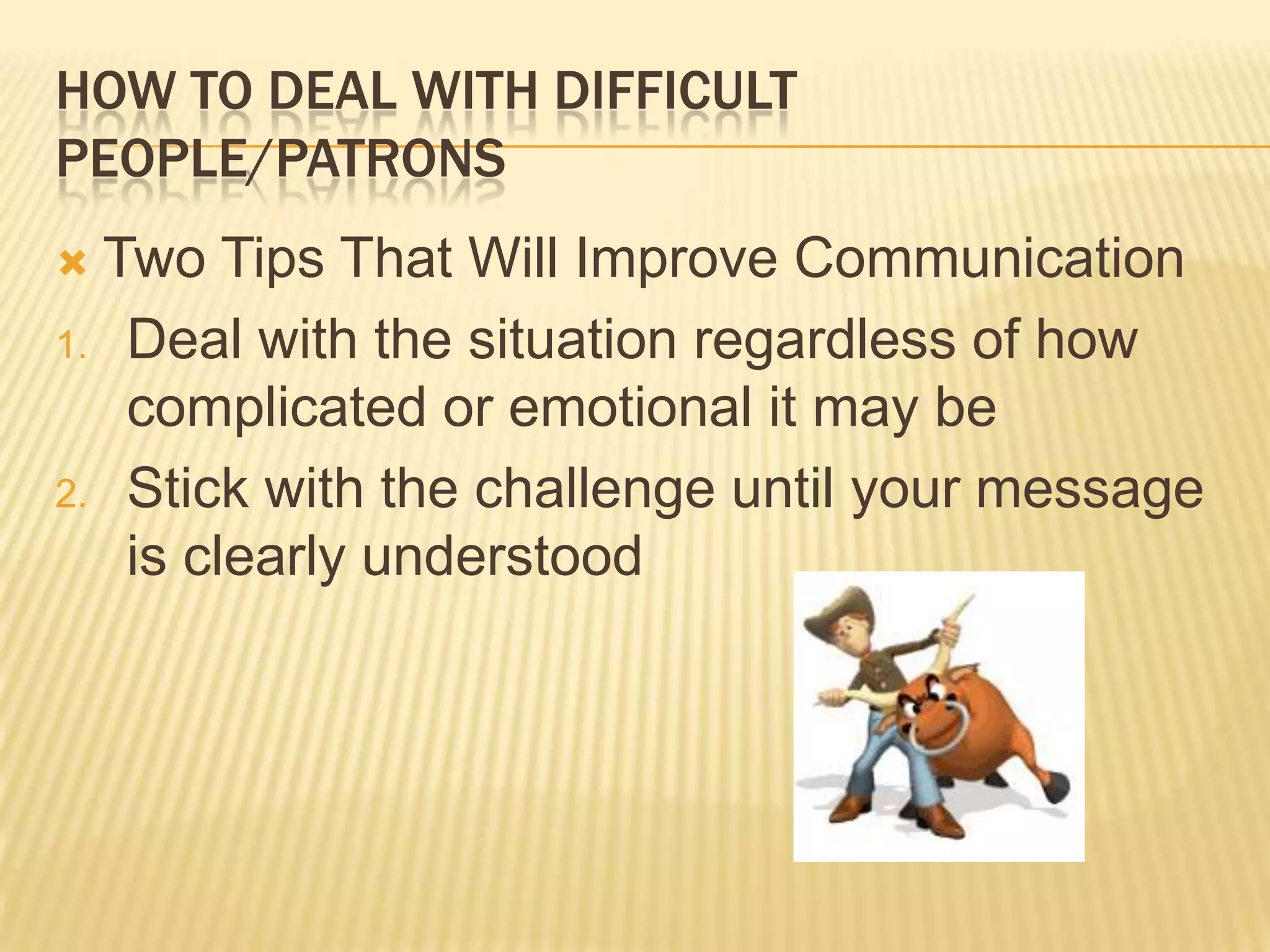
 Two Tips That Will Improve Communication
1. Deal with the situation regardless of how
complicated or emotional it may be
2. Stick with the challenge until your message
is clearly understood
HOW TO DEAL WITH DIFFICULT
PEOPLE/PATRONS
How to Let Someone Save Face:
When: The stakes are minimal, a lose-lose
situation exists, or one of the parties doesn’t
want a confrontation
How: Use “I” instead of “You”, avoid
backing the person into a corner, give the other
person a way out.
HOW TO DEAL WITH DIFFICULT
PEOPLE/PATRONS
Three important ways to prepare:
1. Create and update policies that reduce
problems and protect staff and patrons
2. Develop communications skills to handle
variety of situations
3. Train all staff in dealing with difficult
patrons
Note* Communication Is Critical When Managing
Difficult Patrons
HOW TO DEAL WITH DIFFICULT
PEOPLE/PATRONS
 Be RESPONSIVE and not REACTIONARY
1. Breathe
2. Remember that they have problems you are
not aware of
3. Take notes if needed
4. Get help
HOW TO DEAL WITH DIFFICULT
PEOPLE/PATRONS
 Have Trust
 Say “Yes” (find ways to say yes)
 Give Alternatives
 Be Approachable
 Be Respectful and Kind
 Be Flexible
 Be Patient
 Keep it Simple- make it easy
 Be Positive
 Do the Right Thing
REFERENCES
ALA Editions Workshop (Producer). (2013). How to deliver great library customer service.
[Webinar] Retrieved from https://alapublishing.webex.com
Customer service: Dealing with difficult personalities. (August 16, 2013). Retrieved online
from www.kirkwood.edu/pdf/upload/838/Ap Difficult Customers.pdf
Richards, T. Dealing with difficult patrons. [PDF document]. Retrieved online August 16, 2013
from
www.warrenlibrary.org/district/files/Difficult_Patrons.pdf

Dealing with difficult people

  • 1.
    DEALING WITH DIFFICULT PEOPLE/LIBRARYCUSTOMER SERVICE Kai Williams
  • 2.
    WHO IS ADIFFICULT PERSON?  Someone who has a complaint  Someone dissatisfied with service  Gives staff a hard time  Feels they have to yell or make a scene to get what they want  Doesn’t like to hear “no”  Makes your job difficult
  • 3.
  • 4.
    PERSONALITIES Thinker -”In God WeTrust, All Others Use Data” -Emotional Characteristic: Fear (Critical) -Need Fulfillment: Information - Fear: Fear
  • 5.
    PERSONALITIES Relator - “If ItAin’t Broke, Don’t Fix It” - Emotional Characteristic: Non-Demonstrative - Need Fulfillment: Security - Fear: Loss of Security
  • 6.
    PERSONALITIES Socializer -”Work Made FunGets Done” - Emotional Characteristic: Trust/Optimistic -Need Fulfillment: Acceptance - Fear: Rejection
  • 7.
    PERSONALITIES Driver - “Be Brief,Be Bright, Be Gone” - Emotional Characteristic: Anger - Need Fulfillment: Results - Fear: Taken Advantage Of
  • 8.
    TYPES OF DIFFICULTPATRONS  Mr./Ms. Nice Guy/Girl  Quiet Types  School Yard Bullies  Wait and See Types  Mr./Mrs. Know –It-All  Nothing’s Ever Good Enough Types
  • 9.
    WHAT MAKES APATRON DIFFICULT  Lack of good customer service  Didn’t feel that their needs were met  Personality conflict  Having a bad day
  • 10.
    WHAT DO PATRONSWANT 1. Accessibility 2. Availability 3. Affability 4. Agreeability 5. Accountability 6. Adaptability 7. Ability To summarize: Nice People; Easy Process
  • 11.
    HOW NOT TOSAY “NO”  Filter -choose your words wisely  “Can-Can” rule -let them know what you can acknowledge and what you can do *Only time that you can say “no” is if the request is impossible or illegal*
  • 12.
    HOW TO DEALWITH DIFFICULT PEOPLE/PATRONS  Four steps to Communicate with Difficult Person 1. Establish a Direction-begin with end in mind 2. Focus on the pattern of communication 3. Be flexible 4. Commit to a solution
  • 13.
    HOW TO DEALWITH DIFFICULT PEOPLE/PATRONS  Two Tips That Will Improve Communication 1. Deal with the situation regardless of how complicated or emotional it may be 2. Stick with the challenge until your message is clearly understood
  • 14.
    HOW TO DEALWITH DIFFICULT PEOPLE/PATRONS How to Let Someone Save Face: When: The stakes are minimal, a lose-lose situation exists, or one of the parties doesn’t want a confrontation How: Use “I” instead of “You”, avoid backing the person into a corner, give the other person a way out.
  • 15.
    HOW TO DEALWITH DIFFICULT PEOPLE/PATRONS Three important ways to prepare: 1. Create and update policies that reduce problems and protect staff and patrons 2. Develop communications skills to handle variety of situations 3. Train all staff in dealing with difficult patrons Note* Communication Is Critical When Managing Difficult Patrons
  • 16.
    HOW TO DEALWITH DIFFICULT PEOPLE/PATRONS  Be RESPONSIVE and not REACTIONARY 1. Breathe 2. Remember that they have problems you are not aware of 3. Take notes if needed 4. Get help
  • 17.
    HOW TO DEALWITH DIFFICULT PEOPLE/PATRONS  Have Trust  Say “Yes” (find ways to say yes)  Give Alternatives  Be Approachable  Be Respectful and Kind  Be Flexible  Be Patient  Keep it Simple- make it easy  Be Positive  Do the Right Thing
  • 18.
    REFERENCES ALA Editions Workshop(Producer). (2013). How to deliver great library customer service. [Webinar] Retrieved from https://alapublishing.webex.com Customer service: Dealing with difficult personalities. (August 16, 2013). Retrieved online from www.kirkwood.edu/pdf/upload/838/Ap Difficult Customers.pdf Richards, T. Dealing with difficult patrons. [PDF document]. Retrieved online August 16, 2013 from www.warrenlibrary.org/district/files/Difficult_Patrons.pdf