Ernst & Young virtual presentation Sustaining Effective Communities of Practice collaborative research report overview for KM Chicago 9 February 2010 Darrin Brogan Brad Kenney
Presentation to KM Chicago – Agenda  EY global and Center for Business Knowledge (CBK) Communities of practice (CoPs) at EY Role in supporting APQC’s CoP report Key findings
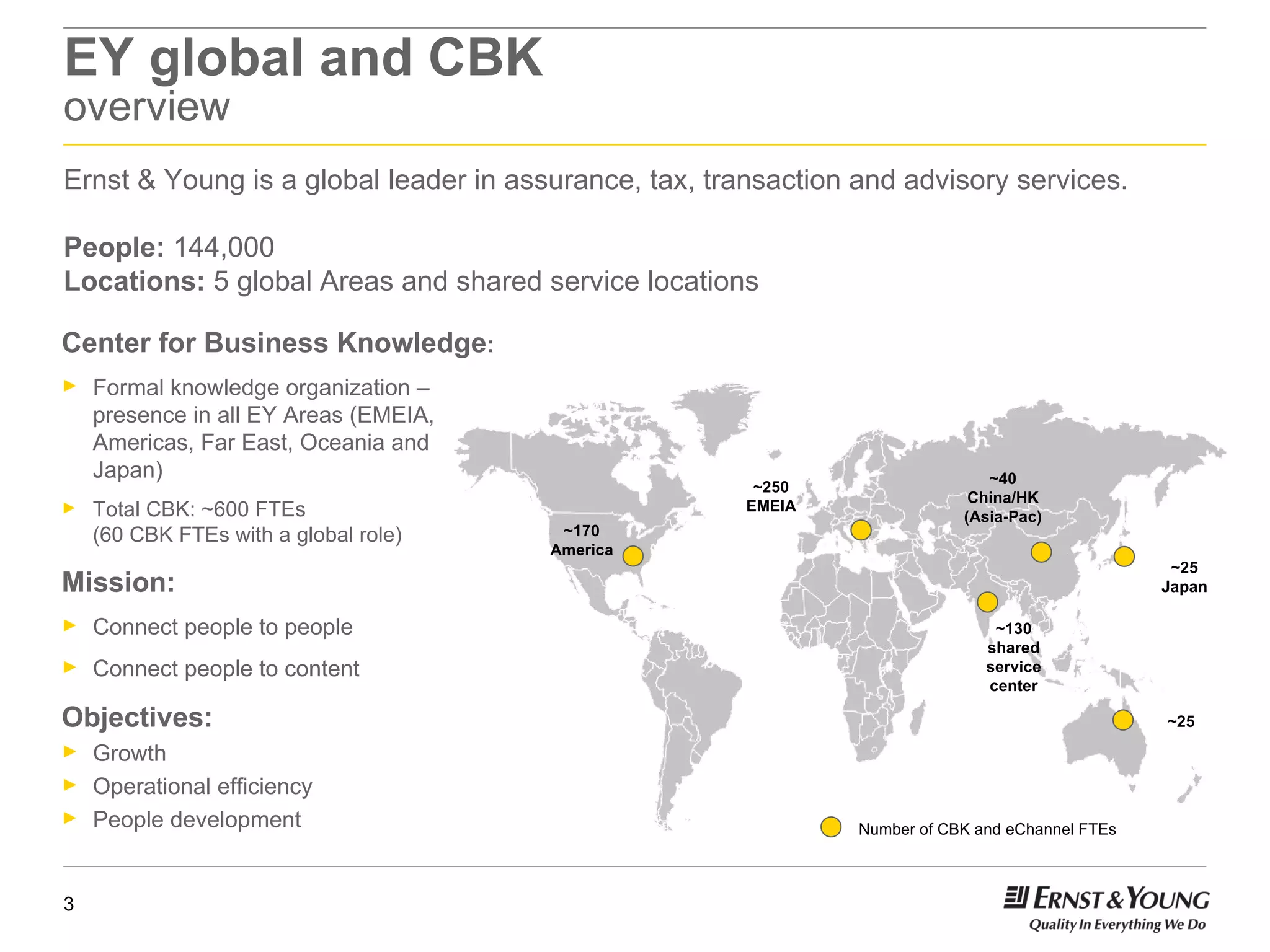
EY global and CBK  overview ~170 America ~250 EMEIA ~130 shared service center ~40 China/HK (Asia-Pac) ~25 Japan ~25 Number of CBK and eChannel FTEs Center for Business Knowledge : Formal knowledge organization – presence in all EY Areas (EMEIA, Americas, Far East, Oceania and Japan) Total CBK: ~600 FTEs  (60 CBK FTEs with a global role) Mission: Connect people to people Connect people to content Objectives: Growth Operational efficiency People development Ernst & Young is a global leader in assurance, tax, transaction and advisory services.  People:  144,000  Locations:  5 global Areas and shared service locations
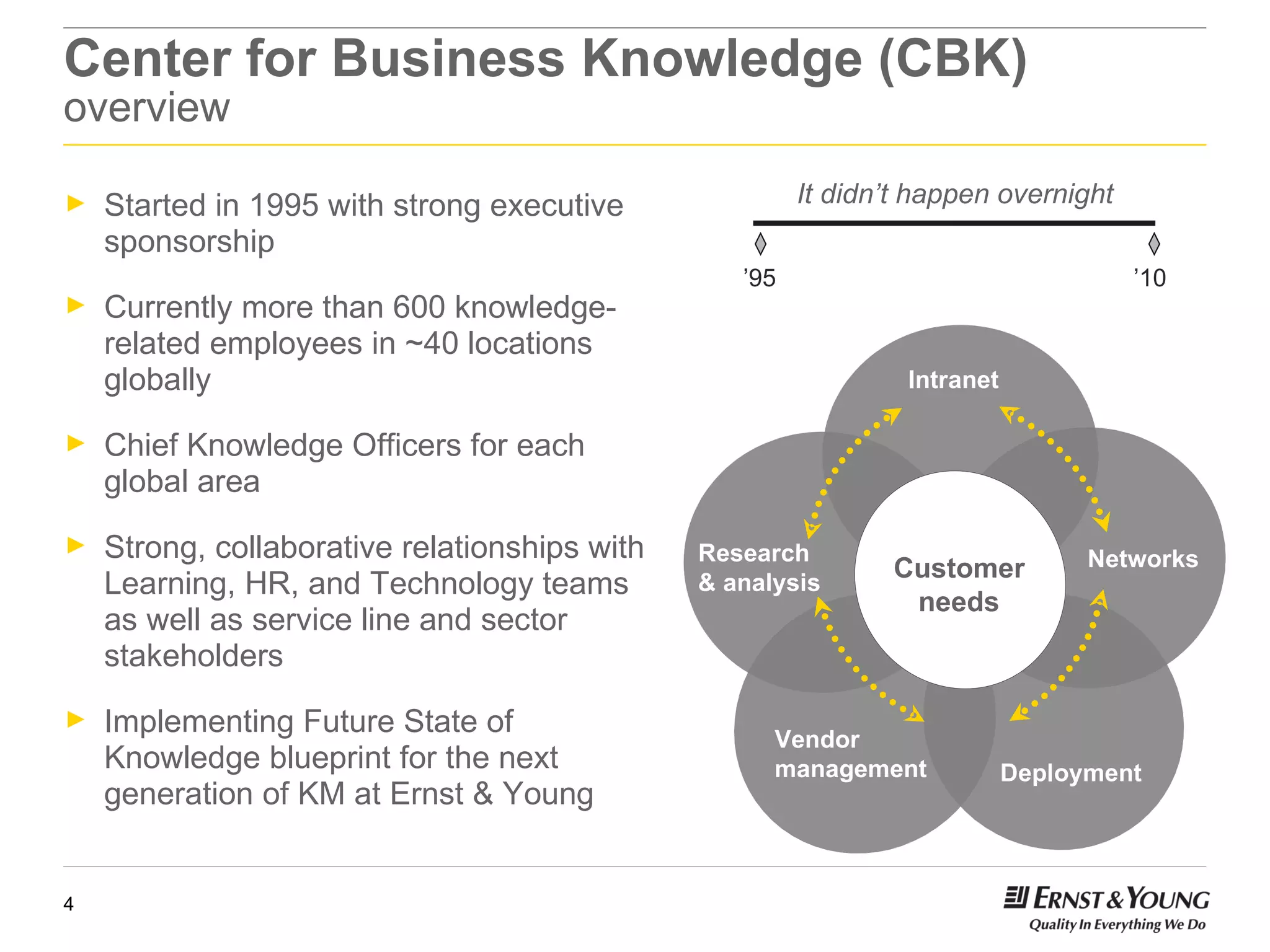
Started in 1995 with strong executive sponsorship Currently more than 600 knowledge-related employees in ~40 locations globally Chief Knowledge Officers for each global area Strong, collaborative relationships with Learning, HR, and Technology teams as well as service line and sector stakeholders Implementing Future State of Knowledge blueprint for the next generation of KM at Ernst & Young Center for Business Knowledge (CBK) overview It didn’t happen overnight ’ 95 ’ 10 Customer needs Intranet Customer needs Research & analysis Networks Vendor management Deployment
Communities of practice at EY EY CoPs have enabled a strong knowledge culture, including the sharing of leading practices, due largely to the following critical success factors: CoPs are easily accessible (and available enterprise-wide) CoP strategy is not “one size fits all” Continuous improvement is essential Rigorous deployment and governance processes are applied Must have executive sponsorship Membership must meet certain thresholds (e.g., all requests go through  an approval process) Must have specific goals/objectives Measurement is applied to goals Communities are retired/consolidated as needed
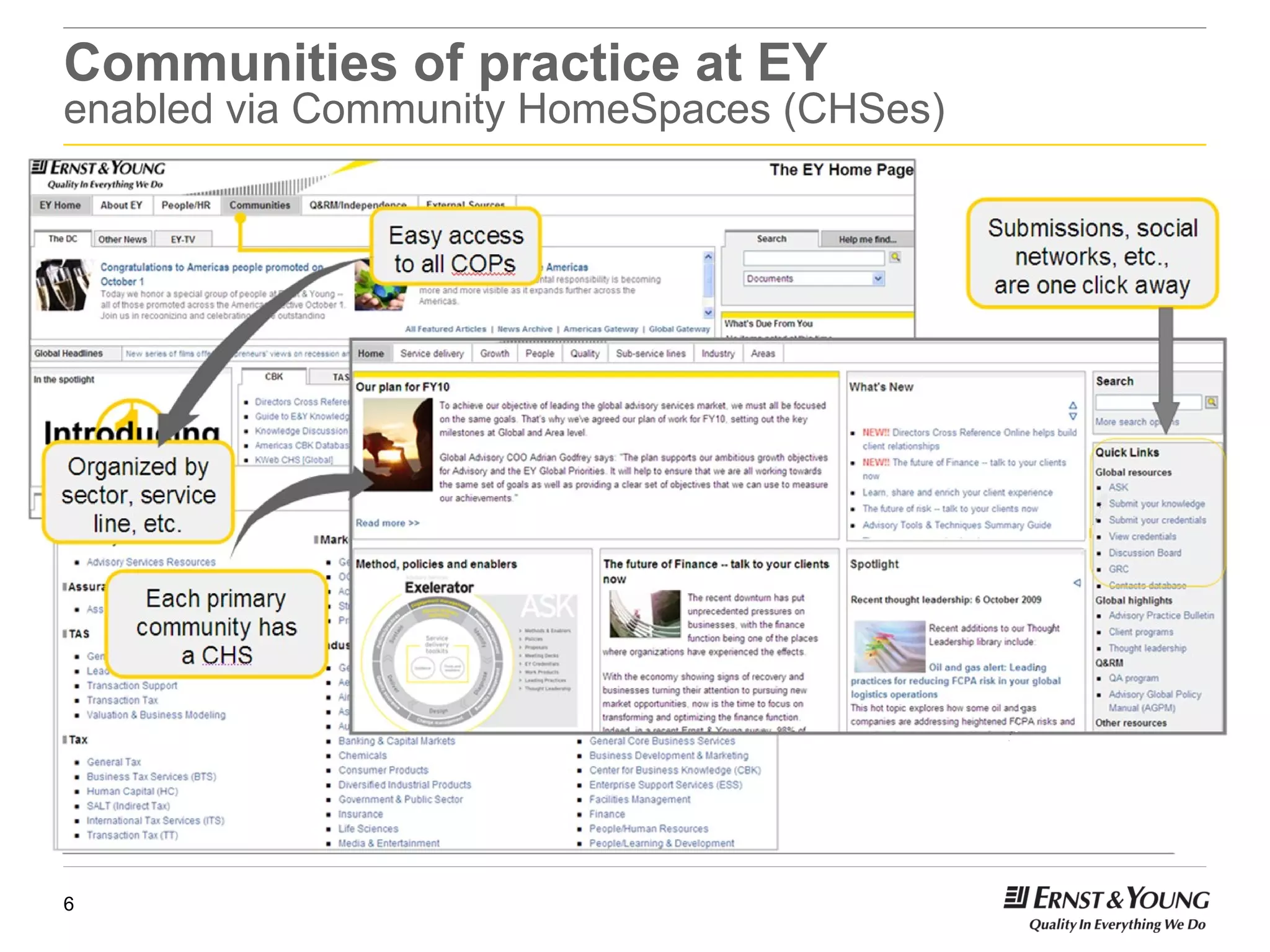
Communities of practice at EY  enabled via Community HomeSpaces (CHSes)
Presentation to KM Chicago – Agenda  EY global and Center for Business Knowledge (CBK) Communities of practice (CoPs) at EY Role in supporting APQC’s CoP report Key findings/EY perspective
Study process overview EY was the research champion for the study, which explored how some of the world’s foremost organizations successfully apply KM techniques and measures to sustain communities of practice Best practice partners for the study included Conoco Philips, Schlumberger and Flour.  About a dozen other firms also participated (e.g., BP, Deere, ExxonMobil, Pfizer) Primary areas of focus included: Strategies and practices for sustaining CoP alignment with business strategies/objectives Practices for promoting and sustaining CoP activity Cultural enablers for sustaining CoPs; and Assessing CoP maturity and business impact Final report is expected to be available by 15 April 2010
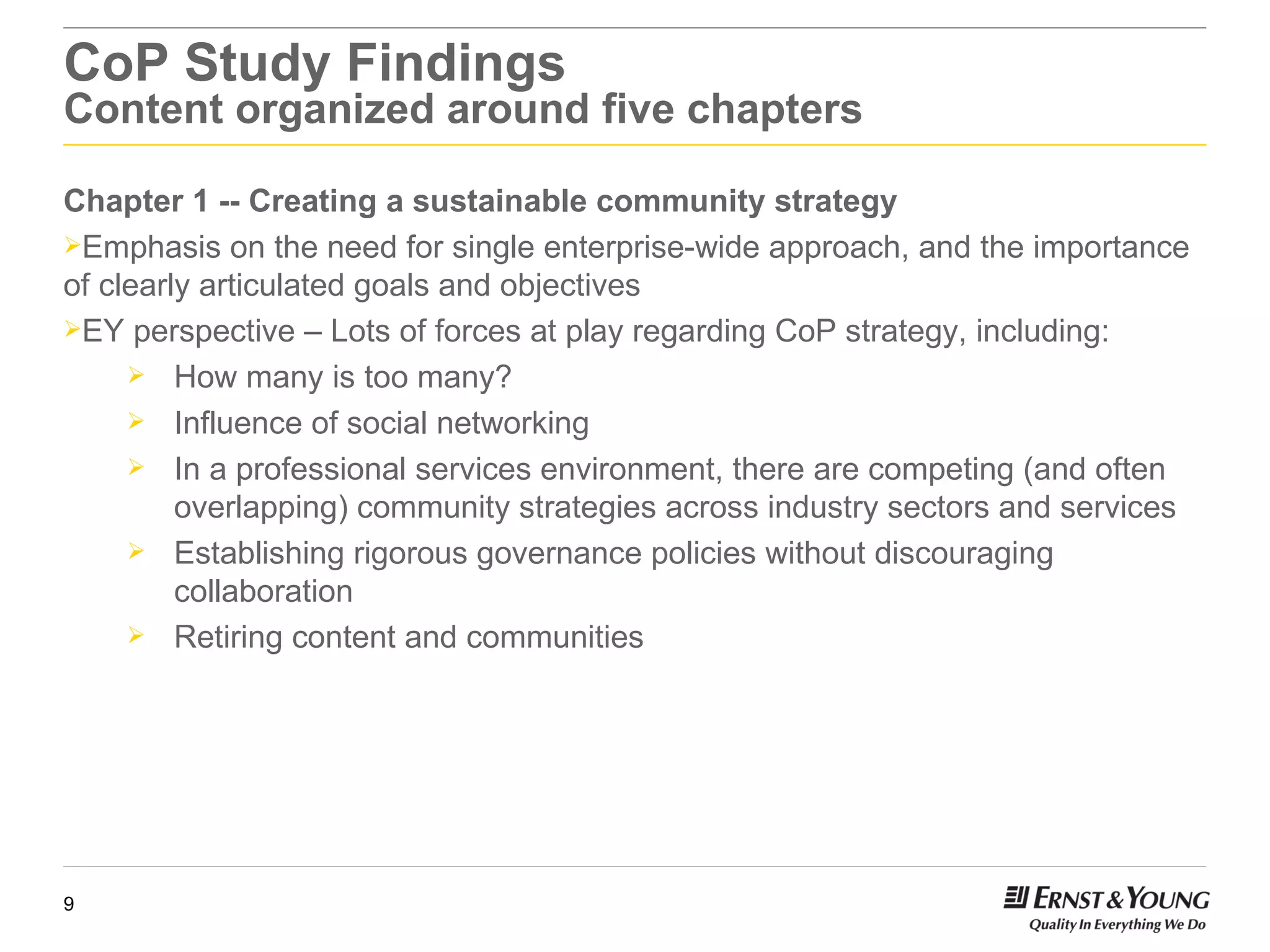
CoP Study Findings Content organized around five chapters Chapter 1 -- Creating a sustainable community strategy  Emphasis on the need for single enterprise-wide approach, and the importance of clearly articulated goals and objectives EY perspective – Lots of forces at play regarding CoP strategy, including: How many is too many? Influence of social networking In a professional services environment, there are competing (and often overlapping) community strategies across industry sectors and services Establishing rigorous governance policies without discouraging collaboration Retiring content and communities
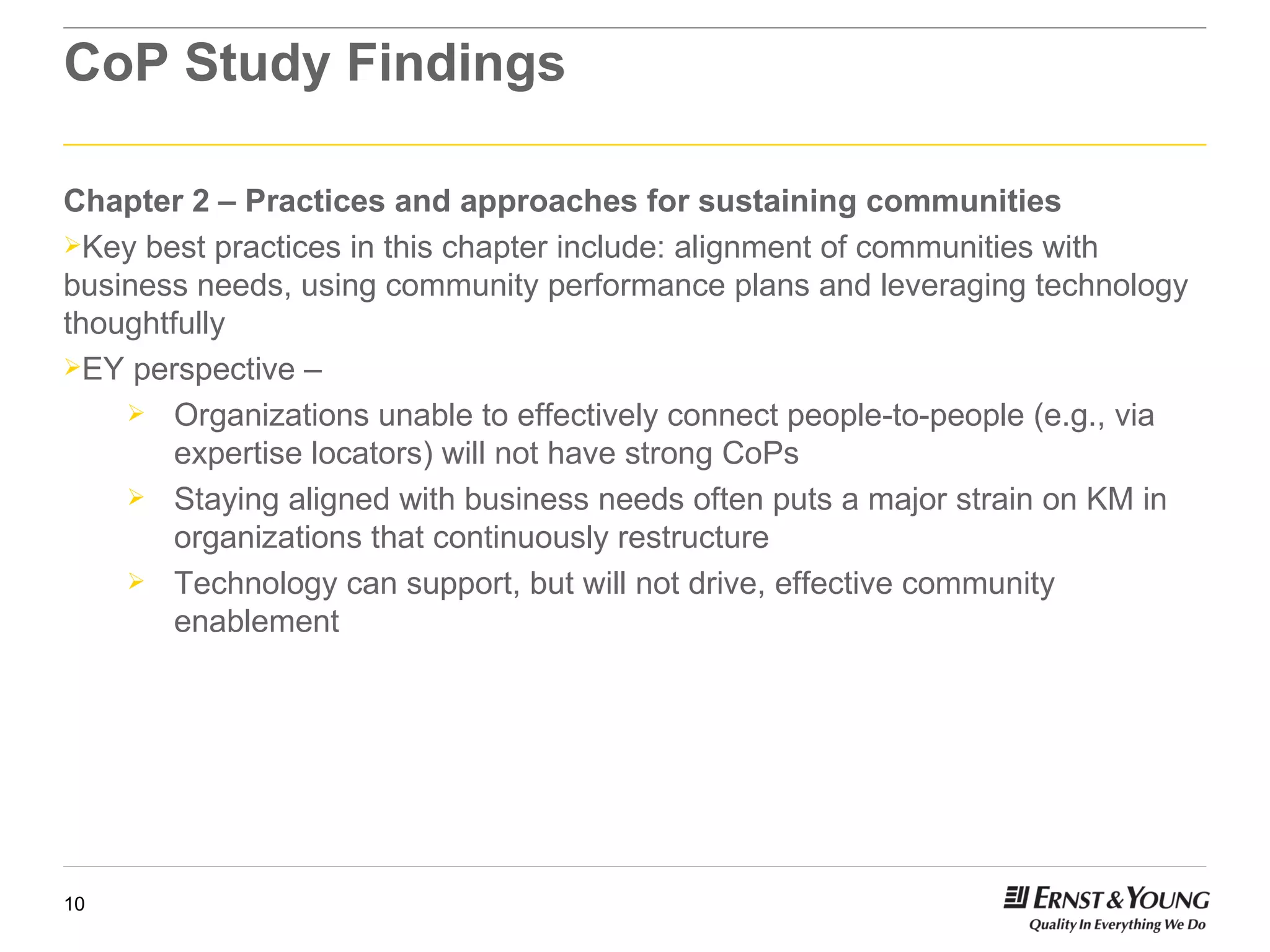
CoP Study Findings Chapter 2 – Practices and approaches for sustaining communities Key best practices in this chapter include: alignment of communities with business needs, using community performance plans and leveraging technology thoughtfully EY perspective –  Organizations unable to effectively connect people-to-people (e.g., via expertise locators) will not have strong CoPs Staying aligned with business needs often puts a major strain on KM in organizations that continuously restructure Technology can support, but will not drive, effective community enablement
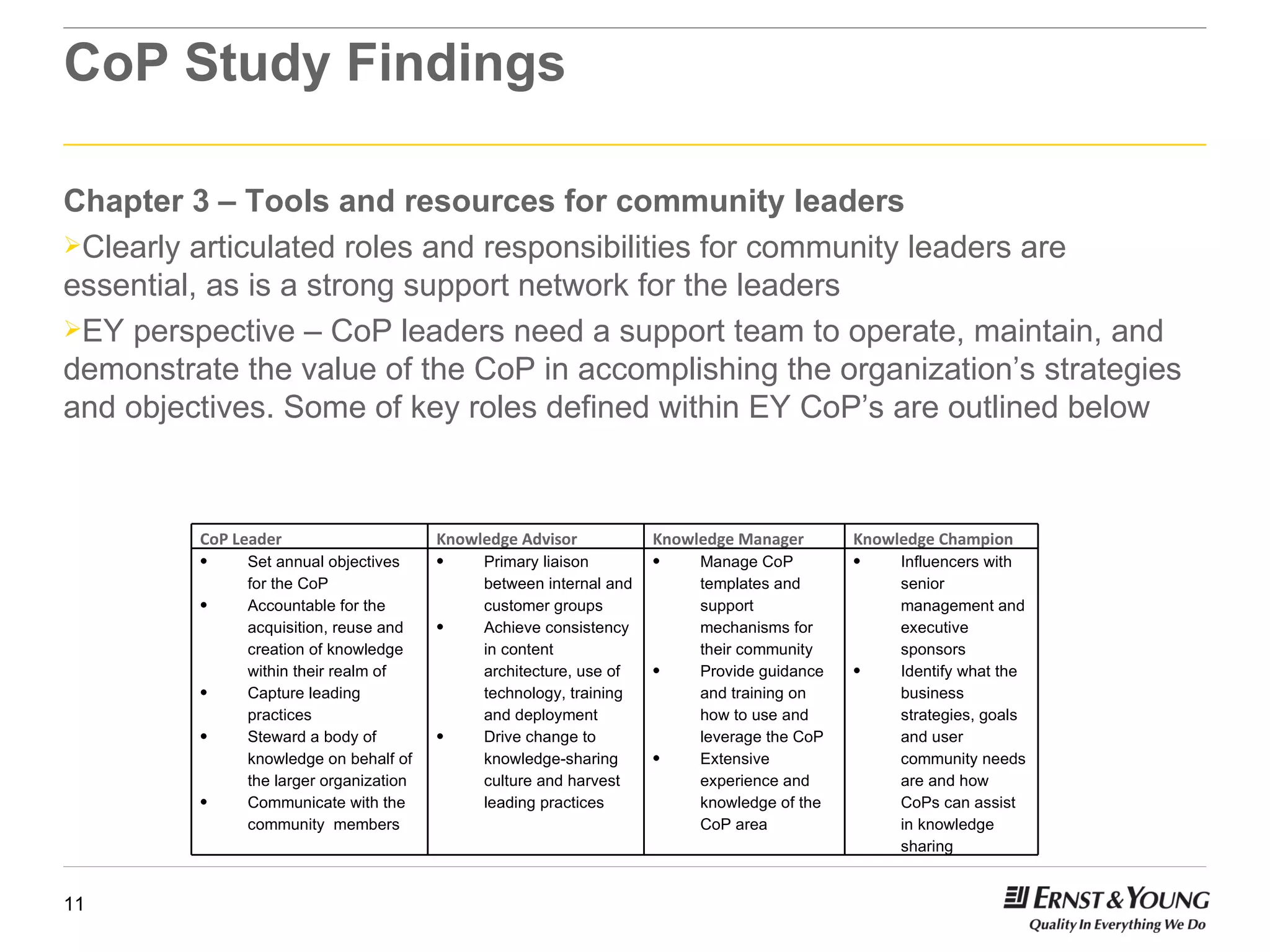
CoP Study Findings Chapter 3 – Tools and resources for community leaders Clearly articulated roles and responsibilities for community leaders are essential, as is a strong support network for the leaders EY perspective – CoP  leaders need a support team to operate, maintain, and demonstrate the value of the CoP in accomplishing the organization’s strategies and objectives. Some of key roles defined within EY CoP’s are outlined below CoP Leader Knowledge Advisor Knowledge Manager Knowledge Champion Set annual objectives for the CoP Accountable for the acquisition, reuse and creation of knowledge within their realm of  Capture leading practices Steward a body of knowledge on behalf of the larger organization Communicate with the community  members Primary liaison between internal and customer groups Achieve consistency in content architecture, use of technology, training and deployment Drive change to knowledge-sharing culture and harvest leading practices Manage CoP templates and support mechanisms for their community Provide guidance and training on how to use and leverage the CoP Extensive experience and knowledge of the CoP area Influencers with senior management and executive sponsors Identify what the business strategies, goals and user community needs are and how CoPs can assist in knowledge sharing
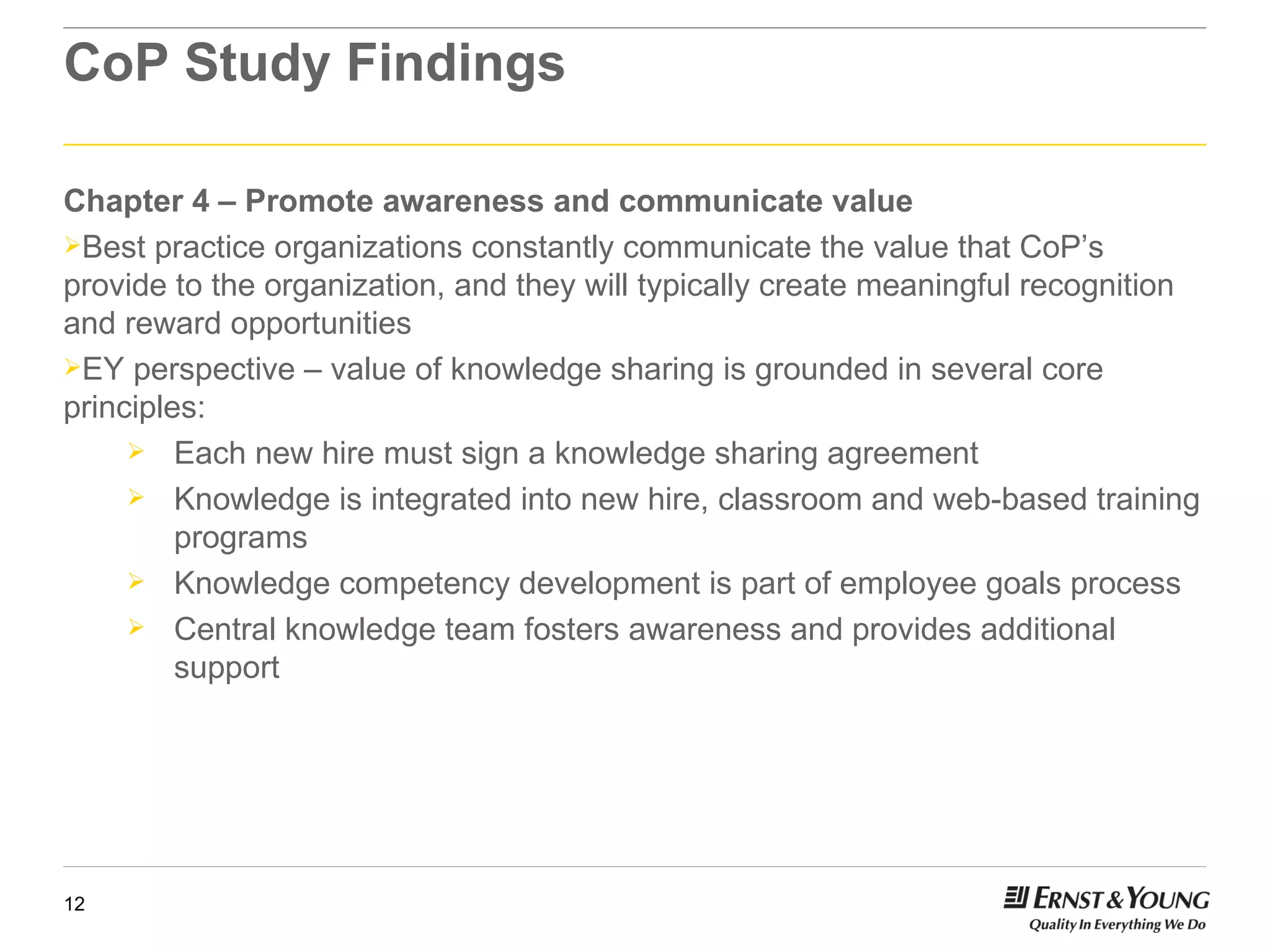
CoP Study Findings Chapter 4 – Promote awareness and communicate value Best practice organizations constantly communicate the value that CoP’s provide to the organization, and they will typically create meaningful recognition and reward opportunities EY perspective – value of knowledge sharing is grounded in several core principles: Each new hire must sign a knowledge sharing agreement Knowledge is integrated into new hire, classroom and web-based training programs Knowledge competency development is part of employee goals process Central knowledge team fosters awareness and provides additional support
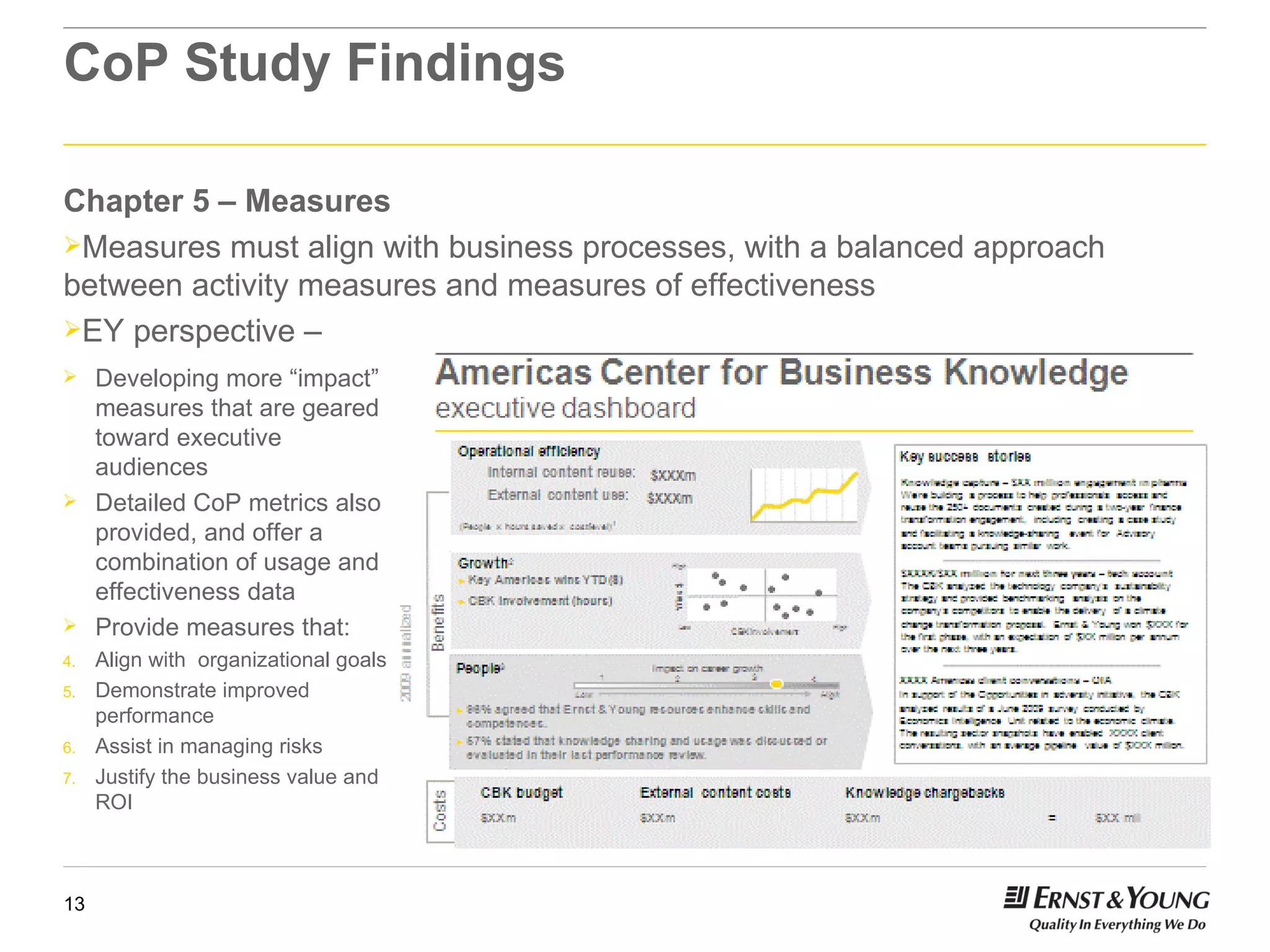
CoP Study Findings Chapter 5 – Measures Measures must align with business processes, with a balanced approach between activity measures and measures of effectiveness  EY perspective –  Developing more “impact” measures that are geared toward executive audiences Detailed CoP metrics also provided, and offer a combination of usage and effectiveness data Provide measures that: Align with  organizational goals Demonstrate improved performance Assist in managing risks Justify the business value and ROI
Questions?

Practicing Communities of Practice with Ernst & Young

  • 1.
    Ernst & Youngvirtual presentation Sustaining Effective Communities of Practice collaborative research report overview for KM Chicago 9 February 2010 Darrin Brogan Brad Kenney
  • 2.
    Presentation to KMChicago – Agenda EY global and Center for Business Knowledge (CBK) Communities of practice (CoPs) at EY Role in supporting APQC’s CoP report Key findings
  • 3.
    EY global andCBK overview ~170 America ~250 EMEIA ~130 shared service center ~40 China/HK (Asia-Pac) ~25 Japan ~25 Number of CBK and eChannel FTEs Center for Business Knowledge : Formal knowledge organization – presence in all EY Areas (EMEIA, Americas, Far East, Oceania and Japan) Total CBK: ~600 FTEs (60 CBK FTEs with a global role) Mission: Connect people to people Connect people to content Objectives: Growth Operational efficiency People development Ernst & Young is a global leader in assurance, tax, transaction and advisory services. People: 144,000 Locations: 5 global Areas and shared service locations
  • 4.
    Started in 1995with strong executive sponsorship Currently more than 600 knowledge-related employees in ~40 locations globally Chief Knowledge Officers for each global area Strong, collaborative relationships with Learning, HR, and Technology teams as well as service line and sector stakeholders Implementing Future State of Knowledge blueprint for the next generation of KM at Ernst & Young Center for Business Knowledge (CBK) overview It didn’t happen overnight ’ 95 ’ 10 Customer needs Intranet Customer needs Research & analysis Networks Vendor management Deployment
  • 5.
    Communities of practiceat EY EY CoPs have enabled a strong knowledge culture, including the sharing of leading practices, due largely to the following critical success factors: CoPs are easily accessible (and available enterprise-wide) CoP strategy is not “one size fits all” Continuous improvement is essential Rigorous deployment and governance processes are applied Must have executive sponsorship Membership must meet certain thresholds (e.g., all requests go through an approval process) Must have specific goals/objectives Measurement is applied to goals Communities are retired/consolidated as needed
  • 6.
    Communities of practiceat EY enabled via Community HomeSpaces (CHSes)
  • 7.
    Presentation to KMChicago – Agenda EY global and Center for Business Knowledge (CBK) Communities of practice (CoPs) at EY Role in supporting APQC’s CoP report Key findings/EY perspective
  • 8.
    Study process overviewEY was the research champion for the study, which explored how some of the world’s foremost organizations successfully apply KM techniques and measures to sustain communities of practice Best practice partners for the study included Conoco Philips, Schlumberger and Flour. About a dozen other firms also participated (e.g., BP, Deere, ExxonMobil, Pfizer) Primary areas of focus included: Strategies and practices for sustaining CoP alignment with business strategies/objectives Practices for promoting and sustaining CoP activity Cultural enablers for sustaining CoPs; and Assessing CoP maturity and business impact Final report is expected to be available by 15 April 2010
  • 9.
    CoP Study FindingsContent organized around five chapters Chapter 1 -- Creating a sustainable community strategy Emphasis on the need for single enterprise-wide approach, and the importance of clearly articulated goals and objectives EY perspective – Lots of forces at play regarding CoP strategy, including: How many is too many? Influence of social networking In a professional services environment, there are competing (and often overlapping) community strategies across industry sectors and services Establishing rigorous governance policies without discouraging collaboration Retiring content and communities
  • 10.
    CoP Study FindingsChapter 2 – Practices and approaches for sustaining communities Key best practices in this chapter include: alignment of communities with business needs, using community performance plans and leveraging technology thoughtfully EY perspective – Organizations unable to effectively connect people-to-people (e.g., via expertise locators) will not have strong CoPs Staying aligned with business needs often puts a major strain on KM in organizations that continuously restructure Technology can support, but will not drive, effective community enablement
  • 11.
    CoP Study FindingsChapter 3 – Tools and resources for community leaders Clearly articulated roles and responsibilities for community leaders are essential, as is a strong support network for the leaders EY perspective – CoP leaders need a support team to operate, maintain, and demonstrate the value of the CoP in accomplishing the organization’s strategies and objectives. Some of key roles defined within EY CoP’s are outlined below CoP Leader Knowledge Advisor Knowledge Manager Knowledge Champion Set annual objectives for the CoP Accountable for the acquisition, reuse and creation of knowledge within their realm of Capture leading practices Steward a body of knowledge on behalf of the larger organization Communicate with the community members Primary liaison between internal and customer groups Achieve consistency in content architecture, use of technology, training and deployment Drive change to knowledge-sharing culture and harvest leading practices Manage CoP templates and support mechanisms for their community Provide guidance and training on how to use and leverage the CoP Extensive experience and knowledge of the CoP area Influencers with senior management and executive sponsors Identify what the business strategies, goals and user community needs are and how CoPs can assist in knowledge sharing
  • 12.
    CoP Study FindingsChapter 4 – Promote awareness and communicate value Best practice organizations constantly communicate the value that CoP’s provide to the organization, and they will typically create meaningful recognition and reward opportunities EY perspective – value of knowledge sharing is grounded in several core principles: Each new hire must sign a knowledge sharing agreement Knowledge is integrated into new hire, classroom and web-based training programs Knowledge competency development is part of employee goals process Central knowledge team fosters awareness and provides additional support
  • 13.
    CoP Study FindingsChapter 5 – Measures Measures must align with business processes, with a balanced approach between activity measures and measures of effectiveness EY perspective – Developing more “impact” measures that are geared toward executive audiences Detailed CoP metrics also provided, and offer a combination of usage and effectiveness data Provide measures that: Align with organizational goals Demonstrate improved performance Assist in managing risks Justify the business value and ROI
  • 14.