Collaboration and communities of
practice. The reality of rural midwifery
practice.


Presentation to NZCOM Conference
Wellington 2012

Carolyn McIntosh, Senior lecturer in Midwifery,
Otago Polytechnic.
Introduction
In this presentation I will cover the
  following topics:
 Communities of practice, what they are
  and why they may be important.
 Rural midwifery practice in the South
  Island of NZ: What communities of
  practice are midwives engaged with?
 Challenges for rural midwives in practice
  relationships which may influence
  communities of practice and
  collaboration.
 Some possible benefits of effective
  collaboration.
Communities of practice.
   Midwives work in a variety of locations
    alongside a variety of other health
    professionals e.g.
    ◦ Midwives, Obstetricians, Plunket
      nurses, GPs, Practice nurses, Ambulance
      personnel, Radiographers, Physiotherapists,
      Occupational therapists, Mental health
      services.
   And a variety of lay groups who support
    women and families e.g
    ◦ La leche league, Plunket mothers groups, etc.
      Etc.
    ◦ not forgetting women themselves and their
Communities of practice
   Professional interactions with all of these
    groups are centred on the care and
    interests of the mother and her infant.

   As matters of interest arise information
    may be shared (within the bounds of
    confidentiality) which may stimulate
    investigation and exploration.

   Group interactions provide a mechanism
    for knowledge transfer and contextualising
    evidence to the local practice situation.
Communities of practice
Wenger (1996)
 Learning is primarily social and occurs through
   the variety of communities to which
   participants belong.
Learning is integrated into participation in
   communities of practice (COP).
COP create their own identity and boundaries.
Boundaries are crossed and negotiated
   between COP. Learning may be facilitated or
   inhibited.
It is this negotiation between COP where
   Innovation is most likely to occur “much
   learning happens when boundaries are rich in
   interactions”
Rural midwives communities of
  practice.
Practice communities are unique to the
 midwives geographical location.
Depends on the realities of the practice in the
 area.
COP may be a local group of midwives or
may involve other health professionals in the
 local area (Midwives, GPs, District
 nurses, facility nurses, Plunket nurses, allied
 health professionals)
COP may also be more geographically
 distant,McIntosh (2007)
          communicating through technology.
C.O.P.
May be influenced by:
 Individual and group philosophy.
 Local relationships between health
  care providers.
 How specialist services are accessed.
  ◦ Are there local specialist clinics or do
    women have to travel to the main
    centre for specialist services.
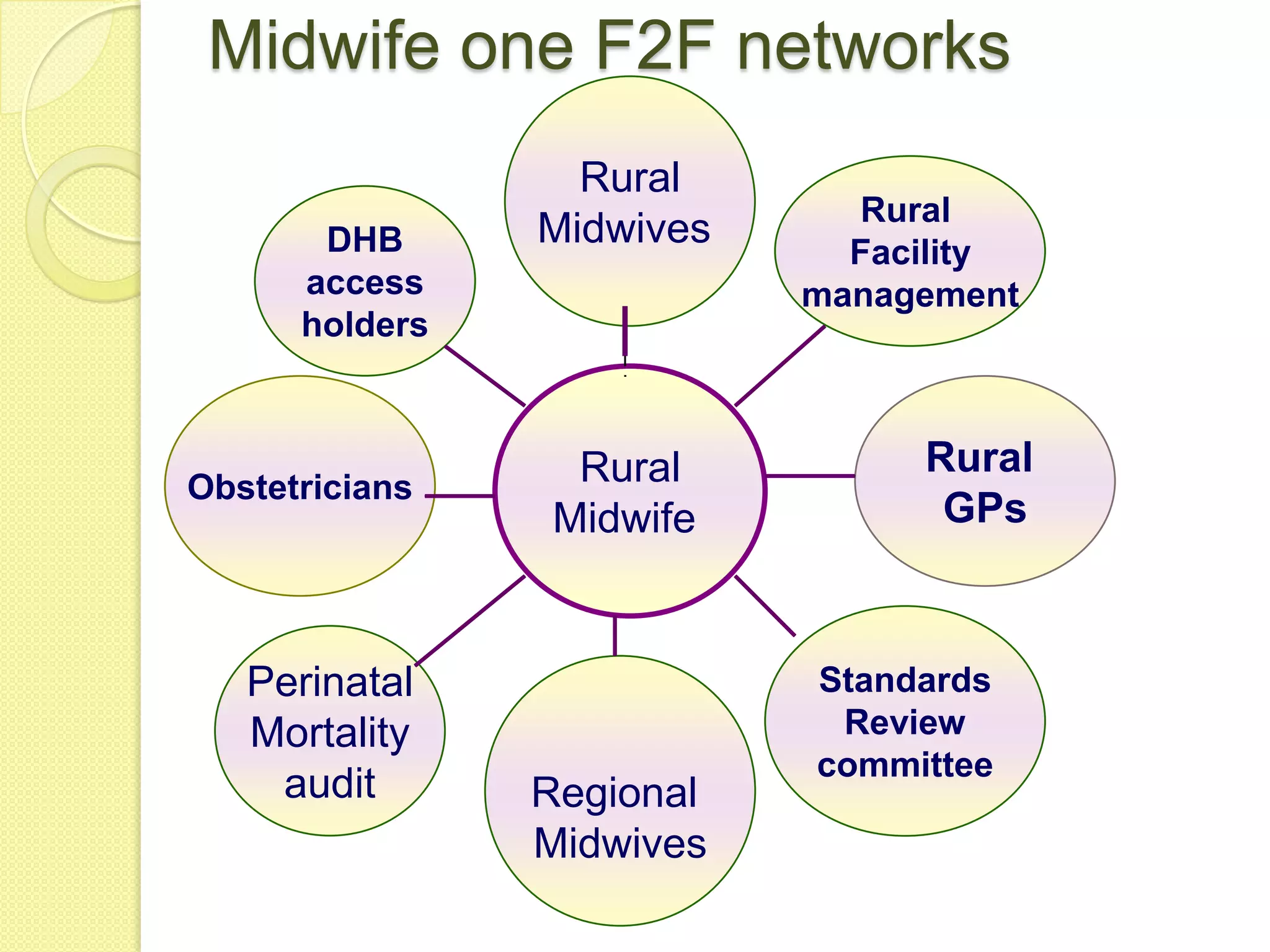
Midwife one F2F networks
                  Rural
                             Rural
       DHB      Midwives
                             Facility
      access               management
      holders


                 Rural          Rural
Obstetricians
                Midwife          GPs


   Perinatal               Standards
   Mortality                Review
                           committee
    audit       Regional
                Midwives
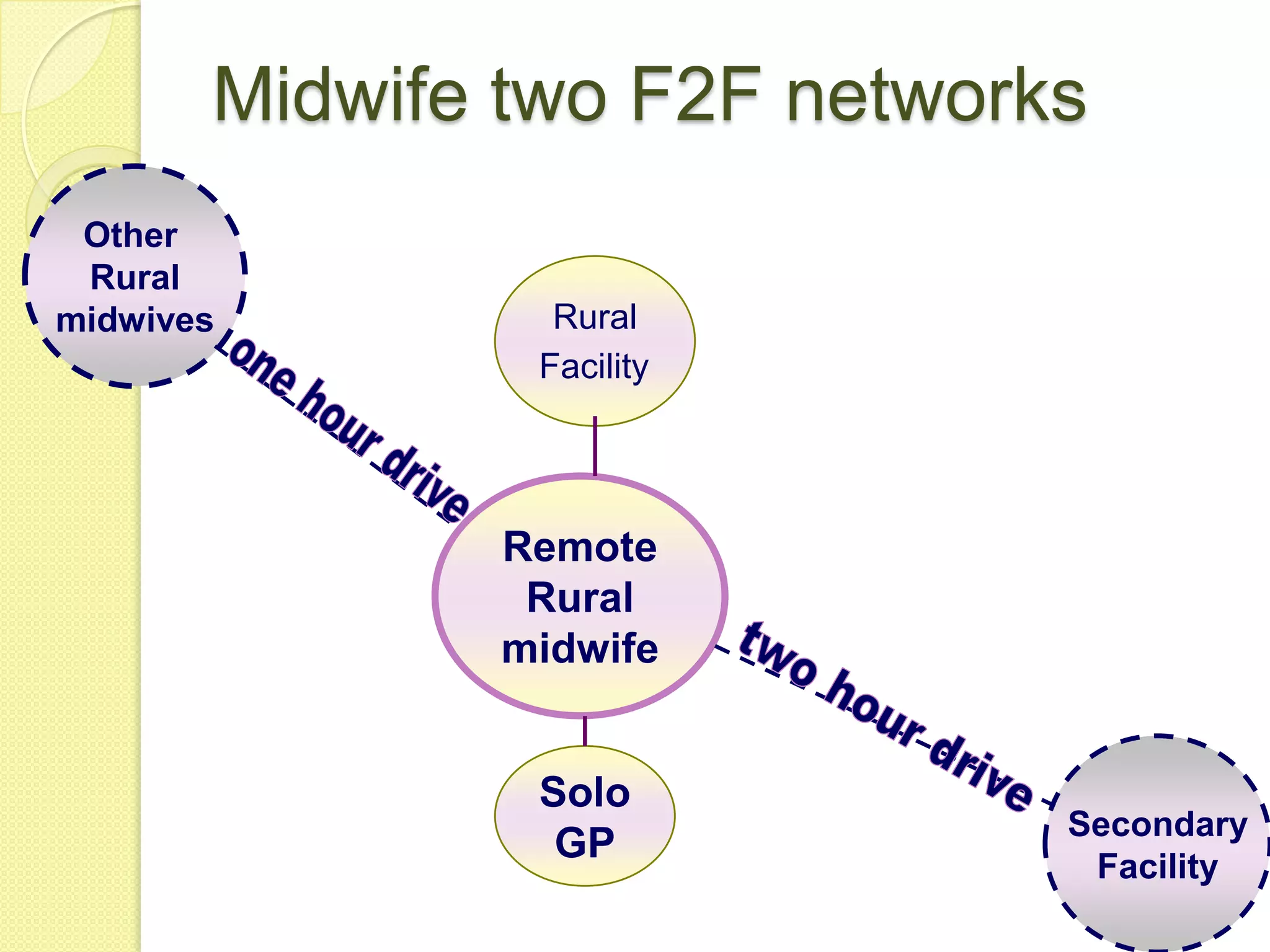
Midwife two F2F networks
 Other
 Rural
midwives        Rural
               Facility


              Remote
               Rural
              midwife


               Solo
                              Secondary
                GP             Facility
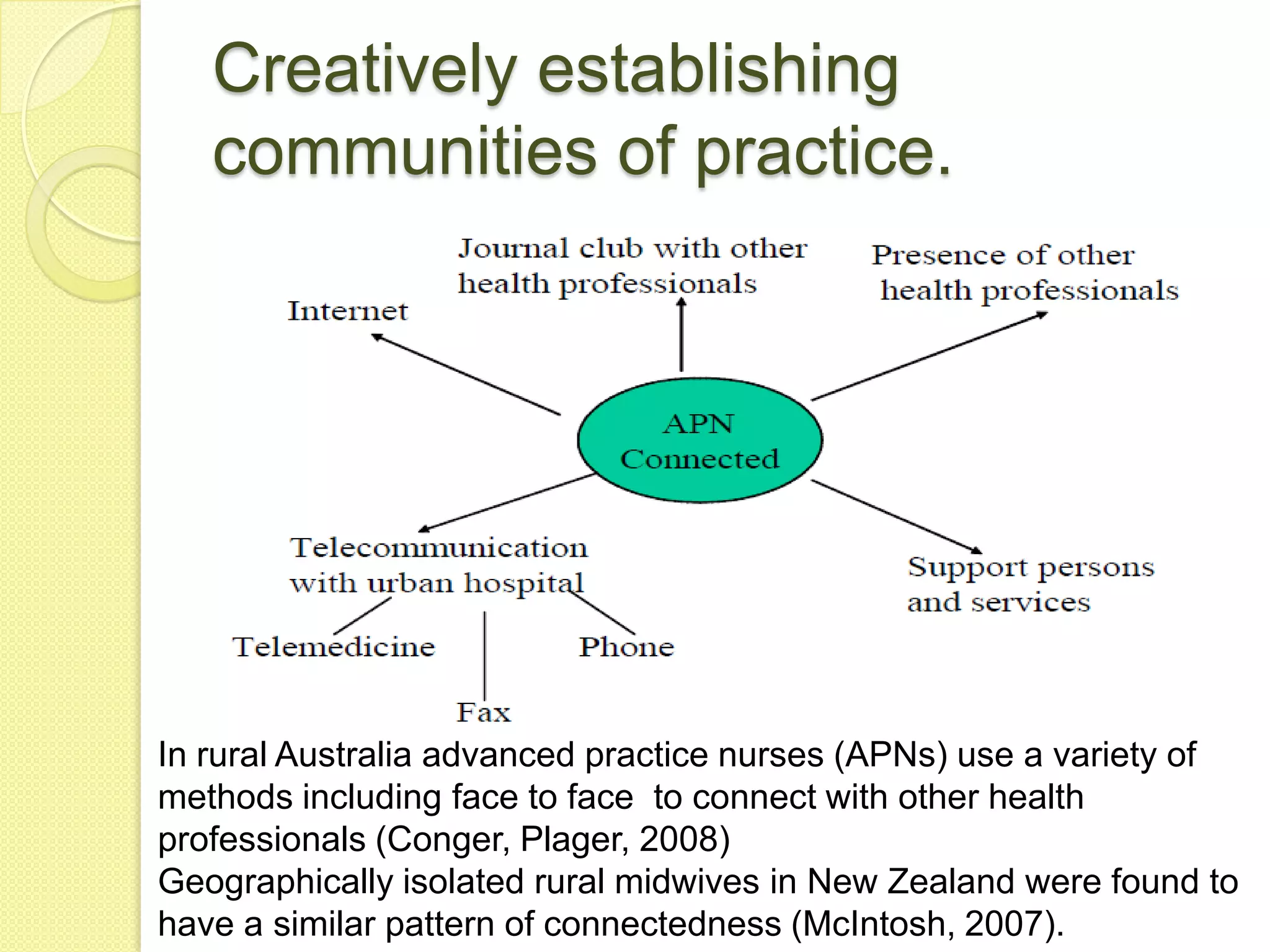
Creatively establishing
   communities of practice.


In rural Australia advanced practice nurses (APNs) use a variety of
methods including face to face to connect with other health
professionals (Conger, Plager, 2008)
Geographically isolated rural midwives in New Zealand were found to
have a similar pattern of connectedness (McIntosh, 2007).
Other midwifery relationships
   Midwives usually live in the communities in which they
    work. Hence they are also involved in community
    activities and have relationships outside work with women
    and families for whom they also provide care. Rural
    midwives are always a midwife in every social interaction.
    (Baird, 2005; Patterson, 2007)

   This is common to all rural health workers and creates
    some additional challenges for health professionals.
    (Bourke, Sheridan, Russell, Jones, Liaw. 2004 )

   Rural midwives may also be involved with lay groups
    which provide information and support to rural women
    (McIntosh, 2007).

   Learning may also be stimulated through interactions with
    these lay communities.
   “Boundaries between practices are
    fertile grounds for innovation. As
    communities of practice
    collaborate, clash, merge, diverge, the
    required process of
    coordination, translation, and
    negotiation is also a process of
    learning”

(Wenger, 1996)
Team learning
 Agreeableness is defined as being
  friendly, trusting, tolerant, compliant and
  modest.
 High levels of agreeableness may have
  a negative effect on problem solving as
  compliance and consensus is reached
  early.
 Effective collaboration within and
  between teams requires a full and critical
  discussion of available data and ideas.
 Participation in “constructive
  controversy”.
Constructive controversy
 Communities of practice are identified by
  shared wisdom and understanding
 When this is in conflict with the
  understanding of another group
  resolution is required
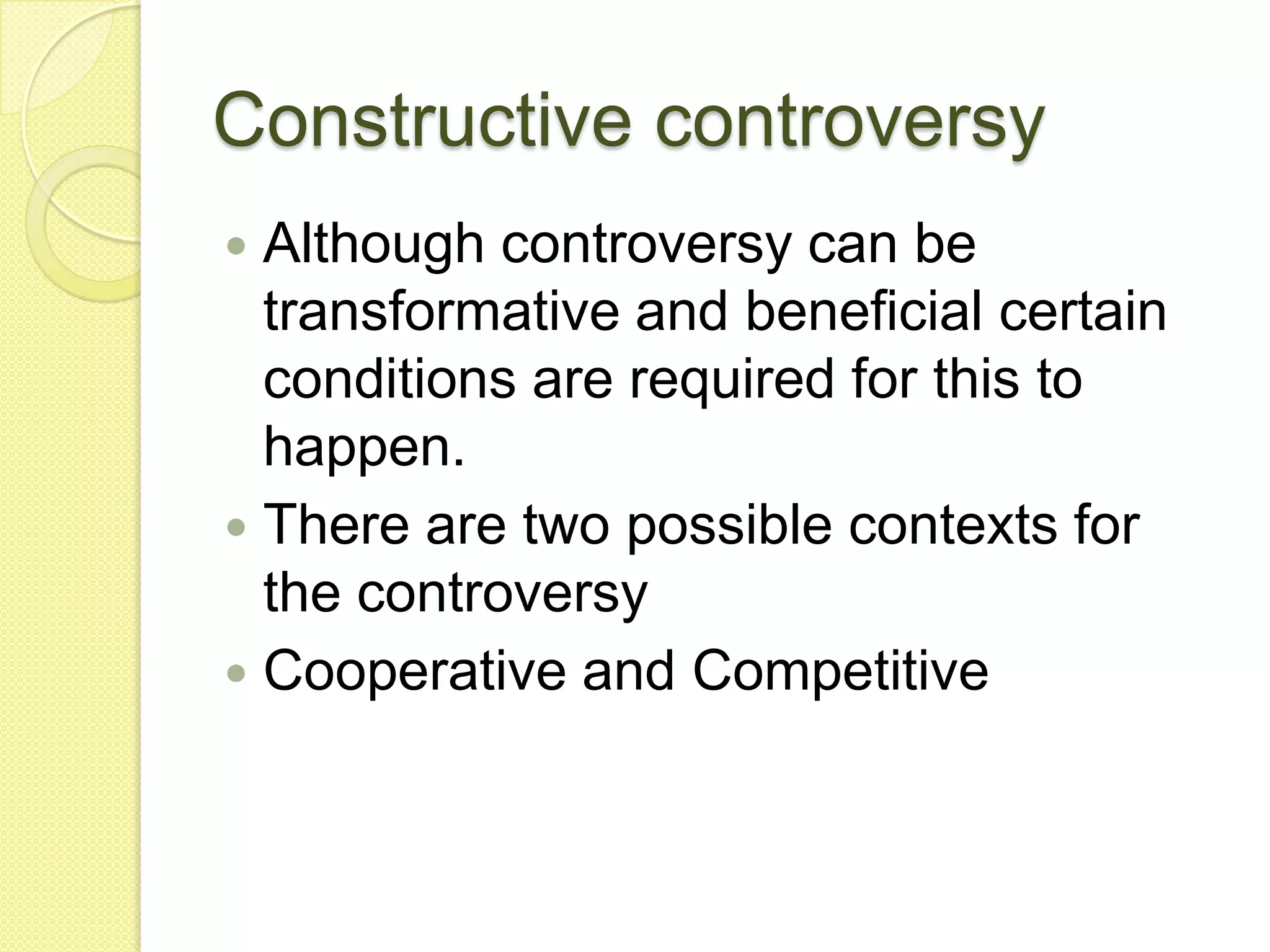
 This process requires
    ◦   Critically analysing the situation
    ◦   Transforming knowledge into argument
    ◦   Viewing the issue from different perspectives
    ◦   Synthesis and consensus

        Johnson, Johnson and Smith, 2000
http://www.mindtools.com/pages/article/newTMC_71.ht
m
Constructive controversy
 Although controversy can be
  transformative and beneficial certain
  conditions are required for this to
  happen.
 There are two possible contexts for
  the controversy
 Cooperative and Competitive
Cooperative (constructive)

 Willing to listen
 Clearly communicate ideas
 Motivated to hear opposing arguments
 Comfortable discussing opposing
  perspectives and
 Willingness to create new
  understanding

    Johnson, Johnson & Smith, 2000
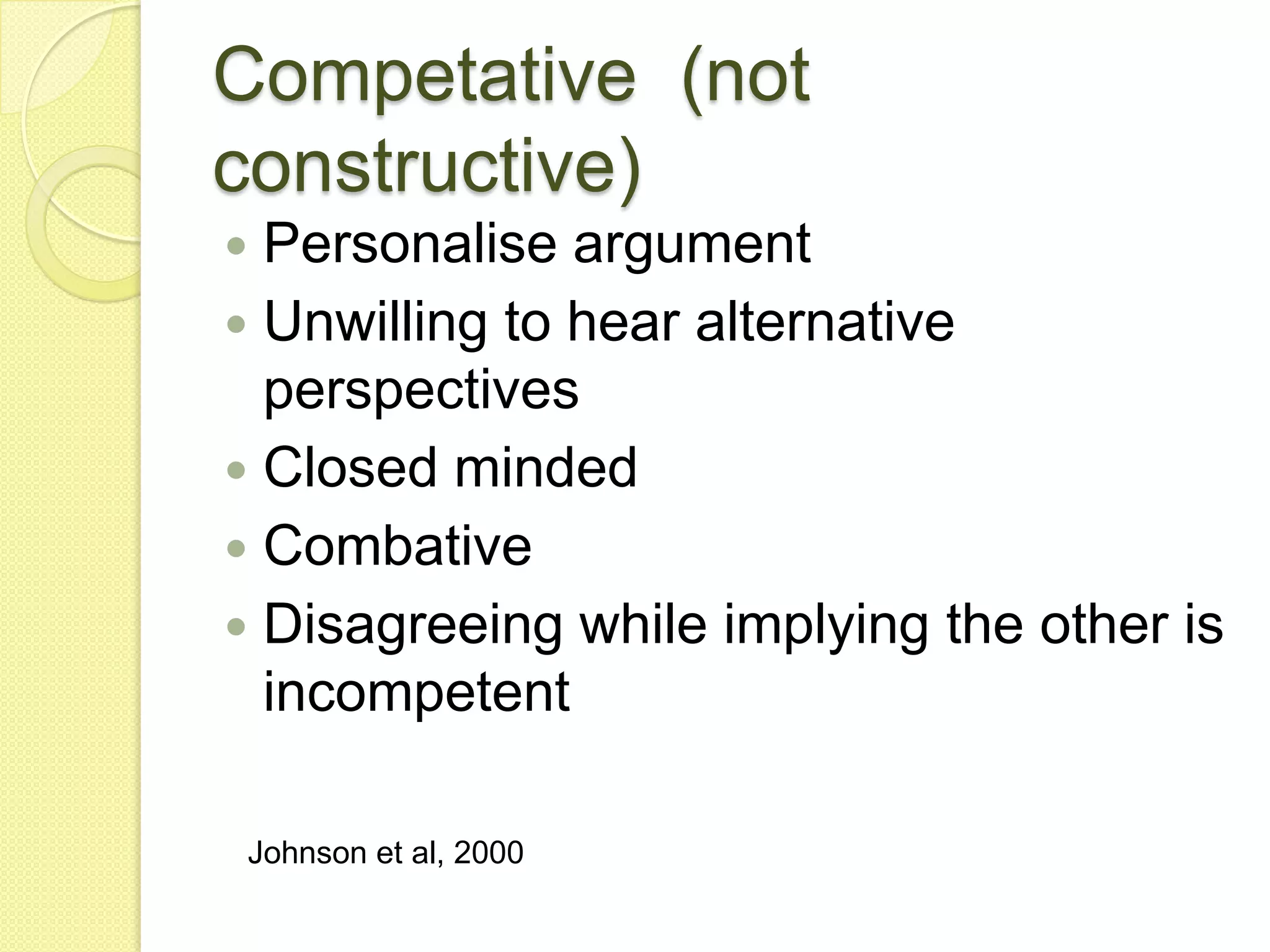
Competative (not
constructive)
 Personalise argument
 Unwilling to hear alternative
  perspectives
 Closed minded
 Combative
 Disagreeing while implying the other is
  incompetent

Johnson et al, 2000
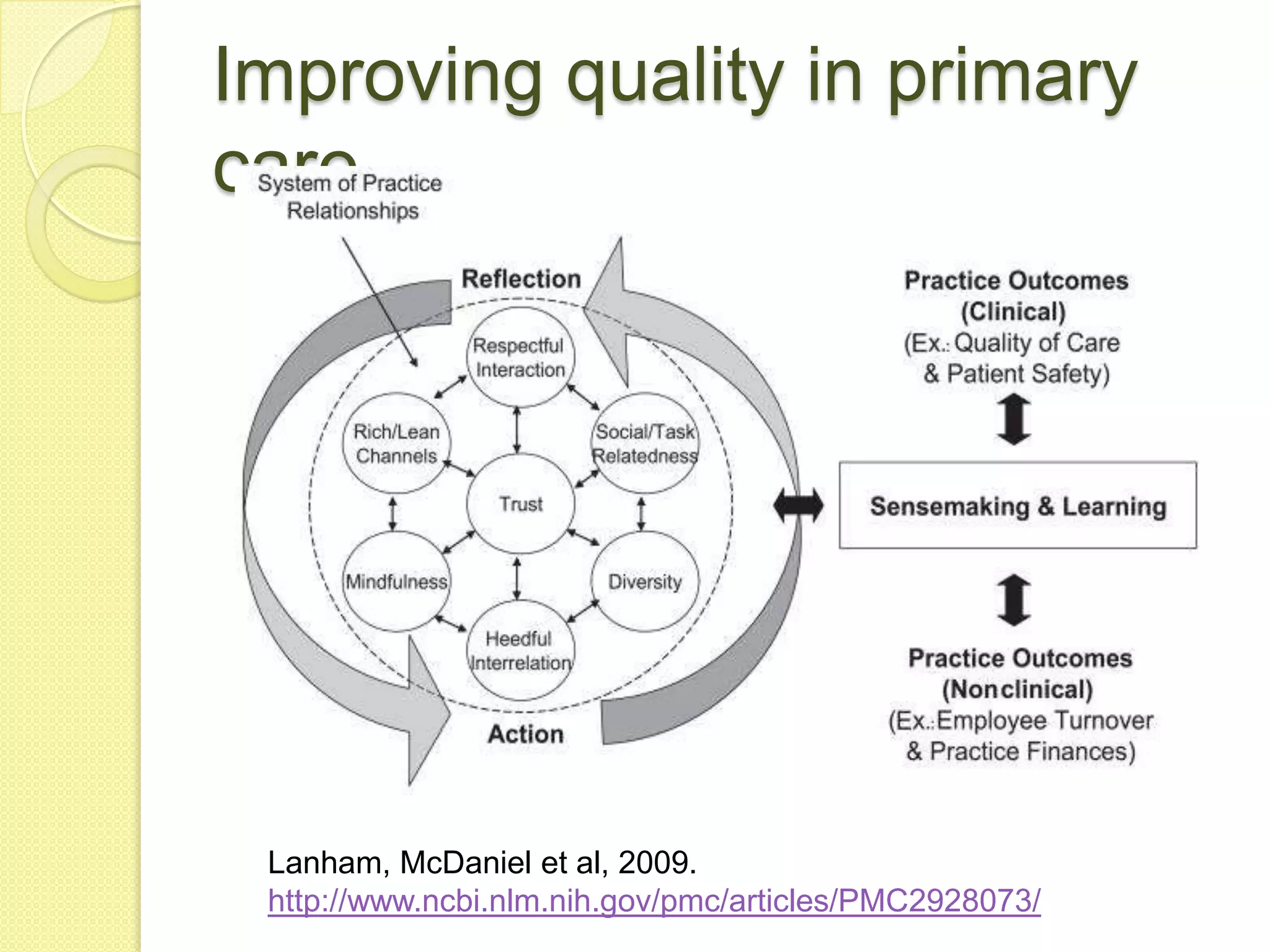
Improving quality in primary
care


 Lanham, McDaniel et al, 2009.
 http://www.ncbi.nlm.nih.gov/pmc/articles/PMC2928073/
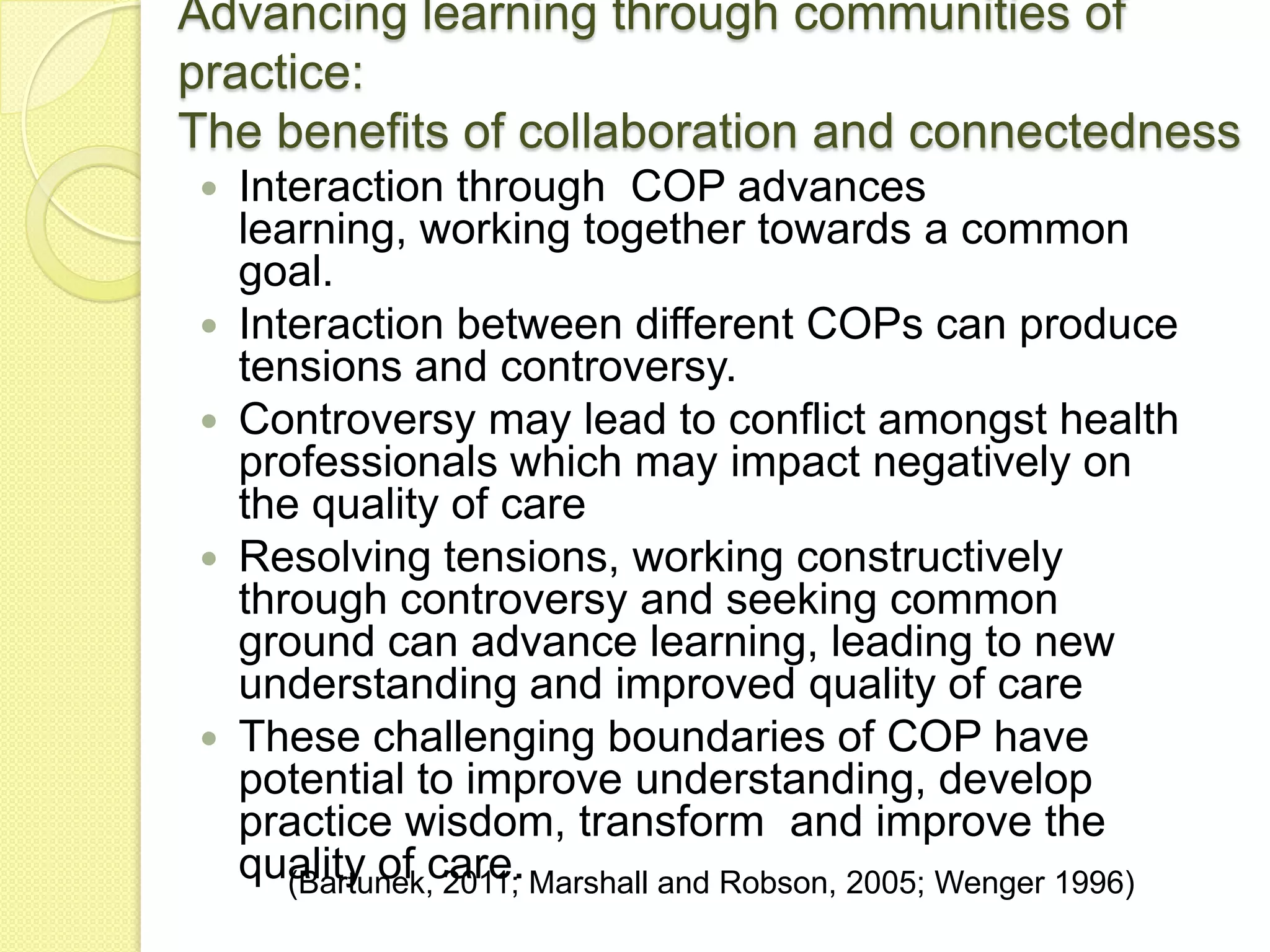
Advancing learning through communities of
practice:
The benefits of collaboration and connectedness
   Interaction through COP advances
    learning, working together towards a common
    goal.
   Interaction between different COPs can produce
    tensions and controversy.
   Controversy may lead to conflict amongst health
    professionals which may impact negatively on
    the quality of care
   Resolving tensions, working constructively
    through controversy and seeking common
    ground can advance learning, leading to new
    understanding and improved quality of care
   These challenging boundaries of COP have
    potential to improve understanding, develop
    practice wisdom, transform and improve the
    quality of care. Marshall and Robson, 2005; Wenger 1996)
       (Bartunek, 2011;
Conclusion
   COP are important for sustaining and
    supporting practice.
   Midwifery practice communities are
    diverse, influenced by the area in which the
    midwives live and work and may involve a
    variety of health care professionals and lay
    groups.
   There is potential for controversy between
    COPs
   Being able to resolve controversy improves
    understanding, can increase knowledge and
    practice wisdom and improves the quality of
    care for the families midwives work with.
   Learning is advanced through interaction and
    collaboration with a variety of COP.
References
    Baird, M. (2005). Sustaining rural midwifery practice:
     New Zealand Midwives’ experiences. Unpublished
     masters thesis, Otago Polytechnic: Dunedin, New
     Zealand.
    Bourke, L., Sheridan, C., Russell, U.
     Jones, G., DeWitt, D. and Liaw, S.T. (2004) Developing
     a conceptual understanding of rural health practice.
     Australian Journal of Rural Health. 12:181-186
    Burtenek, J. M. (2011). . Intergroup relationships and
     quality improvement in healthcare. BMJ Quality and
     Safety, (Supplement 1).
     doi:10.1136/bmjqs.2010.046169
    Conger, M. M., Plager, K. A. (2008). Advanced nursing
     practice in rural areas: Connectedness versus
     disconnectedness. Online journal of rural nursing and
     healthcare. 8 (1), 24-38. retrieved from
     http://www.rno.org/journal/index.php/online-
     journal/article/viewFile/156/194
   Hollenbeck, J, R., Ellis, A,P, J., Humphrey, S.
    E., Garz, A, S., & Iligen, D, R. (2011). Asymmetry
    in structural adaptation: The differential impact of
    centralizing versus decentralizing team decision
    making structures. Organisation behaviour and
    human decision processes.
    114(1), http://dx.doi.org/10.1016/j.obhdp.2010.08.
    003
   Marshall, P., Robson, R. (2005). Preventing and
    managing conflict: Vital pieces in the patient
    safety puzzle. Healthcare quarterly. 8: 39-44.
   McIntosh, C. (2007). Wise womens web: Rural
    midwives’ communities of practice. Unpublished
    maters thesis, Otago Polytechnic: Dunedin, New
    Zealand
   Patterson, J. (2007). Rural midwifery and the
    sense of difference. New Zealand college of
    midwives journal. 37: 15-18
   Wenger, E. (1996). Communities of practice
    the social fabric of the learning organization.

Collaboration and communities of practice nzcom

  • 1.
    Collaboration and communitiesof practice. The reality of rural midwifery practice. Presentation to NZCOM Conference Wellington 2012 Carolyn McIntosh, Senior lecturer in Midwifery, Otago Polytechnic.
  • 2.
    Introduction In this presentationI will cover the following topics:  Communities of practice, what they are and why they may be important.  Rural midwifery practice in the South Island of NZ: What communities of practice are midwives engaged with?  Challenges for rural midwives in practice relationships which may influence communities of practice and collaboration.  Some possible benefits of effective collaboration.
  • 3.
    Communities of practice.  Midwives work in a variety of locations alongside a variety of other health professionals e.g. ◦ Midwives, Obstetricians, Plunket nurses, GPs, Practice nurses, Ambulance personnel, Radiographers, Physiotherapists, Occupational therapists, Mental health services.  And a variety of lay groups who support women and families e.g ◦ La leche league, Plunket mothers groups, etc. Etc. ◦ not forgetting women themselves and their
  • 4.
    Communities of practice  Professional interactions with all of these groups are centred on the care and interests of the mother and her infant.  As matters of interest arise information may be shared (within the bounds of confidentiality) which may stimulate investigation and exploration.  Group interactions provide a mechanism for knowledge transfer and contextualising evidence to the local practice situation.
  • 5.
    Communities of practice Wenger(1996) Learning is primarily social and occurs through the variety of communities to which participants belong. Learning is integrated into participation in communities of practice (COP). COP create their own identity and boundaries. Boundaries are crossed and negotiated between COP. Learning may be facilitated or inhibited. It is this negotiation between COP where Innovation is most likely to occur “much learning happens when boundaries are rich in interactions”
  • 6.
    Rural midwives communitiesof practice. Practice communities are unique to the midwives geographical location. Depends on the realities of the practice in the area. COP may be a local group of midwives or may involve other health professionals in the local area (Midwives, GPs, District nurses, facility nurses, Plunket nurses, allied health professionals) COP may also be more geographically distant,McIntosh (2007) communicating through technology.
  • 7.
    C.O.P. May be influencedby:  Individual and group philosophy.  Local relationships between health care providers.  How specialist services are accessed. ◦ Are there local specialist clinics or do women have to travel to the main centre for specialist services.
  • 8.
    Midwife one F2Fnetworks Rural Rural DHB Midwives Facility access management holders Rural Rural Obstetricians Midwife GPs Perinatal Standards Mortality Review committee audit Regional Midwives
  • 9.
    Midwife two F2Fnetworks Other Rural midwives Rural Facility Remote Rural midwife Solo Secondary GP Facility
  • 10.
    Creatively establishing communities of practice. In rural Australia advanced practice nurses (APNs) use a variety of methods including face to face to connect with other health professionals (Conger, Plager, 2008) Geographically isolated rural midwives in New Zealand were found to have a similar pattern of connectedness (McIntosh, 2007).
  • 11.
    Other midwifery relationships  Midwives usually live in the communities in which they work. Hence they are also involved in community activities and have relationships outside work with women and families for whom they also provide care. Rural midwives are always a midwife in every social interaction. (Baird, 2005; Patterson, 2007)  This is common to all rural health workers and creates some additional challenges for health professionals. (Bourke, Sheridan, Russell, Jones, Liaw. 2004 )  Rural midwives may also be involved with lay groups which provide information and support to rural women (McIntosh, 2007).  Learning may also be stimulated through interactions with these lay communities.
  • 12.
    “Boundaries between practices are fertile grounds for innovation. As communities of practice collaborate, clash, merge, diverge, the required process of coordination, translation, and negotiation is also a process of learning” (Wenger, 1996)
  • 13.
    Team learning  Agreeablenessis defined as being friendly, trusting, tolerant, compliant and modest.  High levels of agreeableness may have a negative effect on problem solving as compliance and consensus is reached early.  Effective collaboration within and between teams requires a full and critical discussion of available data and ideas.  Participation in “constructive controversy”.
  • 14.
    Constructive controversy  Communitiesof practice are identified by shared wisdom and understanding  When this is in conflict with the understanding of another group resolution is required  This process requires ◦ Critically analysing the situation ◦ Transforming knowledge into argument ◦ Viewing the issue from different perspectives ◦ Synthesis and consensus Johnson, Johnson and Smith, 2000
  • 15.
  • 16.
    Constructive controversy  Althoughcontroversy can be transformative and beneficial certain conditions are required for this to happen.  There are two possible contexts for the controversy  Cooperative and Competitive
  • 17.
    Cooperative (constructive)  Willingto listen  Clearly communicate ideas  Motivated to hear opposing arguments  Comfortable discussing opposing perspectives and  Willingness to create new understanding Johnson, Johnson & Smith, 2000
  • 18.
    Competative (not constructive)  Personaliseargument  Unwilling to hear alternative perspectives  Closed minded  Combative  Disagreeing while implying the other is incompetent Johnson et al, 2000
  • 19.
    Improving quality inprimary care Lanham, McDaniel et al, 2009. http://www.ncbi.nlm.nih.gov/pmc/articles/PMC2928073/
  • 20.
    Advancing learning throughcommunities of practice: The benefits of collaboration and connectedness  Interaction through COP advances learning, working together towards a common goal.  Interaction between different COPs can produce tensions and controversy.  Controversy may lead to conflict amongst health professionals which may impact negatively on the quality of care  Resolving tensions, working constructively through controversy and seeking common ground can advance learning, leading to new understanding and improved quality of care  These challenging boundaries of COP have potential to improve understanding, develop practice wisdom, transform and improve the quality of care. Marshall and Robson, 2005; Wenger 1996) (Bartunek, 2011;
  • 21.
    Conclusion  COP are important for sustaining and supporting practice.  Midwifery practice communities are diverse, influenced by the area in which the midwives live and work and may involve a variety of health care professionals and lay groups.  There is potential for controversy between COPs  Being able to resolve controversy improves understanding, can increase knowledge and practice wisdom and improves the quality of care for the families midwives work with.  Learning is advanced through interaction and collaboration with a variety of COP.
  • 22.
    References  Baird, M. (2005). Sustaining rural midwifery practice: New Zealand Midwives’ experiences. Unpublished masters thesis, Otago Polytechnic: Dunedin, New Zealand.  Bourke, L., Sheridan, C., Russell, U. Jones, G., DeWitt, D. and Liaw, S.T. (2004) Developing a conceptual understanding of rural health practice. Australian Journal of Rural Health. 12:181-186  Burtenek, J. M. (2011). . Intergroup relationships and quality improvement in healthcare. BMJ Quality and Safety, (Supplement 1). doi:10.1136/bmjqs.2010.046169  Conger, M. M., Plager, K. A. (2008). Advanced nursing practice in rural areas: Connectedness versus disconnectedness. Online journal of rural nursing and healthcare. 8 (1), 24-38. retrieved from http://www.rno.org/journal/index.php/online- journal/article/viewFile/156/194
  • 23.
    Hollenbeck, J, R., Ellis, A,P, J., Humphrey, S. E., Garz, A, S., & Iligen, D, R. (2011). Asymmetry in structural adaptation: The differential impact of centralizing versus decentralizing team decision making structures. Organisation behaviour and human decision processes. 114(1), http://dx.doi.org/10.1016/j.obhdp.2010.08. 003  Marshall, P., Robson, R. (2005). Preventing and managing conflict: Vital pieces in the patient safety puzzle. Healthcare quarterly. 8: 39-44.  McIntosh, C. (2007). Wise womens web: Rural midwives’ communities of practice. Unpublished maters thesis, Otago Polytechnic: Dunedin, New Zealand  Patterson, J. (2007). Rural midwifery and the sense of difference. New Zealand college of midwives journal. 37: 15-18  Wenger, E. (1996). Communities of practice the social fabric of the learning organization.

Editor's Notes

  • #16 We adopt an initial perspective towards a problem based on our personal experiences and perceptions.The process of persuading others to agree with us strengthens our belief that we are right. When confronted with competing viewpoints, we begin to doubt our rationale.This doubt causes us to seek more information and build a better perspective, because we want to be confident with our choice. This search for a fuller perspective leads to better overall decision making.
  • #20 Trust Trust is exhibited when one individual is willing to be vulnerable to another individual. Trust is particularly important in health care because the relationships among members of health care teams are highly collaborative and interdisciplinary. Trust can be difficult to foster; the culture of health care delivery often works against the development of trusting relationships.12 Policies and procedures in HCOs may lead to distrust. Risk of litigation and clinical documentation requirements can also erode trust. A study of trust in the context of telemedicine showed that physicians must trust each other before physicians will use telemedicine in caring for patients.13 We believe that practices with high levels of trust will be able to have difficult conversations and will be able to openly discuss and learn from successes, failures, and near failures.Mindfulness Mindfulness is a social characteristic exemplified by the openness to new ideas and multiple perspectives,14 a fully engaged presence,15 a rich awareness of discriminatory detail,16 and the seeking of novelty, particularly in seemingly routine situations. Mindfulness is a purposeful cultivation of awareness. People in practices must be aware to be open to novelty. Mindfulness has been shown to be critical in the effective practice of health care.17–19 Mindful approaches are characterized by a continuous creation of new categories, openness to new information, and implicit awareness of more than one perspective.20 Mindfulness—which must be practiced because it is not innate—occurs when people question their assumptions about the nature of the world.Heedfulness Heedfulness occurs when an individual pays attention to his or her specific task at hand21 as well as to the task of the larger group. In heedful practices, people watch to see how their actions influence the actions of the group, and they seek awareness about how their actions are intertwined with the actions of other members of the practice. Heedfulness is difficult to achieve because of the many competing demands placed on health care professionals. Fostering heedfulness, however, might be an effective strategy for reducing medical errors because “when heed is spread across more activities and more connections, there should be more understanding and fewer errors.”21(p. 366)Respectful Interaction Respectful interaction is characterized by honesty, self-confidence, and appreciation of others. In relationships characterized by respectful interaction, new meanings often emerge through interaction.21 For example, in a staff meeting where practice members are interacting respectfully, it is likely that the solution to a particular problem will be created by the group, as opposed to an individual. Medical errors are an unfortunate part of the health care delivery process, but respectful interaction can enable learning from mistakes. Practices can learn from mistakes when people actively seek out and value the opinions of others (appreciation of others), freely share opinions even when these opinions may be unpopular (honesty), and willingly change their minds in response to new meaning created within the practice (self-confidence).Diversity Primary care practices are made up of diverse people. Here we focus on cognitive diversity. Cognitive diversity is the differences in perspectives and world views of individuals (how people think). Moderate levels of diversity can help organizations operate effectively in competitive environments, process information, and learn in real time.22 Too little diversity can block creativity and innovation, and too much diversity can block communication. Diversity in a primary care practice can increase people’s capacity for making sense of the world and broaden the range of available solutions for problems.Social and Task Relatedness Both social and task relatedness are important in practice relationships. Social relationships are personal in nature and are often based on friendships or family relationships that extend outside of work. Task relationships are focused on work issues. Members of a practice characterized by high task relatedness rarely discuss non-work-related topics with one another. The data from the four studies indicated that practices with relationships that were too socially oriented (conversations were dominated by personal topics) and practices with relationships that were too task oriented (conversations were dominated by work topics) tended to perform more poorly than practices with a mixture of social and task relatedness. Our findings suggest that social and task relatedness is not an “either/or” attribute. We suggest that both social and task relatedness are needed for practices to deliver high-quality health care.Rich and Lean Communication We noted the following commonly used communication channels (in the order of richest to leanest) in primary care practices: (1) face-to-face, (2) telephone, (3) personal documents (for example, letters, e-mails, reminders), (4) impersonal documents (mass e-mails and impersonal memos), and (5) numeric documents (appointment schedules and budgets). When ambiguity is high, practices should use face-to-face communication channels, which allow for rapid information flow and for the clarification of meaning in real time (one-on-one conversations and small-group meetings). Less ambiguous messages can be communicated using a leaner channel (memo or e-mail). The medical record—electronic or paper—is often a major communication channel in primary care practices, and its richness/leanness varies depending on the user and the specific context in which it is being used.