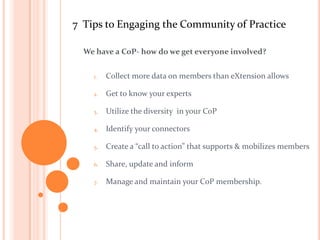

7 Critical Success Factors for Developing Your eXtension Community of Practice Presented by  Marissa Stone, Auburn  University	marissa.stone@gmail.comJerri Caldwell,  Auburn University 	caldwjl@auburn.eduACE/NETC  Ver. 2.011, Denver Colorado
Coming together is a beginning.Keeping together is progress.Working together is success.                                              - Henry Ford
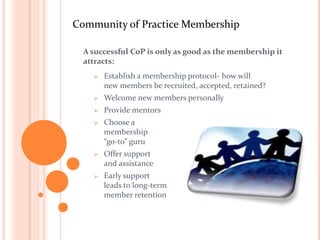
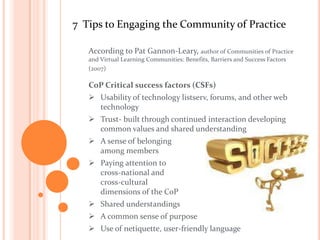
What is a Community of Practice?According to Etienne Wenger [www.ewenger.com]: Communities of practice (CoPs) are groups of people who share a concern or a passion for something they do. Through the CoP they interact regularly learning how to do it better.Three Crucial Characteristics  of CoPs:The Domain (subject): an identity defined by a shared domain of interest. Membership implies a commitment to this domain.The Community (people): In pursuing their interest in their domain, members engage in joint activities and discussions, help each other, and share information.The Practice (action): Members of a community of practice are practitioners. They develop a shared repertoire of resources: experiences, stories, tools, ways of addressing recurring problems—in short a shared practice. This takes time and sustained interaction.
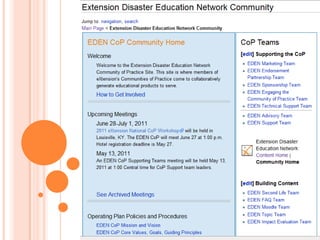
Supporting Syndication and Mobile Interaction
Assessing the Expertise in Membership
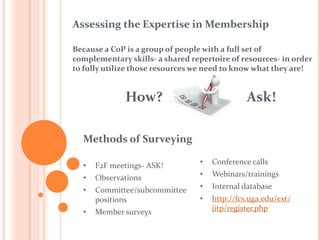
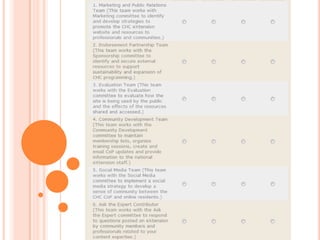
Assessing the Expertise in MembershipBecausea CoP is a group of people with a full set of complementary skills-a shared repertoire of resources- in order to fully utilize those resources we need to know what they are!How?                         Ask!Methods of SurveyingF2F meetings- ASK!
Observations
Committee/subcommittee positions
Member surveys
Conference calls
Webinars/trainings
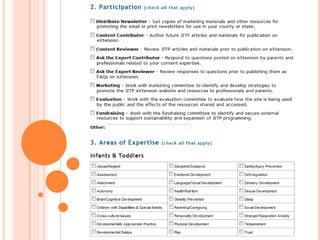
Internal database
http://fcs.uga.edu/ext/jitp/register.php
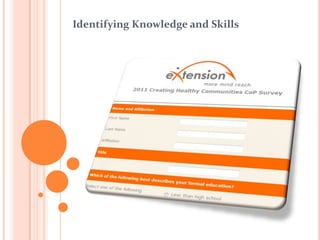
Identifying Knowledge and Skills
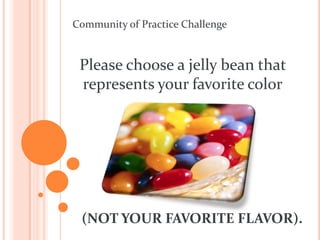
Community of Practice ChallengePlease choose a jelly bean that represents your favorite color(NOT YOUR FAVORITE FLAVOR).
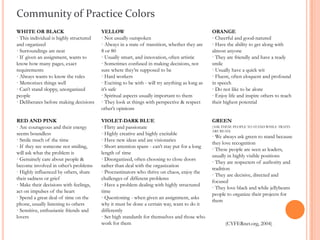
Community of Practice Colors
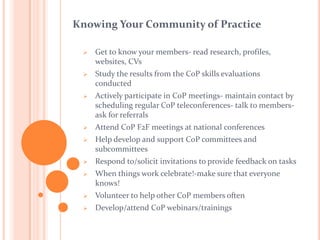
Knowing Your Community of PracticeGet to know your members- read research, profiles, websites, CVs
Study the results from the CoP skills evaluations conducted
Actively participate in CoP meetings- maintain contact by scheduling regular CoP teleconferences- talk to members- ask for referrals
Attend CoP F2F meetings at national conferences

7 critical success_factors_of_co_ps #acenetc2011

  • 1.
    7 Critical SuccessFactors for Developing Your eXtension Community of Practice Presented by Marissa Stone, Auburn University marissa.stone@gmail.comJerri Caldwell, Auburn University caldwjl@auburn.eduACE/NETC Ver. 2.011, Denver Colorado
  • 2.
    Coming together isa beginning.Keeping together is progress.Working together is success. - Henry Ford
  • 3.
    What is aCommunity of Practice?According to Etienne Wenger [www.ewenger.com]: Communities of practice (CoPs) are groups of people who share a concern or a passion for something they do. Through the CoP they interact regularly learning how to do it better.Three Crucial Characteristics of CoPs:The Domain (subject): an identity defined by a shared domain of interest. Membership implies a commitment to this domain.The Community (people): In pursuing their interest in their domain, members engage in joint activities and discussions, help each other, and share information.The Practice (action): Members of a community of practice are practitioners. They develop a shared repertoire of resources: experiences, stories, tools, ways of addressing recurring problems—in short a shared practice. This takes time and sustained interaction.
  • 4.
    Supporting Syndication andMobile Interaction
  • 6.
  • 7.
    Assessing the Expertisein MembershipBecausea CoP is a group of people with a full set of complementary skills-a shared repertoire of resources- in order to fully utilize those resources we need to know what they are!How? Ask!Methods of SurveyingF2F meetings- ASK!
  • 8.
  • 9.
  • 10.
  • 11.
  • 12.
  • 13.
  • 14.
  • 15.
  • 17.
    Community of PracticeChallengePlease choose a jelly bean that represents your favorite color(NOT YOUR FAVORITE FLAVOR).
  • 18.
  • 19.
    Knowing Your Communityof PracticeGet to know your members- read research, profiles, websites, CVs
  • 20.
    Study the resultsfrom the CoP skills evaluations conducted
  • 21.
    Actively participate inCoP meetings- maintain contact by scheduling regular CoP teleconferences- talk to members- ask for referrals
  • 22.
    Attend CoP F2Fmeetings at national conferences