Architectural, Spatial, and
Navigational Metaphors as Design
     Points for Collaboration
             John “Boz” Handy-Bosma, Ph.D.
 Chief Architect for Collaboration, IBM Office of the CIO

              For KM Chicago, May 8, 2012
                                          • May 8, 2012
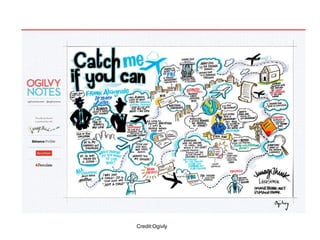
Credit:Ogivly
Credit: Fellowship of the Rich, Flickr
5

    MOSFET Architecture, scaling recipes,
            and Moore’s Law
                     If scaled by   Constant                      Decreased by:

                                                                      K
                   Dimensions                  Circuit delay:

                   Voltages         K          Power/circuit:
                                                                      K

                                                                      K
                   Doping levels               Power delay
                                                 product:
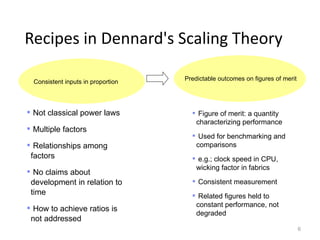
Recipes in Dennard's Scaling Theory

Factors maintained in constant ratio   Predictable outcomes on figures of merit
  Consistent inputs in proportion


 Not classical power laws                Figure of merit: a quantity
                                          characterizing performance
 Multiple factors
                                          Used for benchmarking and
 Relationships among                     comparisons
 factors                                  e.g.; clock speed in CPU,
                                          wicking factor in fabrics
 No claims about
 development in relation to               Consistent measurement
 time                                     Related figures held to
                                          constant performance, not
 How to achieve ratios is
                                          degraded
 not addressed
                                                                                  6
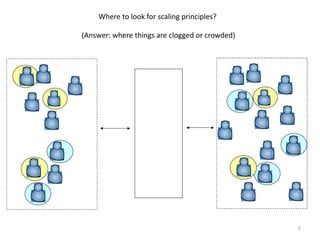
Where to look for scaling principles?

(Answer: where things are clogged or crowded)


                                                7
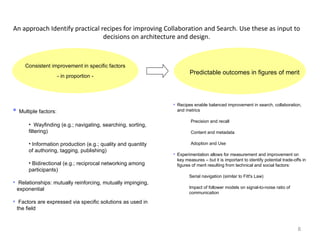
An approach Identify practical recipes for improving Collaboration and Search. Use these as input to
                                decisions on architecture and design.


      Consistent improvement in specific factors
        Factors maintained in constant                                 Predictable outcomes in figures of merit
            ratio(roughly)
                   - in proportion -


                                                                Recipes enable balanced improvement in search, collaboration,
   Multiple factors:                                            and metrics

                                                                       •Precision and recall
        • Wayfinding (e.g.; navigating, searching, sorting,
        filtering)                                                     •Content and metadata

        • Information production (e.g.; quality and quantity           •Adoption and Use
        of authoring, tagging, publishing)
                                                                Experimentation allows for measurement and improvement on
                                                                 key measures – but it is important to identify potential trade-offs in
        • Bidirectional (e.g.; reciprocal networking among       figures of merit resulting from technical and social factors:
        participants)
                                                                       Serial navigation (similar to Fitt's Law)
 Relationships: mutually reinforcing, mutually impinging,
  exponential                                                          Impact of follower models on signal-to-noise ratio of
                                                                       communication

 Factors are expressed via specific solutions as used in
  the field


                                                                                                                                  8
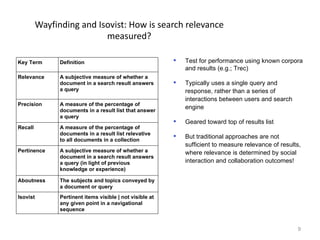
Wayfinding and Isovist: How is search relevance
                          measured?

Key Term       Definition                                    Test for performance using known corpora
                                                              and results (e.g.; Trec)
Relevance      A subjective measure of whether a
               document in a search result answers           Typically uses a single query and
               a query                                        response, rather than a series of
                                                              interactions between users and search
Precision      A measure of the percentage of
               documents in a result list that answer
                                                              engine
               a query
                                                             Geared toward top of results list
Recall         A measure of the percentage of
               documents in a result list relevative
                                                             But traditional approaches are not
               to all documents in a collection
                                                              sufficient to measure relevance of results,
Pertinence     A subjective measure of whether a              where relevance is determined by social
               document in a search result answers
               a query (in light of previous                  interaction and collaboration outcomes!
               knowledge or experience)

Aboutness      The subjects and topics conveyed by
               a document or query
Isovist        Pertinent items visible | not visible at
               any given point in a navigational
               sequence


                                                                                                       9
11


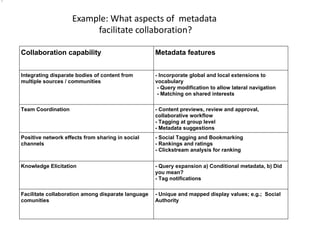
                         Example: What aspects of metadata
                              facilitate collaboration?

     Collaboration capability                            Metadata features


     Integrating disparate bodies of content from        - Incorporate global and local extensions to
     multiple sources / communities                      vocabulary
                                                         -- Query modification to allow lateral navigation
                                                         -- Matching on shared interests

     Team Coordination                                   - Content previews, review and approval,
                                                         collaborative workflow
                                                         - Tagging at group level
                                                         - Metadata suggestions
     Positive network effects from sharing in social     - Social Tagging and Bookmarking
     channels                                            - Rankings and ratings
                                                         - Clickstream analysis for ranking


     Knowledge Elicitation                               - Query expansion a) Conditional metadata, b) Did
                                                         you mean?
                                                         - Tag notifications

     Facilitate collaboration among disparate language   - Unique and mapped display values; e.g.; Social
     comunities                                          Authority
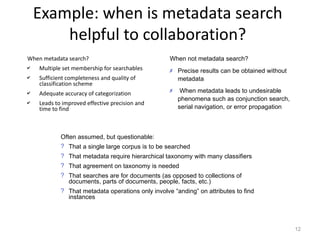
Example: when is metadata search
        helpful to collaboration?
When metadata search?                              When not metadata search?
✔   Multiple set membership for searchables        ✗ Precise results can be obtained without
✔   Sufficient completeness and quality of           metadata
    classification scheme
                                                   ✗    When metadata leads to undesirable
✔   Adequate accuracy of categorization
                                                       phenomena such as conjunction search,
✔   Leads to improved effective precision and
    time to find                                       serial navigation, or error propagation


            Often assumed, but questionable:
            ? That a single large corpus is to be searched
            ? That metadata require hierarchical taxonomy with many classifiers
            ? That agreement on taxonomy is needed
            ? That searches are for documents (as opposed to collections of
              documents, parts of documents, people, facts, etc.)
            ? That metadata operations only involve “anding” on attributes to find
              instances


                                                                                                 12
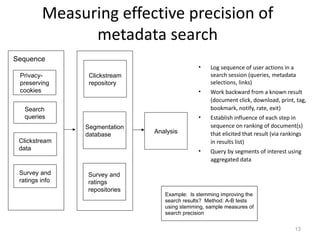
Measuring effective precision of
               metadata search
Sequence
                                              •    Log sequence of user actions in a
 Privacy-        Clickstream                       search session (queries, metadata
 preserving      repository                        selections, links)
 cookies                                      •    Work backward from a known result
                                                   (document click, download, print, tag,
   Search                                          bookmark, notify, rate, exit)
   queries                                    •    Establish influence of each step in
                Segmentation                       sequence on ranking of document(s)
                               Analysis            that elicited that result (via rankings
                database
 Clickstream                                       in results list)
 data                                         •    Query by segments of interest using
                                                   aggregated data

 Survey and     Survey and
 ratings info   ratings
                repositories
                                  Example: Is stemming improving the
                                  search results? Method: A-B tests
                                  using stemming, sample measures of
                                  search precision


                                                                                      13
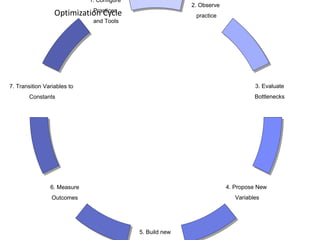
1. Configure
                                                           2. Observe
                  Optimization Cycle
                            Practices
                                                            practice
                              and Tools


7. Transition Variables to                                                        3. Evaluate
        Constants                                                                 Bottlenecks


                6. Measure                                              4. Propose New
                 Outcomes                                                  Variables


                                            5. Build new

Metaphors as design points for collaboration 2012

  • 1.
    Architectural, Spatial, and NavigationalMetaphors as Design Points for Collaboration John “Boz” Handy-Bosma, Ph.D. Chief Architect for Collaboration, IBM Office of the CIO For KM Chicago, May 8, 2012 • May 8, 2012
  • 2.
  • 3.
    Credit: Fellowship ofthe Rich, Flickr
  • 5.
    5 MOSFET Architecture, scaling recipes, and Moore’s Law If scaled by Constant Decreased by: K  Dimensions  Circuit delay:  Voltages K  Power/circuit: K K  Doping levels  Power delay product:
  • 6.
    Recipes in Dennard'sScaling Theory Factors maintained in constant ratio Predictable outcomes on figures of merit Consistent inputs in proportion  Not classical power laws  Figure of merit: a quantity characterizing performance  Multiple factors  Used for benchmarking and  Relationships among comparisons factors  e.g.; clock speed in CPU, wicking factor in fabrics  No claims about development in relation to  Consistent measurement time  Related figures held to constant performance, not  How to achieve ratios is degraded not addressed 6
  • 7.
    Where to lookfor scaling principles? (Answer: where things are clogged or crowded) 7
  • 8.
    An approach Identifypractical recipes for improving Collaboration and Search. Use these as input to decisions on architecture and design. Consistent improvement in specific factors Factors maintained in constant Predictable outcomes in figures of merit ratio(roughly) - in proportion -  Recipes enable balanced improvement in search, collaboration,  Multiple factors: and metrics •Precision and recall • Wayfinding (e.g.; navigating, searching, sorting, filtering) •Content and metadata • Information production (e.g.; quality and quantity •Adoption and Use of authoring, tagging, publishing)  Experimentation allows for measurement and improvement on key measures – but it is important to identify potential trade-offs in • Bidirectional (e.g.; reciprocal networking among figures of merit resulting from technical and social factors: participants) Serial navigation (similar to Fitt's Law)  Relationships: mutually reinforcing, mutually impinging, exponential Impact of follower models on signal-to-noise ratio of communication  Factors are expressed via specific solutions as used in the field 8
  • 9.
    Wayfinding and Isovist:How is search relevance measured? Key Term Definition  Test for performance using known corpora and results (e.g.; Trec) Relevance A subjective measure of whether a document in a search result answers  Typically uses a single query and a query response, rather than a series of interactions between users and search Precision A measure of the percentage of documents in a result list that answer engine a query  Geared toward top of results list Recall A measure of the percentage of documents in a result list relevative  But traditional approaches are not to all documents in a collection sufficient to measure relevance of results, Pertinence A subjective measure of whether a where relevance is determined by social document in a search result answers a query (in light of previous interaction and collaboration outcomes! knowledge or experience) Aboutness The subjects and topics conveyed by a document or query Isovist Pertinent items visible | not visible at any given point in a navigational sequence 9
  • 11.
    11 Example: What aspects of metadata facilitate collaboration? Collaboration capability Metadata features Integrating disparate bodies of content from - Incorporate global and local extensions to multiple sources / communities vocabulary -- Query modification to allow lateral navigation -- Matching on shared interests Team Coordination - Content previews, review and approval, collaborative workflow - Tagging at group level - Metadata suggestions Positive network effects from sharing in social - Social Tagging and Bookmarking channels - Rankings and ratings - Clickstream analysis for ranking Knowledge Elicitation - Query expansion a) Conditional metadata, b) Did you mean? - Tag notifications Facilitate collaboration among disparate language - Unique and mapped display values; e.g.; Social comunities Authority
  • 12.
    Example: when ismetadata search helpful to collaboration? When metadata search? When not metadata search? ✔ Multiple set membership for searchables ✗ Precise results can be obtained without ✔ Sufficient completeness and quality of metadata classification scheme ✗ When metadata leads to undesirable ✔ Adequate accuracy of categorization phenomena such as conjunction search, ✔ Leads to improved effective precision and time to find serial navigation, or error propagation Often assumed, but questionable: ? That a single large corpus is to be searched ? That metadata require hierarchical taxonomy with many classifiers ? That agreement on taxonomy is needed ? That searches are for documents (as opposed to collections of documents, parts of documents, people, facts, etc.) ? That metadata operations only involve “anding” on attributes to find instances 12
  • 13.
    Measuring effective precisionof metadata search Sequence • Log sequence of user actions in a Privacy- Clickstream search session (queries, metadata preserving repository selections, links) cookies • Work backward from a known result (document click, download, print, tag, Search bookmark, notify, rate, exit) queries • Establish influence of each step in Segmentation sequence on ranking of document(s) Analysis that elicited that result (via rankings database Clickstream in results list) data • Query by segments of interest using aggregated data Survey and Survey and ratings info ratings repositories Example: Is stemming improving the search results? Method: A-B tests using stemming, sample measures of search precision 13
  • 14.
    1. Configure 2. Observe Optimization Cycle Practices practice and Tools 7. Transition Variables to 3. Evaluate Constants Bottlenecks 6. Measure 4. Propose New Outcomes Variables 5. Build new

Editor's Notes

  • #5 Credit @adrants, John Sword, Andrson, Flickr.
  • #11 Credit: kimballphoto, Flickr