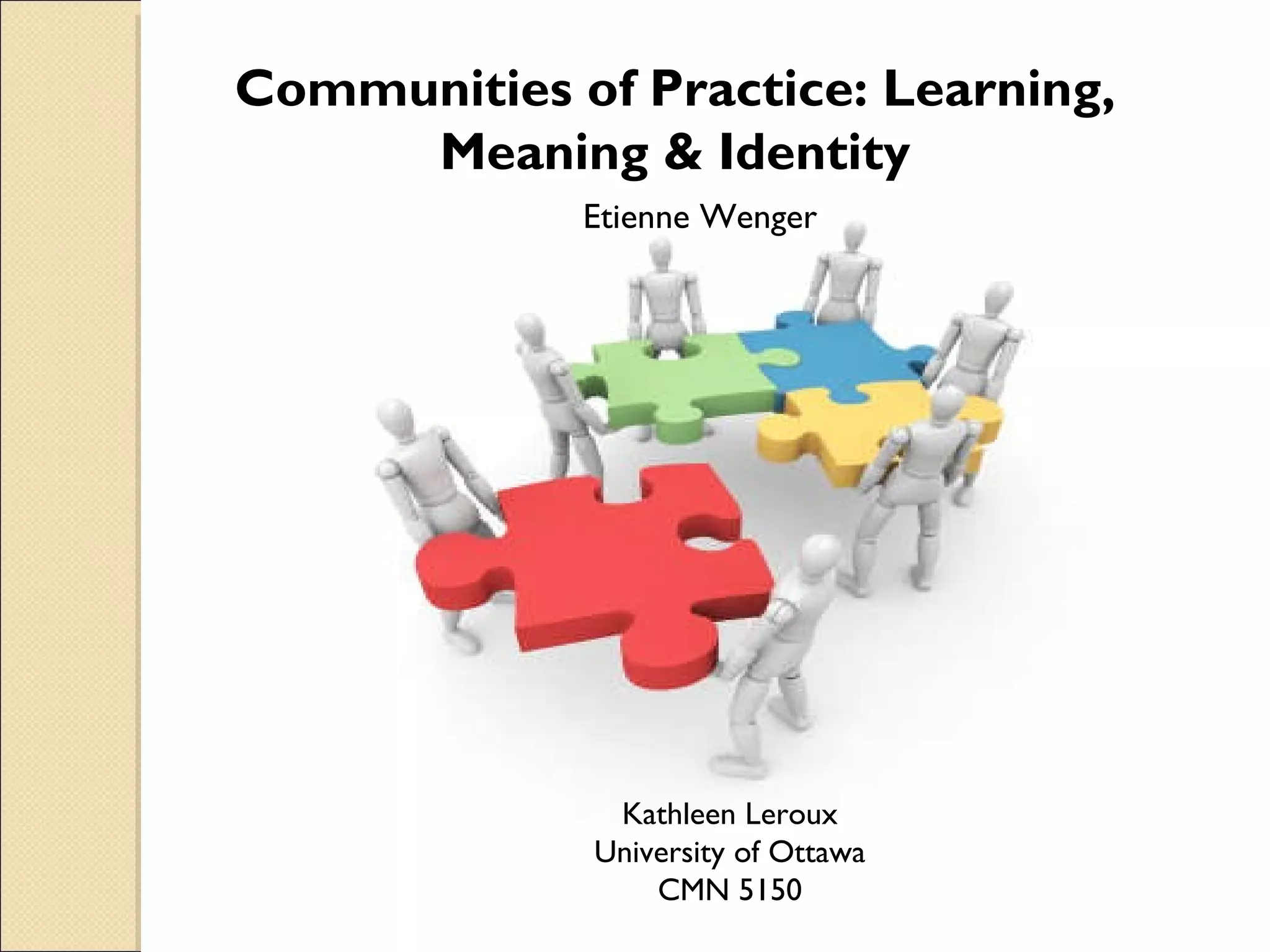
Communities of Practice: Learning, Meaning & Identity Etienne Wenger Kathleen Leroux University of Ottawa CMN 5150
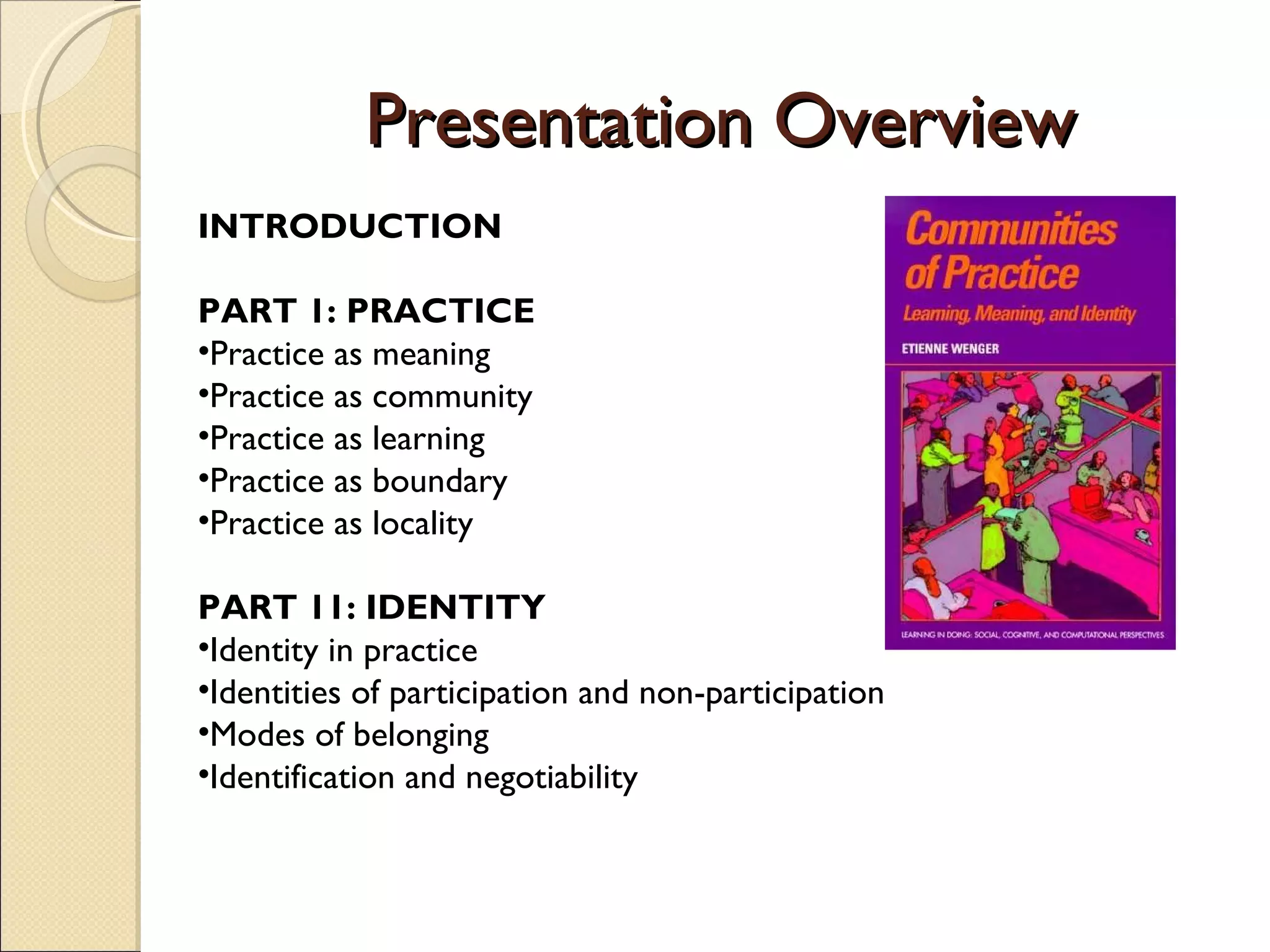
Presentation Overview INTRODUCTION PART 1: PRACTICE Practice as meaning Practice as community Practice as learning Practice as boundary Practice as locality PART 11: IDENTITY Identity in practice Identities of participation and non-participation  Modes of belonging Identification and negotiability
Introduction A theory of learning as a process of social participation Analysis centered on the “informal communities of practice that people form as they pursue shared enterprises over time”  Notion of practice refers to level of social structure that reflects shared learning “ The concept of practice connotes doing, but not just doing in and of itself. It is doing in a historical and social context that gives structure and meaning to what we do.”  (p.47) Concept of practice includes both the explicit and tacit
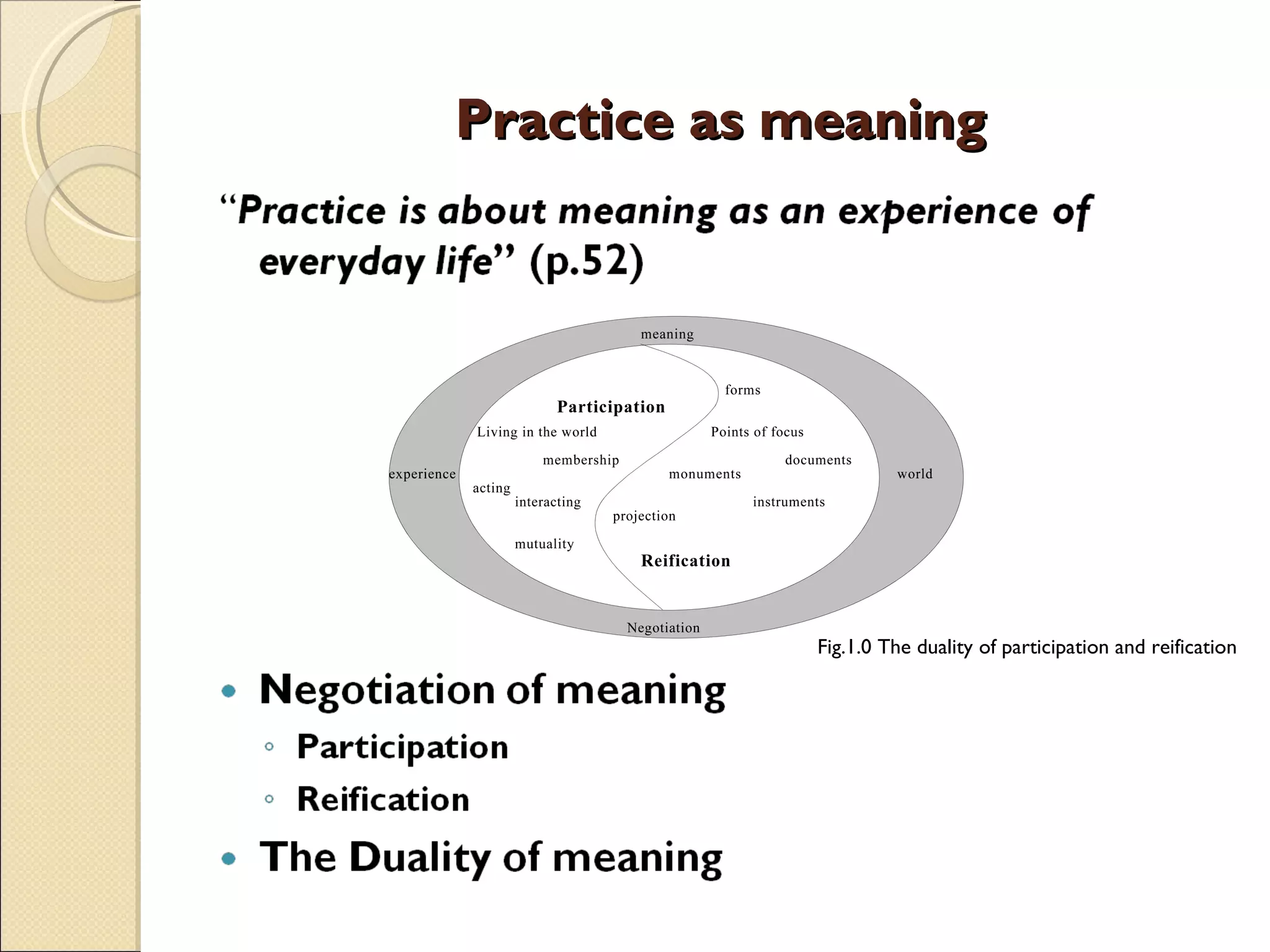
Practice as meaning Fig.1.0 The duality of participation and reification
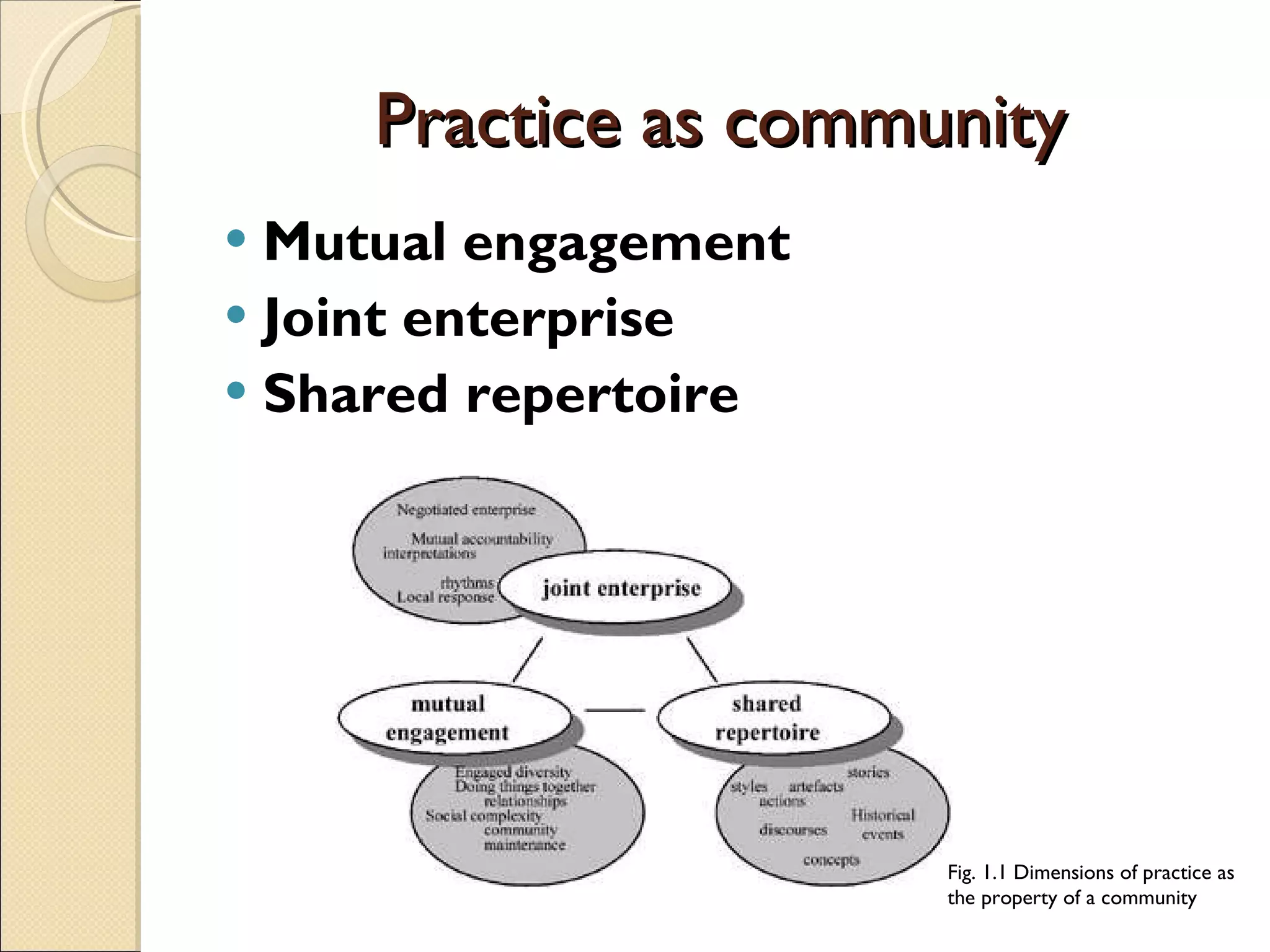
Practice as community Mutual engagement Joint enterprise Shared repertoire Fig. 1.1 Dimensions of practice as the property of a community
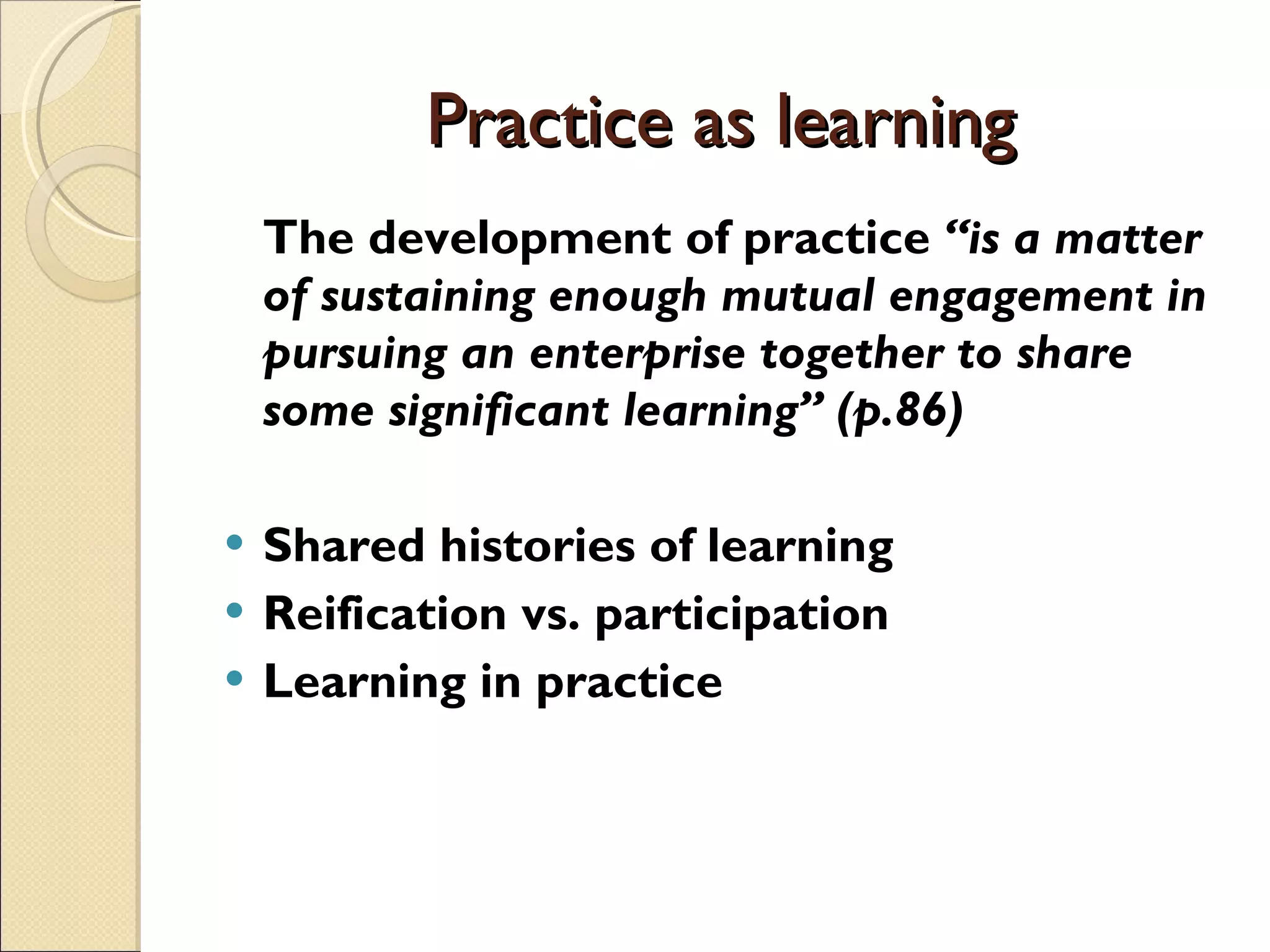
Practice as learning The development of practice  “is a matter of sustaining enough mutual engagement in pursuing an enterprise together to share some significant learning” (p.86) Shared histories of learning Reification vs. participation Learning in practice
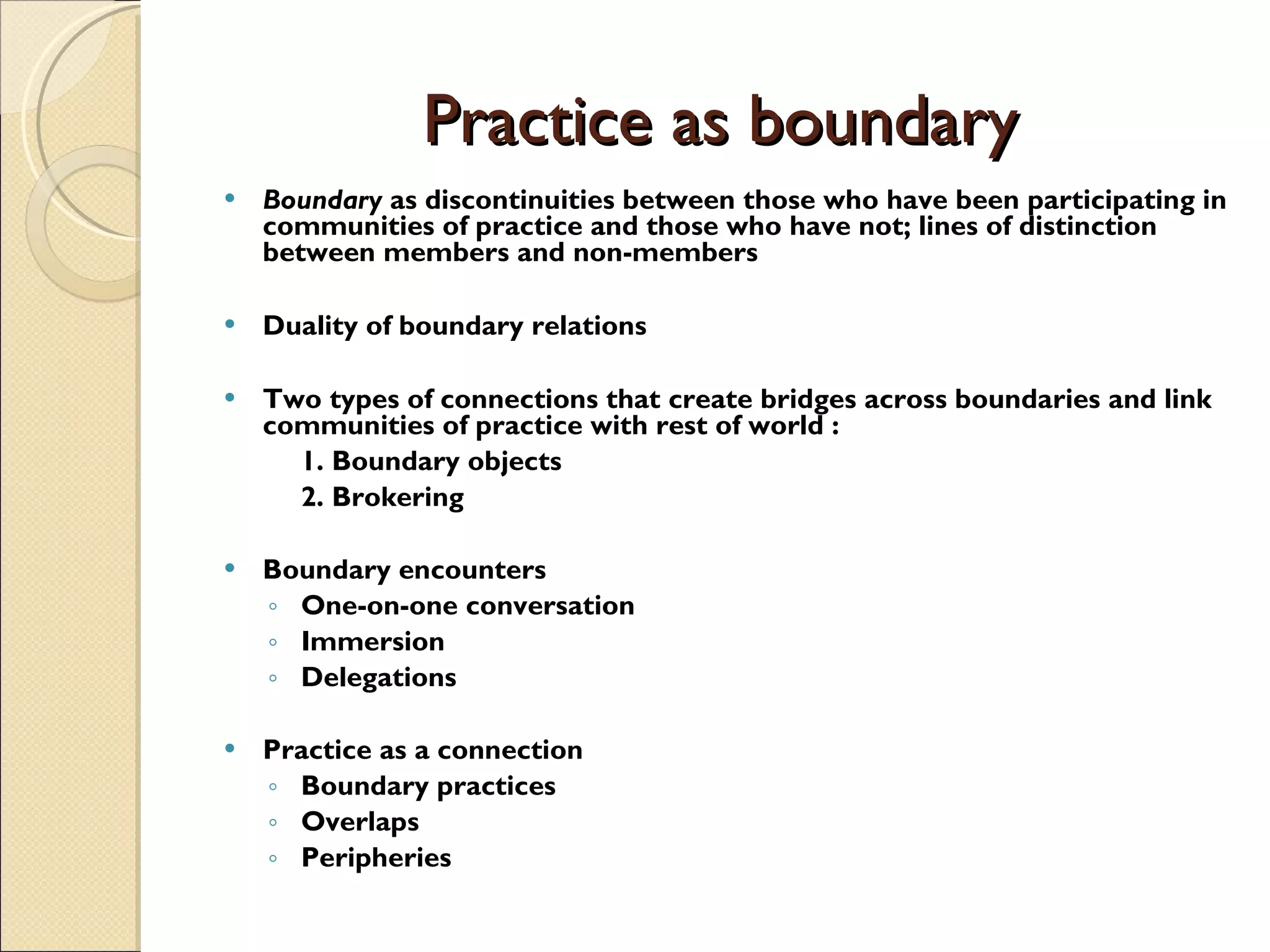
Practice as boundary Boundary  as discontinuities between those who have been participating in communities of practice and those who have not; lines of distinction between members and non-members Duality of boundary relations Two types of connections that create bridges across boundaries and link communities of practice with rest of world   : 1. Boundary objects 2. Brokering Boundary encounters One-on-one conversation Immersion Delegations Practice as a connection Boundary practices Overlaps Peripheries
Practice as locality Community of practice Constellations of communities of practice Indicators a community of practice has formed
Identity in practice Wenger’s perspective of identity   “does justice to the lived experience of identity while recognizing its social character- it is the social, the cultural, the historical with a human face”  (p.145) Parallels between practice and identity Identity as negotiated experience Identity as community membership Identity as learning trajectory Identity as nexus of multimembership Identity as a relation between the local and global
Participation and non-participation Not only do we produce our identities through practices we engage in, we also define ourselves through practices we do not engage in Interaction of participation and non-participation Peripherality Marginality Institutional non-participation Non-participation as compromise Non-participation as strategy Non-participation as cover Non-participation as practice
Modes of belonging Notion of belonging extended beyond local communities of practice Three modes of belonging: Engagement Imagination Alignment
Identification and negotiability Identity formation as a dual process of identification and negotiability Identification Negotiability Economies of meaning Ownership of meaning Inherent tension between the dual process Internal vs. external
Related Links http://www.youtube.com/watch?v=qjw0YoqpEq8 http://www.ewenger.com/theory/ http://www.asaecenter.org/Resources/JALArticleDetail.cfm?ItemNumber=16217 http://www.timhoogenboom.nl/?p=287 http://www.infed.org/biblio/communities_of_practice.htm http://www.biomedcentral.com/content/pdf/1472-6963-10-3.pdf http://www.co-i-l.com/coil/knowledge-garden/cop/lss.shtml http://www.learning-theories.com/communities-of-practice-lave-and-wenger.html http://www.jstor.org/pss/40248418 http://www0.hku.hk/curric/amytsui/bk_reviews/docs/The_complexities_of_identity_formation.pdf

Communities of practice presentation

  • 1.
    Communities of Practice:Learning, Meaning & Identity Etienne Wenger Kathleen Leroux University of Ottawa CMN 5150
  • 2.
    Presentation Overview INTRODUCTIONPART 1: PRACTICE Practice as meaning Practice as community Practice as learning Practice as boundary Practice as locality PART 11: IDENTITY Identity in practice Identities of participation and non-participation Modes of belonging Identification and negotiability
  • 3.
    Introduction A theoryof learning as a process of social participation Analysis centered on the “informal communities of practice that people form as they pursue shared enterprises over time” Notion of practice refers to level of social structure that reflects shared learning “ The concept of practice connotes doing, but not just doing in and of itself. It is doing in a historical and social context that gives structure and meaning to what we do.” (p.47) Concept of practice includes both the explicit and tacit
  • 4.
    Practice as meaningFig.1.0 The duality of participation and reification
  • 5.
    Practice as communityMutual engagement Joint enterprise Shared repertoire Fig. 1.1 Dimensions of practice as the property of a community
  • 6.
    Practice as learningThe development of practice “is a matter of sustaining enough mutual engagement in pursuing an enterprise together to share some significant learning” (p.86) Shared histories of learning Reification vs. participation Learning in practice
  • 7.
    Practice as boundaryBoundary as discontinuities between those who have been participating in communities of practice and those who have not; lines of distinction between members and non-members Duality of boundary relations Two types of connections that create bridges across boundaries and link communities of practice with rest of world : 1. Boundary objects 2. Brokering Boundary encounters One-on-one conversation Immersion Delegations Practice as a connection Boundary practices Overlaps Peripheries
  • 8.
    Practice as localityCommunity of practice Constellations of communities of practice Indicators a community of practice has formed
  • 9.
    Identity in practiceWenger’s perspective of identity “does justice to the lived experience of identity while recognizing its social character- it is the social, the cultural, the historical with a human face” (p.145) Parallels between practice and identity Identity as negotiated experience Identity as community membership Identity as learning trajectory Identity as nexus of multimembership Identity as a relation between the local and global
  • 10.
    Participation and non-participationNot only do we produce our identities through practices we engage in, we also define ourselves through practices we do not engage in Interaction of participation and non-participation Peripherality Marginality Institutional non-participation Non-participation as compromise Non-participation as strategy Non-participation as cover Non-participation as practice
  • 11.
    Modes of belongingNotion of belonging extended beyond local communities of practice Three modes of belonging: Engagement Imagination Alignment
  • 12.
    Identification and negotiabilityIdentity formation as a dual process of identification and negotiability Identification Negotiability Economies of meaning Ownership of meaning Inherent tension between the dual process Internal vs. external
  • 13.
    Related Links http://www.youtube.com/watch?v=qjw0YoqpEq8http://www.ewenger.com/theory/ http://www.asaecenter.org/Resources/JALArticleDetail.cfm?ItemNumber=16217 http://www.timhoogenboom.nl/?p=287 http://www.infed.org/biblio/communities_of_practice.htm http://www.biomedcentral.com/content/pdf/1472-6963-10-3.pdf http://www.co-i-l.com/coil/knowledge-garden/cop/lss.shtml http://www.learning-theories.com/communities-of-practice-lave-and-wenger.html http://www.jstor.org/pss/40248418 http://www0.hku.hk/curric/amytsui/bk_reviews/docs/The_complexities_of_identity_formation.pdf