Lisa BeckersMarch 2011Learning and Knowledge AlignmentOpportunities across blurred boundaries
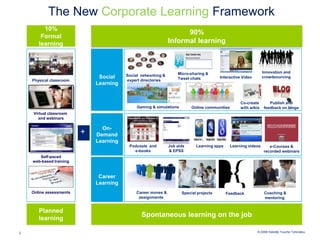
The New Corporate LearningFramework10% Formal learning90%Informal learningSocial LearningInnovation and crowdsourcingMicro-sharing &Tweet chatsSocial  networking & expert directoriesPhysical classroomInteractive VideoPublish and feedback on blogsCo-create with wikis        Gaming & simulations Online communities  Virtual classroom and webinarsOn-DemandLearning +Learning Learning appsPodcasts  and  e-books Job aids & EPSS Learning videose-Courses & recorded webinarsSelf-paced web-based training CareerLearning Online assessments  Career moves & assignmentsSpecial projects Coaching & mentoringFeedbackSpontaneous learning on the jobPlanned learning2
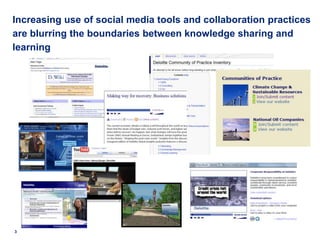
3Increasing use of social media tools and collaboration practices are blurring the boundaries between knowledge sharing and learning
ApproachConduct external research to identify learnings and leading practices from organizations who have implemented similar joint Learning-KM models Conduct internal assessment to understand the landscape and opportunities within current alignment between Learning & KM within DeloitteDefine vision and propose recommendations based on input from KM and Learning stakeholders from member firms, global functions and global industries4
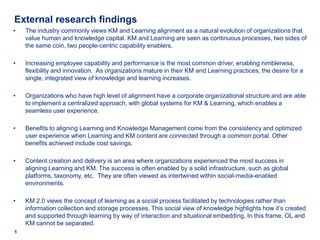
External research findingsThe industry commonly views KM and Learning alignment as a natural evolution of organizations that value human and knowledge capital. KM and Learning are seen as continuous processes, two sides of the same coin, two people-centric capability enablers.
Increasing employee capability and performance is the most common driver, enabling nimbleness, flexibility and innovation.  As organizations mature in their KM and Learning practices, the desire for a single, integrated view of knowledge and learning increases.
Organizations who have high level of alignment have a corporate organizational structure and are able to implement a centralized approach, with global systems for KM & Learning, which enables a seamless user experience.
Benefits to aligning Learning and Knowledge Management come from the consistency and optimized user experience when Learning and KM content are connected through a common portal. Other benefits achieved include cost savings.
Content creation and delivery is an area where organizations experienced the most success in aligning Learning and KM. The success is often enabled by a solid infrastructure, such as global platforms, taxonomy, etc.  They are often viewed as intertwined within social-media-enabled environments.
KM 2.0 views the concept of learning as a social process facilitated by technologies rather than information collection and storage processes. This social view of knowledge highlights how it’s created and supported through learning by way of interaction and situational embedding. In this frame, OL and KM cannot be separated. 5
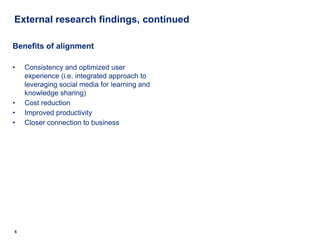
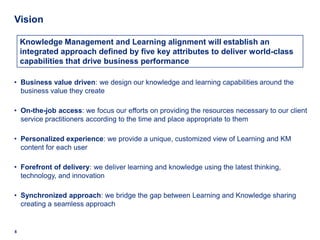
External research findings, continuedBenefits of alignmentConsistency and optimized user experience (i.e. integrated approach to leveraging social media for learning and knowledge sharing)

Learning and Knowledge Alignment

  • 1.
    Lisa BeckersMarch 2011Learningand Knowledge AlignmentOpportunities across blurred boundaries
  • 2.
    The New CorporateLearningFramework10% Formal learning90%Informal learningSocial LearningInnovation and crowdsourcingMicro-sharing &Tweet chatsSocial networking & expert directoriesPhysical classroomInteractive VideoPublish and feedback on blogsCo-create with wikis Gaming & simulations Online communities Virtual classroom and webinarsOn-DemandLearning +Learning Learning appsPodcasts and e-books Job aids & EPSS Learning videose-Courses & recorded webinarsSelf-paced web-based training CareerLearning Online assessments Career moves & assignmentsSpecial projects Coaching & mentoringFeedbackSpontaneous learning on the jobPlanned learning2
  • 3.
    3Increasing use ofsocial media tools and collaboration practices are blurring the boundaries between knowledge sharing and learning
  • 4.
    ApproachConduct external researchto identify learnings and leading practices from organizations who have implemented similar joint Learning-KM models Conduct internal assessment to understand the landscape and opportunities within current alignment between Learning & KM within DeloitteDefine vision and propose recommendations based on input from KM and Learning stakeholders from member firms, global functions and global industries4
  • 5.
    External research findingsTheindustry commonly views KM and Learning alignment as a natural evolution of organizations that value human and knowledge capital. KM and Learning are seen as continuous processes, two sides of the same coin, two people-centric capability enablers.
  • 6.
    Increasing employee capabilityand performance is the most common driver, enabling nimbleness, flexibility and innovation. As organizations mature in their KM and Learning practices, the desire for a single, integrated view of knowledge and learning increases.
  • 7.
    Organizations who havehigh level of alignment have a corporate organizational structure and are able to implement a centralized approach, with global systems for KM & Learning, which enables a seamless user experience.
  • 8.
    Benefits to aligningLearning and Knowledge Management come from the consistency and optimized user experience when Learning and KM content are connected through a common portal. Other benefits achieved include cost savings.
  • 9.
    Content creation anddelivery is an area where organizations experienced the most success in aligning Learning and KM. The success is often enabled by a solid infrastructure, such as global platforms, taxonomy, etc. They are often viewed as intertwined within social-media-enabled environments.
  • 10.
    KM 2.0 viewsthe concept of learning as a social process facilitated by technologies rather than information collection and storage processes. This social view of knowledge highlights how it’s created and supported through learning by way of interaction and situational embedding. In this frame, OL and KM cannot be separated. 5
  • 11.
    External research findings,continuedBenefits of alignmentConsistency and optimized user experience (i.e. integrated approach to leveraging social media for learning and knowledge sharing)

Editor's Notes

  • #5 Accenture, HP, IBM, KPMG, Cisco, Conference Board, Air Products, World Bank
  • #10 Identify pilot projects to test the concept, approach, value, and benefit and gauge the level of interest and commitment from the relevant stakeholders participating.