Building a Change
Community of
Practice
Presented by:
Catherine Smithson
Managing Director
February 2017
Change Community
of Practice Webinars
Introducing Being Human
•  Founded in 1993
•  Our mission: develop
change-capable people
and organisations so they
achieve the benefits of
change
2
Agenda
•  What is a Change
Community of Practice?
•  Benefits
•  Tip 5 tips for success
•  Q&A
3
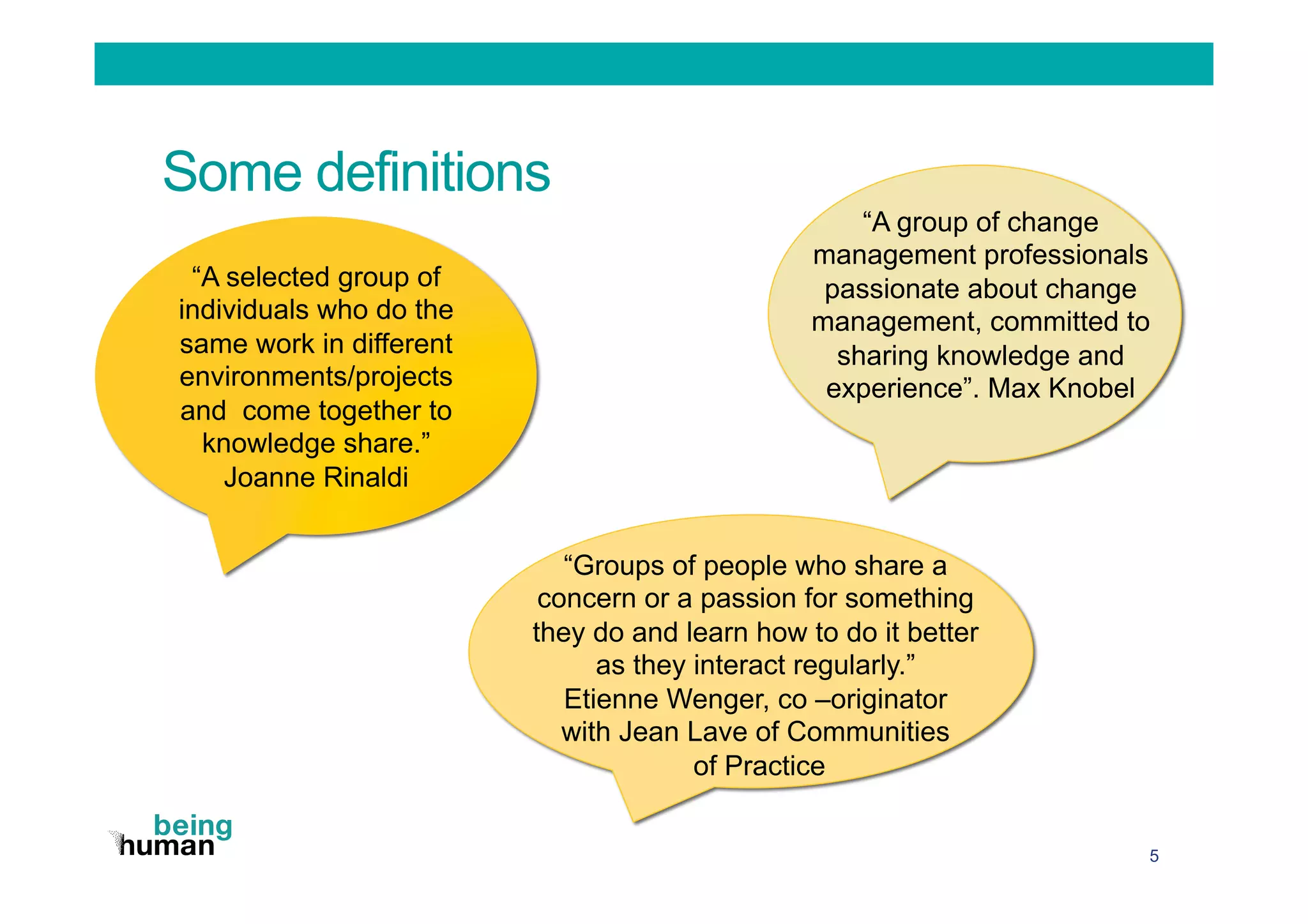
Some definitions
5
“A selected group of
individuals who do the
same work in different
environments/projects
and come together to
knowledge share.”
Joanne Rinaldi
“A group of change
management professionals
passionate about change
management, committed to
sharing knowledge and
experience”. Max Knobel
“Groups of people who share a
concern or a passion for something
they do and learn how to do it better
as they interact regularly.”
Etienne Wenger, co –originator
with Jean Lave of Communities
of Practice
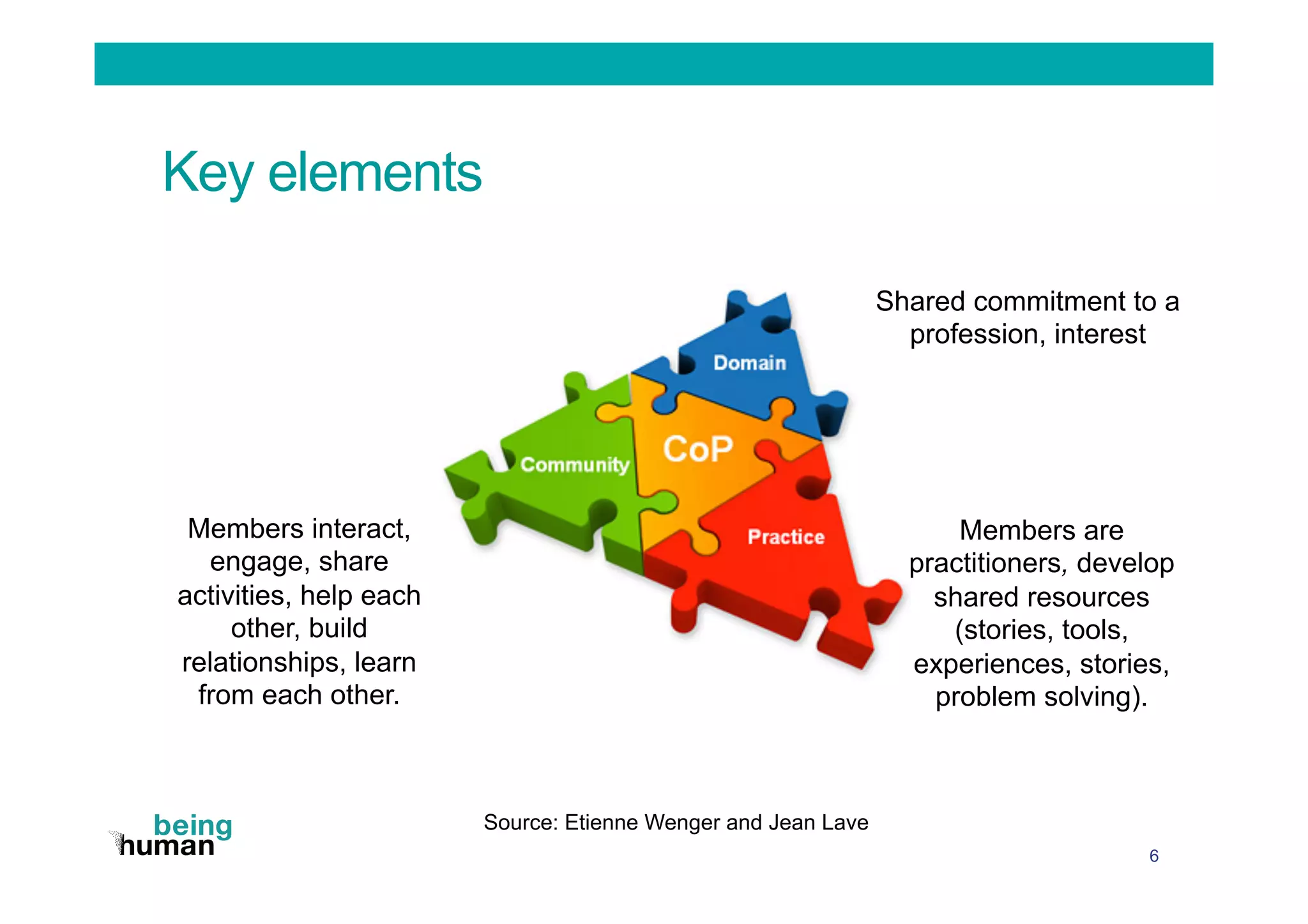
Key elements
Members are
practitioners, develop
shared resources
(stories, tools,
experiences, stories,
problem solving).
6
Members interact,
engage, share
activities, help each
other, build
relationships, learn
from each other.
Shared commitment to a
profession, interest
Source: Etienne Wenger and Jean Lave
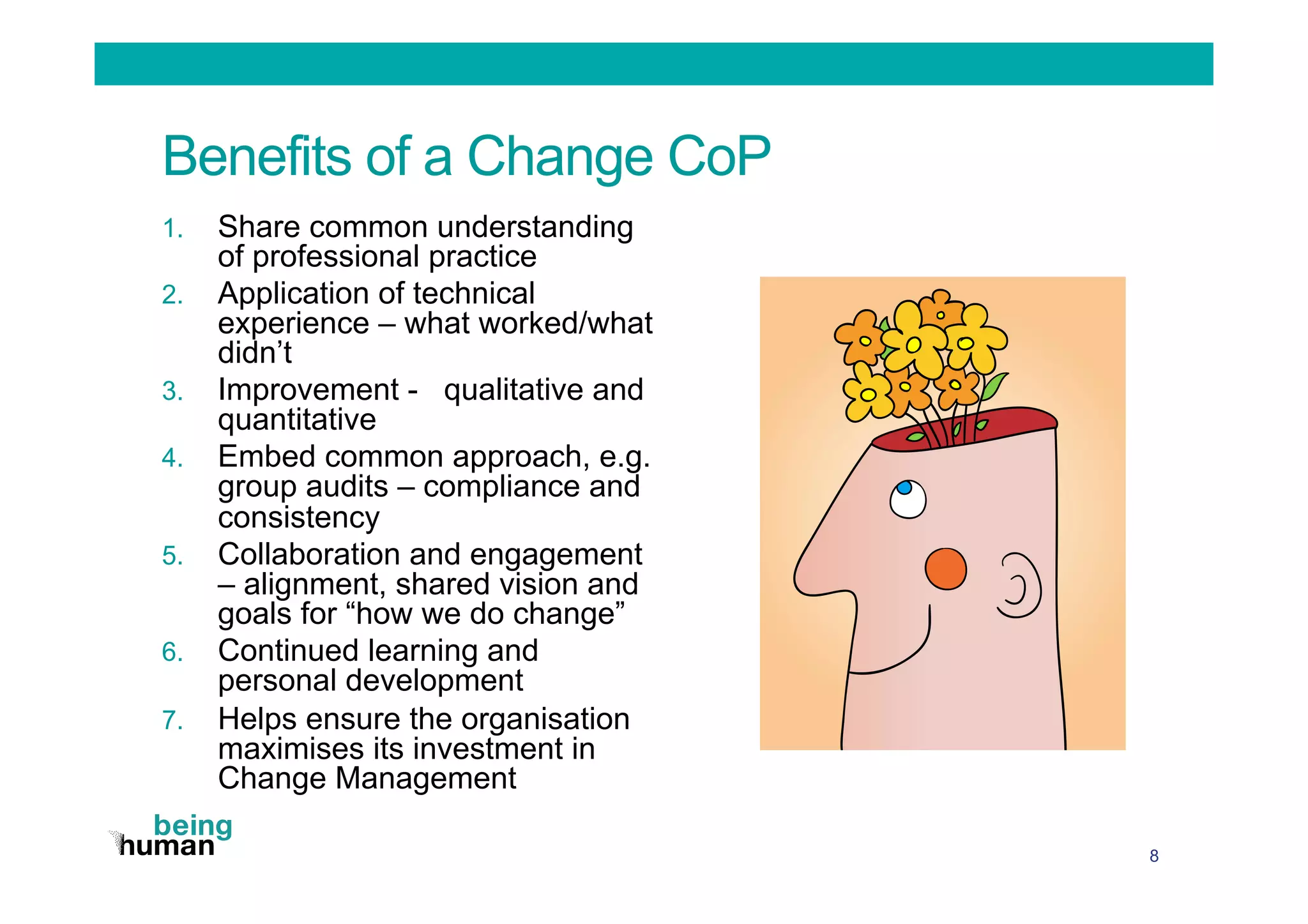
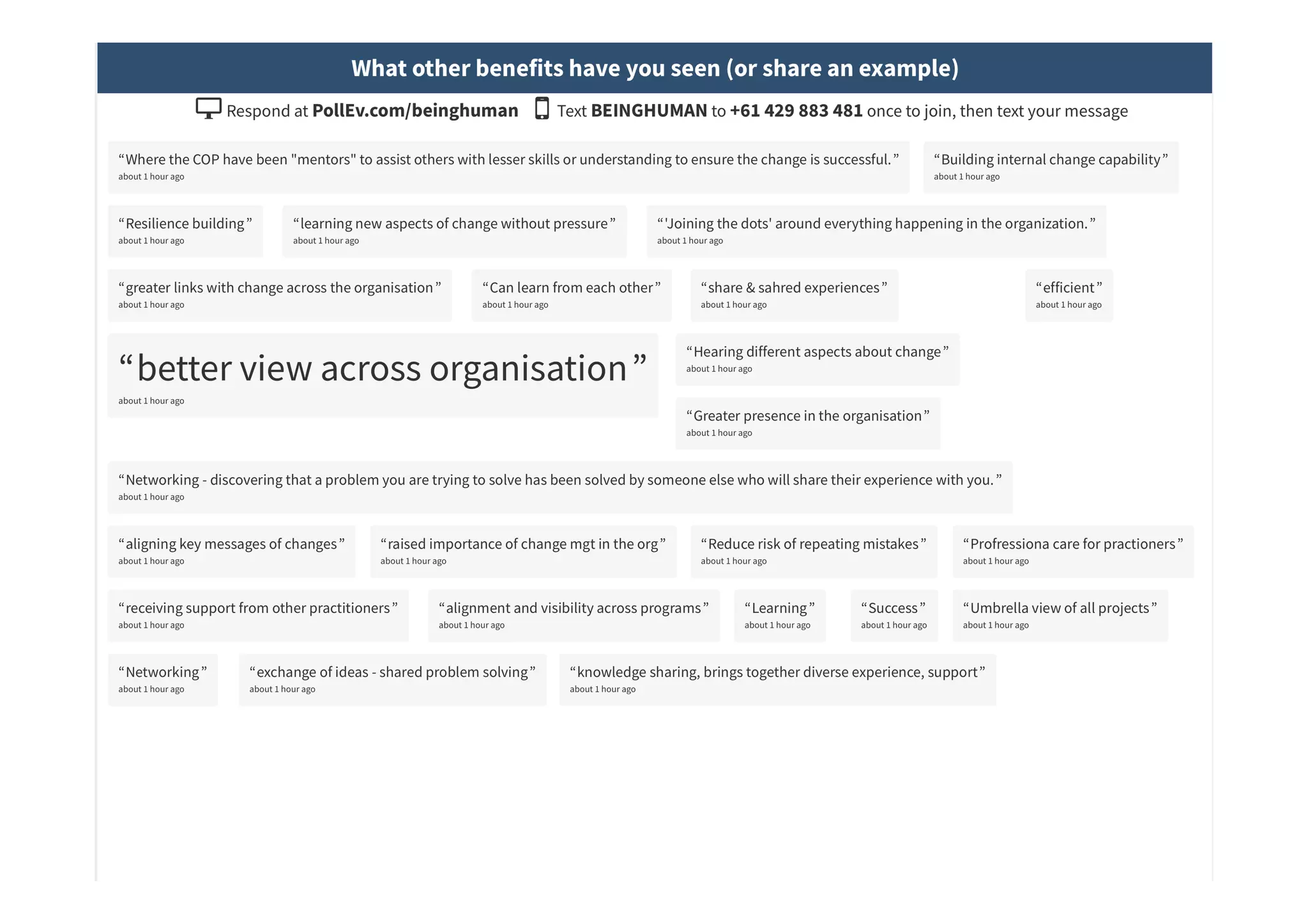
Benefits of a Change CoP
1.  Share common understanding
of professional practice
2.  Application of technical
experience – what worked/what
didn’t
3.  Improvement - qualitative and
quantitative
4.  Embed common approach, e.g.
group audits – compliance and
consistency
5.  Collaboration and engagement
– alignment, shared vision and
goals for “how we do change”
6.  Continued learning and
personal development
7.  Helps ensure the organisation
maximises its investment in
Change Management
8
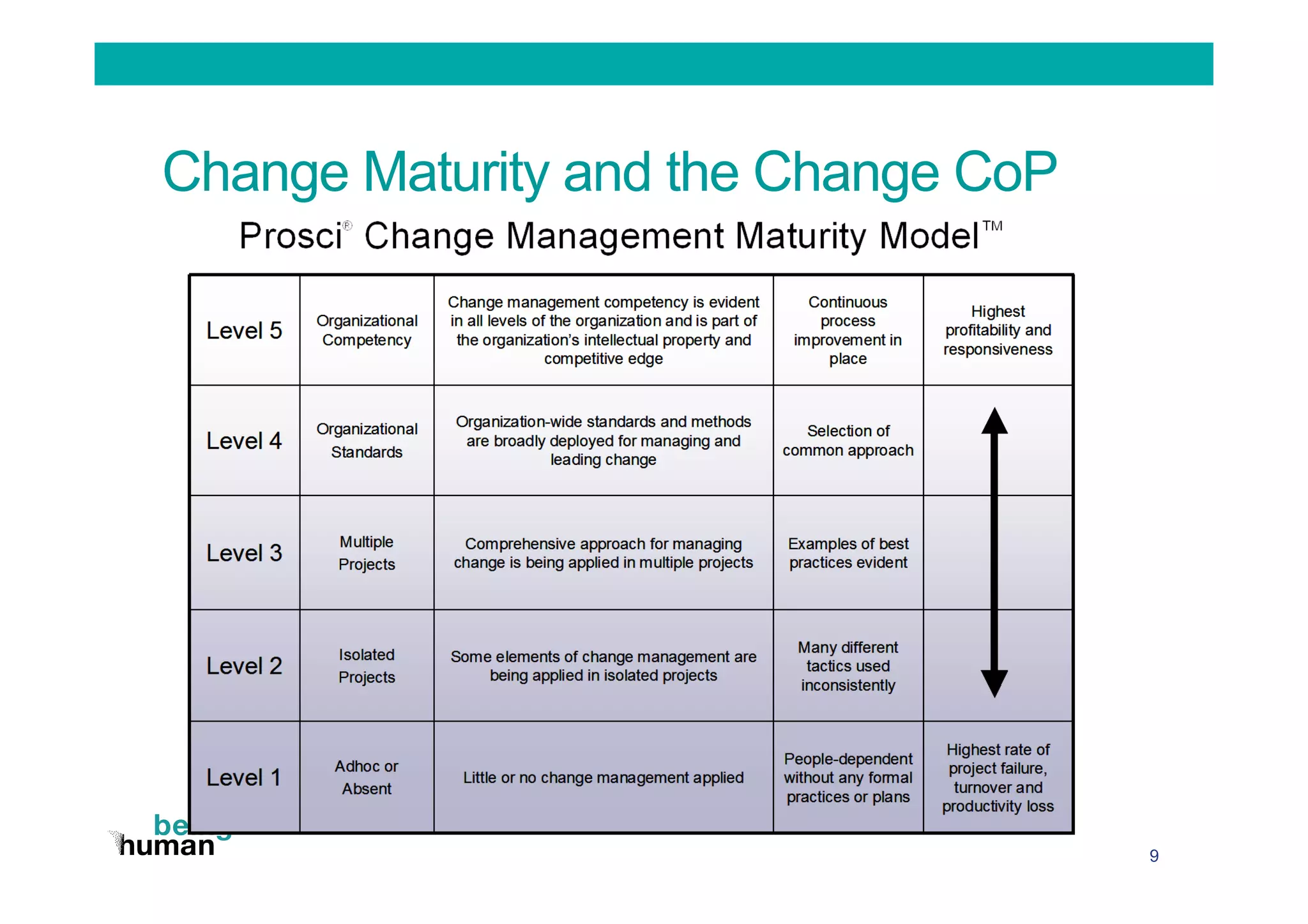
Change Maturity and the Change CoP
9
The CoP will evolve as maturity builds
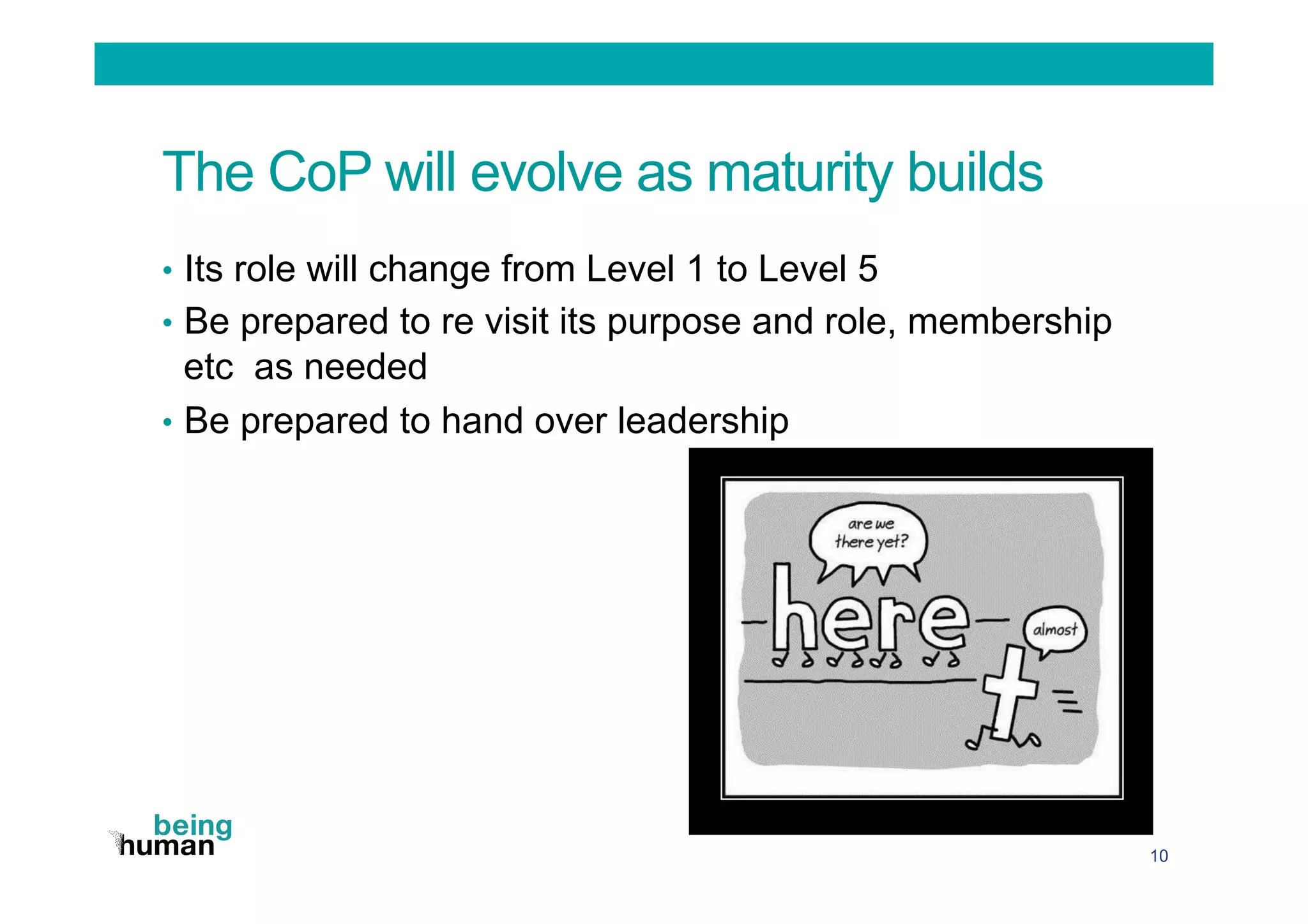
•  Its role will change from Level 1 to Level 5
•  Be prepared to re visit its purpose and role, membership
etc as needed
•  Be prepared to hand over leadership
10
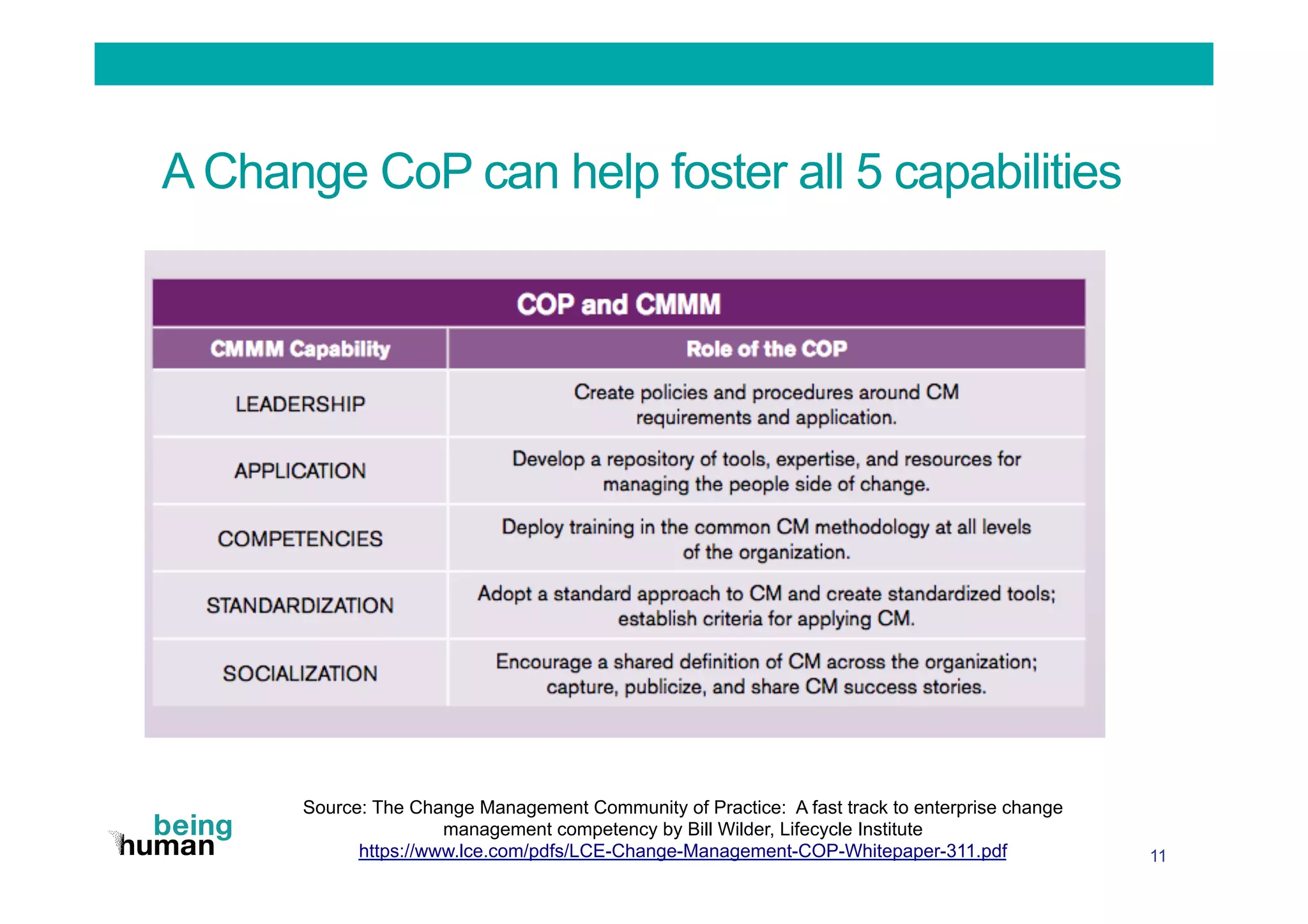
A Change CoP can help foster all 5 capabilities
11
Source: The Change Management Community of Practice: A fast track to enterprise change
management competency by Bill Wilder, Lifecycle Institute
https://www.lce.com/pdfs/LCE-Change-Management-COP-Whitepaper-311.pdf
13
Tip 1: Secure a Sponsor
•  Provides authority and legitimacy
•  Creates motivation for members to
be in involved
•  Align CoPs purpose and goals with
organisational strategy and change
capability goals
•  Make the CoPs work visible and
communicate its value.
•  Select the CoP Sponsor
thoughtfully!
14
Source: The Change Management Community of Practice: A fast track to enterprise change
management competency by Bill Wilder, Lifecycle Institute
https://www.lce.com/pdfs/LCE-Change-Management-COP-Whitepaper-311.pdf
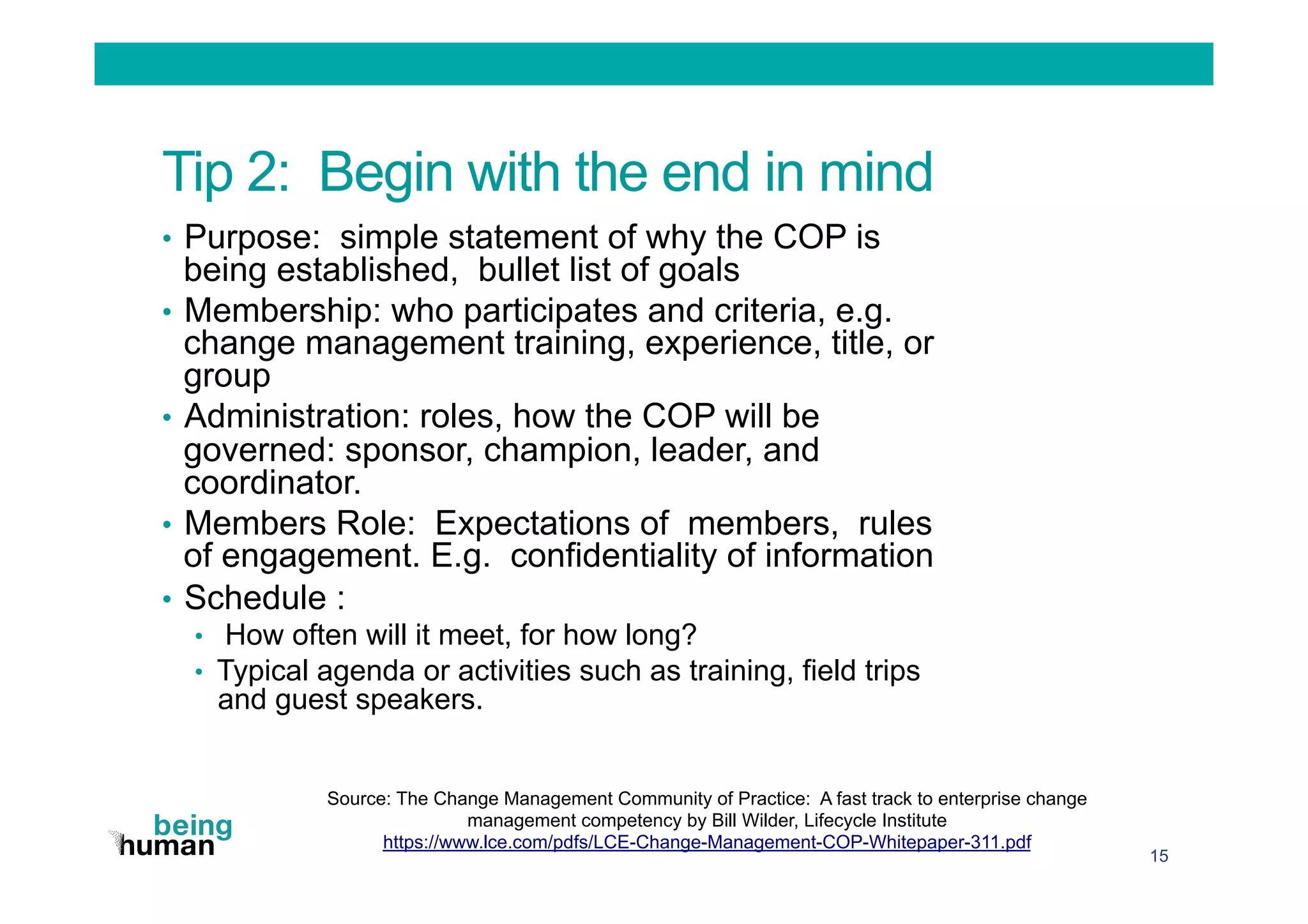
Tip 2: Begin with the end in mind
•  Purpose: simple statement of why the COP is
being established, bullet list of goals
•  Membership: who participates and criteria, e.g.
change management training, experience, title, or
group
•  Administration: roles, how the COP will be
governed: sponsor, champion, leader, and
coordinator.
•  Members Role: Expectations of members, rules
of engagement. E.g. confidentiality of information
•  Schedule :
•  How often will it meet, for how long?
•  Typical agenda or activities such as training, field trips
and guest speakers.
15
Source: The Change Management Community of Practice: A fast track to enterprise change
management competency by Bill Wilder, Lifecycle Institute
https://www.lce.com/pdfs/LCE-Change-Management-COP-Whitepaper-311.pdf
Variations of membership – each has a place
•  Change Management Professionals
•  Change Managers
•  People in a “change role”
•  Prosci Certified Change Managers
•  Project professionals
•  All or some of the above plus project managers, business improvement
specialists, operational excellence etc
•  Everyone involved in change
•  All or some of the above plus people leaders (all, or selected)
•  Other variations?
16
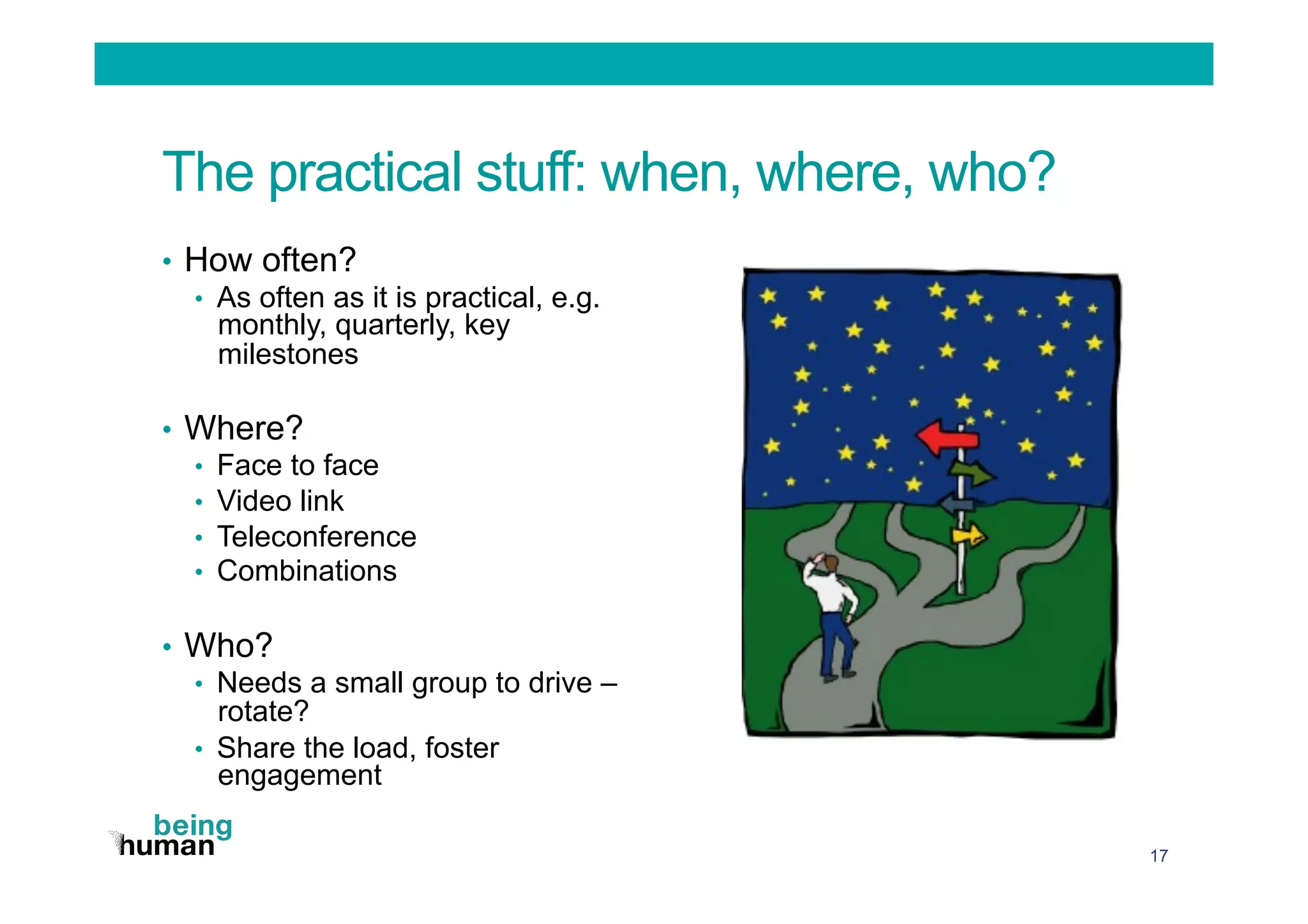
The practical stuff: when, where, who?
•  How often?
•  As often as it is practical, e.g.
monthly, quarterly, key
milestones
•  Where?
•  Face to face
•  Video link
•  Teleconference
•  Combinations
•  Who?
•  Needs a small group to drive –
rotate?
•  Share the load, foster
engagement
17
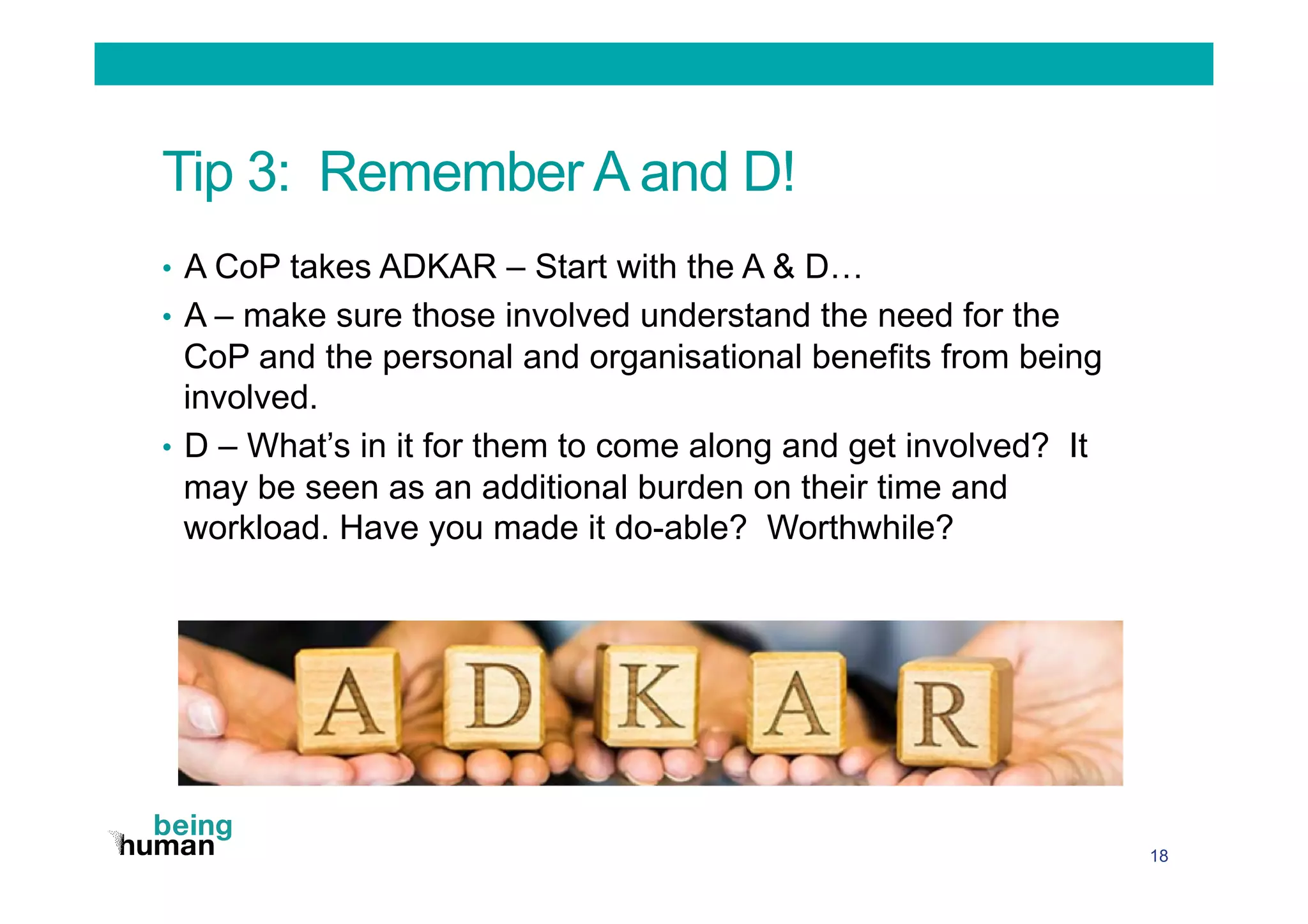
Tip 3: Remember A and D!
•  A CoP takes ADKAR – Start with the A & D…
•  A – make sure those involved understand the need for the
CoP and the personal and organisational benefits from being
involved.
•  D – What’s in it for them to come along and get involved? It
may be seen as an additional burden on their time and
workload. Have you made it do-able? Worthwhile?
18
Tip 4: Role model effective Change
Management
•  Cater for your members with a mix of formats.
•  Use a guest speaker on occasions – internal
representation from a business area, SME or executive.
•  Have a CoP share drive/folder for between meetings to
share resources.
•  Have a communication channel or two that works - email
list, in-person meet up, online forum, teleconferences or
whatever works for the group.
•  Get regular feedback on what’s working and what’s not
from members.
19
Tip 5: Don’t make it all work!
•  Build in fun and allow time for networking either before or
afterwards.
•  Informal feedback and engagement is valuable.
20
Bonus tip… the time commitment
•  Estimate the energy and drive it will take to get it up and
running and then double it!
•  A successful CoP takes a lot of time, commitment, energy and
resources.
•  Don’t go it alone!
•  Are you and the organization up for it?
21
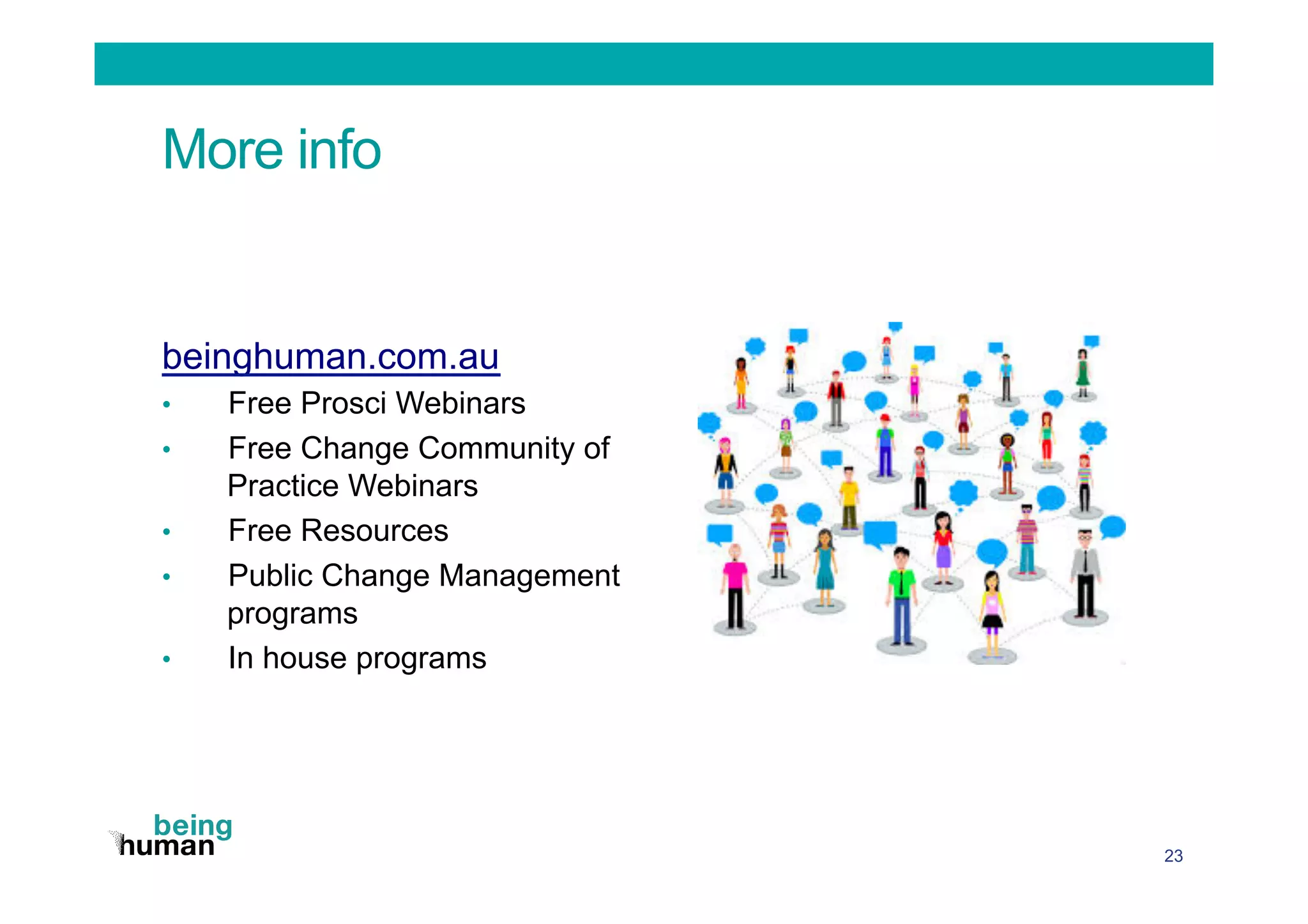
More info
23
beinghuman.com.au
•  Free Prosci Webinars
•  Free Change Community of
Practice Webinars
•  Free Resources
•  Public Change Management
programs
•  In house programs

Building a Change Community of Practice webinar February 2017

  • 1.
    Building a Change Communityof Practice Presented by: Catherine Smithson Managing Director February 2017 Change Community of Practice Webinars
  • 2.
    Introducing Being Human • Founded in 1993 •  Our mission: develop change-capable people and organisations so they achieve the benefits of change 2
  • 3.
    Agenda •  What isa Change Community of Practice? •  Benefits •  Tip 5 tips for success •  Q&A 3
  • 5.
    Some definitions 5 “A selectedgroup of individuals who do the same work in different environments/projects and come together to knowledge share.” Joanne Rinaldi “A group of change management professionals passionate about change management, committed to sharing knowledge and experience”. Max Knobel “Groups of people who share a concern or a passion for something they do and learn how to do it better as they interact regularly.” Etienne Wenger, co –originator with Jean Lave of Communities of Practice
  • 6.
    Key elements Members are practitioners,develop shared resources (stories, tools, experiences, stories, problem solving). 6 Members interact, engage, share activities, help each other, build relationships, learn from each other. Shared commitment to a profession, interest Source: Etienne Wenger and Jean Lave
  • 8.
    Benefits of aChange CoP 1.  Share common understanding of professional practice 2.  Application of technical experience – what worked/what didn’t 3.  Improvement - qualitative and quantitative 4.  Embed common approach, e.g. group audits – compliance and consistency 5.  Collaboration and engagement – alignment, shared vision and goals for “how we do change” 6.  Continued learning and personal development 7.  Helps ensure the organisation maximises its investment in Change Management 8
  • 9.
    Change Maturity andthe Change CoP 9
  • 10.
    The CoP willevolve as maturity builds •  Its role will change from Level 1 to Level 5 •  Be prepared to re visit its purpose and role, membership etc as needed •  Be prepared to hand over leadership 10
  • 11.
    A Change CoPcan help foster all 5 capabilities 11 Source: The Change Management Community of Practice: A fast track to enterprise change management competency by Bill Wilder, Lifecycle Institute https://www.lce.com/pdfs/LCE-Change-Management-COP-Whitepaper-311.pdf
  • 13.
  • 14.
    Tip 1: Securea Sponsor •  Provides authority and legitimacy •  Creates motivation for members to be in involved •  Align CoPs purpose and goals with organisational strategy and change capability goals •  Make the CoPs work visible and communicate its value. •  Select the CoP Sponsor thoughtfully! 14 Source: The Change Management Community of Practice: A fast track to enterprise change management competency by Bill Wilder, Lifecycle Institute https://www.lce.com/pdfs/LCE-Change-Management-COP-Whitepaper-311.pdf
  • 15.
    Tip 2: Beginwith the end in mind •  Purpose: simple statement of why the COP is being established, bullet list of goals •  Membership: who participates and criteria, e.g. change management training, experience, title, or group •  Administration: roles, how the COP will be governed: sponsor, champion, leader, and coordinator. •  Members Role: Expectations of members, rules of engagement. E.g. confidentiality of information •  Schedule : •  How often will it meet, for how long? •  Typical agenda or activities such as training, field trips and guest speakers. 15 Source: The Change Management Community of Practice: A fast track to enterprise change management competency by Bill Wilder, Lifecycle Institute https://www.lce.com/pdfs/LCE-Change-Management-COP-Whitepaper-311.pdf
  • 16.
    Variations of membership– each has a place •  Change Management Professionals •  Change Managers •  People in a “change role” •  Prosci Certified Change Managers •  Project professionals •  All or some of the above plus project managers, business improvement specialists, operational excellence etc •  Everyone involved in change •  All or some of the above plus people leaders (all, or selected) •  Other variations? 16
  • 17.
    The practical stuff:when, where, who? •  How often? •  As often as it is practical, e.g. monthly, quarterly, key milestones •  Where? •  Face to face •  Video link •  Teleconference •  Combinations •  Who? •  Needs a small group to drive – rotate? •  Share the load, foster engagement 17
  • 18.
    Tip 3: RememberA and D! •  A CoP takes ADKAR – Start with the A & D… •  A – make sure those involved understand the need for the CoP and the personal and organisational benefits from being involved. •  D – What’s in it for them to come along and get involved? It may be seen as an additional burden on their time and workload. Have you made it do-able? Worthwhile? 18
  • 19.
    Tip 4: Rolemodel effective Change Management •  Cater for your members with a mix of formats. •  Use a guest speaker on occasions – internal representation from a business area, SME or executive. •  Have a CoP share drive/folder for between meetings to share resources. •  Have a communication channel or two that works - email list, in-person meet up, online forum, teleconferences or whatever works for the group. •  Get regular feedback on what’s working and what’s not from members. 19
  • 20.
    Tip 5: Don’tmake it all work! •  Build in fun and allow time for networking either before or afterwards. •  Informal feedback and engagement is valuable. 20
  • 21.
    Bonus tip… thetime commitment •  Estimate the energy and drive it will take to get it up and running and then double it! •  A successful CoP takes a lot of time, commitment, energy and resources. •  Don’t go it alone! •  Are you and the organization up for it? 21
  • 23.
    More info 23 beinghuman.com.au •  FreeProsci Webinars •  Free Change Community of Practice Webinars •  Free Resources •  Public Change Management programs •  In house programs