
Kirkpatrick’s  Levels of Evaluation
Donald Kirkpatrick Kirkpatrick developed a model of training evaluation in 1959 Arguably the most widely used approach Simple, Flexible and Complete 4-level model
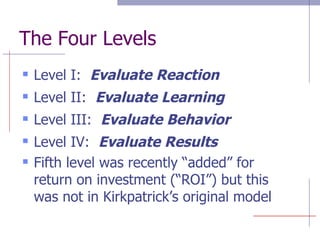
The Four Levels Level I:  Evaluate Reaction Level II:  Evaluate Learning Level III:  Evaluate Behavior Level IV:  Evaluate Results Fifth level was recently “added” for return on investment (“ROI”) but this was not in Kirkpatrick’s original model
Reaction - What Is It? How favorably participants react to the training (“Customer satisfaction”) Collects reactions to instructor, course, and learning environment Communicates to trainees that their feedback is valued Can provide quantitative information Level 1
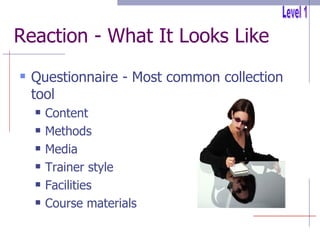
Reaction - What It Looks Like Questionnaire - Most common collection tool Content Methods Media Trainer style Facilities Course materials Level 1
Reaction: Connection to Other Levels The Connection - Can ask trainees if they: Will use new skill(s) or information  (Level II) Plan to change behavior  (Level III) Expect improvements in results  (Level IV) The Disconnection - Does not: Measure  what  was learned  (Level II) Guarantee behavioral change  (Level III) Quantify results from learning  (Level IV) Level 1
Reaction - How to Perform Determine what you want to find out Design a form to collect/quantify reactions Do Immediately Develop acceptable scoring standards Follow-up as appropriate Level 1
Learning - What Is It? Knowledge Skills Attitudes Level 2
Learning: Connection to Other Levels The Connection - People who learn can: Experience pride  (Level I) Experiment with new behaviors  (Level III) Achieve better results  (Level IV) The Disconnection - It doesn’t ensure they: Liked training program  (Level I) Will behave differently  (Level III) Will get expected results  (Level IV) Level 2
Learning - What It Looks Like Media used to measure learning: Text Voice Demonstration Methods used to measure learning: Interviews Surveys Tests (pre-/post-) Observations Combinations Level 2
Learning - How to Perform Use a control group, if feasible Evaluate knowledge, skills, and/or attitudes before and after Get 100% participation or use statistical sample Follow-up as appropriate Level 2
Behavior - What Is It? Transfer of knowledge, skills, and/or attitude to the real world Measure achievement of performance objectives Level 3
Behavior - What It Looks Like Observe performer, first-hand Survey key people who observe performer Use checklists, questionnaires, interviews, or combinations Level 3
Behavior: Connection to Other Levels The Connection - Can determine: Degree to which learning transfers to the post-training environment   (Level II) The Disconnection - Cannot determine if: Participants like the training  (Level I) Participants understand  (Level II) Behaviors accomplish results  (Level IV) Level 3
Behavior - How to Perform Evaluate before and after training Allow ample time before observing Survey key people Consider cost vs. benefits 100% participation or a sampling Repeated evaluations at appropriate intervals Use of a control group Level 3
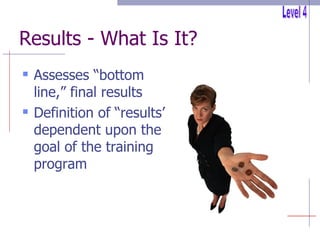
Results - What Is It? Assesses “bottom line,” final results Definition of “results” dependent upon the goal of the training program Level 4
Results - What It Looks Like Depends upon objectives of training program Quantify Proof vs. Evidence Proof is concrete Evidence is soft Level 4
Results: Connection to Other Levels The Connection Positive Levels 1, 2, 3 evaluations results can provide positive Level 4 evidence The Disconnection - Does not: Tell if participants liked training  (Level I) Prove trainees understand  (Level II) Prove use of preferred behaviors  (Level III) Level 4
Results - How to Perform Use a control group Allow time for results to be realized Measure before and after the program Consider cost versus benefits Be satisfied with evidence when proof is not possible Level 4
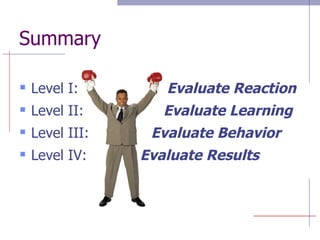
Summary Level I:  Evaluate Reaction Level II:  Evaluate Learning Level III:  Evaluate Behavior Level IV:  Evaluate Results

Kirk Patrick's Level of Evaluation

  • 1.
  • 2.
    Donald Kirkpatrick Kirkpatrickdeveloped a model of training evaluation in 1959 Arguably the most widely used approach Simple, Flexible and Complete 4-level model
  • 3.
    The Four LevelsLevel I: Evaluate Reaction Level II: Evaluate Learning Level III: Evaluate Behavior Level IV: Evaluate Results Fifth level was recently “added” for return on investment (“ROI”) but this was not in Kirkpatrick’s original model
  • 4.
    Reaction - WhatIs It? How favorably participants react to the training (“Customer satisfaction”) Collects reactions to instructor, course, and learning environment Communicates to trainees that their feedback is valued Can provide quantitative information Level 1
  • 5.
    Reaction - WhatIt Looks Like Questionnaire - Most common collection tool Content Methods Media Trainer style Facilities Course materials Level 1
  • 6.
    Reaction: Connection toOther Levels The Connection - Can ask trainees if they: Will use new skill(s) or information (Level II) Plan to change behavior (Level III) Expect improvements in results (Level IV) The Disconnection - Does not: Measure what was learned (Level II) Guarantee behavioral change (Level III) Quantify results from learning (Level IV) Level 1
  • 7.
    Reaction - Howto Perform Determine what you want to find out Design a form to collect/quantify reactions Do Immediately Develop acceptable scoring standards Follow-up as appropriate Level 1
  • 8.
    Learning - WhatIs It? Knowledge Skills Attitudes Level 2
  • 9.
    Learning: Connection toOther Levels The Connection - People who learn can: Experience pride (Level I) Experiment with new behaviors (Level III) Achieve better results (Level IV) The Disconnection - It doesn’t ensure they: Liked training program (Level I) Will behave differently (Level III) Will get expected results (Level IV) Level 2
  • 10.
    Learning - WhatIt Looks Like Media used to measure learning: Text Voice Demonstration Methods used to measure learning: Interviews Surveys Tests (pre-/post-) Observations Combinations Level 2
  • 11.
    Learning - Howto Perform Use a control group, if feasible Evaluate knowledge, skills, and/or attitudes before and after Get 100% participation or use statistical sample Follow-up as appropriate Level 2
  • 12.
    Behavior - WhatIs It? Transfer of knowledge, skills, and/or attitude to the real world Measure achievement of performance objectives Level 3
  • 13.
    Behavior - WhatIt Looks Like Observe performer, first-hand Survey key people who observe performer Use checklists, questionnaires, interviews, or combinations Level 3
  • 14.
    Behavior: Connection toOther Levels The Connection - Can determine: Degree to which learning transfers to the post-training environment (Level II) The Disconnection - Cannot determine if: Participants like the training (Level I) Participants understand (Level II) Behaviors accomplish results (Level IV) Level 3
  • 15.
    Behavior - Howto Perform Evaluate before and after training Allow ample time before observing Survey key people Consider cost vs. benefits 100% participation or a sampling Repeated evaluations at appropriate intervals Use of a control group Level 3
  • 16.
    Results - WhatIs It? Assesses “bottom line,” final results Definition of “results” dependent upon the goal of the training program Level 4
  • 17.
    Results - WhatIt Looks Like Depends upon objectives of training program Quantify Proof vs. Evidence Proof is concrete Evidence is soft Level 4
  • 18.
    Results: Connection toOther Levels The Connection Positive Levels 1, 2, 3 evaluations results can provide positive Level 4 evidence The Disconnection - Does not: Tell if participants liked training (Level I) Prove trainees understand (Level II) Prove use of preferred behaviors (Level III) Level 4
  • 19.
    Results - Howto Perform Use a control group Allow time for results to be realized Measure before and after the program Consider cost versus benefits Be satisfied with evidence when proof is not possible Level 4
  • 20.
    Summary Level I: Evaluate Reaction Level II: Evaluate Learning Level III: Evaluate Behavior Level IV: Evaluate Results