



By Prateek Malik
Kirkpatrick Four Levels Evaluation
Building Training Effectiveness
1
By Prateek Malik
Certified on Kirkpatrick Four Levels Evaluation
By Prateek Malik
Objectives
• Identify Kirkpatrick Four Levels
2
By Prateek Malik
Important Note
3
LEARN
to
UNLEARN
By Prateek Malik
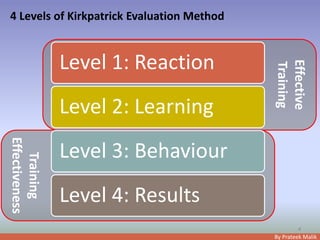
Effective
Training
Training
Effectiveness
4 Levels of Kirkpatrick Evaluation Method
4
Level 1: Reaction
Level 2: Learning
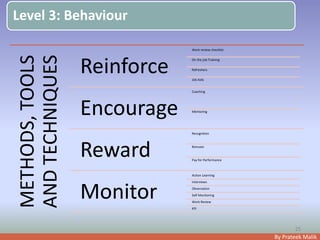
Level 3: Behaviour
Level 4: Results
By Prateek Malik
4 Levels of Kirkpatrick Evaluation Method
5
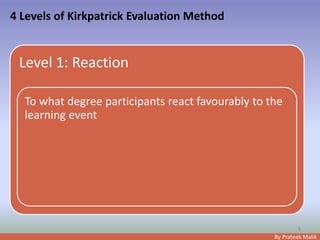
Level 1: Reaction
To what degree participants react favourably to the
learning event
By Prateek Malik
4 Levels of Kirkpatrick Evaluation Method
6
Level 2: Learning
To what degree participants acquire the intended
knowledge, skills and attitude based on their
participation in the event
By Prateek Malik
4 Levels of Kirkpatrick Evaluation Method
7
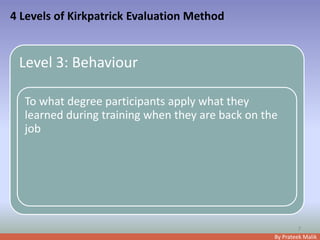
Level 3: Behaviour
To what degree participants apply what they
learned during training when they are back on the
job
By Prateek Malik
4 Levels of Kirkpatrick Evaluation Method
8
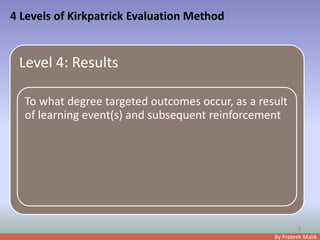
Level 4: Results
To what degree targeted outcomes occur, as a result
of learning event(s) and subsequent reinforcement
By Prateek Malik
4 Levels of Kirkpatrick Evaluation Method
9
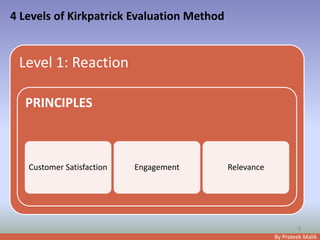
Level 1: Reaction
PRINCIPLES
Customer Satisfaction Engagement Relevance
By Prateek Malik
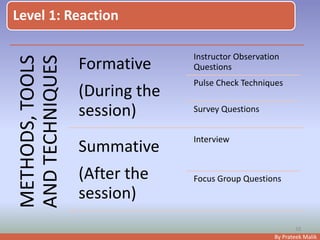
Level 1: Reaction
METHODS,TOOLS
ANDTECHNIQUES
Formative
(During the
session)
Instructor Observation
Questions
Pulse Check Techniques
Survey Questions
Summative
(After the
session)
Interview
Focus Group Questions
10
By Prateek Malik
Level 1: Reaction
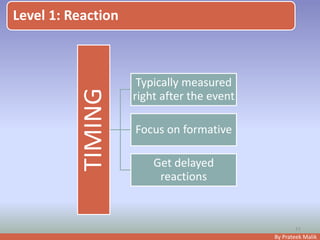
TIMING
Typically measured
right after the event
Focus on formative
Get delayed
reactions
11
By Prateek Malik
4 Levels of Kirkpatrick Evaluation Method
12
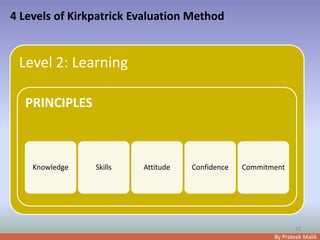
Level 2: Learning
PRINCIPLES
Knowledge Skills Attitude Confidence Commitment
By Prateek Malik
4 Levels of Kirkpatrick Evaluation Method
13
Level 2: Learning
Knowledge
“I Know it”
By Prateek Malik
4 Levels of Kirkpatrick Evaluation Method
14
Level 2: Learning
Skill
“I can do it right now”
By Prateek Malik
4 Levels of Kirkpatrick Evaluation Method
15
Level 2: Learning
Attitude: Relevance of
information for the Participant
“I believe this is worthwhile”
By Prateek Malik
4 Levels of Kirkpatrick Evaluation Method
16
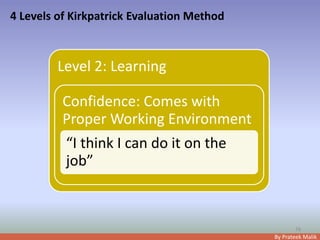
Level 2: Learning
Confidence: Comes with
Proper Working Environment
“I think I can do it on the
job”
By Prateek Malik
4 Levels of Kirkpatrick Evaluation Method
17
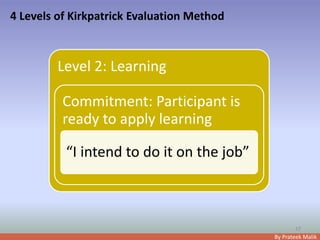
Level 2: Learning
Commitment: Participant is
ready to apply learning
“I intend to do it on the job”
By Prateek Malik
18
Knowledge
“I Know it”
Skill
“I can do it right now”
Attitude: Relevance of information
for the Participant
“I believe this is worthwhile”
Confidence: Comes with Proper
Working Environment
“I think I can do it on the job”
Commitment: Participant is ready to apply learning
“I intend to do it on the job”
Level 2: Learning
By Prateek Malik
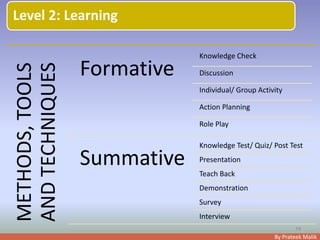
Level 2: Learning
METHODS,TOOLS
ANDTECHNIQUES
Formative
Knowledge Check
Discussion
Individual/ Group Activity
Action Planning
Role Play
Summative
Knowledge Test/ Quiz/ Post Test
Presentation
Teach Back
Demonstration
Survey
Interview
19
By Prateek Malik
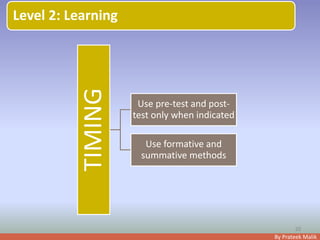
Level 2: Learning
TIMING Use pre-test and post-
test only when indicated
Use formative and
summative methods
20
By Prateek Malik
4 Levels of Kirkpatrick Evaluation Method
21
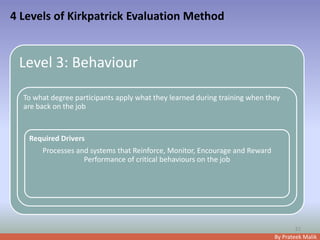
Level 3: Behaviour
To what degree participants apply what they learned during training when they
are back on the job
Required Drivers
Processes and systems that Reinforce, Monitor, Encourage and Reward
Performance of critical behaviours on the job
By Prateek Malik
Level 3: Behaviour
22
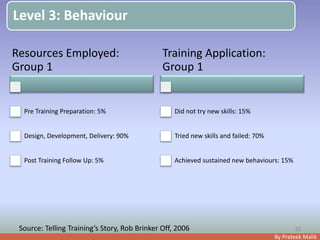
Resources Employed:
Group 1
Pre Training Preparation: 5%
Design, Development, Delivery: 90%
Post Training Follow Up: 5%
Training Application:
Group 1
Did not try new skills: 15%
Tried new skills and failed: 70%
Achieved sustained new behaviours: 15%
Source: Telling Training’s Story, Rob Brinker Off, 2006
By Prateek Malik
Level 3: Behaviour
23
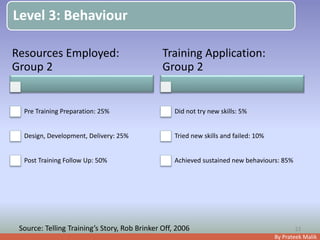
Resources Employed:
Group 2
Pre Training Preparation: 25%
Design, Development, Delivery: 25%
Post Training Follow Up: 50%
Training Application:
Group 2
Did not try new skills: 5%
Tried new skills and failed: 10%
Achieved sustained new behaviours: 85%
Source: Telling Training’s Story, Rob Brinker Off, 2006
By Prateek Malik
4 Levels of Kirkpatrick Evaluation Method
24
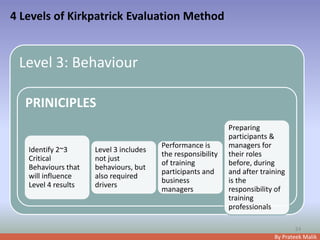
Level 3: Behaviour
PRINICIPLES
Identify 2~3
Critical
Behaviours that
will influence
Level 4 results
Level 3 includes
not just
behaviours, but
also required
drivers
Performance is
the responsibility
of training
participants and
business
managers
Preparing
participants &
managers for
their roles
before, during
and after training
is the
responsibility of
training
professionals
By Prateek Malik
Level 3: Behaviour
25
METHODS,TOOLS
ANDTECHNIQUES
Reinforce
Work review checklist
On the job Training
Refreshers
Job Aids
Encourage
Coaching
Mentoring
Reward
Recognition
Bonuses
Pay for Performance
Monitor
Action Learning
Interviews
Observation
Self Monitoring
Work Review
KPI
By Prateek Malik
Level 3: Behaviour
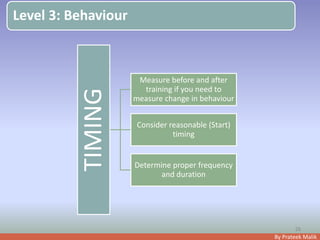
TIMING
Measure before and after
training if you need to
measure change in behaviour
Consider reasonable (Start)
timing
Determine proper frequency
and duration
26
By Prateek Malik
4 Levels of Kirkpatrick Evaluation Method
27
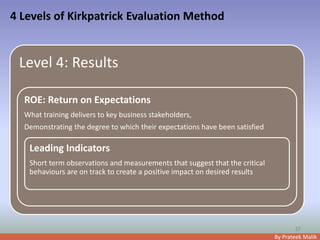
Level 4: Results
ROE: Return on Expectations
What training delivers to key business stakeholders,
Demonstrating the degree to which their expectations have been satisfied
Leading Indicators
Short term observations and measurements that suggest that the critical
behaviours are on track to create a positive impact on desired results
By Prateek Malik
4 Levels of Kirkpatrick Evaluation Method
28
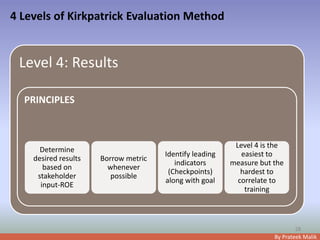
Level 4: Results
PRINCIPLES
Determine
desired results
based on
stakeholder
input-ROE
Borrow metric
whenever
possible
Identify leading
indicators
(Checkpoints)
along with goal
Level 4 is the
easiest to
measure but the
hardest to
correlate to
training
By Prateek Malik
Level 4: Results
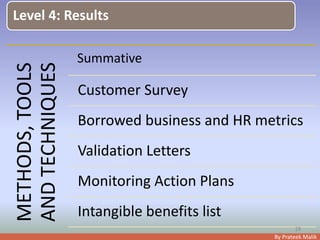
METHODS,TOOLS
ANDTECHNIQUES Summative
Customer Survey
Borrowed business and HR metrics
Validation Letters
Monitoring Action Plans
Intangible benefits list
29
By Prateek Malik
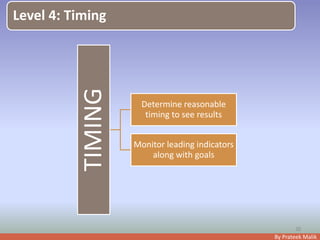
Level 4: Timing
TIMING Determine reasonable
timing to see results
Monitor leading indicators
along with goals
30
By Prateek Malik
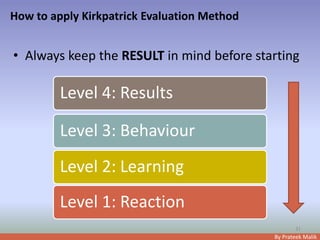
How to apply Kirkpatrick Evaluation Method
• Always keep the RESULT in mind before starting
31
Level 1: Reaction
Level 2: Learning
Level 3: Behaviour
Level 4: Results
By Prateek Malik
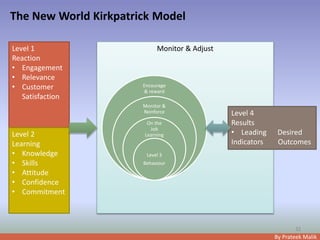
The New World Kirkpatrick Model
32
Level 1
Reaction
• Engagement
• Relevance
• Customer
Satisfaction
Level 2
Learning
• Knowledge
• Skills
• Attitude
• Confidence
• Commitment
Monitor & Adjust
Encourage
& reward
Monitor &
Reinforce
On the
Job
Learning
Level 3
Behaviour
Level 4
Results
• Leading Desired
Indicators Outcomes
By Prateek Malik
• Thanks
33

Kirkpatrick Training Evaluation Method

  • 1.
    By Prateek Malik KirkpatrickFour Levels Evaluation Building Training Effectiveness 1 By Prateek Malik Certified on Kirkpatrick Four Levels Evaluation
  • 2.
    By Prateek Malik Objectives •Identify Kirkpatrick Four Levels 2
  • 3.
    By Prateek Malik ImportantNote 3 LEARN to UNLEARN
  • 4.
    By Prateek Malik Effective Training Training Effectiveness 4Levels of Kirkpatrick Evaluation Method 4 Level 1: Reaction Level 2: Learning Level 3: Behaviour Level 4: Results
  • 5.
    By Prateek Malik 4Levels of Kirkpatrick Evaluation Method 5 Level 1: Reaction To what degree participants react favourably to the learning event
  • 6.
    By Prateek Malik 4Levels of Kirkpatrick Evaluation Method 6 Level 2: Learning To what degree participants acquire the intended knowledge, skills and attitude based on their participation in the event
  • 7.
    By Prateek Malik 4Levels of Kirkpatrick Evaluation Method 7 Level 3: Behaviour To what degree participants apply what they learned during training when they are back on the job
  • 8.
    By Prateek Malik 4Levels of Kirkpatrick Evaluation Method 8 Level 4: Results To what degree targeted outcomes occur, as a result of learning event(s) and subsequent reinforcement
  • 9.
    By Prateek Malik 4Levels of Kirkpatrick Evaluation Method 9 Level 1: Reaction PRINCIPLES Customer Satisfaction Engagement Relevance
  • 10.
    By Prateek Malik Level1: Reaction METHODS,TOOLS ANDTECHNIQUES Formative (During the session) Instructor Observation Questions Pulse Check Techniques Survey Questions Summative (After the session) Interview Focus Group Questions 10
  • 11.
    By Prateek Malik Level1: Reaction TIMING Typically measured right after the event Focus on formative Get delayed reactions 11
  • 12.
    By Prateek Malik 4Levels of Kirkpatrick Evaluation Method 12 Level 2: Learning PRINCIPLES Knowledge Skills Attitude Confidence Commitment
  • 13.
    By Prateek Malik 4Levels of Kirkpatrick Evaluation Method 13 Level 2: Learning Knowledge “I Know it”
  • 14.
    By Prateek Malik 4Levels of Kirkpatrick Evaluation Method 14 Level 2: Learning Skill “I can do it right now”
  • 15.
    By Prateek Malik 4Levels of Kirkpatrick Evaluation Method 15 Level 2: Learning Attitude: Relevance of information for the Participant “I believe this is worthwhile”
  • 16.
    By Prateek Malik 4Levels of Kirkpatrick Evaluation Method 16 Level 2: Learning Confidence: Comes with Proper Working Environment “I think I can do it on the job”
  • 17.
    By Prateek Malik 4Levels of Kirkpatrick Evaluation Method 17 Level 2: Learning Commitment: Participant is ready to apply learning “I intend to do it on the job”
  • 18.
    By Prateek Malik 18 Knowledge “IKnow it” Skill “I can do it right now” Attitude: Relevance of information for the Participant “I believe this is worthwhile” Confidence: Comes with Proper Working Environment “I think I can do it on the job” Commitment: Participant is ready to apply learning “I intend to do it on the job” Level 2: Learning
  • 19.
    By Prateek Malik Level2: Learning METHODS,TOOLS ANDTECHNIQUES Formative Knowledge Check Discussion Individual/ Group Activity Action Planning Role Play Summative Knowledge Test/ Quiz/ Post Test Presentation Teach Back Demonstration Survey Interview 19
  • 20.
    By Prateek Malik Level2: Learning TIMING Use pre-test and post- test only when indicated Use formative and summative methods 20
  • 21.
    By Prateek Malik 4Levels of Kirkpatrick Evaluation Method 21 Level 3: Behaviour To what degree participants apply what they learned during training when they are back on the job Required Drivers Processes and systems that Reinforce, Monitor, Encourage and Reward Performance of critical behaviours on the job
  • 22.
    By Prateek Malik Level3: Behaviour 22 Resources Employed: Group 1 Pre Training Preparation: 5% Design, Development, Delivery: 90% Post Training Follow Up: 5% Training Application: Group 1 Did not try new skills: 15% Tried new skills and failed: 70% Achieved sustained new behaviours: 15% Source: Telling Training’s Story, Rob Brinker Off, 2006
  • 23.
    By Prateek Malik Level3: Behaviour 23 Resources Employed: Group 2 Pre Training Preparation: 25% Design, Development, Delivery: 25% Post Training Follow Up: 50% Training Application: Group 2 Did not try new skills: 5% Tried new skills and failed: 10% Achieved sustained new behaviours: 85% Source: Telling Training’s Story, Rob Brinker Off, 2006
  • 24.
    By Prateek Malik 4Levels of Kirkpatrick Evaluation Method 24 Level 3: Behaviour PRINICIPLES Identify 2~3 Critical Behaviours that will influence Level 4 results Level 3 includes not just behaviours, but also required drivers Performance is the responsibility of training participants and business managers Preparing participants & managers for their roles before, during and after training is the responsibility of training professionals
  • 25.
    By Prateek Malik Level3: Behaviour 25 METHODS,TOOLS ANDTECHNIQUES Reinforce Work review checklist On the job Training Refreshers Job Aids Encourage Coaching Mentoring Reward Recognition Bonuses Pay for Performance Monitor Action Learning Interviews Observation Self Monitoring Work Review KPI
  • 26.
    By Prateek Malik Level3: Behaviour TIMING Measure before and after training if you need to measure change in behaviour Consider reasonable (Start) timing Determine proper frequency and duration 26
  • 27.
    By Prateek Malik 4Levels of Kirkpatrick Evaluation Method 27 Level 4: Results ROE: Return on Expectations What training delivers to key business stakeholders, Demonstrating the degree to which their expectations have been satisfied Leading Indicators Short term observations and measurements that suggest that the critical behaviours are on track to create a positive impact on desired results
  • 28.
    By Prateek Malik 4Levels of Kirkpatrick Evaluation Method 28 Level 4: Results PRINCIPLES Determine desired results based on stakeholder input-ROE Borrow metric whenever possible Identify leading indicators (Checkpoints) along with goal Level 4 is the easiest to measure but the hardest to correlate to training
  • 29.
    By Prateek Malik Level4: Results METHODS,TOOLS ANDTECHNIQUES Summative Customer Survey Borrowed business and HR metrics Validation Letters Monitoring Action Plans Intangible benefits list 29
  • 30.
    By Prateek Malik Level4: Timing TIMING Determine reasonable timing to see results Monitor leading indicators along with goals 30
  • 31.
    By Prateek Malik Howto apply Kirkpatrick Evaluation Method • Always keep the RESULT in mind before starting 31 Level 1: Reaction Level 2: Learning Level 3: Behaviour Level 4: Results
  • 32.
    By Prateek Malik TheNew World Kirkpatrick Model 32 Level 1 Reaction • Engagement • Relevance • Customer Satisfaction Level 2 Learning • Knowledge • Skills • Attitude • Confidence • Commitment Monitor & Adjust Encourage & reward Monitor & Reinforce On the Job Learning Level 3 Behaviour Level 4 Results • Leading Desired Indicators Outcomes
  • 33.