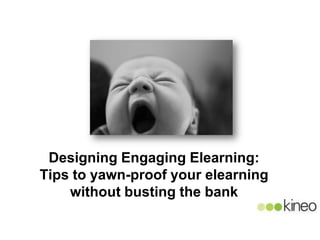
























Designing Engaging Elearning:
Tips to yawn-proof your elearning
    without busting the bank
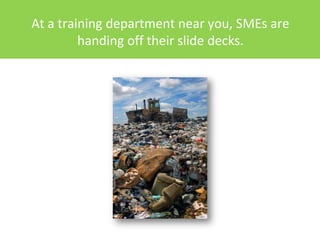
At a training department near you, SMEs are
         handing off their slide decks.
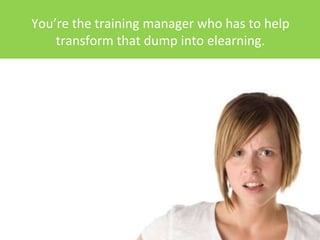
You’re the training manager who has to help
    transform that dump into elearning.
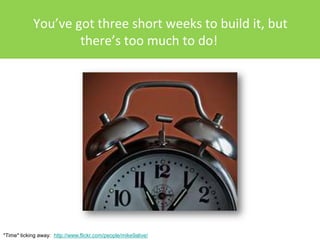
You’ve got three short weeks to build it, but
                    there’s too much to do!


*Time* ticking away: http://www.flickr.com/people/mike9alive/
You want a more streamlined process and
      better eLearning outcomes.
Help your team yawn-proof your elearning without
    busting the bank with these eight top tips.
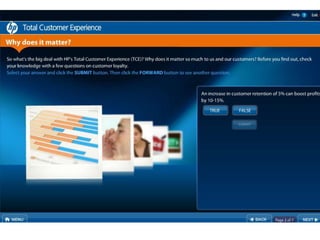
How long have you been involved with
elearning projects?

I haven‟t worked on any yet (that‟s why I‟m
here!)
0.1-1 years
2-5 years
6-10 years
10+ years
Get their attention.
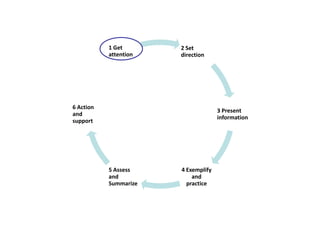
1 Get       2 Set
           attention   direction


6 Action
                                     3 Present
and
                                     information
support


           5 Assess    4 Exemplify
           and             and
           Summarize     practice
Case Study: The Vacation Policy

“In keeping with the overall control environment and to
   ensure compliance with internal control guidelines issued
   by its regulators, AceFinancial has a Global Investment
   Bank Vacation Policy. In EMEA, the requirements of this
   policy (which are set out below) also apply to the Private
   Bank, AceFinancial Partners and the Chief Investment
   Office. TSS staff are required to comply with their own
   LOB policy. In summary, the policy requires certain
   employees in sensitive positions (“Designated
   Employees”) to be out of the office for a specified period
   of time each calendar year...”
1 Get       2 Set
           attention   direction


6 Action
                                     3 Present
and
                                     information
support


           5 Assess    4 Exemplify
           and             and
           Summarise     practise
Object to learning
   objections.
Do your programs typically include a slide
upfront that details the specific learning
objectives of the course?

Yes
No
I have no idea!
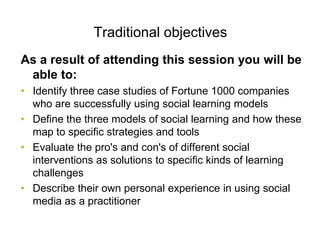
Traditional objectives
As a result of attending this session you will be
 able to:
• Identify three case studies of Fortune 1000 companies
  who are successfully using social learning models
• Define the three models of social learning and how these
  map to specific strategies and tools
• Evaluate the pro's and con's of different social
  interventions as solutions to specific kinds of learning
  challenges
• Describe their own personal experience in using social
  media as a practitioner
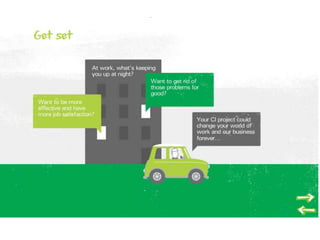
Set direction


           1 Get       2 Set
           attention   direction


6 Action
                                     3 Present
and
                                     information
support


           5 Assess    4 Exemplify
           and             and
           Summarise     practise
Set direction


           1 Get       2 Set
           attention   direction


6 Action
                                     3 Present
and
                                     information
support


           5 Assess    4 Exemplify
           and             and
           Summarise     practise
Set direction


           1 Get       2 Set
           attention   direction


6 Action
                                     3 Present
and
                                     information
support


           5 Assess    4 Exemplify
           and             and
           Summarise     practise
Get the best stories.
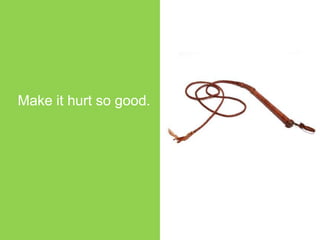
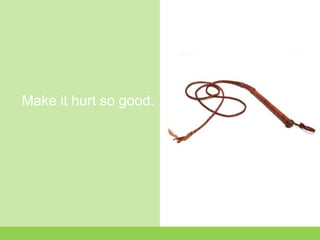
Make it hurt so good.
Do your programs always include a FINAL
TEST?

No, that‟s too much work ;)
Yes, otherwise how can we be sure they‟ve
learned?
Depends on the content.
I have no idea!
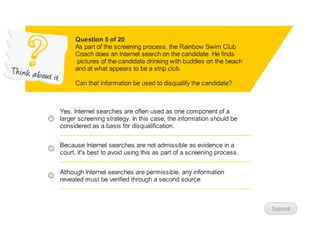
Question 1 of 524:

1. There are ___ Customers types serviced by ACME.
Question 2 of 524:

These customer types are
  i.    ________ ____ ______;

  ii.    _____ ________ _____ ;

  iii.   ________ ____ _____;

  iv.    ______ _______ ________ (___) ____________; and

  v.     ______ __________ ____ _______ ____ _____.
Question 3 of 524:


True or False?

Small Business Owners would benefit from the service ACME
  offers of managing money and good accounting records
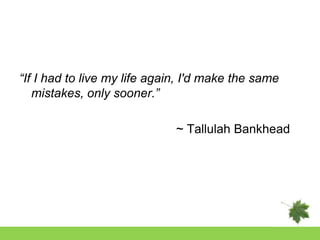
“If I had to live my life again, I'd make the same
   mistakes, only sooner.”

                              ~ Tallulah Bankhead
Don’t be tone deaf.
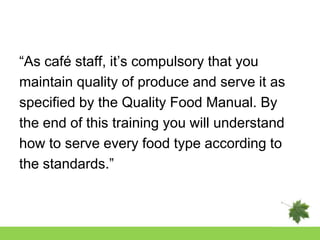
“As café staff, it‟s compulsory that you
maintain quality of produce and serve it as
specified by the Quality Food Manual. By
the end of this training you will understand
how to serve every food type according to
the standards.”
BORING!
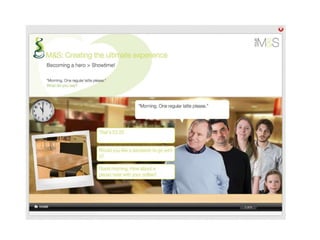
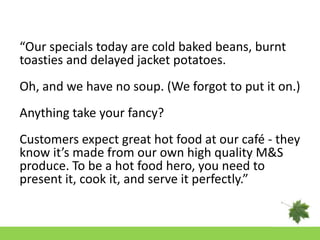
“Our specials today are cold baked beans, burnt
toasties and delayed jacket potatoes.
Oh, and we have no soup. (We forgot to put it on.)
Anything take your fancy?
Customers expect great hot food at our café - they
know it’s made from our own high quality M&S
produce. To be a hot food hero, you need to
present it, cook it, and serve it perfectly.”
True Confessions Time:

What‟s the most boring training program
you‟ve had to take or been a part of?

(type your answers in chat)
Our 5 rule framework
Tone matters – no matter what the content. We‟ve put together a 5 rule
framework to help you write engaging, exciting and yawn proof content.
Our 5 rule framework

1. Keep it light
2. Give it spirit
3. Have a conversation
4. Call for action
5. Be adult
1. Keep it light
Short, snappy, to the point. And don‟t be
               afraid to have fun.

Less of…
“This e-learning module is designed to
explain the principles and practical
requirements of the 11 step process …”

More of…
“Need to get your head around our
process? You‟re in the right place.” Or…

“Process – boring, right? Wrong. This one
will help you, all 11 steps of it. See it to
believe it.”
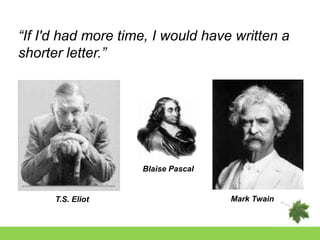
“If I'd had more time, I would have written a
shorter letter.”


                    Blaise Pascal


      T.S. Eliot                    Mark Twain
Any challenges that you can see with
trying to keep it light in your
organization?

(type your thoughts into chat)
2. Give it spirit!
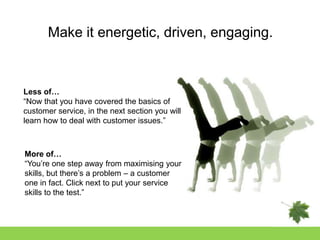
Make it energetic, driven, engaging.


Less of…
“Now that you have covered the basics of
customer service, in the next section you will
learn how to deal with customer issues.”


More of…
“You‟re one step away from maximising your
skills, but there‟s a problem – a customer
one in fact. Click next to put your service
skills to the test.”
3. Have a
conversation.
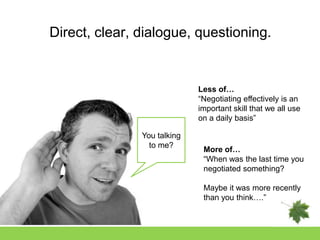
Direct, clear, dialogue, questioning.


                             Less of…
                             “Negotiating effectively is an
                             important skill that we all use
                             on a daily basis”

               You talking
                 to me?
                              More of…
                              “When was the last time you
                              negotiated something?

                              Maybe it was more recently
                              than you think….”
4. Call for action!
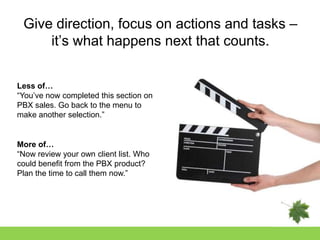
Give direction, focus on actions and tasks –
     it‟s what happens next that counts.


Less of…
“You‟ve now completed this section on
PBX sales. Go back to the menu to
make another selection.”


More of…
“Now review your own client list. Who
could benefit from the PBX product?
Plan the time to call them now.”
5. Be adult.
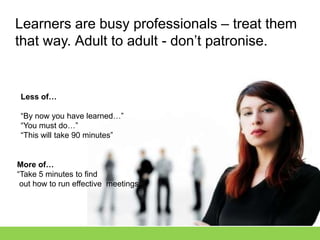
Learners are busy professionals – treat them
that way. Adult to adult - don‟t patronise.


 Less of…

 “By now you have learned…”
 “You must do…”
 “This will take 90 minutes”


More of…
“Take 5 minutes to find
 out how to run effective meetings.”
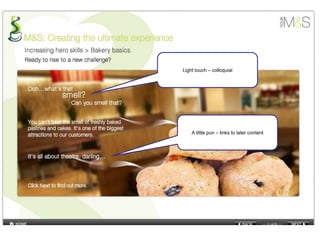
What does it look
     like?
Light touch – colloquial


    A little pun – links to later content
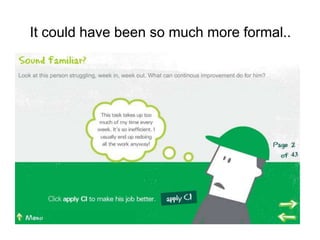
It could have been so much more formal..
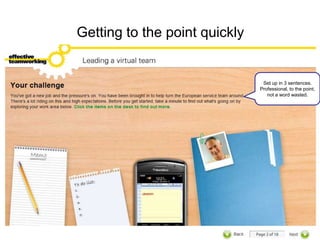
Getting to the point quickly


                                Set up in 3 sentences.
                               Professional, to the point,
                                  not a word wasted.
Having a conversation


• Can I ask you an interesting question?
• Can I tell you a story?
• Can I take you on a journey?*


I don’t know – can you?

*metaphorically. Not in a weird way.
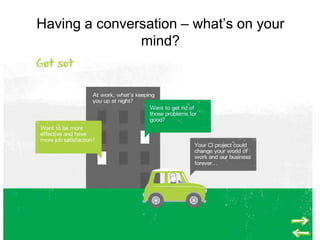
Having a conversation – what‟s on your
               mind?
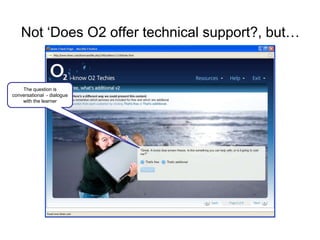
Not „Does O2 offer technical support?, but…


    The question is
conversational - dialogue
    with the learner
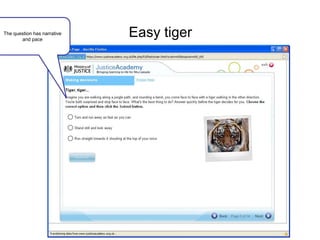
The question has narrative
       and pace
                             Easy tiger
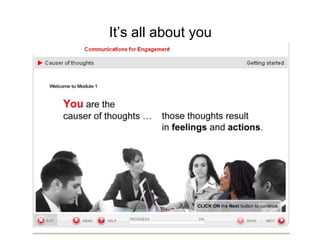
It‟s all about you
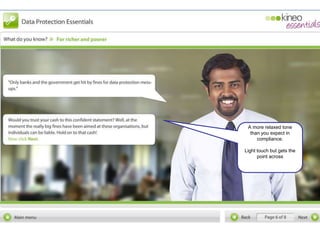
A more relaxed tone
  than you expect in
     compliance.

Light touch but gets the
      point across
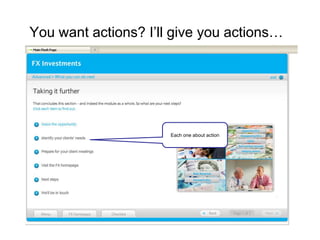
You want actions? I‟ll give you actions…


                      Each one about action
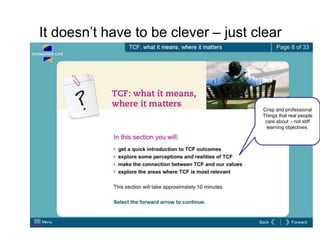
It doesn‟t have to be clever – just clear


                                     Crisp and professional
                                     Things that real people
                                      care about - not stiff
                                       learning objectives.
Let‟s review the 5 rule framework

1. Keep it light
2. Give it spirit
3. Have a conversation
4. Call for action
5. Be adult
Make the graphics
     count.
Think outside the
     course.
1 Get       2 Set
           attention   direction


6 Action
                                     3 Present
and
                                     information
support


           5 Assess    4 Exemplify
           and             and
           Summarise     practise
Space out.
Let‟s review!
Get their attention.
Object to learning
   objections.
Get the best stories.
Make it hurt so good.
Don’t be tone deaf.
Make the graphics
     count.
Think outside the
     course.
Space out.
Poll:

I learned something new today that I think I‟ll
try out on my next project!

-Yes!
-No. I knew all of this already.
-Maybe. But I need to know more.
www.kineo.com
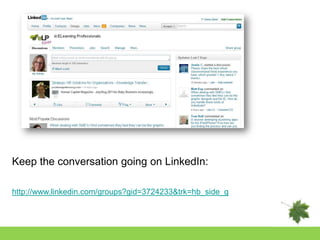
Keep the conversation going on LinkedIn:

http://www.linkedin.com/groups?gid=3724233&trk=hb_side_g
Get lots of free stuff on the Kineo website:
www.kineo.com


                              email: cammy.bean@kineo.com

                              Twitter: cammybean

                              Blog : http://cammybean.kineo.com/


                              email: mark.harrison@kineo.com
Yawn proof your elearning without busting the
  bank by Kineo is licensed under a Creative
  Commons Attribution-NonCommercial-
  ShareAlike 3.0 Unported License.

Kineo Engaging Elearning

  • 1.
    Designing Engaging Elearning: Tipsto yawn-proof your elearning without busting the bank
  • 3.
    At a trainingdepartment near you, SMEs are handing off their slide decks.
  • 4.
    You’re the trainingmanager who has to help transform that dump into elearning.
  • 5.
    You’ve got threeshort weeks to build it, but there’s too much to do! *Time* ticking away: http://www.flickr.com/people/mike9alive/
  • 6.
    You want amore streamlined process and better eLearning outcomes.
  • 7.
    Help your teamyawn-proof your elearning without busting the bank with these eight top tips.
  • 8.
    How long haveyou been involved with elearning projects? I haven‟t worked on any yet (that‟s why I‟m here!) 0.1-1 years 2-5 years 6-10 years 10+ years
  • 9.
  • 10.
    1 Get 2 Set attention direction 6 Action 3 Present and information support 5 Assess 4 Exemplify and and Summarize practice
  • 13.
    Case Study: TheVacation Policy “In keeping with the overall control environment and to ensure compliance with internal control guidelines issued by its regulators, AceFinancial has a Global Investment Bank Vacation Policy. In EMEA, the requirements of this policy (which are set out below) also apply to the Private Bank, AceFinancial Partners and the Chief Investment Office. TSS staff are required to comply with their own LOB policy. In summary, the policy requires certain employees in sensitive positions (“Designated Employees”) to be out of the office for a specified period of time each calendar year...”
  • 14.
    1 Get 2 Set attention direction 6 Action 3 Present and information support 5 Assess 4 Exemplify and and Summarise practise
  • 16.
  • 17.
    Do your programstypically include a slide upfront that details the specific learning objectives of the course? Yes No I have no idea!
  • 18.
    Traditional objectives As aresult of attending this session you will be able to: • Identify three case studies of Fortune 1000 companies who are successfully using social learning models • Define the three models of social learning and how these map to specific strategies and tools • Evaluate the pro's and con's of different social interventions as solutions to specific kinds of learning challenges • Describe their own personal experience in using social media as a practitioner
  • 19.
    Set direction 1 Get 2 Set attention direction 6 Action 3 Present and information support 5 Assess 4 Exemplify and and Summarise practise
  • 20.
    Set direction 1 Get 2 Set attention direction 6 Action 3 Present and information support 5 Assess 4 Exemplify and and Summarise practise
  • 21.
    Set direction 1 Get 2 Set attention direction 6 Action 3 Present and information support 5 Assess 4 Exemplify and and Summarise practise
  • 22.
    Get the beststories.
  • 29.
    Make it hurtso good.
  • 30.
    Do your programsalways include a FINAL TEST? No, that‟s too much work ;) Yes, otherwise how can we be sure they‟ve learned? Depends on the content. I have no idea!
  • 31.
    Question 1 of524: 1. There are ___ Customers types serviced by ACME.
  • 32.
    Question 2 of524: These customer types are i. ________ ____ ______; ii. _____ ________ _____ ; iii. ________ ____ _____; iv. ______ _______ ________ (___) ____________; and v. ______ __________ ____ _______ ____ _____.
  • 33.
    Question 3 of524: True or False? Small Business Owners would benefit from the service ACME offers of managing money and good accounting records
  • 34.
    “If I hadto live my life again, I'd make the same mistakes, only sooner.” ~ Tallulah Bankhead
  • 38.
  • 39.
    “As café staff,it‟s compulsory that you maintain quality of produce and serve it as specified by the Quality Food Manual. By the end of this training you will understand how to serve every food type according to the standards.”
  • 40.
  • 41.
    “Our specials todayare cold baked beans, burnt toasties and delayed jacket potatoes. Oh, and we have no soup. (We forgot to put it on.) Anything take your fancy? Customers expect great hot food at our café - they know it’s made from our own high quality M&S produce. To be a hot food hero, you need to present it, cook it, and serve it perfectly.”
  • 42.
    True Confessions Time: What‟sthe most boring training program you‟ve had to take or been a part of? (type your answers in chat)
  • 43.
    Our 5 ruleframework Tone matters – no matter what the content. We‟ve put together a 5 rule framework to help you write engaging, exciting and yawn proof content.
  • 44.
    Our 5 ruleframework 1. Keep it light 2. Give it spirit 3. Have a conversation 4. Call for action 5. Be adult
  • 45.
  • 46.
    Short, snappy, tothe point. And don‟t be afraid to have fun. Less of… “This e-learning module is designed to explain the principles and practical requirements of the 11 step process …” More of… “Need to get your head around our process? You‟re in the right place.” Or… “Process – boring, right? Wrong. This one will help you, all 11 steps of it. See it to believe it.”
  • 47.
    “If I'd hadmore time, I would have written a shorter letter.” Blaise Pascal T.S. Eliot Mark Twain
  • 48.
    Any challenges thatyou can see with trying to keep it light in your organization? (type your thoughts into chat)
  • 49.
    2. Give itspirit!
  • 50.
    Make it energetic,driven, engaging. Less of… “Now that you have covered the basics of customer service, in the next section you will learn how to deal with customer issues.” More of… “You‟re one step away from maximising your skills, but there‟s a problem – a customer one in fact. Click next to put your service skills to the test.”
  • 51.
  • 52.
    Direct, clear, dialogue,questioning. Less of… “Negotiating effectively is an important skill that we all use on a daily basis” You talking to me? More of… “When was the last time you negotiated something? Maybe it was more recently than you think….”
  • 53.
    4. Call foraction!
  • 54.
    Give direction, focuson actions and tasks – it‟s what happens next that counts. Less of… “You‟ve now completed this section on PBX sales. Go back to the menu to make another selection.” More of… “Now review your own client list. Who could benefit from the PBX product? Plan the time to call them now.”
  • 55.
  • 56.
    Learners are busyprofessionals – treat them that way. Adult to adult - don‟t patronise. Less of… “By now you have learned…” “You must do…” “This will take 90 minutes” More of… “Take 5 minutes to find out how to run effective meetings.”
  • 57.
    What does itlook like?
  • 58.
    Light touch –colloquial A little pun – links to later content
  • 59.
    It could havebeen so much more formal..
  • 60.
    Getting to thepoint quickly Set up in 3 sentences. Professional, to the point, not a word wasted.
  • 61.
    Having a conversation •Can I ask you an interesting question? • Can I tell you a story? • Can I take you on a journey?* I don’t know – can you? *metaphorically. Not in a weird way.
  • 62.
    Having a conversation– what‟s on your mind?
  • 63.
    Not „Does O2offer technical support?, but… The question is conversational - dialogue with the learner
  • 64.
    The question hasnarrative and pace Easy tiger
  • 65.
  • 66.
    A more relaxedtone than you expect in compliance. Light touch but gets the point across
  • 67.
    You want actions?I‟ll give you actions… Each one about action
  • 68.
    It doesn‟t haveto be clever – just clear Crisp and professional Things that real people care about - not stiff learning objectives.
  • 73.
    Let‟s review the5 rule framework 1. Keep it light 2. Give it spirit 3. Have a conversation 4. Call for action 5. Be adult
  • 74.
  • 80.
  • 81.
    1 Get 2 Set attention direction 6 Action 3 Present and information support 5 Assess 4 Exemplify and and Summarise practise
  • 87.
  • 88.
  • 89.
  • 90.
  • 91.
    Get the beststories.
  • 92.
    Make it hurtso good.
  • 93.
  • 94.
  • 95.
  • 96.
  • 97.
    Poll: I learned somethingnew today that I think I‟ll try out on my next project! -Yes! -No. I knew all of this already. -Maybe. But I need to know more.
  • 98.
  • 99.
    Keep the conversationgoing on LinkedIn: http://www.linkedin.com/groups?gid=3724233&trk=hb_side_g
  • 100.
    Get lots offree stuff on the Kineo website: www.kineo.com email: cammy.bean@kineo.com Twitter: cammybean Blog : http://cammybean.kineo.com/ email: mark.harrison@kineo.com
  • 101.
    Yawn proof yourelearning without busting the bank by Kineo is licensed under a Creative Commons Attribution-NonCommercial- ShareAlike 3.0 Unported License.

Editor's Notes

  • #2 Finding yourself a bit bored with the e-Learning you've been creating lately? Looking to jazz up your e-Learning courses, but don't have the resources to create a 3-D immersive learning game that can be delivered on your iPhone? Need to get your content turned around fast – but without sacrificing engagement?In this session, you’ll explore strategies and tips for creating quality e-Learning in a rapid timeframe without busting the bank. You'll see examples of incoming content received from clients, discuss the approach to rapid design, and talk about some of the specific strategies you can use to maximize engagement with minimal investment. In this session, you will learn:How to apply simple instructional strategies to spice up your learning design  Techniques for rapid instructional design  
  • #11 So what are some ways to focus attention and minimize distractions in what is inherently a passive experience (elearning)
  • #12 Get the learner to sit up – make them DO something right away. Get straight into the action. Ask questions – this focuses the learner’s attention on what they don’t know – and presumably what you’re going to cover in the programFind the killer fact, stat, or quoteLead with a killer mistakeSome mistakes make such an impact on business performance that it’s worth highlighting them upfront to the learner. For example: “Did you know that 40% of our customers go elsewhere for services they would happily buy from us if they know we offered them?”
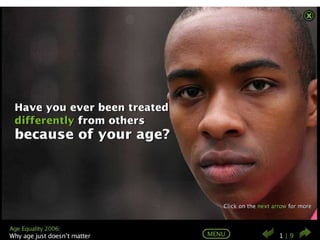
  • #13 Ask provocative questions – turn things around in a surprising way. Rattle expectations a bit…Learn from the marketing team – strong visuals and text to hook the learner emotionally.ink to application share...http://www.kineo.com/showcase/file.php/30/age/index.htmlAs a first screen, it’s a very good attention grabber...Ask provocotavie questions.
  • #14 We’ve all been handed a lengthy PPT or dry source content to start from.
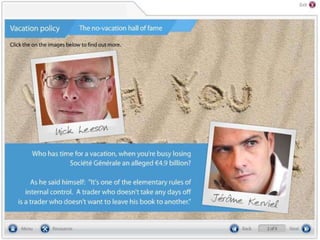
  • #15 What We DidA demo...Wish you were here...about the vacation policy – the surprise is that if you don’t go on holiday, it suggests you’re up to no good. They want you to take vacations so they engatge you upfront.This also shows you what can go wrong – what happens when you don’t follow the policy? Peer pressure – everyone’s doing – these success stories show how people who’ve mastered this learning are now benefiting from it.(Some clients have told us, “people are bored with that risk thing – we see it in all of the compliance courses…” The peer pressure approach can be a good alternative. Or perhaps the utopian ideal if we all learn this…e.g. BIW scenario “In the ideal workplace…”)Tell a story – show the risk (Michael Allen’s famous plane crash example, which has now entered into the annals of eLearning legend. Who’s heard of it? Who’s actually seen the presentation? Who’s actually seen that eLearning?Can I show this demo – or just screen capture? (I could mask the screen capture...)all my points made at the elearning guild still stand though - got good reactions when they put it in front of target audience as a potential approach.[5:29:25 PM] Stephen Walsh: and the HR dept were nervous about the approach etc.
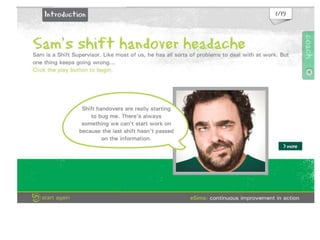
  • #19 Most learners click NEXT on this slide.
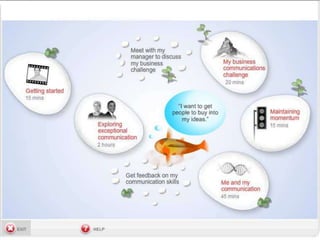
  • #20 BP continuous improvement – unconventional way of setting out what the module is about – AD and messages working together, it’s about a journey to improvement
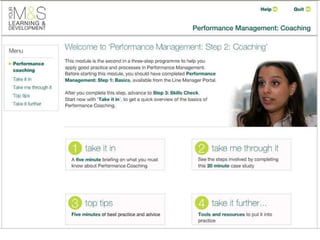
  • #21 Set direction via a menu. By using really clear wording – take it in, etc. The menu sets the direction for the whole program.
  • #22 Effective menus to tell you where you’re going...
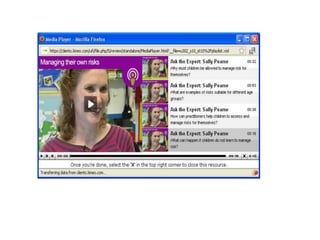
  • #24 Get war stories from your best peopleGet true stories from your newer people (they still know what they didn’t know)You don’t need fancy equipment We recorded this with skype + audacity – both free UFI_ask the expert.swfWhen you click on these you just hear short audio – no moving video or flipping stills.Sometimes these are video – sometimes just audio with stills. (think flip video camera – even an iPod Nano/or iPhone now has video)
  • #25 Do an .flv/.swf…Video and audio where it countsGuerilla approaches to shooting and audioFlip video for secret shopperSkype for expert interviews
  • #28 file:///C:/Documents%20and%20Settings/Cammy%20Bean/My%20Documents/Working/kgi10009/build/index.html
  • #31 Often final assessments are used for the company to tick a box and not to actually help the learner learn more or actually assess what they’ve learned.Often final tests are MCQs or fill-in-the blank to test basic rote memorization of facts and concepts. It’s hard work to write an assessment that may actually help the learner retain something.After the poll have them type into chat – what’s their main goal as a project manager with including assessments? Are you managing compliance records and need to tick a box? Is it to “prove” that someone sat through the program? Is it to ensure that there was effective knowledge transfer and a change in behavior? Do these types of questions prove a change in behavior?
  • #32 Are these the types of questions your courses include?
  • #33 Are these the types of questions your courses include?
  • #34 Are these the types of questions your courses include?
  • #35 Make more mistakes.Find the mistakes that hurt the mostKeep ‘em realPlay it outProvide useful feedback
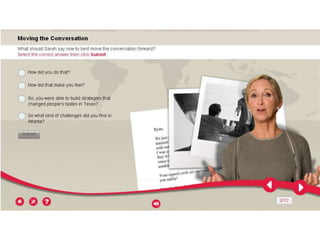
  • #36 Application share: Immerse them in a conextual setting – don’t just quiz them on the ‘facts’ – get them to put it to work.file:///C:/Documents%20and%20Settings/Cammy%20Bean/My%20Documents/Demos/MS%20Cafe/main.swf
  • #37 Application shareShow mistakes and what you can learn from them…As part of your initial TNA – find out where people make the most common (or the most painful mistakes) – make that the focale point of your design.
  • #38 Make it hard.
  • #40 This was the original content we got from them...
  • #41 This was the original content we got from them...
  • #42 Instead, why not this?See the difference?
  • #45 Let’s look at each in turn…
  • #47 Less is more!
  • #48 Less is more!
  • #57 Point about not being patronising
  • #58 People expect to be bored by e-learning – let’s show them it doesn’t have to be like that.Just the right side of sassy
  • #59 Keep it light.
  • #60 Keep it light.
  • #74 Let’s look at each in turn…
  • #75 Define the design and development process so the SME knows their role and how they fit in. The key to success in the SME relationship is getting them to understand clearly their role and what they are expected to do. SME’s most common complaint about participation in eLearning projects is that it takes far longer than they were told it would. If you start by describing the process and how they’ll fit in, the expectations are set to the proper level…
  • #76 For example, is the aim of your visuals to grab attention? Or perhaps you want to use the visuals to tip a common idea on its head by using a recognisable image and altering it in some way or using it out of context.
  • #77 Perhaps you want to use the visuals to tell a story, with text or without.Understanding when a visual is relevant? Is it a diagram that supports a workflow? (Note – these might be better for the novice than an expert who already has his/her own mental model of that work flow).Sometimes a picture can add emotional oomph – that has validity.
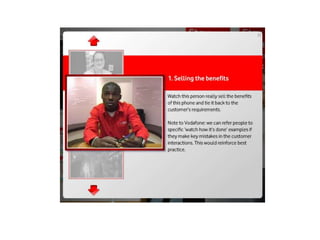
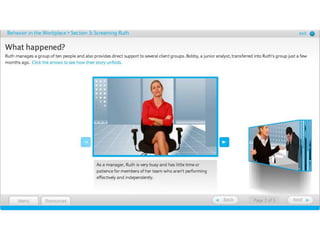
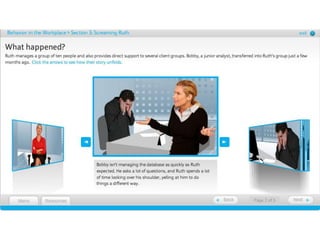
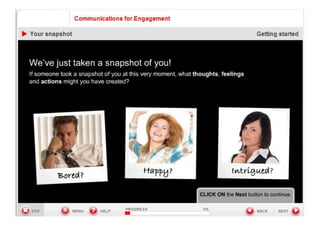
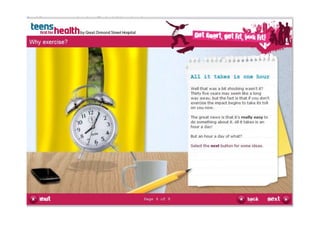
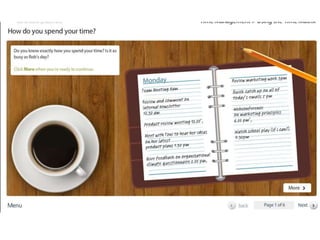
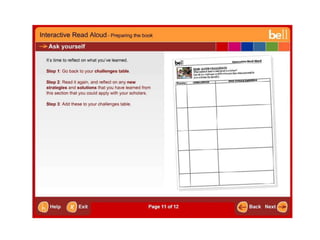
  • #78 When designing your e-learning, think about the purpose of the graphics, as well as the purpose of your whole screen.In this screen, you might say that the coffee cup isn’t completely relevant, but think about the emotional connection and intimacy you’re creating with a topic.
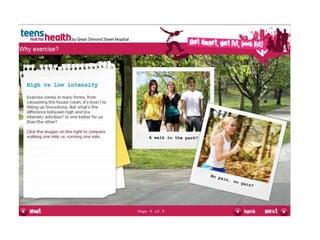
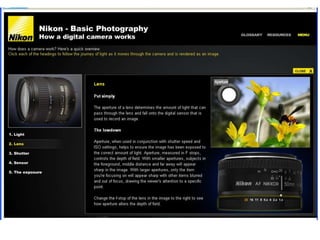
  • #79 Make graphics earn their placeComplement text, don’t fight itIn this example, the visual is interactive – so it not only earns it’s place but is essential!
  • #80 Keep it relevant. Remember – use graphics that support the instructional.
  • #81 Define the design and development process so the SME knows their role and how they fit in. The key to success in the SME relationship is getting them to understand clearly their role and what they are expected to do. SME’s most common complaint about participation in eLearning projects is that it takes far longer than they were told it would. If you start by describing the process and how they’ll fit in, the expectations are set to the proper level…
  • #82 What’s the final call to action – Call to action and don’t let gowhat was the point of the whole thing in the first place. What do you need to go out and do.
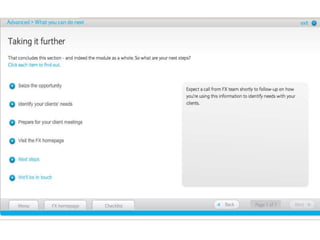
  • #83 They’re coming to get you…Take the Call to Action and make it personal. In this case, a real-live manager will follow up with the learner…
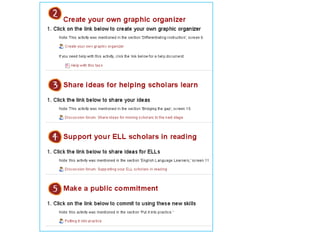
  • #84 More call to actions...with specific links to take the experience beyond the eLearning event...”beyond the course”
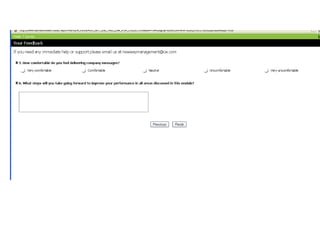
  • #87 Using survey monkey to get calls to action
  • #88 Space it out – create a campaign of events – emails, links, etc. – over a sustained period of time. Gentle nudges, short sharp eLearning bits to keep the concepts alive.
  • #89 Space it out – create a campaign of events – emails, links, etc. – over a sustained period of time. Gentle nudges, short sharp eLearning bits to keep the concepts alive.
  • #90 Define the design and development process so the SME knows their role and how they fit in. The key to success in the SME relationship is getting them to understand clearly their role and what they are expected to do. SME’s most common complaint about participation in eLearning projects is that it takes far longer than they were told it would. If you start by describing the process and how they’ll fit in, the expectations are set to the proper level…
  • #91 Define the design and development process so the SME knows their role and how they fit in. The key to success in the SME relationship is getting them to understand clearly their role and what they are expected to do. SME’s most common complaint about participation in eLearning projects is that it takes far longer than they were told it would. If you start by describing the process and how they’ll fit in, the expectations are set to the proper level…
  • #94 Define the design and development process so the SME knows their role and how they fit in. The key to success in the SME relationship is getting them to understand clearly their role and what they are expected to do. SME’s most common complaint about participation in eLearning projects is that it takes far longer than they were told it would. If you start by describing the process and how they’ll fit in, the expectations are set to the proper level…
  • #95 Define the design and development process so the SME knows their role and how they fit in. The key to success in the SME relationship is getting them to understand clearly their role and what they are expected to do. SME’s most common complaint about participation in eLearning projects is that it takes far longer than they were told it would. If you start by describing the process and how they’ll fit in, the expectations are set to the proper level…
  • #96 Define the design and development process so the SME knows their role and how they fit in. The key to success in the SME relationship is getting them to understand clearly their role and what they are expected to do. SME’s most common complaint about participation in eLearning projects is that it takes far longer than they were told it would. If you start by describing the process and how they’ll fit in, the expectations are set to the proper level…
  • #97 Space it out – create a campaign of events – emails, links, etc. – over a sustained period of time. Gentle nudges, short sharp eLearning bits to keep the concepts alive.
  • #99 http://www.kineo.com/elearning-reports/free-guide-10-ways-to-yawn-proof-your-e-learning.html
  • #100 http://www.linkedin.com/groups?gid=3724233&trk=hb_side_g
  • #101 Contact us!