















Writing better
elearning
scripts.
Presented by Cammy Bean
Senior Solutions Consultant, Kineo US
Jot down...
What do you want to get from this
session?
It was a dark and stormy night.
Across town a subject matter expert
handed off a 62 slide deck to an
instructional designer.
Suddenly, a shot rang out…
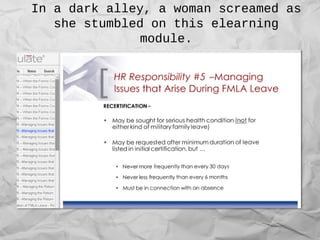
In a dark alley, a woman screamed as
she stumbled on this elearning
module.
The people wept in despair.
How can we write
better programs
to stop this
horror?
Sharpen your quills as we
share some top tips for
writing better elearning
scripts.
First!! Jot
down a
learning
objective!
1. Keep it light.
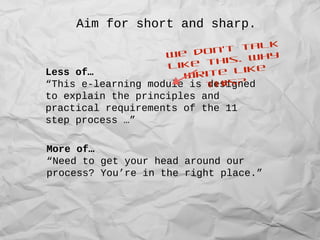
Aim for short and sharp.
Less of…
“This e-learning module is designed
to explain the principles and
practical requirements of the 11
step process …”
More of…
“Need to get your head around our
process? You’re in the right place.”
We don’t talk
like this. Why
write like
this?
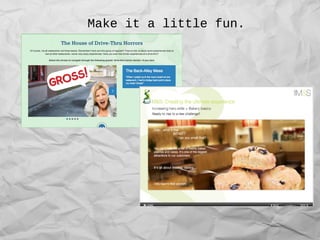
Make it a little fun.
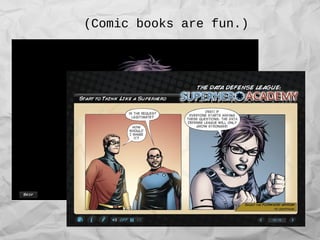
(Comic books are fun.)
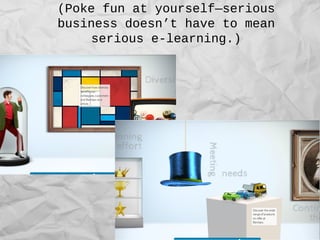
(Poke fun at yourself—serious
business doesn’t have to mean
serious e-learning.)
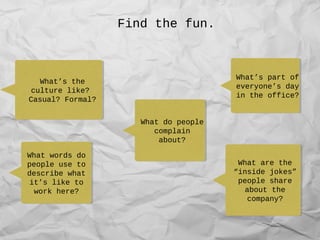
Find the fun.
What’s the
culture like?
Casual? Formal?
What’s the
culture like?
Casual? Formal?
What’s part of
everyone’s day
in the office?
What’s part of
everyone’s day
in the office?
What words do
people use to
describe what
it’s like to
work here?
What words do
people use to
describe what
it’s like to
work here?
What are the
“inside jokes”
people share
about the
company?
What are the
“inside jokes”
people share
about the
company?
What do people
complain
about?
What do people
complain
about?
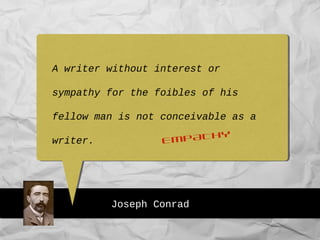
Joseph Conrad
A writer without interest or
sympathy for the foibles of his
fellow man is not conceivable as a
writer. EMPATHY
2. Make it human.
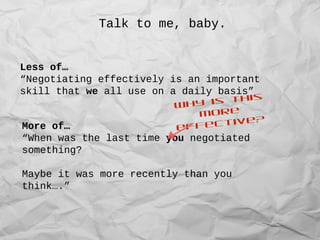
Talk to me, baby.
Less of…
“Negotiating effectively is an important
skill that we all use on a daily basis”
More of…
“When was the last time you negotiated
something?
Maybe it was more recently than you
think….”
Why is this
more
effective?
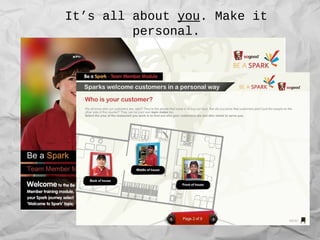
It’s all about you. Make it
personal.
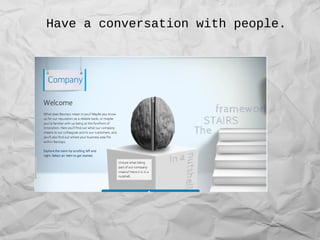
Have a conversation with people.
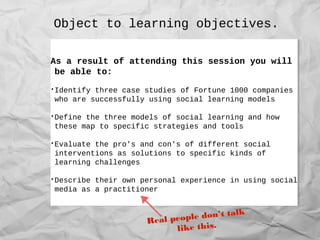
Object to learning objectives.
As a result of attending this session you will
be able to:
•Identify three case studies of Fortune 1000 companies
who are successfully using social learning models
•Define the three models of social learning and how
these map to specific strategies and tools
•Evaluate the pro's and con's of different social
interventions as solutions to specific kinds of
learning challenges
•Describe their own personal experience in using social
media as a practitioner
As a result of attending this session you will
be able to:
•Identify three case studies of Fortune 1000 companies
who are successfully using social learning models
•Define the three models of social learning and how
these map to specific strategies and tools
•Evaluate the pro's and con's of different social
interventions as solutions to specific kinds of
learning challenges
•Describe their own personal experience in using social
media as a practitioner
Real people don’t talk
like this.
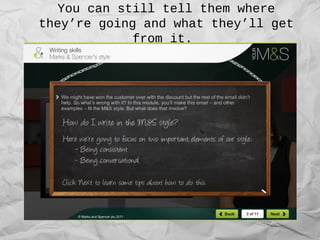
You can still tell them where
they’re going and what they’ll get
from it.
So how can we make this better?
List the characteristics of humans that
we need to be aware of when designing
ships.
List the characteristics of humans that
we need to be aware of when designing
ships.
Want to build ships that feel like a
four-star resort? Here you’ll learn how
people interact with ships and how you
can design for a better experience.
Want to build ships that feel like a
four-star resort? Here you’ll learn how
people interact with ships and how you
can design for a better experience.
How about...
What about this one?
Define the three main potential risks of not
having an ITAM program in place.
Define the three main potential risks of not
having an ITAM program in place.
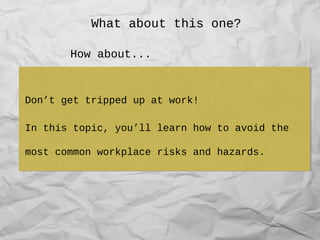
Don’t get tripped up at work!
In this topic, you’ll learn how to avoid the
most common workplace risks and hazards.
Don’t get tripped up at work!
In this topic, you’ll learn how to avoid the
most common workplace risks and hazards.
How about...
Is there hope for this one?
• Recognise the key stages in money
laundering and common techniques used by
money launderers
• Outline key elements of reporting under the
Anti-Money Laundering and Counter-Terrorism
Financing Act 2006
• Recognise the key stages in money
laundering and common techniques used by
money launderers
• Outline key elements of reporting under the
Anti-Money Laundering and Counter-Terrorism
Financing Act 2006
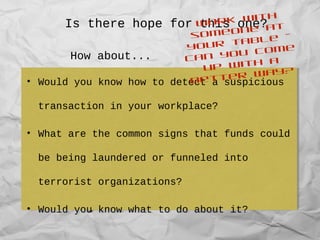
• Would you know how to detect a suspicious
transaction in your workplace?
• What are the common signs that funds could
be being laundered or funneled into
terrorist organizations?
• Would you know what to do about it?
• Would you know how to detect a suspicious
transaction in your workplace?
• What are the common signs that funds could
be being laundered or funneled into
terrorist organizations?
• Would you know what to do about it?
How about...
Work with
someone at
your table –
can you come
up with a
better way?
Read it out loud. Would you want to
listen? Would you know what to
expect?
Rudyard Kipling
If history were taught in the form
of stories, it would never be
forgotten.
3. Tell great stories.
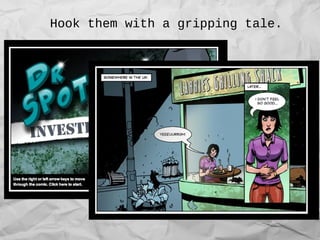
Hook them with a gripping tale.
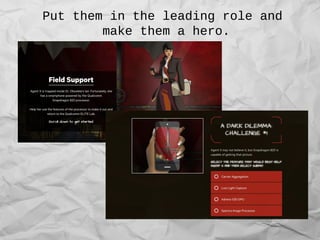
Put them in the leading role and
make them a hero.
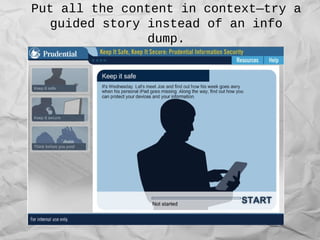
Put all the content in context—try a
guided story instead of an info
dump.
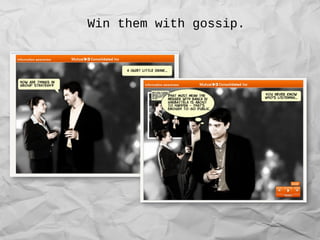
Win them with gossip.
Grab their attention with tales of
risk and intrigue.
Alice Munro
Anecdotes don’t make good stories.
Generally I dig down underneath them
so far that the story that finally
comes out is not what people thought
their anecdotes were about.
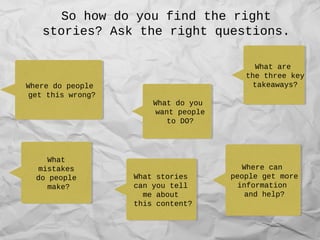
So how do you find the right
stories? Ask the right questions.
Where do people
get this wrong?
Where do people
get this wrong?
What do you
want people
to DO?
What do you
want people
to DO?
What
mistakes
do people
make?
What
mistakes
do people
make?
Where can
people get more
information
and help?
Where can
people get more
information
and help?
What are
the three key
takeaways?
What are
the three key
takeaways?
What stories
can you tell
me about
this content?
What stories
can you tell
me about
this content?
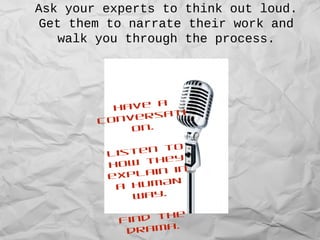
Ask your experts to think out loud.
Get them to narrate their work and
walk you through the process.
Have a
conversati
on.
Listen to
how they
explain in
a HUMAN
way.
Find the
drama.
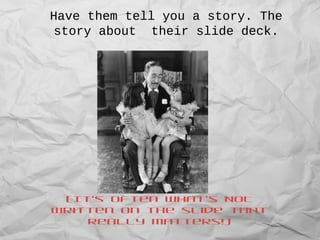
Have them tell you a story. The
story about their slide deck.
(It’s often what’s NOT
written on the slide that
really matters!)
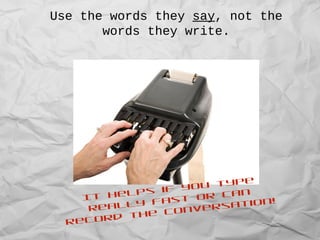
Use the words they say, not the
words they write.
It helps if you type
really fast or can
record the conversation!
Marilyn Hacker
Good writing gives energy, whatever
it is about.
4. Give it spirit.
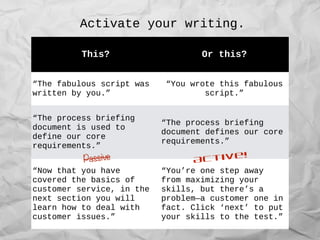
Activate your writing.
This? Or this?
“The fabulous script was
written by you.”
“You wrote this fabulous
script.”
“The process briefing
document is used to
define our core
requirements.”
“The process briefing
document defines our core
requirements.”
“Now that you have
covered the basics of
customer service, in the
next section you will
learn how to deal with
customer issues.”
“You’re one step away
from maximizing your
skills, but there’s a
problem—a customer one in
fact. Click ‘next’ to put
your skills to the test.”
Active!
Rainer Maria Rilke
May what I do flow from me like a
river, no forcing and no holding
back, the way it is with children.
5. Make it flow.
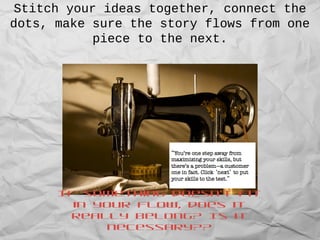
Stitch your ideas together, connect the
dots, make sure the story flows from one
piece to the next.
If something doesn’t fit
in your flow, does it
really belong? Is it
necessary??
Henry David Thoreau
Not that the story need be long, but
it will take a long while to make it
short.
6. Cut it.
Cut the blather and focus on the
doing.
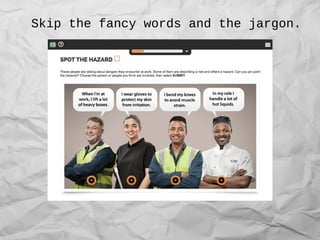
Skip the fancy words and the jargon.
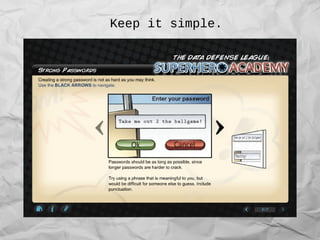
Keep it simple.
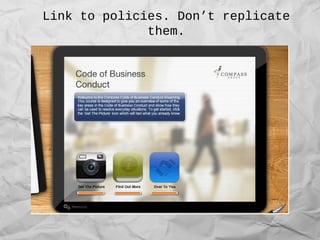
Link to policies. Don’t replicate
them.
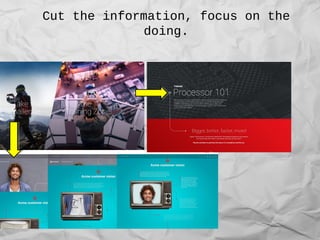
Cut the information, focus on the
doing.
E.B. White
No one can write decently who is
distrustful of the reader’s
intelligence or whose attitude is
patronizing.
7. Don’t patronize.
Oops. Do you
feel
patronized
now?
Talk adult-to-adult.
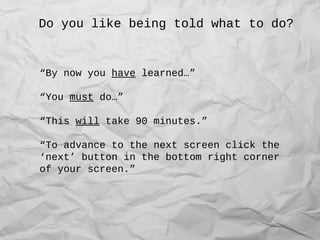
Do you like being told what to do?
“By now you have learned…”
“You must do…”
“This will take 90 minutes.”
“To advance to the next screen click the
‘next’ button in the bottom right corner
of your screen.”
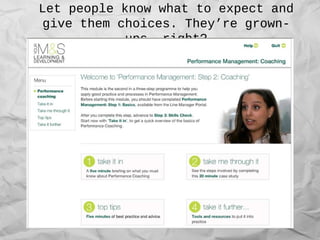
Let people know what to expect and
give them choices. They’re grown-
ups, right?
Henry Wadsworth Longfellow
Great is the art of beginning, but
greater is the art of ending.
8. Write the
never-ending
story.
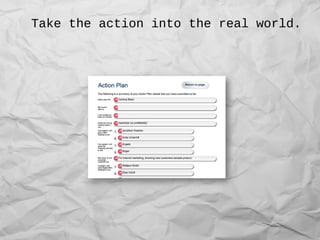
Take the action into the real world.
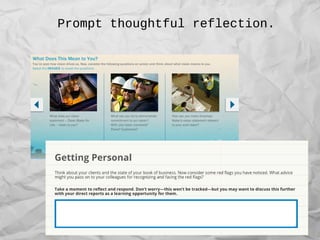
Prompt thoughtful reflection.
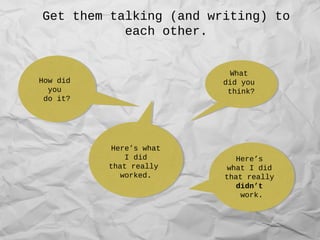
Get them talking (and writing) to
each other.
What
did you
think?
What
did you
think?
How did
you
do it?
How did
you
do it?
Here’s what
I did
that really
worked.
Here’s what
I did
that really
worked.
Here’s
what I did
that really
didn’t
work.
Here’s
what I did
that really
didn’t
work.
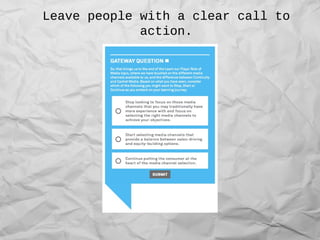
Leave people with a clear call to
action.
Repeat after me.
Keep it light.
Make it human.
Tell great stories.
Give it spirit.
Make it flow.
Cut it.
Don’t patronize.
Write the never-ending story.
Ernest Hemingway (A Moveable
Feast)
I would stand and look out over the roofs of Paris and think, 'Do not worry. You have
always written before and you will write now. All you have to do is write one true
sentence. Write the truest sentence that you know.’
Write home.
Cammy.bean@kineo.com
Twitter: @cammybean
www.kineo.com
Want more ideas?
Check out our blog!
http://www.kineo.com/us/blog/
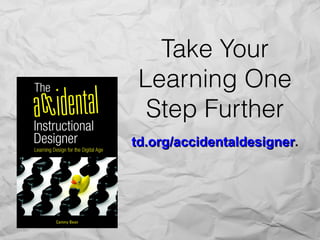
Take Your
Learning One
Step Further
td.org/accidentaldesignertd.org/accidentaldesigner..
Writing Better e-Learning Scripts #Training18

Writing Better e-Learning Scripts #Training18

  • 1.
    Writing better elearning scripts. Presented byCammy Bean Senior Solutions Consultant, Kineo US
  • 2.
    Jot down... What doyou want to get from this session?
  • 3.
    It was adark and stormy night.
  • 4.
    Across town asubject matter expert handed off a 62 slide deck to an instructional designer.
  • 5.
    Suddenly, a shotrang out…
  • 6.
    In a darkalley, a woman screamed as she stumbled on this elearning module.
  • 7.
    The people weptin despair.
  • 8.
    How can wewrite better programs to stop this horror?
  • 9.
    Sharpen your quillsas we share some top tips for writing better elearning scripts. First!! Jot down a learning objective!
  • 10.
    1. Keep itlight.
  • 11.
    Aim for shortand sharp. Less of… “This e-learning module is designed to explain the principles and practical requirements of the 11 step process …” More of… “Need to get your head around our process? You’re in the right place.” We don’t talk like this. Why write like this?
  • 12.
    Make it alittle fun.
  • 13.
  • 14.
    (Poke fun atyourself—serious business doesn’t have to mean serious e-learning.)
  • 15.
    Find the fun. What’sthe culture like? Casual? Formal? What’s the culture like? Casual? Formal? What’s part of everyone’s day in the office? What’s part of everyone’s day in the office? What words do people use to describe what it’s like to work here? What words do people use to describe what it’s like to work here? What are the “inside jokes” people share about the company? What are the “inside jokes” people share about the company? What do people complain about? What do people complain about?
  • 16.
    Joseph Conrad A writerwithout interest or sympathy for the foibles of his fellow man is not conceivable as a writer. EMPATHY
  • 17.
    2. Make ithuman.
  • 18.
    Talk to me,baby. Less of… “Negotiating effectively is an important skill that we all use on a daily basis” More of… “When was the last time you negotiated something? Maybe it was more recently than you think….” Why is this more effective?
  • 19.
    It’s all aboutyou. Make it personal.
  • 20.
    Have a conversationwith people.
  • 21.
    Object to learningobjectives. As a result of attending this session you will be able to: •Identify three case studies of Fortune 1000 companies who are successfully using social learning models •Define the three models of social learning and how these map to specific strategies and tools •Evaluate the pro's and con's of different social interventions as solutions to specific kinds of learning challenges •Describe their own personal experience in using social media as a practitioner As a result of attending this session you will be able to: •Identify three case studies of Fortune 1000 companies who are successfully using social learning models •Define the three models of social learning and how these map to specific strategies and tools •Evaluate the pro's and con's of different social interventions as solutions to specific kinds of learning challenges •Describe their own personal experience in using social media as a practitioner Real people don’t talk like this.
  • 22.
    You can stilltell them where they’re going and what they’ll get from it.
  • 23.
    So how canwe make this better? List the characteristics of humans that we need to be aware of when designing ships. List the characteristics of humans that we need to be aware of when designing ships. Want to build ships that feel like a four-star resort? Here you’ll learn how people interact with ships and how you can design for a better experience. Want to build ships that feel like a four-star resort? Here you’ll learn how people interact with ships and how you can design for a better experience. How about...
  • 24.
    What about thisone? Define the three main potential risks of not having an ITAM program in place. Define the three main potential risks of not having an ITAM program in place. Don’t get tripped up at work! In this topic, you’ll learn how to avoid the most common workplace risks and hazards. Don’t get tripped up at work! In this topic, you’ll learn how to avoid the most common workplace risks and hazards. How about...
  • 25.
    Is there hopefor this one? • Recognise the key stages in money laundering and common techniques used by money launderers • Outline key elements of reporting under the Anti-Money Laundering and Counter-Terrorism Financing Act 2006 • Recognise the key stages in money laundering and common techniques used by money launderers • Outline key elements of reporting under the Anti-Money Laundering and Counter-Terrorism Financing Act 2006 • Would you know how to detect a suspicious transaction in your workplace? • What are the common signs that funds could be being laundered or funneled into terrorist organizations? • Would you know what to do about it? • Would you know how to detect a suspicious transaction in your workplace? • What are the common signs that funds could be being laundered or funneled into terrorist organizations? • Would you know what to do about it? How about... Work with someone at your table – can you come up with a better way?
  • 26.
    Read it outloud. Would you want to listen? Would you know what to expect?
  • 27.
    Rudyard Kipling If historywere taught in the form of stories, it would never be forgotten.
  • 28.
    3. Tell greatstories.
  • 29.
    Hook them witha gripping tale.
  • 30.
    Put them inthe leading role and make them a hero.
  • 31.
    Put all thecontent in context—try a guided story instead of an info dump.
  • 32.
  • 33.
    Grab their attentionwith tales of risk and intrigue.
  • 34.
    Alice Munro Anecdotes don’tmake good stories. Generally I dig down underneath them so far that the story that finally comes out is not what people thought their anecdotes were about.
  • 35.
    So how doyou find the right stories? Ask the right questions. Where do people get this wrong? Where do people get this wrong? What do you want people to DO? What do you want people to DO? What mistakes do people make? What mistakes do people make? Where can people get more information and help? Where can people get more information and help? What are the three key takeaways? What are the three key takeaways? What stories can you tell me about this content? What stories can you tell me about this content?
  • 36.
    Ask your expertsto think out loud. Get them to narrate their work and walk you through the process. Have a conversati on. Listen to how they explain in a HUMAN way. Find the drama.
  • 37.
    Have them tellyou a story. The story about their slide deck. (It’s often what’s NOT written on the slide that really matters!)
  • 38.
    Use the wordsthey say, not the words they write. It helps if you type really fast or can record the conversation!
  • 39.
    Marilyn Hacker Good writinggives energy, whatever it is about.
  • 40.
    4. Give itspirit.
  • 41.
    Activate your writing. This?Or this? “The fabulous script was written by you.” “You wrote this fabulous script.” “The process briefing document is used to define our core requirements.” “The process briefing document defines our core requirements.” “Now that you have covered the basics of customer service, in the next section you will learn how to deal with customer issues.” “You’re one step away from maximizing your skills, but there’s a problem—a customer one in fact. Click ‘next’ to put your skills to the test.” Active!
  • 42.
    Rainer Maria Rilke Maywhat I do flow from me like a river, no forcing and no holding back, the way it is with children.
  • 43.
  • 44.
    Stitch your ideastogether, connect the dots, make sure the story flows from one piece to the next. If something doesn’t fit in your flow, does it really belong? Is it necessary??
  • 45.
    Henry David Thoreau Notthat the story need be long, but it will take a long while to make it short.
  • 46.
  • 47.
    Cut the blatherand focus on the doing.
  • 48.
    Skip the fancywords and the jargon.
  • 49.
  • 50.
    Link to policies.Don’t replicate them.
  • 51.
    Cut the information,focus on the doing.
  • 52.
    E.B. White No onecan write decently who is distrustful of the reader’s intelligence or whose attitude is patronizing.
  • 53.
    7. Don’t patronize. Oops.Do you feel patronized now?
  • 54.
  • 55.
    Do you likebeing told what to do? “By now you have learned…” “You must do…” “This will take 90 minutes.” “To advance to the next screen click the ‘next’ button in the bottom right corner of your screen.”
  • 56.
    Let people knowwhat to expect and give them choices. They’re grown- ups, right?
  • 57.
    Henry Wadsworth Longfellow Greatis the art of beginning, but greater is the art of ending.
  • 58.
  • 59.
    Take the actioninto the real world.
  • 60.
  • 61.
    Get them talking(and writing) to each other. What did you think? What did you think? How did you do it? How did you do it? Here’s what I did that really worked. Here’s what I did that really worked. Here’s what I did that really didn’t work. Here’s what I did that really didn’t work.
  • 62.
    Leave people witha clear call to action.
  • 63.
    Repeat after me. Keepit light. Make it human. Tell great stories. Give it spirit. Make it flow. Cut it. Don’t patronize. Write the never-ending story.
  • 64.
    Ernest Hemingway (AMoveable Feast) I would stand and look out over the roofs of Paris and think, 'Do not worry. You have always written before and you will write now. All you have to do is write one true sentence. Write the truest sentence that you know.’
  • 66.
    Write home. Cammy.bean@kineo.com Twitter: @cammybean www.kineo.com Wantmore ideas? Check out our blog! http://www.kineo.com/us/blog/
  • 67.
    Take Your Learning One StepFurther td.org/accidentaldesignertd.org/accidentaldesigner..

Editor's Notes

  • #2 Good morning all. I’m Cammy Bean, Senior Solutions Consultant at Kineo. Work out of MA. Been in eLearning since 1996. Since then many different elearning projects, industries and an insane amount of CONTENT Can’t spare the deep, dark tunnels of compliance content, standard operating procedures, and financial policies Which gets me to the point of what we’re here to talk about today…writing better elearning scripts!
  • #3 Before we dig in, I want you all to do me a favor. Take 30 seconds to just jot down somewhere the answer to this question—what do you want to get from this session? Great – anyone care to share? (I always like to know what expectations people have of me. Whether I meet them or not is another question!) Great, now set that aside for a bit. We’ll come back to that. Let’s get started with a little story…
  • #7 This was an actual course we received from a client as the original e-learning module we were tasked with doing a makeover.
  • #9 The question is – what can we do as writers to stop this horror? Part of it is good design, but a HUGE part of bringing that design to life, is in how we write our e-learning.
  • #10 Ok!! Let’s sharpen our quills and dig in. First, put your instructional designer/instructional writer hats on. Write down one learning objective that you think might represent a learning outcome for this session. Ok – set that aside; we’ll come back to it later. Let’s rock and roll! (drumroll…first tip!!)
  • #11 On to our first tip to writing better e-learning scripts is to keep it light.
  • #12 aim for every elearning script is to keep things short and sharp. create a light tone that’s more accessible, and cuts unnecessary words. So less of...And more of... See the difference? We don’t talk like that first example. So why write like that? We don’t need to over-intellectualize our messages.
  • #13 Fun writing is more accessible. It draws the learner in and makes them want to read. Who wants to miss out on a good joke? Or a good innuendo?
  • #14 Just another example here – this was a really boring information security course that we turned into a comic book/guided story format.
  • #15 This was an onboarding course for Barclays…a very professional, financial institution who fully embraced their quirky side in this virtual “gallery”. This is an interesting example, because when you look at the writing itself, it’s very clean and straight forward. In this case, the graphics are doing the “singing” so we pared back on being too goofy with the writing. But it’s still short and sharp.
  • #16 You might look at these examples and have an instinctive reaction: “my company culture is NOT fun.” Is that really true? Or have you just not asked the questions to find the fun? But explore the boundaries by asking questions… Use what you learn to inform (at the very least) the tone and language you use, and if you hit on something unique that you can leverage into your training, go for it!!
  • #17 Let’s get intellectual now…what’s he talking about here? Joseph Conrad’s message to us is to be empathetic to other human beings. Which leads us into the next tip.
  • #18 One of our mantras is to make it human – As I like to say (in my perfect hippie accent), “it’s all about the people, man.”
  • #19 Question: Why is the second statement more effective? What’s it doing that the first statement isn’t? I don’t know about you, but when I read “we” in the first sentence, I kind of tune out – we doesn’t necessarily mean me, so do I really need to pay attention? But the second statement, it’s pulling the learner in. Connecting directly to them. It’s prompting personal reflection.
  • #20 Who is YOUR end customer? It’s not the company. It’s not the people who want the training to be made. It’s the people who are going through the training.
  • #21 Have a conversation – a key tip we give to our instructional writers is to write like you’re sitting down with the learner over coffee at a coffee shop. Does this work for every course to this degree? No – sometimes there are courses where technical language is required.
  • #22 Also – OBJECT TO LEARNING OBJECTIVES!! What do most people do when they see a slide like this? Pause…. They click the next button. Important to have learning objectives but learner doesn’t nee to see in this format. Important to set direction but we don’t have to set it in this way. So, be honest now…take a look at your learning objectives you wrote earlier. How many of you wrote them with words starting with “identify, define, describe” or something similar? Who might be willing to share one of their “learning objectives” you wrote down earlier? Thanks for sharing...now can I ask, what did you jot down for the response to what YOU wanted to get from this session? See the disconnect in the two different answers? You may need to use these objectives as part of your design documentation, but in now way does that mean you have to make your learners read them. It’s not going to change what they get from the content.
  • #23 Conversational, I know what I’m going to get from this experience. Boom. Done. As a side note here – it certainly helps more when your course is focused on 1-3 key outcomes. More than that, and you better think about breaking up delivering those learning objectives across different topics or you’ll overwhelm the learner, no matter how simply you write.
  • #24 These are learning objectives we got from clients – how can we rewrite them?
  • #25 And this one?
  • #26 (BEFORE CLICKING FORWARD) Your turn!! Discuss with those at your table to do a quick brainstorm on a better approach here. What did you come up with?
  • #27 If you’re trying to think and see if something is accessible, read it out loud – check for the flow, the pacing, and whether it has the right touch.
  • #28 What are we talking about here? Storytelling…
  • #29 Story trumps all – a lot of research on how storytelling draws people in. Stories are like a flight simulator for the brain. When we can put ourselves into other people’s shoes it’s like we’re doing a dress rehearsal in our minds.
  • #30 Hook them with a gripping tale and make them want to pay attention. How about this course on food safety? Don’t start by telling learners “food safety is important...” TELL A STORY TO ILLUSTRATE WHY IT’S IMPORTANT. Incite the curiousity gap – why do we like to watch mysteries? We want to get to the end to find out what happens.
  • #31 This was some product training for retail sales reps. Engaged learners in a mission they had to solve. make this information easy for retail sales reps to recall when working with customers. The story helps give the retail sales rep a starting point for building their own narrative with customers.
  • #32 You can also do guided stories – Like this, “meet joe” and follow him as he goes through his week interacting with data and information.
  • #33 Win them with gossip…having a quiet little drink but someone is overhearing. Why is this compelling? As humans we’re tuned into gossip and these cautionary tales of what could go wrong. We’re looking out to ensure our own survival and stories of intrigue and gossip.
  • #34 Risk and intrigue…duhn duhn DUHN!!!
  • #35 How do you get the stories? Sometimes you have to dig…
  • #36 Work with your SMEs or people who have experience in the area of your content. Questions you can ask…
  • #37 Have your expert think out loud – have them narrate their work, hear the language they’re using and how they explain in a human way. Have them tell the story of their slide deck. It’s really important when you have that SME conversation, have a CONVERSATION. Find the elements of drama in what they have to say.
  • #38 Often as e-learning designers we’re given a slide deck from the ILT. Big tip: use the words they say, not the words that they write. Slide decks are often very formal but when they speak it’s more human.
  • #39 Capture those snippets they use and get those into your script. Not only will this make your content more accessible to the learner, the great side benefit here is that when a SME reviews your work, they’ll feel totally validated!
  • #40 Next tip…
  • #41 Give it spirit! (I feel like I need some pom poms here!)
  • #42 Simple writing rules here: Write in the first person Active not passive
  • #44 Another quick tip here – make it flow
  • #45 Far too often it’s one idea followed by one idea followed by another idea. Make sure if you’re narrative flow is holding together. Find a way to stitch it all together so it’s an entire narrative. Think about sequencing so that the story builds on itself, rather than taking the learner down various dead-end paths. And think about your transitions. I find this is often the thing I have to work on with writers the most. Before I even commit to writing my script, I weave all the content together in my head in a story. If I can’t find some order to the content that makes sense, I keep working on it until I can justify and rationalize what I present first, second, third, fourth, etc. It all has to build and connect. And if something doesn’t fit...well, ask yourself, does it really belong?
  • #46 Our next piece of wisdom here…
  • #48 Make sure content maps to objectives. If it doesn’t, cut it out or put it in a resource. Again, go back to that coffee shop conversation idea. If I’m trying to explain to you, my new colleague, how expense reimbursements are handled, I’m going to tell you about the general procedure to follow and some tips and tricks I learned along the way. But then, I’ll likely point you to a resource where you can see the full policy and get the expense report template. I’m not going to pull that out of my bag and start to read it aloud to you!
  • #50 Keep it really simple – we didn’t need to spend more than 2 sentences describing making a challenging password. And we don’t need to use big vocabulary to do it.
  • #51 Don’t spend all your time reiterating…find out more by going to the resource
  • #52 This module is focused on scenarios and putting code of conduct into context. Didn’t spend a lot of time on the content – more on the application/doing. More powerful learning experience.
  • #54 Don’t tell people what they should do or should have learned. Oops!
  • #56 People are too stupid to figure this out? Do you need to tell them on every screen? Assume they’re grown ups and will do the right thing. At the very least, only give them the instruction the first time…no need to repeat it every time.
  • #57 Don’t make e-learning a game of Clue – help them know what to expect and give them choices with open navigation if possible.
  • #59 What do we mean by this? The learning doesn’t end on the last screen of the course. What matters is we want people to take this out into the real world. Ideally, the last screen of your e-learning is some sort of call to action.
  • #60 As they worked through the course they were building an action plan I’m targeting who I’m going to call, three steps I’m going to take…this gets completed as you go through the course and at the end you can print it out.
  • #61 End with some reflection…
  • #62 Or get people talking or writing to each other with social forums – set them up with provocative questions to get people sharing Help people learn from collective mistakes and successes with social learning if you have a culture that will support it.
  • #63 What will you stop, start or continue doing? Create a clear call to action at the end of every module.
  • #68 Want to get more in the heads of Kineo designers and writers? Check out Cammy Bean’s book – there’s a chapter in there about writing.