USING THE
BOCA
MODEL
DIFFICULT FEEDBACK
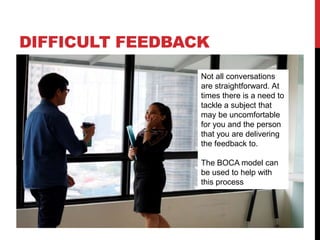
Not all conversations
are straightforward. At
times there is a need to
tackle a subject that
may be uncomfortable
for you and the person
that you are delivering
the feedback to.
The BOCA model can
be used to help with
this process
WHAT IS BOCA?
Behaviour
Outcome
Consequence
Action
BEHAVIOUR
Outline the behavior that you experienced and how you feel.
For example
"When you interrupted me in the meeting I felt humiliated"
”When you ignored my request for support I felt let down".
It is good to have the element of how you felt as this
emphasises the point that is made and makes it personnel.
B O C A
OUTCOME
This is the what you would like to be happening.
For example
"I would really like you to show me more respect and listen to
my answers"
"I would like to know that you are there to support me"
B O C A
CONSEQUENCES
Clearly define what will happen if the behavior doesn't
changes.
For example
"If I don't feel that you value my ideas I will take them to
another manager for consideration"
"If you are not willing to support me then it will have a knock
on effect across the call centre"
B O C A
ACTION
At this stage state what you want to happen or ask the other
person what they will do about the situation.
For example,
"At the next meeting I would like you to clearly listen to my
ideas with an open mind"
"Are you generally willing to support me in this venture"
B O C A
HOW DO I USE IT?
1. Plan – Think about what you will say at each
stage
2. Practise – ask someone to listen to you and
feedback their thoughts
3. Learn – this won’t be an easy model to start
using, especially when difficult conversations
are needed. Try, and if it goes wrong, learn from
your failure and try again
B O C A

Using the BOCA model

  • 1.
  • 2.
    DIFFICULT FEEDBACK Not allconversations are straightforward. At times there is a need to tackle a subject that may be uncomfortable for you and the person that you are delivering the feedback to. The BOCA model can be used to help with this process
  • 3.
  • 4.
    BEHAVIOUR Outline the behaviorthat you experienced and how you feel. For example "When you interrupted me in the meeting I felt humiliated" ”When you ignored my request for support I felt let down". It is good to have the element of how you felt as this emphasises the point that is made and makes it personnel. B O C A
  • 5.
    OUTCOME This is thewhat you would like to be happening. For example "I would really like you to show me more respect and listen to my answers" "I would like to know that you are there to support me" B O C A
  • 6.
    CONSEQUENCES Clearly define whatwill happen if the behavior doesn't changes. For example "If I don't feel that you value my ideas I will take them to another manager for consideration" "If you are not willing to support me then it will have a knock on effect across the call centre" B O C A
  • 7.
    ACTION At this stagestate what you want to happen or ask the other person what they will do about the situation. For example, "At the next meeting I would like you to clearly listen to my ideas with an open mind" "Are you generally willing to support me in this venture" B O C A
  • 8.
    HOW DO IUSE IT? 1. Plan – Think about what you will say at each stage 2. Practise – ask someone to listen to you and feedback their thoughts 3. Learn – this won’t be an easy model to start using, especially when difficult conversations are needed. Try, and if it goes wrong, learn from your failure and try again B O C A