Executive Presence Masterful Presentations The  AHA  method L earning How to Learn   Mark W. Hardwick, Ph.D.
Learning Objectives Heighten your  awareness  … Increase your  knowledge  … Enhance your  skills .  . . Move the needle…
Agenda Learn how to establish instant connection Understand AHA Communication Model Review strategies for successful interactions Individual/team prepare a presentation Real-time presenting—interjective coaching  Video recall and coaching— 1 on 1 Create Individual Development Plan
Our Philosophy Prescription without  diagnosis  is an ineffective communication strategy Having access to all emotions is the basis of  authenticity  Smart-Step  connection and change processes improve learning
The Learning Process Tell me … Show me … Let me practice … Coach me …
“ We judge ourselves by our intentions … others judge us by our actions”.  Peter Drucker
AHA  “Process with Structure” A UDIENCE-CENTERED- Actively Involved unique connect bring energy and passion discover and meet needs/expectations assess strengths/areas for improvement ask open ended questions actively listen- CPR Techniques  two-way communications demonstrate empathy by using MMFI rule
AHA  “ Process with Structure”  continued … H ook audience by making message sticky: demonstrate confident leadership presence message believable and sticky surprise, insightful and unusual share memorable examples, truthful stories utilize  Knowledge   Rule  :(I+rd)+(I+rd)= K
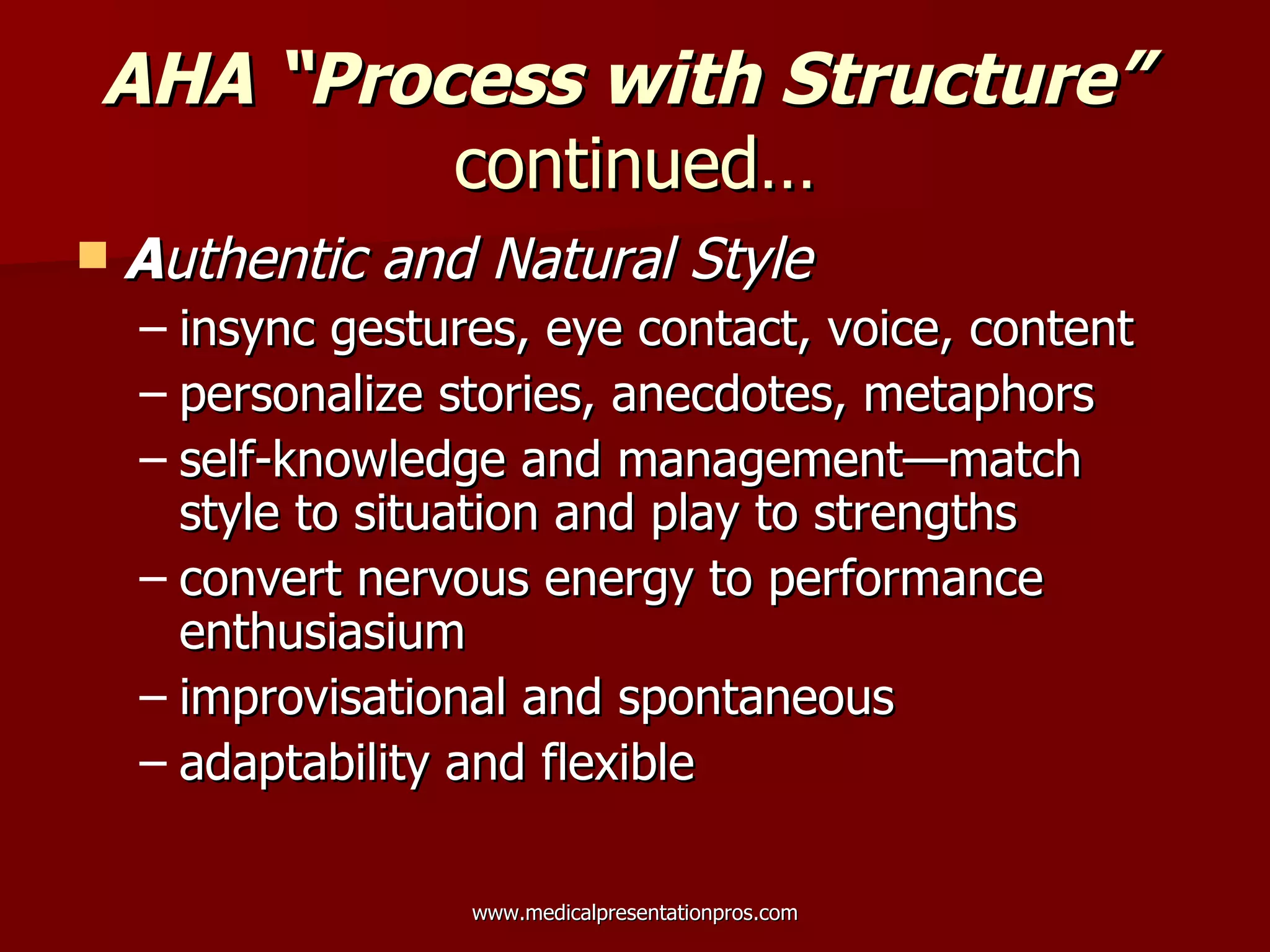
AHA “Process with Structure”   continued… A uthentic and Natural Style insync gestures, eye contact, voice, content  personalize stories, anecdotes, metaphors self-knowledge and management—match style to situation and play to strengths convert nervous energy to performance enthusiasium  improvisational and spontaneous  adaptability and flexible
“ Adult learners want to take an  active role  in their learning” Malcolm Knoles
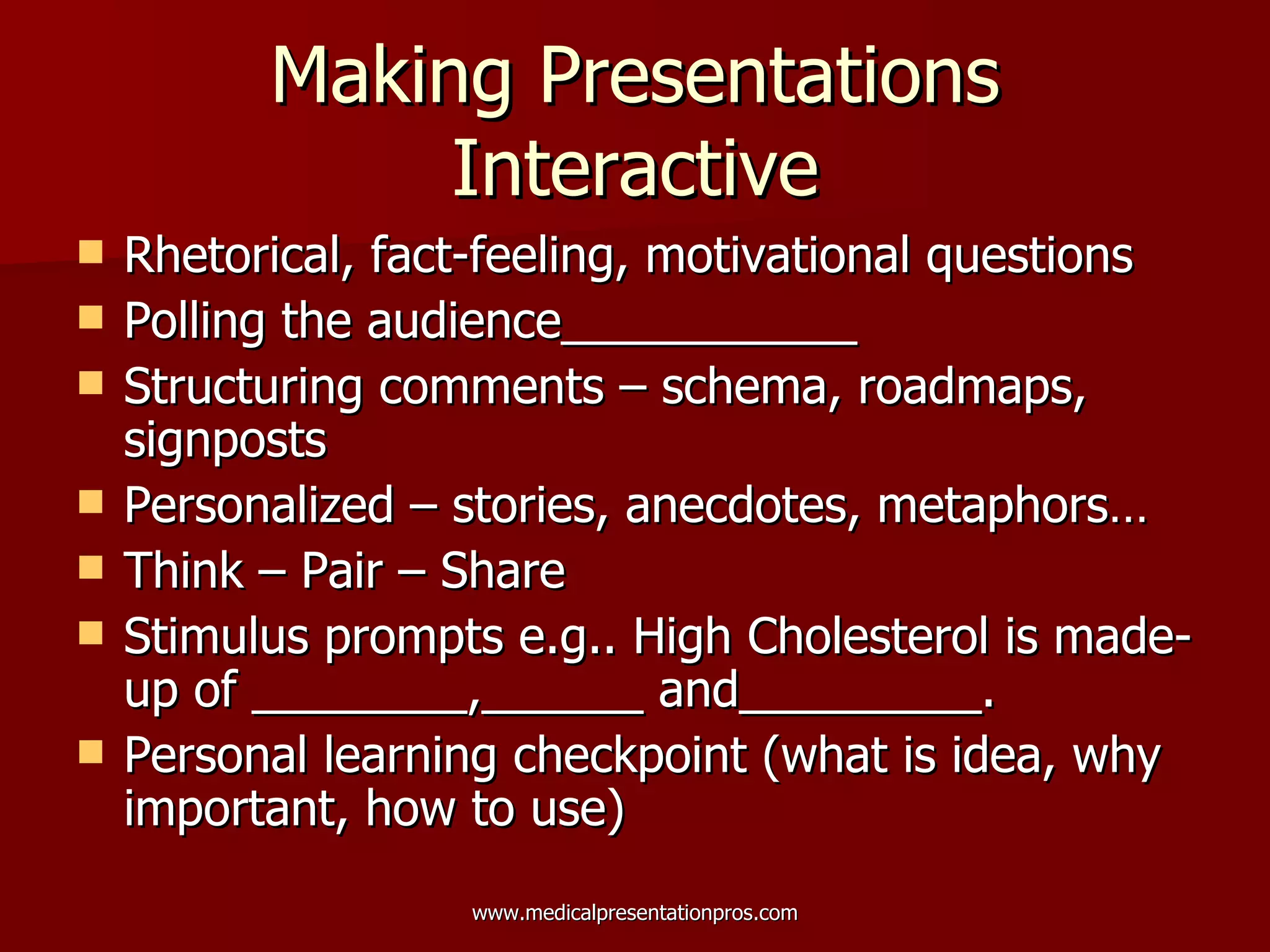
Making Presentations Interactive Rhetorical, fact-feeling, motivational questions Polling the audience___________ Structuring comments – schema, roadmaps, signposts Personalized – stories, anecdotes, metaphors… Think – Pair – Share  Stimulus prompts e.g.. High Cholesterol is made-up of ________,______ and_________. Personal learning checkpoint (what is idea, why important, how to use)
From Your Experience… Characteristics of ineffective presentations Characteristics of effective presentations
Remember Aristotle’s advice…  “ We are what we repeatedly do.  Excellence is not an act but a habit”.   AND It only takes 10,000 hours for mastery
Masterful  Presentations   “The 15- 30 Minute  AHA ”
Critical Success Factors “AHA”  Presentation Showing Up “ Burning aha”— Passionate Purpose Stay “in the moment” 3 C’s-Connect-Credibility-Confidence Benefits of interaction— WII-FM Audience-centered Close
Design Tips—  Phase 1: Burning “Aha” Align with audience’s expectations  Get to the point - skip the jokes Quote an expert or study Clear, concise and compelling message Pose a challenging question or statistic Purpose: grab audience attention Completion time 3-5 min.
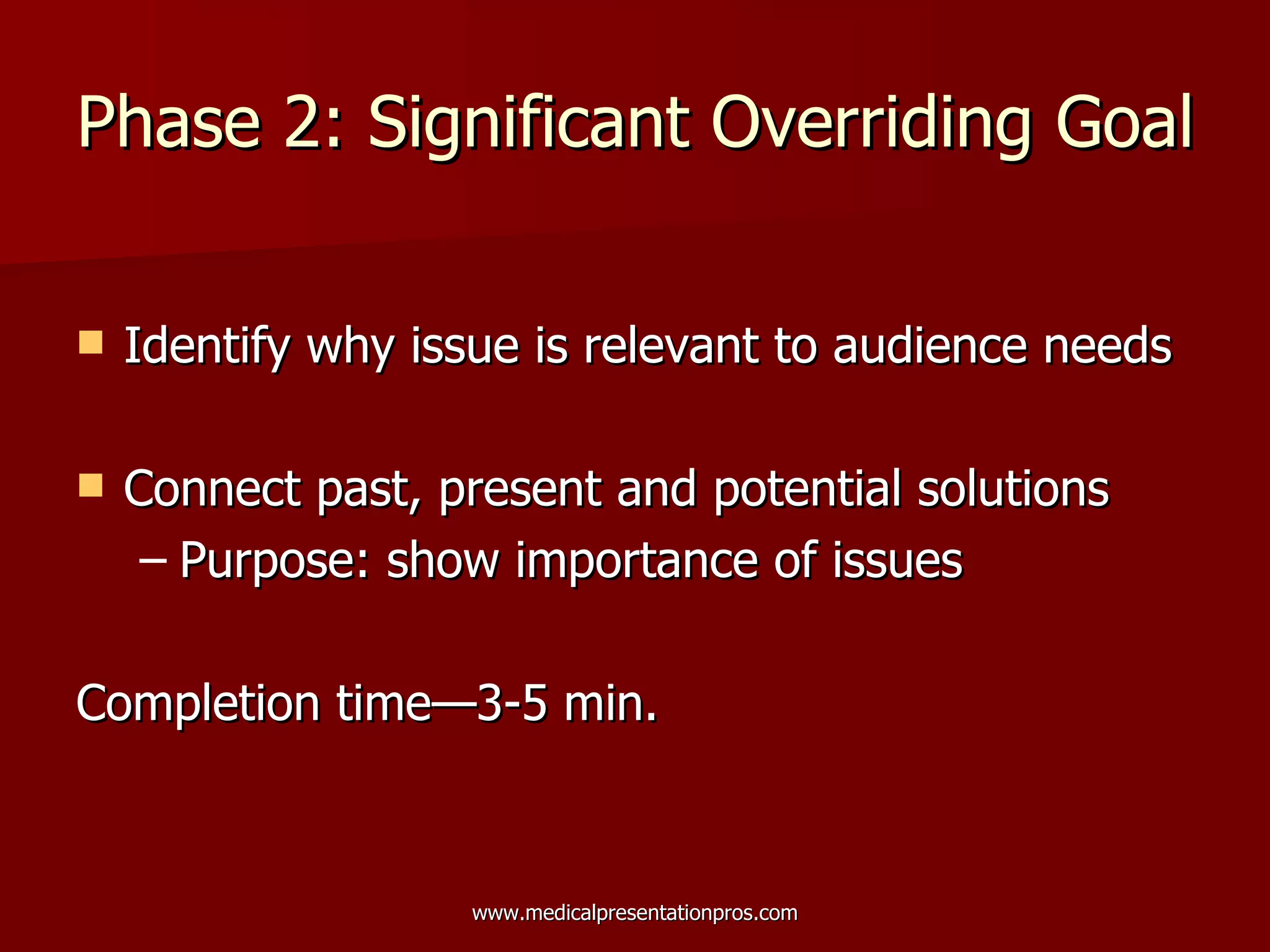
Phase 2: Significant Overriding Goal  Identify why issue is relevant to audience needs Connect past, present and potential solutions Purpose: show importance of issues Completion time—3-5 min.
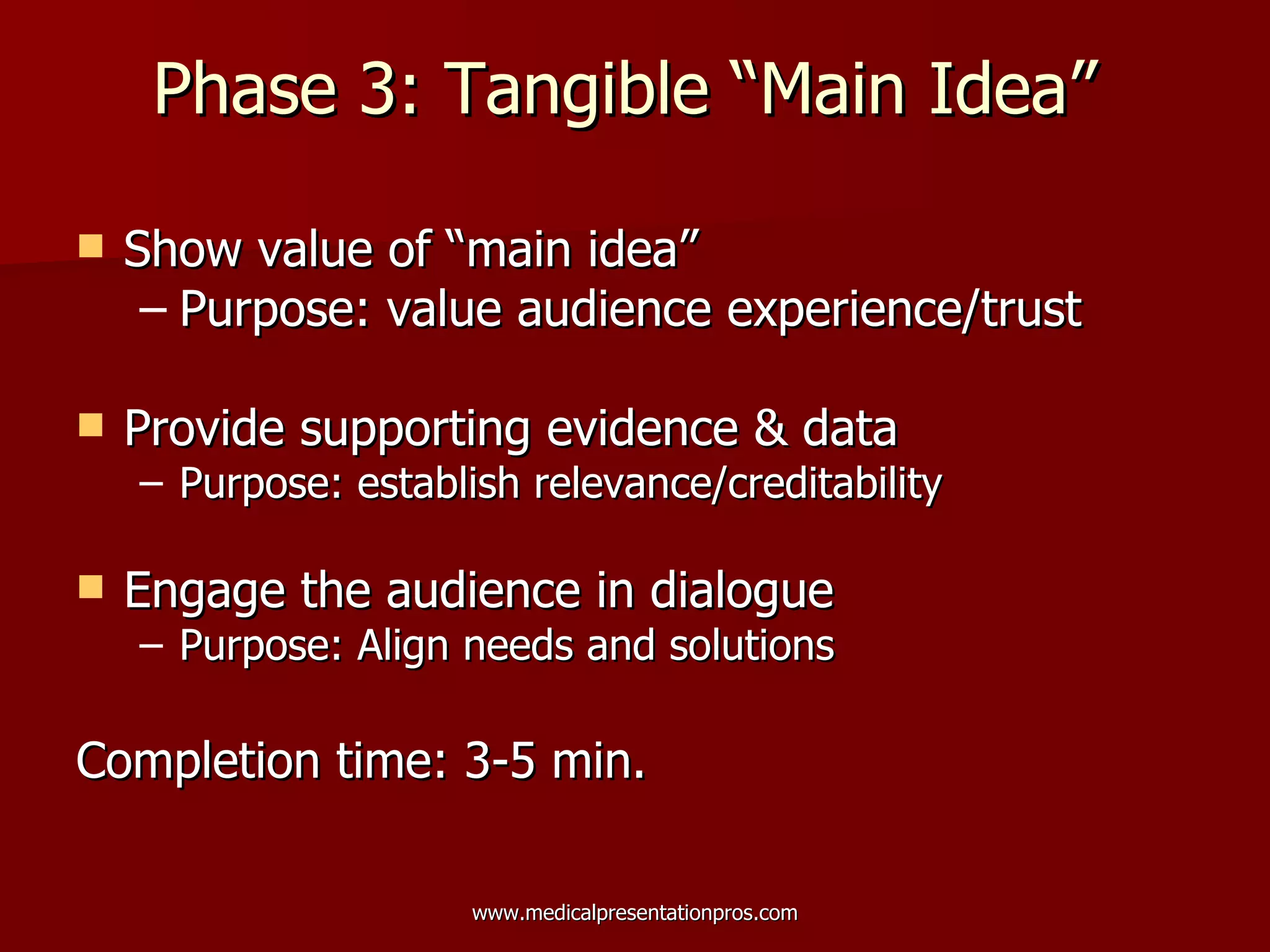
Phase 3: Tangible “Main Idea”  Show value of “main idea” Purpose: value audience experience/trust  Provide supporting evidence & data Purpose: establish relevance/creditability Engage the audience in dialogue Purpose: Align needs and solutions Completion time: 3-5 min.
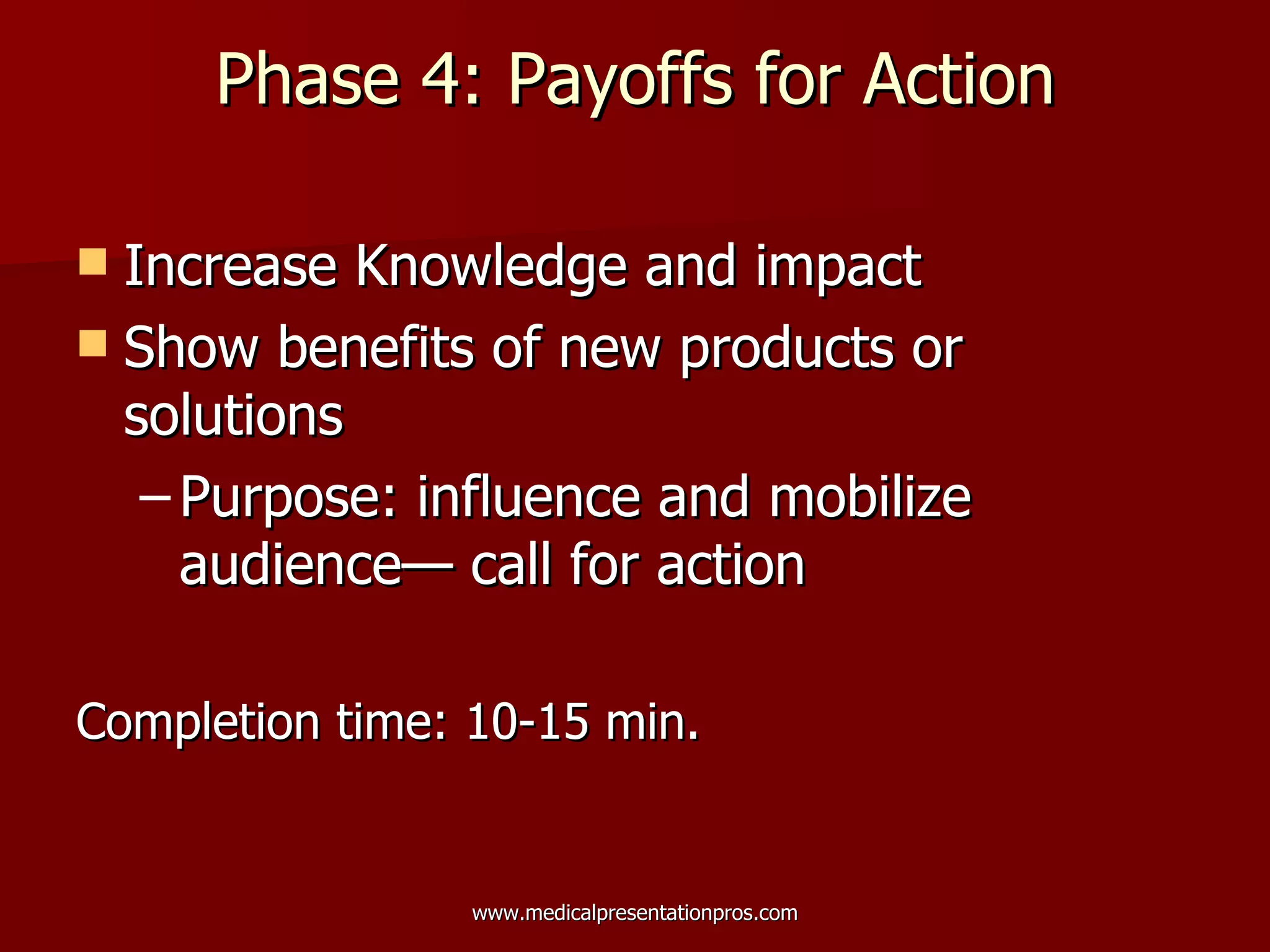
Phase 4: Payoffs for Action Increase Knowledge and impact Show benefits of new products or solutions Purpose: influence and mobilize audience— call for action Completion time: 10-15 min.
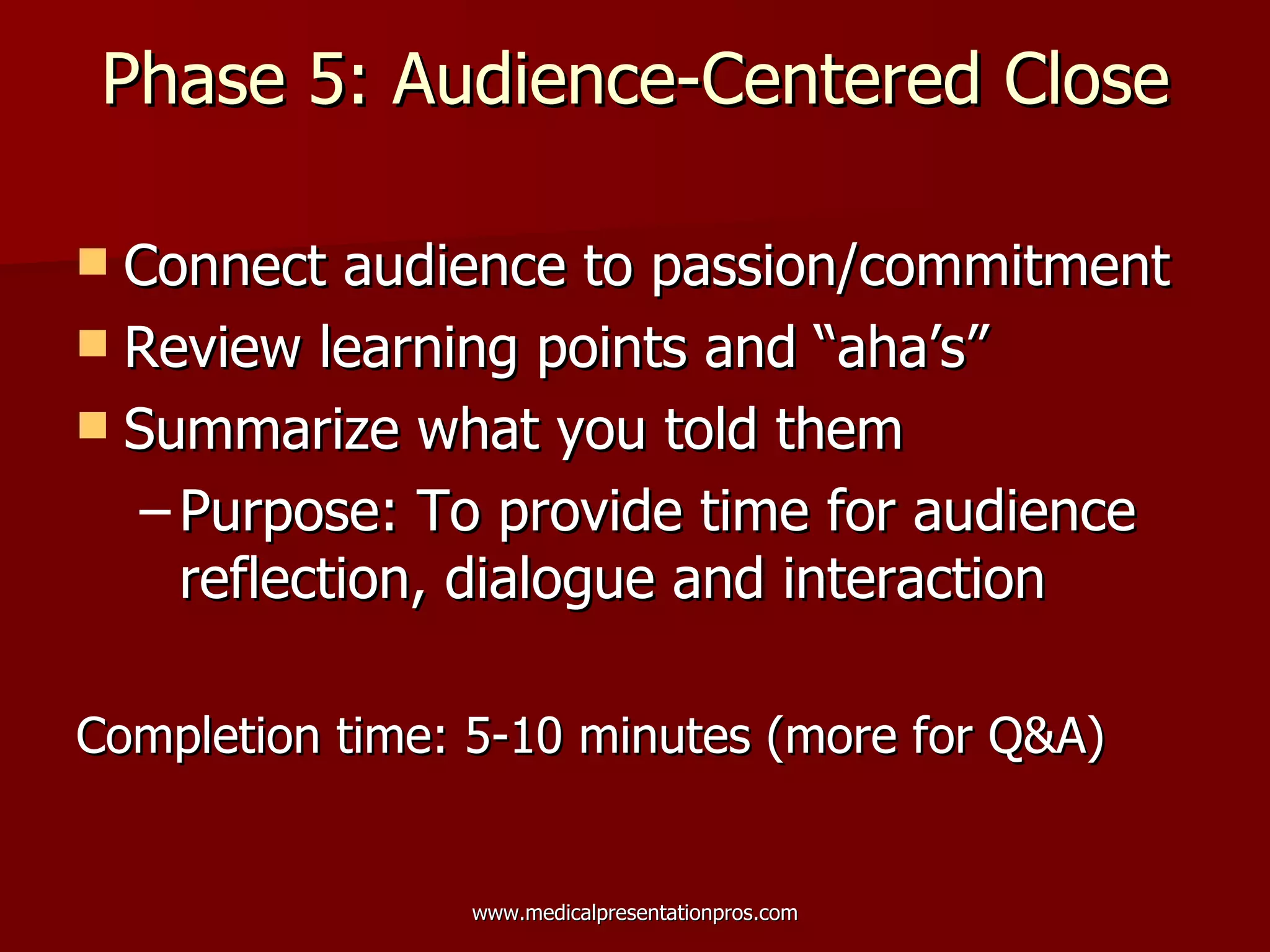
Phase 5: Audience-Centered Close Connect audience to passion/commitment Review learning points and “aha’s” Summarize what you told them Purpose: To provide time for audience reflection, dialogue and interaction Completion time: 5-10 minutes (more for Q&A)
Magic Number 7 You will have  3 0   seconds  to read the words below: Read through the paragraph  one time  only Don’t study them. Just read the words to yourself. Analyze response and insights
How Adult Learning impacts retention?   car deck table tree snow bottle money dog pole sand sky dog Plant book soap psychotic music plant rug Freud plant cellar gate  HDL dog presentation skills trunk PAPER road knife stool hay smile string plant  Grocho Marx  wheel air expert rain bird dog
THE MAGIC # 7   WHAT DO YOU REMEMEBER ?
Making Presentations Effective: Primacy effect— 60 second “knockout rule” Create clear, truthful, compelling messages—support  with evidence Stickiness—make message unusual-relevant-personal –answer question “wii-fm”  Repetition, repetition—repeat key points/provide “hot spice” every 6-8 minutes  Maximize audience involvement— unique connections—create interactive format, tell stories and ask questions  Be Concise and Chunk— MAGIC # 7 rule  Recency effect– memorable ending-be inspirational
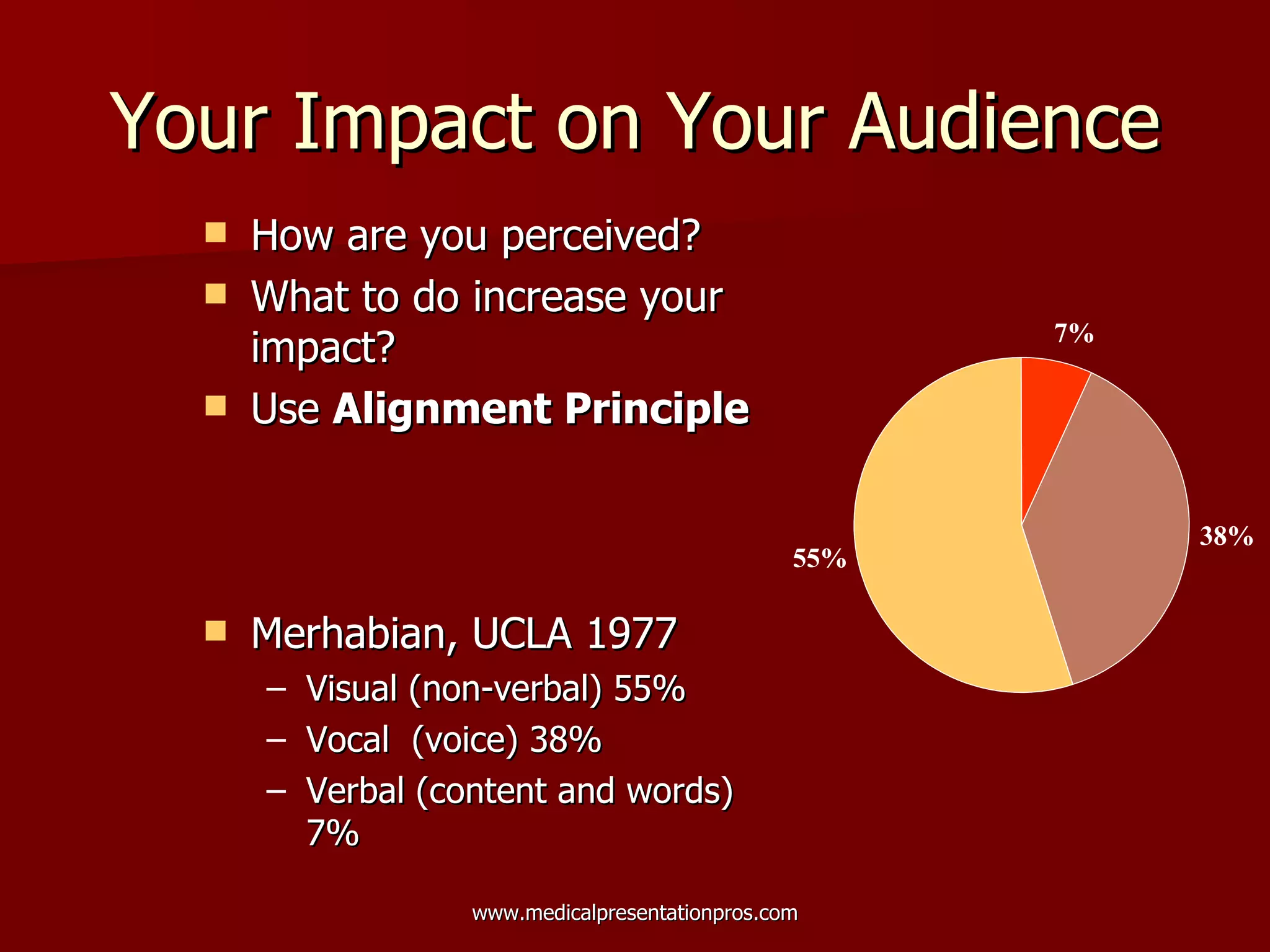
Your Impact on Your Audience How are you perceived? What to do increase your impact? Use  Alignment Principle Merhabian, UCLA 1977 Visual (non-verbal) 55% Vocal  (voice) 38% Verbal (content and words) 7%
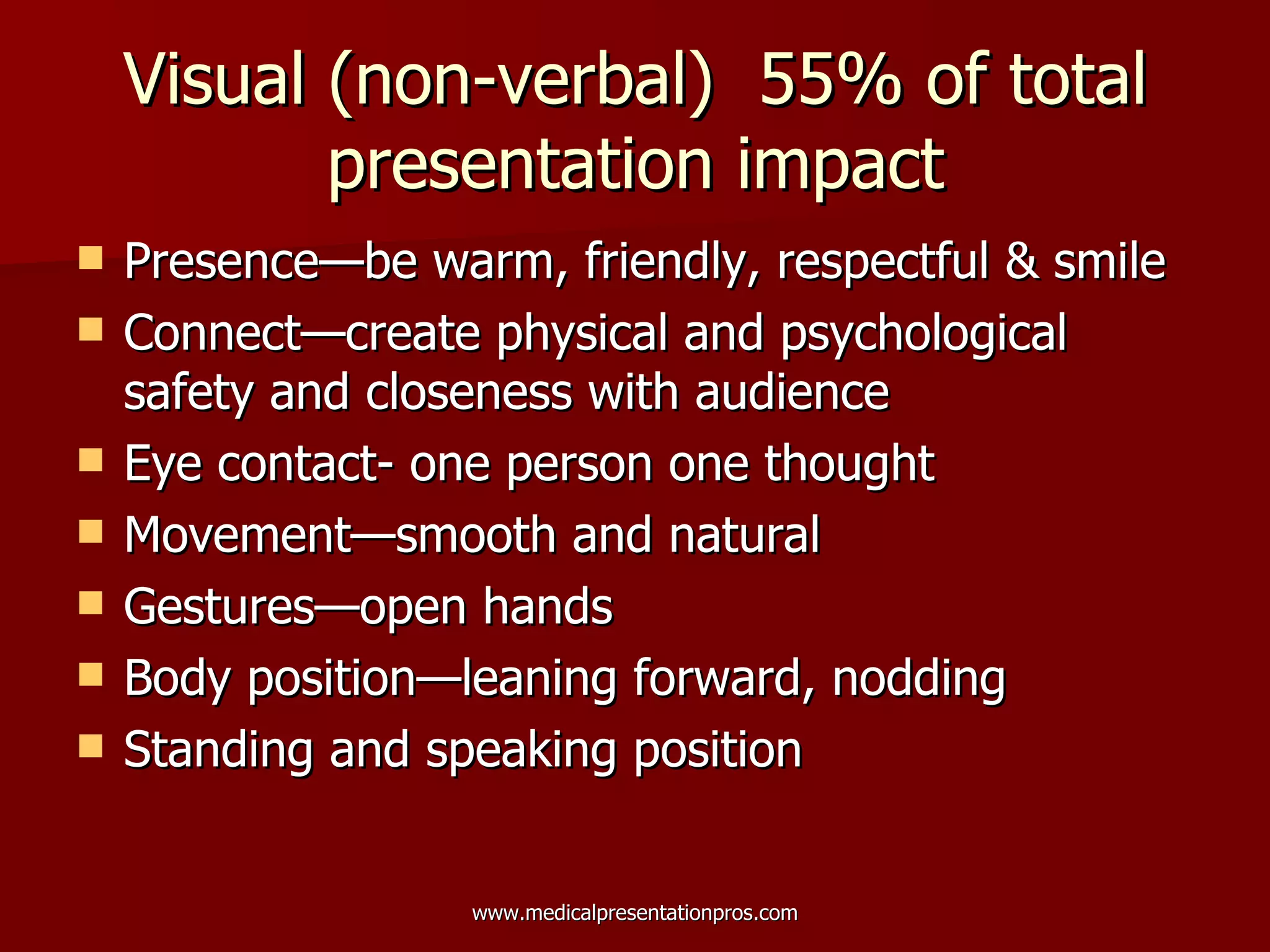
Visual (non-verbal)  55% of total presentation impact Presence—be warm, friendly, respectful & smile Connect—create physical and psychological  safety and closeness with audience  Eye contact- one person one thought  Movement—smooth and natural Gestures—open hands Body position—leaning forward, nodding Standing and speaking position
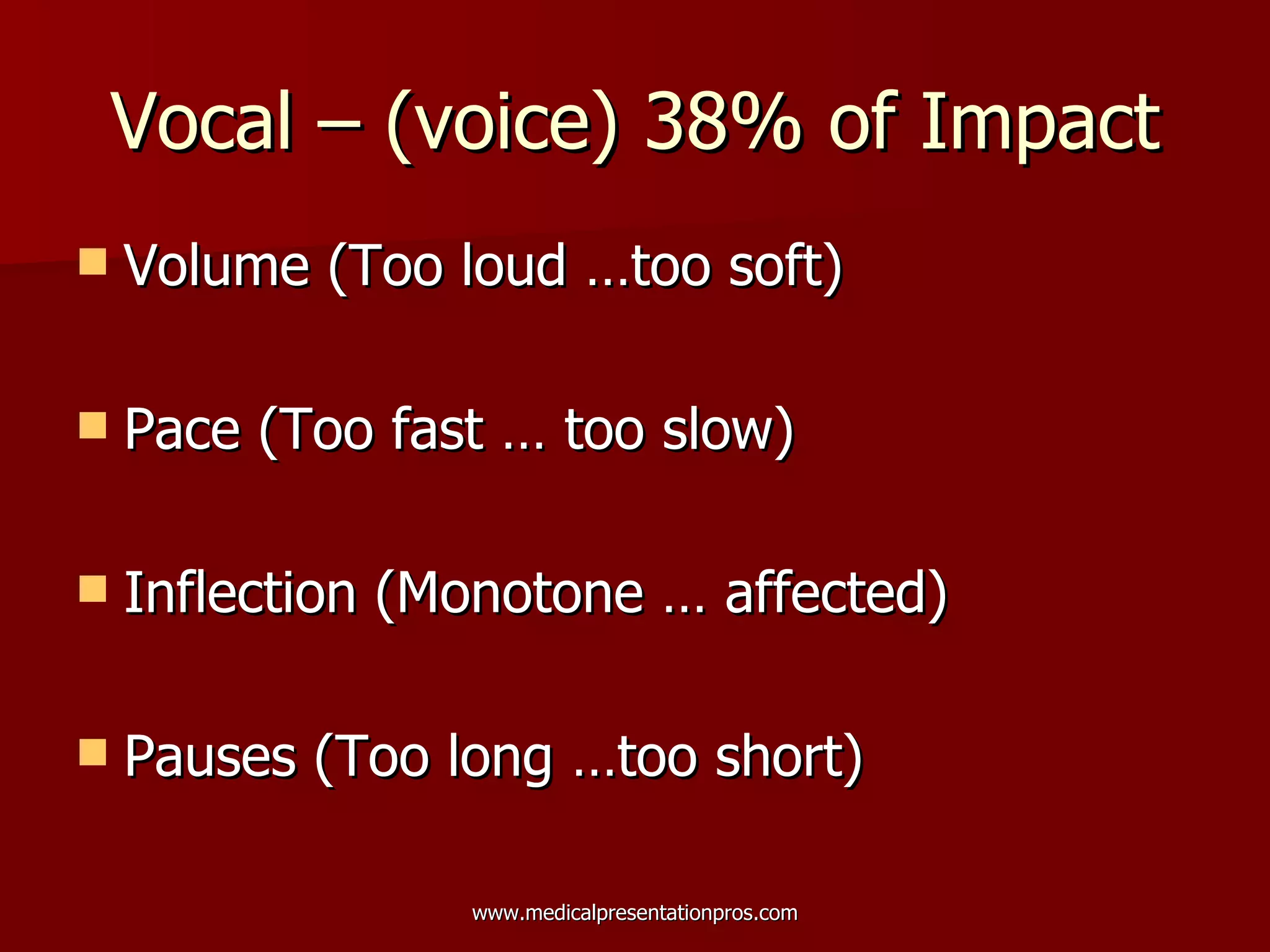
Vocal – (voice) 38% of Impact Volume (Too loud …too soft) Pace (Too fast … too slow) Inflection (Monotone … affected) Pauses (Too long …too short)
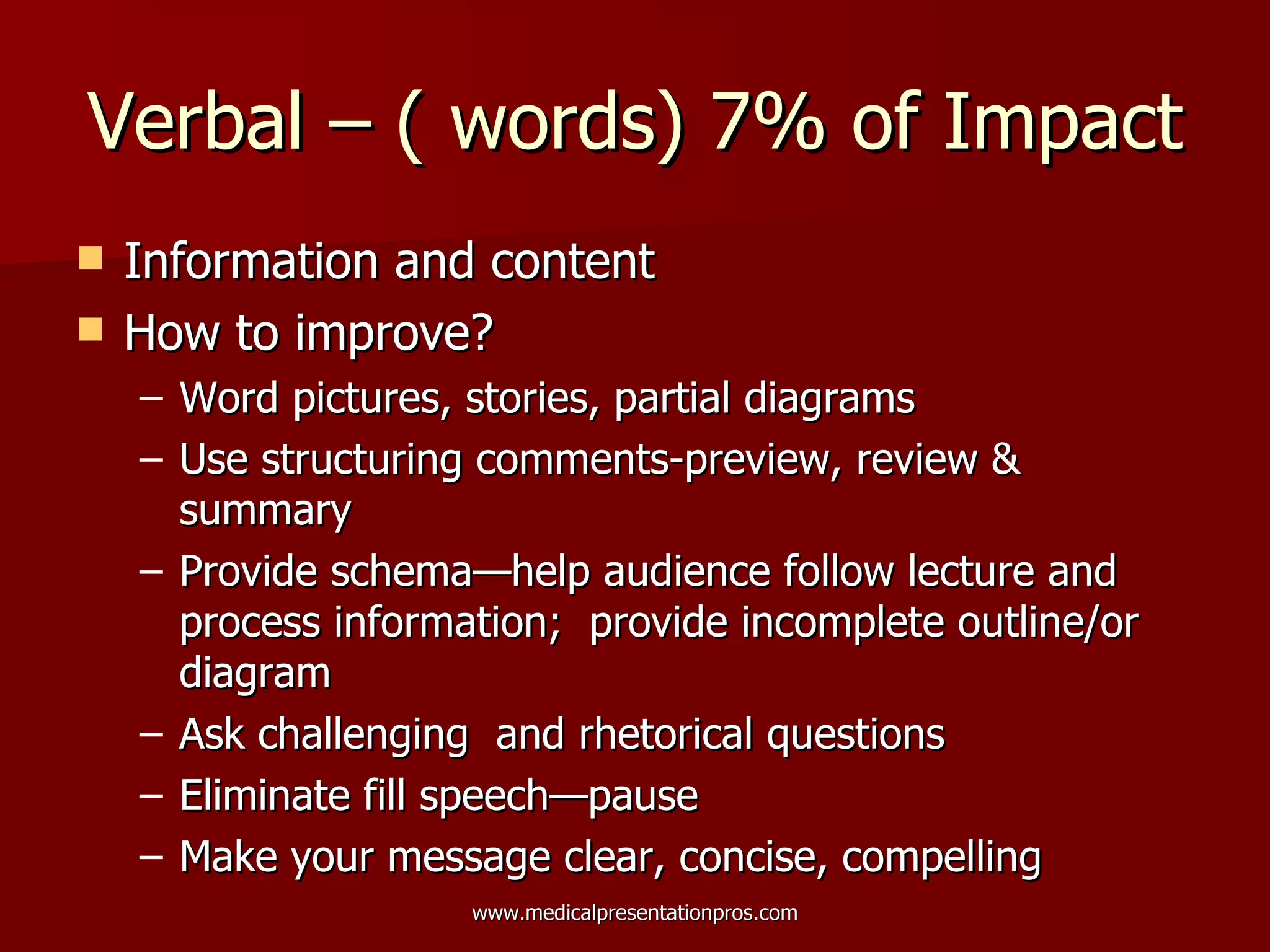
Verbal – ( words) 7% of Impact Information and content How to improve? Word pictures, stories, partial diagrams Use structuring comments-preview, review & summary Provide schema—help audience follow lecture and process information;  provide incomplete outline/or diagram Ask challenging  and rhetorical questions Eliminate fill speech—pause  Make your message clear, concise, compelling
Summary Ideas—message, mechanics, mental processes Visualize success…10 second stress tool Primacy effect…Open with energy  Unique connection…friendly & approachable Be natural—align voice, gestures and content Provide data-based evidence—make message compelling and credible Involve audience— create interaction—align audience, material, presenter  Recency effect… end with passion
Getting Started-Baseline Video Name and hometown What you get paid to do Experience giving presentations What skills you would like to enhance
Your Turn to Present... Review your deck of slides—pick 3 slides  Analyze slides— what are key learning points develop a power question for audience identify “watch outs” about slide Prepare  AHA  presentation ( open, body & close)  Make it interactive  Deliver slides-receive interjective coaching Feedback –what did well, what would change…
Putting Theory Into Practice…   Personal Development Plan Things to start doing… Things to stop doing… Things to continue learning more about…
Game of Life: Improvement is a Commitment to Growing  “ If I always do what I’ve always done,  I’ll always get what I’ve always gotten.” -  Eric Hoffer
Thank you for your active participation!
Extra Slides and Stress Presentation
New Presentation 30 min.  How to Embrace Stress and be fully engaged in Presentation  (draft)
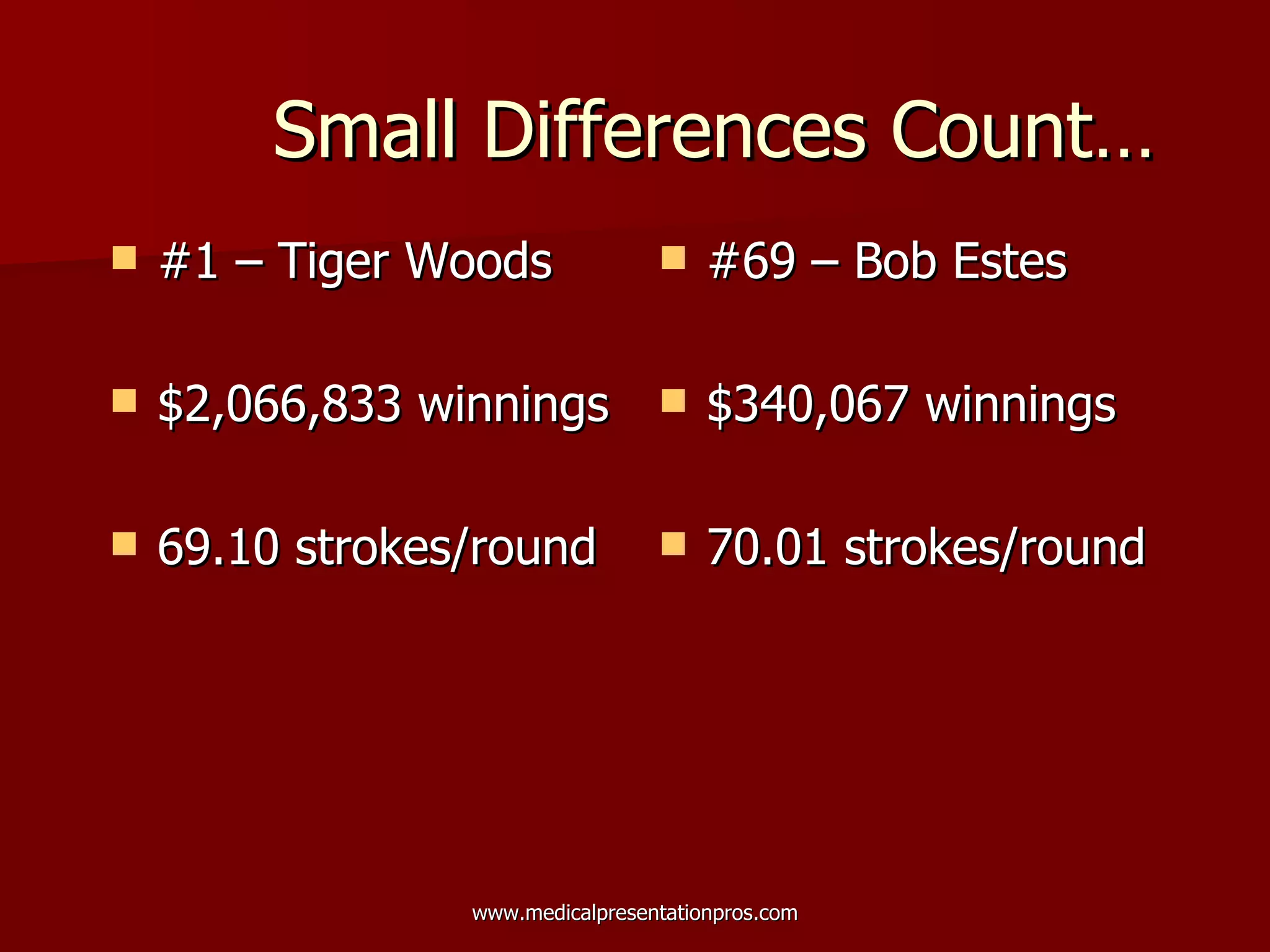
Small Differences Count… #1 – Tiger Woods $2,066,833 winnings 69.10 strokes/round #69 – Bob Estes $340,067 winnings 70.01 strokes/round
Small Changes BIG Impact  How many get anxious before a presentation? What makes the difference between good stress and bad stress in your life ?
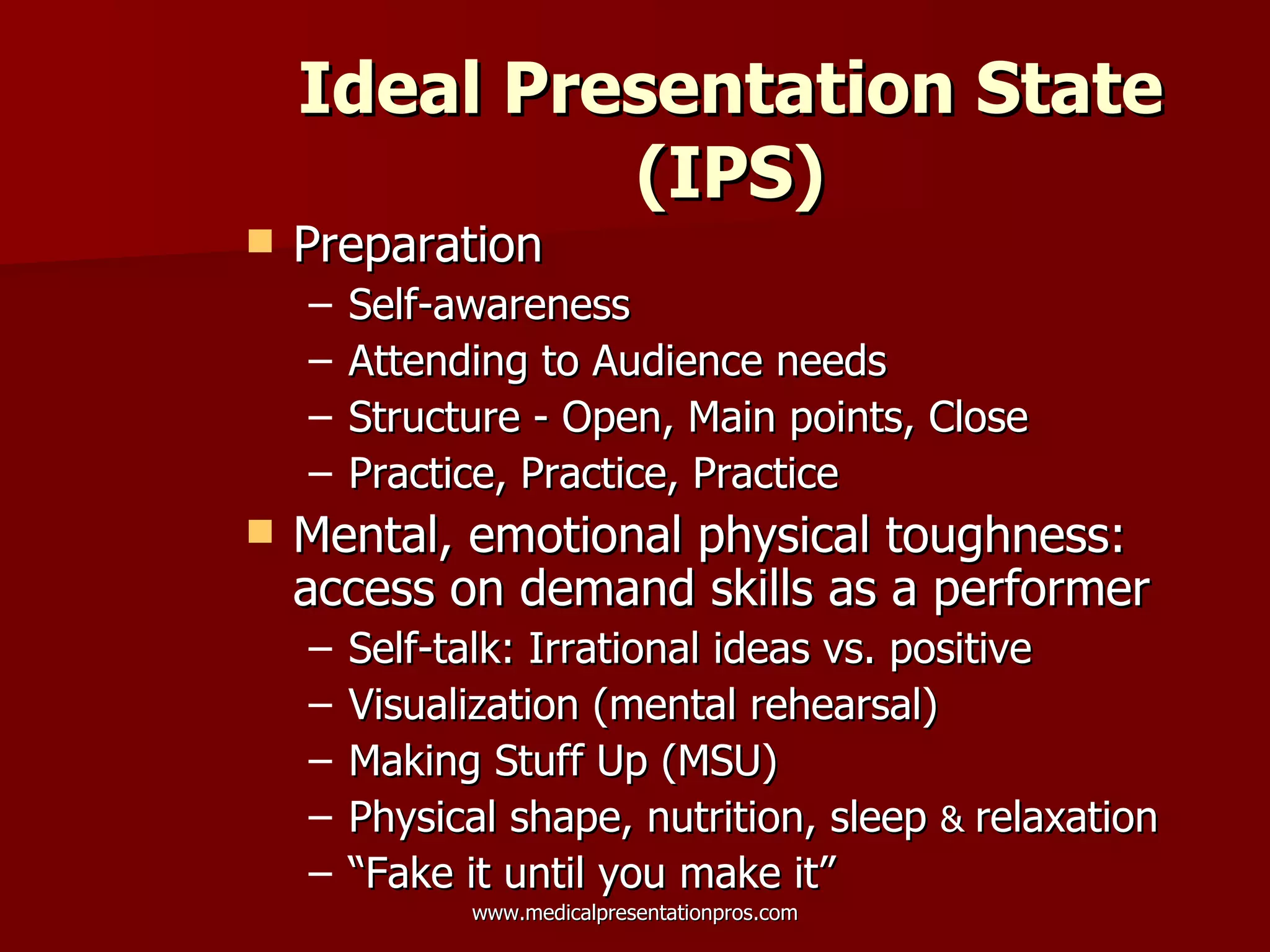
Ideal Presentation State (IPS) Preparation Self-awareness Attending to Audience needs Structure - Open, Main points, Close Practice, Practice, Practice Mental, emotional physical toughness:  access on demand skills as a performer Self-talk: Irrational ideas vs. positive Visualization (mental rehearsal) Making Stuff Up (MSU)  Physical shape, nutrition, sleep  &  relaxation “ Fake it until you make it”
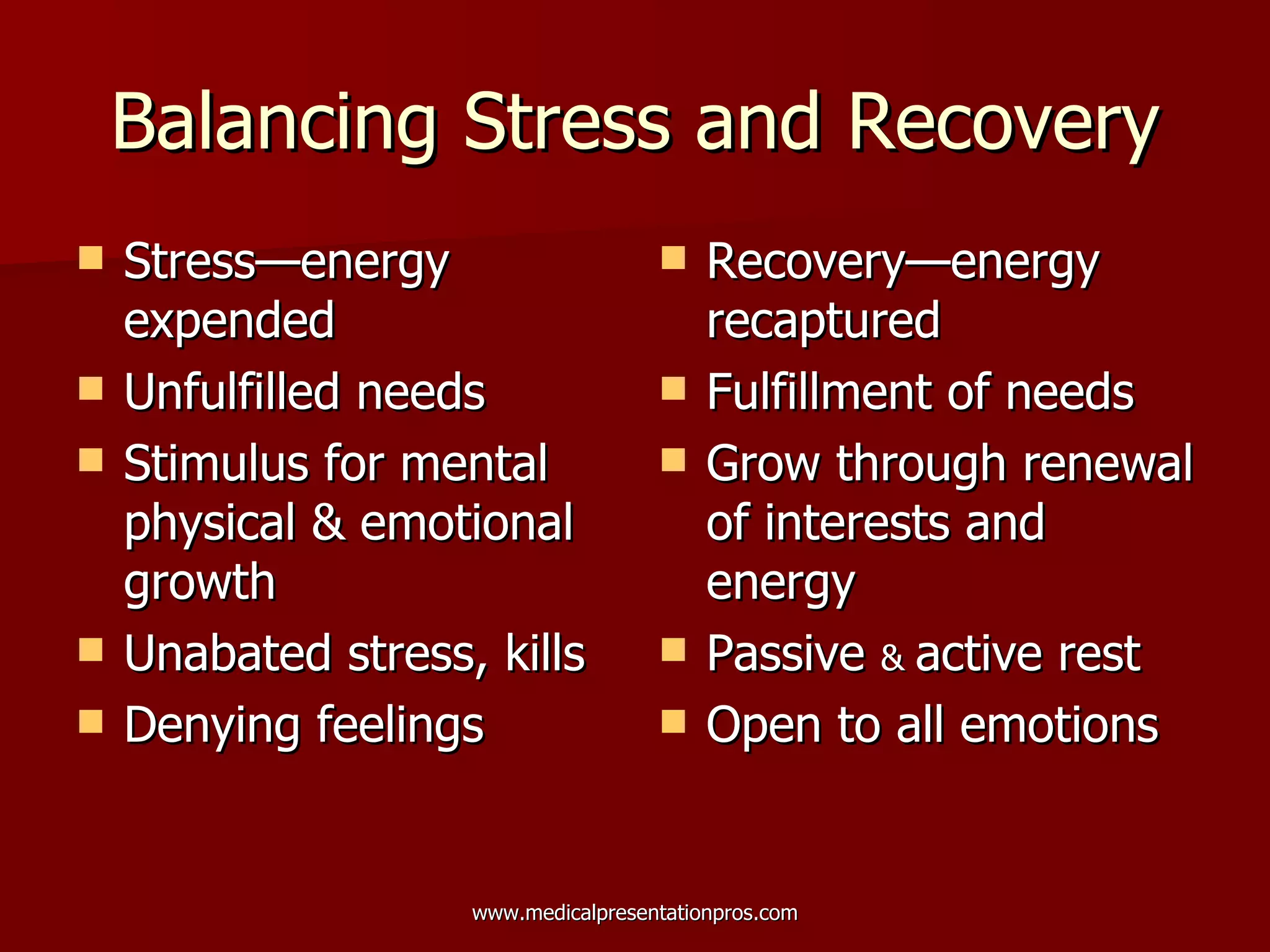
Balancing Stress and Recovery Stress—energy expended Unfulfilled needs Stimulus for mental physical & emotional growth Unabated stress, kills Denying feelings Recovery—energy recaptured Fulfillment of needs Grow through renewal of interests and energy Passive  &  active rest Open to all emotions
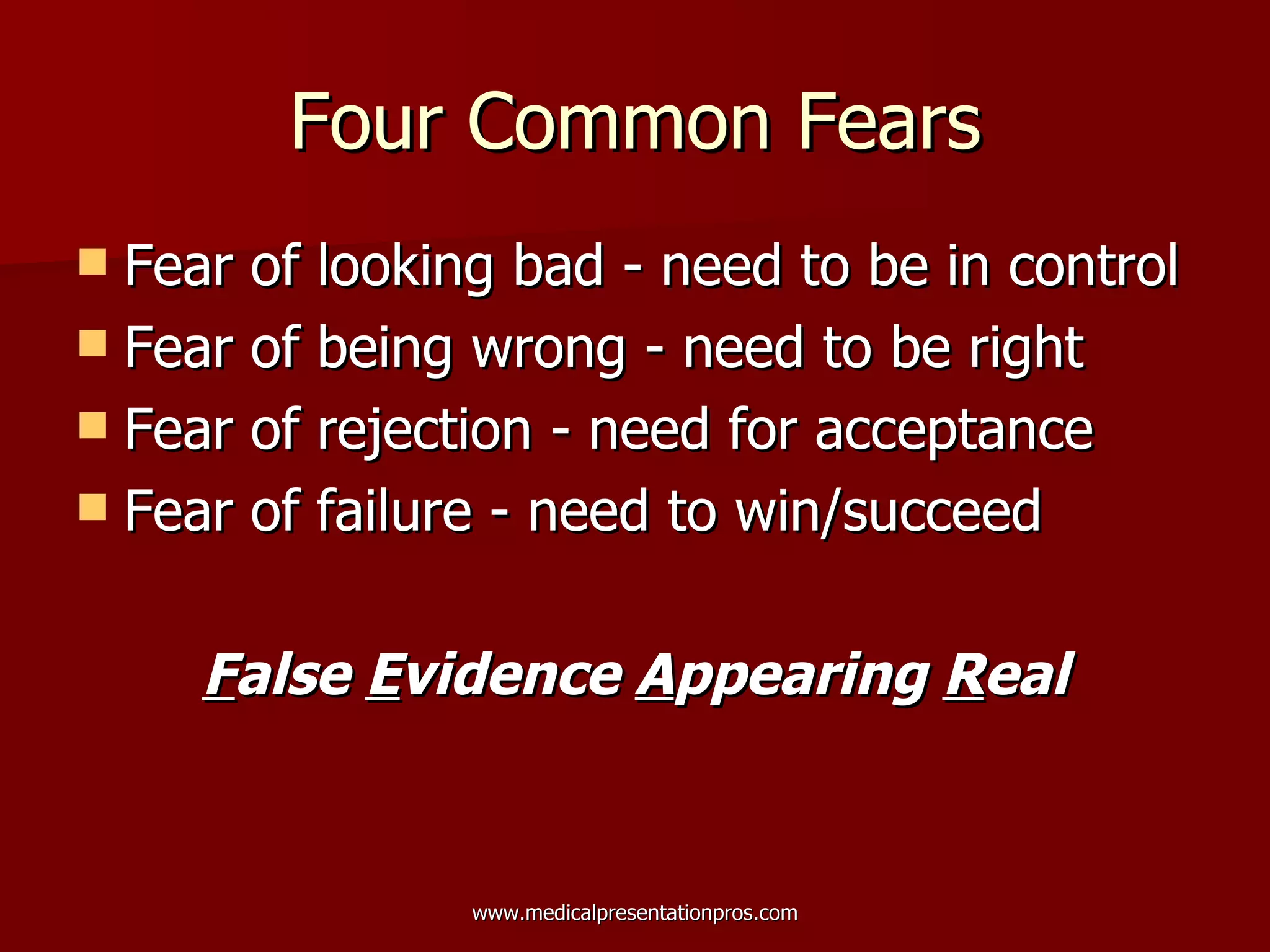
Four Common Fears Fear of looking bad - need to be in control Fear of being wrong - need to be right  Fear of rejection - need for acceptance Fear of failure - need to win/succeed F alse  E vidence  A ppearing  R eal
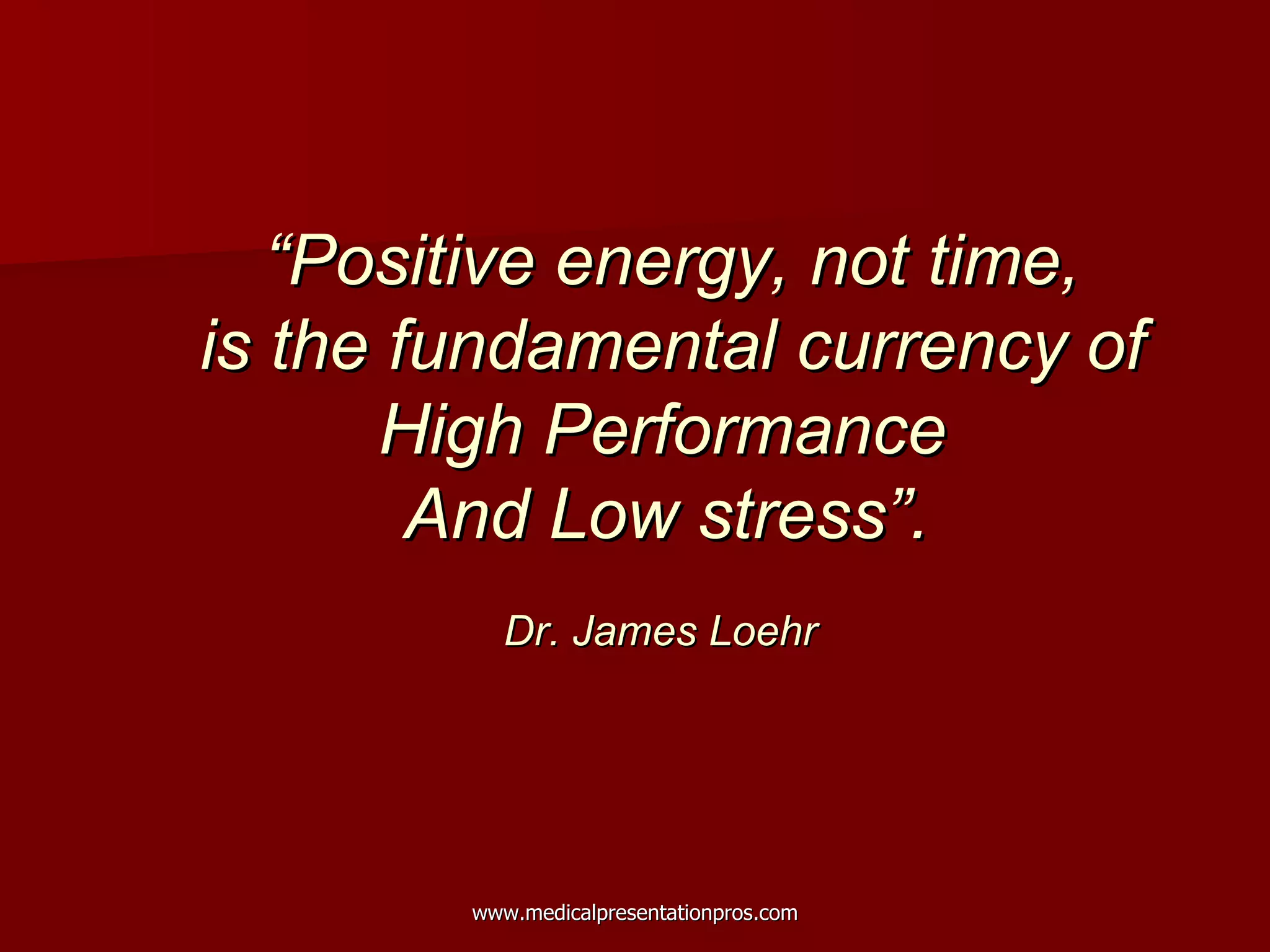
“ Positive energy, not time,  is the fundamental currency of  High Performance  And Low stress”.   Dr. James Loehr

Aha Presentation Final April 30 09

  • 1.
    Executive Presence MasterfulPresentations The AHA method L earning How to Learn Mark W. Hardwick, Ph.D.
  • 2.
    Learning Objectives Heightenyour awareness … Increase your knowledge … Enhance your skills . . . Move the needle…
  • 3.
    Agenda Learn howto establish instant connection Understand AHA Communication Model Review strategies for successful interactions Individual/team prepare a presentation Real-time presenting—interjective coaching Video recall and coaching— 1 on 1 Create Individual Development Plan
  • 4.
    Our Philosophy Prescriptionwithout diagnosis is an ineffective communication strategy Having access to all emotions is the basis of authenticity Smart-Step connection and change processes improve learning
  • 5.
    The Learning ProcessTell me … Show me … Let me practice … Coach me …
  • 6.
    “ We judgeourselves by our intentions … others judge us by our actions”. Peter Drucker
  • 7.
    AHA “Processwith Structure” A UDIENCE-CENTERED- Actively Involved unique connect bring energy and passion discover and meet needs/expectations assess strengths/areas for improvement ask open ended questions actively listen- CPR Techniques two-way communications demonstrate empathy by using MMFI rule
  • 8.
    AHA “Process with Structure” continued … H ook audience by making message sticky: demonstrate confident leadership presence message believable and sticky surprise, insightful and unusual share memorable examples, truthful stories utilize Knowledge Rule :(I+rd)+(I+rd)= K
  • 9.
    AHA “Process withStructure” continued… A uthentic and Natural Style insync gestures, eye contact, voice, content personalize stories, anecdotes, metaphors self-knowledge and management—match style to situation and play to strengths convert nervous energy to performance enthusiasium improvisational and spontaneous adaptability and flexible
  • 10.
    “ Adult learnerswant to take an active role in their learning” Malcolm Knoles
  • 11.
    Making Presentations InteractiveRhetorical, fact-feeling, motivational questions Polling the audience___________ Structuring comments – schema, roadmaps, signposts Personalized – stories, anecdotes, metaphors… Think – Pair – Share Stimulus prompts e.g.. High Cholesterol is made-up of ________,______ and_________. Personal learning checkpoint (what is idea, why important, how to use)
  • 12.
    From Your Experience…Characteristics of ineffective presentations Characteristics of effective presentations
  • 13.
    Remember Aristotle’s advice… “ We are what we repeatedly do. Excellence is not an act but a habit”. AND It only takes 10,000 hours for mastery
  • 14.
    Masterful Presentations “The 15- 30 Minute AHA ”
  • 15.
    Critical Success Factors“AHA” Presentation Showing Up “ Burning aha”— Passionate Purpose Stay “in the moment” 3 C’s-Connect-Credibility-Confidence Benefits of interaction— WII-FM Audience-centered Close
  • 16.
    Design Tips— Phase 1: Burning “Aha” Align with audience’s expectations Get to the point - skip the jokes Quote an expert or study Clear, concise and compelling message Pose a challenging question or statistic Purpose: grab audience attention Completion time 3-5 min.
  • 17.
    Phase 2: SignificantOverriding Goal Identify why issue is relevant to audience needs Connect past, present and potential solutions Purpose: show importance of issues Completion time—3-5 min.
  • 18.
    Phase 3: Tangible“Main Idea” Show value of “main idea” Purpose: value audience experience/trust Provide supporting evidence & data Purpose: establish relevance/creditability Engage the audience in dialogue Purpose: Align needs and solutions Completion time: 3-5 min.
  • 19.
    Phase 4: Payoffsfor Action Increase Knowledge and impact Show benefits of new products or solutions Purpose: influence and mobilize audience— call for action Completion time: 10-15 min.
  • 20.
    Phase 5: Audience-CenteredClose Connect audience to passion/commitment Review learning points and “aha’s” Summarize what you told them Purpose: To provide time for audience reflection, dialogue and interaction Completion time: 5-10 minutes (more for Q&A)
  • 21.
    Magic Number 7You will have 3 0 seconds to read the words below: Read through the paragraph one time only Don’t study them. Just read the words to yourself. Analyze response and insights
  • 22.
    How Adult Learningimpacts retention? car deck table tree snow bottle money dog pole sand sky dog Plant book soap psychotic music plant rug Freud plant cellar gate HDL dog presentation skills trunk PAPER road knife stool hay smile string plant Grocho Marx wheel air expert rain bird dog
  • 23.
    THE MAGIC #7 WHAT DO YOU REMEMEBER ?
  • 24.
    Making Presentations Effective:Primacy effect— 60 second “knockout rule” Create clear, truthful, compelling messages—support with evidence Stickiness—make message unusual-relevant-personal –answer question “wii-fm” Repetition, repetition—repeat key points/provide “hot spice” every 6-8 minutes Maximize audience involvement— unique connections—create interactive format, tell stories and ask questions Be Concise and Chunk— MAGIC # 7 rule Recency effect– memorable ending-be inspirational
  • 25.
    Your Impact onYour Audience How are you perceived? What to do increase your impact? Use Alignment Principle Merhabian, UCLA 1977 Visual (non-verbal) 55% Vocal (voice) 38% Verbal (content and words) 7%
  • 26.
    Visual (non-verbal) 55% of total presentation impact Presence—be warm, friendly, respectful & smile Connect—create physical and psychological safety and closeness with audience Eye contact- one person one thought Movement—smooth and natural Gestures—open hands Body position—leaning forward, nodding Standing and speaking position
  • 27.
    Vocal – (voice)38% of Impact Volume (Too loud …too soft) Pace (Too fast … too slow) Inflection (Monotone … affected) Pauses (Too long …too short)
  • 28.
    Verbal – (words) 7% of Impact Information and content How to improve? Word pictures, stories, partial diagrams Use structuring comments-preview, review & summary Provide schema—help audience follow lecture and process information; provide incomplete outline/or diagram Ask challenging and rhetorical questions Eliminate fill speech—pause Make your message clear, concise, compelling
  • 29.
    Summary Ideas—message, mechanics,mental processes Visualize success…10 second stress tool Primacy effect…Open with energy Unique connection…friendly & approachable Be natural—align voice, gestures and content Provide data-based evidence—make message compelling and credible Involve audience— create interaction—align audience, material, presenter Recency effect… end with passion
  • 30.
    Getting Started-Baseline VideoName and hometown What you get paid to do Experience giving presentations What skills you would like to enhance
  • 31.
    Your Turn toPresent... Review your deck of slides—pick 3 slides Analyze slides— what are key learning points develop a power question for audience identify “watch outs” about slide Prepare AHA presentation ( open, body & close) Make it interactive Deliver slides-receive interjective coaching Feedback –what did well, what would change…
  • 32.
    Putting Theory IntoPractice… Personal Development Plan Things to start doing… Things to stop doing… Things to continue learning more about…
  • 33.
    Game of Life:Improvement is a Commitment to Growing “ If I always do what I’ve always done, I’ll always get what I’ve always gotten.” - Eric Hoffer
  • 34.
    Thank you foryour active participation!
  • 35.
    Extra Slides andStress Presentation
  • 36.
    New Presentation 30min. How to Embrace Stress and be fully engaged in Presentation (draft)
  • 37.
    Small Differences Count…#1 – Tiger Woods $2,066,833 winnings 69.10 strokes/round #69 – Bob Estes $340,067 winnings 70.01 strokes/round
  • 38.
    Small Changes BIGImpact How many get anxious before a presentation? What makes the difference between good stress and bad stress in your life ?
  • 39.
    Ideal Presentation State(IPS) Preparation Self-awareness Attending to Audience needs Structure - Open, Main points, Close Practice, Practice, Practice Mental, emotional physical toughness: access on demand skills as a performer Self-talk: Irrational ideas vs. positive Visualization (mental rehearsal) Making Stuff Up (MSU) Physical shape, nutrition, sleep & relaxation “ Fake it until you make it”
  • 40.
    Balancing Stress andRecovery Stress—energy expended Unfulfilled needs Stimulus for mental physical & emotional growth Unabated stress, kills Denying feelings Recovery—energy recaptured Fulfillment of needs Grow through renewal of interests and energy Passive & active rest Open to all emotions
  • 41.
    Four Common FearsFear of looking bad - need to be in control Fear of being wrong - need to be right Fear of rejection - need for acceptance Fear of failure - need to win/succeed F alse E vidence A ppearing R eal
  • 42.
    “ Positive energy,not time, is the fundamental currency of High Performance And Low stress”. Dr. James Loehr