


1 
Blends that work for 
Onboarding 
Mark Harrison, Director 
25/11/14
2 
Introduction
3 
Blended Learning & Onboarding 
• The CG Kineo Guide to Onboarding 
• The findings through Learning Insights 
• Some sample blends that compliment the findings 
in our research this year 
• The value of the Learning Management System 
in your Blended Onboarding Programme
4 
The 
Onboarding 
Guide
“The mechanism through which 
new employees acquire the necessary 
knowledge, skills, and behaviours to 
become effective organisational 
members.” 
© City & Guilds Kineo. All rights reserved 5
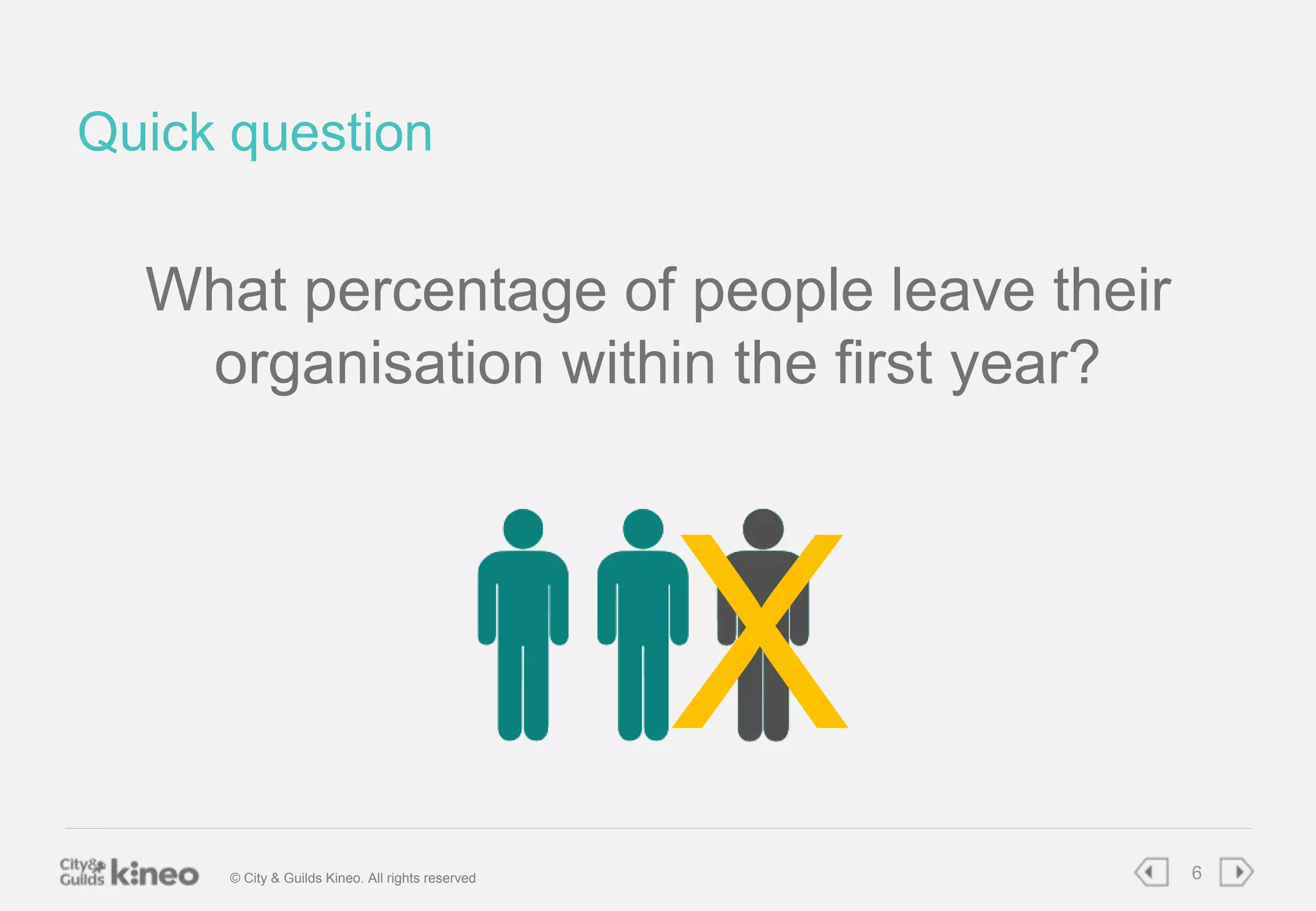
Quick question 
What percentage of people leave their 
organisation within the first year? 
X 
© City & Guilds Kineo. All rights reserved 6
It’s also the case… 
22% of staff turnover occurs in the first 
six weeks 
Wynhurst Group & PWC 
© City & Guilds Kineo. All rights reserved 7
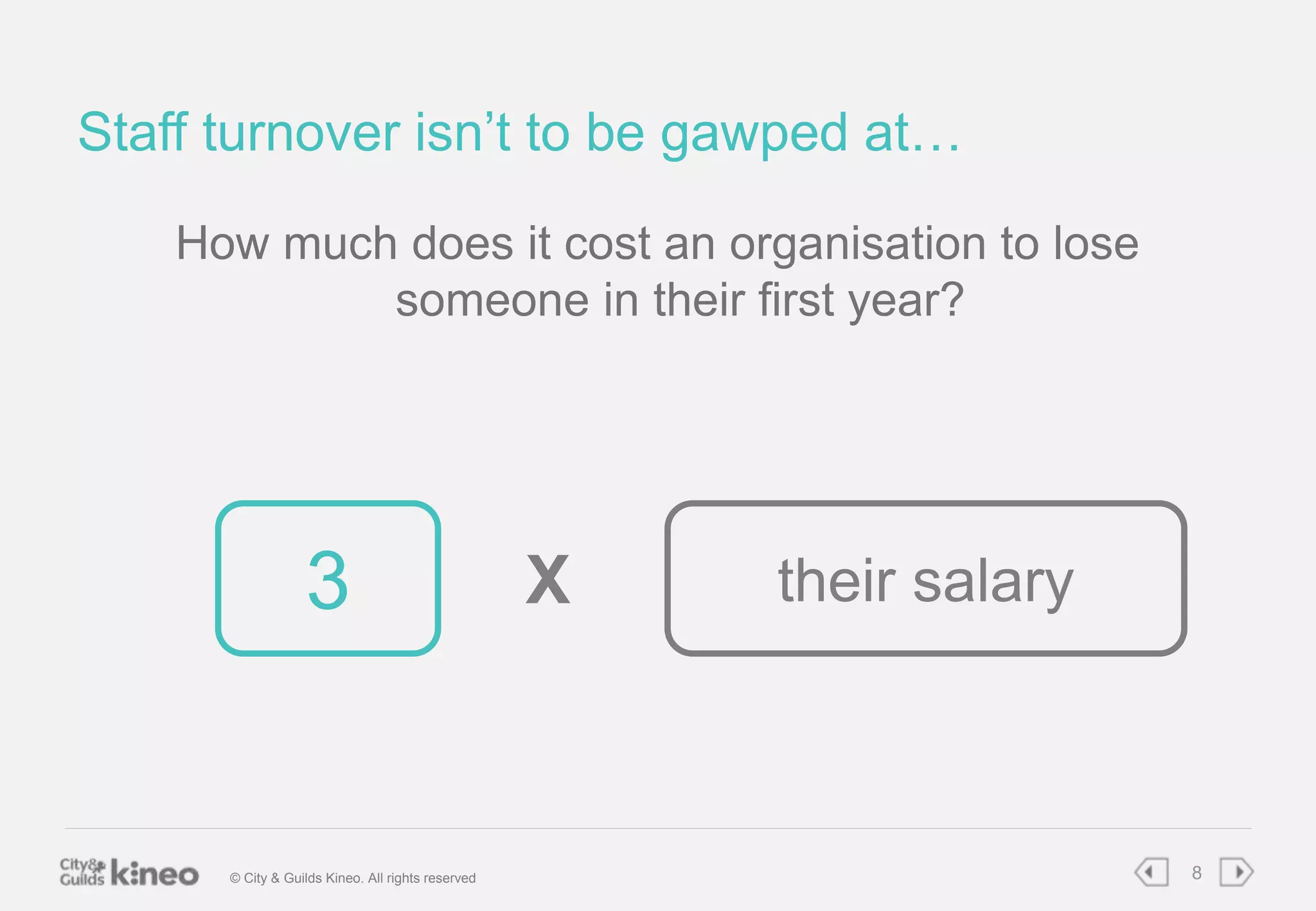
Staff turnover isn’t to be gawped at… 
How much does it cost an organisation to lose 
someone in their first year? 
3 X their salary 
© City & Guilds Kineo. All rights reserved 8
The potential costs… 
£42b 
a 
year 
3 x 
their 
salary 
© City & Guilds Kineo. All rights reserved 9
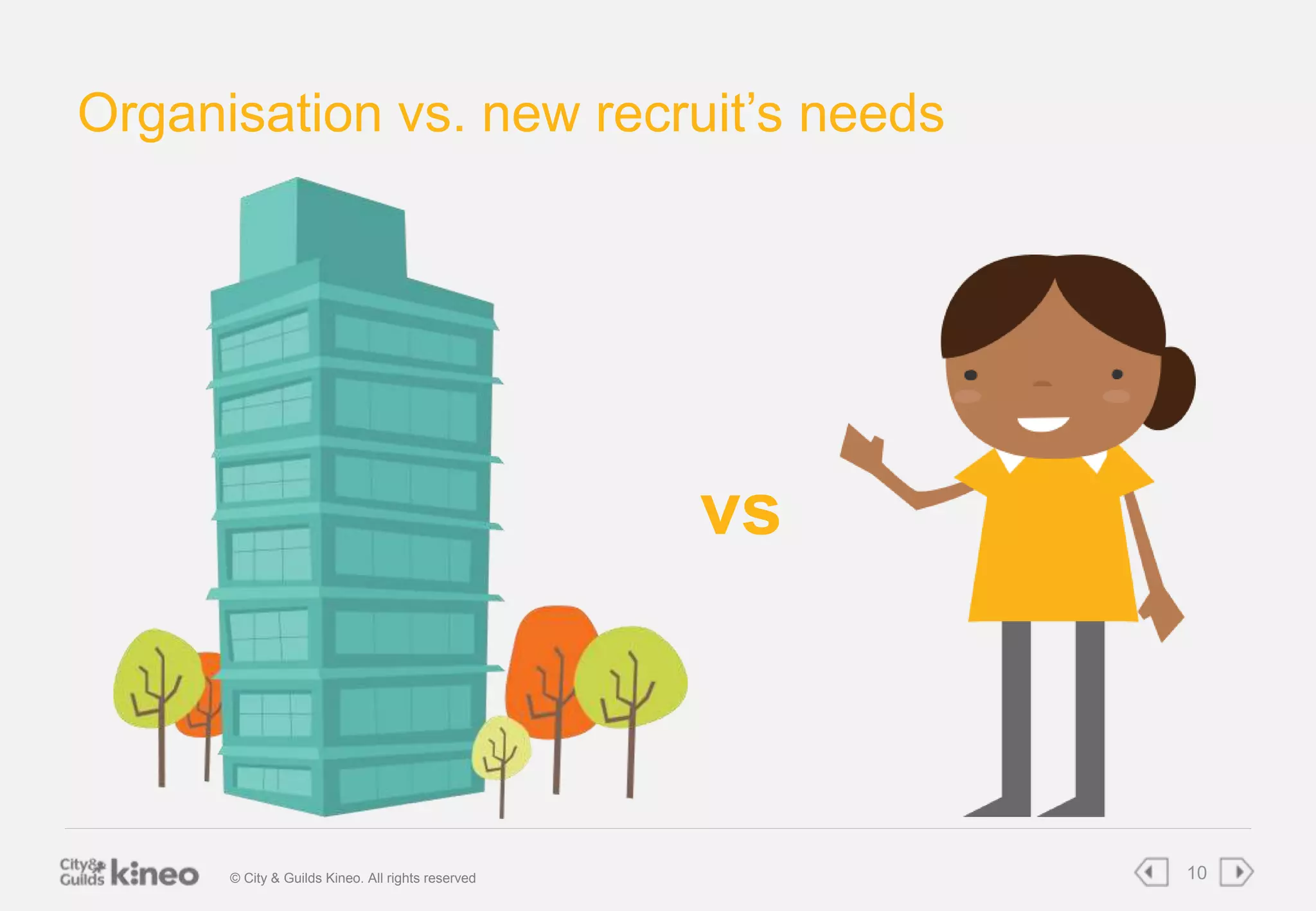
Organisation vs. new recruit’s needs 
vs 
© City & Guilds Kineo. All rights reserved 10
© City & Guilds Kineo. All rights reserved 11
© City & Guilds Kineo. All rights reserved 12
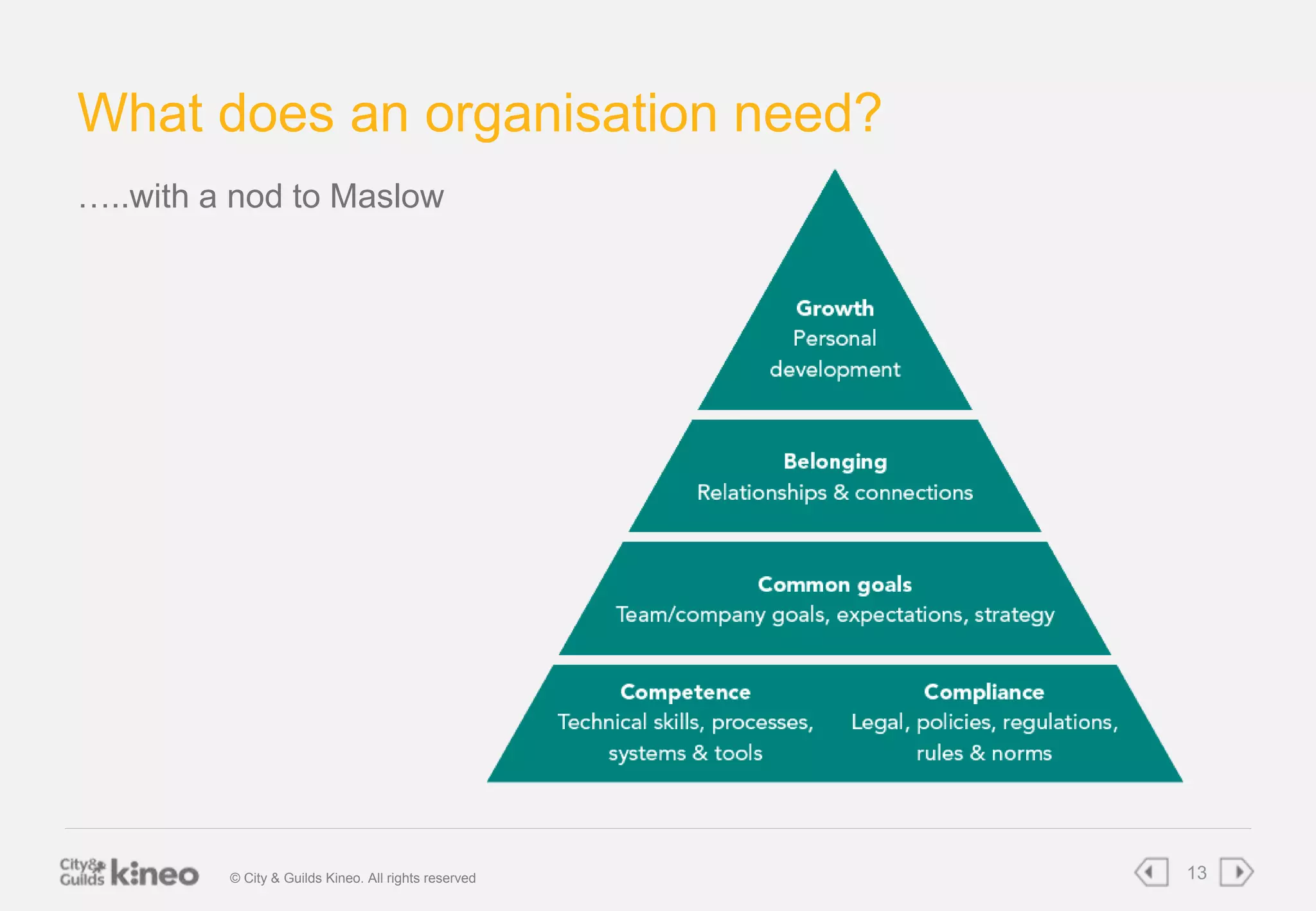
What does an organisation need? 
…..with a nod to Maslow 
© City & Guilds Kineo. All rights reserved 13
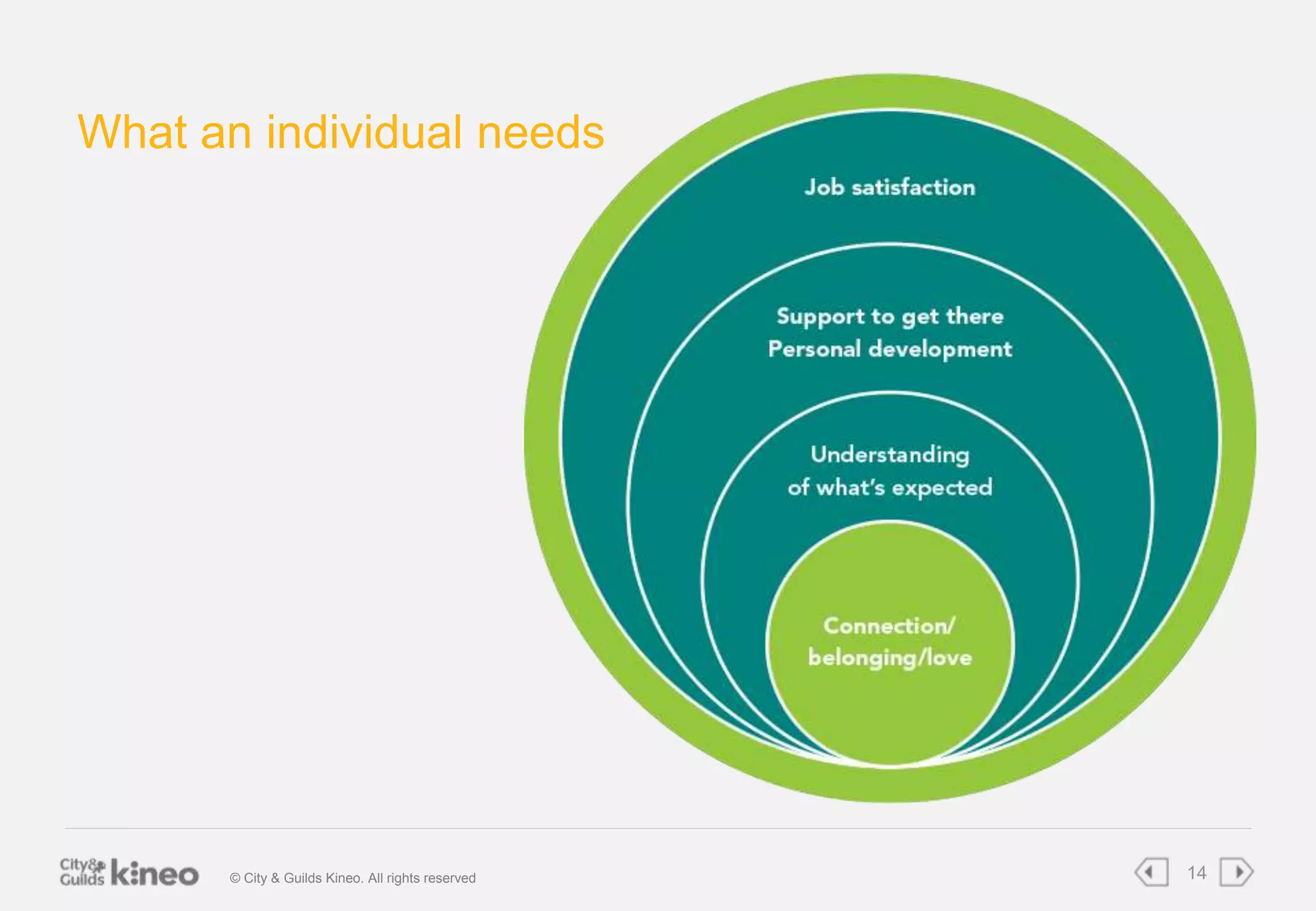
What an individual needs 
© City & Guilds Kineo. All rights reserved 14
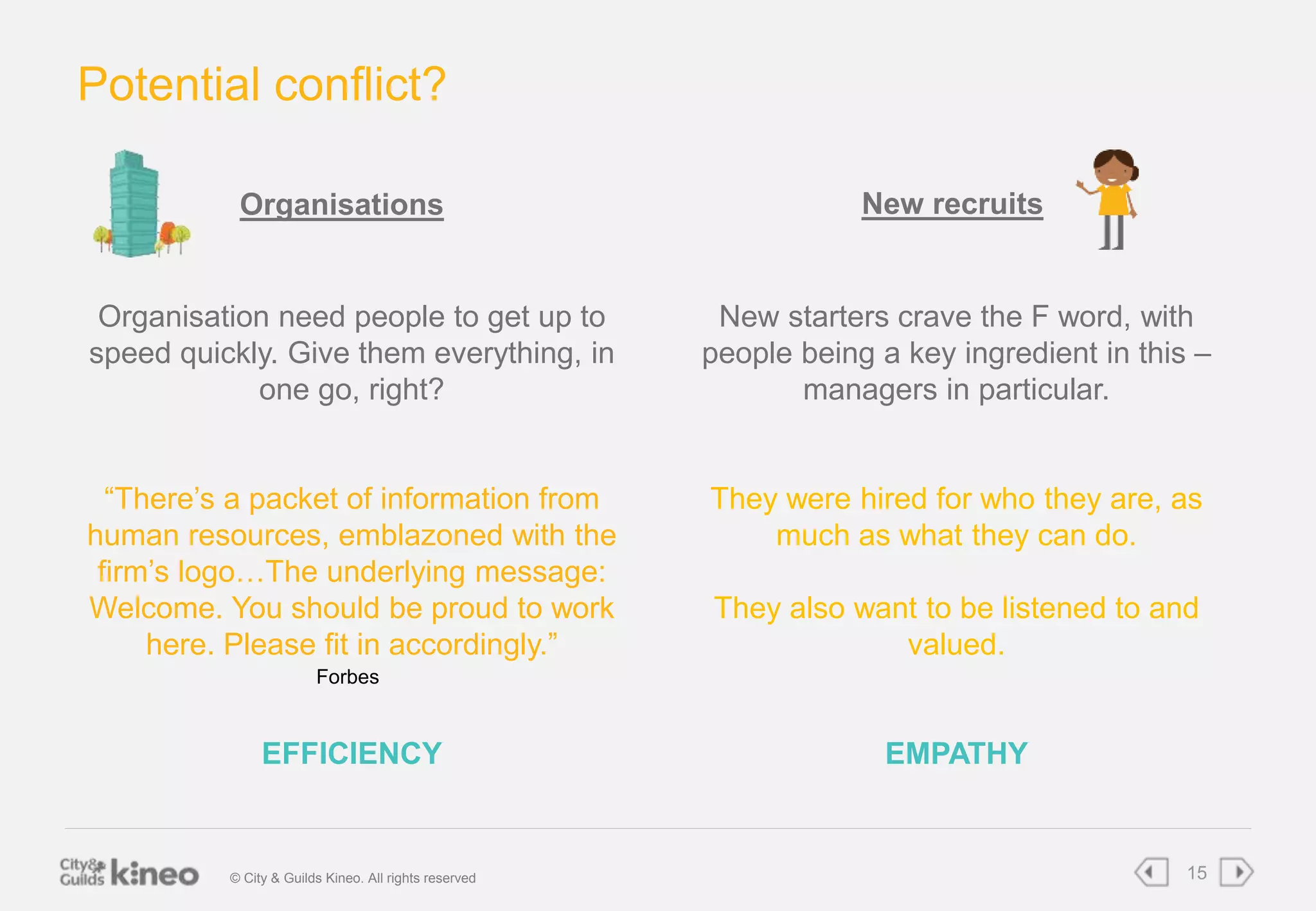
Potential conflict? 
Organisations New recruits 
Organisation need people to get up to 
speed quickly. Give them everything, in 
one go, right? 
“There’s a packet of information from 
human resources, emblazoned with the 
firm’s logo…The underlying message: 
Welcome. You should be proud to work 
here. Please fit in accordingly.” 
Forbes 
EFFICIENCY 
New starters crave the F word, with 
people being a key ingredient in this – 
managers in particular. 
They were hired for who they are, as 
much as what they can do. 
They also want to be listened to and 
valued. 
EMPATHY 
© City & Guilds Kineo. All rights reserved 15
16 
Learning 
Insight 
Blends
17 
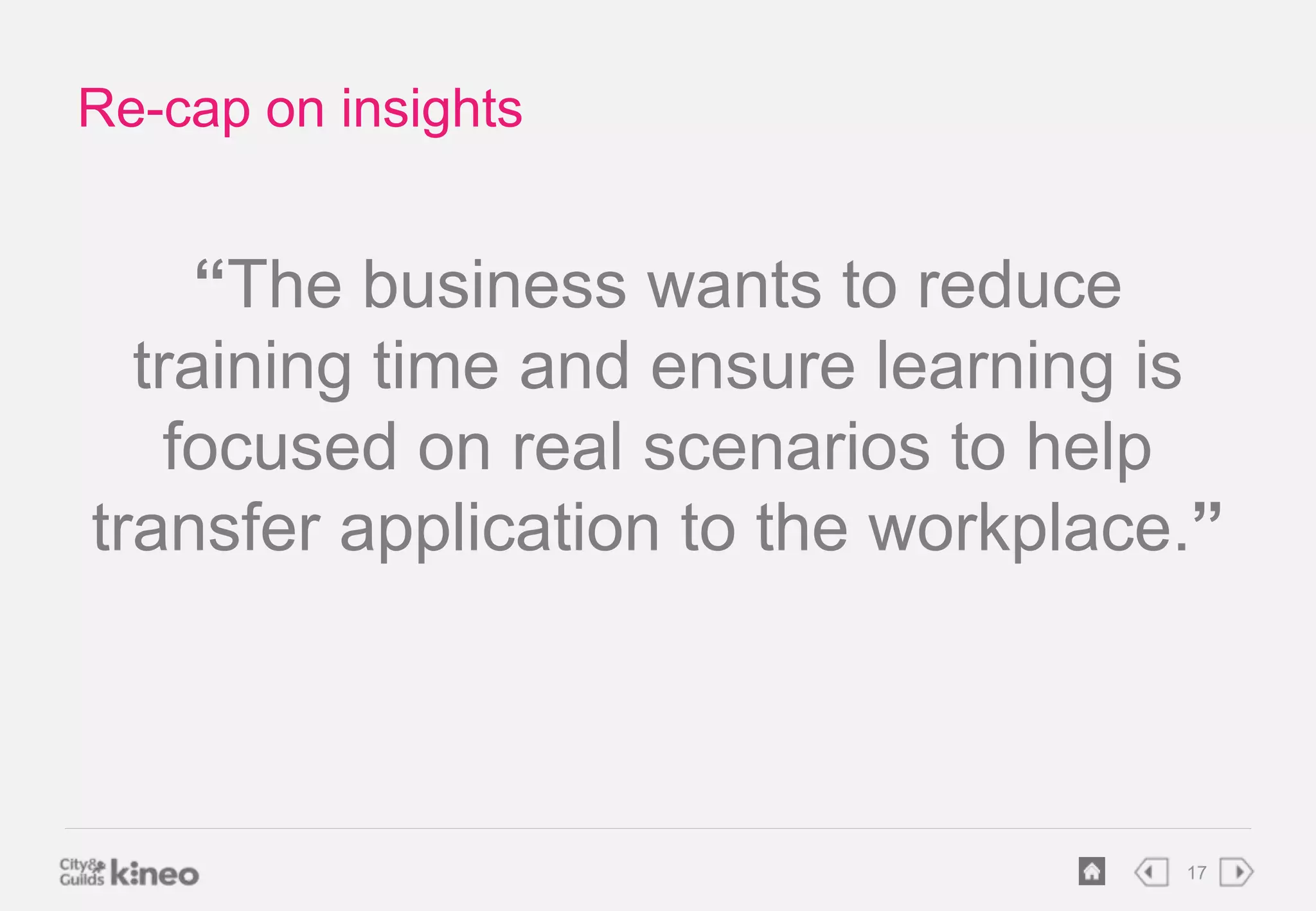
Re-cap on insights 
“The business wants to reduce 
training time and ensure learning is 
focused on real scenarios to help 
transfer application to the workplace.”
18 
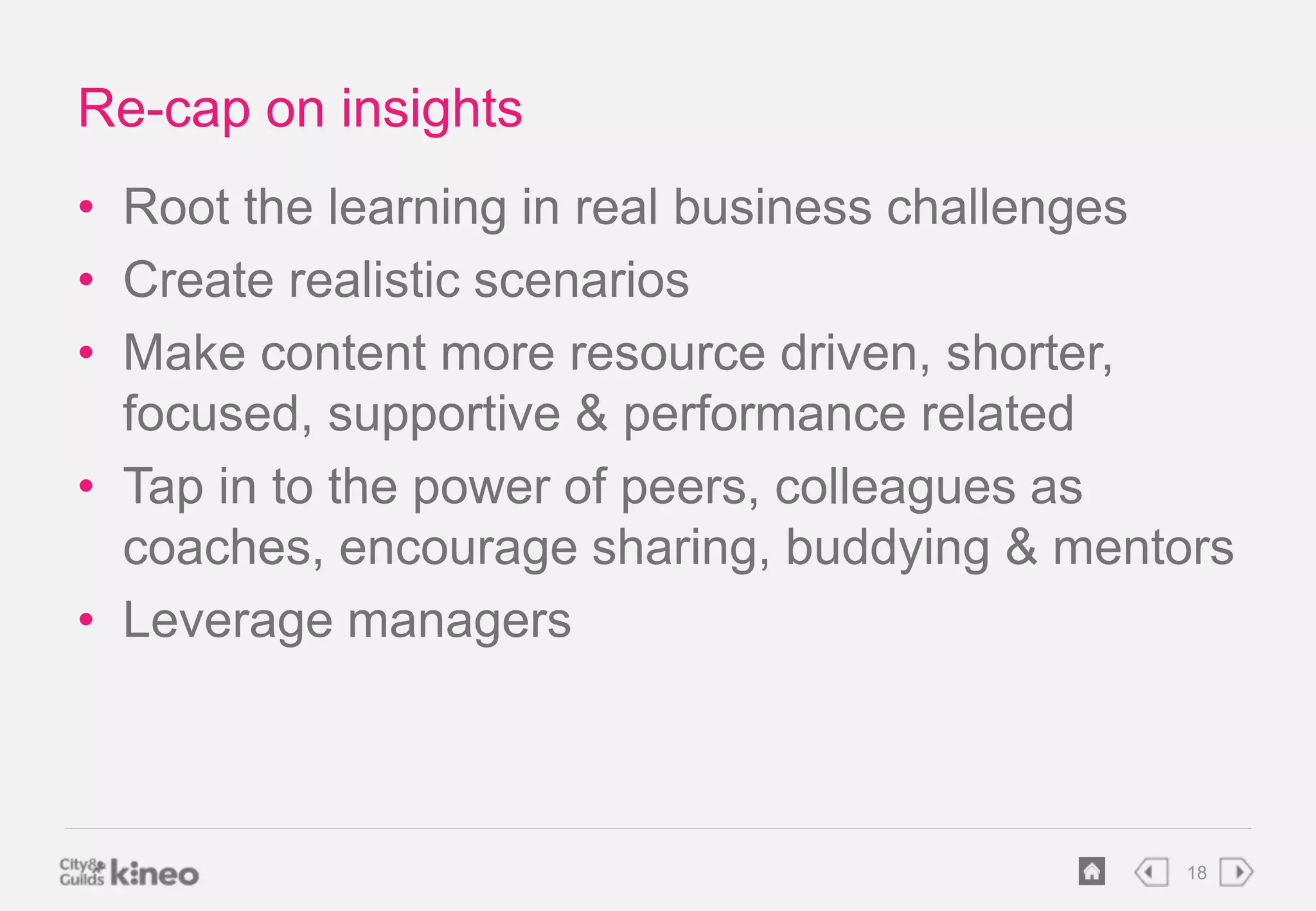
Re-cap on insights 
• Root the learning in real business challenges 
• Create realistic scenarios 
• Make content more resource driven, shorter, 
focused, supportive & performance related 
• Tap in to the power of peers, colleagues as 
coaches, encourage sharing, buddying & mentors 
• Leverage managers
19 
How does this 
impact on 
your design?
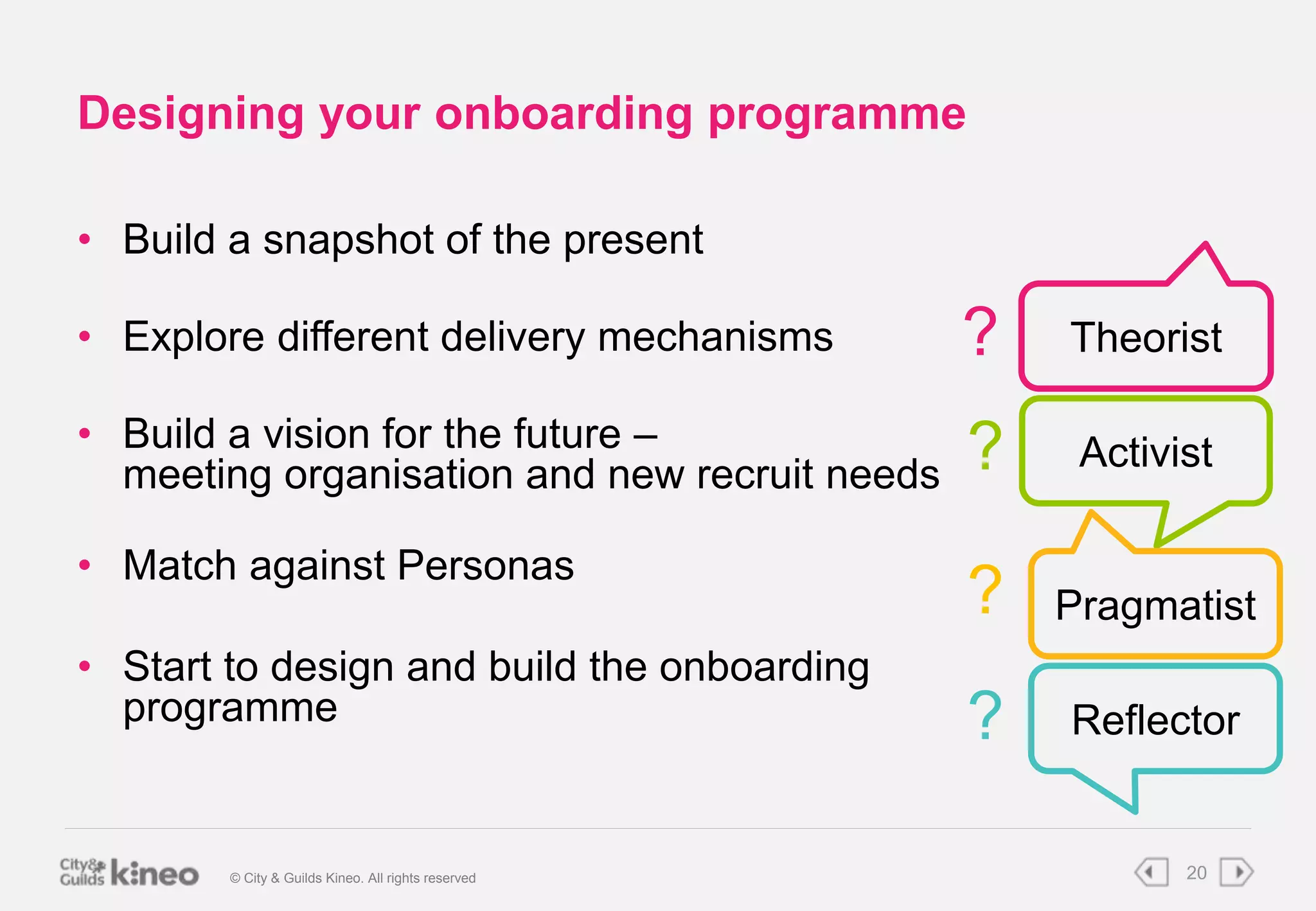
Designing your onboarding programme 
• Build a snapshot of the present 
• Explore different delivery mechanisms 
• Build a vision for the future – 
meeting organisation and new recruit needs 
• Match against Personas 
• Start to design and build the onboarding 
programme 
Theorist 
Activist 
Pragmatist 
Reflector 
? 
? 
? 
? 
© City & Guilds Kineo. All rights reserved 20
High efficiency 
Where would you 
position your 
current onboarding 
programme? 
Low empathy High empathy 
Low efficiency 
© City & Guilds Kineo. All rights reserved 21
© City & Guilds Kineo. All rights reserved 22
© City & Guilds Kineo. All rights reserved 23 
e 
High efficiency 
High empathy 
High empathy 
High efficiency
High efficiency 
Low empathy 
Low efficiency 
High empathy 
© City & Guilds Kineo. All rights reserved 24
© City & Guilds Kineo. All rights reserved 25
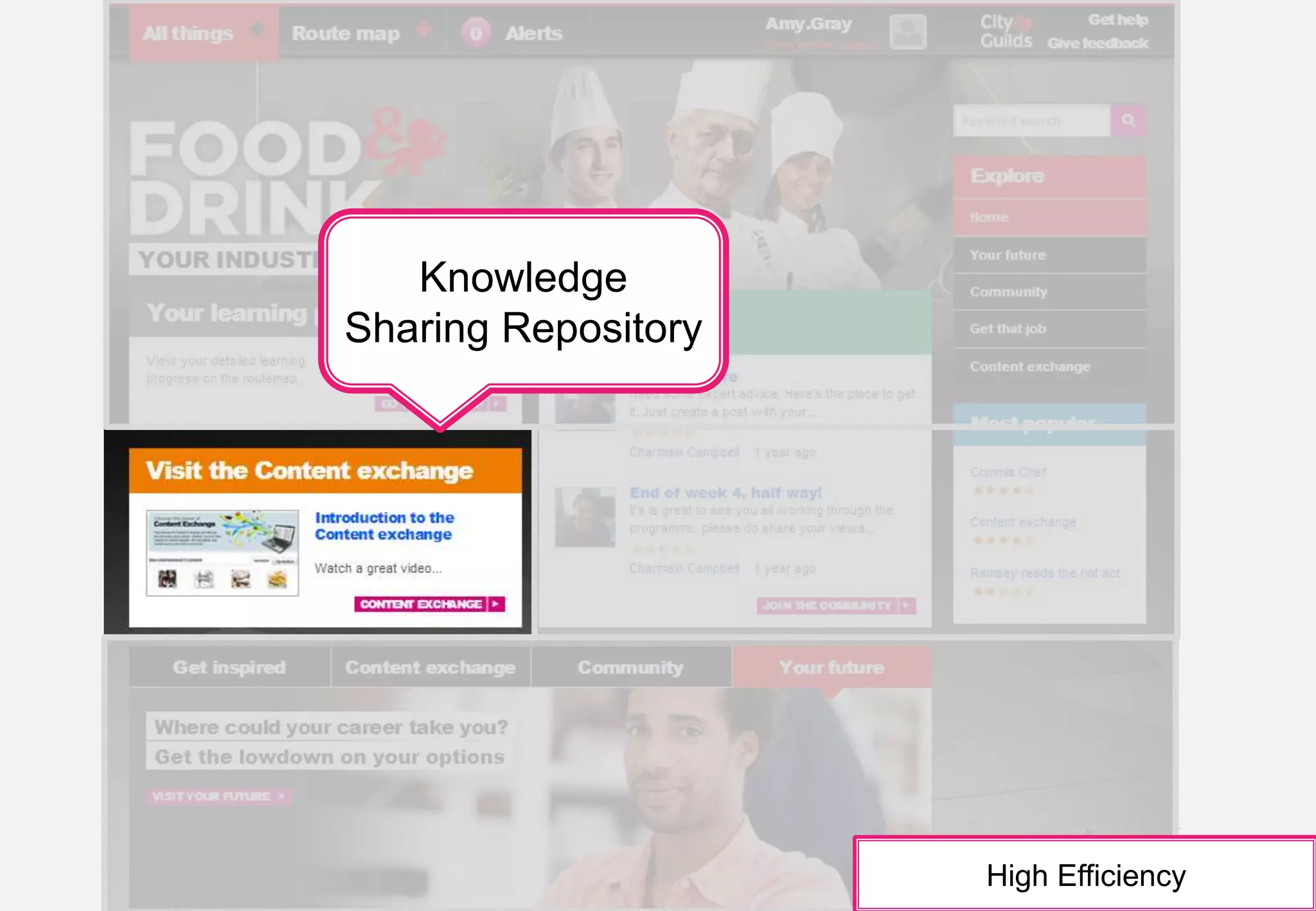
Knowledge 
Sharing Repository 
High Efficiency 
© City & Guilds Kineo. All rights reserved 26
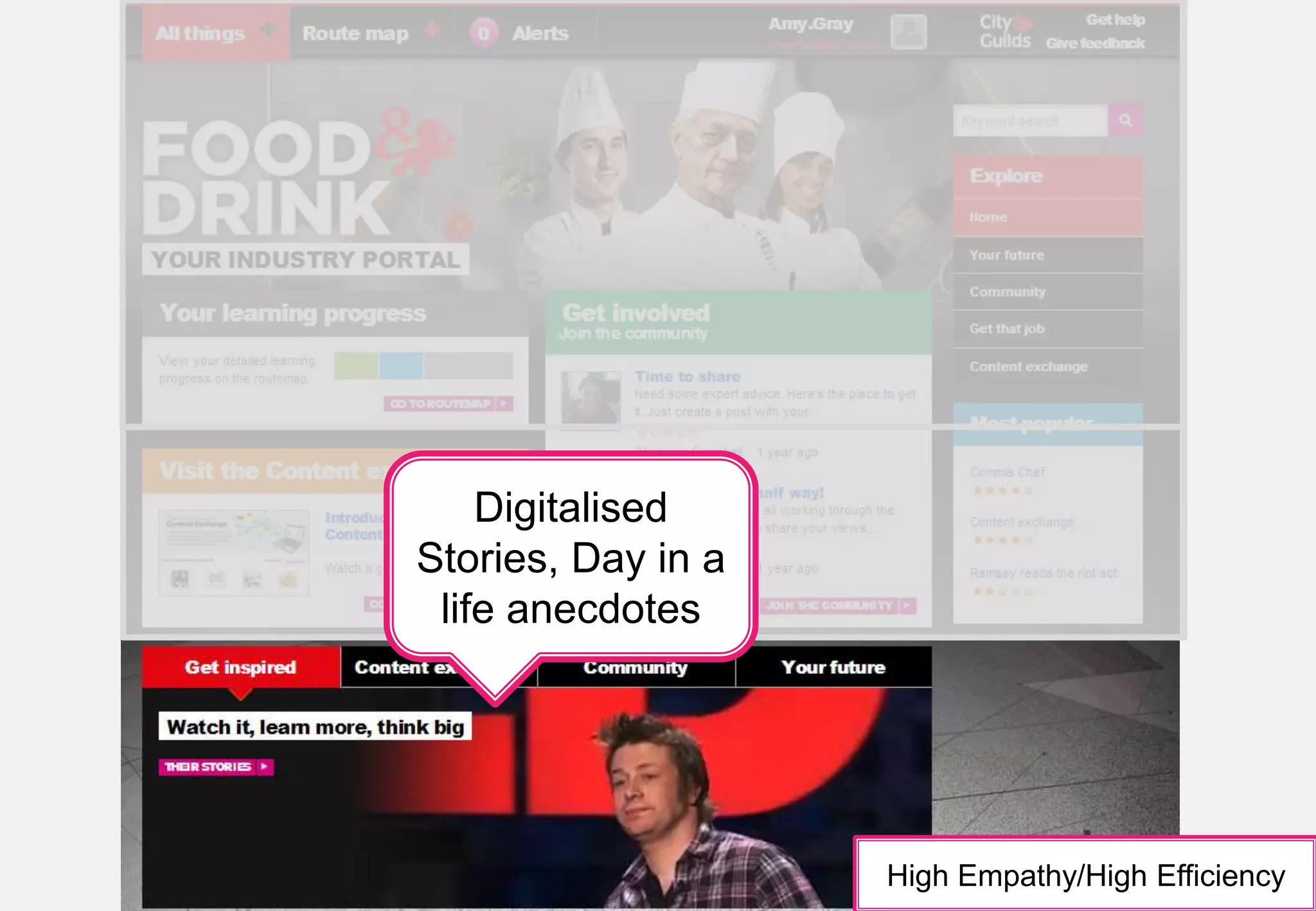
Digitalised 
Stories, Day in a 
life anecdotes 
High Empathy/High Efficiency 
© City & Guilds Kineo. All rights reserved 27
© City & Guilds Kineo. All rights reserved High Empathy/High Eff2i8ciency
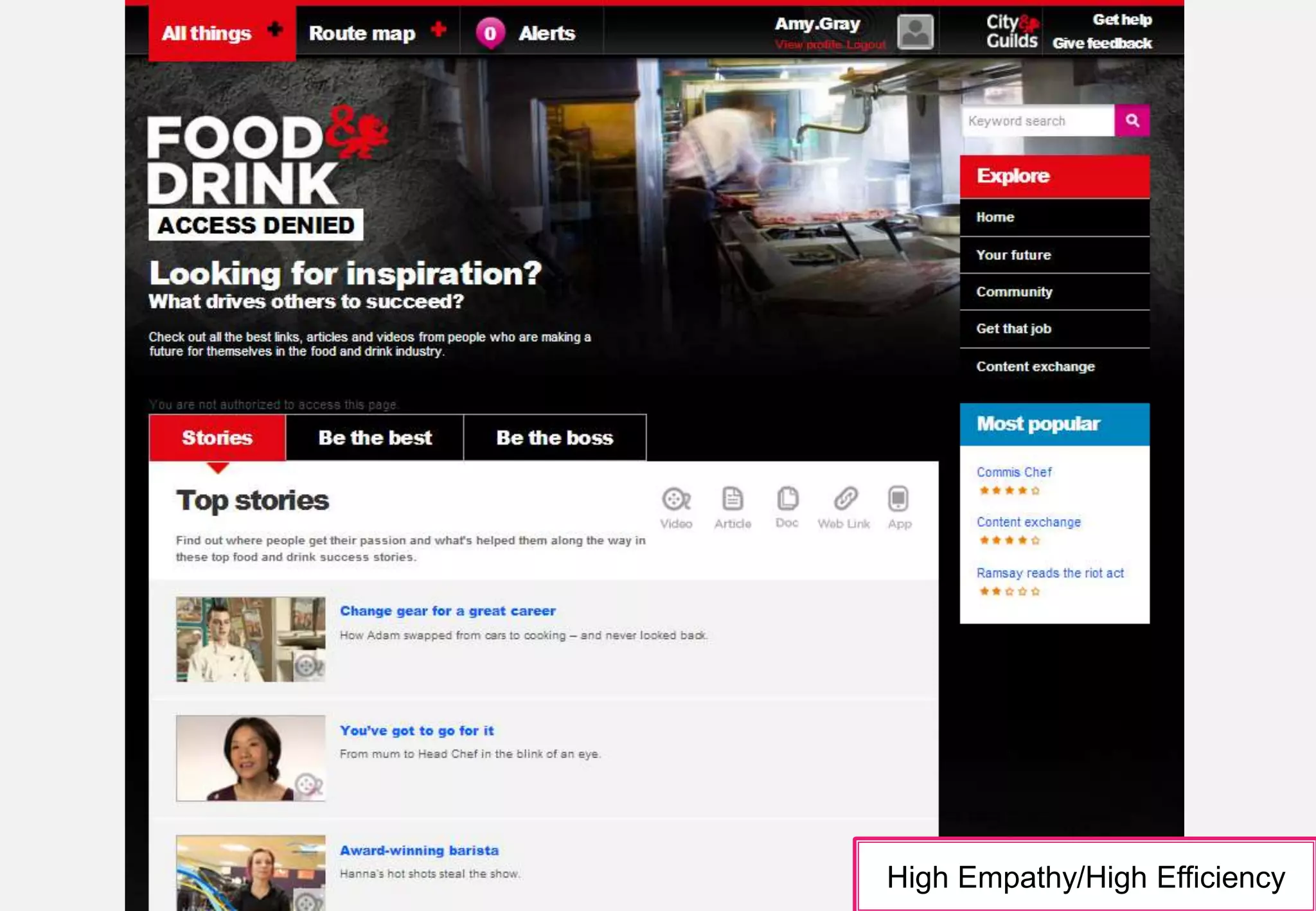
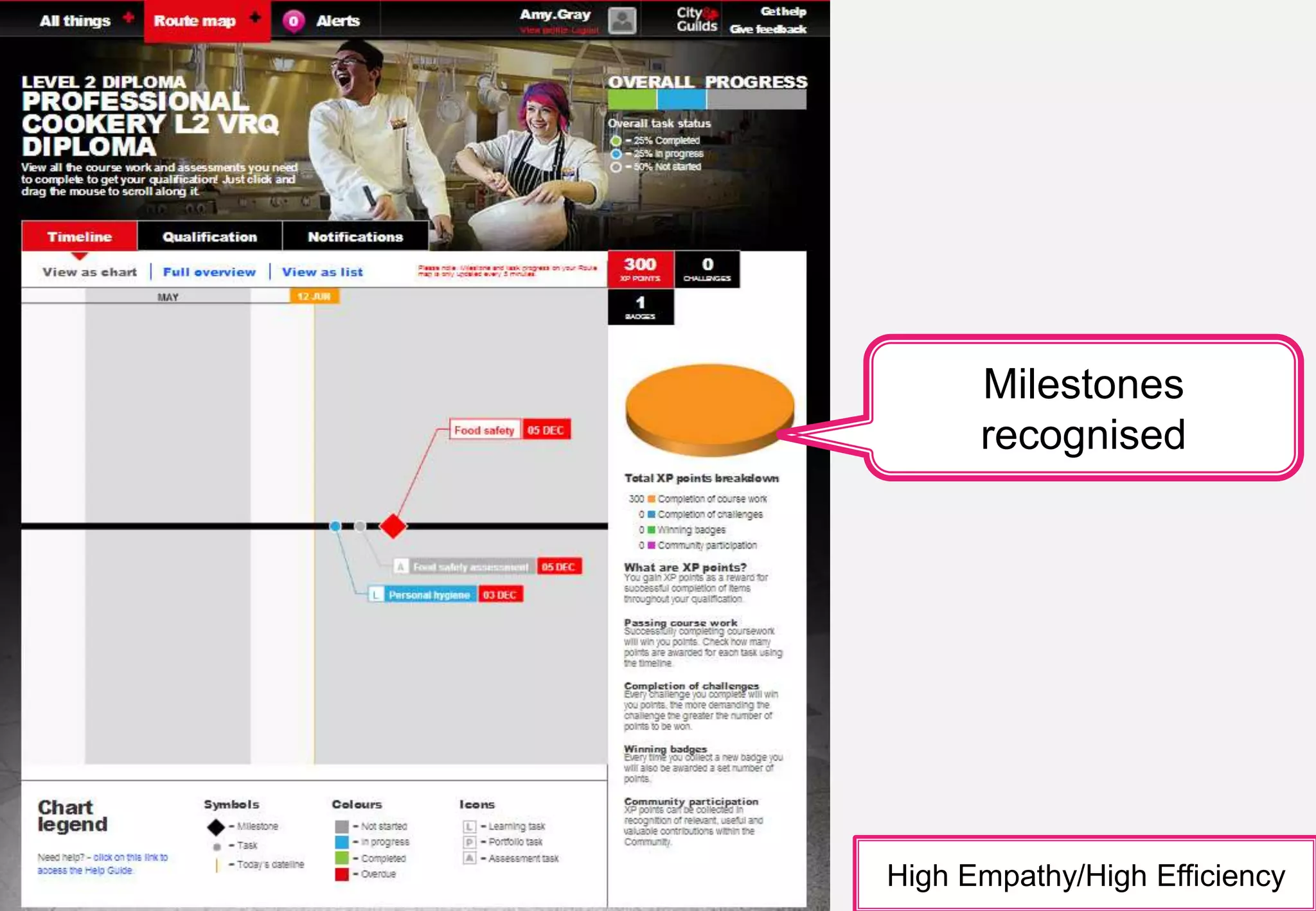
Milestones 
recognised 
High Empathy/High Efficiency 
© City & Guilds Kineo. All rights reserved 29
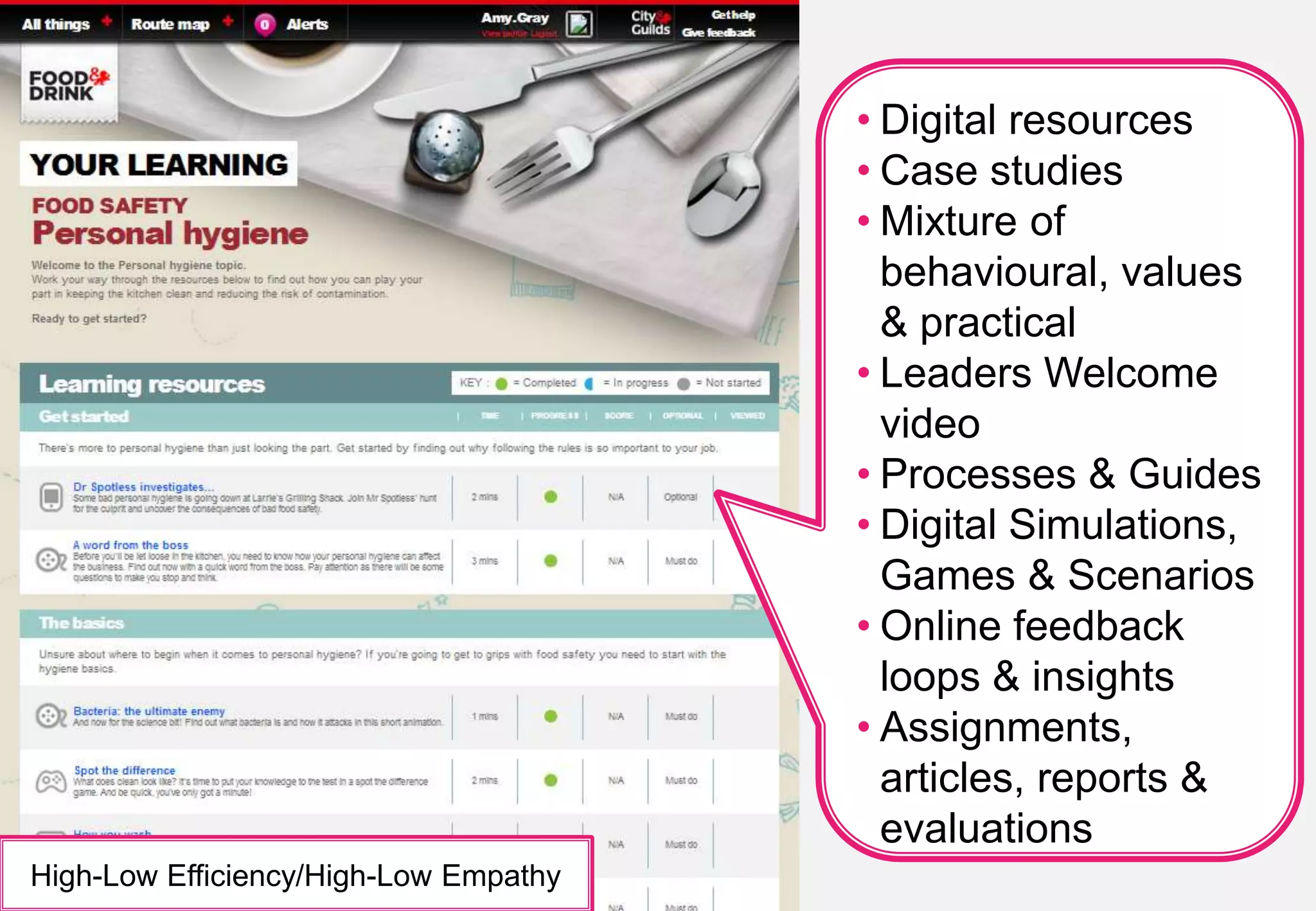
• Digital resources 
• Case studies 
• Mixture of 
behavioural, values 
& practical 
• Leaders Welcome 
video 
• Processes & Guides 
• Digital Simulations, 
Games & Scenarios 
• Online feedback 
loops & insights 
• Assignments, 
articles, reports & 
evaluations 
High-Low Efficiency/High-Low Empathy 
© City & Guilds Kineo. All rights reserved 30
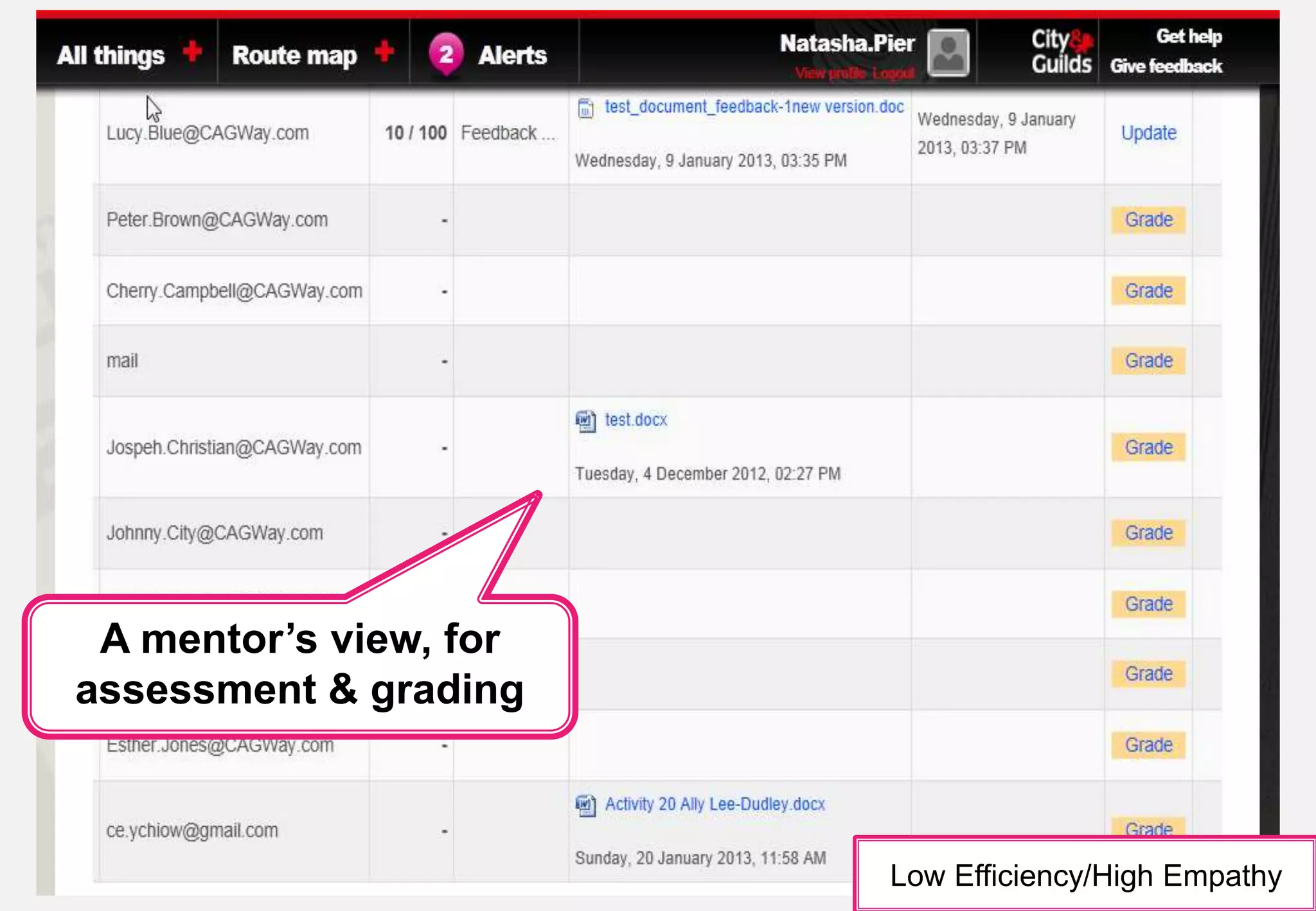
A mentor’s view, for 
assessment & grading 
Low Efficiency/High Empathy 
© City & Guilds Kineo. All rights reserved 31
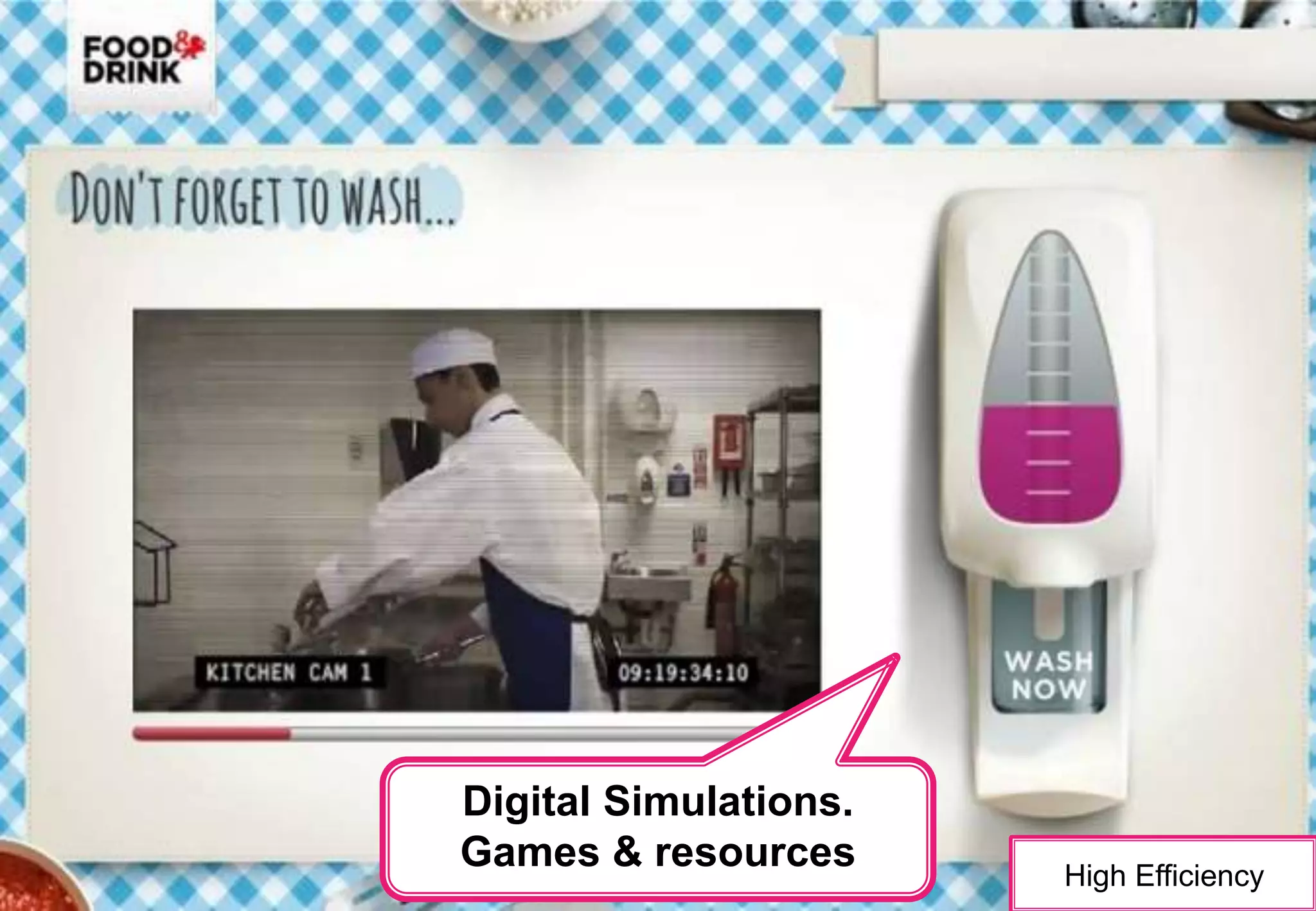
Digital Simulations. 
Games & resources 
High Efficiency 
© City & Guilds Kineo. All rights reserved 32
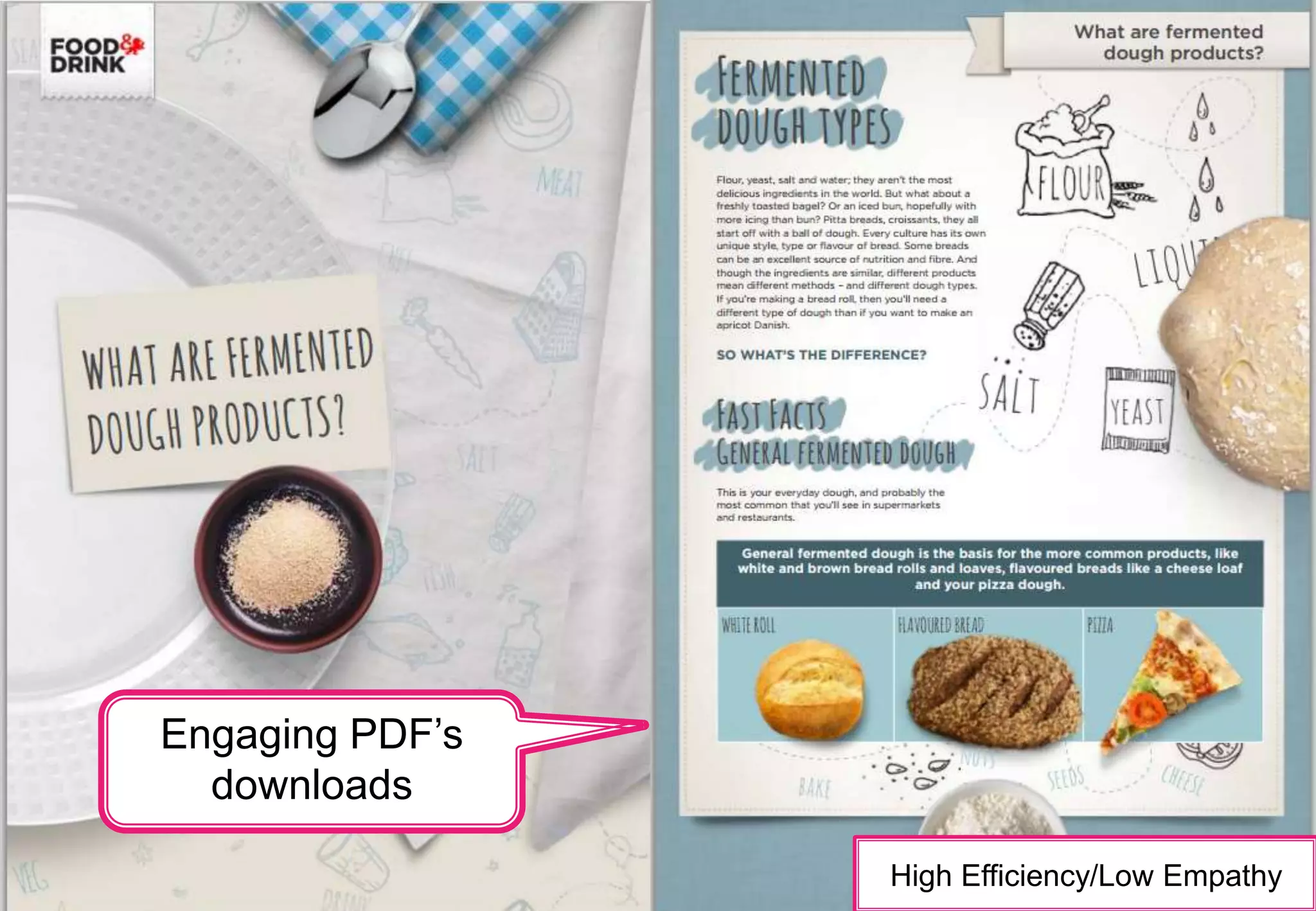
Engaging PDF’s 
downloads 
High Efficiency/Low Empathy 
© City & Guilds Kineo. All rights reserved 33
34 
The role of 
the LMS
Joining a new business is a emotional 
experience. 
Make it a positive and supported one through a 
focused onboarding portal.
36 
Features & Benefits 
• Reach them before day 1 
• Attract new hires 
• Make it on brand 
• Manage blended learning 
• Powerful reporting 
• Target specific audiences 
• Pre-load with relevant content 
• Align to competencies and learning plans 
• Search and support 
• Great for young joiners and apprentices
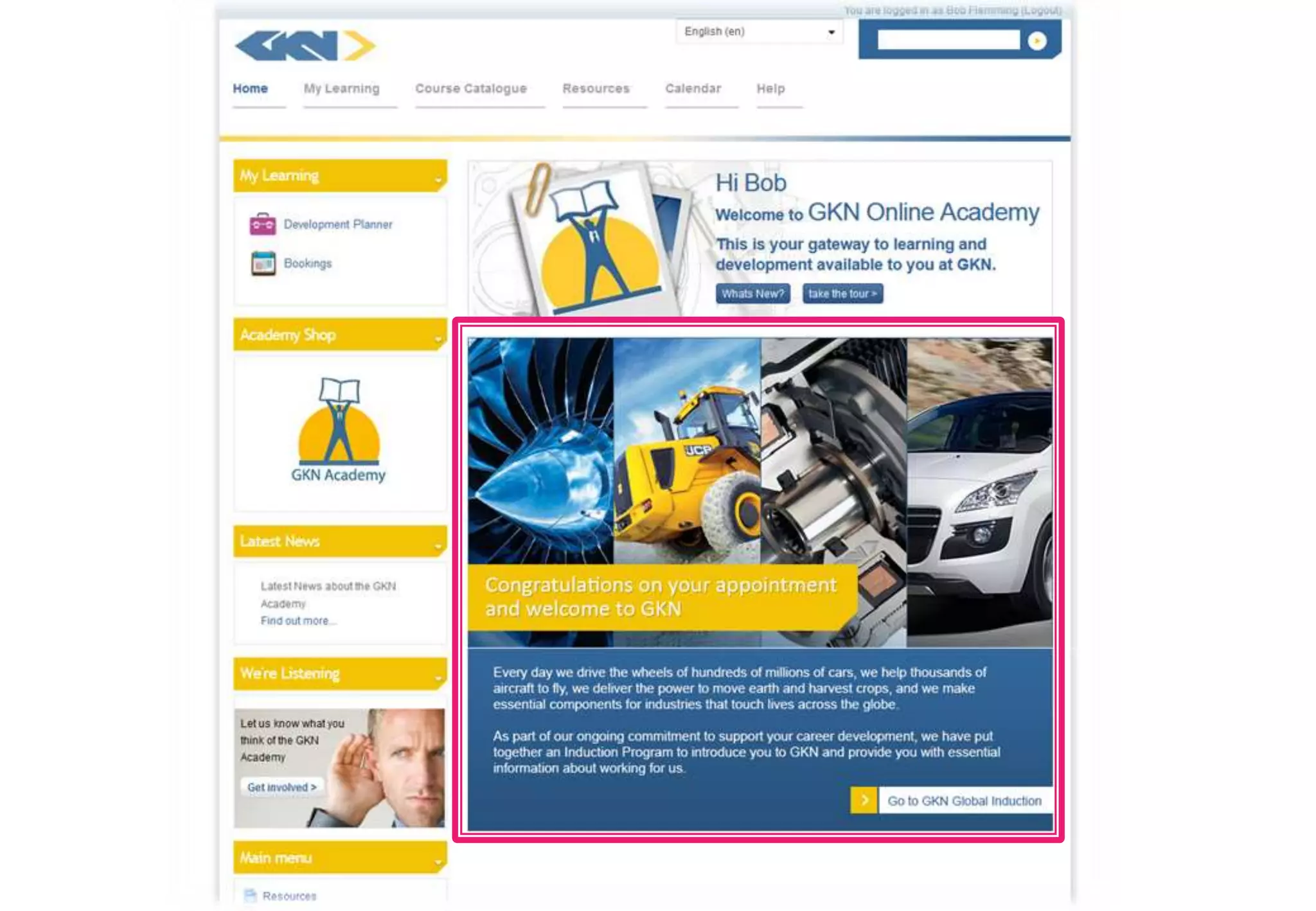
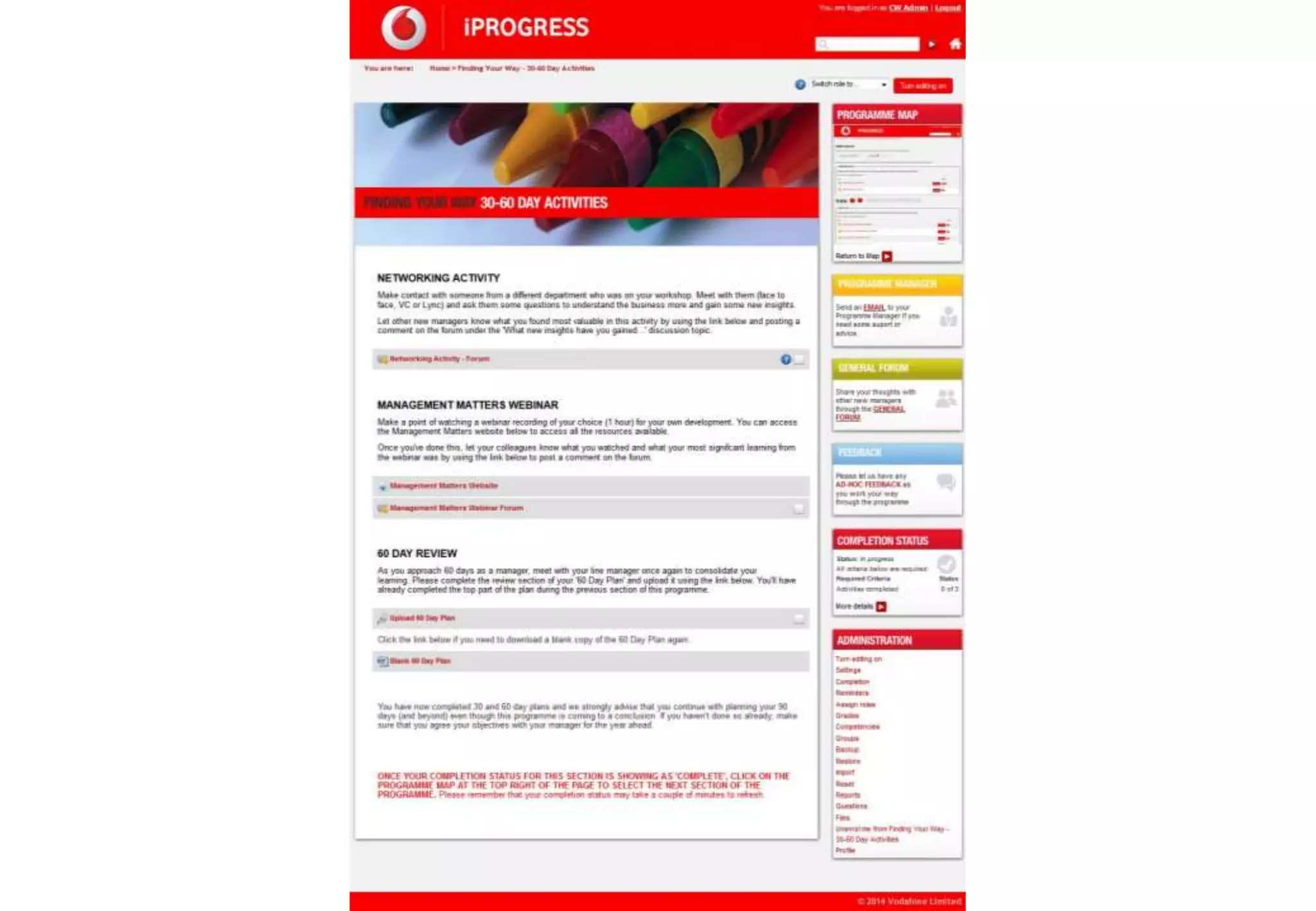
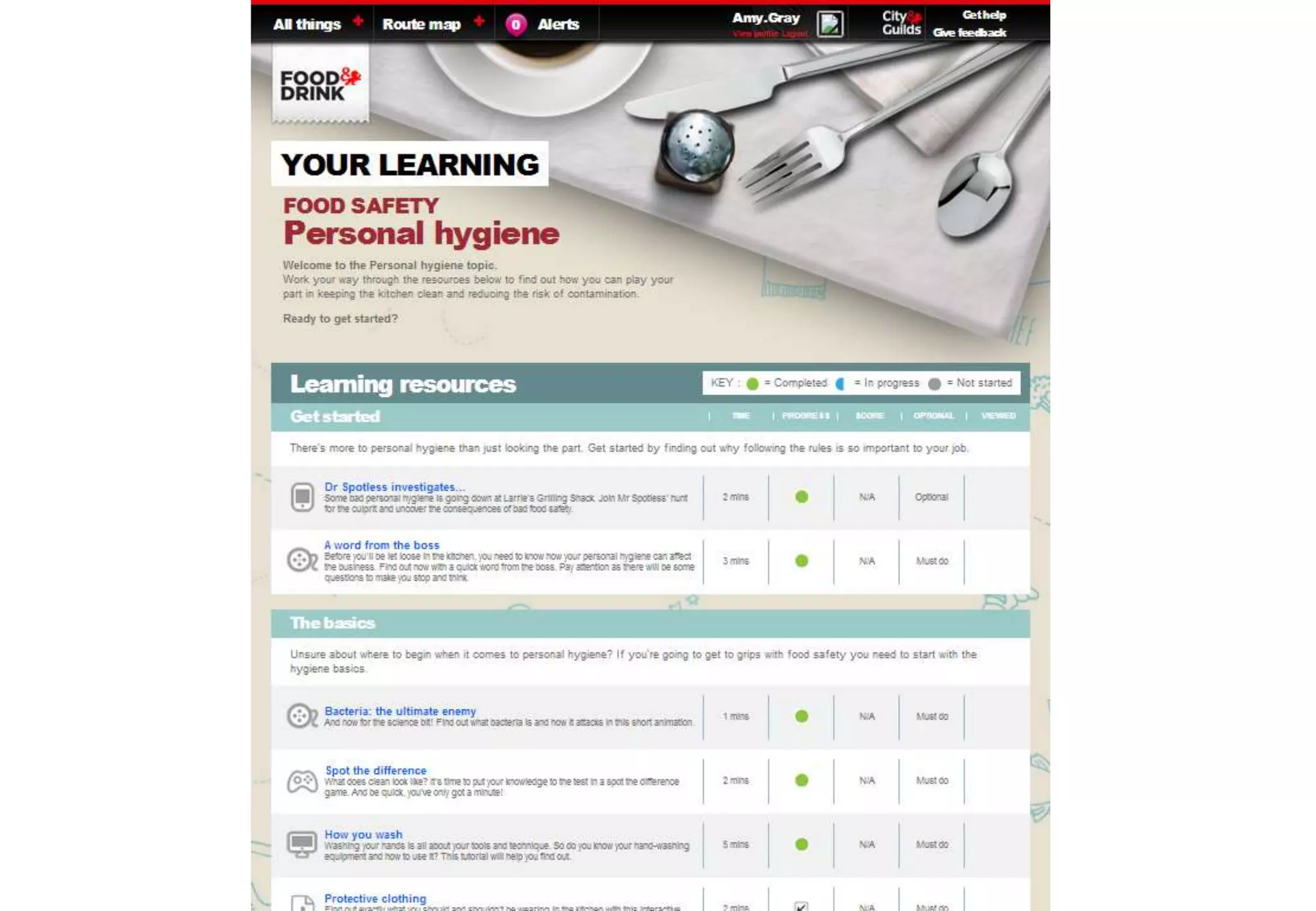
Homepage Sign Posting
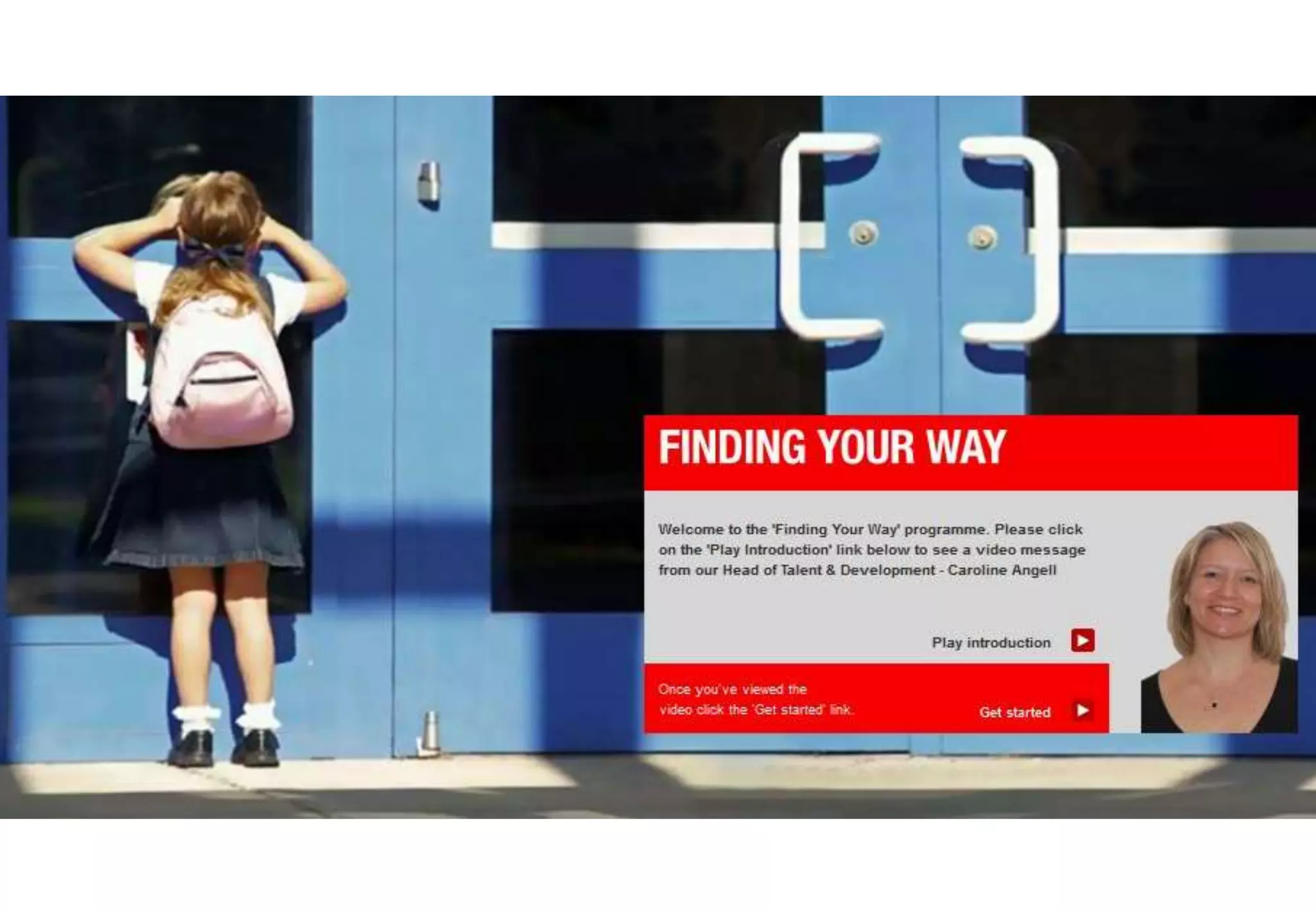
Splash Page
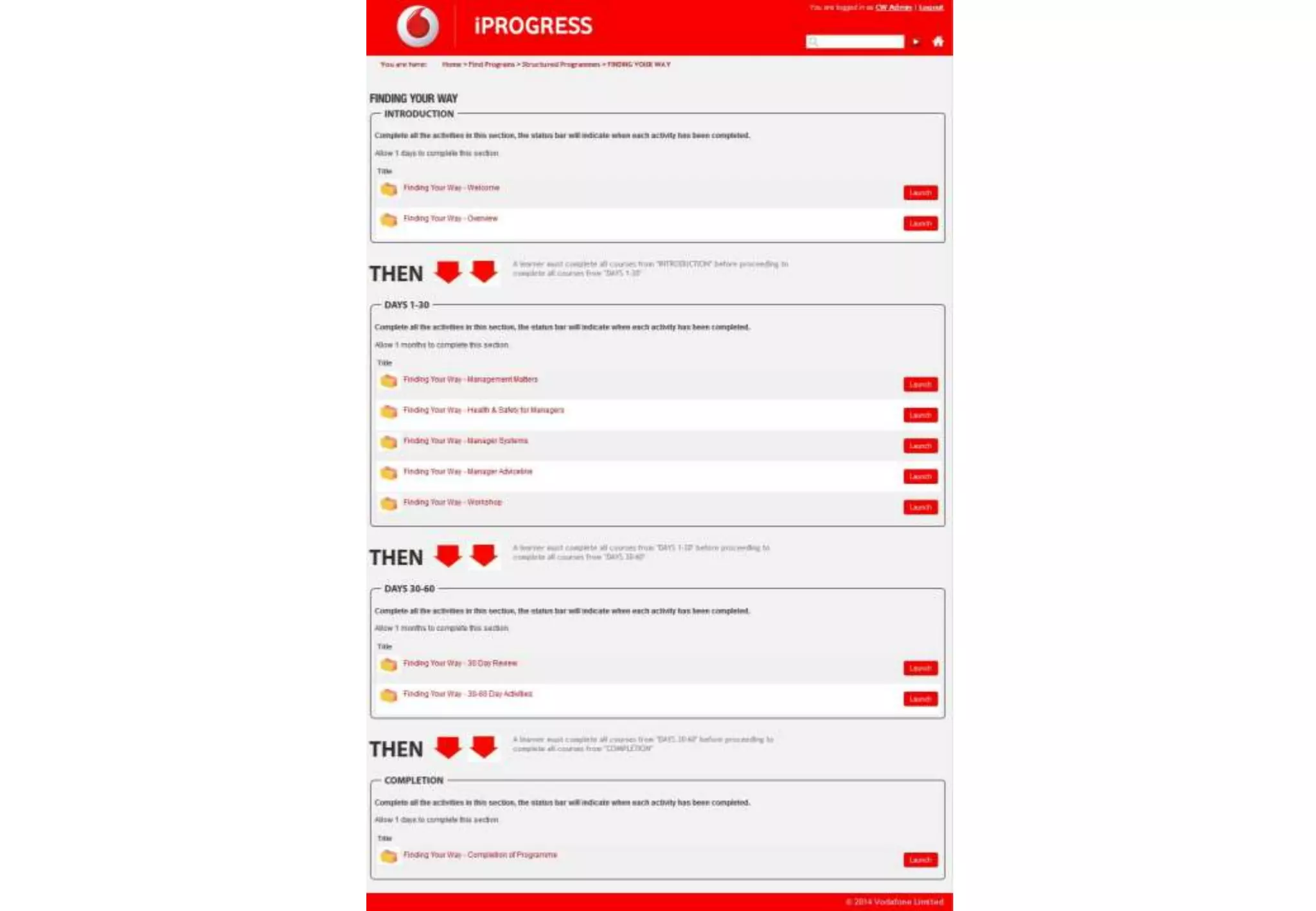
Programme Management
Programme Pages
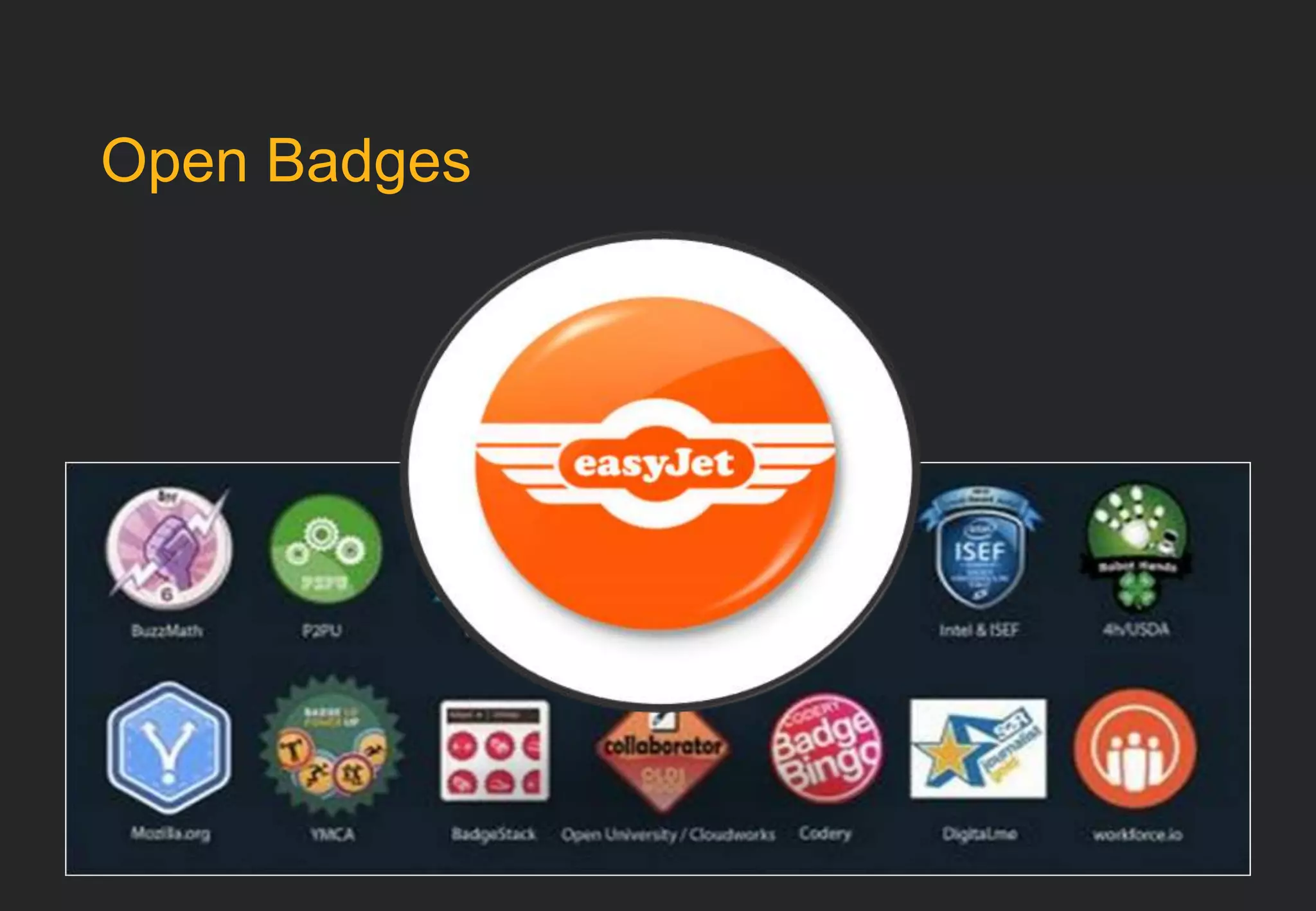
Reward through badges
Open Badges
49 
10 take away 
must-dos 
To help you
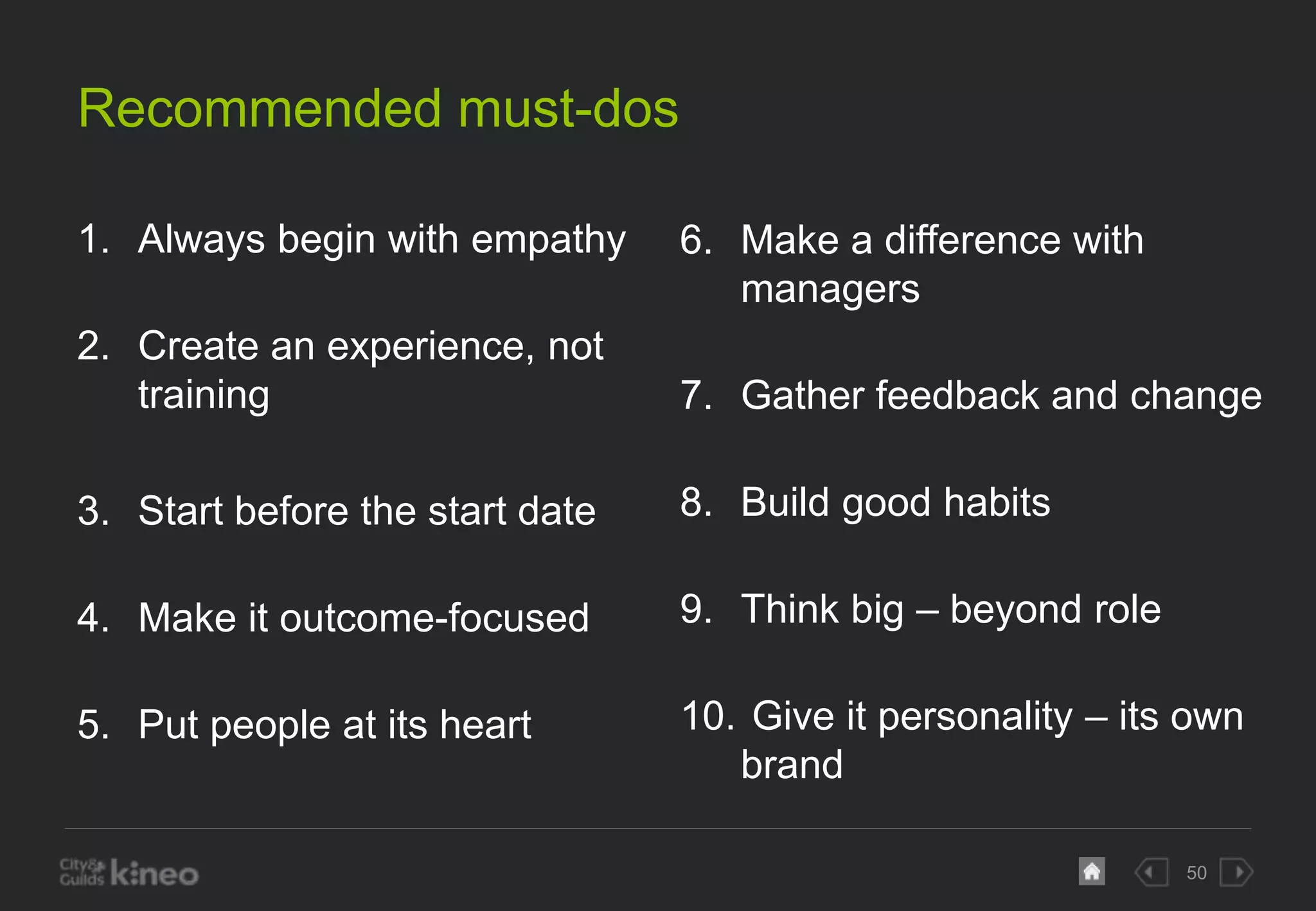
50 
Recommended must-dos 
1. Always begin with empathy 
2. Create an experience, not 
training 
3. Start before the start date 
4. Make it outcome-focused 
5. Put people at its heart 
6. Make a difference with 
managers 
7. Gather feedback and change 
8. Build good habits 
9. Think big – beyond role 
10. Give it personality – its own 
brand
Learning Insights Live Nov 14 - Blends That Work For Onboarding & Induction

Learning Insights Live Nov 14 - Blends That Work For Onboarding & Induction

  • 1.
    1 Blends thatwork for Onboarding Mark Harrison, Director 25/11/14
  • 2.
  • 3.
    3 Blended Learning& Onboarding • The CG Kineo Guide to Onboarding • The findings through Learning Insights • Some sample blends that compliment the findings in our research this year • The value of the Learning Management System in your Blended Onboarding Programme
  • 4.
  • 5.
    “The mechanism throughwhich new employees acquire the necessary knowledge, skills, and behaviours to become effective organisational members.” © City & Guilds Kineo. All rights reserved 5
  • 6.
    Quick question Whatpercentage of people leave their organisation within the first year? X © City & Guilds Kineo. All rights reserved 6
  • 7.
    It’s also thecase… 22% of staff turnover occurs in the first six weeks Wynhurst Group & PWC © City & Guilds Kineo. All rights reserved 7
  • 8.
    Staff turnover isn’tto be gawped at… How much does it cost an organisation to lose someone in their first year? 3 X their salary © City & Guilds Kineo. All rights reserved 8
  • 9.
    The potential costs… £42b a year 3 x their salary © City & Guilds Kineo. All rights reserved 9
  • 10.
    Organisation vs. newrecruit’s needs vs © City & Guilds Kineo. All rights reserved 10
  • 11.
    © City &Guilds Kineo. All rights reserved 11
  • 12.
    © City &Guilds Kineo. All rights reserved 12
  • 13.
    What does anorganisation need? …..with a nod to Maslow © City & Guilds Kineo. All rights reserved 13
  • 14.
    What an individualneeds © City & Guilds Kineo. All rights reserved 14
  • 15.
    Potential conflict? OrganisationsNew recruits Organisation need people to get up to speed quickly. Give them everything, in one go, right? “There’s a packet of information from human resources, emblazoned with the firm’s logo…The underlying message: Welcome. You should be proud to work here. Please fit in accordingly.” Forbes EFFICIENCY New starters crave the F word, with people being a key ingredient in this – managers in particular. They were hired for who they are, as much as what they can do. They also want to be listened to and valued. EMPATHY © City & Guilds Kineo. All rights reserved 15
  • 16.
  • 17.
    17 Re-cap oninsights “The business wants to reduce training time and ensure learning is focused on real scenarios to help transfer application to the workplace.”
  • 18.
    18 Re-cap oninsights • Root the learning in real business challenges • Create realistic scenarios • Make content more resource driven, shorter, focused, supportive & performance related • Tap in to the power of peers, colleagues as coaches, encourage sharing, buddying & mentors • Leverage managers
  • 19.
    19 How doesthis impact on your design?
  • 20.
    Designing your onboardingprogramme • Build a snapshot of the present • Explore different delivery mechanisms • Build a vision for the future – meeting organisation and new recruit needs • Match against Personas • Start to design and build the onboarding programme Theorist Activist Pragmatist Reflector ? ? ? ? © City & Guilds Kineo. All rights reserved 20
  • 21.
    High efficiency Wherewould you position your current onboarding programme? Low empathy High empathy Low efficiency © City & Guilds Kineo. All rights reserved 21
  • 22.
    © City &Guilds Kineo. All rights reserved 22
  • 23.
    © City &Guilds Kineo. All rights reserved 23 e High efficiency High empathy High empathy High efficiency
  • 24.
    High efficiency Lowempathy Low efficiency High empathy © City & Guilds Kineo. All rights reserved 24
  • 25.
    © City &Guilds Kineo. All rights reserved 25
  • 26.
    Knowledge Sharing Repository High Efficiency © City & Guilds Kineo. All rights reserved 26
  • 27.
    Digitalised Stories, Dayin a life anecdotes High Empathy/High Efficiency © City & Guilds Kineo. All rights reserved 27
  • 28.
    © City &Guilds Kineo. All rights reserved High Empathy/High Eff2i8ciency
  • 29.
    Milestones recognised HighEmpathy/High Efficiency © City & Guilds Kineo. All rights reserved 29
  • 30.
    • Digital resources • Case studies • Mixture of behavioural, values & practical • Leaders Welcome video • Processes & Guides • Digital Simulations, Games & Scenarios • Online feedback loops & insights • Assignments, articles, reports & evaluations High-Low Efficiency/High-Low Empathy © City & Guilds Kineo. All rights reserved 30
  • 31.
    A mentor’s view,for assessment & grading Low Efficiency/High Empathy © City & Guilds Kineo. All rights reserved 31
  • 32.
    Digital Simulations. Games& resources High Efficiency © City & Guilds Kineo. All rights reserved 32
  • 33.
    Engaging PDF’s downloads High Efficiency/Low Empathy © City & Guilds Kineo. All rights reserved 33
  • 34.
    34 The roleof the LMS
  • 35.
    Joining a newbusiness is a emotional experience. Make it a positive and supported one through a focused onboarding portal.
  • 36.
    36 Features &Benefits • Reach them before day 1 • Attract new hires • Make it on brand • Manage blended learning • Powerful reporting • Target specific audiences • Pre-load with relevant content • Align to competencies and learning plans • Search and support • Great for young joiners and apprentices
  • 37.
  • 39.
  • 41.
  • 43.
  • 46.
  • 47.
  • 49.
    49 10 takeaway must-dos To help you
  • 50.
    50 Recommended must-dos 1. Always begin with empathy 2. Create an experience, not training 3. Start before the start date 4. Make it outcome-focused 5. Put people at its heart 6. Make a difference with managers 7. Gather feedback and change 8. Build good habits 9. Think big – beyond role 10. Give it personality – its own brand

Editor's Notes

  • #4 In the last year CG Kineo have talked a lot about Onboarding. We started the year talking about what getting Onboarding right means to organisations and shared with you some case studies where companies have invested in Onboarding and what the perfect blend looks like for them. As moved further in to the year we held our Totara user group forum and shared with you some ideas and stories on where some of customers have brought their Onboarding journey to life using their LMS. We now close the year on the Learning Insights report which believe it or not has pulled through the theme of blended learning, over this presentation we re-cap over the Onboarding blended learning paper, talk about what we learnt around blended learning from the various companies that were interviewed, show some sample blends based our findings and then close of the importance of the LMS
  • #6 So lets start with what we mean by Onboarding – interesting when you look this up on the internet it provides a very clear wording that underpins the overall objective
  • #7 Ok to kick off, here’s a quick question for you. Any one got any ideas, or perhaps a loud voice? OK thanks. Well, one in three people leave voluntarily or involuntarily before the end of their first year, on average.
  • #8 It’s also the case that one in five leave in their first six weeks.
  • #9 Now the cost of this isn’t something to be taken lightly. Anyone got a clue as to how much it costs businesses on average? Shout out if you’ve got an idea. On average, it costs three times a person’s salary to lose someone in their first year. And according to PWC, it costs £42 billion a year across UK businesses. Ouch. These are obviously averages. Do you a sense for how this relates to your organisation? Does it ring true for you? Perhaps you’re doing something that others aren’t. Since losing people is costly it’s absolutely in all our interests to nurture and retain employees, particularly in that all-important FIRST year. The fact that so many people leave, especially in those first six weeks indicates that something’s not right.
  • #10 It can cost up 3 times their salary to lose someone within their first year. PWC state that even when calculated on the cost of 1 x an average salary, the UK loses £42billion a year through losing people in their first year. These are obviously averages, but they are eyewatering. But losing people isn’t just about money, it obviously also affects team morale, culture, and an organisations ability to meet objectives, loss of innovation etc. You might be sitting there thinking, this rings true for my organisation or you might be thinking, well, we don’t lose that many people. That’s great, and perhaps you’re doing something others might not be.
  • #11 Good is obviously a subjective term. But when it comes to learning or performance support programs, we would normally talk about ‘good’ in relation to whether it’s met the goals or needs it’s meant to. One of the reasons that onboarding can appear challenging or doesn’t always hit the mark may be because we aren’t thinking through the needs it’s trying to meet well enough or from the right perspectives. So, we’re going to weigh up two sides of the coin: organisation’s needs and those of the new hire . We’ll start with the organisation’s needs.
  • #12 Good is obviously a subjective term. But when it comes to learning or performance support programs, we would normally talk about ‘good’ in relation to whether it’s met the goals or needs it’s meant to. One of the reasons that onboarding can appear challenging or doesn’t always hit the mark may be because we aren’t thinking through the needs it’s trying to meet well enough or from the right perspectives. So, we’re going to weigh up two sides of the coin: organisation’s needs and those of the new hire . We’ll start with the organisation’s needs.
  • #14 If we were to try to make a Maslow-like hierarchy of needs for organisations, it might look something like this. Along the bottom we have two core needs. You hire someone for a reason right? To do a job. So for most organisations they have two core needs when it comes to new starters: one is competency, the other compliance. You need to get new recruits up to speed as soon as possible applying the right technical skills, using any necessary tools, processes or procedures, and working effectively as part of their team. You probably also want to get them to a place where they can function without day to day support too – because that’s costly right? The second core need is probably compliance. You need them to work safely and within any required laws, legislations and policies. And of course, organisations also want and need new recruits to embrace company values and work towards common goals, leading up to having a sense of belonging and having effective relationships within the workplace. It’s also true that organisations are interested in people’s potential and growing their skills and abilities. But at its roots, onboarding often focuses on this foundation level, and why wouldn’t it?
  • #15 What we think people really need on their first day, week, month are Feelings. Feelings of being welcomed, feelings of connection - with people and culture; feelings of belonging. We can’t underestimate the F word when it comes to new recruits. And people are often at the heart of that. If we were to draw the needs of new recruits, it might look something like this. All the peopley feely stuff is core to everything else. It sounds obvious, but it’s so often overlooked. Feelings and connection need to underpin everything. But as someone moves through their onboarding program, they will also want to know what’s expected of them, feel supported getting there and look for performance development, and in say their first month or so, we’d look for them to start feeling satisfied with their job and feel valued doing it Value doesn’t necessarily mean achieving targets though. For me, it would be as much about being listened to and appreciated for what I bring as a person.
  • #16 So, it seems there’s a potential conflict. On the one hand organisations need an efficient solution to get new recruits up to speed quickly, which often means that swathes of information gets pushed onto a new recruit in the hope that it will speed things up. On the other, new recruits crave that F word – feelings of connection and belonging. A major reason why people leave organisations is a fairly to connect with colleagues – managers in particular. And yet they often don’t feature (enough) in onboarding programs. We also often hire people for their ideas and new blood, and yet kind of forget about it when we onboard them, and instead accidentally transfuse the new blood for the ‘company’ way. Losing out on fresh perspectives, as well as a chance to show that we value that person. So, on the one side you could say we have a need for efficiency. We know organisations need to get people compliant and competent systematically and fast. On the other, empathy – empathy for the individual’s needs. Onboarding programs are much more successful if they are more about the person than the company. So can we be efficient and empathetic at the same time? Of course. It doesn’t have to be a sum zero game. It just too often is.
  • #19 Get managers to track the impact on performance – it is important to take this back to the point of learning has to prove value. Learning must be meaningful, make a difference, change behaviour and you should be able to measure the impact of this effect to enable you to adjust your learning to keep it effective and prove great investment and remove initiatives that are not.
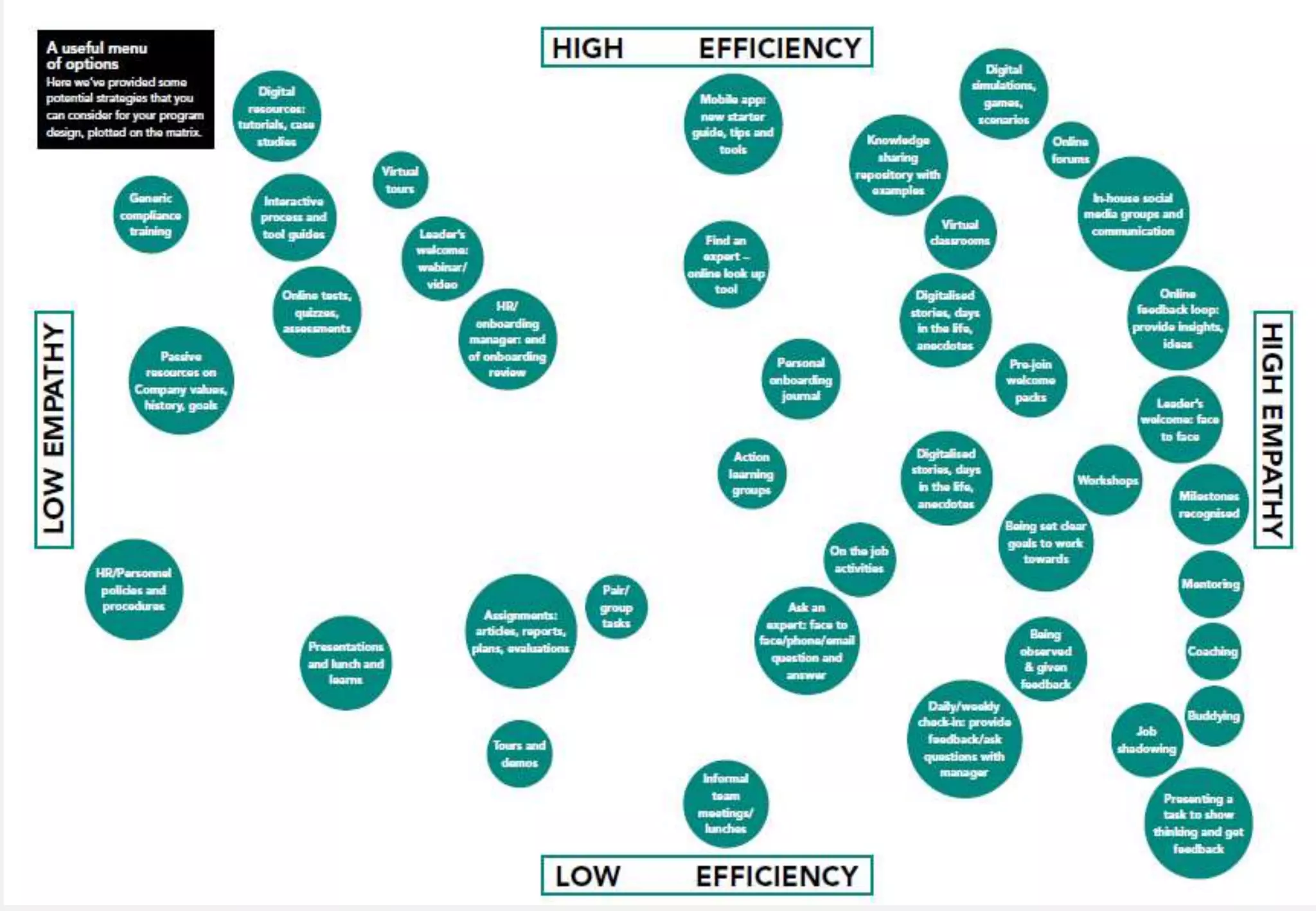
  • #21 Build a visual of the present Subject Delivery Mechanism Duration etc. Explore and learn about different delivery mechanisms Mentorship Elearning Face to face Build a visual of the future Examine the Persona’s/Learner Type – This is after all about creating a programme of high efficiency that meets the needs of the business and high empathy meeting the needs of the learner Now that we understand the subjects, delivery mechanisms and the audiences we are delivering too – we design the blended onboarding programme that meets the needs of the empathy, efficiency framework. We can create a personalised empathetic journey through Understanding the learner type of the learner In turn creating a high efficiency programme through Effective learning technology Appropriate offline activity A journey tailored to the way the learner likes to learn Creating a faster more effective uptake of knowledge through Learning your way A sense of belonging and being cared for Knowing what you need to know when you need to know So what might that look like?
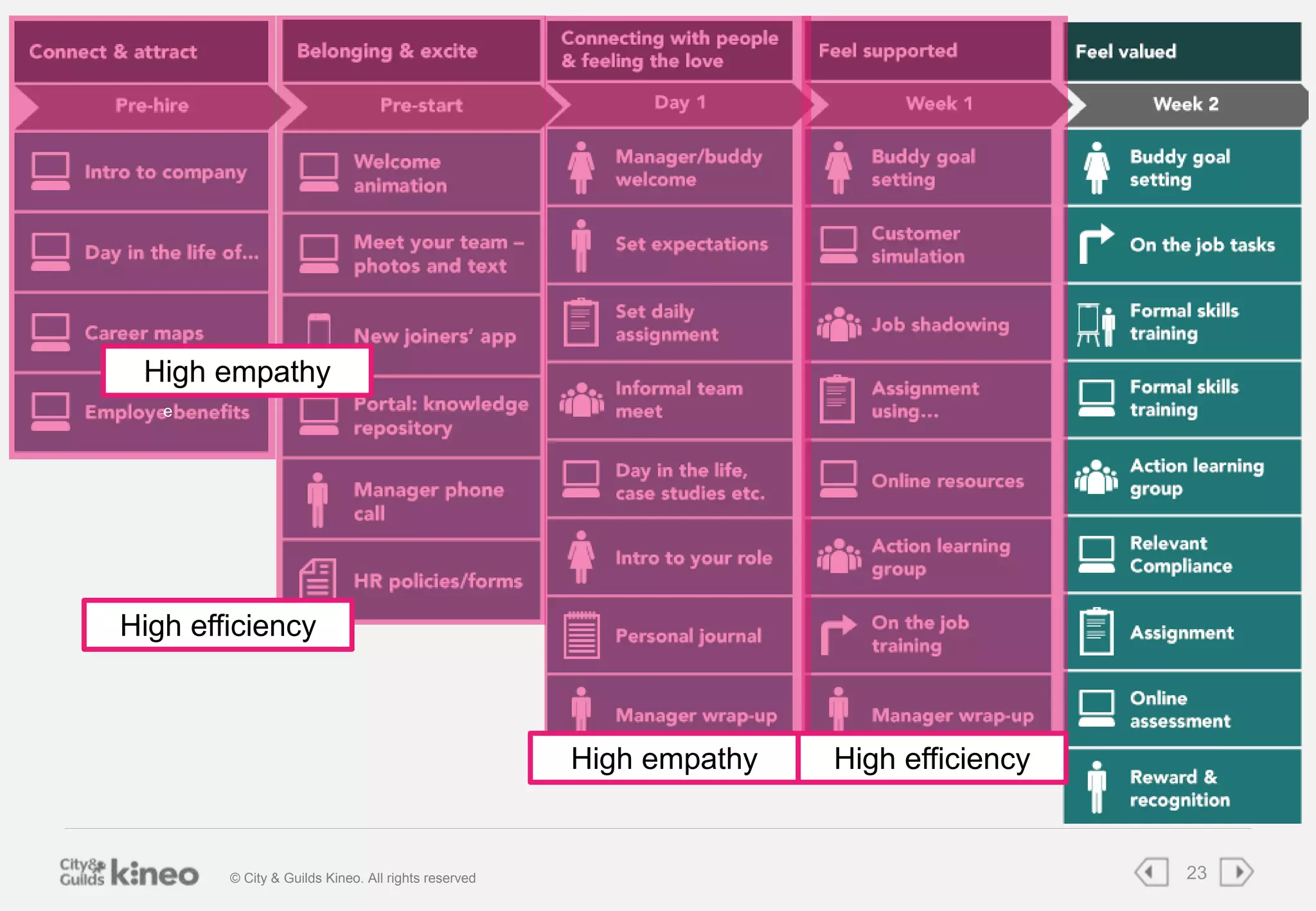
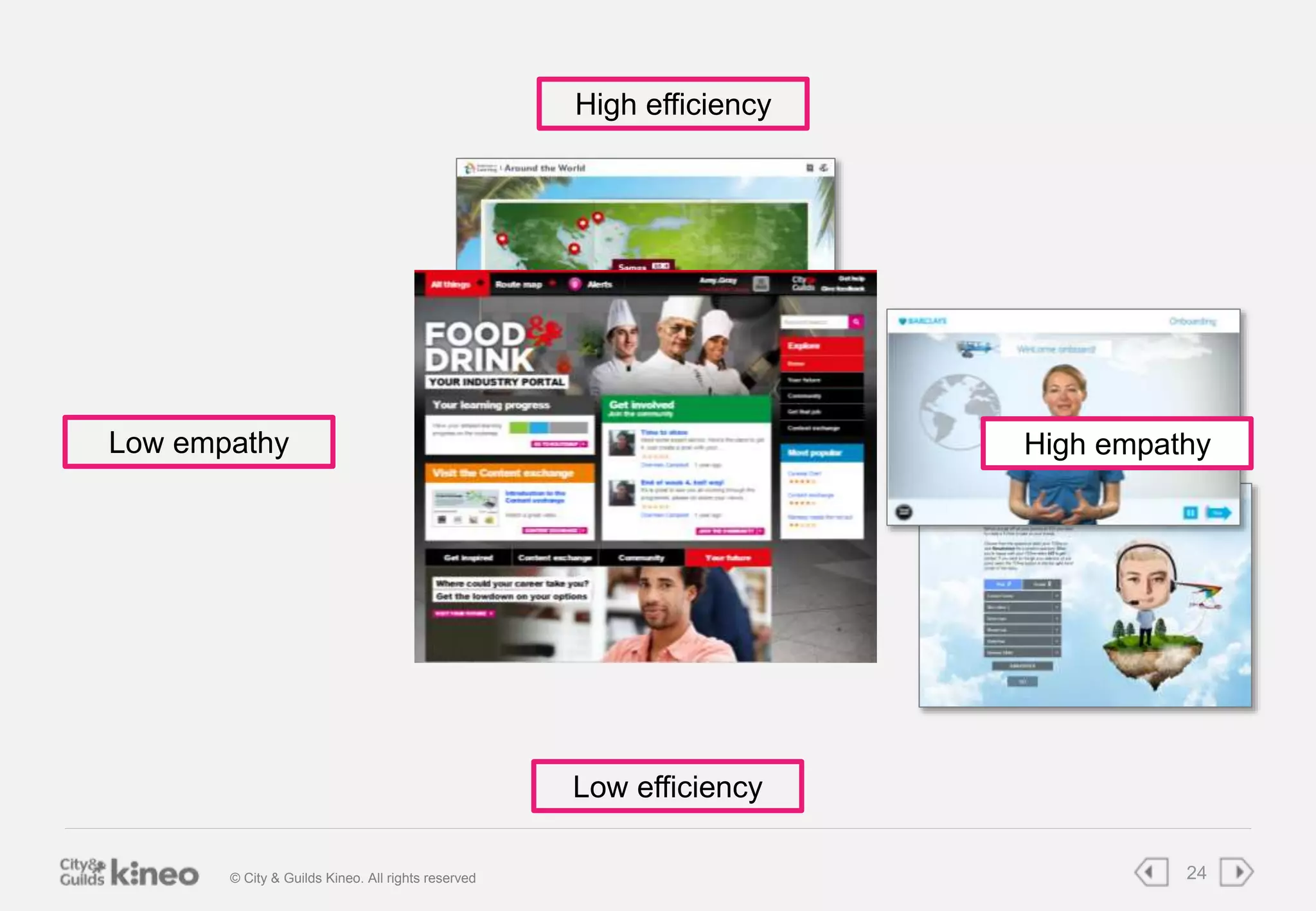
  • #24 We recognise that each onboarding blend needs to be different and you may need more than one to cater for roles and personas You blend will also be effected by Location Access to technology Work patterns and much more To help you visualise what this might look like we have created a sample blend from our blend design workshop You can see that this blend incorporates many of the components mentioned above from the insights as well as the onboarding guide. We start the blend with a high empathy approach, its all about validating the persons decision for joining your organisation, making them feel welcomed before day one, setting expectations, not overwhelming them and building the basics. As we start from day one, we introduce the importance of a buddy with a manager touch in at both ends of the day, as we start to move in to week one and two we start to see a more formal approach to the onboarding which starts to reduce the amount of high empathy learning and focuses on the efficiency learning needed by the employer, this becomes about getting you competent and effectively doing your job as quickly as possible, you are supported with day to day tasks, formal skills training is introduced, but retain some high empathy with continuation of the manager check in and off course reward and recognition. Over the next few slides we show you some customer examples.
  • #48 New way of continuous assessment – issuer, earn, display