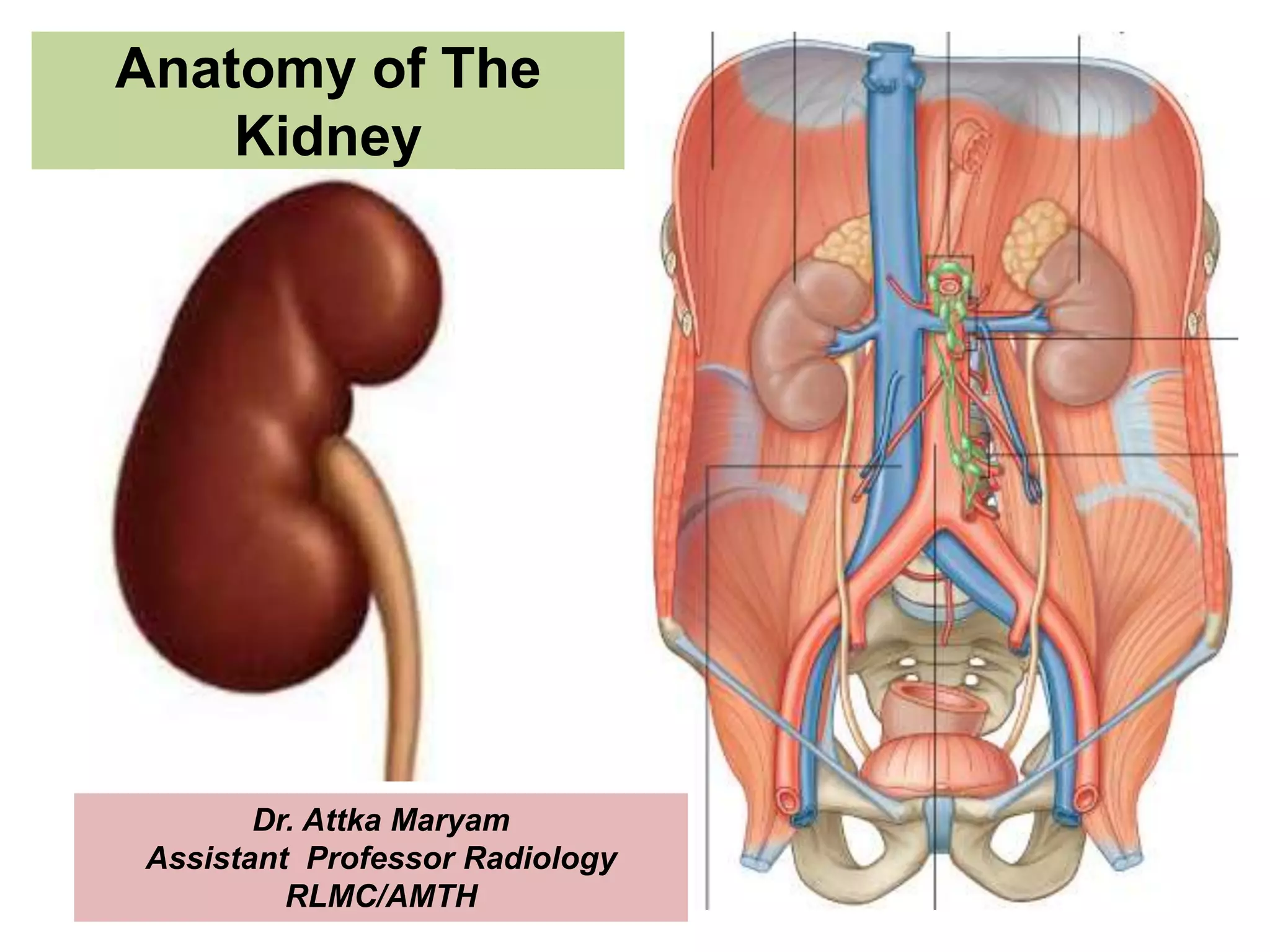
Anatomy of The
Kidney
Dr. Attka Maryam
Assistant Professor Radiology
RLMC/AMTH
By the end of the lecture, the student should be able to
describe the:
 Anatomical features of the kidneys:
position, extent, relations, hilum, peritoneal coverings.
 Internal structure of the kidneys:
Cortex, medulla and renal sinus.
 The vascular segments of the kidneys.
 The blood supply and lymphatics of the kidneys.
Objectives
• Kidneys are
retroperitoneal paired
organs.
• Each kidney lies , on
the posterior
abdominal wall, lateral
to the vertebral column
• In the supine position,
the kidneys extend
from approx T12 to L3.
Position of the kidneys
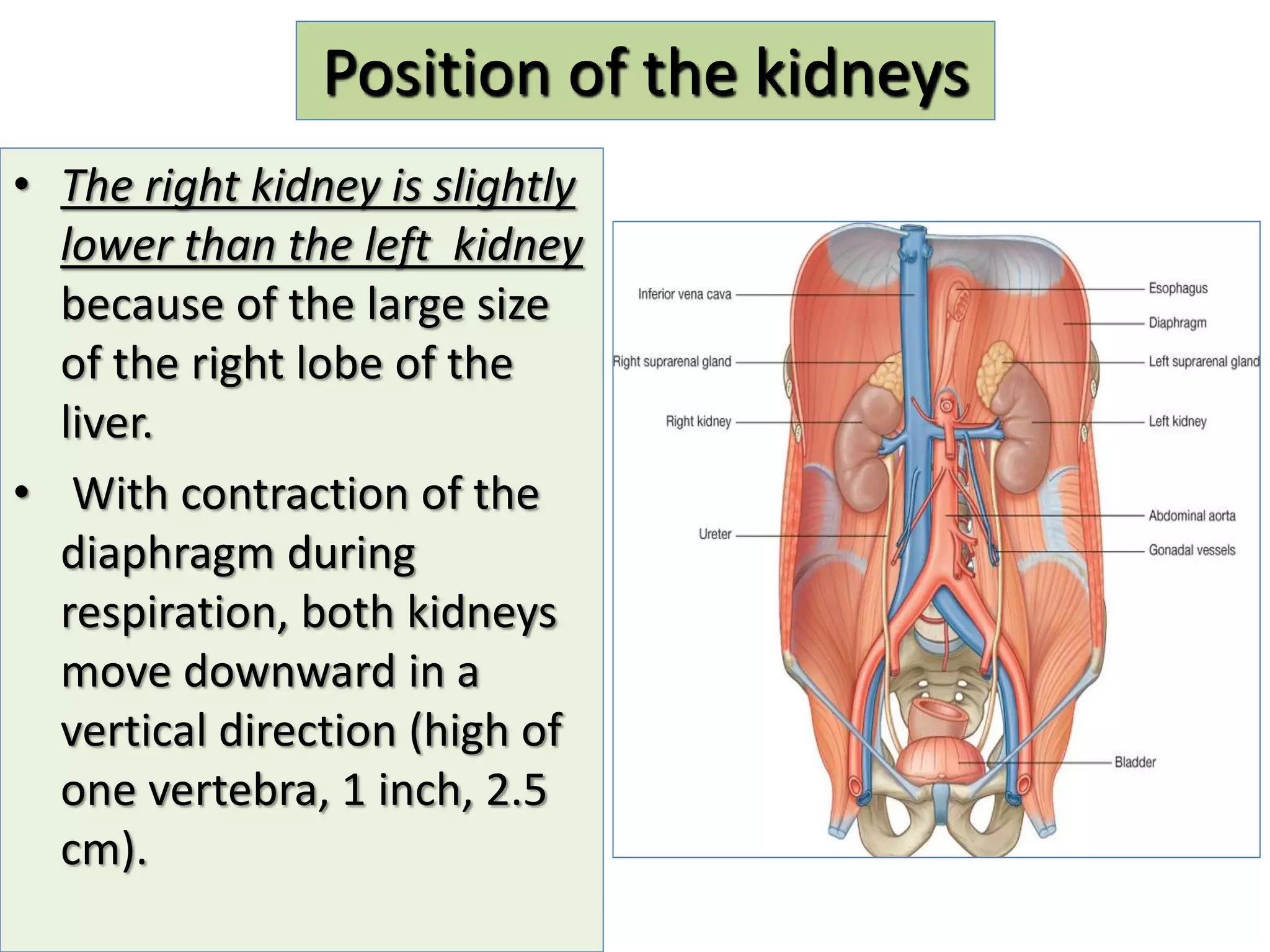
• The right kidney is slightly
lower than the left kidney
because of the large size
of the right lobe of the
liver.
• With contraction of the
diaphragm during
respiration, both kidneys
move downward in a
vertical direction (high of
one vertebra, 1 inch, 2.5
cm).
Position of the kidneys
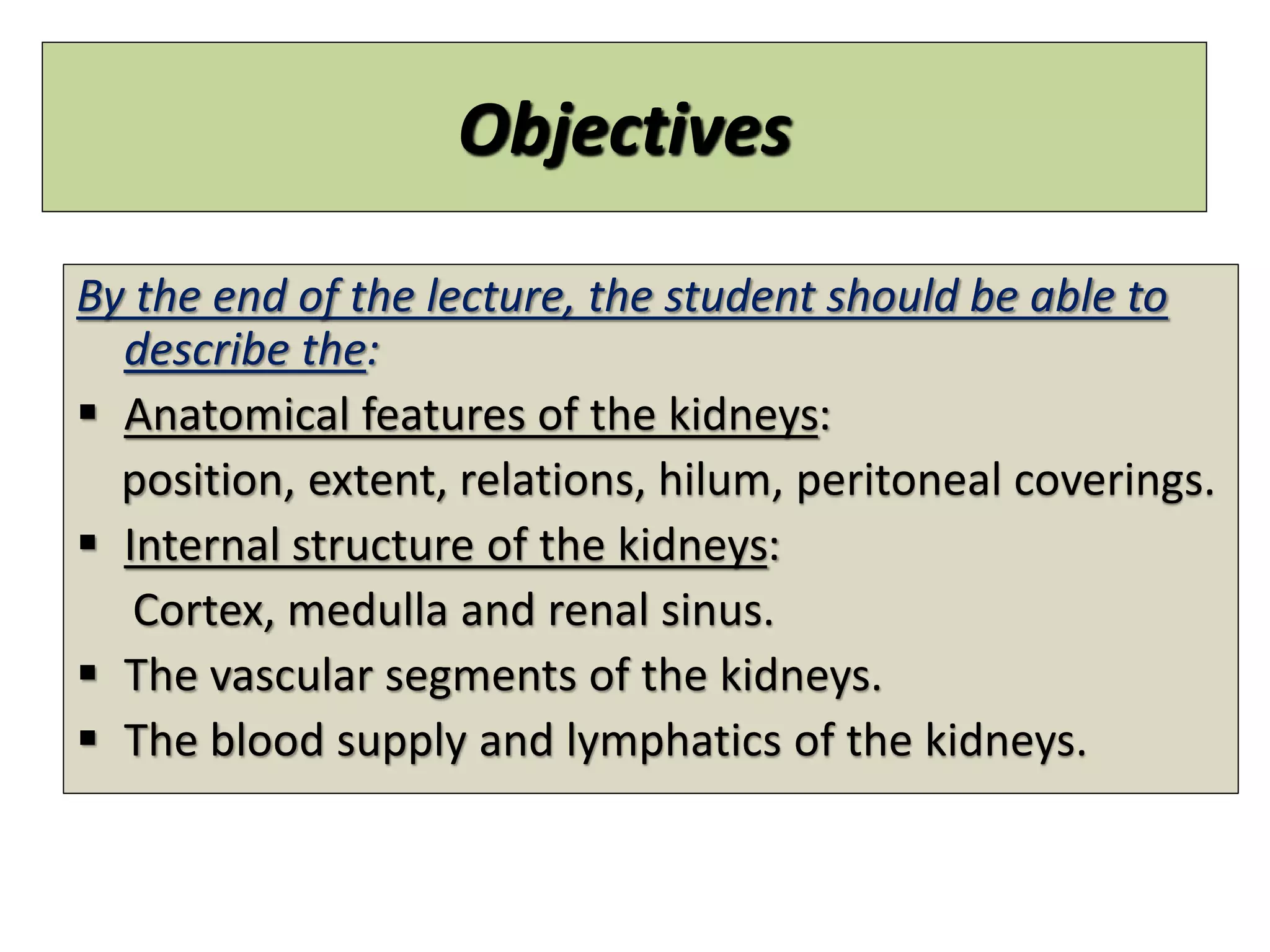
• The kidney is a reddish
brown, bean-shaped organ
with the dimensions 12 x 6
x 3cm.
• Although they are similar in
size and shape, the left
kidney is slightly longer and
more slender than the right
kidney, and nearer to the
midline.
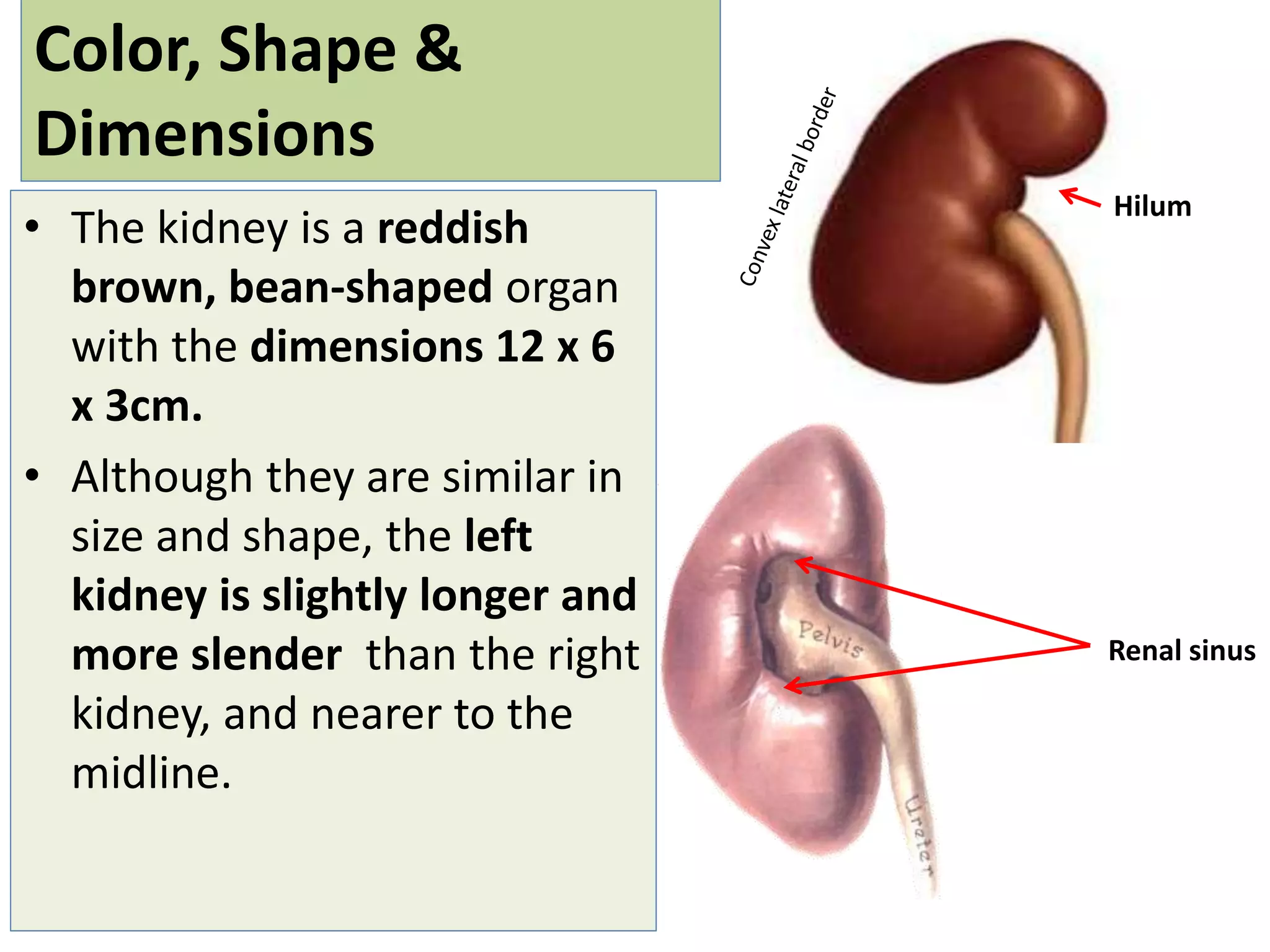
Hilum
Renal
sinus
Color, Shape &
Dimensions
Renal sinus
• Each kidneys has:
o Convex upper & lower
ends.
o Convex lateral border.
o Convex medial border at
both ends, but its middle
shows a vertical slit called
the hilum.
Internally the hilum extends
into a large cavity called the
renal sinus.
Hilum
Renal
sinus
Color, Shape &
Dimensions
Renal sinus
Hilum & Renal sinus
• The hilum transmits, from
anterior to posterior, the renal
vein, renal artery & the ureter
(VAU).
• Lymph vessels & sympathetic
fibers also pass through the
hilum.
• The renal sinus contains the
upper expanded part of the
ureter called the renal pelvis.
• Perinephric fat is continues
into the hilum and the sinus
and surrounds all these
structures.
V
A
U
Coverings
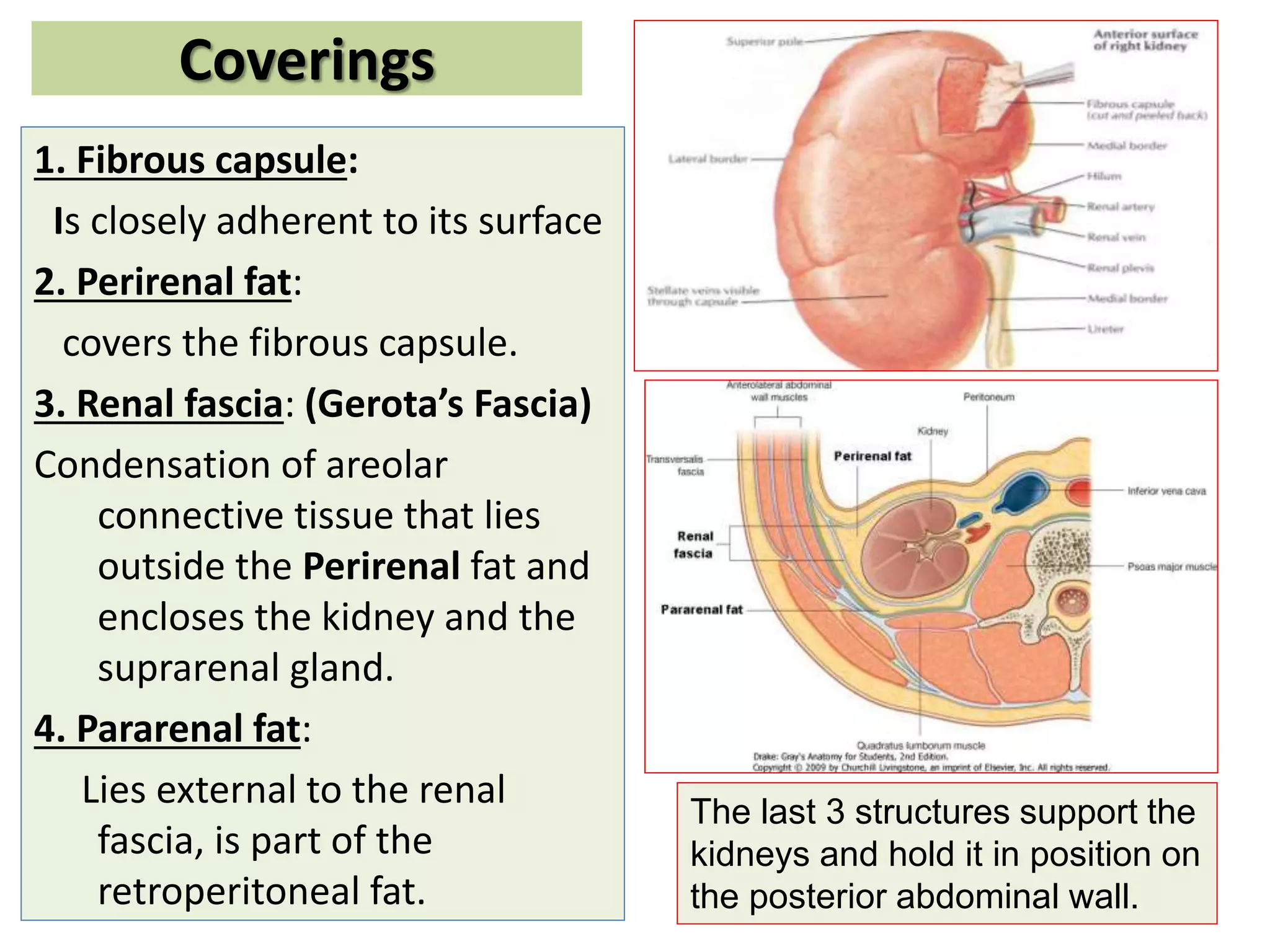
1. Fibrous capsule:
Is closely adherent to its surface
2. Perirenal fat:
covers the fibrous capsule.
3. Renal fascia: (Gerota’s Fascia)
Condensation of areolar
connective tissue that lies
outside the Perirenal fat and
encloses the kidney and the
suprarenal gland.
4. Pararenal fat:
Lies external to the renal
fascia, is part of the
retroperitoneal fat.
The last 3 structures support the
kidneys and hold it in position on
the posterior abdominal wall.
Relations
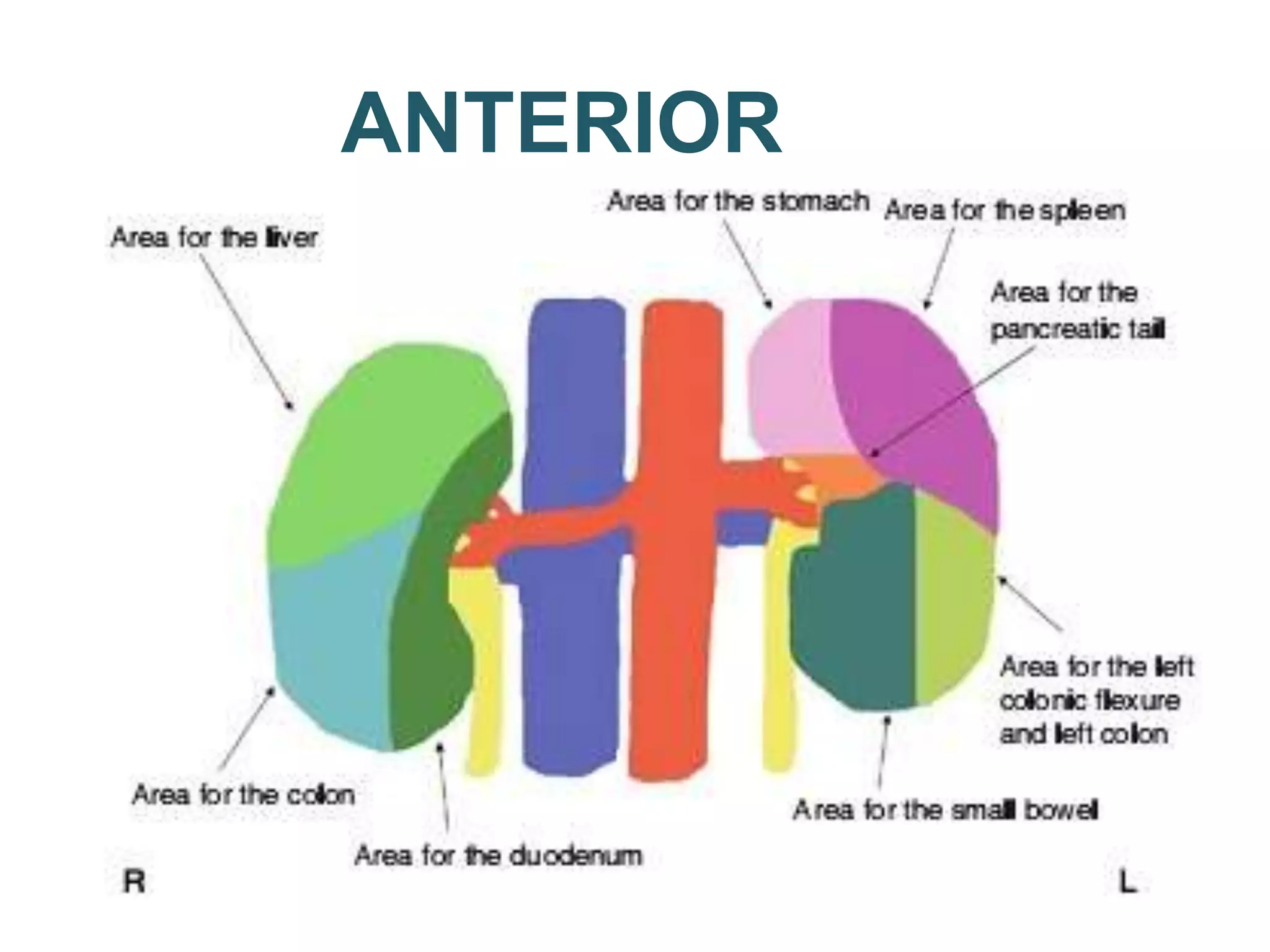
I- Anterior
The anterior
surface of both
kidneys are related
to numerous
structures, some
with an intervening
layer of peritoneum
and others lie
directly against the
kidney without
peritoneum.
Left kidney:
• A small part of the superior
pole, along the medial border
, is covered by left suprarenal
gland.
• The rest of the superior pole
is covered by the
intraperitoneal stomach and
spleen.
• The retroperitoneal pancreas
covers the middle part of the
kidney.
• Its lower lateral part is directly
related to the left colic
flexure and beginning of
descending colon.
• Its lower medial part is
covered by the
intraperitoneal jejunum.
Right kidney
• A small part of the upper
pole is covered by right
suprarenal gland.
• The rest of the upper part
of anterior surface is
related to the liver and is
separated by a layer of
peritoneum.
• The 2nd part of duodenum
lies directly in front of the
kidney close to its hilum.
• The lower lateral part is
directly related to the right
colic flexure and, on its
lower medial side, is related
to the intraperitoneal small
intestine.
ANTERIOR
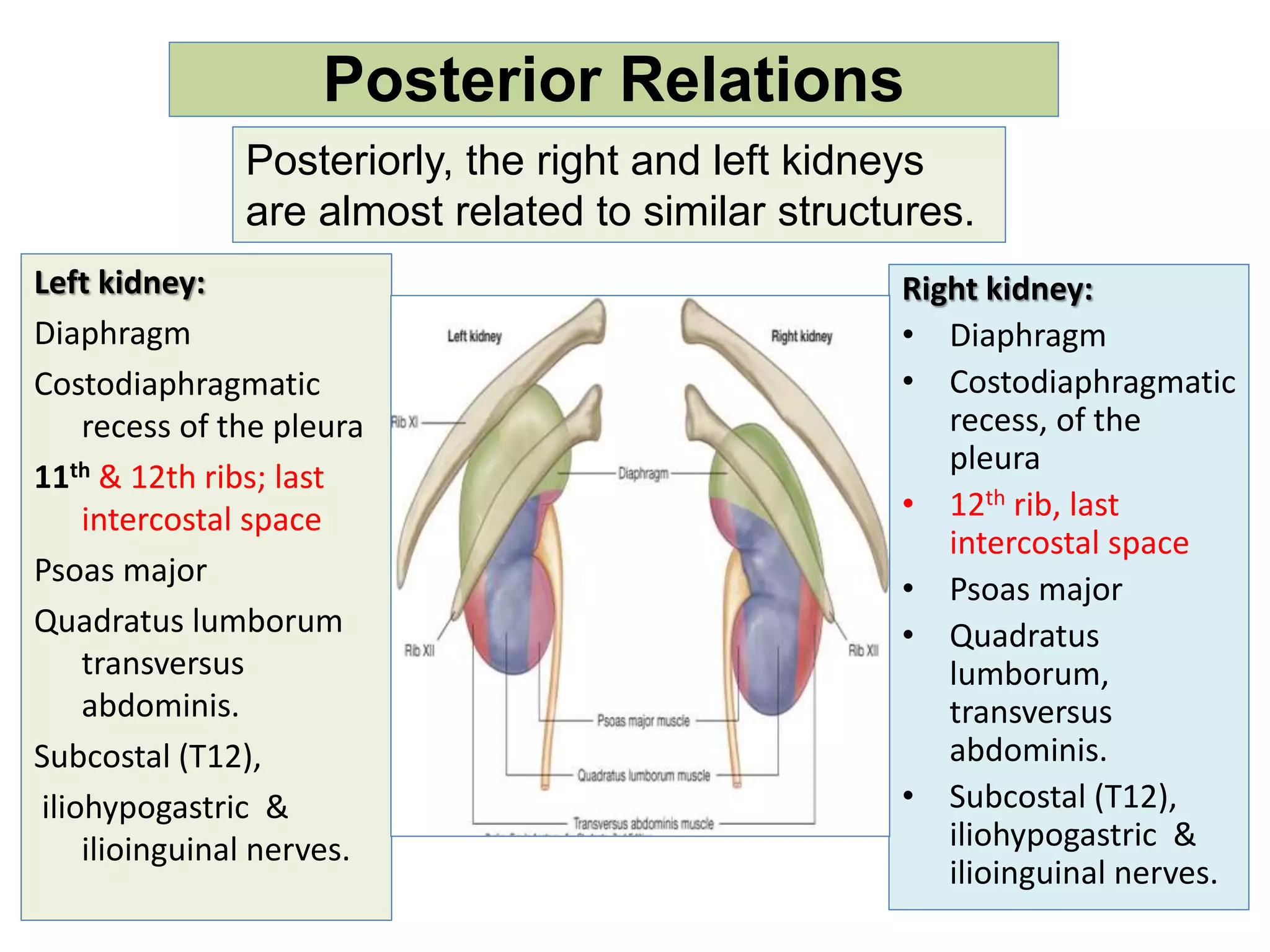
Right kidney:
• Diaphragm
• Costodiaphragmatic
recess, of the
pleura
• 12th rib, last
intercostal space
• Psoas major
• Quadratus
lumborum,
transversus
abdominis.
• Subcostal (T12),
iliohypogastric &
ilioinguinal nerves.
Left kidney:
Diaphragm
Costodiaphragmatic
recess of the pleura
11th & 12th ribs; last
intercostal space
Psoas major
Quadratus lumborum
transversus
abdominis.
Subcostal (T12),
iliohypogastric &
ilioinguinal nerves.
Posteriorly, the right and left kidneys
are almost related to similar structures.
Posterior Relations
Vertebrocostal & Renal Angles
• The angle between the
last rib and the lateral
border of erector spinae
muscle is occupied by
kidney and is called the
‘Renal angle’
• The Vertebrocostal
angle is occupied by the
lower part of the pleural
sac.
E
r
e
c
t
o
r
s
p
i
n
a
e
Renal angle
Vertebro-
costal angle
Internal structure
• Each kidney consists of an
outer renal cortex and an
inner renal medulla.
• The renal cortex is a
continuous band of pale tissue
that completely surrounds the
renal medulla.
• Extensions of the renal cortex,
the renal columns project into
the inner aspect of the kidney,
dividing the renal medulla into
discontinuous aggregations of
triangular-shaped tissue, the
renal pyramids.
Renal column Renal
pyramid
Medulla
Cortex
• The bases of the renal
pyramids are directed
outward, toward the cortex,
while the apex of each
renal pyramid projects
inward, toward the renal
sinus.
• The apical projection (renal
papilla) is surrounded by a
minor calyx
• In the renal sinus, several
minor calices unite to form
a major calyx, and two or
three major calices unite to
form the renal pelvis, which
is the funnel-shaped
superior end of the ureters.
Base Apex, Renal papilla
Minor
calyx
Major
calyx
Renal
pelvis
Arterial Supply
• The renal artery arises from the
aorta at the level of the second
lumbar vertebra.
• Each renal artery divides into 5
segmental arteries that enter the
hilum of the kidney, 4 in front of
the renal pelvis and one behind it.
• They are distributed to the
different segments of the kidney.
• Each segmental artery gives rise to
number of lobar arteries, each
supplies a renal pyramid.
• Before entering the renal
substance, each lobar artery gives
off two or three interlobar
arteries.
Segmental
arteries
Interlobar
arteries
Lobar
arteries
• The interlobar arteries
run toward the cortex
on each side of the
renal pyramid.
• At the junction of the
cortex and the medulla,
the Interlobar arteries
give off the arcuate
arteries, which arch
over the bases of the
pyramids.
• The arcuate arteries
give off several
interlobular arteries
that ascend in the
cortex and give off the
afferent glomerular
arterioles.
Arcuate arteries
Interlobular
arteries
Interlobar
arteries
Segmental branches &
vascular segments of kidneys
• Each kidney has 5
segmental branches
and is divided into 5
vascular segments:
1. Apical.
2. Caudal.
3. Anterior Superior.
4. Anterior Inferior.
5. Posterior.
1
5
2
3
4
5
4
3
2
1
Blood Supply
• Abdominal aorta
• Renal artery
• Segmental arteries
• lobar arteries
• Interlobar arteries
• Arcuate arteries
• Interlobular
arteries
• afferent glomerular
arterioles
• Inferior vena
cava
• Renal vein
• Interlobar veins
• Arcuate veins
• Interlobular
veins
Venous Drainage
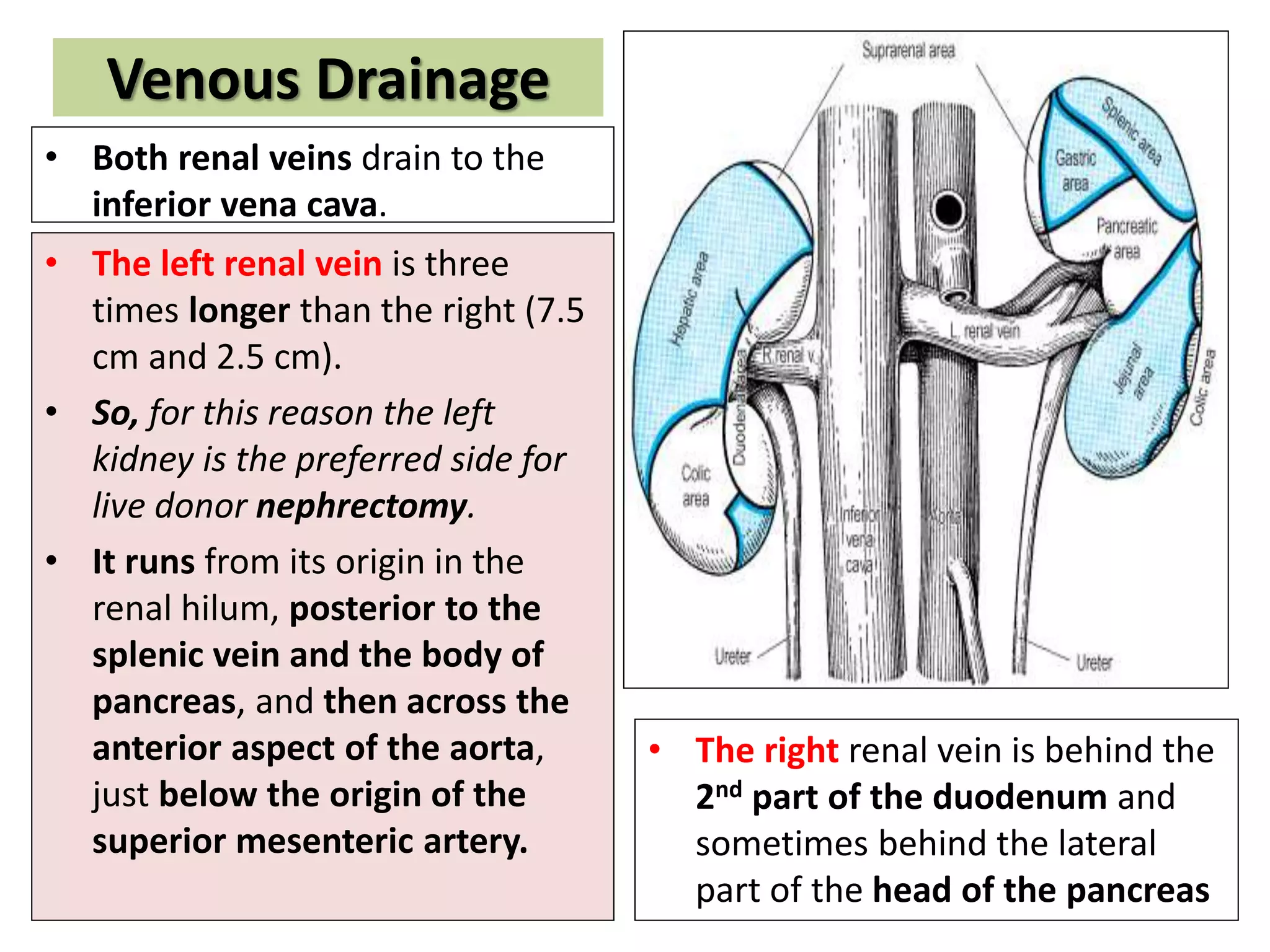
• Both renal veins drain to the
inferior vena cava.
• The right renal vein is behind the
2nd part of the duodenum and
sometimes behind the lateral
part of the head of the pancreas
• The left renal vein is three
times longer than the right (7.5
cm and 2.5 cm).
• So, for this reason the left
kidney is the preferred side for
live donor nephrectomy.
• It runs from its origin in the
renal hilum, posterior to the
splenic vein and the body of
pancreas, and then across the
anterior aspect of the aorta,
just below the origin of the
superior mesenteric artery.
Venous Drainage
• Both renal veins drain to the
inferior vena cava.
• The right renal vein is behind the 2nd
part of the duodenum and
sometimes behind the lateral part of
the head of the pancreas
• The left gonadal vein
enters it from below and
the left suprarenal vein,
usually receiving one of
the left inferior phrenic
veins, enters it above but
nearer the midline.
• The left renal vein enters
the inferior vena cava a
little above the right
vein.
Nerve Supply:
The nerve supply is the renal sympathetic plexus. The afferent
fibers that travel through the renal plexus enter the spinal cord in
the 10th, 11th, and 12th thoracic nerves.
Lymphatic
Drainage:
• The lymph
vessels follow
the arteries.
• Lymph drains to
the lateral aortic
lymph nodes
around the
origin of the
renal artery.
Supra- Renal Glands

01-Anatomy of Kidney.ppt

  • 1.
    Anatomy of The Kidney Dr.Attka Maryam Assistant Professor Radiology RLMC/AMTH
  • 2.
    By the endof the lecture, the student should be able to describe the:  Anatomical features of the kidneys: position, extent, relations, hilum, peritoneal coverings.  Internal structure of the kidneys: Cortex, medulla and renal sinus.  The vascular segments of the kidneys.  The blood supply and lymphatics of the kidneys. Objectives
  • 3.
    • Kidneys are retroperitonealpaired organs. • Each kidney lies , on the posterior abdominal wall, lateral to the vertebral column • In the supine position, the kidneys extend from approx T12 to L3. Position of the kidneys
  • 4.
    • The rightkidney is slightly lower than the left kidney because of the large size of the right lobe of the liver. • With contraction of the diaphragm during respiration, both kidneys move downward in a vertical direction (high of one vertebra, 1 inch, 2.5 cm). Position of the kidneys
  • 5.
    • The kidneyis a reddish brown, bean-shaped organ with the dimensions 12 x 6 x 3cm. • Although they are similar in size and shape, the left kidney is slightly longer and more slender than the right kidney, and nearer to the midline. Hilum Renal sinus Color, Shape & Dimensions Renal sinus
  • 6.
    • Each kidneyshas: o Convex upper & lower ends. o Convex lateral border. o Convex medial border at both ends, but its middle shows a vertical slit called the hilum. Internally the hilum extends into a large cavity called the renal sinus. Hilum Renal sinus Color, Shape & Dimensions Renal sinus
  • 7.
    Hilum & Renalsinus • The hilum transmits, from anterior to posterior, the renal vein, renal artery & the ureter (VAU). • Lymph vessels & sympathetic fibers also pass through the hilum. • The renal sinus contains the upper expanded part of the ureter called the renal pelvis. • Perinephric fat is continues into the hilum and the sinus and surrounds all these structures. V A U
  • 8.
    Coverings 1. Fibrous capsule: Isclosely adherent to its surface 2. Perirenal fat: covers the fibrous capsule. 3. Renal fascia: (Gerota’s Fascia) Condensation of areolar connective tissue that lies outside the Perirenal fat and encloses the kidney and the suprarenal gland. 4. Pararenal fat: Lies external to the renal fascia, is part of the retroperitoneal fat. The last 3 structures support the kidneys and hold it in position on the posterior abdominal wall.
  • 9.
    Relations I- Anterior The anterior surfaceof both kidneys are related to numerous structures, some with an intervening layer of peritoneum and others lie directly against the kidney without peritoneum.
  • 10.
    Left kidney: • Asmall part of the superior pole, along the medial border , is covered by left suprarenal gland. • The rest of the superior pole is covered by the intraperitoneal stomach and spleen. • The retroperitoneal pancreas covers the middle part of the kidney. • Its lower lateral part is directly related to the left colic flexure and beginning of descending colon. • Its lower medial part is covered by the intraperitoneal jejunum.
  • 11.
    Right kidney • Asmall part of the upper pole is covered by right suprarenal gland. • The rest of the upper part of anterior surface is related to the liver and is separated by a layer of peritoneum. • The 2nd part of duodenum lies directly in front of the kidney close to its hilum. • The lower lateral part is directly related to the right colic flexure and, on its lower medial side, is related to the intraperitoneal small intestine.
  • 12.
  • 13.
    Right kidney: • Diaphragm •Costodiaphragmatic recess, of the pleura • 12th rib, last intercostal space • Psoas major • Quadratus lumborum, transversus abdominis. • Subcostal (T12), iliohypogastric & ilioinguinal nerves. Left kidney: Diaphragm Costodiaphragmatic recess of the pleura 11th & 12th ribs; last intercostal space Psoas major Quadratus lumborum transversus abdominis. Subcostal (T12), iliohypogastric & ilioinguinal nerves. Posteriorly, the right and left kidneys are almost related to similar structures. Posterior Relations
  • 14.
    Vertebrocostal & RenalAngles • The angle between the last rib and the lateral border of erector spinae muscle is occupied by kidney and is called the ‘Renal angle’ • The Vertebrocostal angle is occupied by the lower part of the pleural sac. E r e c t o r s p i n a e Renal angle Vertebro- costal angle
  • 15.
    Internal structure • Eachkidney consists of an outer renal cortex and an inner renal medulla. • The renal cortex is a continuous band of pale tissue that completely surrounds the renal medulla. • Extensions of the renal cortex, the renal columns project into the inner aspect of the kidney, dividing the renal medulla into discontinuous aggregations of triangular-shaped tissue, the renal pyramids. Renal column Renal pyramid Medulla Cortex
  • 16.
    • The basesof the renal pyramids are directed outward, toward the cortex, while the apex of each renal pyramid projects inward, toward the renal sinus. • The apical projection (renal papilla) is surrounded by a minor calyx • In the renal sinus, several minor calices unite to form a major calyx, and two or three major calices unite to form the renal pelvis, which is the funnel-shaped superior end of the ureters. Base Apex, Renal papilla Minor calyx Major calyx Renal pelvis
  • 18.
    Arterial Supply • Therenal artery arises from the aorta at the level of the second lumbar vertebra. • Each renal artery divides into 5 segmental arteries that enter the hilum of the kidney, 4 in front of the renal pelvis and one behind it. • They are distributed to the different segments of the kidney. • Each segmental artery gives rise to number of lobar arteries, each supplies a renal pyramid. • Before entering the renal substance, each lobar artery gives off two or three interlobar arteries. Segmental arteries Interlobar arteries Lobar arteries
  • 19.
    • The interlobararteries run toward the cortex on each side of the renal pyramid. • At the junction of the cortex and the medulla, the Interlobar arteries give off the arcuate arteries, which arch over the bases of the pyramids. • The arcuate arteries give off several interlobular arteries that ascend in the cortex and give off the afferent glomerular arterioles. Arcuate arteries Interlobular arteries Interlobar arteries
  • 20.
    Segmental branches & vascularsegments of kidneys • Each kidney has 5 segmental branches and is divided into 5 vascular segments: 1. Apical. 2. Caudal. 3. Anterior Superior. 4. Anterior Inferior. 5. Posterior. 1 5 2 3 4 5 4 3 2 1
  • 21.
    Blood Supply • Abdominalaorta • Renal artery • Segmental arteries • lobar arteries • Interlobar arteries • Arcuate arteries • Interlobular arteries • afferent glomerular arterioles • Inferior vena cava • Renal vein • Interlobar veins • Arcuate veins • Interlobular veins
  • 22.
    Venous Drainage • Bothrenal veins drain to the inferior vena cava. • The right renal vein is behind the 2nd part of the duodenum and sometimes behind the lateral part of the head of the pancreas • The left renal vein is three times longer than the right (7.5 cm and 2.5 cm). • So, for this reason the left kidney is the preferred side for live donor nephrectomy. • It runs from its origin in the renal hilum, posterior to the splenic vein and the body of pancreas, and then across the anterior aspect of the aorta, just below the origin of the superior mesenteric artery.
  • 23.
    Venous Drainage • Bothrenal veins drain to the inferior vena cava. • The right renal vein is behind the 2nd part of the duodenum and sometimes behind the lateral part of the head of the pancreas • The left gonadal vein enters it from below and the left suprarenal vein, usually receiving one of the left inferior phrenic veins, enters it above but nearer the midline. • The left renal vein enters the inferior vena cava a little above the right vein.
  • 24.
    Nerve Supply: The nervesupply is the renal sympathetic plexus. The afferent fibers that travel through the renal plexus enter the spinal cord in the 10th, 11th, and 12th thoracic nerves. Lymphatic Drainage: • The lymph vessels follow the arteries. • Lymph drains to the lateral aortic lymph nodes around the origin of the renal artery.
  • 26.