1 v1.0
1
DDoS Attack Prevention
KHNOG 3
Jamie Gillespie, APNIC
2 v1.0
2
Overview
• What is a DDoS?
• DDoS threats and trends
• How does a DDoS work?
• Details on reflection and amplification techniques
• Mitigation strategies for inbound DDoS
• Mitigation strategies for outbound DDoS
3 v1.0
3
What is DoS and DDoS?
• In general, a denial of service is an attack against availability
of a service
❑ A service can be a network, or a specific service such as a web site
• DoS - Denial of Service
❑ Usually from only one source
❑ Can be caused by resource exhaustion, or targeted exploitation
• DDoS - Distributed Denial of Service
❑ Attack originates from multiple sources
❑ This is caused through resource exhaustion
4 v1.0
4
Impacts of a DDoS
• Users sees DDoS as an outage
• Security team sees DDoS as a loss of availability
❑ Think back to CIA triad
Confidentiality, Integrity, Availability
• Business management, sees DDoS as impacting the business
financially
❑ Especially if the business makes money using the Internet
▪ ISP, credit card gateway, online casino, online gaming
• What is the cost per hour of your network or services being
unavailable? (not including reputation damage)
5 v1.0
5
DoS and DDoS by Traffic
• DDoS traffic is largely grouped into these categories:
❑ Bandwidth exhaustion
▪ If the attacker has access to more bandwidth than the victim, then the attacker
can send any traffic to flood the victim’s network connection, denying
legitimate access to all services on the network
❑ Connection exhaustion
▪ If the victim’s services have a limited number of concurrent sessions/
connections, then the attacker can open more sessions faster than the victim
can expire/close the sessions, denying legitimate access to the service. A
similar attack uses a high number of packets per second against routers and
other networking equipment, exhausting their routing processors.
❑ Targeted exploitation
▪ Usually executed as a single source DoS, these attacks exploit a weakness in
the OS, application, or physical components to crash, reboot, or otherwise
deny access to a service
6 v1.0
6
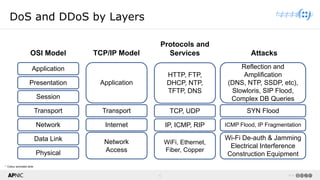
DoS and DDoS by Layers
Network
Access
Application
Transport
Internet
Application
Presentation
Session
Transport
Network
Data Link
Physical
WiFi, Ethernet,
Fiber, Copper
HTTP, FTP,
DHCP, NTP,
TFTP, DNS
TCP, UDP
IP, ICMP, RIP
SYN Flood
ICMP Flood, IP Fragmentation
Wi-Fi De-auth & Jamming
Electrical Interference
Construction Equipment
Reflection and
Amplification
(DNS, NTP, SSDP, etc),
Slowloris, SIP Flood,
Complex DB Queries
TCP/IP Model
OSI Model
Protocols and
Services Attacks
* Colour animated slide
7 v1.0
7
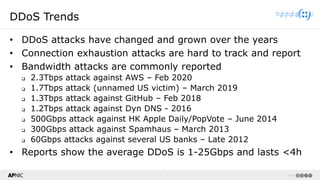
DDoS Trends
• DDoS attacks have changed and grown over the years
• Connection exhaustion attacks are hard to track and report
• Bandwidth attacks are commonly reported
❑ 2.3Tbps attack against AWS – Feb 2020
❑ 1.7Tbps attack (unnamed US victim) – March 2019
❑ 1.3Tbps attack against GitHub – Feb 2018
❑ 1.2Tbps attack against Dyn DNS - 2016
❑ 500Gbps attack against HK Apple Daily/PopVote – June 2014
❑ 300Gbps attack against Spamhaus – March 2013
❑ 60Gbps attacks against several US banks – Late 2012
• Reports show the average DDoS is 1-25Gbps and lasts <4h
8 v1.0
8
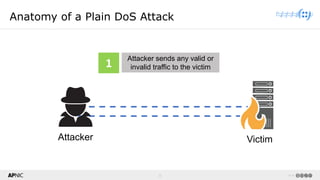
Anatomy of a Plain DoS Attack
Attacker Victim
Attacker sends any valid or
invalid traffic to the victim
1
9 v1.0
9
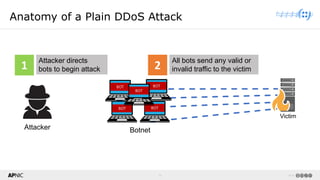
Anatomy of a Plain DDoS Attack
Botnet
Attacker
Victim
Attacker directs
bots to begin attack
1
All bots send any valid or
invalid traffic to the victim
2
BOT
BOT BOT
BOT
BOT
10 v1.0
10
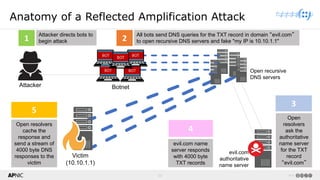
Anatomy of a Reflected Amplification Attack
Open recursive
DNS servers
Botnet
Attacker directs bots to
begin attack
1
All bots send DNS queries for the TXT record in domain “evil.com”
to open recursive DNS servers and fake "my IP is 10.10.1.1"
2
Open
resolvers
ask the
authoritative
name server
for the TXT
record
“evil.com”
3
4
evil.com name
server responds
with 4000 byte
TXT records
Open resolvers
cache the
response and
send a stream of
4000 byte DNS
responses to the
victim
5
Victim
(10.10.1.1)
BOT
BOT BOT
BOT
evil.com
authoritative
name server
Attacker
BOT
14 v1.0
14
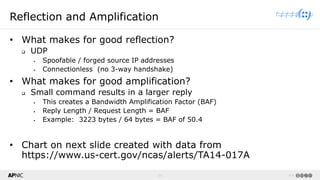
Reflection and Amplification
• What makes for good reflection?
❑ UDP
▪ Spoofable / forged source IP addresses
▪ Connectionless (no 3-way handshake)
• What makes for good amplification?
❑ Small command results in a larger reply
▪ This creates a Bandwidth Amplification Factor (BAF)
▪ Reply Length / Request Length = BAF
▪ Example: 3223 bytes / 64 bytes = BAF of 50.4
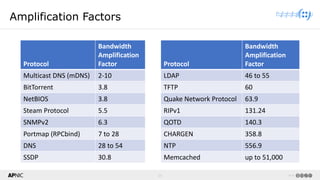
• Chart on next slide created with data from
https://www.us-cert.gov/ncas/alerts/TA14-017A
15 v1.0
15
Protocol
Bandwidth
Amplification
Factor
LDAP 46 to 55
TFTP 60
Quake Network Protocol 63.9
RIPv1 131.24
QOTD 140.3
CHARGEN 358.8
NTP 556.9
Amplification Factors
Protocol
Bandwidth
Amplification
Factor
Multicast DNS (mDNS) 2-10
BitTorrent 3.8
NetBIOS 3.8
Steam Protocol 5.5
SNMPv2 6.3
Portmap (RPCbind) 7 to 28
DNS 28 to 54
SSDP 30.8
Protocol
Bandwidth
Amplification
Factor
LDAP 46 to 55
TFTP 60
Quake Network Protocol 63.9
RIPv1 131.24
QOTD 140.3
CHARGEN 358.8
NTP 556.9
Memcached up to 51,000
16 v1.0
16
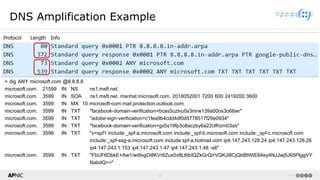
DNS Amplification Example
> dig ANY microsoft.com @8.8.8.8
microsoft.com. 21599 IN NS ns1.msft.net.
microsoft.com. 3599 IN SOA ns1.msft.net. msnhst.microsoft.com. 2018052001 7200 600 2419200 3600
microsoft.com. 3599 IN MX 10 microsoft-com.mail.protection.outlook.com.
microsoft.com. 3599 IN TXT "facebook-domain-verification=bcas5uzlvu0s3mrw139a00os3o66wr"
microsoft.com. 3599 IN TXT "adobe-sign-verification=c1fea9b4cdd4df0d5778517f29e0934"
microsoft.com. 3599 IN TXT "facebook-domain-verification=gx5s19fp3o8aczby6a22clfhzm03as"
microsoft.com. 3599 IN TXT "v=spf1 include:_spf-a.microsoft.com include:_spf-b.microsoft.com include:_spf-c.microsoft.com
include:_spf-ssg-a.microsoft.com include:spf-a.hotmail.com ip4:147.243.128.24 ip4:147.243.128.26
ip4:147.243.1.153 ip4:147.243.1.47 ip4:147.243.1.48 -all"
microsoft.com. 3599 IN TXT "FbUF6DbkE+Aw1/wi9xgDi8KVrIIZus5v8L6tbIQZkGrQ/rVQKJi8CjQbBtWtE64ey4NJJwj5J65PIggVY
NabdQ=="
17 v1.0
17
Mitigation Strategies – Connection Exhaustion
• Protecting your services from connection exhaustion attacks
• Configure OS level TCP/IP stack settings
❑ Enable tcp_tw_reuse (Linux)
❑ Decrease TcpTimedWaitDelay (Windows)
❑ Enable SYN cookies (default on newer OSs)
• Configure service applications
❑ Web servers can mitigate against Slowloris style attacks by using an
event based MPM in Apache, or using nginx either as the web server
or as a reverse proxy in front
18 v1.0
18
Mitigation Strategies – Connection Exhaustion
• Implement an IPS and/or DDoS filtering on your NGFW
❑ Even if your firewall doesn’t provide DDoS protection, some IPS
services will block some types of DDoS attacks
• Implement load balancing with additional servers
❑ Better yet, configure auto-scaling on your servers/cloud/containers
• For web servers, implement a WAF at the network or server
❑ Web Application Firewalls can block malicious traffic and provide rate
limiting at the application layer
❑ ModSecurity is a free WAF that can be embedded on web servers or
installed as a reverse proxy
19 v1.0
19
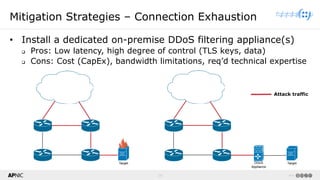
Mitigation Strategies – Connection Exhaustion
• Install a dedicated on-premise DDoS filtering appliance(s)
❑ Pros: Low latency, high degree of control (TLS keys, data)
❑ Cons: Cost (CapEx), bandwidth limitations, req’d technical expertise
Attack traffic
20 v1.0
20
Mitigation Strategies – Bandwidth Exhaustion
• Protecting your network from bandwidth exhaustion attacks
• Pro-active rate limiting
❑ Rate limit non-initial fragments, but exclude your recursive DNS
❑ Rate limit traffic from commonly abused or unwanted ports
• Reactive rate limiting
❑ During an attack, rate limit traffic from less-critical network locations
21 v1.0
21
Mitigation Strategies – Bandwidth Exhaustion
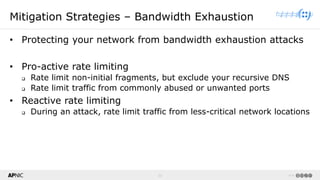
• Remote Triggered Black Hole (RTBH) filtering
❑ Locally only
Attack traffic
22 v1.0
22
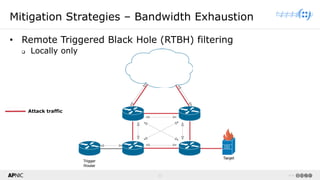
Mitigation Strategies – Bandwidth Exhaustion
• Remote Triggered Black Hole (RTBH) filtering
❑ Locally only
Attack traffic
Signalling
23 v1.0
23
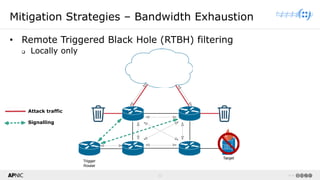
Mitigation Strategies – Bandwidth Exhaustion
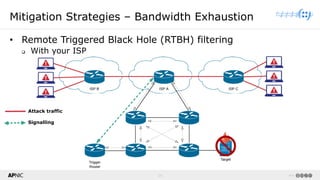
• Remote Triggered Black Hole (RTBH) filtering
❑ With your ISP
Attack traffic
Signalling
24 v1.0
24
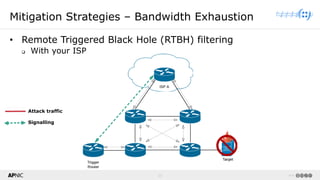
Mitigation Strategies – Bandwidth Exhaustion
• Remote Triggered Black Hole (RTBH) filtering
❑ With your ISP
Attack traffic
Signalling
25 v1.0
25
Mitigation Strategies – Bandwidth Exhaustion
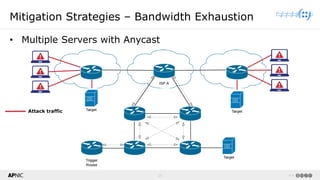
• Multiple Servers with Anycast
Attack traffic
26 v1.0
26
Mitigation Strategies – Bandwidth Exhaustion
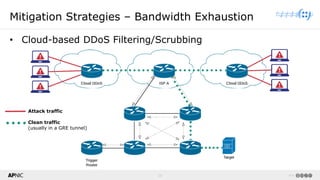
• Cloud-based DDoS Filtering/Scrubbing
Attack traffic
Clean traffic
(usually in a GRE tunnel)
27 v1.0
27
Mitigation Strategies
• Protecting your services from attacking others
• Rate limiting outbound connections
• Outbound filtering on source address validation
❑ BCP38
❑ Anti-spoofing filtering is also an important part of MANRS, which
is part of a larger routing security initiative - www.manrs.org
• Securely configure your DNS, NTP, SNMP, Memcached servers
• No open resolvers!
❑ Only allow your own and authorised IP addresses to connect
28
28 v1.0

KHNOG 3: DDoS Attack Prevention

  • 1.
    1 v1.0 1 DDoS AttackPrevention KHNOG 3 Jamie Gillespie, APNIC
  • 2.
    2 v1.0 2 Overview • Whatis a DDoS? • DDoS threats and trends • How does a DDoS work? • Details on reflection and amplification techniques • Mitigation strategies for inbound DDoS • Mitigation strategies for outbound DDoS
  • 3.
    3 v1.0 3 What isDoS and DDoS? • In general, a denial of service is an attack against availability of a service ❑ A service can be a network, or a specific service such as a web site • DoS - Denial of Service ❑ Usually from only one source ❑ Can be caused by resource exhaustion, or targeted exploitation • DDoS - Distributed Denial of Service ❑ Attack originates from multiple sources ❑ This is caused through resource exhaustion
  • 4.
    4 v1.0 4 Impacts ofa DDoS • Users sees DDoS as an outage • Security team sees DDoS as a loss of availability ❑ Think back to CIA triad Confidentiality, Integrity, Availability • Business management, sees DDoS as impacting the business financially ❑ Especially if the business makes money using the Internet ▪ ISP, credit card gateway, online casino, online gaming • What is the cost per hour of your network or services being unavailable? (not including reputation damage)
  • 5.
    5 v1.0 5 DoS andDDoS by Traffic • DDoS traffic is largely grouped into these categories: ❑ Bandwidth exhaustion ▪ If the attacker has access to more bandwidth than the victim, then the attacker can send any traffic to flood the victim’s network connection, denying legitimate access to all services on the network ❑ Connection exhaustion ▪ If the victim’s services have a limited number of concurrent sessions/ connections, then the attacker can open more sessions faster than the victim can expire/close the sessions, denying legitimate access to the service. A similar attack uses a high number of packets per second against routers and other networking equipment, exhausting their routing processors. ❑ Targeted exploitation ▪ Usually executed as a single source DoS, these attacks exploit a weakness in the OS, application, or physical components to crash, reboot, or otherwise deny access to a service
  • 6.
    6 v1.0 6 DoS andDDoS by Layers Network Access Application Transport Internet Application Presentation Session Transport Network Data Link Physical WiFi, Ethernet, Fiber, Copper HTTP, FTP, DHCP, NTP, TFTP, DNS TCP, UDP IP, ICMP, RIP SYN Flood ICMP Flood, IP Fragmentation Wi-Fi De-auth & Jamming Electrical Interference Construction Equipment Reflection and Amplification (DNS, NTP, SSDP, etc), Slowloris, SIP Flood, Complex DB Queries TCP/IP Model OSI Model Protocols and Services Attacks * Colour animated slide
  • 7.
    7 v1.0 7 DDoS Trends •DDoS attacks have changed and grown over the years • Connection exhaustion attacks are hard to track and report • Bandwidth attacks are commonly reported ❑ 2.3Tbps attack against AWS – Feb 2020 ❑ 1.7Tbps attack (unnamed US victim) – March 2019 ❑ 1.3Tbps attack against GitHub – Feb 2018 ❑ 1.2Tbps attack against Dyn DNS - 2016 ❑ 500Gbps attack against HK Apple Daily/PopVote – June 2014 ❑ 300Gbps attack against Spamhaus – March 2013 ❑ 60Gbps attacks against several US banks – Late 2012 • Reports show the average DDoS is 1-25Gbps and lasts <4h
  • 8.
    8 v1.0 8 Anatomy ofa Plain DoS Attack Attacker Victim Attacker sends any valid or invalid traffic to the victim 1
  • 9.
    9 v1.0 9 Anatomy ofa Plain DDoS Attack Botnet Attacker Victim Attacker directs bots to begin attack 1 All bots send any valid or invalid traffic to the victim 2 BOT BOT BOT BOT BOT
  • 10.
    10 v1.0 10 Anatomy ofa Reflected Amplification Attack Open recursive DNS servers Botnet Attacker directs bots to begin attack 1 All bots send DNS queries for the TXT record in domain “evil.com” to open recursive DNS servers and fake "my IP is 10.10.1.1" 2 Open resolvers ask the authoritative name server for the TXT record “evil.com” 3 4 evil.com name server responds with 4000 byte TXT records Open resolvers cache the response and send a stream of 4000 byte DNS responses to the victim 5 Victim (10.10.1.1) BOT BOT BOT BOT evil.com authoritative name server Attacker BOT
  • 11.
    14 v1.0 14 Reflection andAmplification • What makes for good reflection? ❑ UDP ▪ Spoofable / forged source IP addresses ▪ Connectionless (no 3-way handshake) • What makes for good amplification? ❑ Small command results in a larger reply ▪ This creates a Bandwidth Amplification Factor (BAF) ▪ Reply Length / Request Length = BAF ▪ Example: 3223 bytes / 64 bytes = BAF of 50.4 • Chart on next slide created with data from https://www.us-cert.gov/ncas/alerts/TA14-017A
  • 12.
    15 v1.0 15 Protocol Bandwidth Amplification Factor LDAP 46to 55 TFTP 60 Quake Network Protocol 63.9 RIPv1 131.24 QOTD 140.3 CHARGEN 358.8 NTP 556.9 Amplification Factors Protocol Bandwidth Amplification Factor Multicast DNS (mDNS) 2-10 BitTorrent 3.8 NetBIOS 3.8 Steam Protocol 5.5 SNMPv2 6.3 Portmap (RPCbind) 7 to 28 DNS 28 to 54 SSDP 30.8 Protocol Bandwidth Amplification Factor LDAP 46 to 55 TFTP 60 Quake Network Protocol 63.9 RIPv1 131.24 QOTD 140.3 CHARGEN 358.8 NTP 556.9 Memcached up to 51,000
  • 13.
    16 v1.0 16 DNS AmplificationExample > dig ANY microsoft.com @8.8.8.8 microsoft.com. 21599 IN NS ns1.msft.net. microsoft.com. 3599 IN SOA ns1.msft.net. msnhst.microsoft.com. 2018052001 7200 600 2419200 3600 microsoft.com. 3599 IN MX 10 microsoft-com.mail.protection.outlook.com. microsoft.com. 3599 IN TXT "facebook-domain-verification=bcas5uzlvu0s3mrw139a00os3o66wr" microsoft.com. 3599 IN TXT "adobe-sign-verification=c1fea9b4cdd4df0d5778517f29e0934" microsoft.com. 3599 IN TXT "facebook-domain-verification=gx5s19fp3o8aczby6a22clfhzm03as" microsoft.com. 3599 IN TXT "v=spf1 include:_spf-a.microsoft.com include:_spf-b.microsoft.com include:_spf-c.microsoft.com include:_spf-ssg-a.microsoft.com include:spf-a.hotmail.com ip4:147.243.128.24 ip4:147.243.128.26 ip4:147.243.1.153 ip4:147.243.1.47 ip4:147.243.1.48 -all" microsoft.com. 3599 IN TXT "FbUF6DbkE+Aw1/wi9xgDi8KVrIIZus5v8L6tbIQZkGrQ/rVQKJi8CjQbBtWtE64ey4NJJwj5J65PIggVY NabdQ=="
  • 14.
    17 v1.0 17 Mitigation Strategies– Connection Exhaustion • Protecting your services from connection exhaustion attacks • Configure OS level TCP/IP stack settings ❑ Enable tcp_tw_reuse (Linux) ❑ Decrease TcpTimedWaitDelay (Windows) ❑ Enable SYN cookies (default on newer OSs) • Configure service applications ❑ Web servers can mitigate against Slowloris style attacks by using an event based MPM in Apache, or using nginx either as the web server or as a reverse proxy in front
  • 15.
    18 v1.0 18 Mitigation Strategies– Connection Exhaustion • Implement an IPS and/or DDoS filtering on your NGFW ❑ Even if your firewall doesn’t provide DDoS protection, some IPS services will block some types of DDoS attacks • Implement load balancing with additional servers ❑ Better yet, configure auto-scaling on your servers/cloud/containers • For web servers, implement a WAF at the network or server ❑ Web Application Firewalls can block malicious traffic and provide rate limiting at the application layer ❑ ModSecurity is a free WAF that can be embedded on web servers or installed as a reverse proxy
  • 16.
    19 v1.0 19 Mitigation Strategies– Connection Exhaustion • Install a dedicated on-premise DDoS filtering appliance(s) ❑ Pros: Low latency, high degree of control (TLS keys, data) ❑ Cons: Cost (CapEx), bandwidth limitations, req’d technical expertise Attack traffic
  • 17.
    20 v1.0 20 Mitigation Strategies– Bandwidth Exhaustion • Protecting your network from bandwidth exhaustion attacks • Pro-active rate limiting ❑ Rate limit non-initial fragments, but exclude your recursive DNS ❑ Rate limit traffic from commonly abused or unwanted ports • Reactive rate limiting ❑ During an attack, rate limit traffic from less-critical network locations
  • 18.
    21 v1.0 21 Mitigation Strategies– Bandwidth Exhaustion • Remote Triggered Black Hole (RTBH) filtering ❑ Locally only Attack traffic
  • 19.
    22 v1.0 22 Mitigation Strategies– Bandwidth Exhaustion • Remote Triggered Black Hole (RTBH) filtering ❑ Locally only Attack traffic Signalling
  • 20.
    23 v1.0 23 Mitigation Strategies– Bandwidth Exhaustion • Remote Triggered Black Hole (RTBH) filtering ❑ With your ISP Attack traffic Signalling
  • 21.
    24 v1.0 24 Mitigation Strategies– Bandwidth Exhaustion • Remote Triggered Black Hole (RTBH) filtering ❑ With your ISP Attack traffic Signalling
  • 22.
    25 v1.0 25 Mitigation Strategies– Bandwidth Exhaustion • Multiple Servers with Anycast Attack traffic
  • 23.
    26 v1.0 26 Mitigation Strategies– Bandwidth Exhaustion • Cloud-based DDoS Filtering/Scrubbing Attack traffic Clean traffic (usually in a GRE tunnel)
  • 24.
    27 v1.0 27 Mitigation Strategies •Protecting your services from attacking others • Rate limiting outbound connections • Outbound filtering on source address validation ❑ BCP38 ❑ Anti-spoofing filtering is also an important part of MANRS, which is part of a larger routing security initiative - www.manrs.org • Securely configure your DNS, NTP, SNMP, Memcached servers • No open resolvers! ❑ Only allow your own and authorised IP addresses to connect
  • 25.