Mitigating DDoS
Attacks at Layer 7
Detect, Localize and
Mitigate using DNS GSLB
Allan Jude
ScaleEngine Inc.
Introductions
Allan Jude
● 12 Years as FreeBSD Server Admin
● Architect of the ScaleEngine CDN (HTTP and Video)
● Host of BSDNow.tv & TechSNAP.tv Podcasts
● Former Professor @ Mohawk College (2008-2011)
teaching Network Engineering and Security Analysis
● Extensive work with Puppet to manage our 80 odd
servers in 28 data centers in 10 countries
● Lots of work with ZFS to manage large collections of
videos as well as extremely large website caches (15+
million objects in ff*ff directories)
History
From 2002 - 2012 I ran an IRC shell provider,
specializing in hosting smallish IRC networks
as well as protection bots and BNCs (proxies)
During this time my servers were subject to
numerous different types and sizes of DDoS
attacks and other attempts to disrupt services
(take down IRC servers, gain control of rooms
on EFNet etc)
Overview
● DDoS Attack Types
● Defensive Techniques
● Commercial Solutions
● Using a GSLB to Localize Attackers
and Mitigate Volume
● Implementation Examples
● Where to go from here
What Is Distributed Denial of Service
● "A Denial of Service attack (DoS) is any
intended attempt to prevent legitimate users
from reaching a specific network resource."
[1]
● Distributed Denial of Service attacks are
harder to mitigate because there are
innumerable source addresses and they
attack traffic can be difficult to distinguish
from legitimate traffic
[1] Protection against Denial of Service Attacks: A Survey - http://staffweb.cms.gre.ac.uk/~lg47/publications/LoukasOke-
DoSSurveyComputerJournal.pdf
Types of DDoS
● Volumetric / Link Saturation (Bandwidth)
● Protocol Attacks (SYN flood, fragments)
● Packet Storm (Excessive PPS)
● Resource Starvation (CPU, I/O, Memory)
● Stealth/Creeper (Slowloris, Slow POST)
● Exploit (Application or OS Specific DoS)
● DoS L2 - Intentionally trigger defensive
mechanisms to block traffic from the
(spoofed) source address or subnet
Statistics
● Average attack lasts 34.5 hours
● China is #1 origin of DDoS traffic, making up
40-50% of all botnet activity
● 75% of attacks are against Infrastructure
(layers 3 & 4, SYN Flood, ICMP/UDP attack)
with only 25% against Applications (layer 7)
● 25% of all attacks are under 1 gbps, and
50% of all attacks are under 6 gbps
[Source] Prolexic Quarterly Global DDoS Attack Report 2013Q1 - http://www.prolexic.
com/kcresources/attack-report/attack_report_q113_english-
version/Prolexic_Quarterly_Global_DDoS_Attack_Report_Q113_041613.pdf
Planning ...
Defensive Techniques
● Simple Failover
● Null Route (Automated or Manual)
● Web Application Firewall
● Anycast
● Proactive Name servers (a service from your
registrar that provides failover to additional
name servers, especially useful in the event
of a DDoS against your name servers)
● Commercial Solutions
Simple Failover (Hidden Spares)
● When a machine or location is under attack,
fail over to another machine/location
● Works better in Active/Passive mode,
because in Active/Active the attacker may
attack both locations
● If you have a sufficient number of hidden
spares, you may be able to evade the
attacker for a while
Null Route (Blackhole)
● You or your provider send /32 routes
upstream, routers stop forwarding the attack
(and all other) traffic to you, preventing the
saturation of your link
● This allows traffic to adjacent machines or
customers that are not under attack to
continue normally
● Some providers implement this automatically
to lessen the disruption of a single customer
being attacked
Web Application Firewall
● Only protect against specific known attacks
● Actually meant to prevent intrusions and
exploits, rather than brute force attacks
● Are often a bottleneck or failure point
because they can handle only very limited
packets-per-second and often have
underpowered CPUs, can actually amplify
the attack and take you down sooner
● Usually subject to limits on the number of
concurrent sessions/connections or other
scalability issues
Anycast
● Announce BGP routes for a single prefix
from multiple locations
● Traffic is directed based on fewest hops
● Automatically distributes traffic between
locations based on source network
● Limits damage caused by DDoS attacks to
the areas nearest the attackers
● Requires your own IP space or LoA
● Often requires 24/7 NOC
● Much harder to maintain and scale on a
limited budget with limited personnel
Commercial Solutions
● Filtering Hardware
○ Arbor Networks (PeakFlow) - Profiling and trend
analysis, attempts to automatically detect out of
character traffic in addition to known attack patterns
○ Checkpoint (DDoS Protector Appliances)
○ Cisco (Guard XT)
○ Fortinet (FortiDDoS)
● Protected Hosting
○ BlackLotus - Dedicated Servers or (BGP)
GRE Tunnel to your own network
○ Staminus - Dedicated Servers
Commercial Solutions (Continued)
● Protection for Hire
○ Prolexic (PLXRouter) - Prolexic announces your
BGP routes and Inbound traffic is routed through
Prolexic ‘Scrubbing’ facilities then on to your facilities
via a GRE tunnel. Asymmetric (outbound traffic
comes directly from your facilities)
○ Prolexic (PLXProxy) - HTTP and HTTPS only, traffic
is symmetrically routed through scrubbing facilities
○ CloudFlare - Application Proxy. HTTP(S) only
○ DDoSArrest - HTTP(S) only
Global Server Load Balancer
Using a GSLB
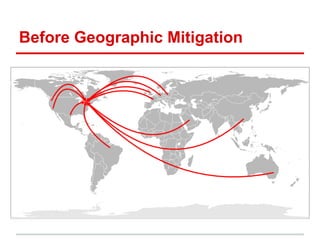
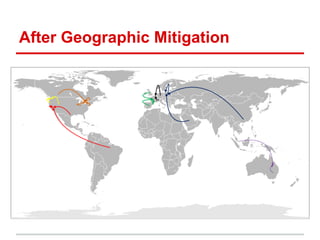
Another option for dealing with inbound DDoS
is to mitigate with a GSLB. The solution we
use, gdnsd (in ports), brings with it a number of
useful features.
The first of these is its integration with GeoIP.
Providing some of the functionality of Anycast,
it allows you to localize an attack. If most of the
attackers are in Europe, your North American
nodes will remain up
Before Geographic Mitigation
After Geographic Mitigation
“Transit providers are simply not going to transport
more than 40 Gbps of dirty traffic across the world;
the only solution is to launch multiple
geographically distributed scrubbing centers”
[1] https://blog.staminus.net/mitigation-of-attacks-exceeding-40-gbps
Sinkhole
Another option with the GSLB is to sinkhole all
traffic from a specific region. If the attack is
coming from zombies in China, you can point
all of those clients to an unroutable address
GSLB also allows ‘overrides’ to the GeoIP
database, allowing you to return a different
response for addresses in specific network
ranges. This can be used to prevent known
bots on some blacklist from reaching your sites
Sinkhole Mitigation - DC Map
plugins => { geoip => { maps => { geo_map => {
geoip_db => GeoIPCity.dat,
datacenters => [US-WEST, EU-WEST, EU-EAST, NULL],
map => {
EU => {
NL => [ EU-WEST ],
DE => [ EU-WEST ],
PL => [ EU-EAST ],
default => [ EU-WEST, EU-EAST ]
},
NA => { default => [ US-WEST ] }
}
Identify and Classify Attackers
nets => { #Bogons
10.0.0.0/16 => [ NULL ],
127.0.0.0/8 => [ NULL ],
#China
1.80.0.0/13 => [ NULL ],
1.192.0.0/13 => [ NULL ],
1.202.0.0/15 => [ NULL ],
#Autogenerated list of attackers below
},
},
Adapt DNS results sent to Attackers
resources => {
prod_www => {
map => geo_map
service_types => default
dcmap => {
US-WEST => 192.0.2.1,
EU-WEST => [ 192.0.2.4, 192.0.2.5, 192.0.2.6 ]
EU-EAST => {
lb01 => 192.0.2.2, lb02 => 192.0.2.3 },
NULL => 127.0.0.2,
}
}
} }
Whack-a-mole
If you have various geographically separated nodes, a
less graceful approach I have used in the past
● All traffic is sent to node A and everything is fine
● Attack starts, and overwhelms node A
● GSLB kicks in and redirects new users to node B
● Attackers often only do an initial DNS lookups or
cache the results, so they keep attacking node A for
a while
● Attackers eventually migrate to node B
● GSLB shifts load to node C
● repeat
● Shift back to node A, which has since recovered
Detecting an Attack
In order to respond to an attack, you must first detect when
you are under attack
In our case this is especially important. With video
streaming, it is not uncommon for our servers to see very
large sudden spikes in traffic; this does not necessarily
indicate an attack.
Even a large spike of incoming HTTP requests from diverse
sources does not presage an attack. We host an
advertising network that is used on CBS / CBSSports.com
TechRepublic.com, CollegeHumor.com and various others.
A large news event can drive a sudden surge of traffic.
Business Rules
What is an expected increase in traffic, and
what is an not? Is it an attack or just a surge?
For video streaming, does the traffic level
correspond to the viewer count (outbound) or
repeater count (inbound)? If not, this may be a
sign of an attack
False positives would be a very bad thing, so
extra care must be taken here
Implementation - Traffic Level
service_types => {
netif => {
plugin => "extmon", timeout => 5,
cmd => [
"/usr/local/libexec/nagios/check_snmp_int.pl",
"-H", "%%IPADDR%%", "-n", "em0", "-fkBM", "-w",
"500,500",
"-c", "640,640", "-d", "300", "-2", "--64bits", "-C",
"public", "--label"
]
}
}
Implementation - Business Rule
service_types => {
viewers_vs_bw => {
plugin => "extmon", timeout => 5,
cmd => [ "/usr/local/libexec/nagios/check_ddos",
"--viewers",
"http://%%IPADDR%%:8086/connectioncounts",
"--bandwidth", "-H %%IPADDR%%",
"--avgout", "2000"
]
}
}
Going Forward
● Implement Flow Analysis - automatically add
source addresses that match known attack
fingerprints to the ‘NULL’ class
● Increase adoption of EDNS0-Client-Subnet
so that addresses of zombies can be more
easily identified. May require mitigation
measures to prevent L2DoS
● Consider additional factors and business
rules to more accurately identify attack
conditions and attack sources
Podcasts
BSDNow.tv is a weekly video podcast featuring
News, Interviews and Tutorials about the BSD
family of Operating Systems. Hosted by Kris
Moore (founder of PC-BSD) and Myself.
TechSNAP.tv is a weekly sysadmin video
podcast covering an OS agnostic range of
security and production issues of interest to
those working , studying or interested in the
field.

EuroBSDCon 2013 - Mitigating DDoS Attacks at Layer 7

  • 1.
    Mitigating DDoS Attacks atLayer 7 Detect, Localize and Mitigate using DNS GSLB Allan Jude ScaleEngine Inc.
  • 2.
    Introductions Allan Jude ● 12Years as FreeBSD Server Admin ● Architect of the ScaleEngine CDN (HTTP and Video) ● Host of BSDNow.tv & TechSNAP.tv Podcasts ● Former Professor @ Mohawk College (2008-2011) teaching Network Engineering and Security Analysis ● Extensive work with Puppet to manage our 80 odd servers in 28 data centers in 10 countries ● Lots of work with ZFS to manage large collections of videos as well as extremely large website caches (15+ million objects in ff*ff directories)
  • 3.
    History From 2002 -2012 I ran an IRC shell provider, specializing in hosting smallish IRC networks as well as protection bots and BNCs (proxies) During this time my servers were subject to numerous different types and sizes of DDoS attacks and other attempts to disrupt services (take down IRC servers, gain control of rooms on EFNet etc)
  • 4.
    Overview ● DDoS AttackTypes ● Defensive Techniques ● Commercial Solutions ● Using a GSLB to Localize Attackers and Mitigate Volume ● Implementation Examples ● Where to go from here
  • 5.
    What Is DistributedDenial of Service ● "A Denial of Service attack (DoS) is any intended attempt to prevent legitimate users from reaching a specific network resource." [1] ● Distributed Denial of Service attacks are harder to mitigate because there are innumerable source addresses and they attack traffic can be difficult to distinguish from legitimate traffic [1] Protection against Denial of Service Attacks: A Survey - http://staffweb.cms.gre.ac.uk/~lg47/publications/LoukasOke- DoSSurveyComputerJournal.pdf
  • 6.
    Types of DDoS ●Volumetric / Link Saturation (Bandwidth) ● Protocol Attacks (SYN flood, fragments) ● Packet Storm (Excessive PPS) ● Resource Starvation (CPU, I/O, Memory) ● Stealth/Creeper (Slowloris, Slow POST) ● Exploit (Application or OS Specific DoS) ● DoS L2 - Intentionally trigger defensive mechanisms to block traffic from the (spoofed) source address or subnet
  • 7.
    Statistics ● Average attacklasts 34.5 hours ● China is #1 origin of DDoS traffic, making up 40-50% of all botnet activity ● 75% of attacks are against Infrastructure (layers 3 & 4, SYN Flood, ICMP/UDP attack) with only 25% against Applications (layer 7) ● 25% of all attacks are under 1 gbps, and 50% of all attacks are under 6 gbps [Source] Prolexic Quarterly Global DDoS Attack Report 2013Q1 - http://www.prolexic. com/kcresources/attack-report/attack_report_q113_english- version/Prolexic_Quarterly_Global_DDoS_Attack_Report_Q113_041613.pdf
  • 8.
  • 9.
    Defensive Techniques ● SimpleFailover ● Null Route (Automated or Manual) ● Web Application Firewall ● Anycast ● Proactive Name servers (a service from your registrar that provides failover to additional name servers, especially useful in the event of a DDoS against your name servers) ● Commercial Solutions
  • 10.
    Simple Failover (HiddenSpares) ● When a machine or location is under attack, fail over to another machine/location ● Works better in Active/Passive mode, because in Active/Active the attacker may attack both locations ● If you have a sufficient number of hidden spares, you may be able to evade the attacker for a while
  • 11.
    Null Route (Blackhole) ●You or your provider send /32 routes upstream, routers stop forwarding the attack (and all other) traffic to you, preventing the saturation of your link ● This allows traffic to adjacent machines or customers that are not under attack to continue normally ● Some providers implement this automatically to lessen the disruption of a single customer being attacked
  • 12.
    Web Application Firewall ●Only protect against specific known attacks ● Actually meant to prevent intrusions and exploits, rather than brute force attacks ● Are often a bottleneck or failure point because they can handle only very limited packets-per-second and often have underpowered CPUs, can actually amplify the attack and take you down sooner ● Usually subject to limits on the number of concurrent sessions/connections or other scalability issues
  • 13.
    Anycast ● Announce BGProutes for a single prefix from multiple locations ● Traffic is directed based on fewest hops ● Automatically distributes traffic between locations based on source network ● Limits damage caused by DDoS attacks to the areas nearest the attackers ● Requires your own IP space or LoA ● Often requires 24/7 NOC ● Much harder to maintain and scale on a limited budget with limited personnel
  • 14.
    Commercial Solutions ● FilteringHardware ○ Arbor Networks (PeakFlow) - Profiling and trend analysis, attempts to automatically detect out of character traffic in addition to known attack patterns ○ Checkpoint (DDoS Protector Appliances) ○ Cisco (Guard XT) ○ Fortinet (FortiDDoS) ● Protected Hosting ○ BlackLotus - Dedicated Servers or (BGP) GRE Tunnel to your own network ○ Staminus - Dedicated Servers
  • 15.
    Commercial Solutions (Continued) ●Protection for Hire ○ Prolexic (PLXRouter) - Prolexic announces your BGP routes and Inbound traffic is routed through Prolexic ‘Scrubbing’ facilities then on to your facilities via a GRE tunnel. Asymmetric (outbound traffic comes directly from your facilities) ○ Prolexic (PLXProxy) - HTTP and HTTPS only, traffic is symmetrically routed through scrubbing facilities ○ CloudFlare - Application Proxy. HTTP(S) only ○ DDoSArrest - HTTP(S) only
  • 16.
  • 17.
    Using a GSLB Anotheroption for dealing with inbound DDoS is to mitigate with a GSLB. The solution we use, gdnsd (in ports), brings with it a number of useful features. The first of these is its integration with GeoIP. Providing some of the functionality of Anycast, it allows you to localize an attack. If most of the attackers are in Europe, your North American nodes will remain up
  • 18.
  • 19.
  • 20.
    “Transit providers aresimply not going to transport more than 40 Gbps of dirty traffic across the world; the only solution is to launch multiple geographically distributed scrubbing centers” [1] https://blog.staminus.net/mitigation-of-attacks-exceeding-40-gbps
  • 21.
    Sinkhole Another option withthe GSLB is to sinkhole all traffic from a specific region. If the attack is coming from zombies in China, you can point all of those clients to an unroutable address GSLB also allows ‘overrides’ to the GeoIP database, allowing you to return a different response for addresses in specific network ranges. This can be used to prevent known bots on some blacklist from reaching your sites
  • 22.
    Sinkhole Mitigation -DC Map plugins => { geoip => { maps => { geo_map => { geoip_db => GeoIPCity.dat, datacenters => [US-WEST, EU-WEST, EU-EAST, NULL], map => { EU => { NL => [ EU-WEST ], DE => [ EU-WEST ], PL => [ EU-EAST ], default => [ EU-WEST, EU-EAST ] }, NA => { default => [ US-WEST ] } }
  • 23.
    Identify and ClassifyAttackers nets => { #Bogons 10.0.0.0/16 => [ NULL ], 127.0.0.0/8 => [ NULL ], #China 1.80.0.0/13 => [ NULL ], 1.192.0.0/13 => [ NULL ], 1.202.0.0/15 => [ NULL ], #Autogenerated list of attackers below }, },
  • 24.
    Adapt DNS resultssent to Attackers resources => { prod_www => { map => geo_map service_types => default dcmap => { US-WEST => 192.0.2.1, EU-WEST => [ 192.0.2.4, 192.0.2.5, 192.0.2.6 ] EU-EAST => { lb01 => 192.0.2.2, lb02 => 192.0.2.3 }, NULL => 127.0.0.2, } } } }
  • 25.
    Whack-a-mole If you havevarious geographically separated nodes, a less graceful approach I have used in the past ● All traffic is sent to node A and everything is fine ● Attack starts, and overwhelms node A ● GSLB kicks in and redirects new users to node B ● Attackers often only do an initial DNS lookups or cache the results, so they keep attacking node A for a while ● Attackers eventually migrate to node B ● GSLB shifts load to node C ● repeat ● Shift back to node A, which has since recovered
  • 26.
    Detecting an Attack Inorder to respond to an attack, you must first detect when you are under attack In our case this is especially important. With video streaming, it is not uncommon for our servers to see very large sudden spikes in traffic; this does not necessarily indicate an attack. Even a large spike of incoming HTTP requests from diverse sources does not presage an attack. We host an advertising network that is used on CBS / CBSSports.com TechRepublic.com, CollegeHumor.com and various others. A large news event can drive a sudden surge of traffic.
  • 27.
    Business Rules What isan expected increase in traffic, and what is an not? Is it an attack or just a surge? For video streaming, does the traffic level correspond to the viewer count (outbound) or repeater count (inbound)? If not, this may be a sign of an attack False positives would be a very bad thing, so extra care must be taken here
  • 28.
    Implementation - TrafficLevel service_types => { netif => { plugin => "extmon", timeout => 5, cmd => [ "/usr/local/libexec/nagios/check_snmp_int.pl", "-H", "%%IPADDR%%", "-n", "em0", "-fkBM", "-w", "500,500", "-c", "640,640", "-d", "300", "-2", "--64bits", "-C", "public", "--label" ] } }
  • 29.
    Implementation - BusinessRule service_types => { viewers_vs_bw => { plugin => "extmon", timeout => 5, cmd => [ "/usr/local/libexec/nagios/check_ddos", "--viewers", "http://%%IPADDR%%:8086/connectioncounts", "--bandwidth", "-H %%IPADDR%%", "--avgout", "2000" ] } }
  • 30.
    Going Forward ● ImplementFlow Analysis - automatically add source addresses that match known attack fingerprints to the ‘NULL’ class ● Increase adoption of EDNS0-Client-Subnet so that addresses of zombies can be more easily identified. May require mitigation measures to prevent L2DoS ● Consider additional factors and business rules to more accurately identify attack conditions and attack sources
  • 31.
    Podcasts BSDNow.tv is aweekly video podcast featuring News, Interviews and Tutorials about the BSD family of Operating Systems. Hosted by Kris Moore (founder of PC-BSD) and Myself. TechSNAP.tv is a weekly sysadmin video podcast covering an OS agnostic range of security and production issues of interest to those working , studying or interested in the field.