DR. R. K. KHANDAL
SHRIRAM INSTITUTE FOR INDUSTRIAL RESEARCH
19, UNIVERSITY ROAD, DELHI-110 007
Email : sridlhi@vsnl.com Website : www.shriraminstitute.org
POLYMER WORKFLOW – FROM PELLET TO
PRODUCT
RELEVANCE OF THERMAL & RHEOLOGICAL
ANALYSIS
Keynote Address by
Outline
 From Pellet to Product : Steps, Process &
Properties
 Thermal Analysis by DSC & TGA
 Rheological Properties
 Importance of Rheology
 Visco-Elastic Behaviour
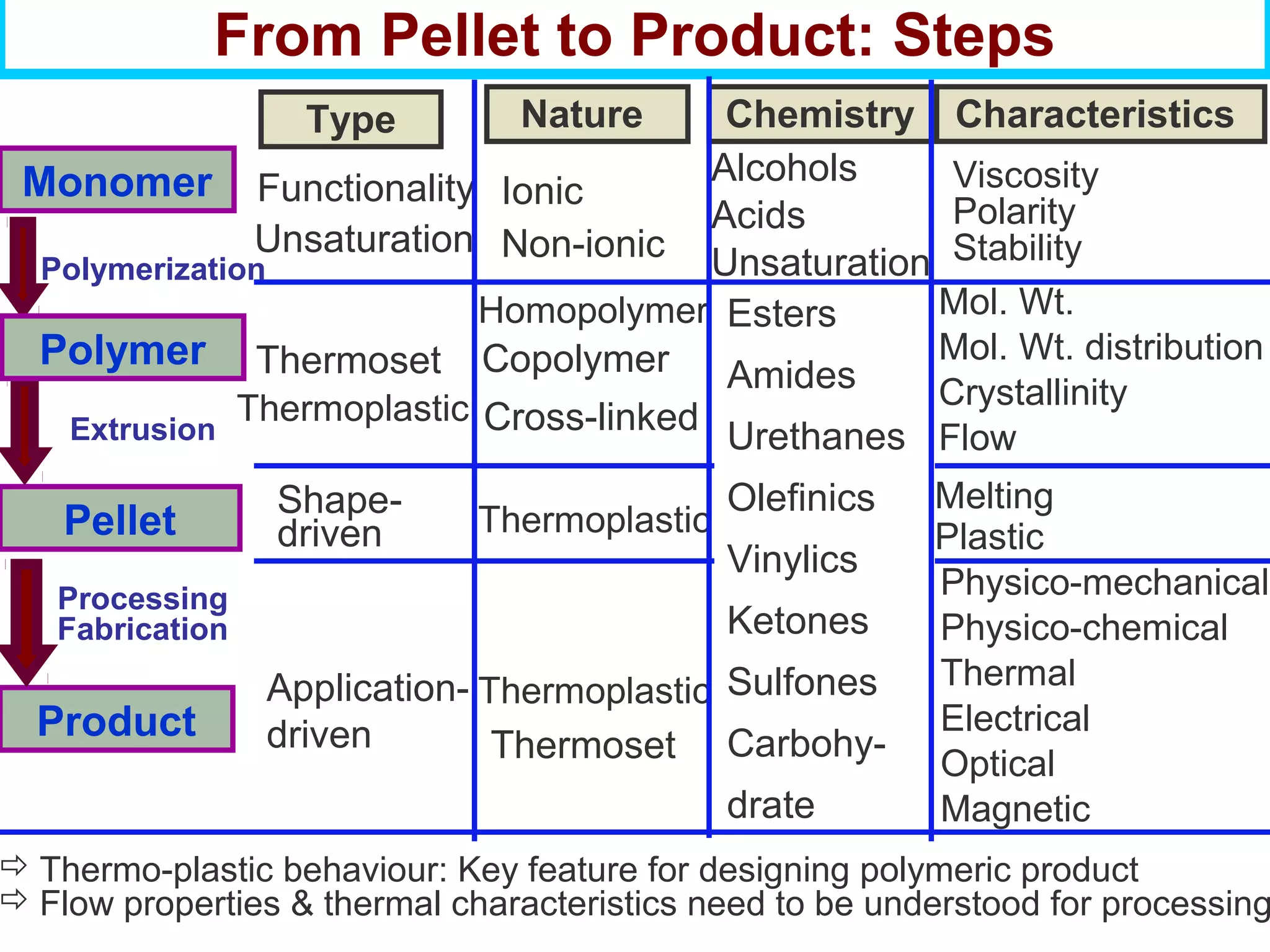
Monomer
Pellet
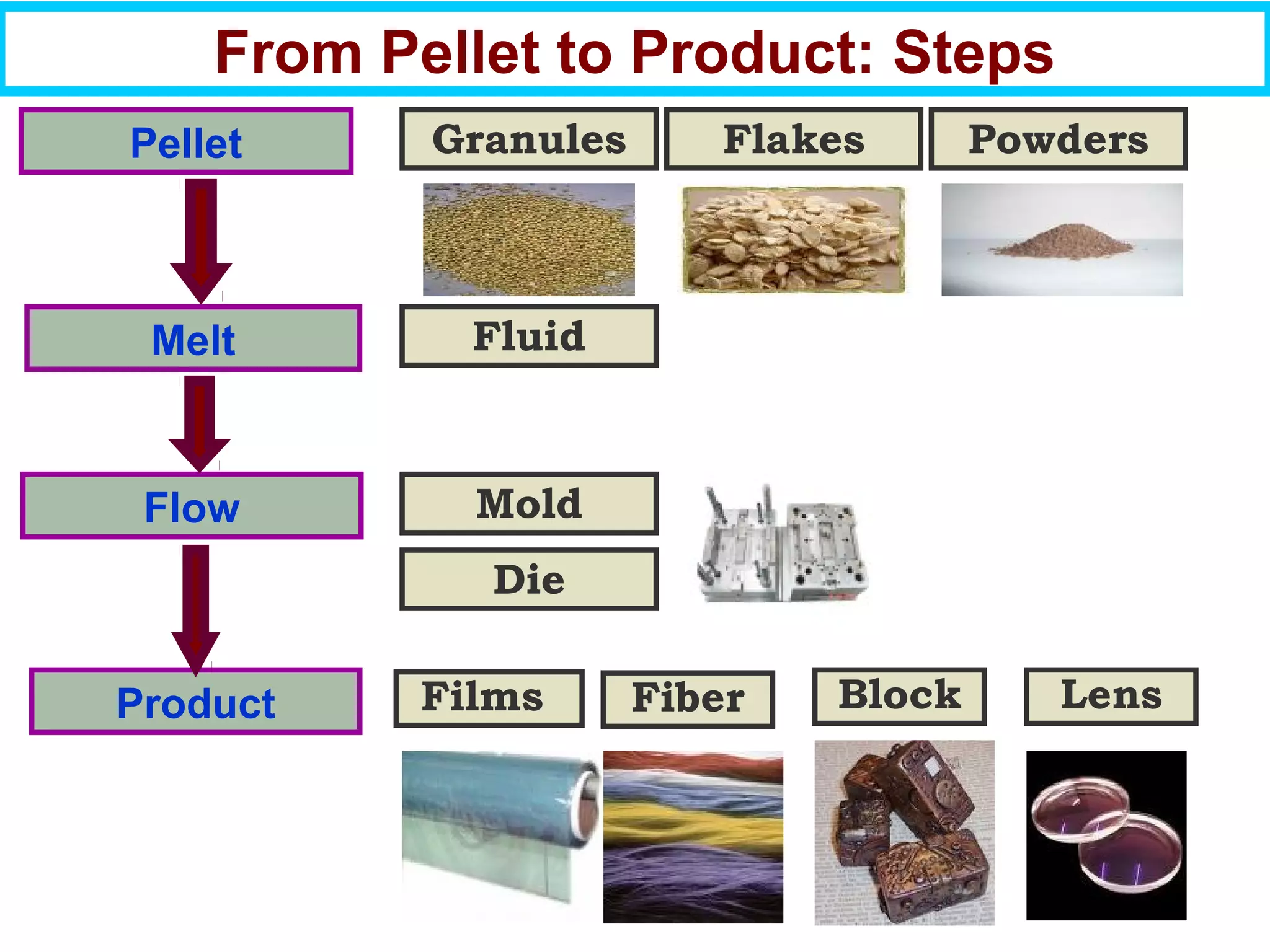
From Pellet to Product: Steps
Product
Type CharacteristicsNature Chemistry
IonicFunctionality
Unsaturation Non-ionic
Esters
Amides
Urethanes
Olefinics
Vinylics
Ketones
Sulfones
Carbohy-
drate
Viscosity
Polarity
Stability
Physico-mechanical
Physico-chemical
Thermal
Electrical
Optical
Magnetic
Homopolymer
Copolymer
Cross-linked
Thermoplastic
Thermoplastic
Thermoset
Melting
Plastic
Mol. Wt.
Mol. Wt. distribution
Crystallinity
Flow
Alcohols
Acids
Unsaturation
Application-
driven
Shape-
driven
 Thermo-plastic behaviour: Key feature for designing polymeric product
 Flow properties & thermal characteristics need to be understood for processing
Polymerization
Extrusion
Processing
Fabrication
Thermoplastic
ThermosetPolymer
Granules
Melt
Pellet
Flow
From Pellet to Product: Steps
Product
Flakes Powders
Fluid
Block
Die
Mold
Films LensFiber
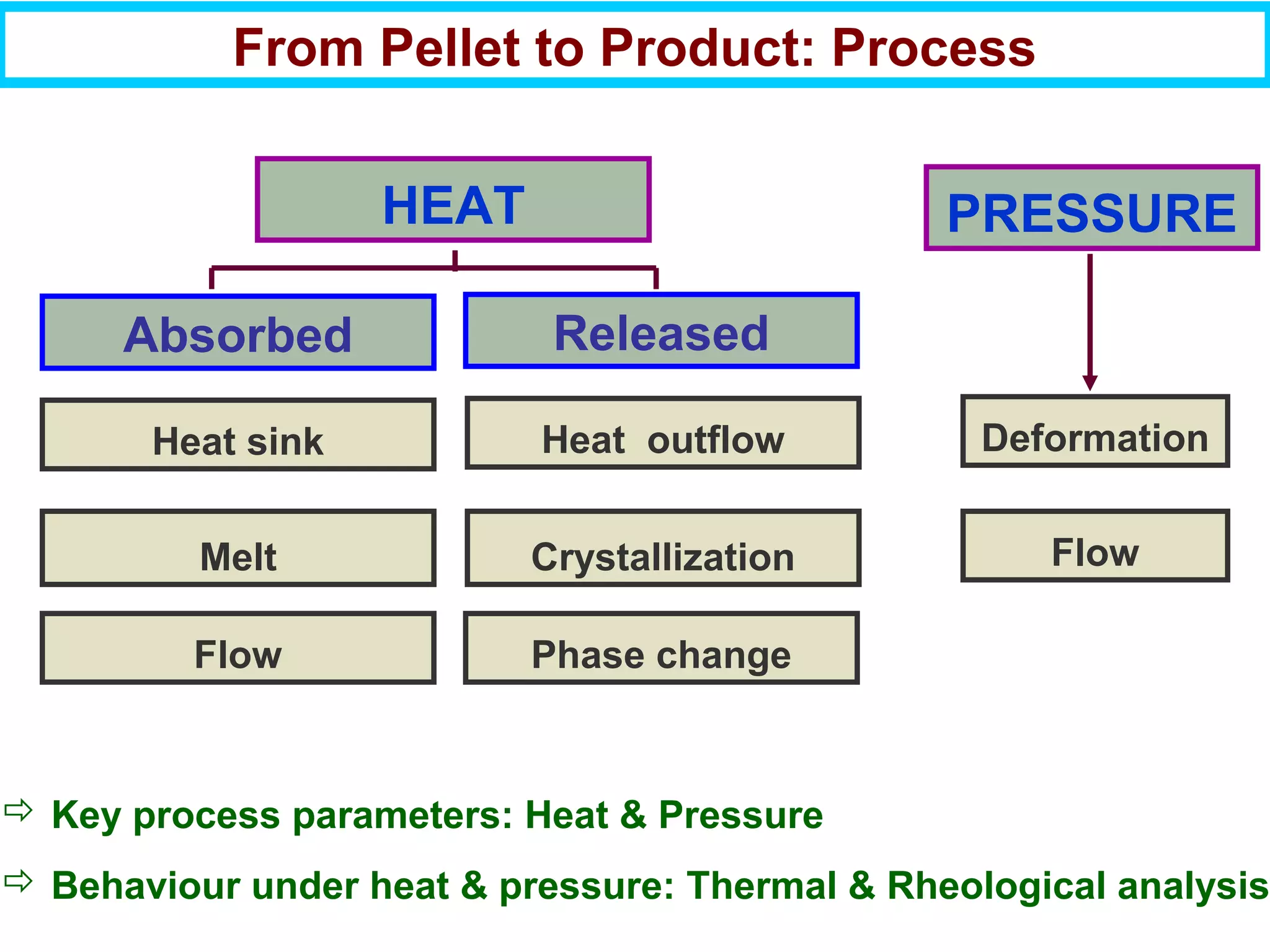
Heat sink
PRESSUREHEAT
From Pellet to Product: Process
Melt
Absorbed Released
Heat outflow
Crystallization
Deformation
Flow
Phase change
 Key process parameters: Heat & Pressure
 Behaviour under heat & pressure: Thermal & Rheological analysis
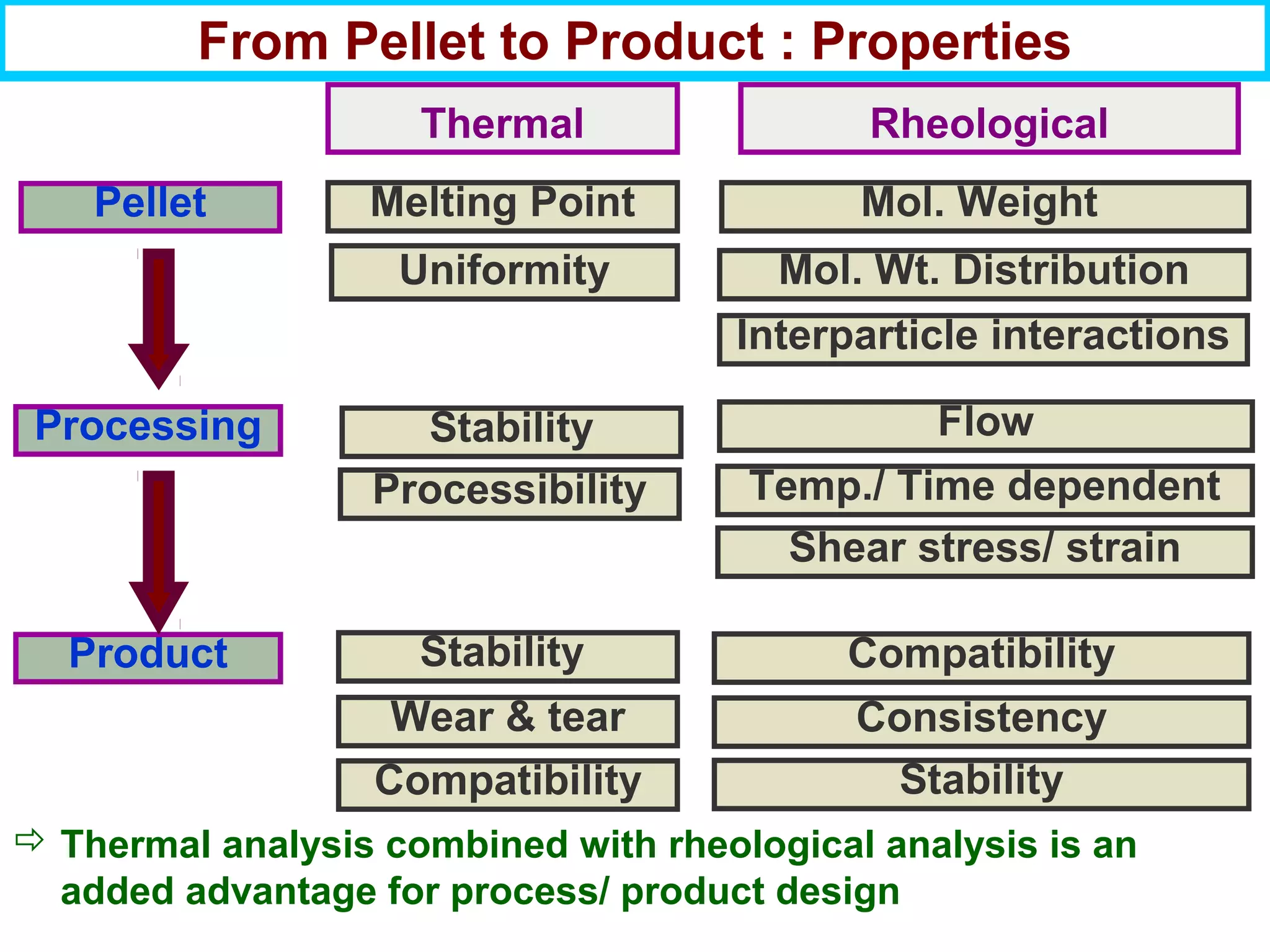
Flow
Melting PointPellet
Processing
From Pellet to Product : Properties
Product
Mol. Weight
Uniformity
Stability Flow
Wear & tear
Stability Compatibility
Mol. Wt. Distribution
Compatibility
Thermal Rheological
Temp./ Time dependent
Shear stress/ strain
Consistency
 Thermal analysis combined with rheological analysis is an
added advantage for process/ product design
Stability
Interparticle interactions
Processibility
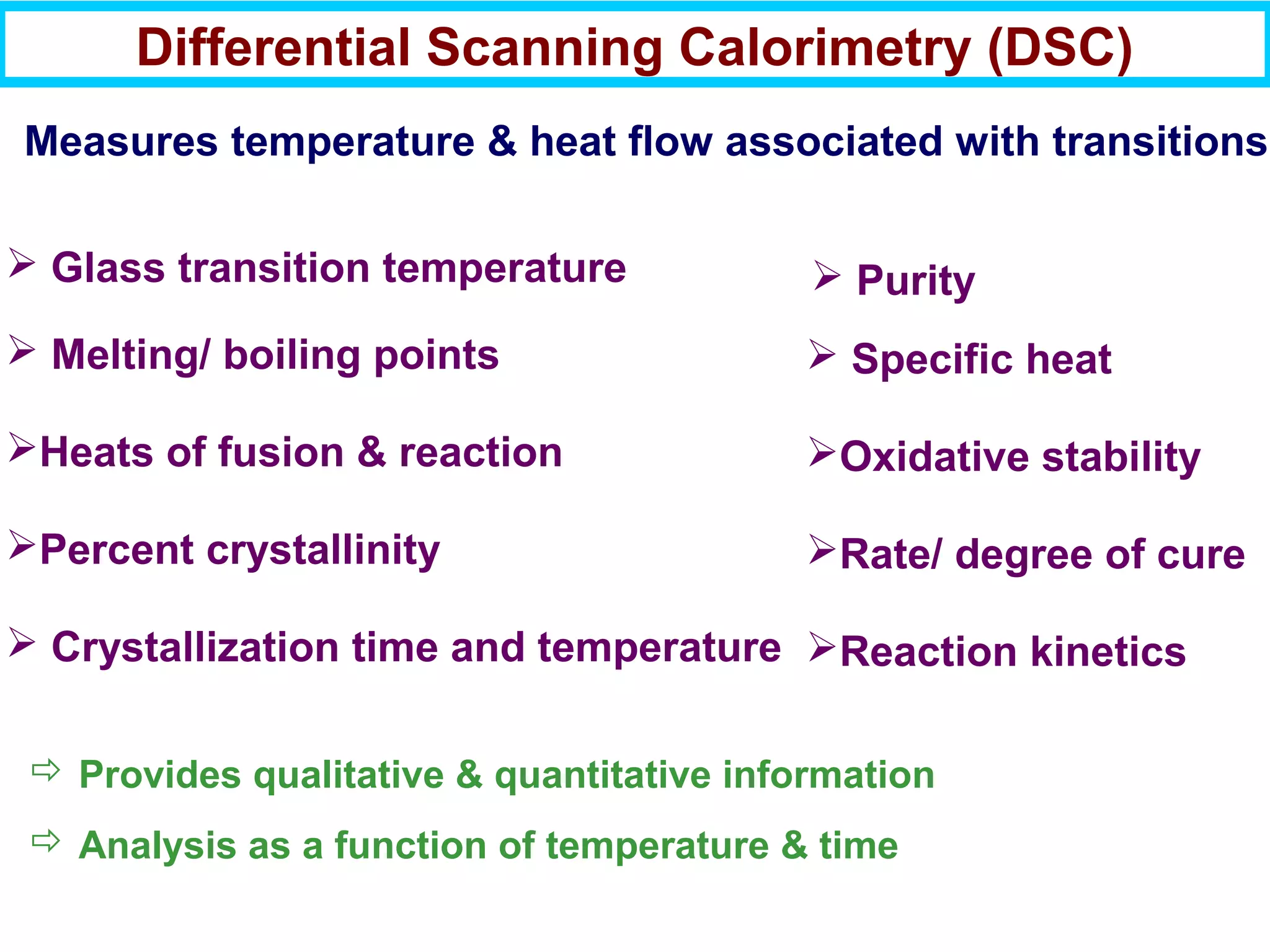
Differential Scanning Calorimetry (DSC)
 Glass transition temperature
 Provides qualitative & quantitative information
 Analysis as a function of temperature & time
 Melting/ boiling points
Heats of fusion & reaction
Percent crystallinity
 Crystallization time and temperature
 Specific heat
Oxidative stability
Rate/ degree of cure
Reaction kinetics
 Purity
Measures temperature & heat flow associated with transitions
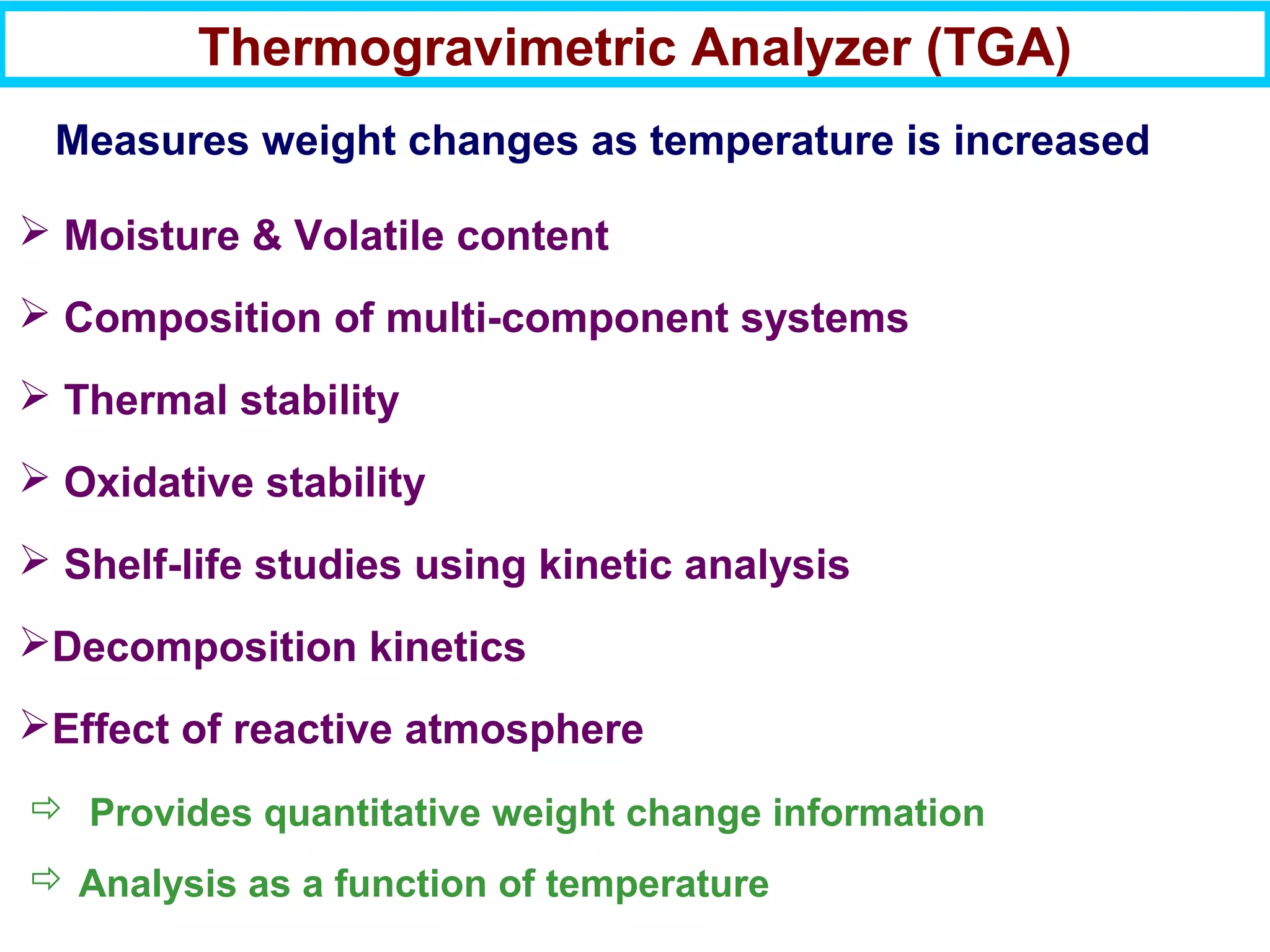
Thermogravimetric Analyzer (TGA)
 Provides quantitative weight change information
 Analysis as a function of temperature
 Moisture & Volatile content
 Composition of multi-component systems
 Thermal stability
 Oxidative stability
 Shelf-life studies using kinetic analysis
Decomposition kinetics
Effect of reactive atmosphere
Measures weight changes as temperature is increased
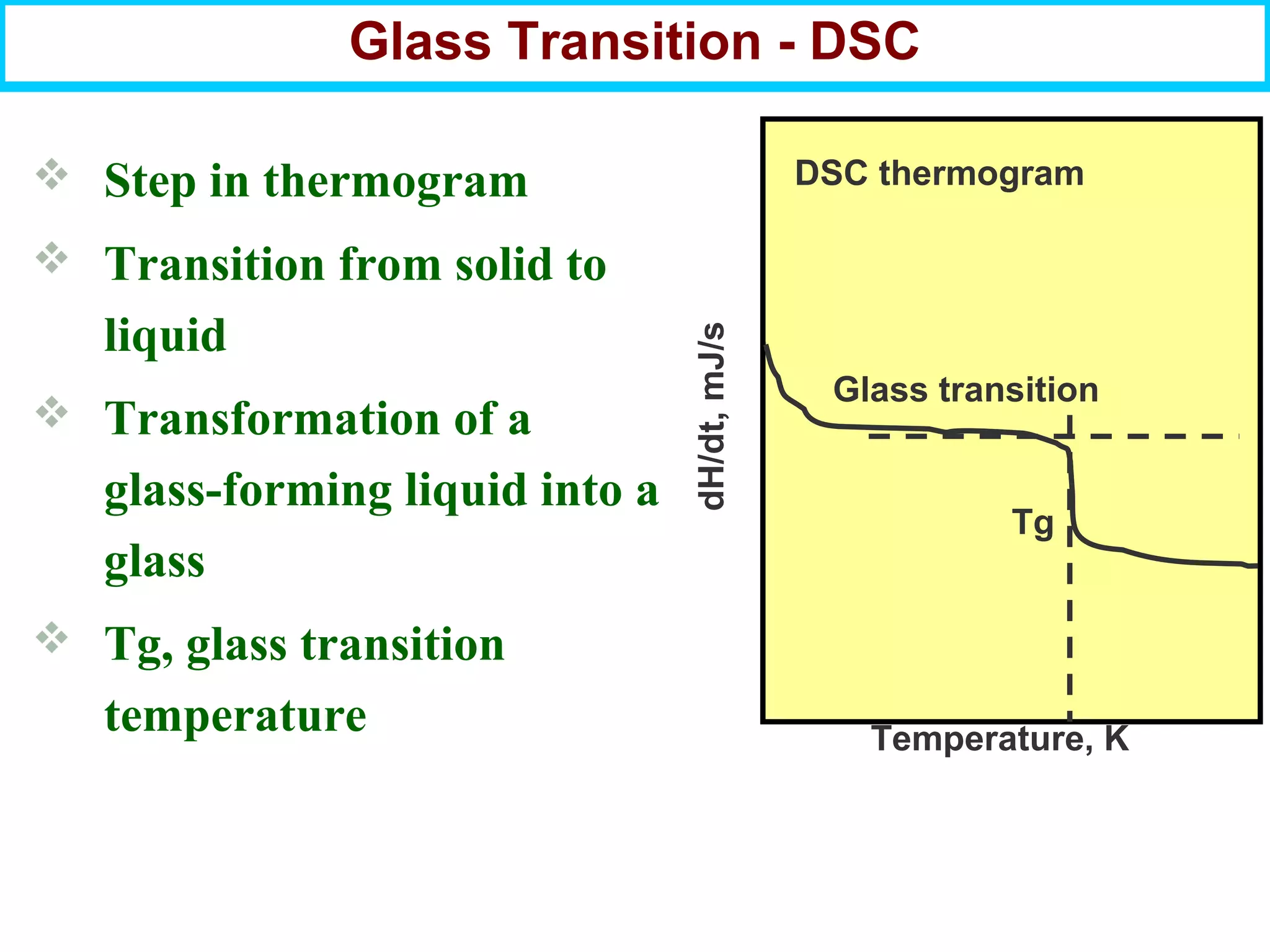
Glass Transition - DSC
 Step in thermogram
 Transition from solid to
liquid
 Transformation of a
glass-forming liquid into a
glass
 Tg, glass transition
temperature Temperature, K
DSC thermogram
dH/dt,mJ/s
Glass transition
Tg
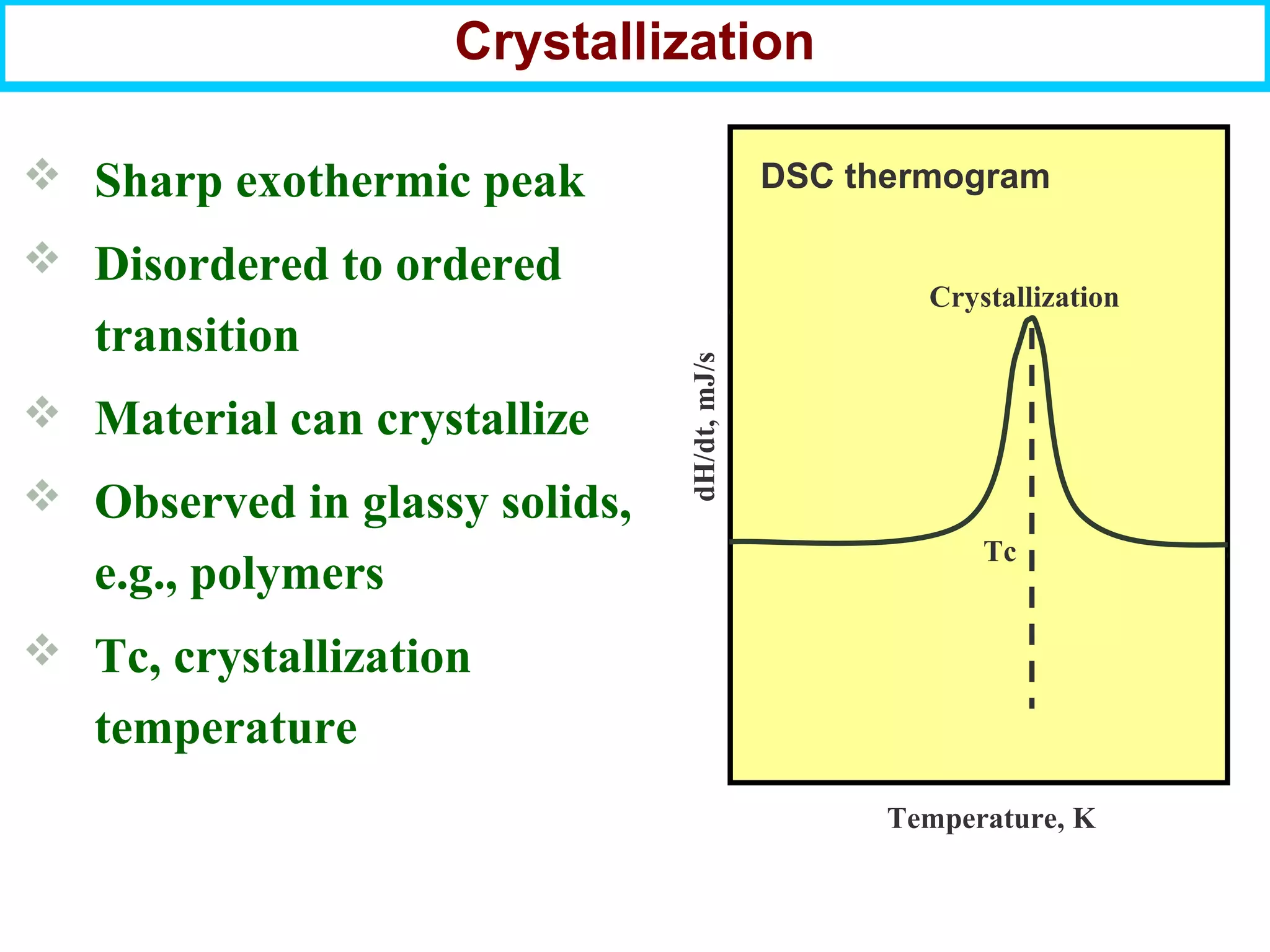
Crystallization
 Sharp exothermic peak
 Disordered to ordered
transition
 Material can crystallize
 Observed in glassy solids,
e.g., polymers
 Tc, crystallization
temperature
Temperature, K
DSC thermogram
dH/dt,mJ/s
Crystallization
Tc
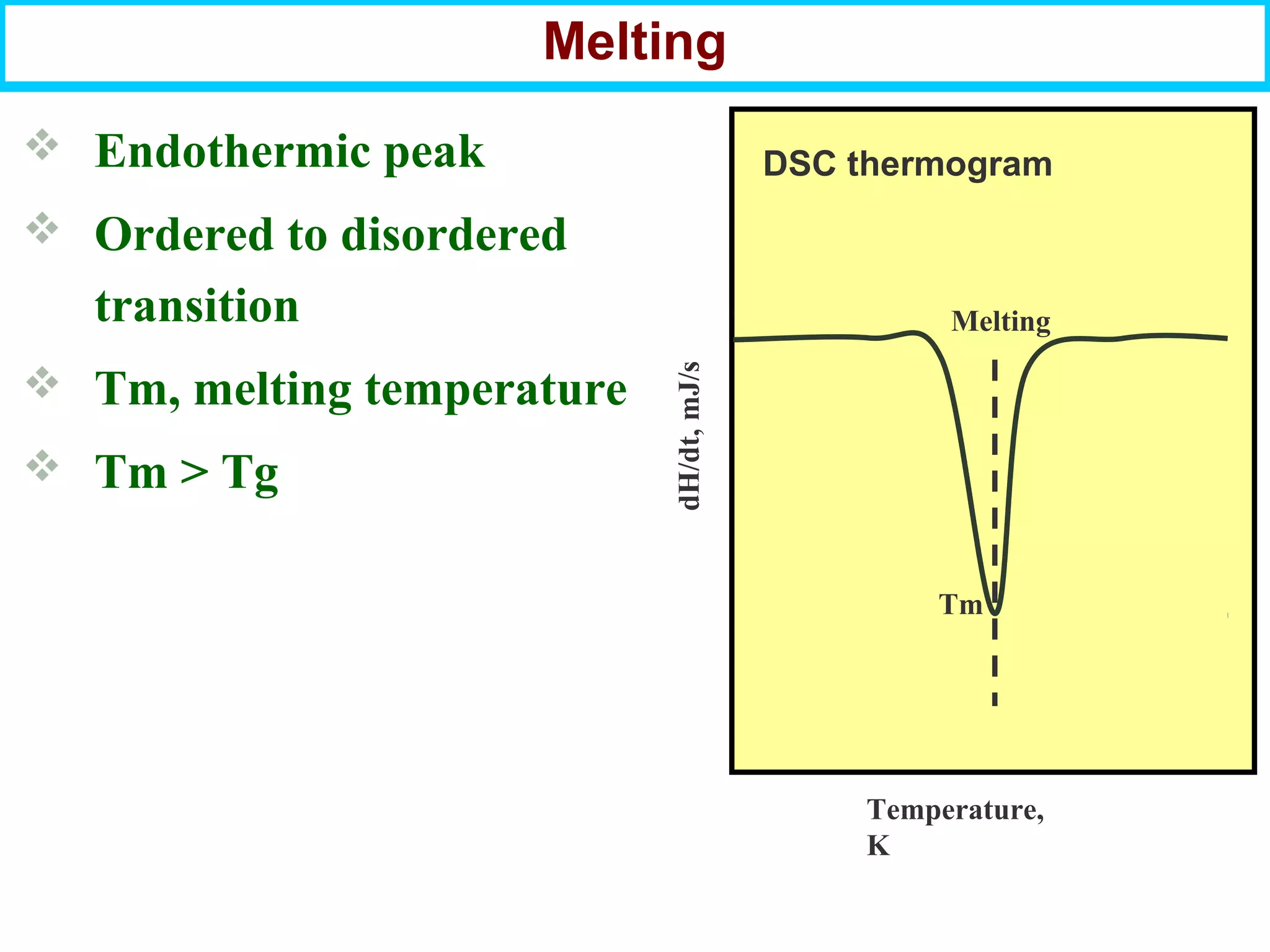
Melting
 Endothermic peak
 Ordered to disordered
transition
 Tm, melting temperature
 Tm > Tg
Temperature,
K
DSC thermogram
dH/dt,mJ/s
Melting
Tm
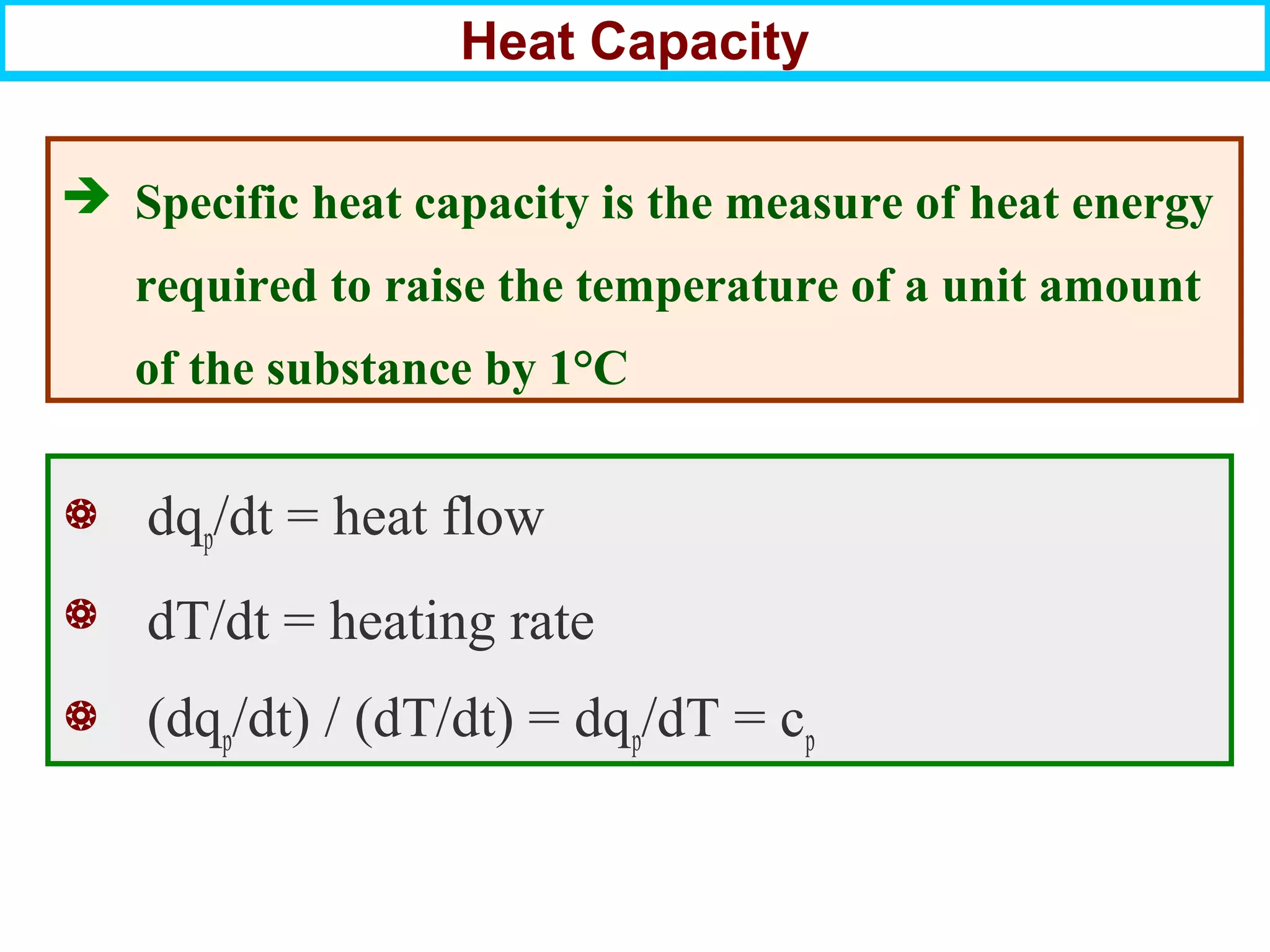
 dqp/dt = heat flow
 dT/dt = heating rate
 (dqp/dt) / (dT/dt) = dqp/dT = cp
Heat Capacity
 Specific heat capacity is the measure of heat energy
required to raise the temperature of a unit amount
of the substance by 1°C
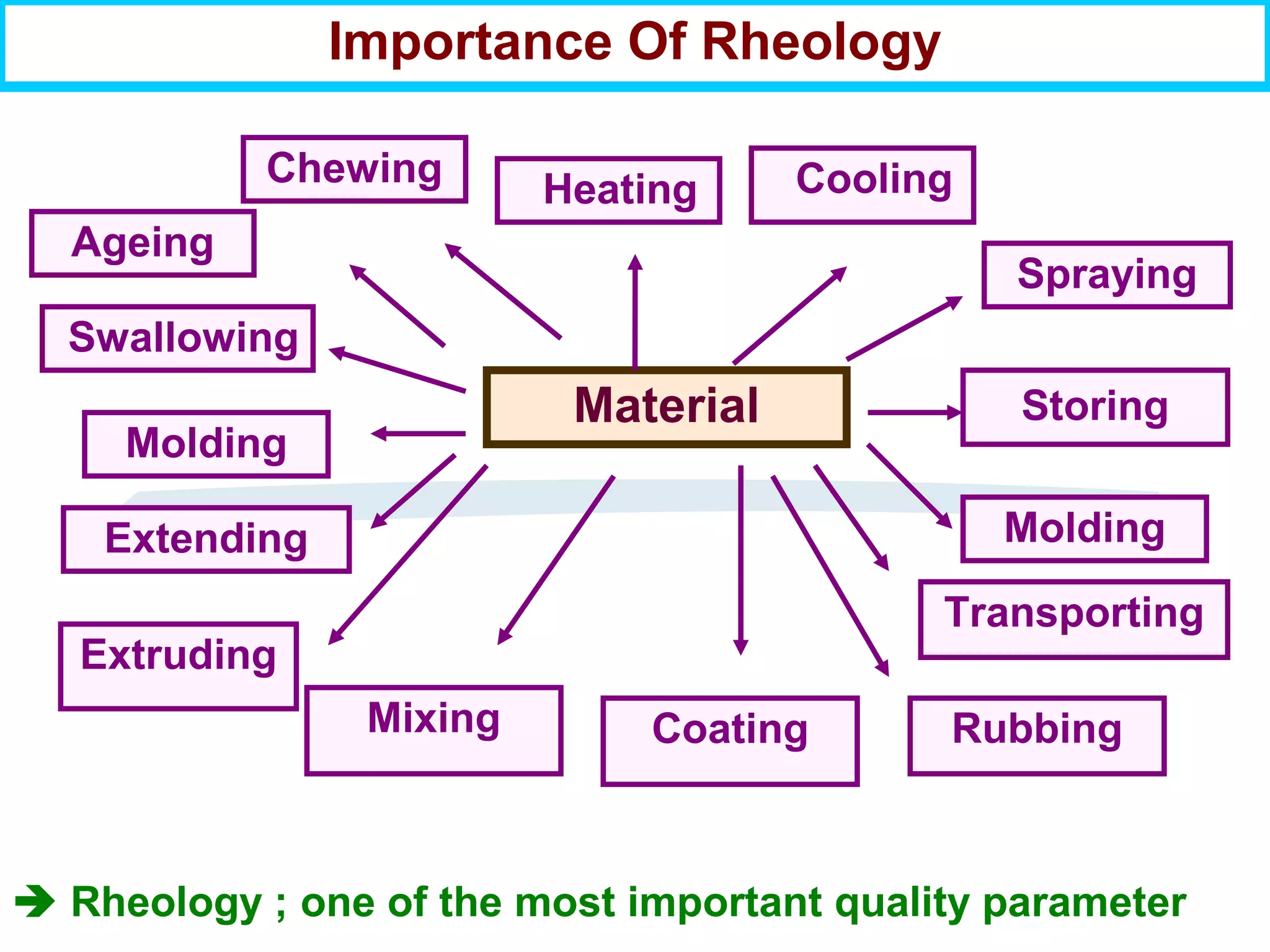
Importance Of Rheology
Material
Spraying
Transporting
Extending
Extruding
Molding
Heating
Swallowing
Storing
Molding
RubbingCoatingMixing
Chewing Cooling
 Rheology ; one of the most important quality parameter
Ageing
Newtonian
Example :Oil,Water
Shear rate γ•
[1/ S]
Shearstressτ[Pa]
Viscosity is independent of shear rate
 Shear rate ∝ shear stress
Non-Newtonian: Dilatant
Shear-thickening or Dilatant
Shear rate[1/S]
Shearstressτ[Pa]
Viscosity  with  in shear rate
Example: ceramic suspension, plastisol pastes, starch
dispersions
Non-Newtonian: Pseudoplastic
Shear rate[1/ γ•
S]
Shear thinning: Example: Polymer melts, paints, glues.
Viscosity  as shear rate 
Material shows plasticity only after yield point
 Above yield point Plasticity,below yield point elasticity
Shearstressτ[Pa]
THIXOTROPY & RHEOPEXY
Time(t)
For Thixotropic
materials, viscosity 
as time , at a constant
shear rate.
Example: Paraffin
oil,Pastes,cream,gels
For Rheopectic fluid ,
viscosity as time 
at a constant shear
rate
Thixotropic
Rheopectic
Shearstressτ[Pa]
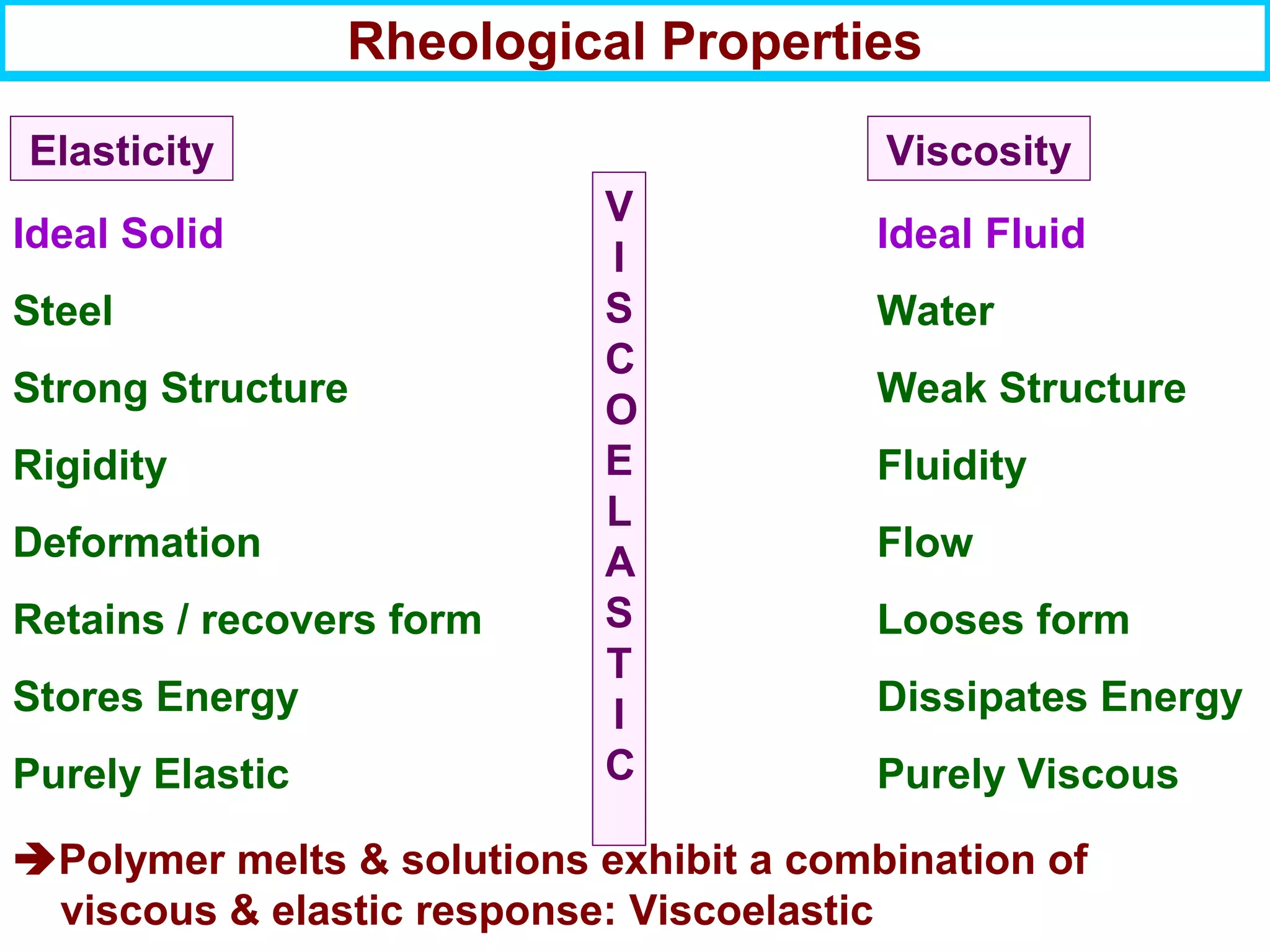
Rheological Properties
Ideal Solid Ideal Fluid
Steel Water
Strong Structure Weak Structure
Rigidity Fluidity
Deformation Flow
Retains / recovers form Looses form
Stores Energy Dissipates Energy
Purely Elastic Purely Viscous
V
I
S
C
O
E
L
A
S
T
I
C
Elasticity Viscosity
Polymer melts & solutions exhibit a combination of
viscous & elastic response: Viscoelastic
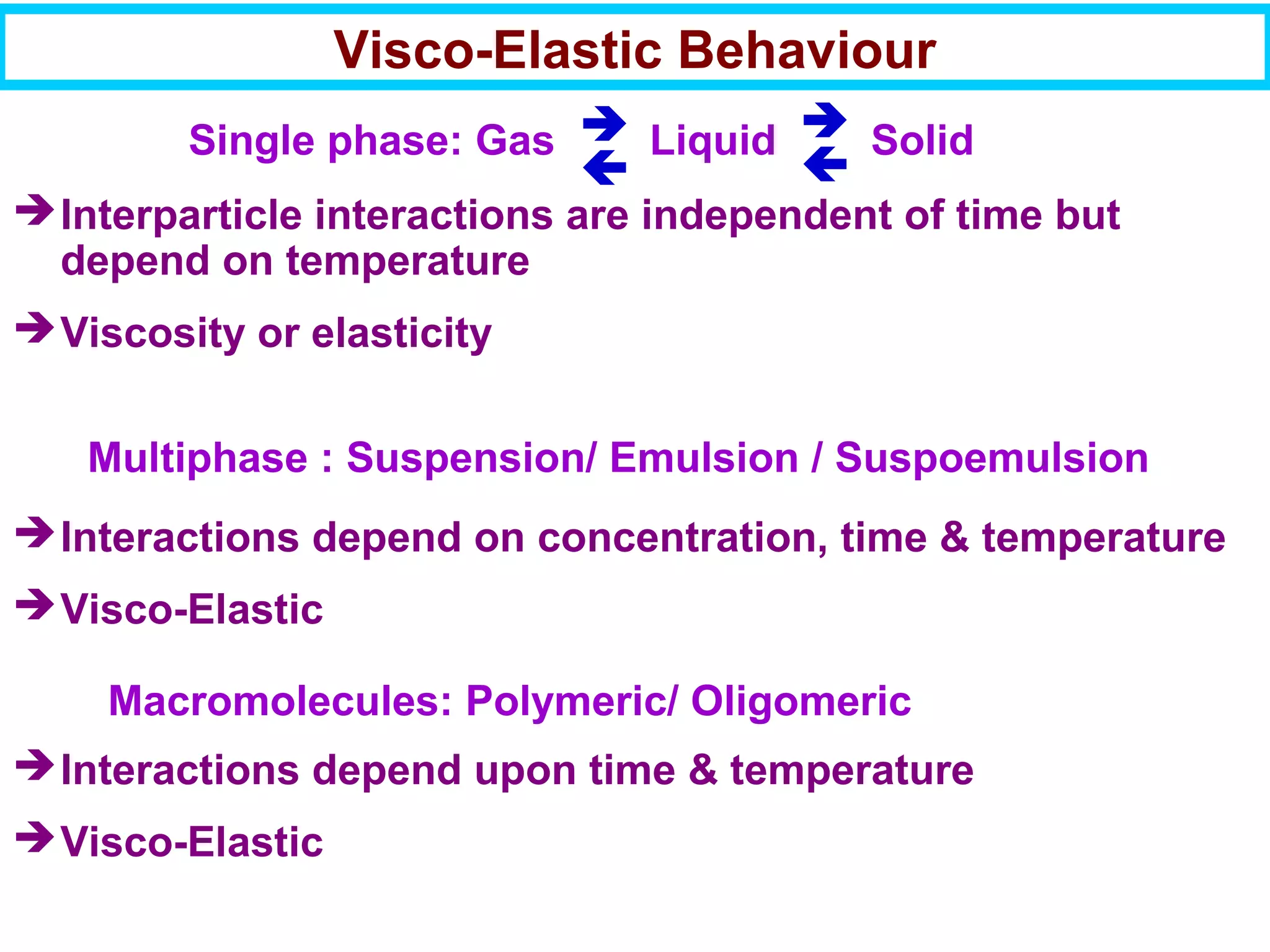
Single phase: Gas Liquid Solid
Interparticle interactions are independent of time but
depend on temperature
Viscosity or elasticity




Multiphase : Suspension/ Emulsion / Suspoemulsion
Interactions depend on concentration, time & temperature
Visco-Elastic
Macromolecules: Polymeric/ Oligomeric
Interactions depend upon time & temperature
Visco-Elastic
Visco-Elastic Behaviour
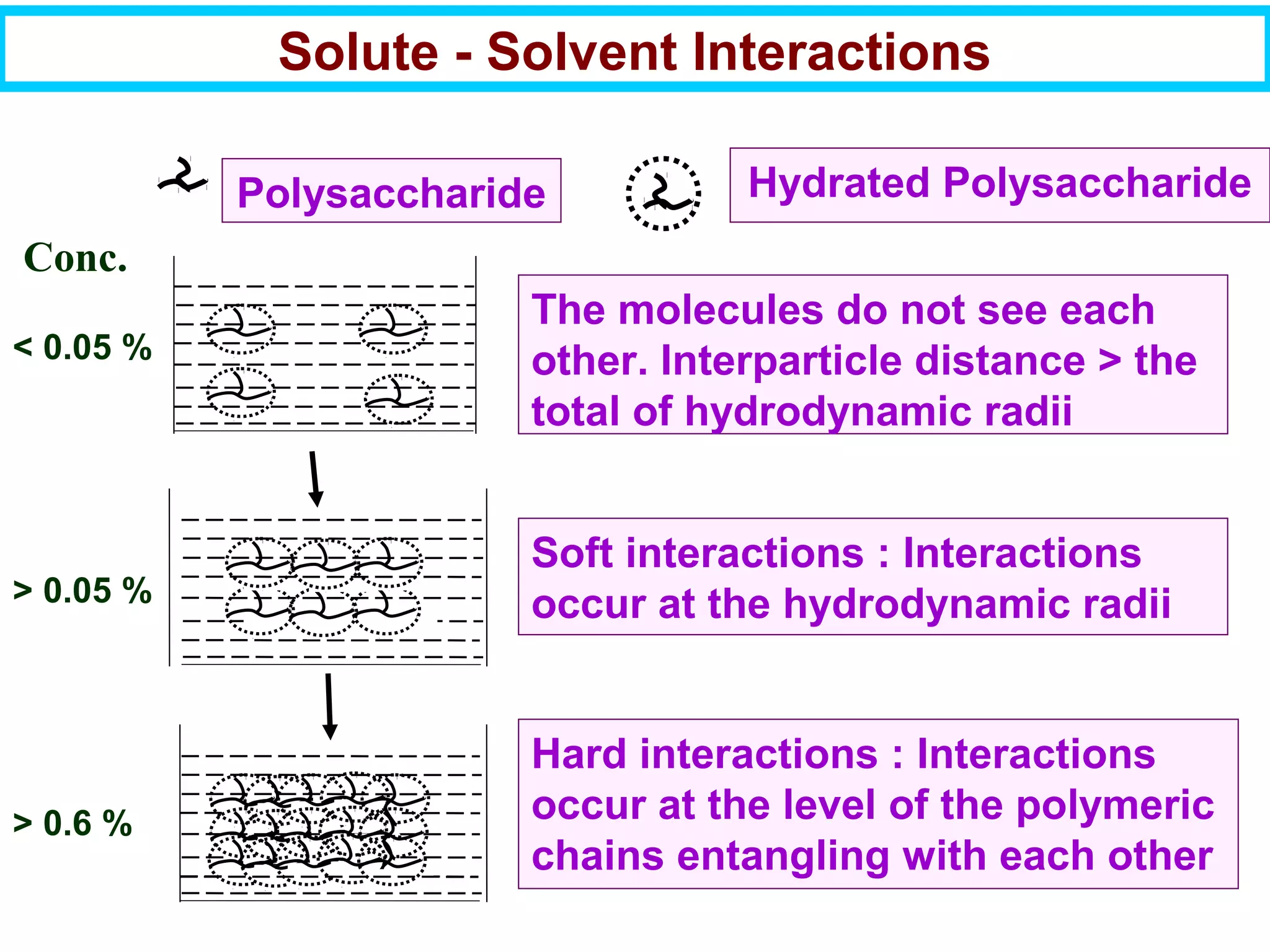
Solute - Solvent Interactions
Polysaccharide Hydrated Polysaccharide
The molecules do not see each
other. Interparticle distance > the
total of hydrodynamic radii
Soft interactions : Interactions
occur at the hydrodynamic radii
Hard interactions : Interactions
occur at the level of the polymeric
chains entangling with each other
< 0.05 %
Conc.
> 0.05 %
> 0.6 %
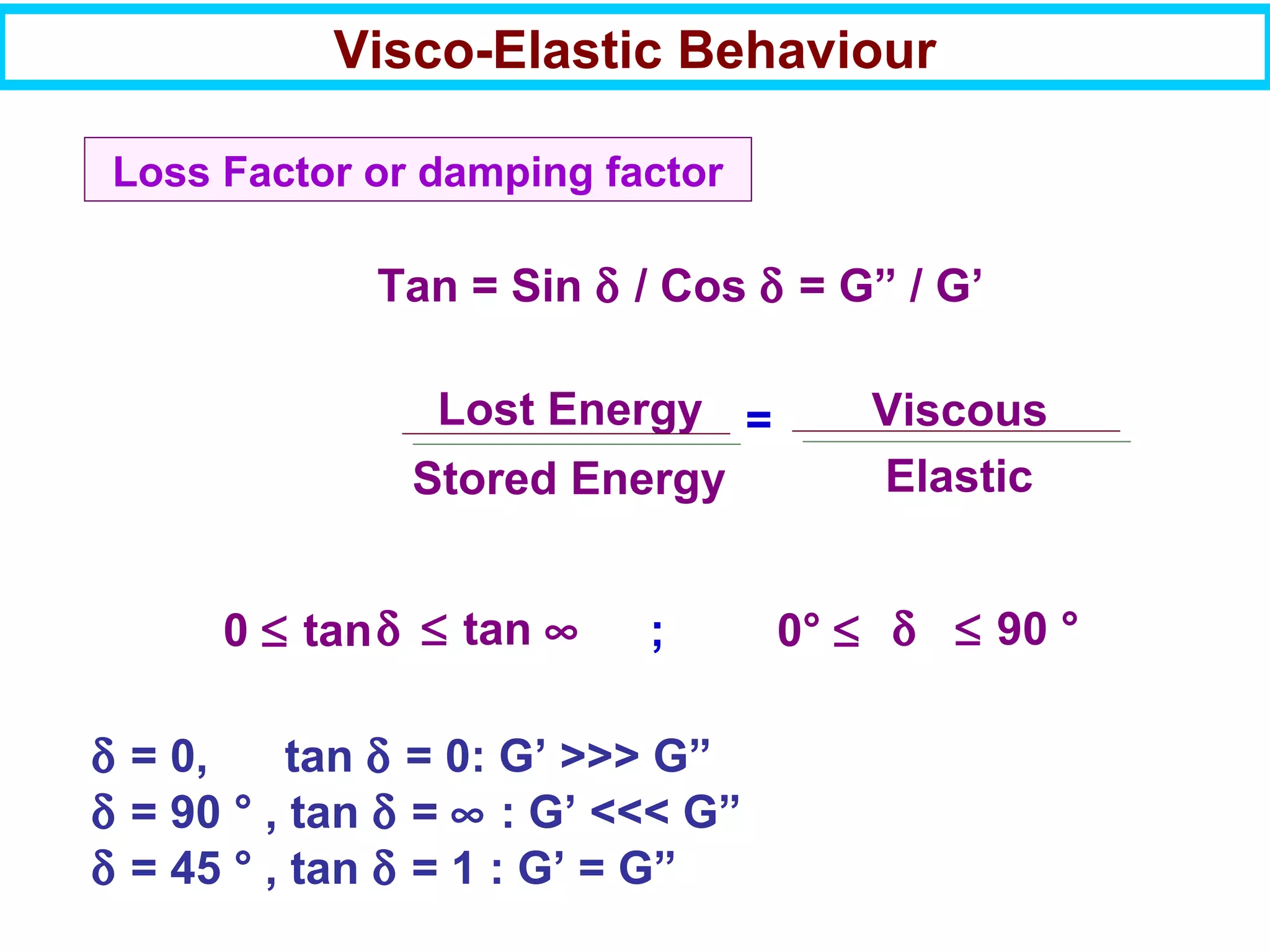
Loss Factor or damping factor
Tan = Sin δ / Cos δ = G” / G’
Lost Energy
Stored Energy
Viscous
Elastic
=
0 ≤ tanδ ≤ tan ∞ 0° ≤ δ ≤ 90 °;
δ = 0, tan δ = 0: G’ >>> G”
δ = 90 ° , tan δ = ∞ : G’ <<< G”
δ = 45 ° , tan δ = 1 : G’ = G”
Visco-Elastic Behaviour
Sol Gel

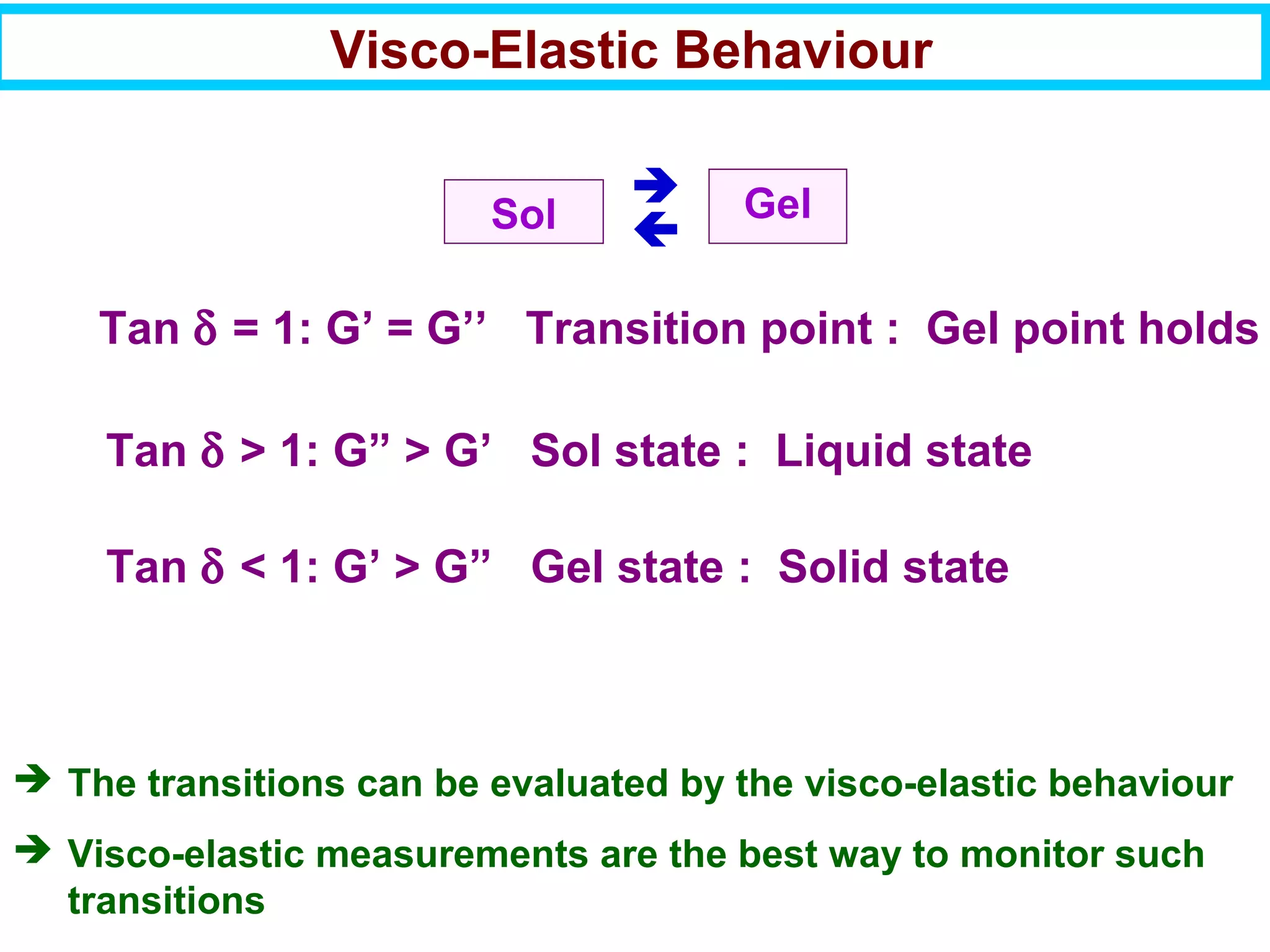
Tan δ = 1: G’ = G’’ Transition point : Gel point holds
 The transitions can be evaluated by the visco-elastic behaviour
 Visco-elastic measurements are the best way to monitor such
transitions
Tan δ > 1: G” > G’ Sol state : Liquid state
Tan δ < 1: G’ > G” Gel state : Solid state
Visco-Elastic Behaviour
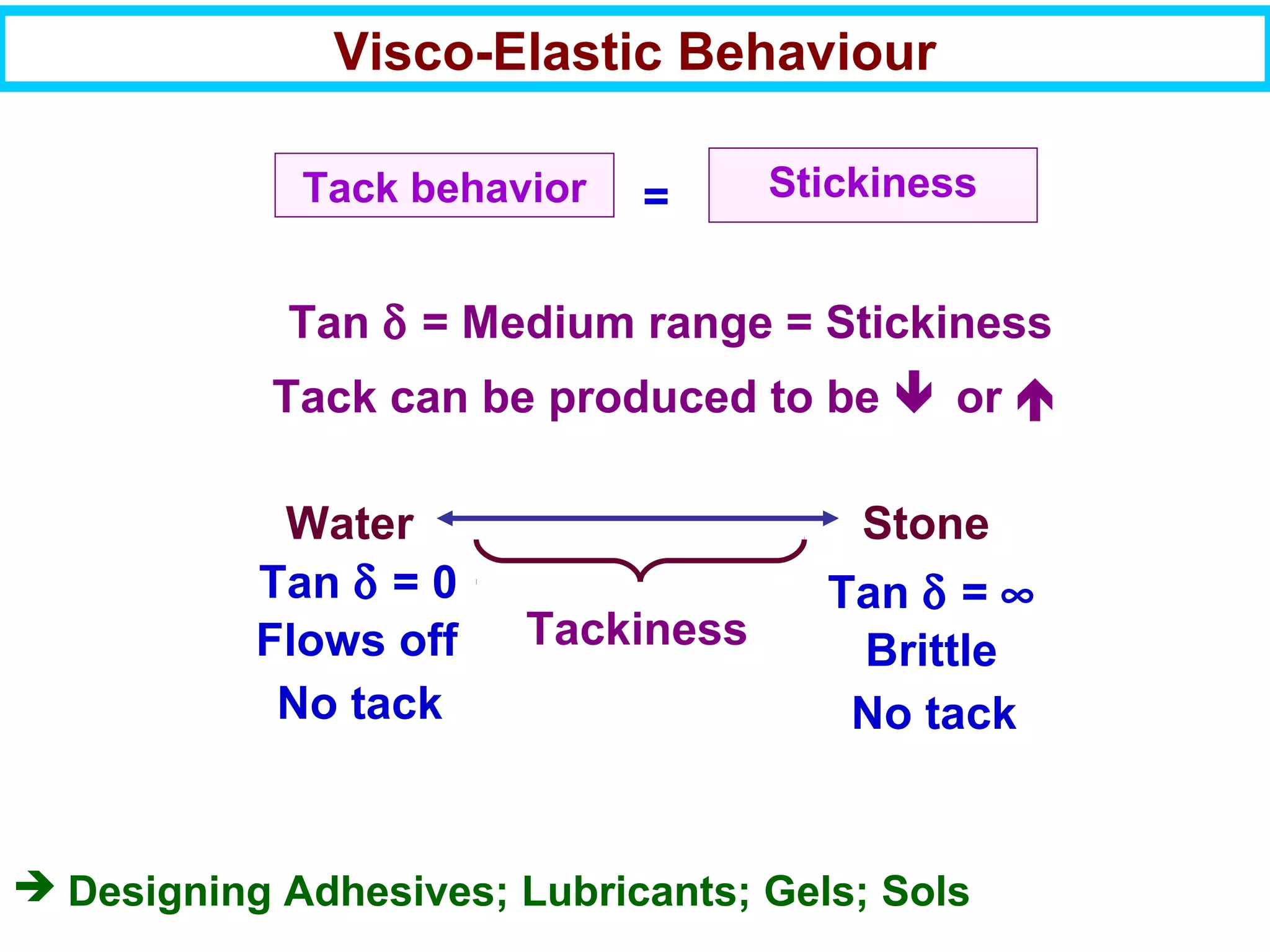
Tack behavior Stickiness=
Tan δ = Medium range = Stickiness
Tack can be produced to be  or 
Water Stone
Tan δ = 0
Flows off
No tack
Tan δ = ∞
Brittle
No tack
 Designing Adhesives; Lubricants; Gels; Sols
Tackiness
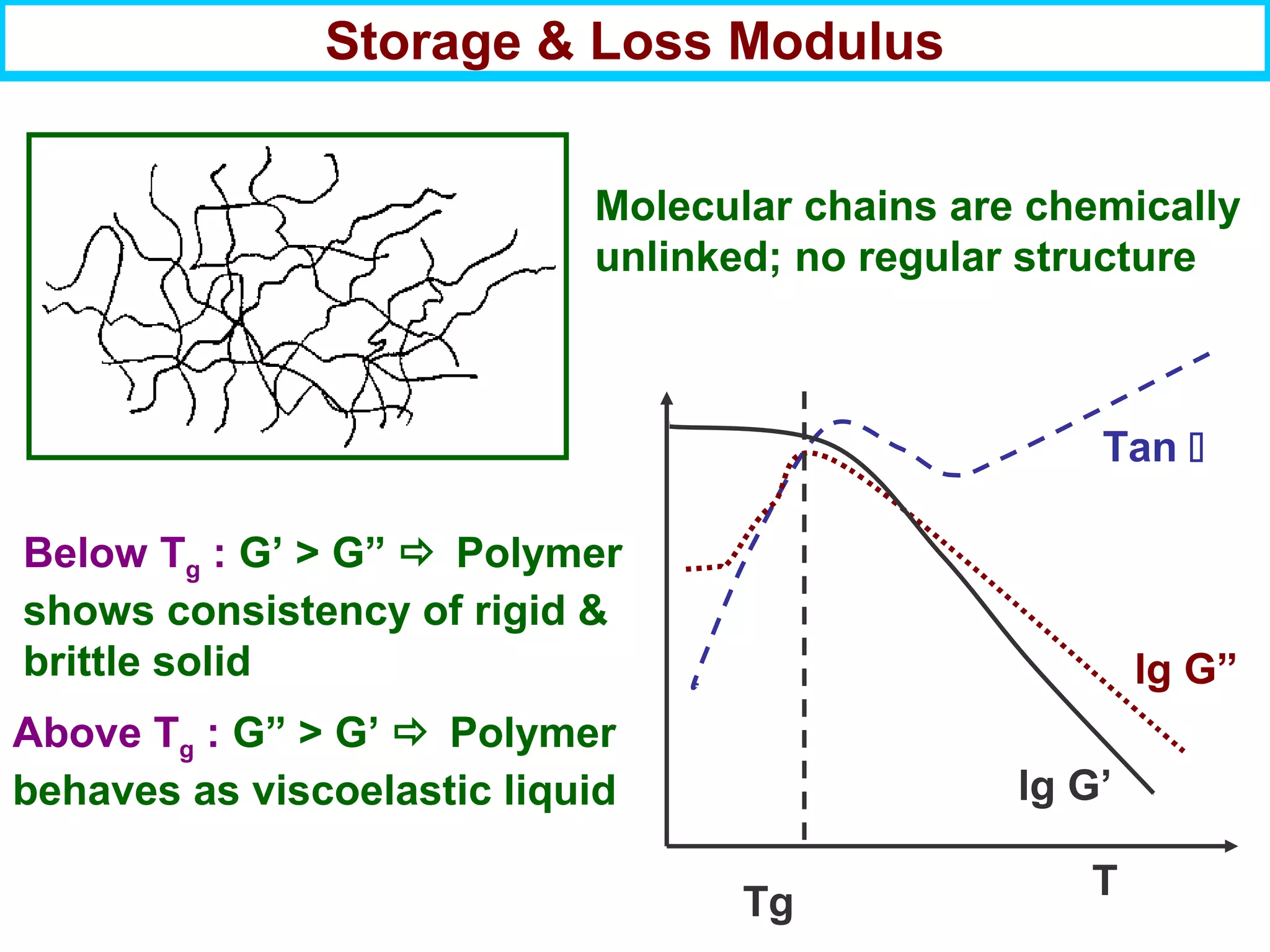
T
Tg
lg G’
Tan 
lg G”
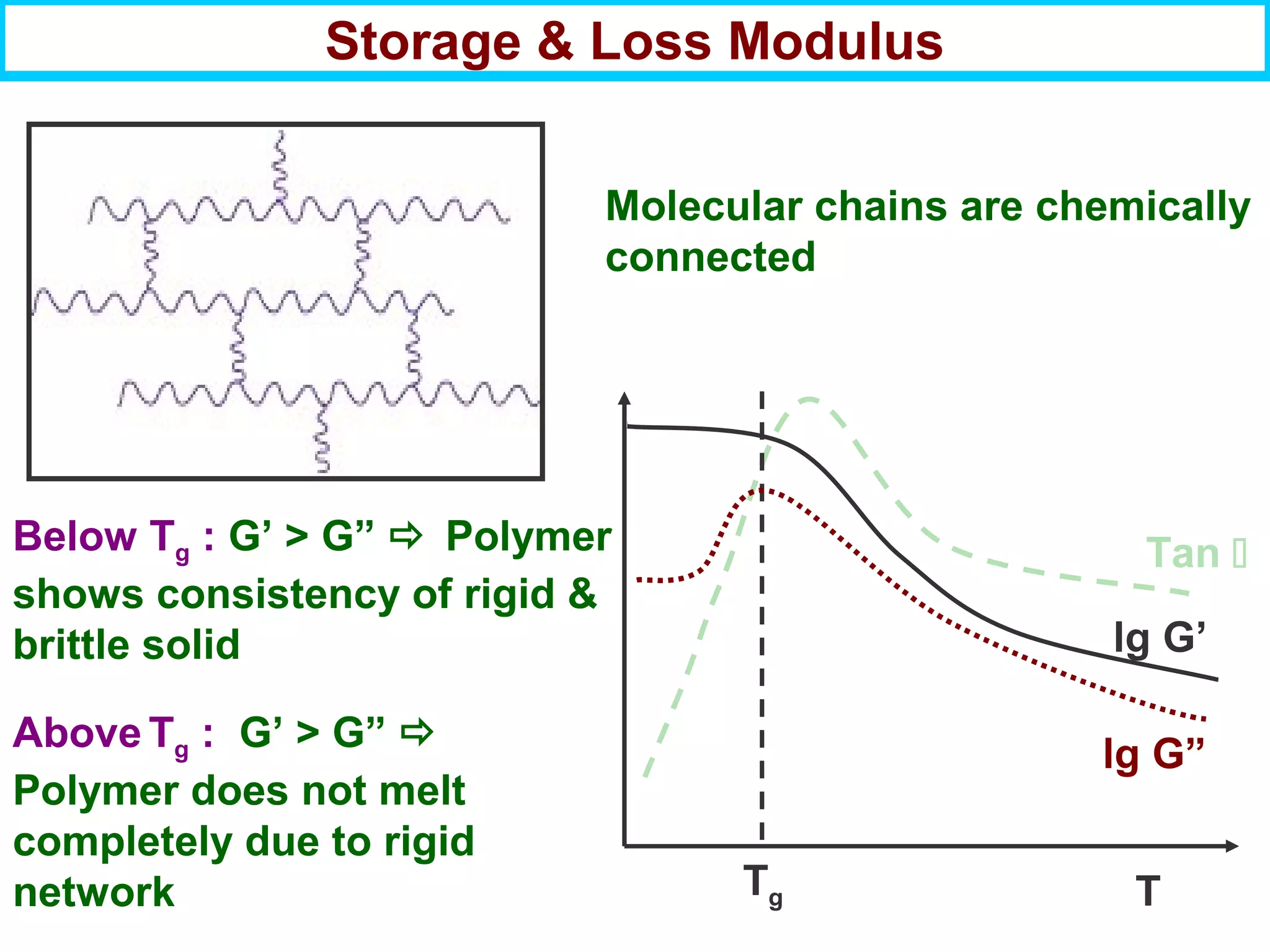
Molecular chains are chemically
unlinked; no regular structure
Below Tg : G’ > G”  Polymer
shows consistency of rigid &
brittle solid
Above Tg : G” > G’  Polymer
behaves as viscoelastic liquid
Storage & Loss Modulus
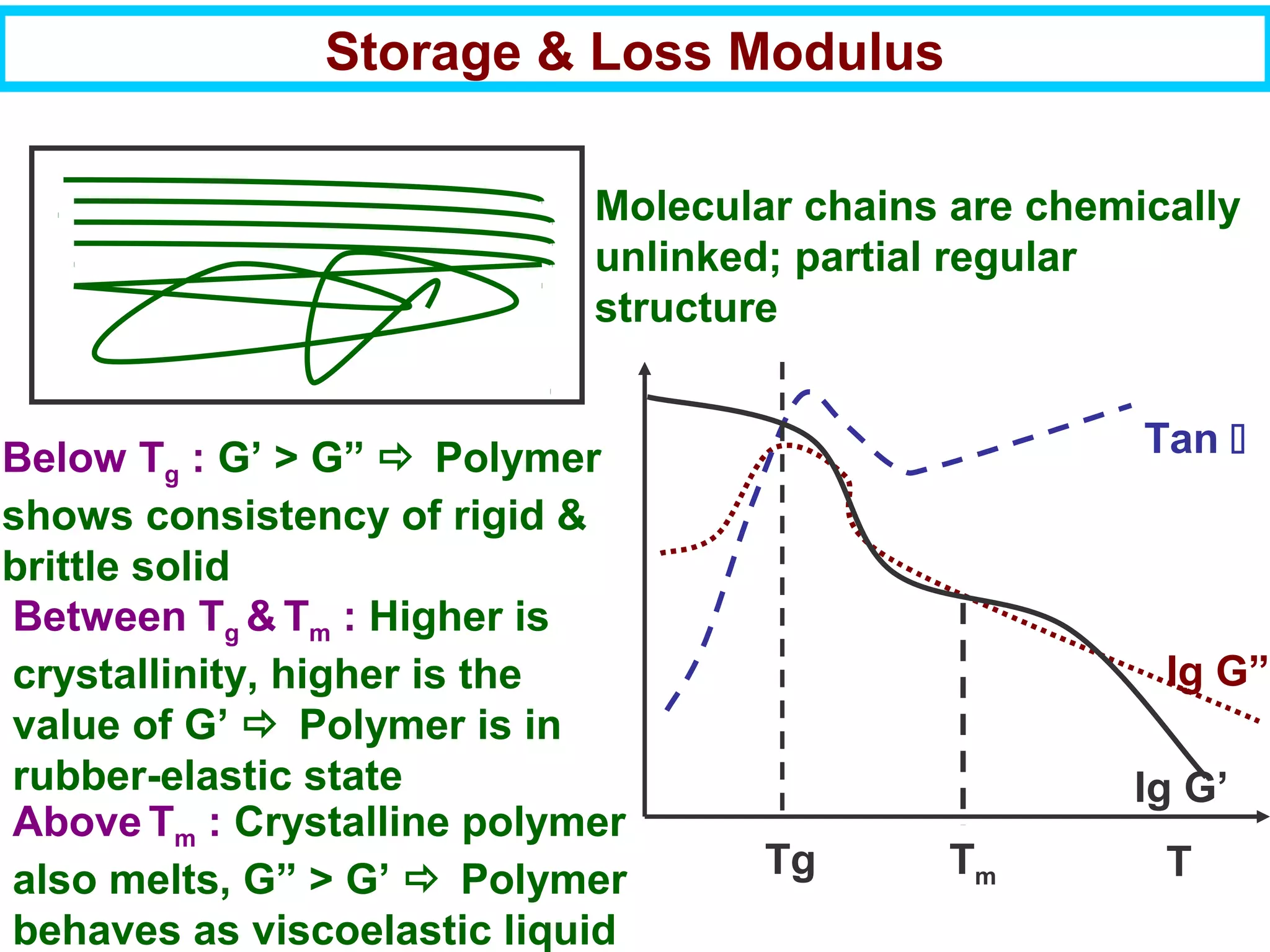
Molecular chains are chemically
unlinked; partial regular
structure
Below Tg : G’ > G”  Polymer
shows consistency of rigid &
brittle solid
Between Tg & Tm : Higher is
crystallinity, higher is the
value of G’  Polymer is in
rubber-elastic state Ig G’
Tan 
Ig G”
Tg TTm
Above Tm : Crystalline polymer
also melts, G” > G’  Polymer
behaves as viscoelastic liquid
Storage & Loss Modulus
Tan 
Tg
lg G’
lg G”
T
Molecular chains are chemically
connected
Below Tg : G’ > G”  Polymer
shows consistency of rigid &
brittle solid
Above Tg : G’ > G” 
Polymer does not melt
completely due to rigid
network
THANK YOU

Keynote090310

  • 1.
    DR. R. K.KHANDAL SHRIRAM INSTITUTE FOR INDUSTRIAL RESEARCH 19, UNIVERSITY ROAD, DELHI-110 007 Email : sridlhi@vsnl.com Website : www.shriraminstitute.org POLYMER WORKFLOW – FROM PELLET TO PRODUCT RELEVANCE OF THERMAL & RHEOLOGICAL ANALYSIS Keynote Address by
  • 2.
    Outline  From Pelletto Product : Steps, Process & Properties  Thermal Analysis by DSC & TGA  Rheological Properties  Importance of Rheology  Visco-Elastic Behaviour
  • 3.
    Monomer Pellet From Pellet toProduct: Steps Product Type CharacteristicsNature Chemistry IonicFunctionality Unsaturation Non-ionic Esters Amides Urethanes Olefinics Vinylics Ketones Sulfones Carbohy- drate Viscosity Polarity Stability Physico-mechanical Physico-chemical Thermal Electrical Optical Magnetic Homopolymer Copolymer Cross-linked Thermoplastic Thermoplastic Thermoset Melting Plastic Mol. Wt. Mol. Wt. distribution Crystallinity Flow Alcohols Acids Unsaturation Application- driven Shape- driven  Thermo-plastic behaviour: Key feature for designing polymeric product  Flow properties & thermal characteristics need to be understood for processing Polymerization Extrusion Processing Fabrication Thermoplastic ThermosetPolymer
  • 4.
    Granules Melt Pellet Flow From Pellet toProduct: Steps Product Flakes Powders Fluid Block Die Mold Films LensFiber
  • 5.
    Heat sink PRESSUREHEAT From Pelletto Product: Process Melt Absorbed Released Heat outflow Crystallization Deformation Flow Phase change  Key process parameters: Heat & Pressure  Behaviour under heat & pressure: Thermal & Rheological analysis Flow
  • 6.
    Melting PointPellet Processing From Pelletto Product : Properties Product Mol. Weight Uniformity Stability Flow Wear & tear Stability Compatibility Mol. Wt. Distribution Compatibility Thermal Rheological Temp./ Time dependent Shear stress/ strain Consistency  Thermal analysis combined with rheological analysis is an added advantage for process/ product design Stability Interparticle interactions Processibility
  • 7.
    Differential Scanning Calorimetry(DSC)  Glass transition temperature  Provides qualitative & quantitative information  Analysis as a function of temperature & time  Melting/ boiling points Heats of fusion & reaction Percent crystallinity  Crystallization time and temperature  Specific heat Oxidative stability Rate/ degree of cure Reaction kinetics  Purity Measures temperature & heat flow associated with transitions
  • 8.
    Thermogravimetric Analyzer (TGA) Provides quantitative weight change information  Analysis as a function of temperature  Moisture & Volatile content  Composition of multi-component systems  Thermal stability  Oxidative stability  Shelf-life studies using kinetic analysis Decomposition kinetics Effect of reactive atmosphere Measures weight changes as temperature is increased
  • 9.
    Glass Transition -DSC  Step in thermogram  Transition from solid to liquid  Transformation of a glass-forming liquid into a glass  Tg, glass transition temperature Temperature, K DSC thermogram dH/dt,mJ/s Glass transition Tg
  • 10.
    Crystallization  Sharp exothermicpeak  Disordered to ordered transition  Material can crystallize  Observed in glassy solids, e.g., polymers  Tc, crystallization temperature Temperature, K DSC thermogram dH/dt,mJ/s Crystallization Tc
  • 11.
    Melting  Endothermic peak Ordered to disordered transition  Tm, melting temperature  Tm > Tg Temperature, K DSC thermogram dH/dt,mJ/s Melting Tm
  • 12.
     dqp/dt =heat flow  dT/dt = heating rate  (dqp/dt) / (dT/dt) = dqp/dT = cp Heat Capacity  Specific heat capacity is the measure of heat energy required to raise the temperature of a unit amount of the substance by 1°C
  • 13.
  • 14.
    Newtonian Example :Oil,Water Shear rateγ• [1/ S] Shearstressτ[Pa] Viscosity is independent of shear rate  Shear rate ∝ shear stress
  • 15.
    Non-Newtonian: Dilatant Shear-thickening orDilatant Shear rate[1/S] Shearstressτ[Pa] Viscosity  with  in shear rate Example: ceramic suspension, plastisol pastes, starch dispersions
  • 16.
    Non-Newtonian: Pseudoplastic Shear rate[1/γ• S] Shear thinning: Example: Polymer melts, paints, glues. Viscosity  as shear rate  Material shows plasticity only after yield point  Above yield point Plasticity,below yield point elasticity Shearstressτ[Pa]
  • 17.
    THIXOTROPY & RHEOPEXY Time(t) ForThixotropic materials, viscosity  as time , at a constant shear rate. Example: Paraffin oil,Pastes,cream,gels For Rheopectic fluid , viscosity as time  at a constant shear rate Thixotropic Rheopectic Shearstressτ[Pa]
  • 18.
    Rheological Properties Ideal SolidIdeal Fluid Steel Water Strong Structure Weak Structure Rigidity Fluidity Deformation Flow Retains / recovers form Looses form Stores Energy Dissipates Energy Purely Elastic Purely Viscous V I S C O E L A S T I C Elasticity Viscosity Polymer melts & solutions exhibit a combination of viscous & elastic response: Viscoelastic
  • 19.
    Single phase: GasLiquid Solid Interparticle interactions are independent of time but depend on temperature Viscosity or elasticity     Multiphase : Suspension/ Emulsion / Suspoemulsion Interactions depend on concentration, time & temperature Visco-Elastic Macromolecules: Polymeric/ Oligomeric Interactions depend upon time & temperature Visco-Elastic Visco-Elastic Behaviour
  • 20.
    Solute - SolventInteractions Polysaccharide Hydrated Polysaccharide The molecules do not see each other. Interparticle distance > the total of hydrodynamic radii Soft interactions : Interactions occur at the hydrodynamic radii Hard interactions : Interactions occur at the level of the polymeric chains entangling with each other < 0.05 % Conc. > 0.05 % > 0.6 %
  • 21.
    Loss Factor ordamping factor Tan = Sin δ / Cos δ = G” / G’ Lost Energy Stored Energy Viscous Elastic = 0 ≤ tanδ ≤ tan ∞ 0° ≤ δ ≤ 90 °; δ = 0, tan δ = 0: G’ >>> G” δ = 90 ° , tan δ = ∞ : G’ <<< G” δ = 45 ° , tan δ = 1 : G’ = G” Visco-Elastic Behaviour
  • 22.
    Sol Gel  Tan δ= 1: G’ = G’’ Transition point : Gel point holds  The transitions can be evaluated by the visco-elastic behaviour  Visco-elastic measurements are the best way to monitor such transitions Tan δ > 1: G” > G’ Sol state : Liquid state Tan δ < 1: G’ > G” Gel state : Solid state Visco-Elastic Behaviour
  • 23.
    Visco-Elastic Behaviour Tack behaviorStickiness= Tan δ = Medium range = Stickiness Tack can be produced to be  or  Water Stone Tan δ = 0 Flows off No tack Tan δ = ∞ Brittle No tack  Designing Adhesives; Lubricants; Gels; Sols Tackiness
  • 24.
    T Tg lg G’ Tan  lgG” Molecular chains are chemically unlinked; no regular structure Below Tg : G’ > G”  Polymer shows consistency of rigid & brittle solid Above Tg : G” > G’  Polymer behaves as viscoelastic liquid Storage & Loss Modulus
  • 25.
    Molecular chains arechemically unlinked; partial regular structure Below Tg : G’ > G”  Polymer shows consistency of rigid & brittle solid Between Tg & Tm : Higher is crystallinity, higher is the value of G’  Polymer is in rubber-elastic state Ig G’ Tan  Ig G” Tg TTm Above Tm : Crystalline polymer also melts, G” > G’  Polymer behaves as viscoelastic liquid Storage & Loss Modulus
  • 26.
    Storage & LossModulus Tan  Tg lg G’ lg G” T Molecular chains are chemically connected Below Tg : G’ > G”  Polymer shows consistency of rigid & brittle solid Above Tg : G’ > G”  Polymer does not melt completely due to rigid network
  • 27.