PROSPECTING & CAPTURING
BUSINESS OPPORTUNITIES FROM
INNOVATION & TECHNOLOGY
SHRIRAM INSTITUTE FOR INDUSTRIAL RESEARCH
19, UNIVERSITY ROAD, DELHI-110 007
Presented by :
Dr. R.K. KHANDAL
Email : sridlhi@vsnl.com Website : www.shriraminstitute.org
OUTLINE OF THE PRESENTATION
1. Defining Innovation
2. Dimensions of Innovation
3. Steps involved in Innovation
4. Driving force for Innovation
5. Technology
6. Technology Package
1. Defining Innovation
DEFINING INNOVATION
 Innovation is sought at every step
 Not necessarily, every development can be termed as innovation
Product
DEVELOPMENT
CYCLE
Improvement
Modification
R & D
Technology
Material & Process
Requirement
Cost Quality
Value additionPerformance
IndustrialAcademic
Alternate Green
Alternative New
Advance Simple
2. Dimensions of Innovation
DIMENSIONS OF INNOVATION
INNOVATION
SCIENTIFIC
APPLICATIONS
BUSINESS
DEVELOPMENT
TECHNOLOGY
DEVELOPMENT
SOCIETIAL UPLIFTMENT
 Ordinary
 Extraordinary
Gains
DIMENSIONS OF INNOVATION
Parameter
 Both are complementary and essential
 While the ordinary innovations succeed due to the involvement
and use of the local resources, the extraordinary innovations
would need a special set up as also an altogether different
nurturing approach
Ordinary Extraordinary
Significant Substantial
Coverage Local Global
Driving force Skill Knowledge
Diffusion Society Technology
Degree Simple Advance
Impact Short Term Long Term
Changing the way business is
done in terms of capturing value
DIMENSIONS OF INNOVATION: ORDINARY
BUSINESS MODEL
INNOVATION
Development of new marketing
methods with improvement in
product design, promotion or
pricing
MARKETING
INNOVATION
Creation or alteration of business
structures, practices, and models
ORGANIZATIONAL
INNOVATION
Implementation of a new or
significantly improved production
or delivery method
PROCESS
INNOVATION
`
Introduction of a new good or service
that is new or substantially improved
DIMENSIONS OF INNOVATION: ORDINARY
Refers to service product innovation
which might be, compared to goods
product or process innovation
Sourcing of input products from
suppliers and the delivery of output
products to customers
Introducing a different product or
service within the same line
PRODUCT
INNOVATION
SERVICE
INNOVATION
SUPPLY CHAIN
INNOVATION
SUBSTANTIAL
INNOVATION
Providing the assistance to the users to
value add their product
VALUE ADDITION
INNOVATION
A new product with innovative
approach process or from
alternative materials
DIMENSIONS OF INNOVATION:
EXTRAORDINARY
Existing product for novel
application
Novel ways to obtain sustainable
materials with unique features &
properties
PRODUCT
INNOVATION
APPLICATION
INOVATION
MATERIALS
INNOVATION
Process using natural route and
mechanism
PROCESS
INNOVATION
3. Steps involved in Innovation
STEPS INVOLVED IN INNOVATION
Initiation; Analysis of situation,
identification of challenges
Collecting ideas Developing ideas
Systematic
recording of ideas
Screening
Evaluation
Decision
Implementation
Diffusion
Innovationcontrol
Implementation,
Evaluation,generating
ideas
 A policy that encourages the translation of ideas into products
that are easily diffused would ensure competitiveness
4. Driving Force For Innovation
Reduced
labour costs
Creation of
new
markets
Improved
quality
Conformanc
e to
regulations
Reduced
materials
Extension of
the product
range
Reduced
environmental
damage
Improved
production
processes
DRIVING FORCE FOR INNOVATION:
FACTORS FOR COMPETITIVENESS
Replacement
of products/
services
Reduced
energy
consumption
Factors For
Competitiveness
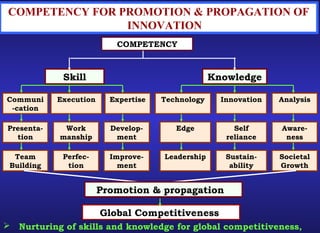
COMPETENCY
Skill Knowledge
Communi
-cation
Execution
 Nurturing of skills and knowledge for global competitiveness,
COMPETENCY FOR PROMOTION & PROPAGATION OF
INNOVATION
Expertise Technology Innovation Analysis
Presenta-
tion
Work
manship
Develop-
ment
Edge Self
reliance
Aware-
ness
Team
Building
Perfec-
tion
Improve-
ment
Leadership Sustain-
ability
Societal
Growth
Global Competitiveness
Promotion & propagation
INNOVATION FOR GLOBAL COMPETITIVENESS
INNOVATION
NextDifferentShift
 Change is the only tool for survival, growth and global
competitiveness; through innovation
BetterImprovedAlternative
CompetencyGrowthOptions
Global Competitiveness
LeadershipSelf RelianceSustainability
5. Technology
 Approach Dynamics : Evolutionary Process
 Approach Dynamics : Technology Inputs
 Approach Dynamics : Technology Process
 Approach Dynamics : Technology Outputs
 Technology Transfer
TECHNOLOGY
APPROACH DYNAMICS : EVOLUTIONARY PROCESS
 The process of development of technology has
under gone a continuous evolutionary changes
over the years depending upon the changes in
requirements, availability of resources and
awareness about environment & ecology
 The evolutionary changes have directly affected
the approach dynamics in several ways but
mainly in terms of :
 Technology Inputs
 Technology Process
 Technology Outputs
APPROACH DYNAMICS : TECHNOLOGY INPUTS
Work Force
Regimental
Non-Hierarchical
Multi-racial
Global
Machine
Heavy
Light
Automation
Biotech
Materials
Selective
Collective
Sustainability
Alternatives
 Changes in approach in line with evolutionary developments
lead to the approach dynamics requiring completely different
technology inputs
 Production focus to customer focus
 Resource utilization focus to sustainability focus
 Hardware focus to software focus
APPROACH DYNAMICS : TECHNOLOGY PROCESS
Production Focus
Process
Multi-product
Batch wise
Multi-product
Continuous
Hardware Focus
On-line
Control
Automation
Resource Utilisation Focus
Production
Rate
First Time Pass Rate
Manual Control % YieldBatch wise
Green Concepts
Customer Focus
Distributed Control System
Energy Efficiency
Process Controls
Software Focus Sustainability Focus
Process Efficiency
Env. Friendly Fail Safe
Sustainability Focus
Effluent Reduction
APPROACH DYNAMICS : TECHNOLOGY OUTPUTS
Quality Focus
Purity
Impurity Profile
Use Focus
Purpose & Application
Specific
Bulk Quality
Residual Control
Safety Focus
Degradation
Life Cycle
Disposal Focus
Cradle -to-Grave
Quality
Recycle
Reduction
Utilization
Value Addition
Safe Disposal
Cost Reduction
Efficiency Focus
PRODUCT BY-PRODUCT
 While selecting a technology, all essential components of technology package
must be understood
TECHNOLOGY TRANSFER
Technology
 Input
 Process
 Output
Technology
Document
 Methodology
 Algorithm
 Control Data
Technology
Package
 Process
 Product
 Application
 Costs
 Safety Data
Technology
Transfer
 Knowledge
 Research Backup
 Capability to adopt
 Capability to innovate
6. Technology Package
 Technology Package : Components
 Feasibility / Acceptability / Adaptability
 Techno-Economic Viability
 Technology : Know-How
 Technology : Know Why?
 Technology : Know All
 Innovation & Improvements
 Environment Friendliness : Sustainability
TECHNOLOGY PACKAGE
TECHNOLOGY PACKAGE : COMPONENTS
Is the package wholesome?
TECHNOLOGY
PACKAGE
Feasibility
Improvement
Innovation
Economic/
Technical
viability
Know All
Know Why
Know How
Is it inline with requirements?
Sustainability
FEASIBILITY /ACCEPTABILITY / ADAPTABILITY
INPUT PROCESS OUTPUT
 Market demand
 Market potential
 Value addition
 Export potential
 Availability
 Sustainability
 Feasibility: important for technology selection
 Must before selecting technology & partner
 Adaptable
 Available resources
 Safety & hazards
scrutiny
INPUT PROCESS OUTPUT
• Technology cost
• Equipment cost
• Manpower cost
• Safety cost
• Tech. capability
• Affordable
• Value addition for
consumer
• Competitive export
 Cost-effectiveness:
 can convert potential into demand;
 low cost quality product always preferred
TECHNO-ECONOMIC VIABILITY
• Availability cost
• Sustainability
• Necessary skills
INPUT PROCESS OUTPUT

Process Parameters

Process Conditions

Process Control

Control Parameters

Efficiency Hazards

Percent Yield

Percent Purity

By-products and
impurities

Packing conditions

Packaging, Storage &
Handling

Raw Materials
Quality of RMs

Selection of Raw
Materials

Composition of RMs

Process Equipment,
Space Auxiliaries &
Utilities
 Important for the adoption of technology as per the design and
meeting design criteria
TECHNOLOGY : KNOW-HOW
INPUT PROCESS OUTPUT

Batch/continuous
sequence of addition of
RMs

A particular way

A given route
 Important for continuous improvements in terms of time,
cost, quality, efficiency, safety and sustainability
TECHNOLOGY : KNOW WHY?

A given type of raw
material (RM)

A typical composition

Given Application

A typical composition
INPUT PROCESS OUTPUT
 Why a given
process
 Why not flexibility
 Carry over
reactions
 Algorithm
 With waste
 With by-products
 Failed batches
 Spillages
 Failure on storage
and handling
 Enhance shelf-life
 Safety data
 Why this ?
 Why not that ?
 Alternates
 Important for over all success of the technology, technology
transfer and its adaptation
TECHNOLOGY : KNOW ALL
INPUT PROCESS OUTPUT
Process modification to:
• Minimize batch cycle time
• Maximize productivity
• Minimum hazards
• Green route
• Maximize yield
• Minimize inputs
• Minimize waste
• Reduction of
rejections
• Alternate source of
RMs
• Alternate process
equipment
 Never ending tool for development of newer technologies,
improved product quality and cost-effective product
INNOVATION & IMPROVEMENTS
ENVIRONMENT FRIENDLINESS : SUSTAINABILITY
INPUT PROCESS OUTPUT
 Effluent treatment
 Non-hazardous by-
products
 Energy-efficiency
 Green route
 Biodegradability and
cradle -to - grave
approach
 Impact on
environment is
minimum
 Renewable resource
 Impact on
environment due to
RM production
 Environment-friendliness has become over riding factor and
criteria for success of any technology
 While deciding about technology it must be ensured
CONCLUSION
Prospecting with:
 Defining objectives
 Evaluating options against objectives
 Assessing level of innovation
 Short listing the right partner and technology
Capturing through:
 Know-how
 Technology package
 Continuous innovation support system
THANK YOU

Prospecting & capturing

  • 1.
    PROSPECTING & CAPTURING BUSINESSOPPORTUNITIES FROM INNOVATION & TECHNOLOGY SHRIRAM INSTITUTE FOR INDUSTRIAL RESEARCH 19, UNIVERSITY ROAD, DELHI-110 007 Presented by : Dr. R.K. KHANDAL Email : sridlhi@vsnl.com Website : www.shriraminstitute.org
  • 2.
    OUTLINE OF THEPRESENTATION 1. Defining Innovation 2. Dimensions of Innovation 3. Steps involved in Innovation 4. Driving force for Innovation 5. Technology 6. Technology Package
  • 3.
  • 4.
    DEFINING INNOVATION  Innovationis sought at every step  Not necessarily, every development can be termed as innovation Product DEVELOPMENT CYCLE Improvement Modification R & D Technology Material & Process Requirement Cost Quality Value additionPerformance IndustrialAcademic Alternate Green Alternative New Advance Simple
  • 5.
    2. Dimensions ofInnovation
  • 6.
  • 7.
    Gains DIMENSIONS OF INNOVATION Parameter Both are complementary and essential  While the ordinary innovations succeed due to the involvement and use of the local resources, the extraordinary innovations would need a special set up as also an altogether different nurturing approach Ordinary Extraordinary Significant Substantial Coverage Local Global Driving force Skill Knowledge Diffusion Society Technology Degree Simple Advance Impact Short Term Long Term
  • 8.
    Changing the waybusiness is done in terms of capturing value DIMENSIONS OF INNOVATION: ORDINARY BUSINESS MODEL INNOVATION Development of new marketing methods with improvement in product design, promotion or pricing MARKETING INNOVATION Creation or alteration of business structures, practices, and models ORGANIZATIONAL INNOVATION Implementation of a new or significantly improved production or delivery method PROCESS INNOVATION `
  • 9.
    Introduction of anew good or service that is new or substantially improved DIMENSIONS OF INNOVATION: ORDINARY Refers to service product innovation which might be, compared to goods product or process innovation Sourcing of input products from suppliers and the delivery of output products to customers Introducing a different product or service within the same line PRODUCT INNOVATION SERVICE INNOVATION SUPPLY CHAIN INNOVATION SUBSTANTIAL INNOVATION Providing the assistance to the users to value add their product VALUE ADDITION INNOVATION
  • 10.
    A new productwith innovative approach process or from alternative materials DIMENSIONS OF INNOVATION: EXTRAORDINARY Existing product for novel application Novel ways to obtain sustainable materials with unique features & properties PRODUCT INNOVATION APPLICATION INOVATION MATERIALS INNOVATION Process using natural route and mechanism PROCESS INNOVATION
  • 11.
    3. Steps involvedin Innovation
  • 12.
    STEPS INVOLVED ININNOVATION Initiation; Analysis of situation, identification of challenges Collecting ideas Developing ideas Systematic recording of ideas Screening Evaluation Decision Implementation Diffusion Innovationcontrol Implementation, Evaluation,generating ideas  A policy that encourages the translation of ideas into products that are easily diffused would ensure competitiveness
  • 13.
    4. Driving ForceFor Innovation
  • 14.
    Reduced labour costs Creation of new markets Improved quality Conformanc eto regulations Reduced materials Extension of the product range Reduced environmental damage Improved production processes DRIVING FORCE FOR INNOVATION: FACTORS FOR COMPETITIVENESS Replacement of products/ services Reduced energy consumption Factors For Competitiveness
  • 15.
    COMPETENCY Skill Knowledge Communi -cation Execution  Nurturingof skills and knowledge for global competitiveness, COMPETENCY FOR PROMOTION & PROPAGATION OF INNOVATION Expertise Technology Innovation Analysis Presenta- tion Work manship Develop- ment Edge Self reliance Aware- ness Team Building Perfec- tion Improve- ment Leadership Sustain- ability Societal Growth Global Competitiveness Promotion & propagation
  • 16.
    INNOVATION FOR GLOBALCOMPETITIVENESS INNOVATION NextDifferentShift  Change is the only tool for survival, growth and global competitiveness; through innovation BetterImprovedAlternative CompetencyGrowthOptions Global Competitiveness LeadershipSelf RelianceSustainability
  • 17.
  • 18.
     Approach Dynamics: Evolutionary Process  Approach Dynamics : Technology Inputs  Approach Dynamics : Technology Process  Approach Dynamics : Technology Outputs  Technology Transfer TECHNOLOGY
  • 19.
    APPROACH DYNAMICS :EVOLUTIONARY PROCESS  The process of development of technology has under gone a continuous evolutionary changes over the years depending upon the changes in requirements, availability of resources and awareness about environment & ecology  The evolutionary changes have directly affected the approach dynamics in several ways but mainly in terms of :  Technology Inputs  Technology Process  Technology Outputs
  • 20.
    APPROACH DYNAMICS :TECHNOLOGY INPUTS Work Force Regimental Non-Hierarchical Multi-racial Global Machine Heavy Light Automation Biotech Materials Selective Collective Sustainability Alternatives  Changes in approach in line with evolutionary developments lead to the approach dynamics requiring completely different technology inputs
  • 21.
     Production focusto customer focus  Resource utilization focus to sustainability focus  Hardware focus to software focus APPROACH DYNAMICS : TECHNOLOGY PROCESS Production Focus Process Multi-product Batch wise Multi-product Continuous Hardware Focus On-line Control Automation Resource Utilisation Focus Production Rate First Time Pass Rate Manual Control % YieldBatch wise Green Concepts Customer Focus Distributed Control System Energy Efficiency Process Controls Software Focus Sustainability Focus Process Efficiency Env. Friendly Fail Safe Sustainability Focus Effluent Reduction
  • 22.
    APPROACH DYNAMICS :TECHNOLOGY OUTPUTS Quality Focus Purity Impurity Profile Use Focus Purpose & Application Specific Bulk Quality Residual Control Safety Focus Degradation Life Cycle Disposal Focus Cradle -to-Grave Quality Recycle Reduction Utilization Value Addition Safe Disposal Cost Reduction Efficiency Focus PRODUCT BY-PRODUCT
  • 23.
     While selectinga technology, all essential components of technology package must be understood TECHNOLOGY TRANSFER Technology  Input  Process  Output Technology Document  Methodology  Algorithm  Control Data Technology Package  Process  Product  Application  Costs  Safety Data Technology Transfer  Knowledge  Research Backup  Capability to adopt  Capability to innovate
  • 24.
  • 25.
     Technology Package: Components  Feasibility / Acceptability / Adaptability  Techno-Economic Viability  Technology : Know-How  Technology : Know Why?  Technology : Know All  Innovation & Improvements  Environment Friendliness : Sustainability TECHNOLOGY PACKAGE
  • 26.
    TECHNOLOGY PACKAGE :COMPONENTS Is the package wholesome? TECHNOLOGY PACKAGE Feasibility Improvement Innovation Economic/ Technical viability Know All Know Why Know How Is it inline with requirements? Sustainability
  • 27.
    FEASIBILITY /ACCEPTABILITY /ADAPTABILITY INPUT PROCESS OUTPUT  Market demand  Market potential  Value addition  Export potential  Availability  Sustainability  Feasibility: important for technology selection  Must before selecting technology & partner  Adaptable  Available resources  Safety & hazards scrutiny
  • 28.
    INPUT PROCESS OUTPUT •Technology cost • Equipment cost • Manpower cost • Safety cost • Tech. capability • Affordable • Value addition for consumer • Competitive export  Cost-effectiveness:  can convert potential into demand;  low cost quality product always preferred TECHNO-ECONOMIC VIABILITY • Availability cost • Sustainability • Necessary skills
  • 29.
    INPUT PROCESS OUTPUT  ProcessParameters  Process Conditions  Process Control  Control Parameters  Efficiency Hazards  Percent Yield  Percent Purity  By-products and impurities  Packing conditions  Packaging, Storage & Handling  Raw Materials Quality of RMs  Selection of Raw Materials  Composition of RMs  Process Equipment, Space Auxiliaries & Utilities  Important for the adoption of technology as per the design and meeting design criteria TECHNOLOGY : KNOW-HOW
  • 30.
    INPUT PROCESS OUTPUT  Batch/continuous sequenceof addition of RMs  A particular way  A given route  Important for continuous improvements in terms of time, cost, quality, efficiency, safety and sustainability TECHNOLOGY : KNOW WHY?  A given type of raw material (RM)  A typical composition  Given Application  A typical composition
  • 31.
    INPUT PROCESS OUTPUT Why a given process  Why not flexibility  Carry over reactions  Algorithm  With waste  With by-products  Failed batches  Spillages  Failure on storage and handling  Enhance shelf-life  Safety data  Why this ?  Why not that ?  Alternates  Important for over all success of the technology, technology transfer and its adaptation TECHNOLOGY : KNOW ALL
  • 32.
    INPUT PROCESS OUTPUT Processmodification to: • Minimize batch cycle time • Maximize productivity • Minimum hazards • Green route • Maximize yield • Minimize inputs • Minimize waste • Reduction of rejections • Alternate source of RMs • Alternate process equipment  Never ending tool for development of newer technologies, improved product quality and cost-effective product INNOVATION & IMPROVEMENTS
  • 33.
    ENVIRONMENT FRIENDLINESS :SUSTAINABILITY INPUT PROCESS OUTPUT  Effluent treatment  Non-hazardous by- products  Energy-efficiency  Green route  Biodegradability and cradle -to - grave approach  Impact on environment is minimum  Renewable resource  Impact on environment due to RM production  Environment-friendliness has become over riding factor and criteria for success of any technology  While deciding about technology it must be ensured
  • 34.
    CONCLUSION Prospecting with:  Definingobjectives  Evaluating options against objectives  Assessing level of innovation  Short listing the right partner and technology Capturing through:  Know-how  Technology package  Continuous innovation support system
  • 35.