Ketone Bodies
Ketone bodies are water soluble products of lipid oxidation that are
formed in liver and kidney mitochondria during fasting. They include
• Acetoacetic acid
• β-hydroxybutyrate
• Acetone
They are synthesized from acetyl coA produced by fatty acid and amino
acid catabolism. They serve as an important energy source for organs
such as cardiac muscle, skeletal muscle and brain during fasting.
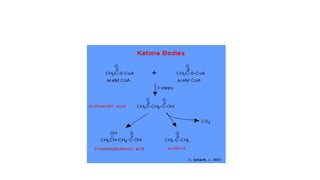
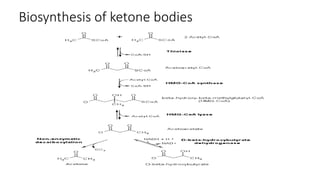
• Ketone body synthesis occurs in the mitochondrial
matrix and begins with condensation of two acetyl
coA molecules to form acetoacetyl coA, in a reaction
that is the reverse of the final step of β - oxidation.The
enzyme involved, β-ketothiolase is an isozyme of the
enzyme that functions in β-oxidation. HMG-coA
synthase catalyzes the condensation of acetoacetyl
coA with another molecule of acetyl coA to form β-
hydroxy- β-methyl glutayl coenzyme A(HMG-coA).
HMGcoA lyase then cleaves HMGCoA to yield
acetoacetic acid and acetyl coA.
Biosynthesis of ketone bodies
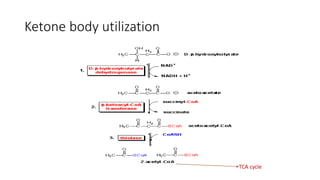
Ketone Bodies are metabolized in the mitochondria of
non hepatic tissues. Β-hydroxybutyrate
dehydrogenase converts β-hydroxybutyrate to
acetoacetate by an NAD-linked oxidation.
Acetoacetate is the converted to its CoA derivative by
acetoacetate: succinyl-CoA transferase, which is
present in tissue that use ketone bodies but is not
present in liver. Succinyl CoA serves as the source of
the CoA. β-ketothiolase converts the acetoacetyl CoA
into 2 acetyl CoAs, which enter the TCA cycle for
energy production.
• Thus, the key enzymes of ketone body synthesis , HMG-CoA synthase
and HMG-CoA lyase are present in liver (and kidney cortex) but not in
other tissues.
• The key enzymes of ketone body utilization, acetoacetate: succinyl-
CoA transferase is found in many tissues, but not in liver. These
differences ensure that ketone bodies are made in the liver and
utilized in other tissues.
Ketone body utilization
TCA cycle
Clinical aspects
• Carnitine deficiency
Occurs particularly in the new-born and preterm infants
due to inadequate biosynthesis or renal leakage.
Symptoms include hypoglycemia, lipid accumulation and
muscular weakness
Treatment is by oral supplementation with carnitine
• Refsum’s disease
An autosomal recessive neurologic disorder of lipid
metabolism which occurs due to a metabolic defect that
results in accumulation of phytanic acid .Affected
individuals may display retinitis pigmentosa, diminished
deep tendon reflexes and incoordination.
Since Carnitine is an essential carrier for long-chained
F.As from the cytosol through the inner mitochondrial
membrane into the matrix , where beta-oxidation
takes place.
Clinical Aspects
• Zellweger’s syndrome
Occurs in individuals with a rare inherited absence of functional
peroxisomes in all tissues.
Patients show elevated very long chain fatty acids in plasma as a result
of impaired VLCFA oxidation
The disease also causes severe neurological symptoms, and most
patients die in the first year of life.
• Jamaican Vomiting Sickness
Caused by eating the unripe fruit of the ackee tree
which contains the toxin hypoglycin and inactivates
medium and short chain acyl-CoA dehydrogenase,
This inhibits β- oxidation and leads to non ketotic
hypoglycemia.
• Ketoacidosis
Higher than normal quantities of ketone bodies
present in blood or urine constitute ketonemia and
ketonuria respectively. The overall condition is called
ketosis. It is pathologic in Diabetes Mellitus. Non
pathologic forms of ketosis are found under
conditions of high fat feeding and after severe
exercise in the post absorptive phase.

Ketone Bodies.pptx

  • 1.
    Ketone Bodies Ketone bodiesare water soluble products of lipid oxidation that are formed in liver and kidney mitochondria during fasting. They include • Acetoacetic acid • β-hydroxybutyrate • Acetone They are synthesized from acetyl coA produced by fatty acid and amino acid catabolism. They serve as an important energy source for organs such as cardiac muscle, skeletal muscle and brain during fasting.
  • 2.
    • Ketone bodysynthesis occurs in the mitochondrial matrix and begins with condensation of two acetyl coA molecules to form acetoacetyl coA, in a reaction that is the reverse of the final step of β - oxidation.The enzyme involved, β-ketothiolase is an isozyme of the enzyme that functions in β-oxidation. HMG-coA synthase catalyzes the condensation of acetoacetyl coA with another molecule of acetyl coA to form β- hydroxy- β-methyl glutayl coenzyme A(HMG-coA). HMGcoA lyase then cleaves HMGCoA to yield acetoacetic acid and acetyl coA.
  • 4.
  • 5.
    Ketone Bodies aremetabolized in the mitochondria of non hepatic tissues. Β-hydroxybutyrate dehydrogenase converts β-hydroxybutyrate to acetoacetate by an NAD-linked oxidation. Acetoacetate is the converted to its CoA derivative by acetoacetate: succinyl-CoA transferase, which is present in tissue that use ketone bodies but is not present in liver. Succinyl CoA serves as the source of the CoA. β-ketothiolase converts the acetoacetyl CoA into 2 acetyl CoAs, which enter the TCA cycle for energy production.
  • 6.
    • Thus, thekey enzymes of ketone body synthesis , HMG-CoA synthase and HMG-CoA lyase are present in liver (and kidney cortex) but not in other tissues. • The key enzymes of ketone body utilization, acetoacetate: succinyl- CoA transferase is found in many tissues, but not in liver. These differences ensure that ketone bodies are made in the liver and utilized in other tissues.
  • 7.
  • 8.
    Clinical aspects • Carnitinedeficiency Occurs particularly in the new-born and preterm infants due to inadequate biosynthesis or renal leakage. Symptoms include hypoglycemia, lipid accumulation and muscular weakness Treatment is by oral supplementation with carnitine • Refsum’s disease An autosomal recessive neurologic disorder of lipid metabolism which occurs due to a metabolic defect that results in accumulation of phytanic acid .Affected individuals may display retinitis pigmentosa, diminished deep tendon reflexes and incoordination. Since Carnitine is an essential carrier for long-chained F.As from the cytosol through the inner mitochondrial membrane into the matrix , where beta-oxidation takes place.
  • 9.
    Clinical Aspects • Zellweger’ssyndrome Occurs in individuals with a rare inherited absence of functional peroxisomes in all tissues. Patients show elevated very long chain fatty acids in plasma as a result of impaired VLCFA oxidation The disease also causes severe neurological symptoms, and most patients die in the first year of life.
  • 10.
    • Jamaican VomitingSickness Caused by eating the unripe fruit of the ackee tree which contains the toxin hypoglycin and inactivates medium and short chain acyl-CoA dehydrogenase, This inhibits β- oxidation and leads to non ketotic hypoglycemia. • Ketoacidosis Higher than normal quantities of ketone bodies present in blood or urine constitute ketonemia and ketonuria respectively. The overall condition is called ketosis. It is pathologic in Diabetes Mellitus. Non pathologic forms of ketosis are found under conditions of high fat feeding and after severe exercise in the post absorptive phase.