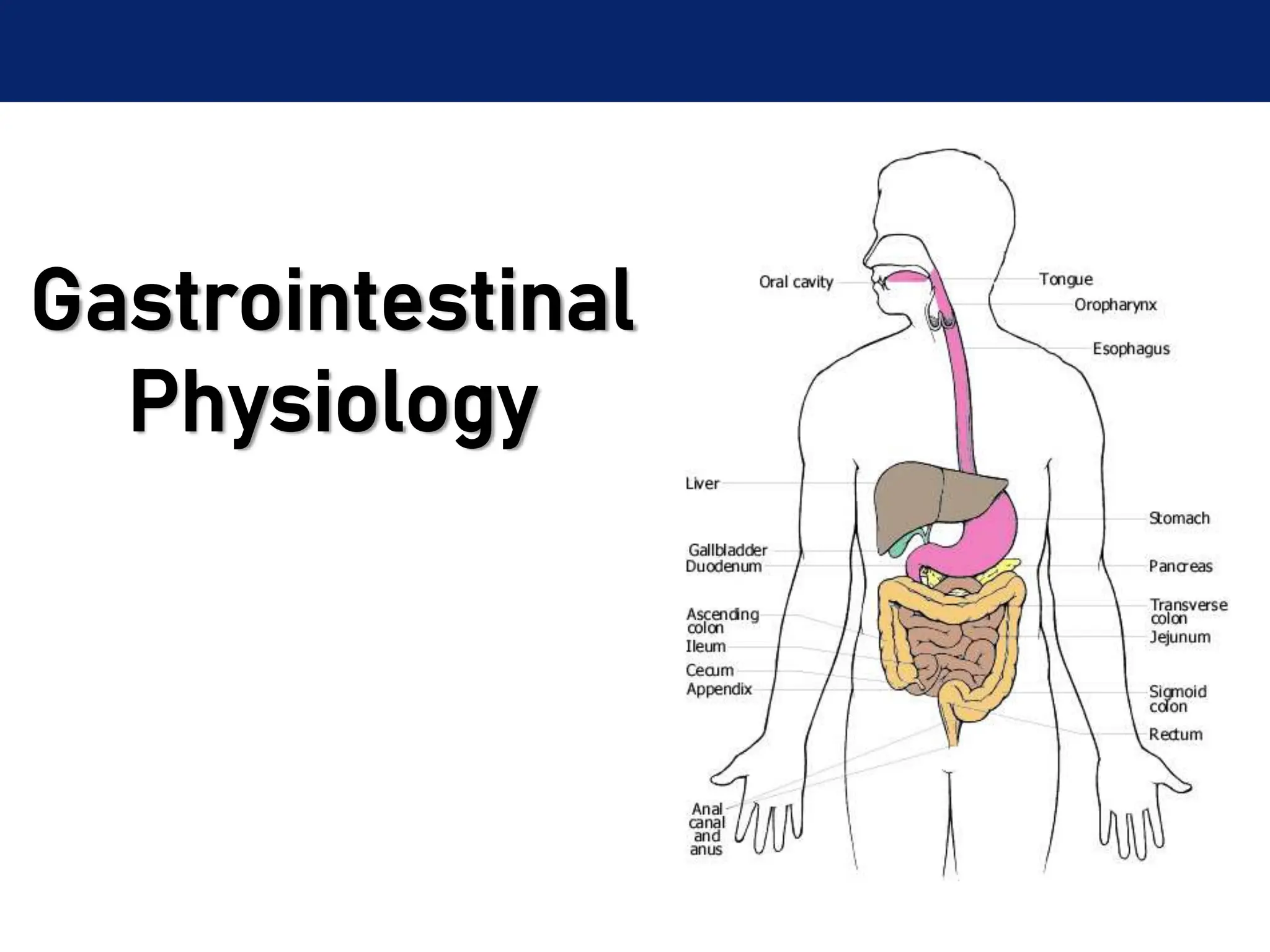
Gastrointestinal
Physiology
Overview of the Digestive System
The Digestive System Consists of;
a) Long hollow muscular tube or canal or tract called
gastrointestinal tract or (GIT): it is about 5 meters
long
b) Accessory glands: include:
• Salivary glands
• Liver
• gall bladder
• Pancreas
Overview of the Digestive Tract
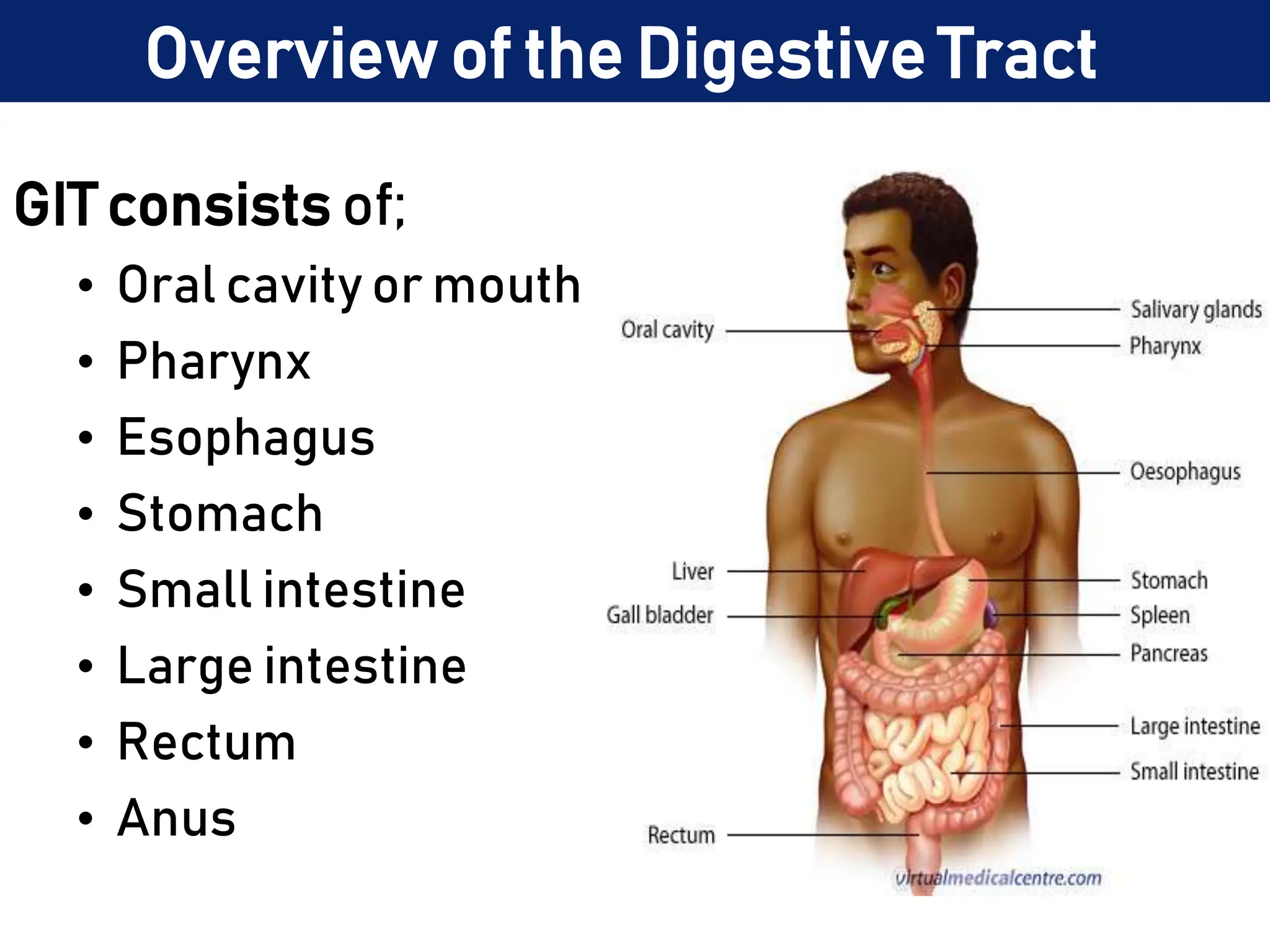
GIT consists of;
• Oral cavity or mouth
• Pharynx
• Esophagus
• Stomach
• Small intestine
• Large intestine
• Rectum
• Anus
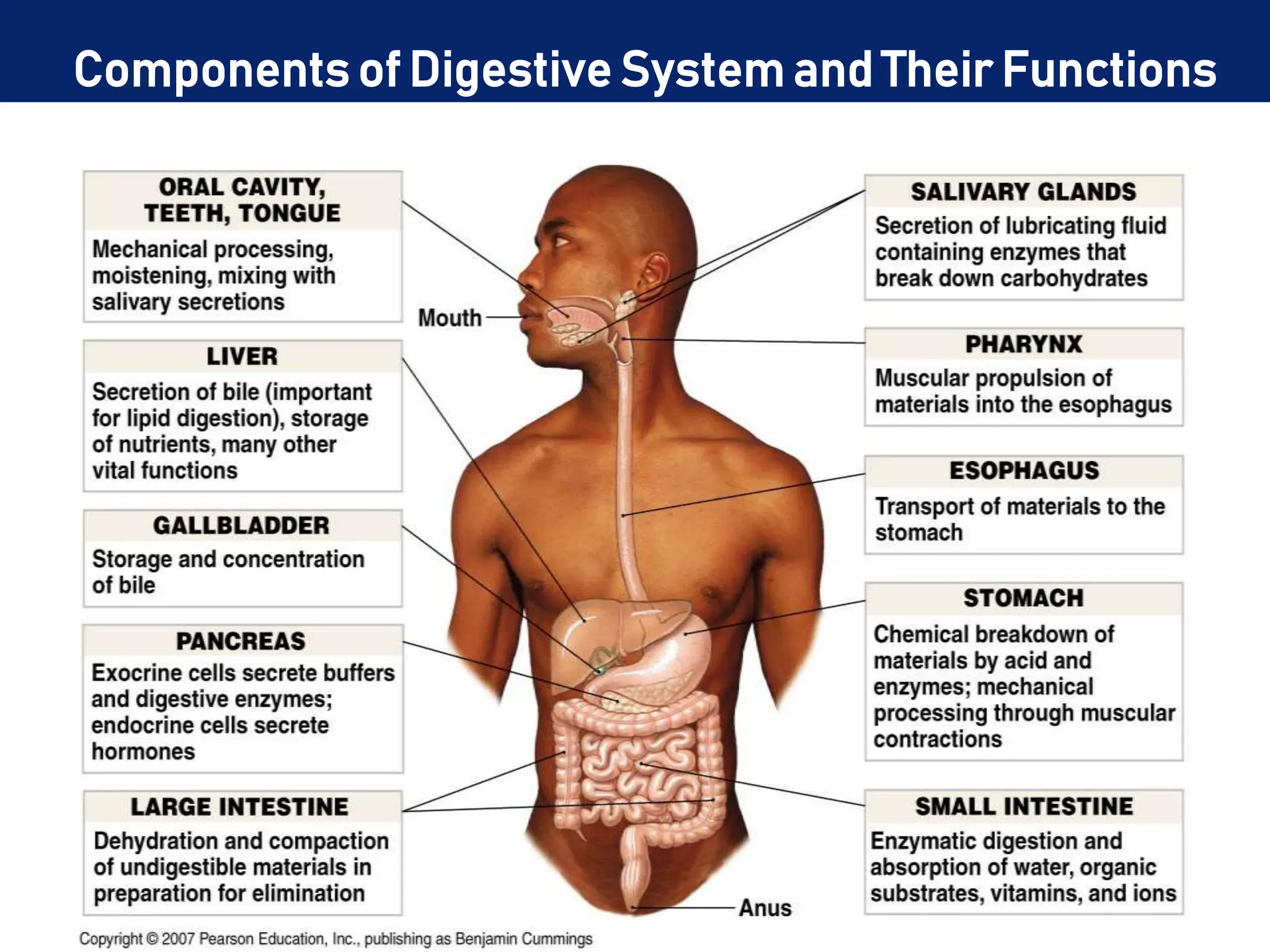
Components of Digestive System and Their Functions
Main Functions of Digestive System
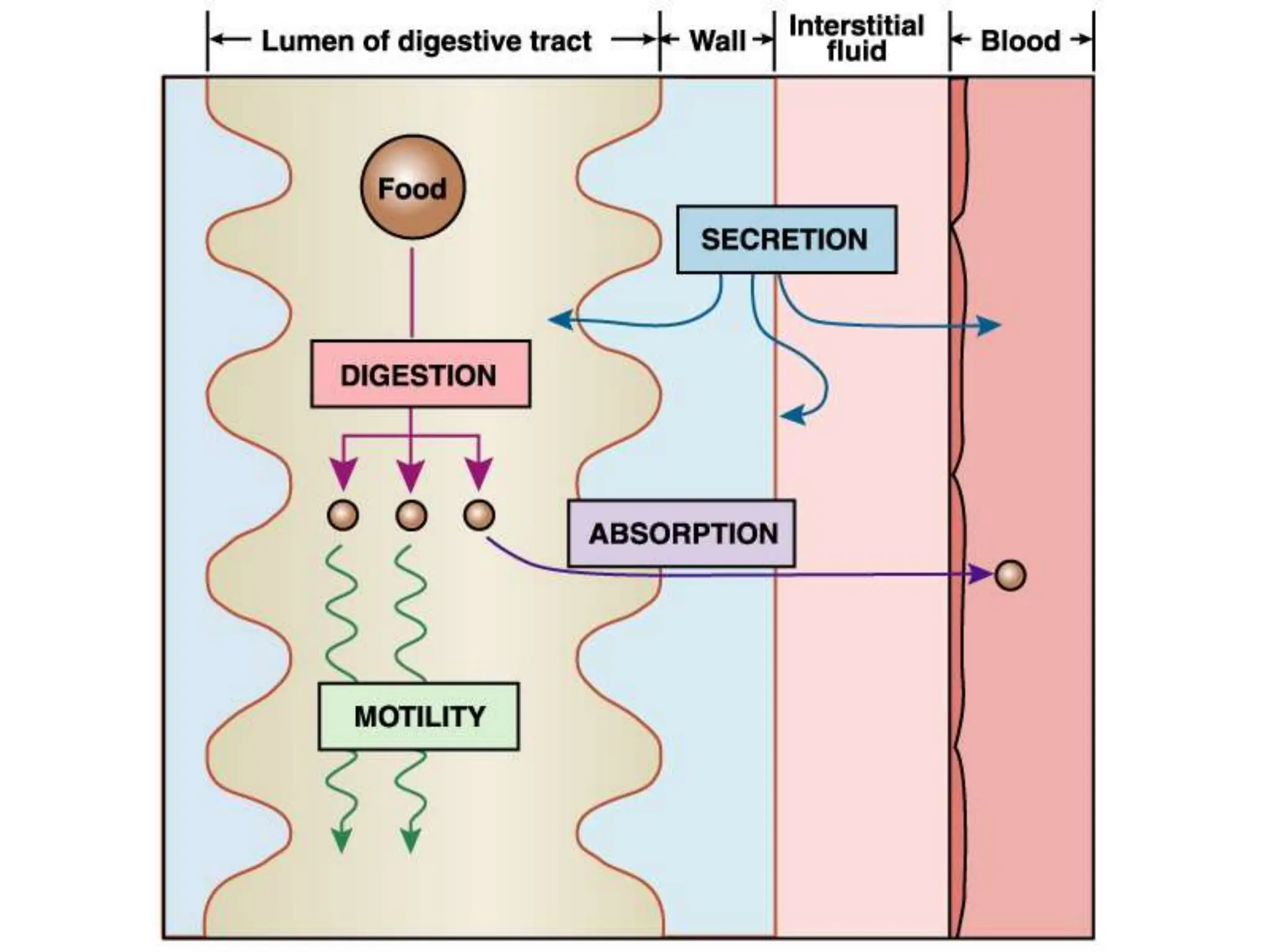
• 4 major activities of GI tract
1. Motility
• Propel ingested food from mouth toward rectum
2. Secretion of juices e.g. saliva
• Aid in digestion and absorption
3. Digestion
• Food broken down into absorbable molecules
4. Absorption
• Nutrients, electrolytes, and water are absorbed
or transported from lumen of GIT to blood stream
Motor Functions (Motility) of GIT
Motility of the GIT
1. Motility in the mouth
2 types;
a) Chewing is important because
-The food is lubricated by being mixed with saliva
-The food is exposed to salivary amylase, which
begins digestion of starch
-It breaks the food into small pieces to be easily
swallowed
b) Swallowing is the transport of food from mouth to
stomach
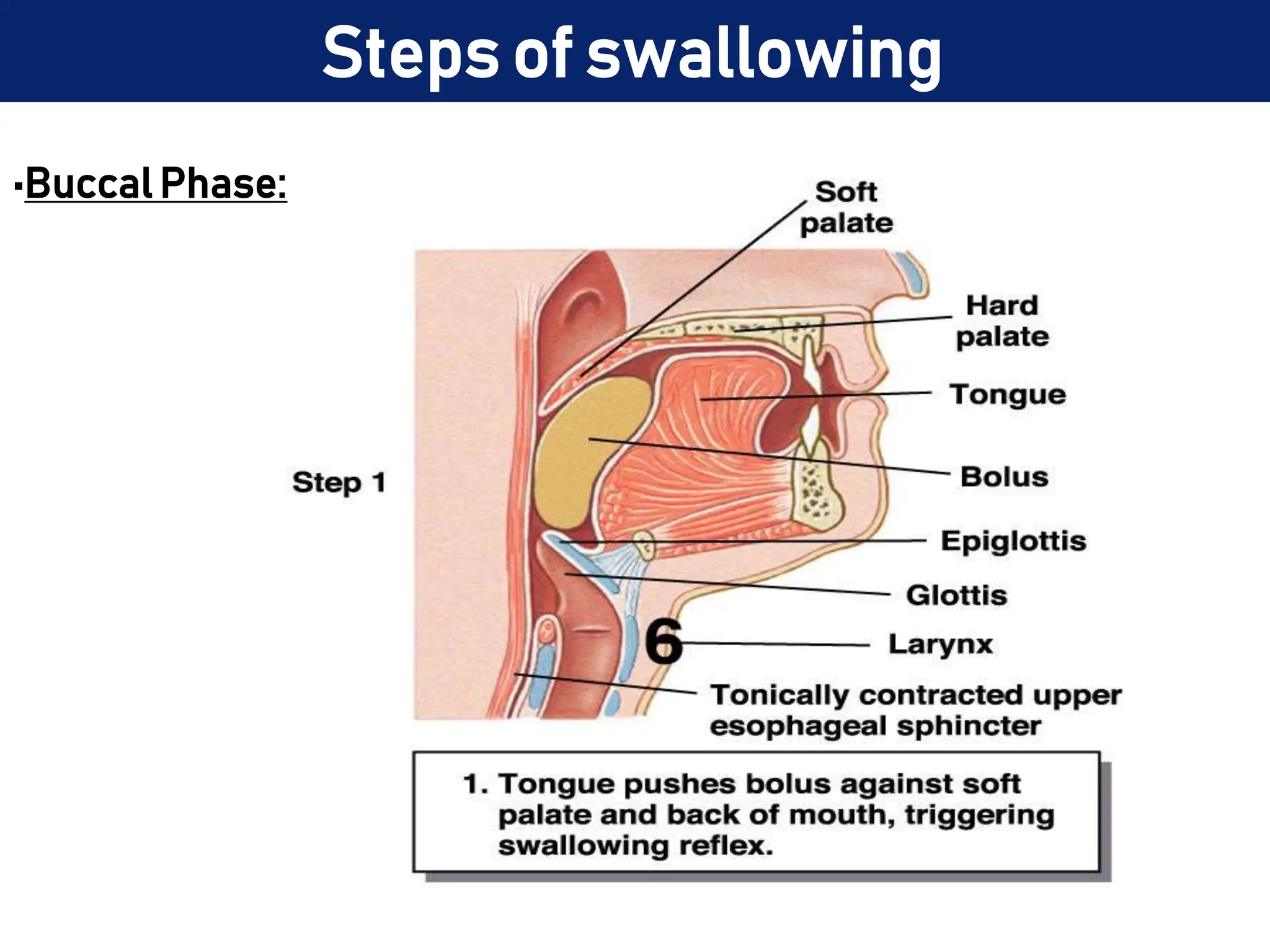
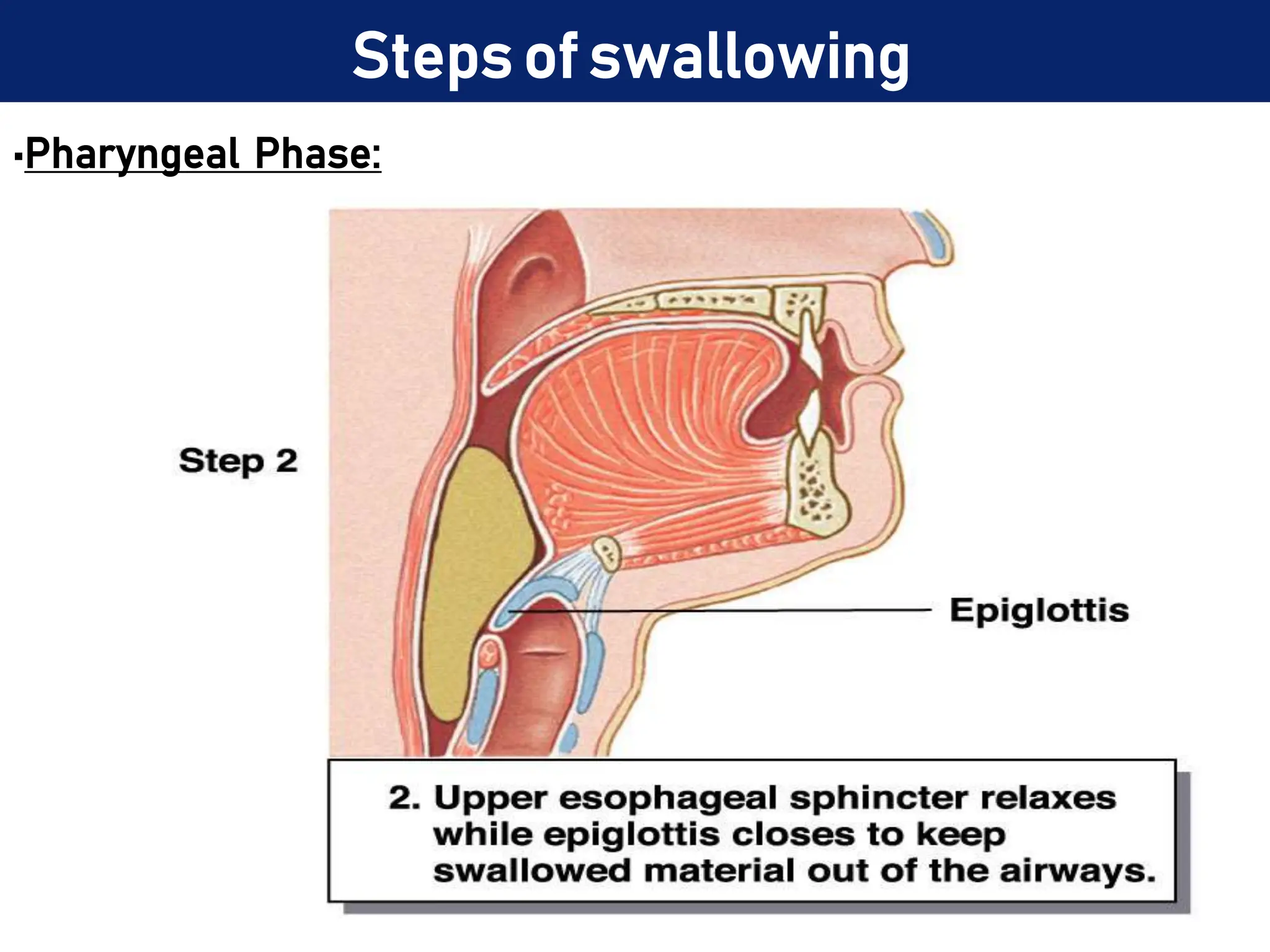
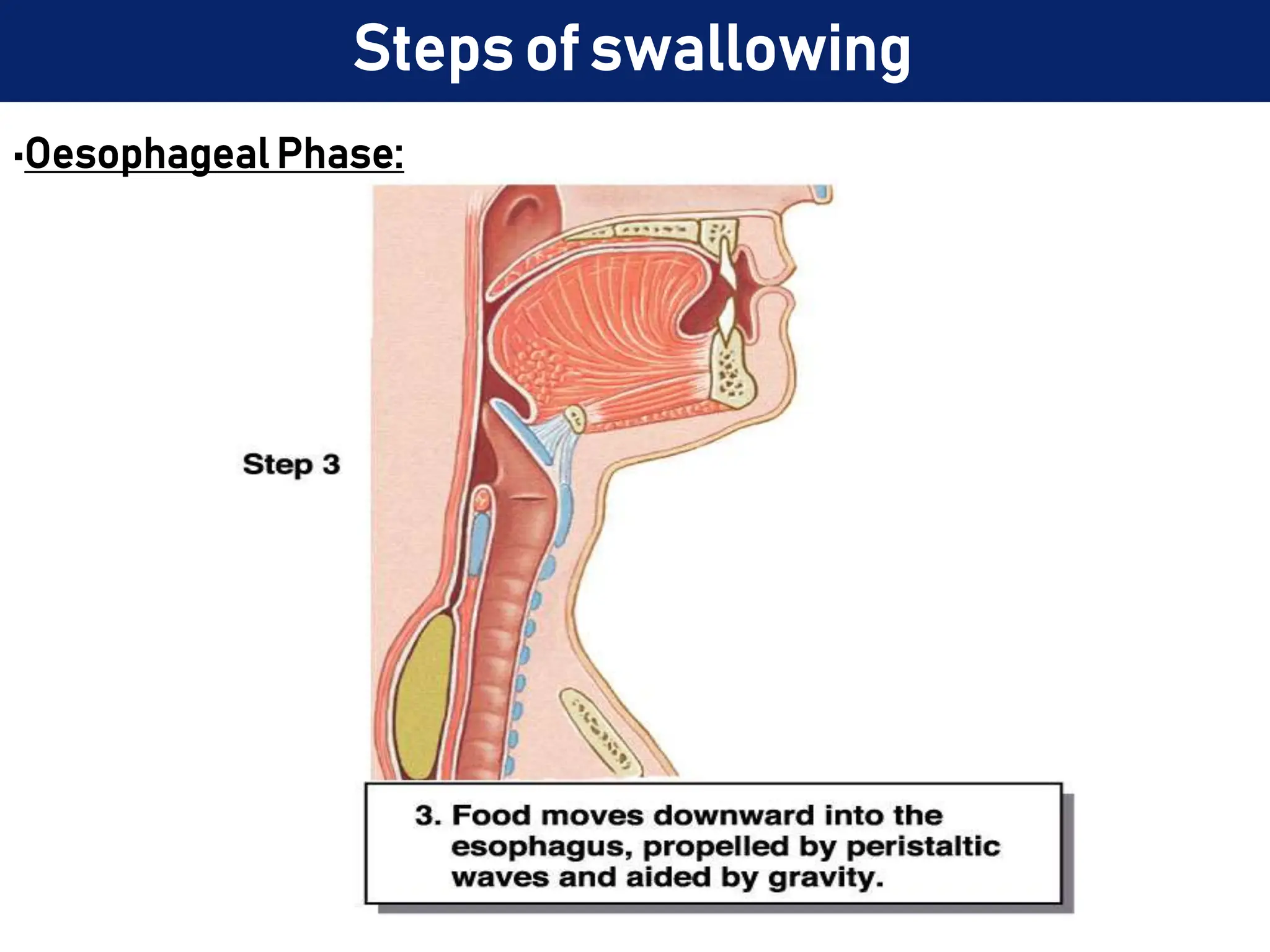
• It consists of 3 phases or steps;
Steps of swallowing
•Buccal Phase:
Steps of swallowing
•Pharyngeal Phase:
Steps of swallowing
•Oesophageal Phase:
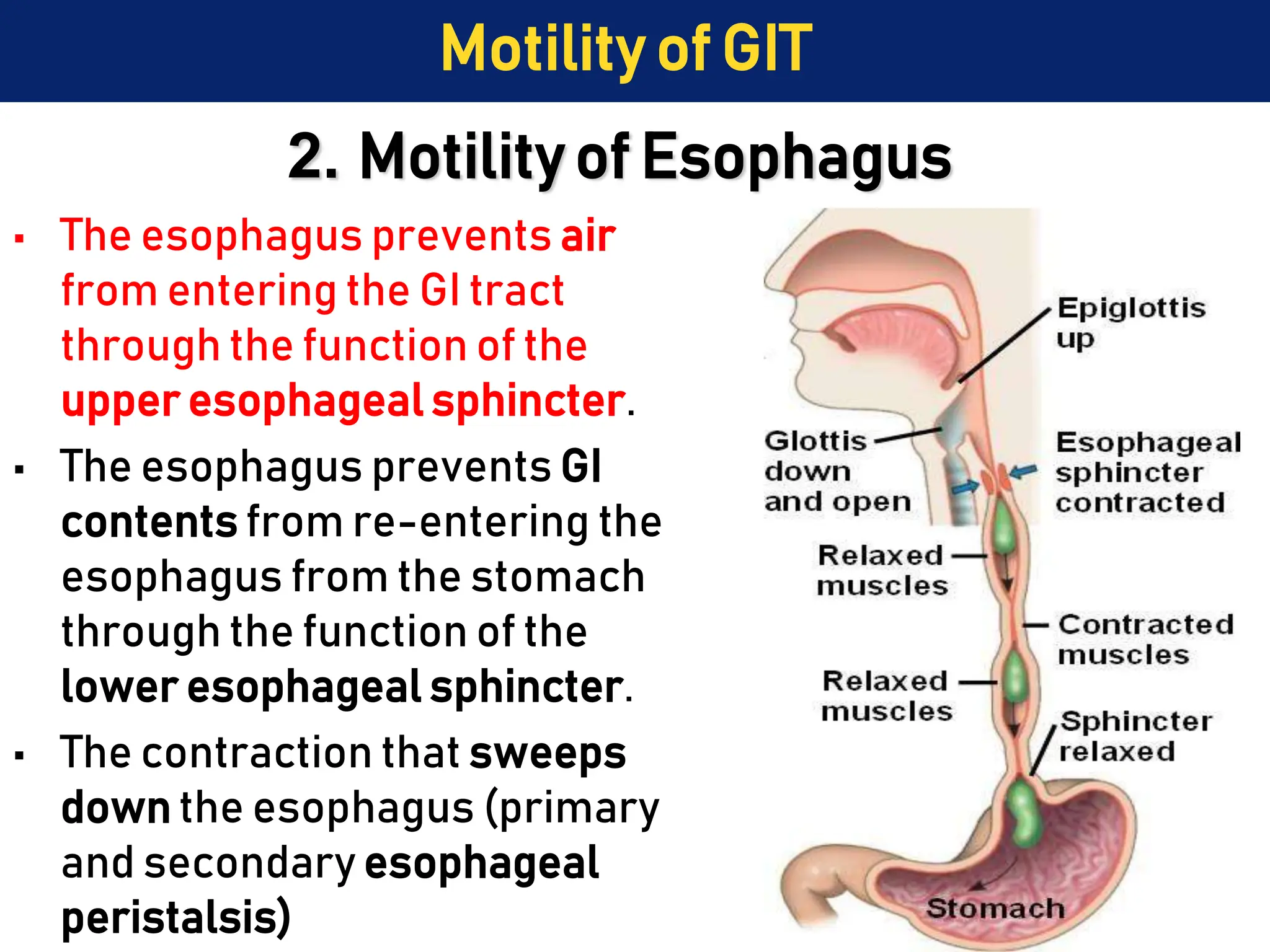
2. Motility of Esophagus
• The esophagus prevents air
from entering the GI tract
through the function of the
upper esophageal sphincter.
• The esophagus prevents GI
contents from re-entering the
esophagus from the stomach
through the function of the
lower esophageal sphincter.
• The contraction that sweeps
down the esophagus (primary
and secondary esophageal
peristalsis)
Motility of GIT
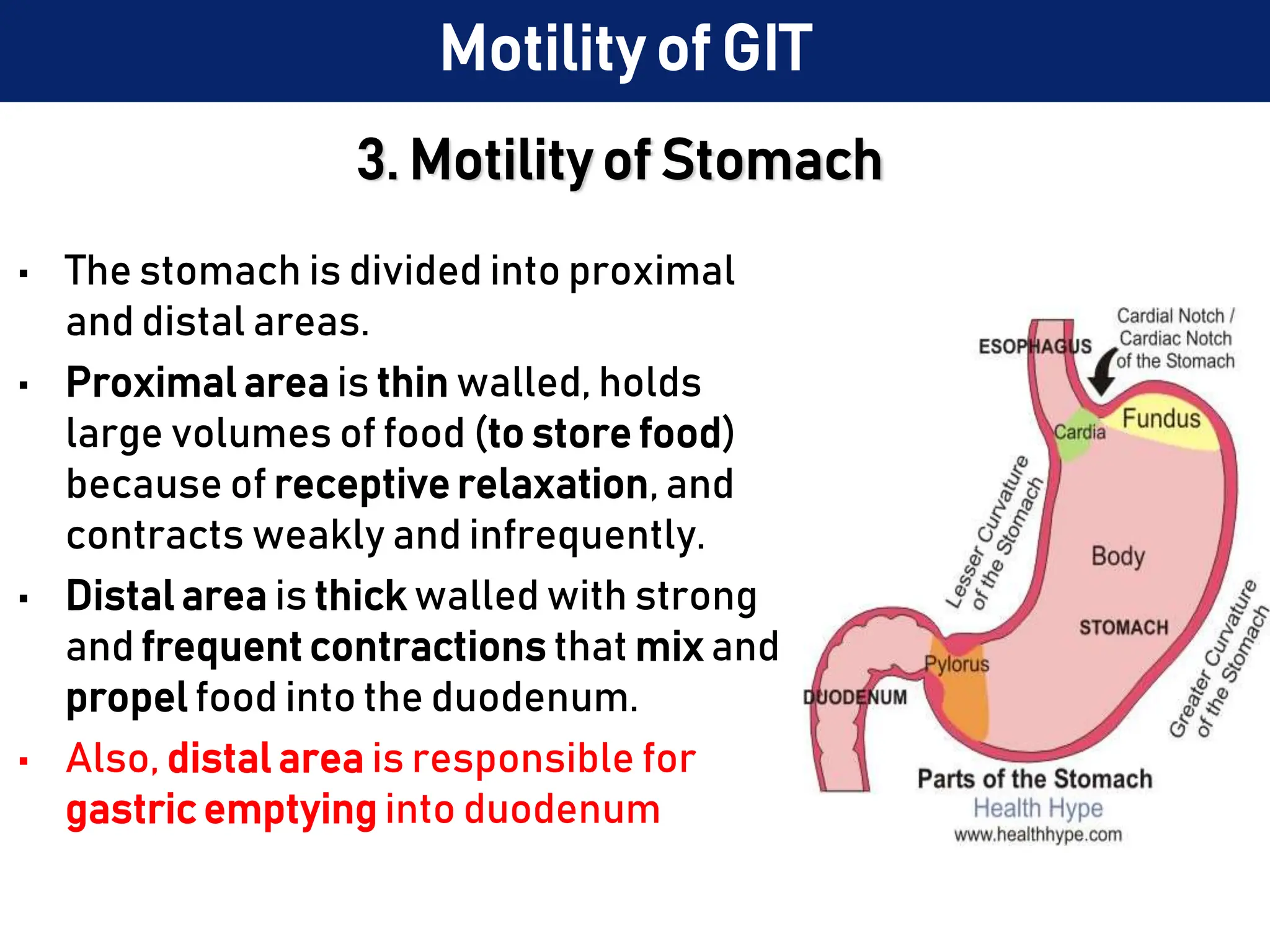
3. Motility of Stomach
• The stomach is divided into proximal
and distal areas.
• Proximal area is thin walled, holds
large volumes of food (to store food)
because of receptive relaxation, and
contracts weakly and infrequently.
• Distal area is thick walled with strong
and frequent contractions that mix and
propel food into the duodenum.
• Also, distal area is responsible for
gastric emptying into duodenum
Motility of GIT
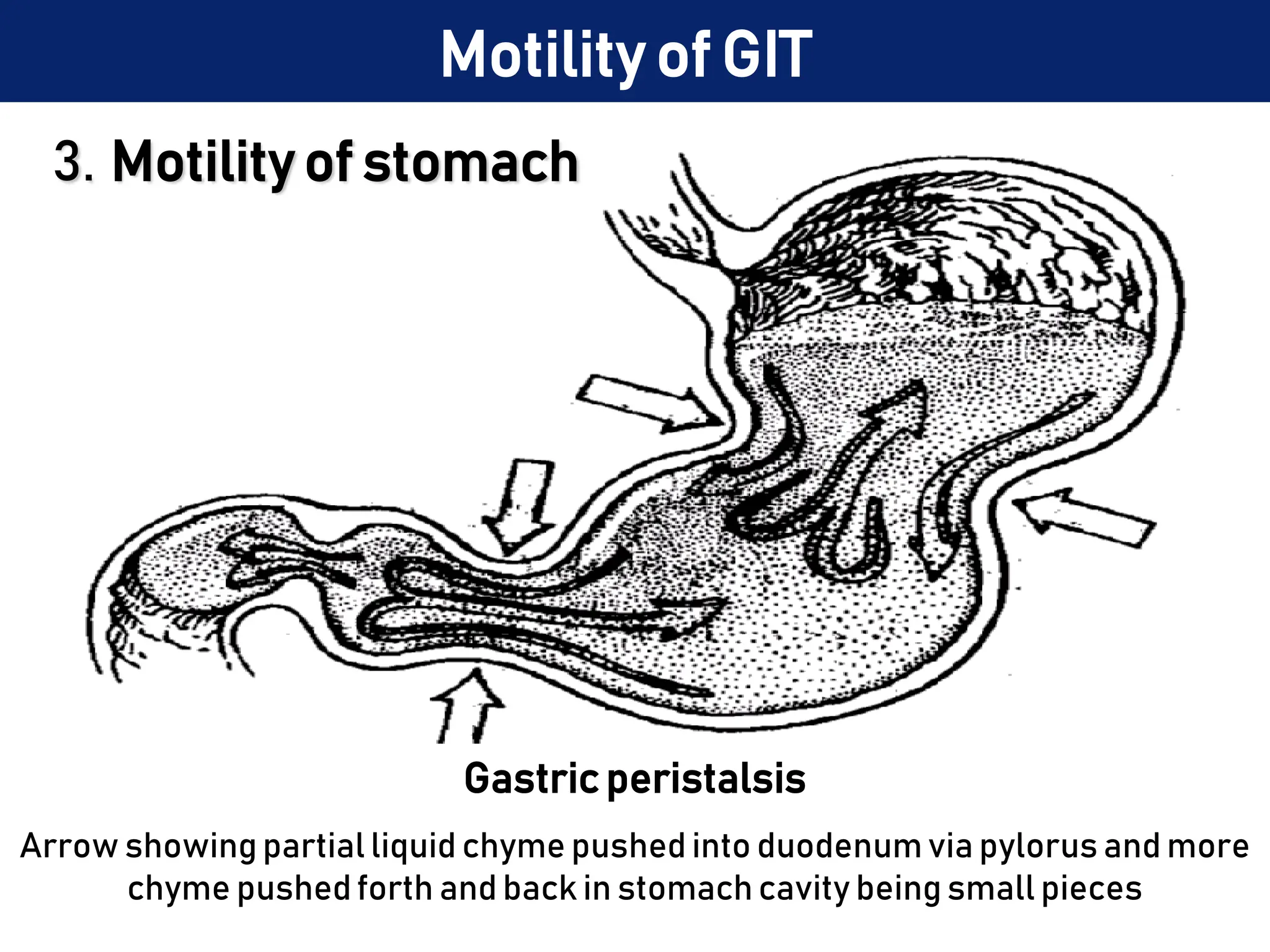
3. Motility of stomach
Gastric peristalsis
Arrow showing partial liquid chyme pushed into duodenum via pylorus and more
chyme pushedforth and back in stomach cavity being small pieces
Motility of GIT
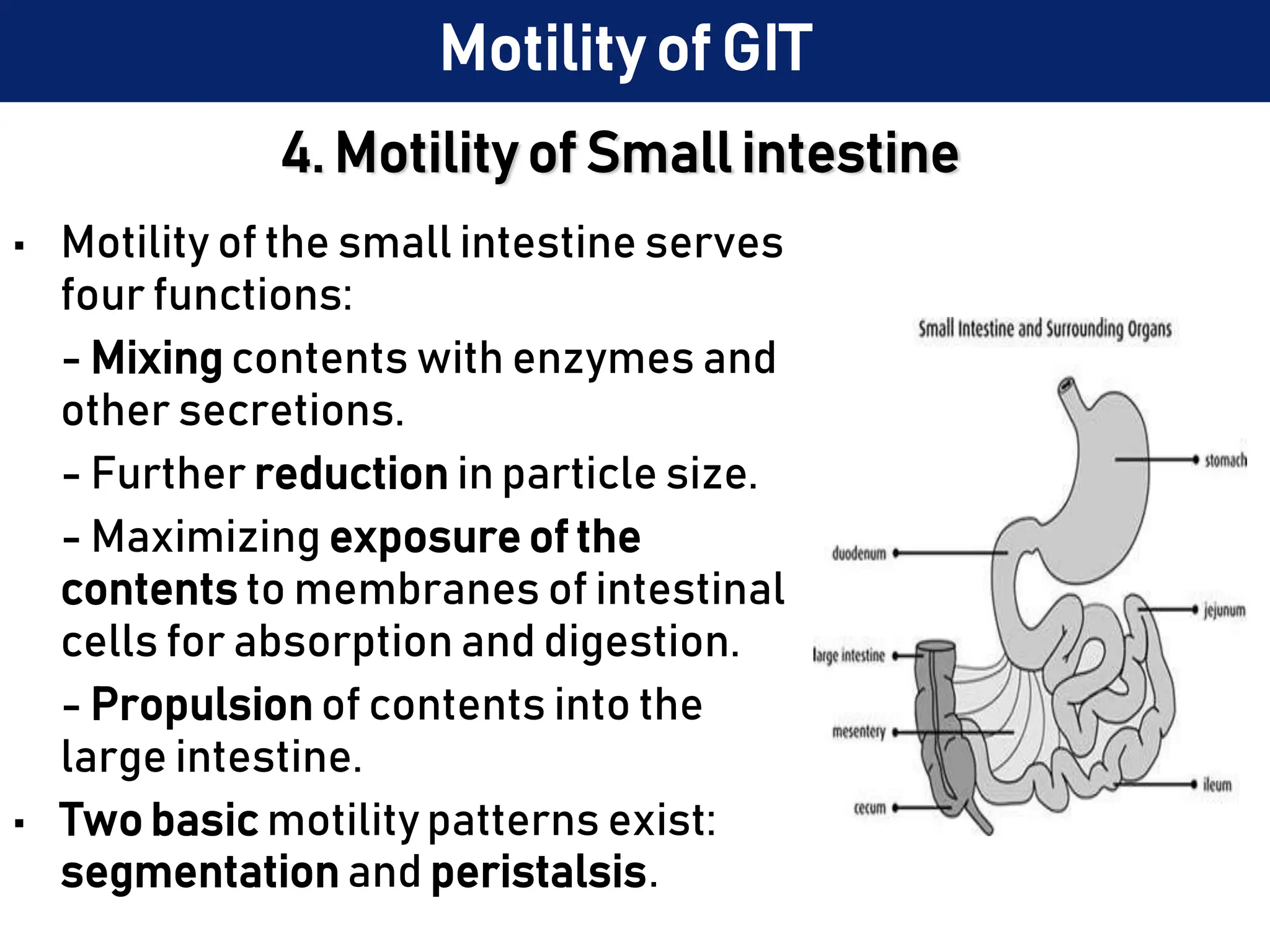
4. Motility of Small intestine
• Motility of the small intestine serves
four functions:
- Mixing contents with enzymes and
other secretions.
- Further reduction in particle size.
- Maximizing exposure of the
contents to membranes of intestinal
cells for absorption and digestion.
- Propulsion of contents into the
large intestine.
• Two basic motility patterns exist:
segmentation and peristalsis.
Motility of GIT
Motility of GIT
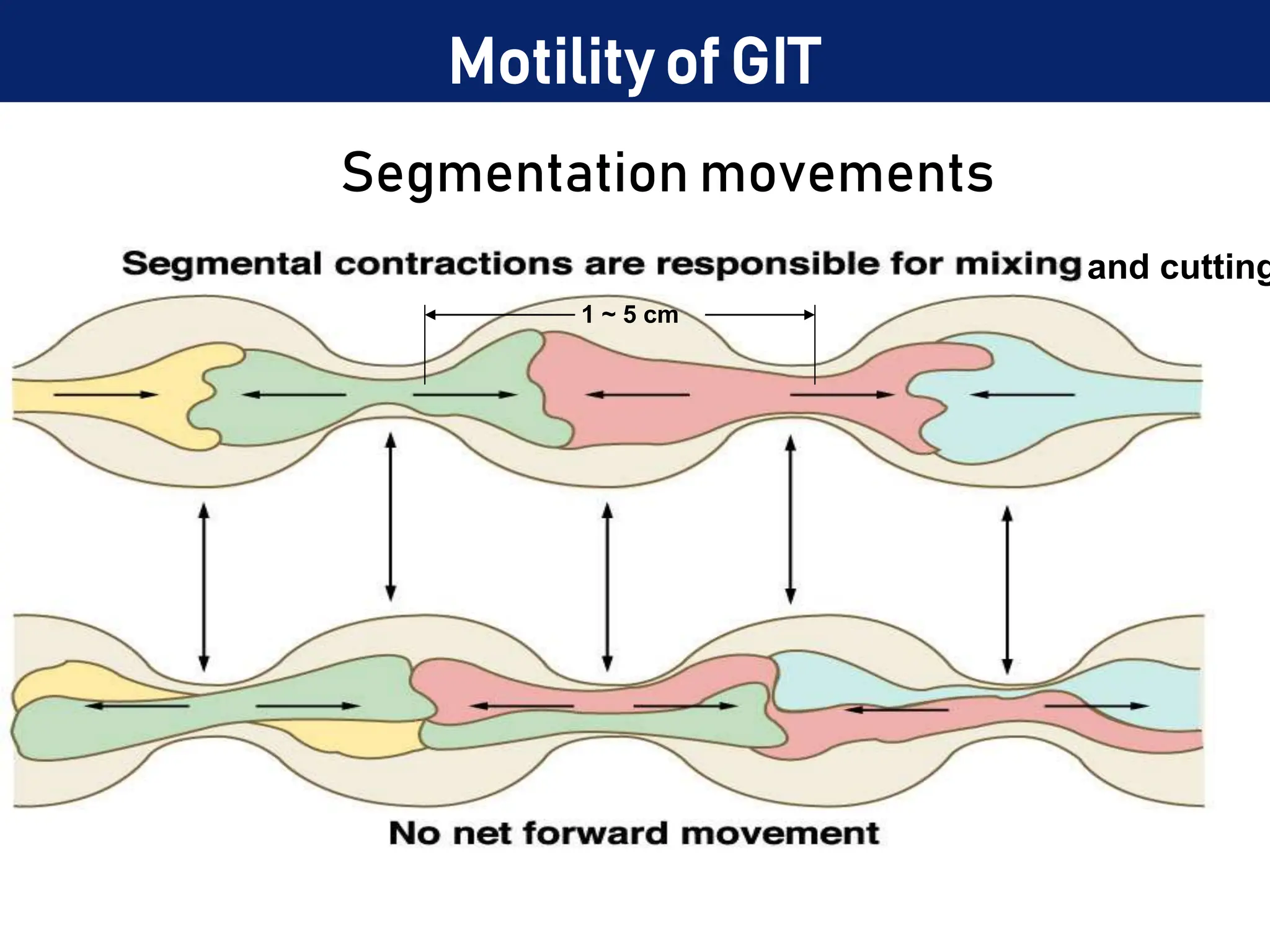
1 ~ 5 cm
and cutting
Segmentation movements
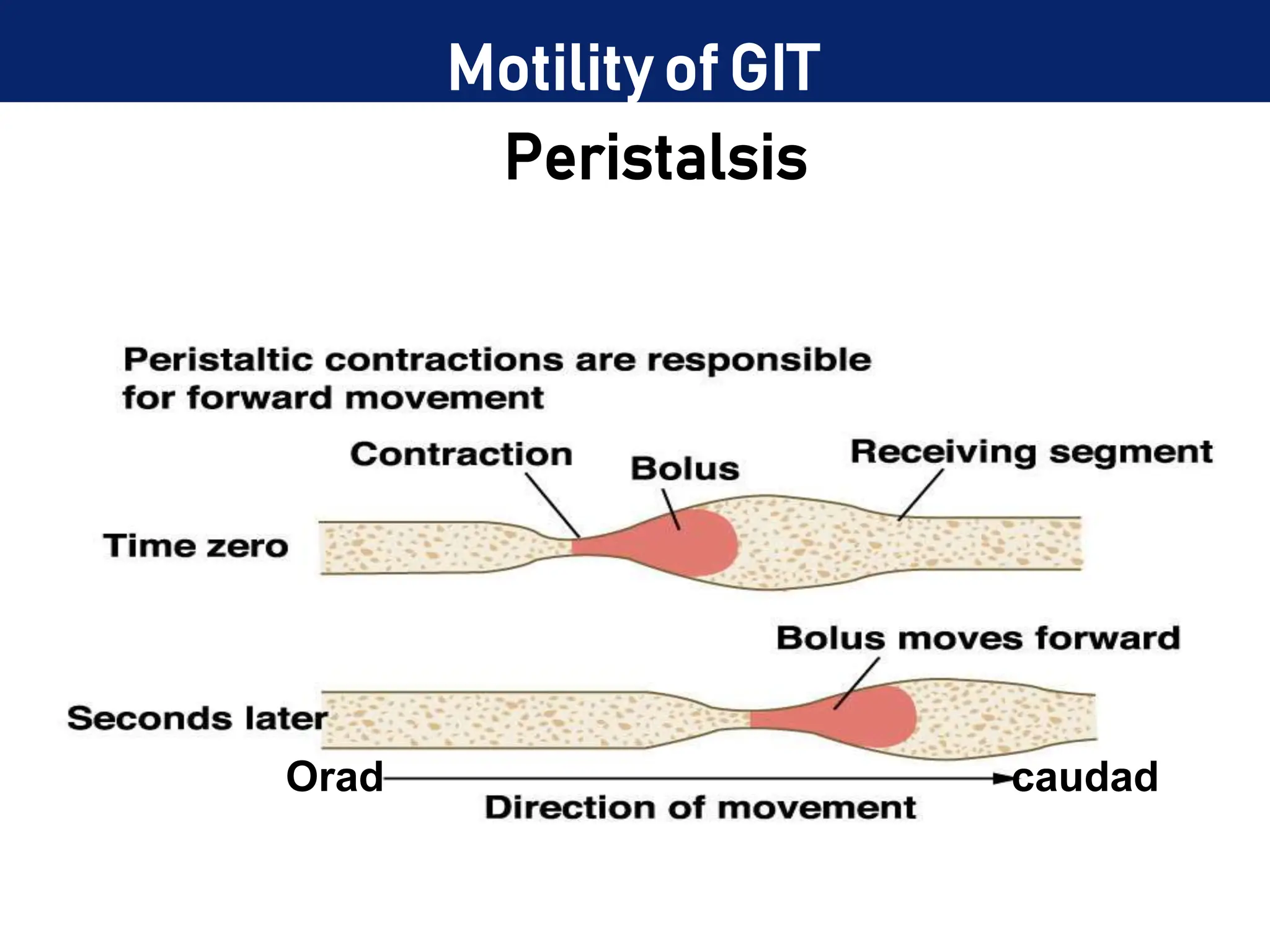
Peristalsis
Orad caudad
Motility of GIT
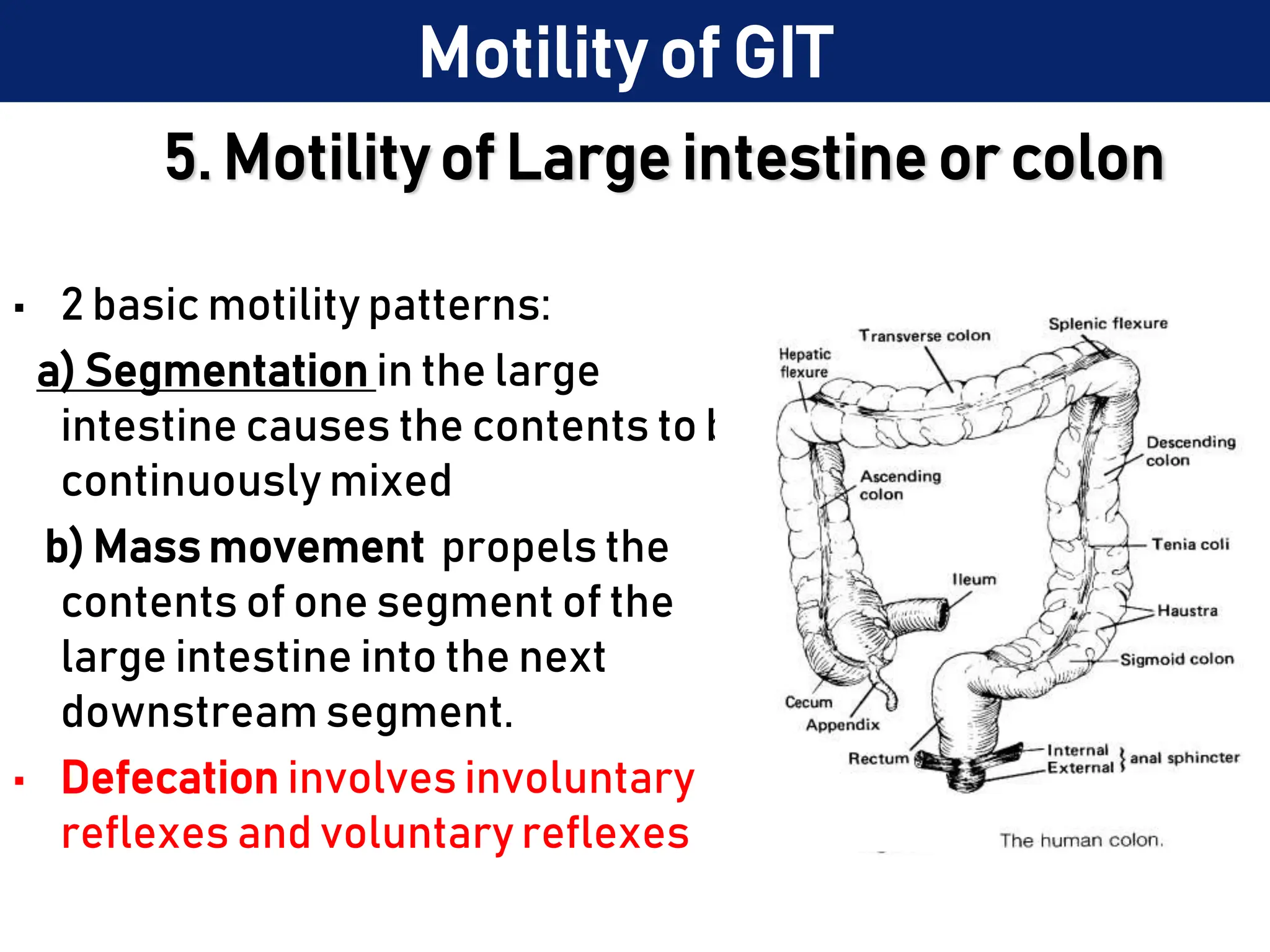
5. Motility of Large intestine or colon
• 2 basic motility patterns:
a) Segmentation in the large
intestine causes the contents to be
continuously mixed
b) Mass movement propels the
contents of one segment of the
large intestine into the next
downstream segment.
• Defecation involves involuntary
reflexes and voluntary reflexes
Motility of GIT
Secretory Functions
(Secretions) of GIT
• GI secretions function to lubricate (water and
mucus), protect (mucus), sterilize (HCl),
neutralize (HCO3
-), and digest (enzymes).
• Secretions arise from specialized cells lining
the GI tract, the pancreas, liver and
gallbladder.
• The total volume of GIT secretions is about 6-
8 L/day
Secretions of GIT
Secretions of GIT in Mouth
Salivary Glands
• Three pairs of glands
• Parotid
• Sublingual
• Submandibular
• Functions of saliva
• Lubricates, cleanses
oral cavity
• Dissolves chemicals
• Suppresses bacterial
growth
• Digest starch by
amylase
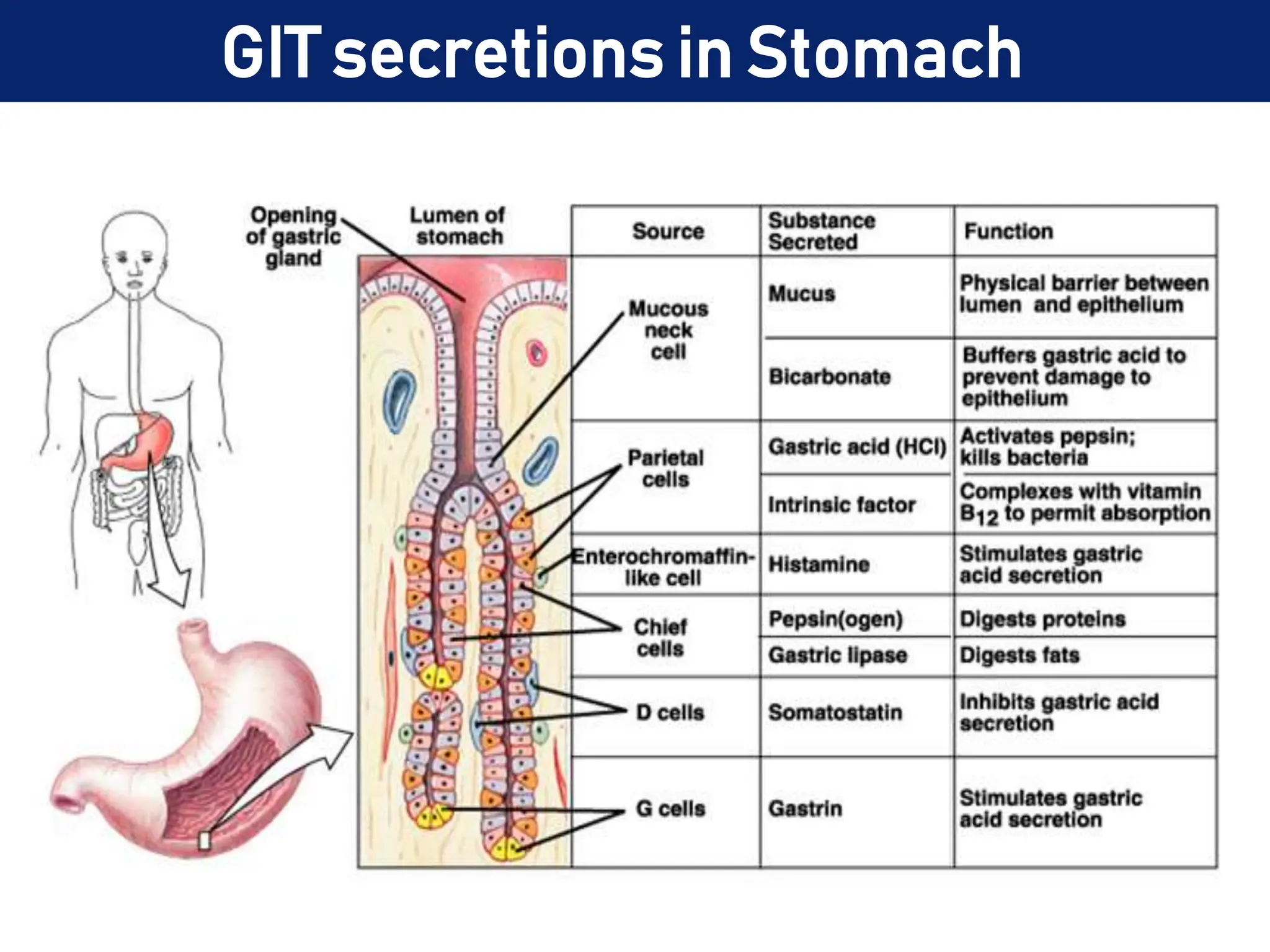
GIT secretions in Stomach
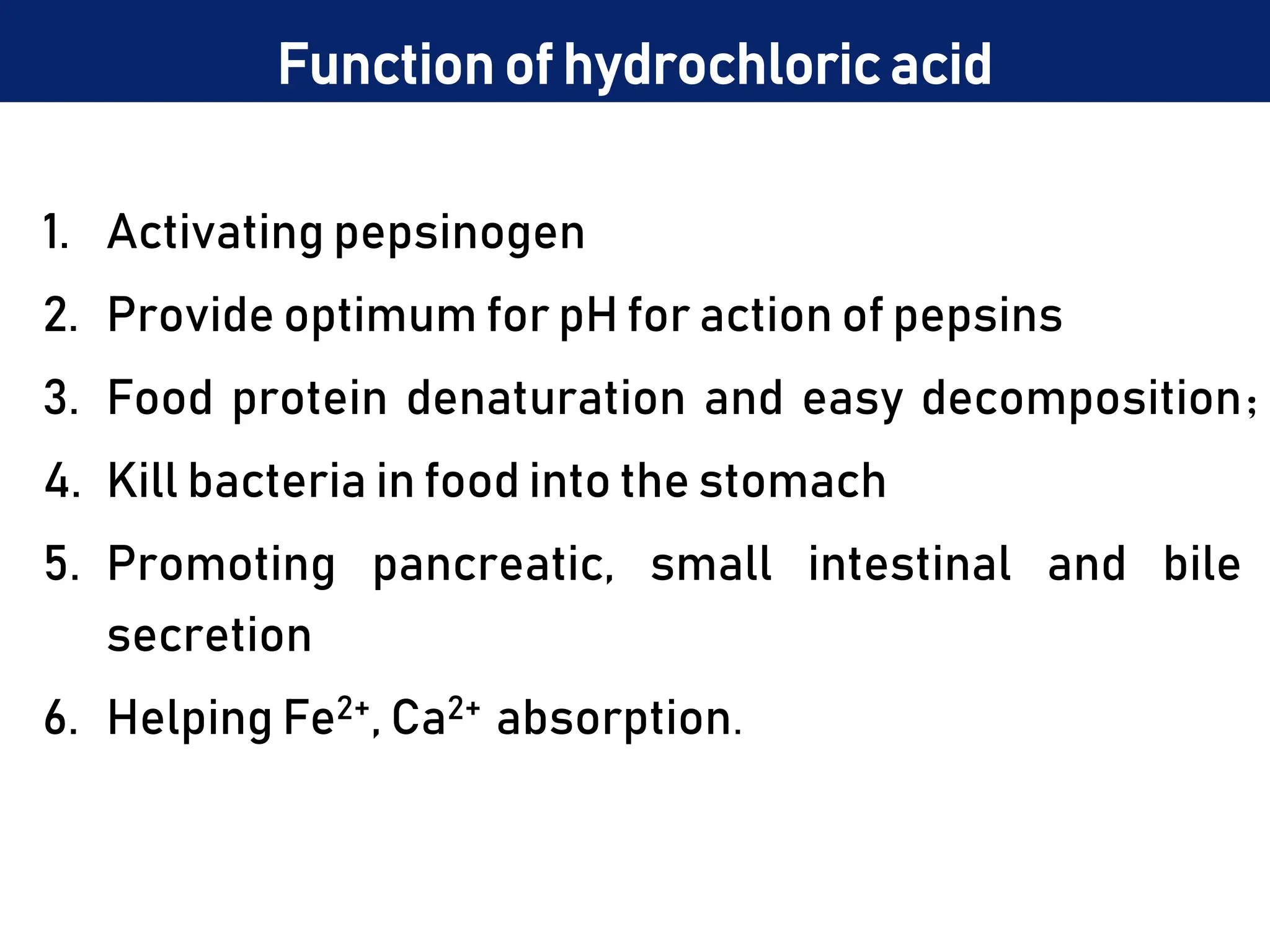
Function of hydrochloric acid
1. Activating pepsinogen
2. Provide optimum for pH for action of pepsins
3. Food protein denaturation and easy decomposition;
4. Kill bacteria in food into the stomach
5. Promoting pancreatic, small intestinal and bile
secretion
6. Helping Fe2+, Ca2+ absorption.
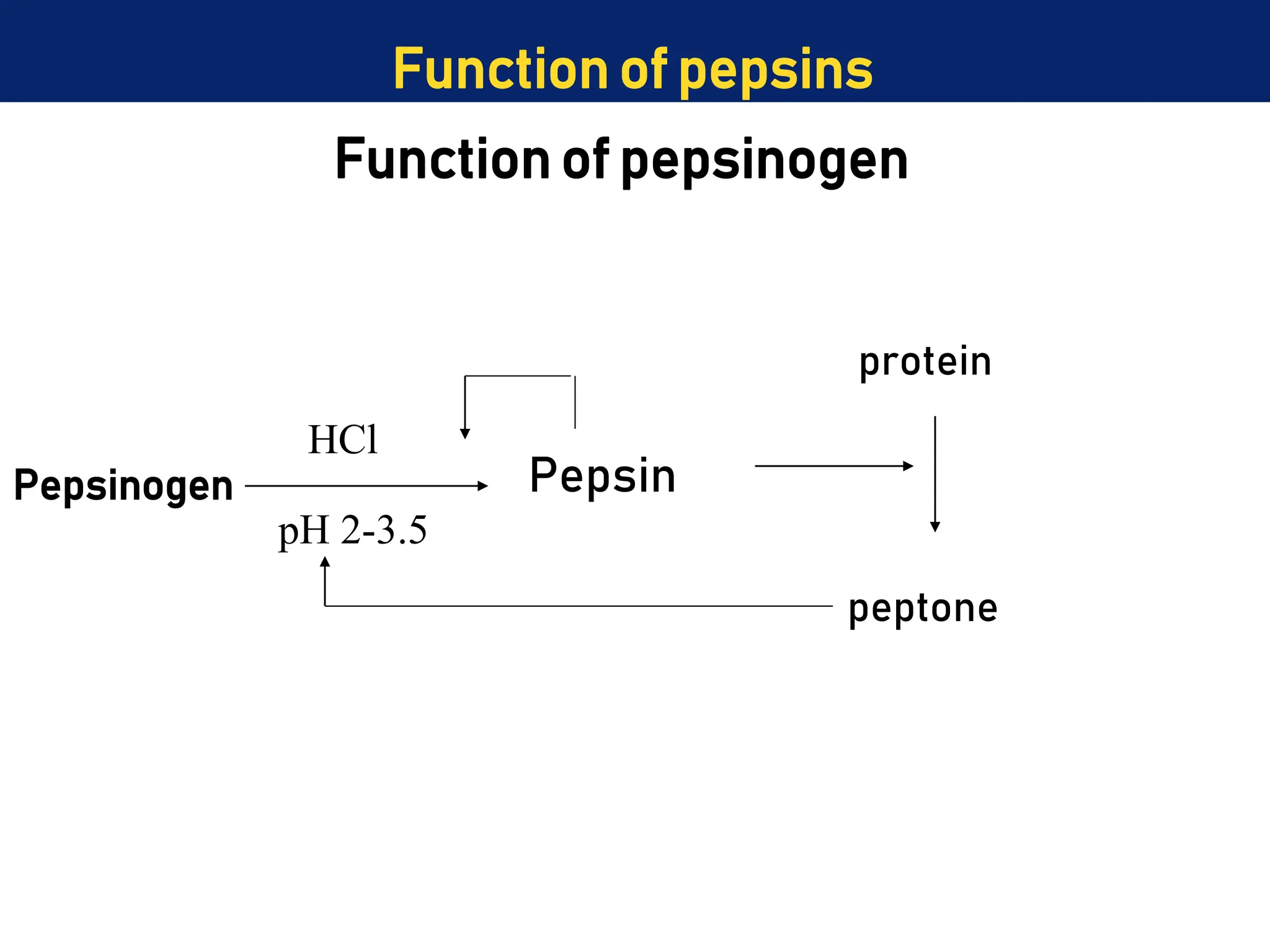
Pepsinogen Pepsin
protein
peptone
pH 2-3.5
HCl
Function of pepsinogen
Function of pepsins
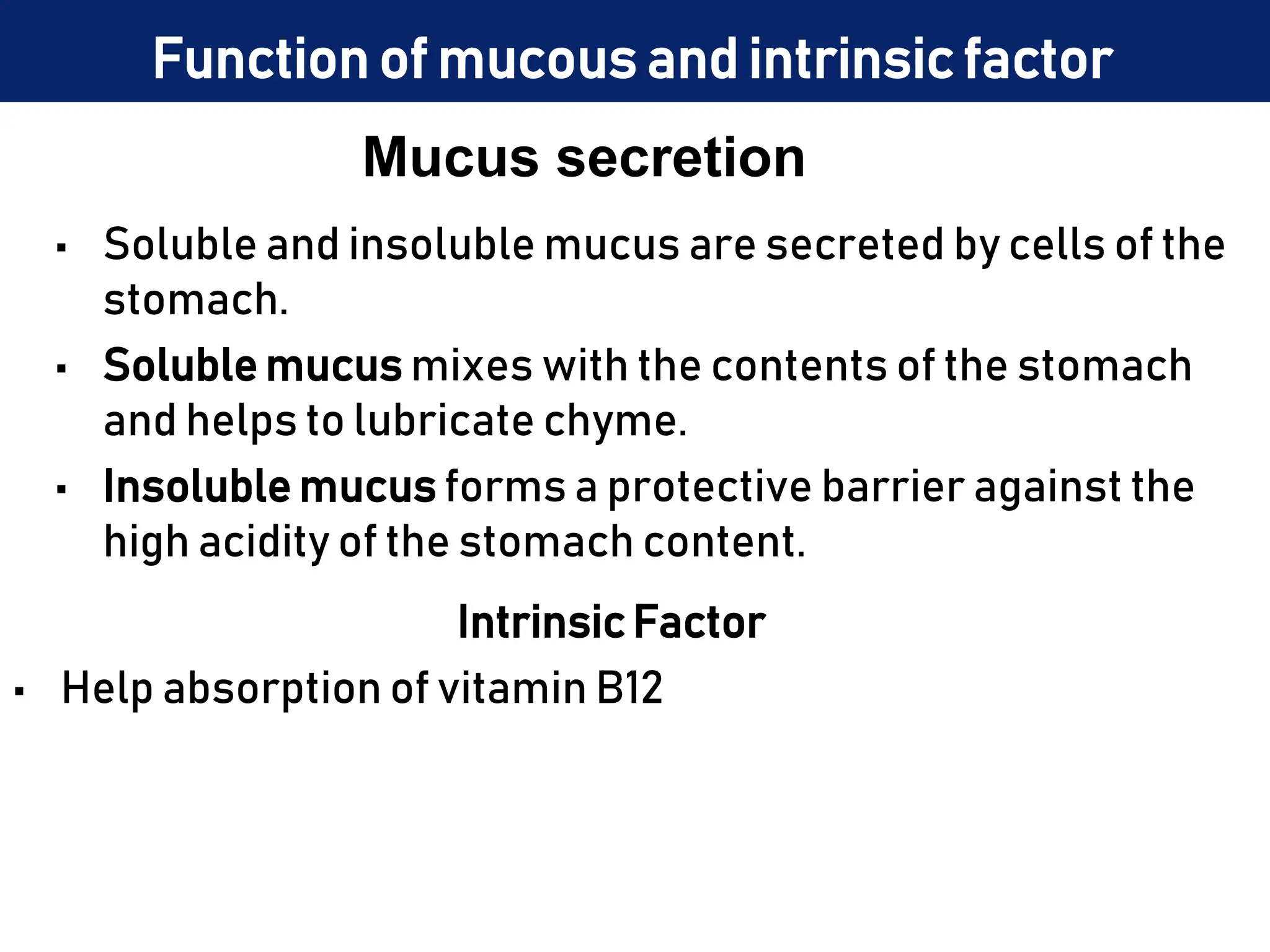
Mucus secretion
• Soluble and insoluble mucus are secreted by cells of the
stomach.
• Soluble mucus mixes with the contents of the stomach
and helps to lubricate chyme.
• Insoluble mucus forms a protective barrier against the
high acidity of the stomach content.
Intrinsic Factor
• Help absorption of vitamin B12
Function of mucous and intrinsic factor
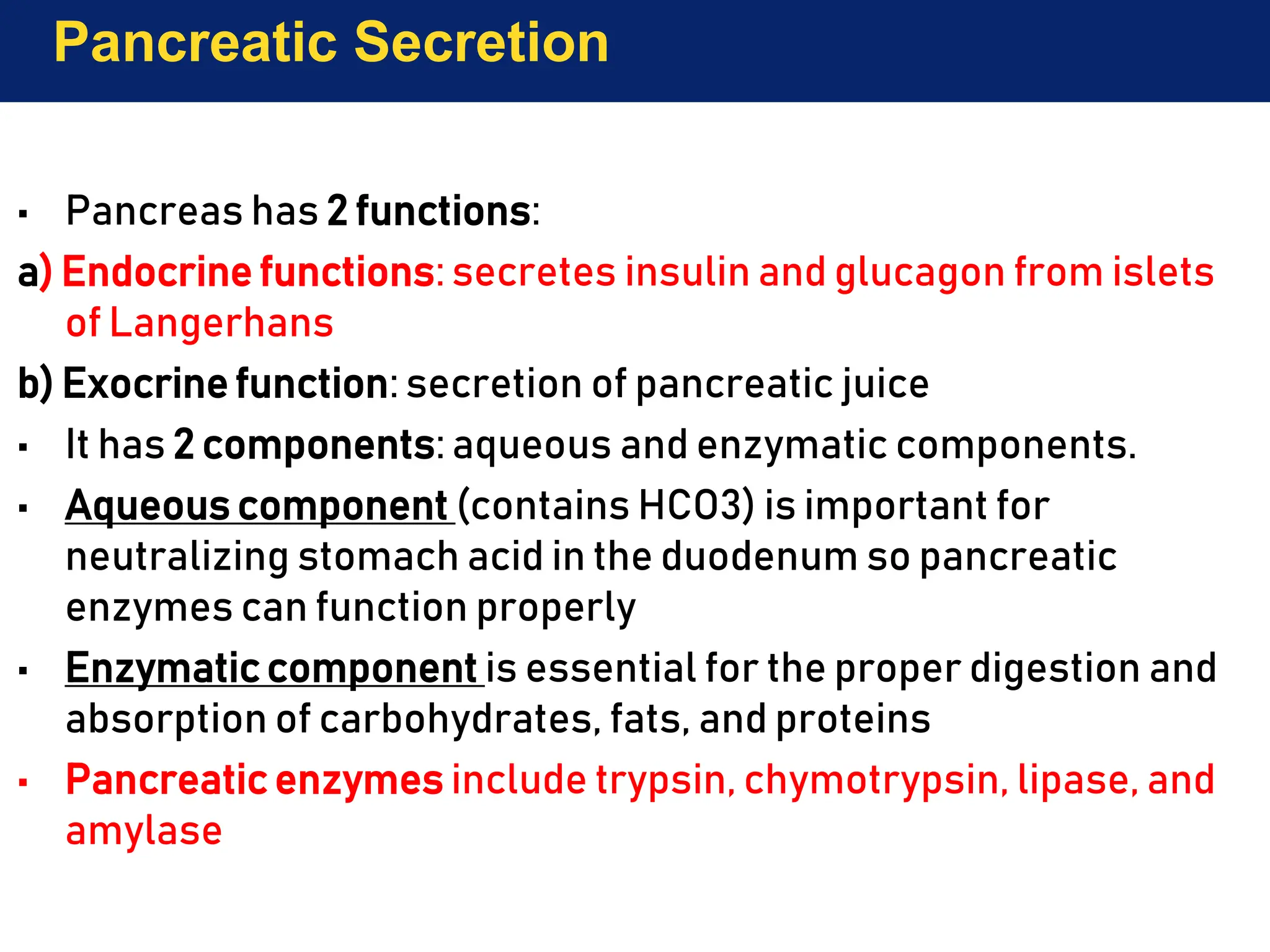
• Pancreas has 2 functions:
a) Endocrine functions: secretes insulin and glucagon from islets
of Langerhans
b) Exocrine function: secretion of pancreatic juice
• It has 2 components: aqueous and enzymatic components.
• Aqueous component (contains HCO3) is important for
neutralizing stomach acid in the duodenum so pancreatic
enzymes can function properly
• Enzymatic component is essential for the proper digestion and
absorption of carbohydrates, fats, and proteins
• Pancreatic enzymes include trypsin, chymotrypsin, lipase, and
amylase
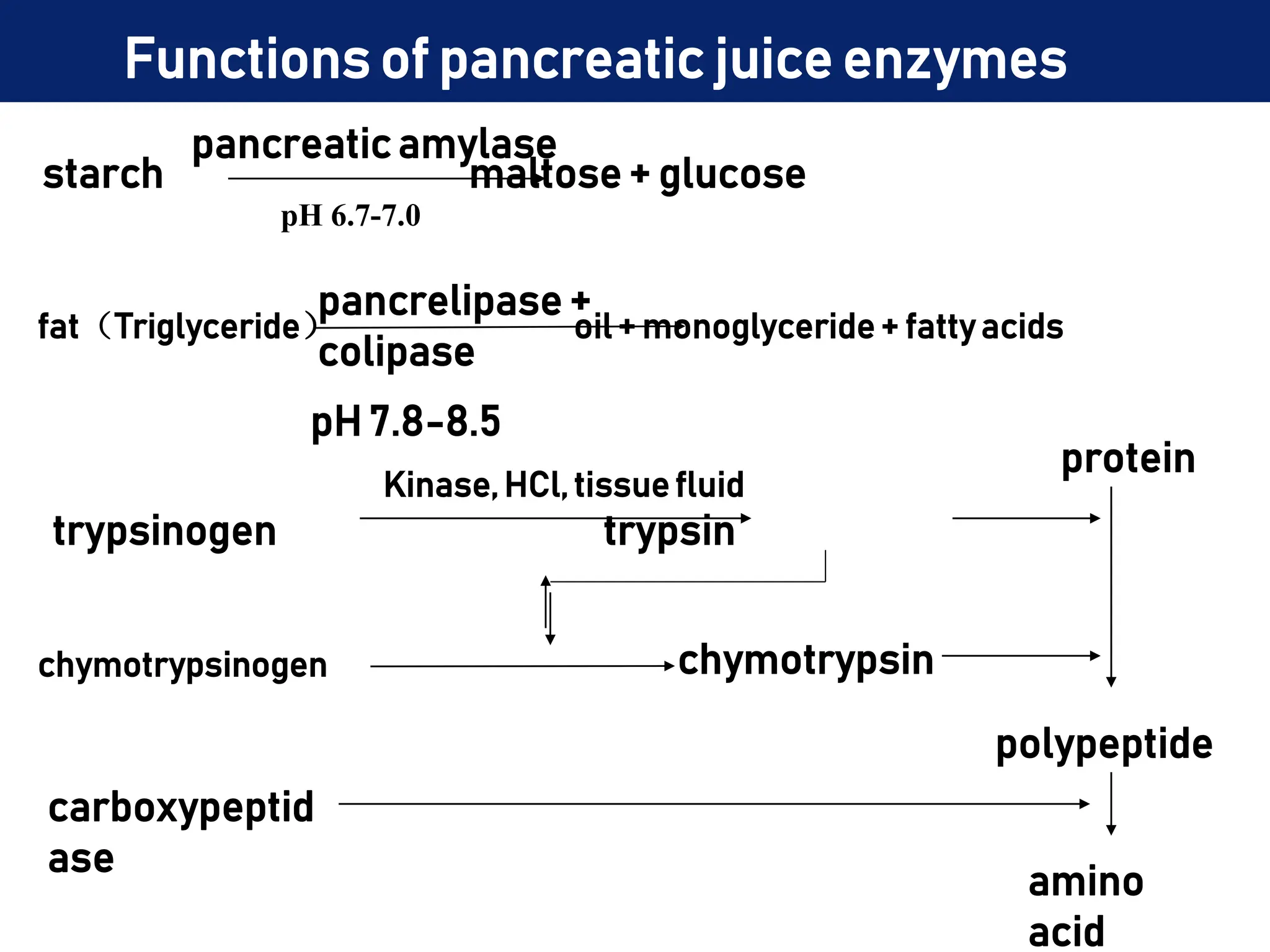
Pancreatic Secretion
starch maltose + glucose
pancreatic amylase
pH 6.7-7.0
fat(Triglyceride) oil+ monoglyceride+ fattyacids
pancrelipase +
colipase
pH 7.8-8.5
trypsinogen trypsin
Kinase, HCl, tissuefluid
chymotrypsinogen chymotrypsin
protein
polypeptide
carboxypeptid
ase
amino
acid
Functions of pancreatic juice enzymes
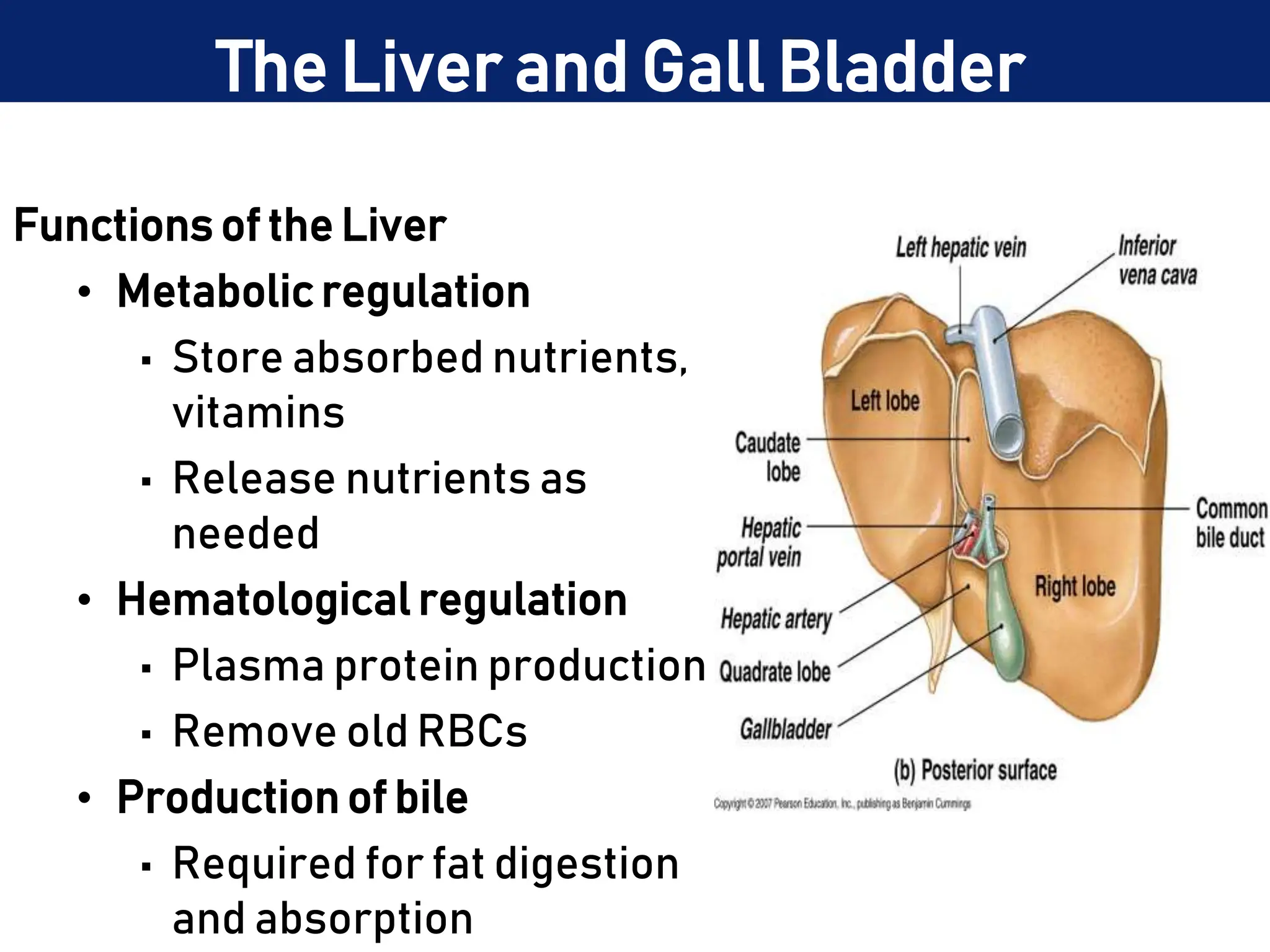
The Liver and Gall Bladder
Functions of the Liver
• Metabolic regulation
• Store absorbed nutrients,
vitamins
• Release nutrients as
needed
• Hematological regulation
• Plasma protein production
• Remove old RBCs
• Production of bile
• Required for fat digestion
and absorption
• Secretion from duodenal gland and intestinal gland
• Secretory volume is 1~3L/day
• It contains inorganic ion, mucoprotein, IgA, various
enzyme, e.g. enterokinase ,etc
• Function:
• Protective effect by mucous
• Digestion by enzymes such as peptidase, sucrase,
lipase
• Dilution
Secretion of small intestine
1. colonic alkaline secretion to neutralize acids produced
by intestinal bacteria
2. secretion of mucous for protection, lubrication of fecal
matter
3. Vitamin B and K absorption made from bacterial flora
in colon
Secretion of large intestine
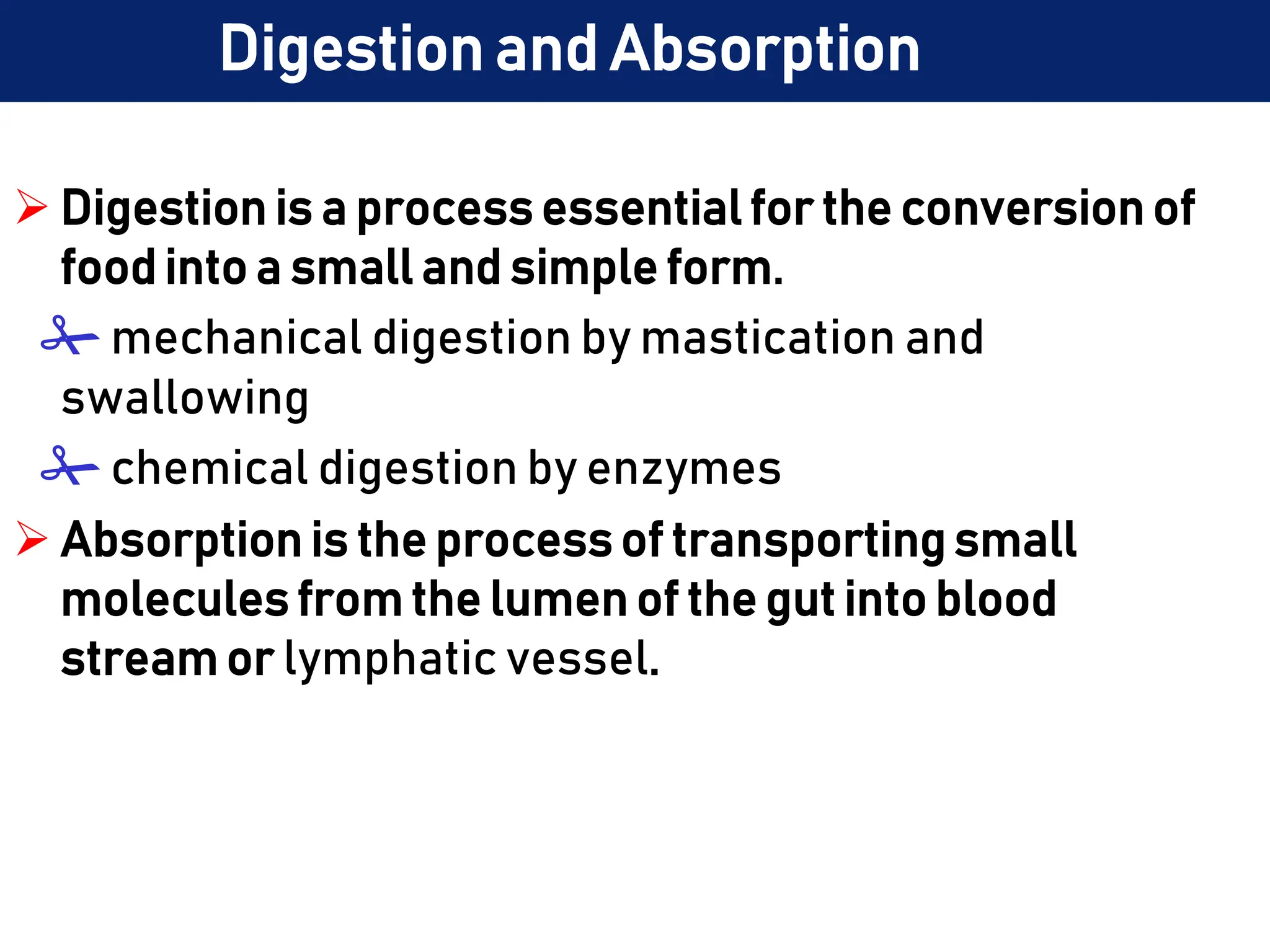
Digestion and Absorption
 Digestion is a process essential for the conversion of
food into a small and simple form.
 mechanical digestion by mastication and
swallowing
 chemical digestion by enzymes
 Absorption is the process of transporting small
molecules from the lumen of the gut into blood
stream or lymphatic vessel.
Digestion and Absorption
• Small intestine is primary site for
digestion and absorption of food.
• Digestion occurs in the GI lumen
by secreted enzymes and on
surface of enterocytes by
membrane-bound enzymes.
• Absorption occurs by simple
diffusion, facilitated diffusion,
active transport, endocytosis, and
paracellular transport.
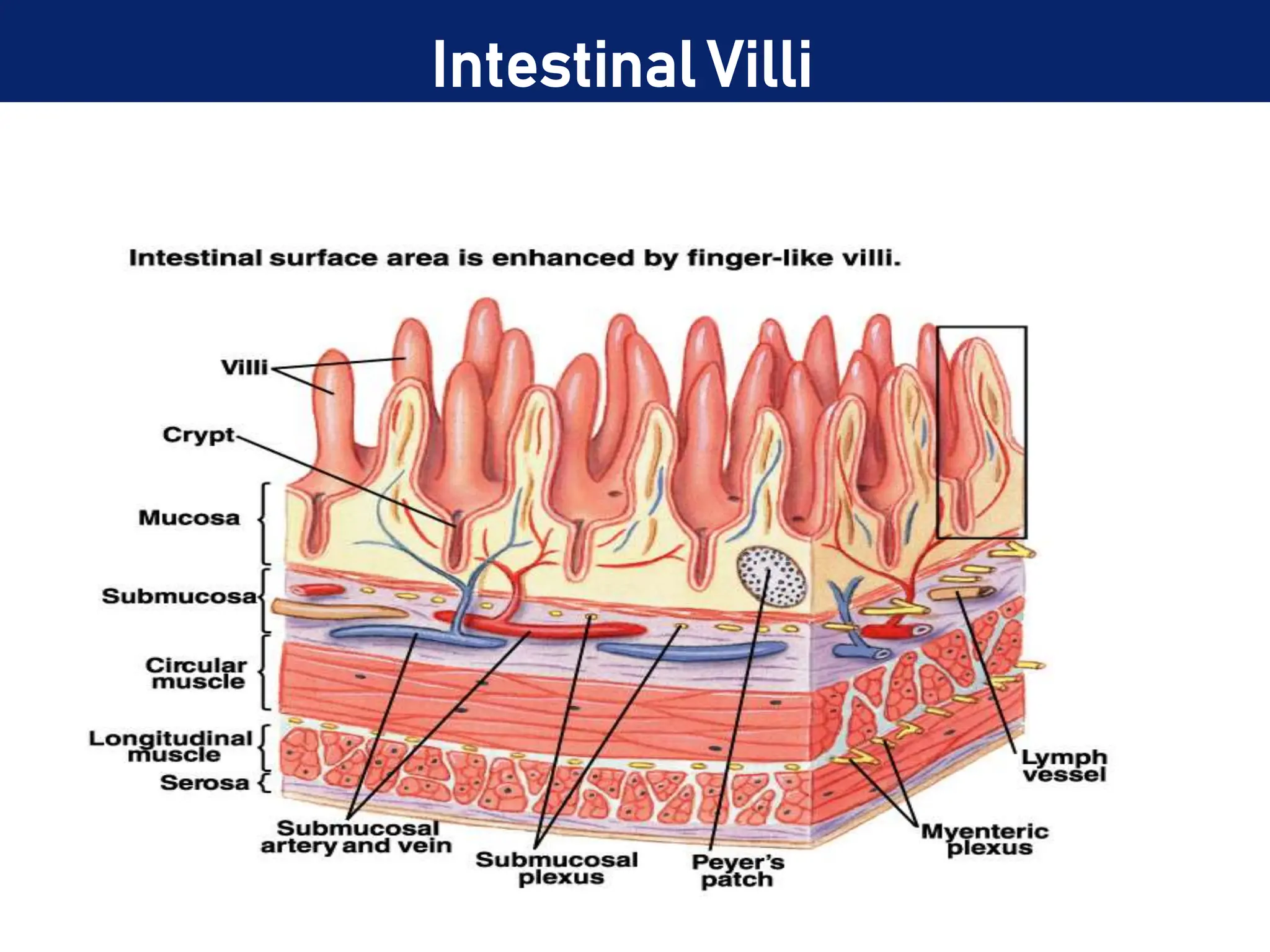
• Surface area of small intestine is
greatly increased by extensive
folding and the projection of
fingerlike villi covered with
microvilli.
Digestion and Absorption
Intestinal Villi
Intestinal Villi
(salivary and pancreatic)
Digestion of CHO
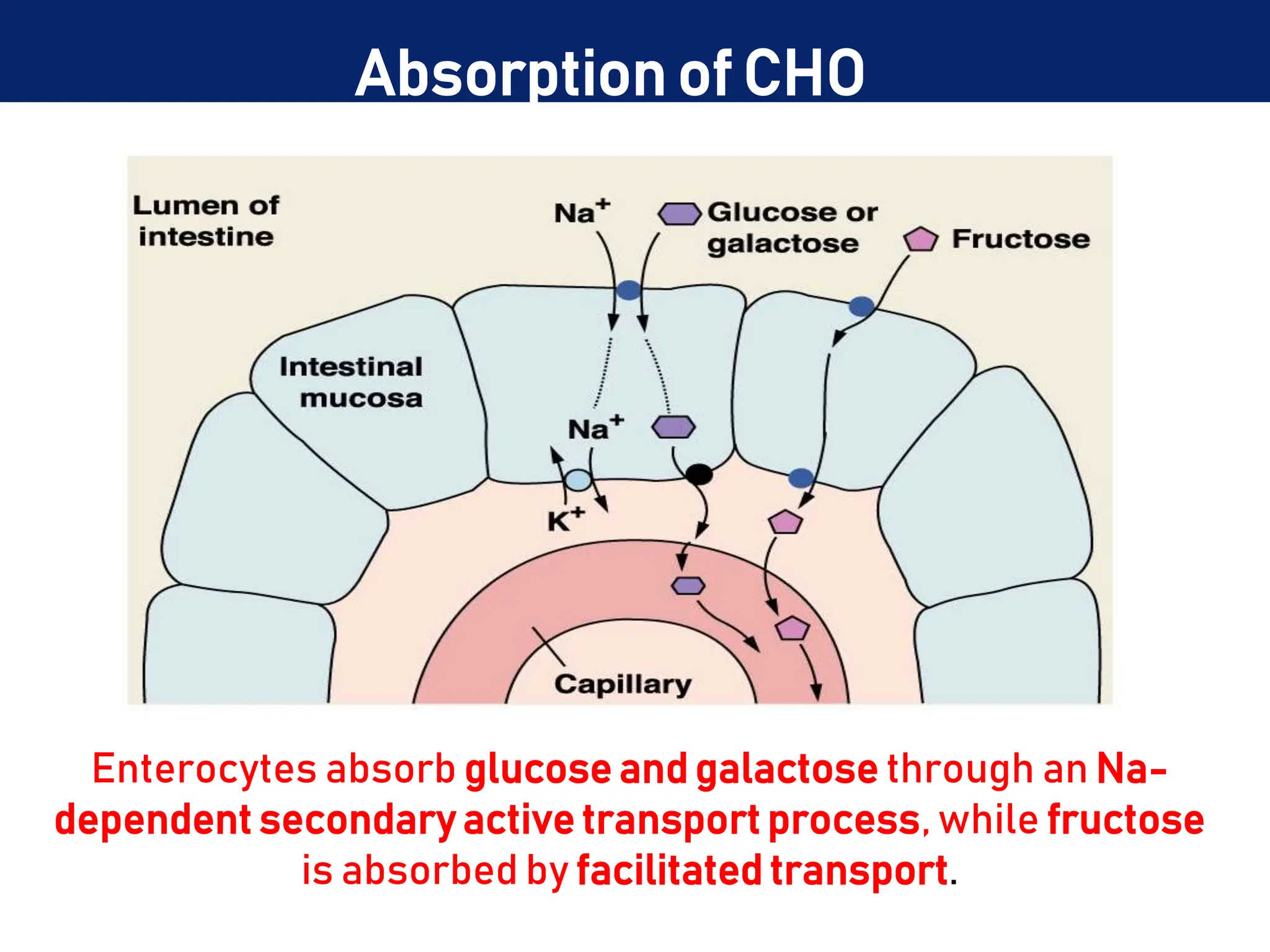
Enterocytes absorb glucose and galactose through an Na-
dependent secondary active transport process, while fructose
is absorbed by facilitated transport.
Absorption of CHO
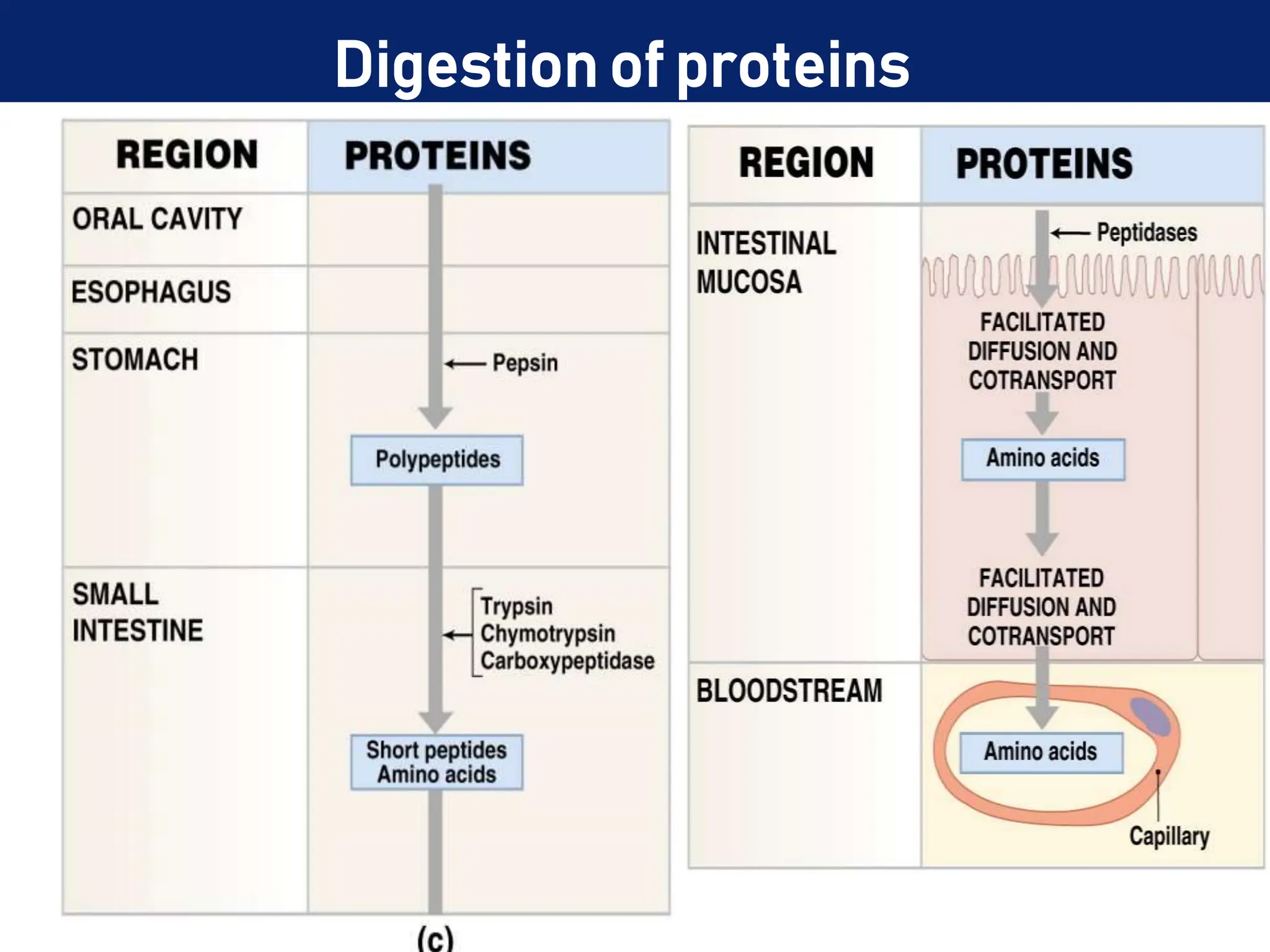
Digestion of proteins
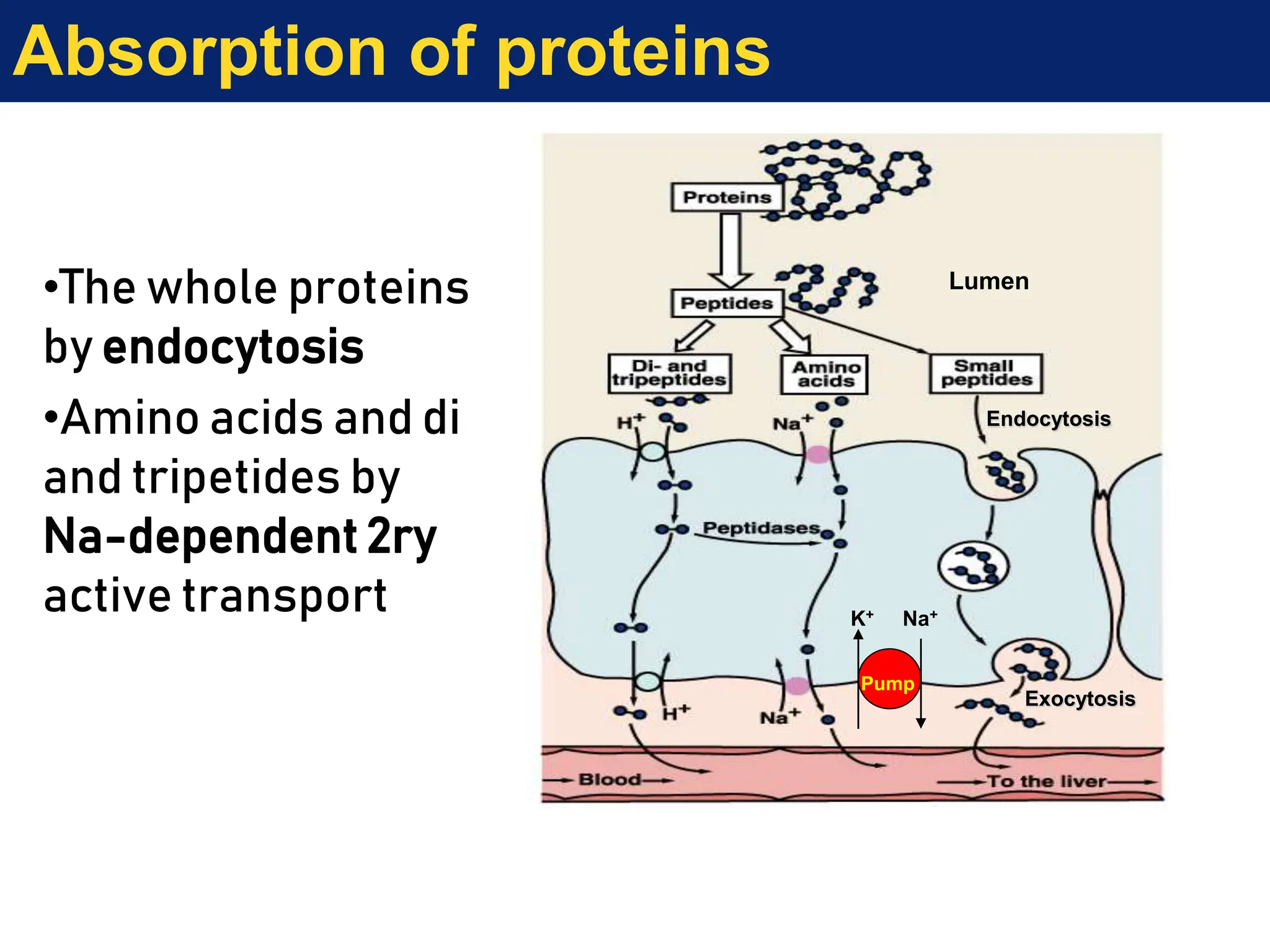
Absorption of proteins
K+ Na+
Pump
Lumen
Endocytosis
Exocytosis
•The whole proteins
by endocytosis
•Amino acids and di
and tripetides by
Na-dependent 2ry
active transport
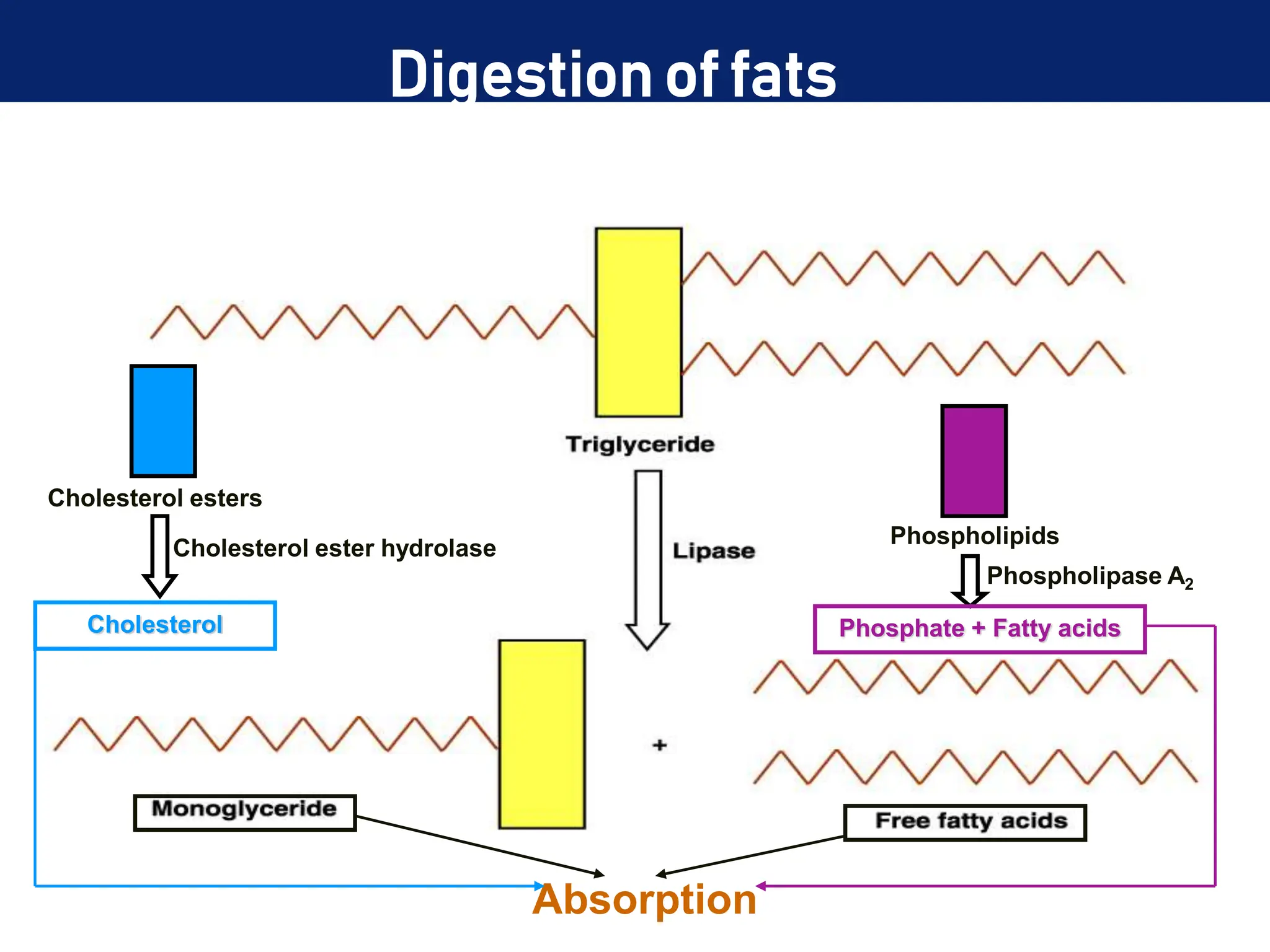
Digestion of fats
Phospholipase A2
Cholesterol esters
Cholesterol ester hydrolase
Cholesterol
Phospholipids
Phosphate + Fatty acids
Absorption
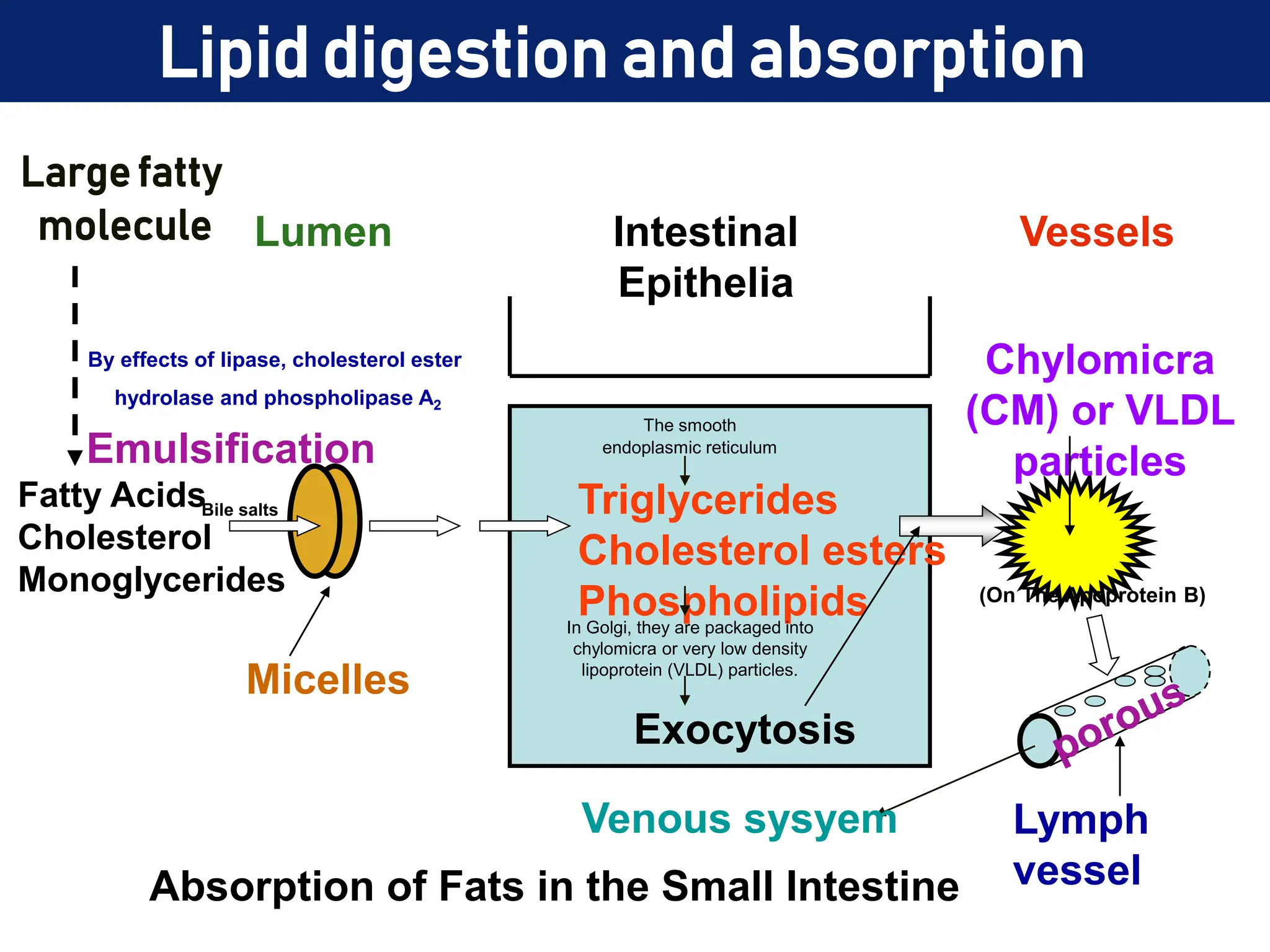
Lipid digestion and absorption
Lymph
vessel
Chylomicra
(CM) or VLDL
particles
Triglycerides
Cholesterol esters
Phospholipids
Exocytosis
Micelles
Fatty Acids
Cholesterol
Monoglycerides
Absorption of Fats in the Small Intestine
Lumen Vessels
Intestinal
Epithelia
Bile salts
Emulsification
By effects of lipase, cholesterol ester
hydrolase and phospholipase A2
Large fatty
molecule
In Golgi, they are packaged into
chylomicra or very low density
lipoprotein (VLDL) particles.
The smooth
endoplasmic reticulum
Venous sysyem
(On The Apoprotein B)

20. Physiology of Digestive System 1.ppt

  • 1.
  • 2.
    Overview of theDigestive System The Digestive System Consists of; a) Long hollow muscular tube or canal or tract called gastrointestinal tract or (GIT): it is about 5 meters long b) Accessory glands: include: • Salivary glands • Liver • gall bladder • Pancreas
  • 3.
    Overview of theDigestive Tract GIT consists of; • Oral cavity or mouth • Pharynx • Esophagus • Stomach • Small intestine • Large intestine • Rectum • Anus
  • 4.
    Components of DigestiveSystem and Their Functions
  • 5.
    Main Functions ofDigestive System • 4 major activities of GI tract 1. Motility • Propel ingested food from mouth toward rectum 2. Secretion of juices e.g. saliva • Aid in digestion and absorption 3. Digestion • Food broken down into absorbable molecules 4. Absorption • Nutrients, electrolytes, and water are absorbed or transported from lumen of GIT to blood stream
  • 7.
  • 8.
    Motility of theGIT 1. Motility in the mouth 2 types; a) Chewing is important because -The food is lubricated by being mixed with saliva -The food is exposed to salivary amylase, which begins digestion of starch -It breaks the food into small pieces to be easily swallowed b) Swallowing is the transport of food from mouth to stomach • It consists of 3 phases or steps;
  • 9.
  • 10.
  • 11.
  • 12.
    2. Motility ofEsophagus • The esophagus prevents air from entering the GI tract through the function of the upper esophageal sphincter. • The esophagus prevents GI contents from re-entering the esophagus from the stomach through the function of the lower esophageal sphincter. • The contraction that sweeps down the esophagus (primary and secondary esophageal peristalsis) Motility of GIT
  • 13.
    3. Motility ofStomach • The stomach is divided into proximal and distal areas. • Proximal area is thin walled, holds large volumes of food (to store food) because of receptive relaxation, and contracts weakly and infrequently. • Distal area is thick walled with strong and frequent contractions that mix and propel food into the duodenum. • Also, distal area is responsible for gastric emptying into duodenum Motility of GIT
  • 14.
    3. Motility ofstomach Gastric peristalsis Arrow showing partial liquid chyme pushed into duodenum via pylorus and more chyme pushedforth and back in stomach cavity being small pieces Motility of GIT
  • 15.
    4. Motility ofSmall intestine • Motility of the small intestine serves four functions: - Mixing contents with enzymes and other secretions. - Further reduction in particle size. - Maximizing exposure of the contents to membranes of intestinal cells for absorption and digestion. - Propulsion of contents into the large intestine. • Two basic motility patterns exist: segmentation and peristalsis. Motility of GIT
  • 16.
    Motility of GIT 1~ 5 cm and cutting Segmentation movements
  • 17.
  • 18.
    5. Motility ofLarge intestine or colon • 2 basic motility patterns: a) Segmentation in the large intestine causes the contents to be continuously mixed b) Mass movement propels the contents of one segment of the large intestine into the next downstream segment. • Defecation involves involuntary reflexes and voluntary reflexes Motility of GIT
  • 19.
  • 20.
    • GI secretionsfunction to lubricate (water and mucus), protect (mucus), sterilize (HCl), neutralize (HCO3 -), and digest (enzymes). • Secretions arise from specialized cells lining the GI tract, the pancreas, liver and gallbladder. • The total volume of GIT secretions is about 6- 8 L/day Secretions of GIT
  • 21.
    Secretions of GITin Mouth Salivary Glands • Three pairs of glands • Parotid • Sublingual • Submandibular • Functions of saliva • Lubricates, cleanses oral cavity • Dissolves chemicals • Suppresses bacterial growth • Digest starch by amylase
  • 22.
  • 23.
    Function of hydrochloricacid 1. Activating pepsinogen 2. Provide optimum for pH for action of pepsins 3. Food protein denaturation and easy decomposition; 4. Kill bacteria in food into the stomach 5. Promoting pancreatic, small intestinal and bile secretion 6. Helping Fe2+, Ca2+ absorption.
  • 24.
  • 25.
    Mucus secretion • Solubleand insoluble mucus are secreted by cells of the stomach. • Soluble mucus mixes with the contents of the stomach and helps to lubricate chyme. • Insoluble mucus forms a protective barrier against the high acidity of the stomach content. Intrinsic Factor • Help absorption of vitamin B12 Function of mucous and intrinsic factor
  • 26.
    • Pancreas has2 functions: a) Endocrine functions: secretes insulin and glucagon from islets of Langerhans b) Exocrine function: secretion of pancreatic juice • It has 2 components: aqueous and enzymatic components. • Aqueous component (contains HCO3) is important for neutralizing stomach acid in the duodenum so pancreatic enzymes can function properly • Enzymatic component is essential for the proper digestion and absorption of carbohydrates, fats, and proteins • Pancreatic enzymes include trypsin, chymotrypsin, lipase, and amylase Pancreatic Secretion
  • 27.
    starch maltose +glucose pancreatic amylase pH 6.7-7.0 fat(Triglyceride) oil+ monoglyceride+ fattyacids pancrelipase + colipase pH 7.8-8.5 trypsinogen trypsin Kinase, HCl, tissuefluid chymotrypsinogen chymotrypsin protein polypeptide carboxypeptid ase amino acid Functions of pancreatic juice enzymes
  • 28.
    The Liver andGall Bladder Functions of the Liver • Metabolic regulation • Store absorbed nutrients, vitamins • Release nutrients as needed • Hematological regulation • Plasma protein production • Remove old RBCs • Production of bile • Required for fat digestion and absorption
  • 29.
    • Secretion fromduodenal gland and intestinal gland • Secretory volume is 1~3L/day • It contains inorganic ion, mucoprotein, IgA, various enzyme, e.g. enterokinase ,etc • Function: • Protective effect by mucous • Digestion by enzymes such as peptidase, sucrase, lipase • Dilution Secretion of small intestine
  • 30.
    1. colonic alkalinesecretion to neutralize acids produced by intestinal bacteria 2. secretion of mucous for protection, lubrication of fecal matter 3. Vitamin B and K absorption made from bacterial flora in colon Secretion of large intestine
  • 31.
  • 32.
     Digestion isa process essential for the conversion of food into a small and simple form.  mechanical digestion by mastication and swallowing  chemical digestion by enzymes  Absorption is the process of transporting small molecules from the lumen of the gut into blood stream or lymphatic vessel. Digestion and Absorption
  • 33.
  • 34.
    • Small intestineis primary site for digestion and absorption of food. • Digestion occurs in the GI lumen by secreted enzymes and on surface of enterocytes by membrane-bound enzymes. • Absorption occurs by simple diffusion, facilitated diffusion, active transport, endocytosis, and paracellular transport. • Surface area of small intestine is greatly increased by extensive folding and the projection of fingerlike villi covered with microvilli. Digestion and Absorption
  • 35.
  • 36.
  • 37.
  • 38.
    Enterocytes absorb glucoseand galactose through an Na- dependent secondary active transport process, while fructose is absorbed by facilitated transport. Absorption of CHO
  • 39.
  • 40.
    Absorption of proteins K+Na+ Pump Lumen Endocytosis Exocytosis •The whole proteins by endocytosis •Amino acids and di and tripetides by Na-dependent 2ry active transport
  • 41.
    Digestion of fats PhospholipaseA2 Cholesterol esters Cholesterol ester hydrolase Cholesterol Phospholipids Phosphate + Fatty acids Absorption
  • 42.
    Lipid digestion andabsorption Lymph vessel Chylomicra (CM) or VLDL particles Triglycerides Cholesterol esters Phospholipids Exocytosis Micelles Fatty Acids Cholesterol Monoglycerides Absorption of Fats in the Small Intestine Lumen Vessels Intestinal Epithelia Bile salts Emulsification By effects of lipase, cholesterol ester hydrolase and phospholipase A2 Large fatty molecule In Golgi, they are packaged into chylomicra or very low density lipoprotein (VLDL) particles. The smooth endoplasmic reticulum Venous sysyem (On The Apoprotein B)